
 ЖИ көмекші


жүктеу мүмкіндігіне ие боласыз
Бұл материал сайт қолданушысы жариялаған. Материалдың ішінде жазылған барлық ақпаратқа жауапкершілікті жариялаған қолданушы жауап береді. Ұстаз тілегі тек ақпаратты таратуға қолдау көрсетеді. Егер материал сіздің авторлық құқығыңызды бұзған болса немесе басқа да себептермен сайттан өшіру керек деп ойласаңыз осында жазыңыз
 18 Қазан 2020
 647
647
Ашық сабақ. Environment 7 сынып
Келісемін
мектеп директорының
оқу-ісі жөніндегі орынбасары
______________
« » ___________
|
Unit 4. Space and Earth |
School: #273 |
|||||||
|
Date: 13.12.19 |
Teacher name: Nauryzalieva D
K |
|||||||
|
CLASS: 7A Room 306 |
Number present: |
absent: |
||||||
|
Lesson title |
The most environmental issues |
|||||||
|
Learning objectives(s) that this lesson is contributing to (link to the Subject programme) |
7.C9 use imagination to express thoughts, ideas, experiences and
feelings 7.R2 Understand specific information and details in texts on a range of familiar general and curricular topics. |
|||||||
|
Lesson objectives |
All learners will be able to: Use formal and informal registers; understand the texts and words connected on the environmental problems; Most learners will be able to: Ask and answer the questions; make up sentences with “will” to make predictions about the future of the Earth. Some learners will be able to: Speak about environmental problems and give solutions to the problems of the Earth. |
|||||||
|
Assessment criteria |
Apply the difference between formal and informal speech in a talk. Identify the position of speakers in an extended talk with some support. Demonstrate an ability to organize and express idea clearly. Define the correct and incorrect sentences; |
|||||||
|
Level thinking |
Knowledge, understanding, application, analysis. |
|||||||
|
Values links |
Our country’s national security and its engagement in addressing global and regional issues. |
|||||||
|
Cross-curricular link |
Biology, geography. |
|||||||
|
Previous learning |
The most environmental issues |
|||||||
|
Plan |
||||||||
|
Planned timing |
Planned activities |
Resources |
||||||
|
Start |
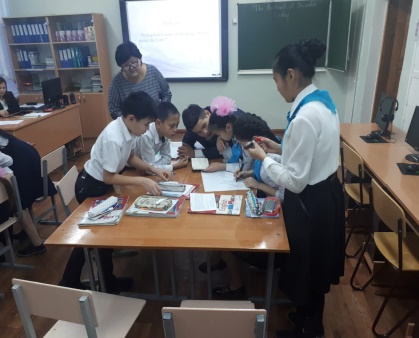
Organization moment Good morning, boys and girls! Sit down, please. How are you? How do you feel? (Students’ answers: I’m fine. I feel good. I feel happy. I feel comfortable., etc.) Now children take the cards from the table. Nature and Environment. Warm up. - I’m glad you’re fine and feel good and comfortable. Please, look at the slides. Introduction of new words: 1.dry up-құрғау 2.shortage of –жетіспеушілік 3.become extinct-жойылып кету 4.lose habitats- өмір сүру ортасын жоғалту 5.have better living conditions- жақсы өмір сүру жағдайлары 6.save natural resources – табиғи ресурстарды сақтау 7.protect endangered species –жойылу қаупіндегі түрлерді қорғау Can plants and animals feel? How do you think? (Students’ own answers) Now let’s watch a film. All of you look at the board. What can you see on them? (Students’ answers: ….) Ok, how do you think what are we going to speak about? Our new lesson is about environment. There are some questions and you must answer for these questions. There are questions for each group. So, we can say that everything in the world can feel. Now imagine that you are a fish in the waters of the Mediterranean Sea. - You know it is very polluted. How do you feel? (Students’ answers: Unhappy, uncomfortable, …). - What can you see on the bottom of the sea? (Students’ answers: Bottles, metal parts, sunk ships, coins, gold, rubbish, …) - What can you see on the surface of the water? (Students’ answers: Plastic bottles, oil slick, wooden sticks, …) - Are you able to breathe well? What is your best dream/ wish? - Who can help you to survive? Who can stop the pollution? ( Students’ answers: People can) Yes, only men are guilty of the pollution and only they can stop the pollution. So we’ll speak about ecology and discuss many urgent problems connected with this topic. Maybe we’ll find out some ways out of this problem. - How do you think which ecological problems are the most important? Let’s enumerate them. (Students’ answers: Air pollution, water pollution, soil pollution, noise, disappearing animals, destruction of forests, destruction of the ozone layer). - What are the sources of these problems? (Students’ answers: oil pollution, industrial pollution, chemical/biological pollution, littering, acid rain, run-off pollution, fertilizers and chemicals, exhaust fumes, railway pollution, radioactive pollution, fires, fuel leak, illegal dumping). Group work. Method jigsaw. Теxt. “Save Our Mother Earth”. Please, read the text “Save Our Mother Earth” in a group. Speakers must retell the text. And the Speakers must change groups. Save Our Mother Earth Our Earth is the most beautiful planet in our solar system. As far as we know, Earth is the only planet that has life. Before 500 A.D., man had a good relationship with Mother Earth. But since humans developed cities and industries, the modern lifestyle has changed. Man has been using and misusing natural resources up to the limit. Our environment is totally polluted: we drink polluted water, breath air full of dust, and eat unhealthy food with toxic chemicals. So we are suffering from diseases. All the problems we face today are made worse by deforestation, global warming, overpopulation, and shortage of food and freshwater and climate change. Now thousands of species are becoming extinct because their habitat is gone. Mother Earth is in danger; life on Earth is in danger. So what should we do? As citizens of the planet Earth we hope that still we have time to save our planet. We think we will plant more trees and stop cutting trees. We hope we will save wild animals and close polluting industries. I believe we will make citizens aware of the importance of saving the environment, and we will do many things to protect the environment, forests and wildlife. The Earth is our home we need to protect it.
Task 1. Read the text again and do True/False exercise individually. Read the sentences and write T(True) or F(False) 1. The Earth is not the only planet that has life. F 2. Some of our diseases are because of pollution of our environment. T 3. Thousands of species are losing their habitats. T 4. People shouldn’t think about protecting the environment. F 5. The environment is being destroyed because of humans’ lifestyle. T Descriptor: Learners define the correct sentences according to the text. Group work. Making posters. What are the ways out of these problems? Let’s work in groups. Imagine that we are invited to work in the commission on environmental pollution. The first group will suggest its own project to solve the problem of air pollution. The second group is to make a project on water pollution. Use the pattern: There are several ways out of the problem of … pollution. (Students present their projects and discuss them with other groups). Conclusion Well, you have worked really hard and your ideas are very good. I hope that one day you will be able to fulfill all of them. We use auxiliary verb “Will” to make predictions based on what we think, believe, or imagine with the verbs think, believe, hope, and know. For example: I think forests will disappear in 50 years’ time. I hope people won’t (will not) have problems of air pollutions. Make your own predictions about the future of our planet Earth. Possible answers: I think the Earth will be overcrowded in the future. I hope we will have better living conditions. I know some animals will become extinct. I believe we will protect endangered species. I hope animals won’t lose their habitats. I know we will save natural resources. I believe we will have shortage of food. Descriptor: Learners -make up sentences with auxiliary verb “will”; -make predictions about the future. |
Power Point presentations
Poster and stickers
|
||||||
|
|
|
|
||||||
|
End Giving home task. Reflection |
Writing a short essay on the theme “How to protect the Earth?” They should use to conclude their impressions about the lesson. |
Cards colorful stickers. |
||||||
|
Additional information |
||||||||
|
Differentiation – how do you plan to give more support? How do you plan to challenge the more able learners? |
Assessment – how are you planning to check learners’ learning? |
Health and safety check |
||||||
|
Differentiation can be achieved through the selection of activities, identification of learning outcomes for a certain student, provision of individual support to learners,selection of learning materials and resources based on the individual abilities of leaners (Theory of Multiple Intelligences by Gardner). |
Use this section to record the techniques that you will use to assess what the learners have learned during the lesson. |
Health saving technologies. Using physical exercises and active activities. Rules from the Safety Rules book which can be applied in this lesson. |
||||||
|
Reflection
Were the lesson objectives/learning objectives realistic? Did all the learners achieve thelesson objectives/ learning objectives? If not, why? Did my planned differentiation work well? Did I stick to timings? What changes did I make from my plan and why? |
Use the space below to reflect on your lesson. Answer the most relevant questions from the box on the left about your lesson. |
|||||||
|
|
||||||||
|
Summary evaluation What two things went really well (consider both teaching and learning)? 1: 2: What two things would have improved the lesson (consider both teaching and learning)? 1: 2: What have I learned from this lesson about the class orindividuals that will inform my next lesson? |
||||||||
ҚАРМАҚШЫ АУДАНДЫҚ КОММУНАЛДЫҚ БІЛІМ БЕРУ МЕКЕМЕСІ
№ 273 ОРТА БІЛІМ БЕРЕТІН МЕКТЕП
АШЫҚ САБАҚ
ТАҚЫРЫБЫ: The most environmental issues
(13.12.2019ж өткізілді)

 Жүктеу


 Жүктеу
шағым қалдыра аласыз

 Бұл курс Қазақстан Республикасы Оқу-ағарту министрлігімен келісілген










