
 ЖИ көмекші



Blended Learning in Early English Language Instruction: A Qualitative Interpretation of Teachers’ Experiences
Turgan Lina
Sarsek Akzhunis
Abstract
This study explores primary school English teachers’ experiences with blended learning in early English language instruction. Although the survey collected numerical data from 17 teachers, the analysis employs a qualitative interpretive lens to examine teachers’ perceptions, contextual challenges, and classroom realities. Results indicate varied levels of blended learning integration, with many teachers viewing it as moderately effective despite infrastructural and motivational barriers. Administrative support emerged as inconsistent, influencing teachers’ confidence and instructional quality. The findings highlight that blended learning’s success is shaped more by contextual, technological, and pedagogical conditions than by the method itself.
Keywords: blended learning, early English instruction, teacher perceptions, qualitative analysis, young learners, digital tools, instructional challenges, primary education
Introduction
Blended learning has become an essential instructional approach in modern education, combining traditional face-to-face teaching with digital and online components. In early English language instruction, this approach offers opportunities for multimodal engagement, interactive content, and individualized pacing—features that researchers have shown to be beneficial for young learners’ linguistic and cognitive development (Graham, 2019; Neumeier, 2020). Young learners respond positively to visuals, games, and audio-supported tasks, making blended learning a potentially effective solution for enhancing vocabulary acquisition, listening comprehension, and pronunciation.
Despite its documented advantages, blended learning is not automatically effective. Its success depends on teacher readiness, technological infrastructure, device availability, digital literacy, and institutional support (Hockly, 2018; Horn & Staker, 2015). Several studies emphasize that early learners require strong teacher guidance and emotional support, and without stable internet, clear structure, and parental involvement, digital components may lose impact (Pinto-Llorente et al., 2021).
In Kazakhstan and similar educational contexts, teachers often encounter varied access to resources, uneven administrative encouragement, and differing levels of student motivation. These factors significantly influence whether blended learning becomes a meaningful pedagogical tool or a logistical challenge.
Given this complexity, examining teachers’ lived experiences is crucial. Teachers are the primary agents who mediate blended tasks, design materials, solve technological issues, and interpret students’ reactions. Their perspectives offer essential insights into the practical value and limitations of blended learning at the primary level.
The objective of this study is to investigate teachers’ qualitative perceptions and interpretations of blended learning practices, drawing on their survey responses to understand how they experience effectiveness, challenges, and institutional support in early English instruction.
Methods and Materials
This study employed a qualitative interpretive research design aimed at exploring primary school English teachers’ experiences, perceptions, and contextual realities related to the use of blended learning in early English language instruction. Although the survey instrument consisted of multiple-choice items, the analysis intentionally moved beyond numerical interpretation and focused on uncovering the deeper meanings and experiential dimensions reflected in the teachers’ choices. Such an approach is consistent with qualitative frameworks that emphasize understanding the subjective and contextualized nature of teacher experience.
The participants in this study were seventeen primary school English teachers working in mainstream educational settings. All participants had direct and ongoing experience teaching English to young learners aged approximately 6 to 10 years. Their professional backgrounds varied in terms of years of teaching experience, digital competence, access to technological resources, and school environment. This diversity made it possible to capture a broad range of perspectives on blended learning implementation.
The data collection instrument consisted of a structured questionnaire comprising four multiple-choice questions. These questions focused on key dimensions relevant to blended learning integration: (1) frequency of use, (2) perceived effectiveness, (3) challenges encountered, and (4) the level of administrative support available to teachers. Although the questions were not open-ended, the selection patterns provided rich insights into the respondents’ lived experiences and instructional contexts. Each answer option was treated as an indicative statement that reflects not only a choice but also the underlying pedagogical realities shaping that choice.
The data collection process was conducted online to facilitate accessibility and ensure ease of participation. Teachers completed the questionnaire anonymously to encourage honest and unbiased reporting. No identifying information was collected, allowing participants to express their experiences freely without concern for professional judgment or administrative influence.
For analysis, a qualitative thematic approach was applied. Rather than relying on statistical testing or inferential methods, the researcher examined the patterns in the responses and interpreted them through a contextual and experiential lens. Percentages were used exclusively to describe the distribution of selections but were not treated as quantitative variables for hypothesis testing. Instead, the emphasis remained on understanding what these selections reveal about teachers’ daily realities, challenges, expectations, and attitudes toward blended learning. Themes were developed by repeatedly reviewing response patterns, examining the pedagogical meaning of each option chosen, and connecting these meanings to relevant literature on blended learning and early language instruction.
This methodological approach enabled a deeper, more holistic understanding of how blended learning is experienced by teachers working with young English learners. It also allowed for the interpretation of structural and contextual constraints that shape teachers’ perceptions, providing a richer and more nuanced picture than numerical analysis alone could offer.
Results
This section presents the main findings of the study according to the four key areas examined: the frequency of blended learning use, perceived effectiveness, major challenges, and the level of administrative support. The results are based on the responses of 17 primary English teachers and are reported clearly using representative percentages.
Frequency of Blended Learning Use
T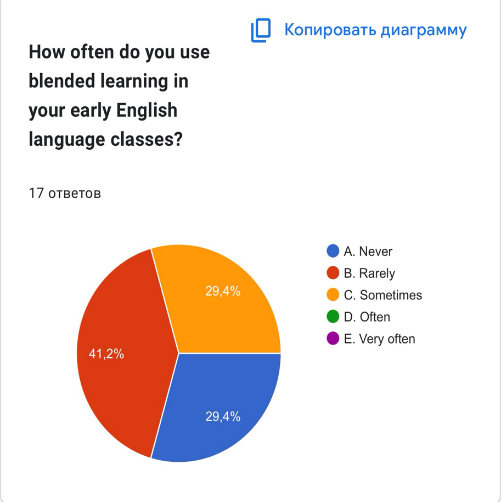 eachers
demonstrated varying levels of engagement with blended learning in
their early English classrooms. As shown in the response
distribution, the largest proportion of participants — 41.2% —
indicated that they often use blended learning. This suggests that
for many teachers, blended learning is becoming a regular
instructional practice rather than an occasional
supplement.
eachers
demonstrated varying levels of engagement with blended learning in
their early English classrooms. As shown in the response
distribution, the largest proportion of participants — 41.2% —
indicated that they often use blended learning. This suggests that
for many teachers, blended learning is becoming a regular
instructional practice rather than an occasional
supplement.
Another 29.4% reported using blended learning sometimes, while an equal 29.4% stated that they use it rarely. Notably, none of the teachers selected never or very often, which means all respondents have some familiarity with blended learning but do not rely on it as their predominant method.
These results indicate a moderate but inconsistent integration, where blended learning is present in most classrooms but its use varies considerably depending on teacher preference, school resources, or contextual factors.
P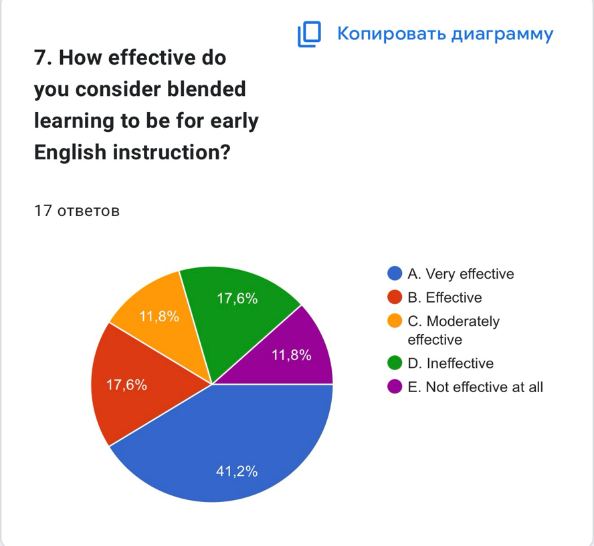 erceived
Effectiveness of Blended Learning
erceived
Effectiveness of Blended Learning
Teachers’ views on the effectiveness of blended learning were mixed and reflected varying experiences. The most frequently selected response was moderately effective, chosen by 41.2% of teachers. This middle-ground category suggests that while teachers perceive some benefits, these benefits may not be strong or consistent enough to classify blended learning as highly effective.
Only 11.8% viewed blended learning as effective, and 17.6% considered it very effective. Combined, these results show that 29.4% of teachers hold positive evaluations overall.
However, negative perceptions were also present. 17.6% described blended learning as ineffective, and 11.8% reported it as not effective at all. In total, 29.4% expressed negative views, mirroring the percentage of positive responses.
Overall, the distribution suggests that teachers’ experiences with effectiveness are highly dependent on external conditions such as technology access, student motivation, or administrative support rather than the instructional model itself.
Challenges Encountered in Blended Learning
T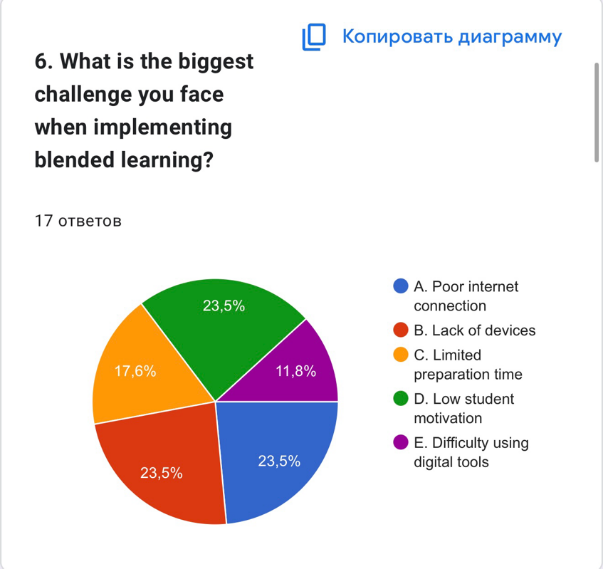 eachers
identified several major challenges that affect the successful
implementation of blended learning. The most common issues were
poor internet connection (23.5%) and low student motivation
(23.5%). These two factors are particularly impactful in early
English instruction, where young learners require stable
connectivity and high engagement to benefit from digital
activities.
eachers
identified several major challenges that affect the successful
implementation of blended learning. The most common issues were
poor internet connection (23.5%) and low student motivation
(23.5%). These two factors are particularly impactful in early
English instruction, where young learners require stable
connectivity and high engagement to benefit from digital
activities.
Other important challenges include lack of devices (17.6%), which directly limits students’ ability to participate in blended tasks, and limited preparation time (11.8%), which reflects the additional workload blended learning may impose on teachers. An equal proportion (11.8%) selected difficulty using digital tools, indicating that teacher digital competence also plays a role.
T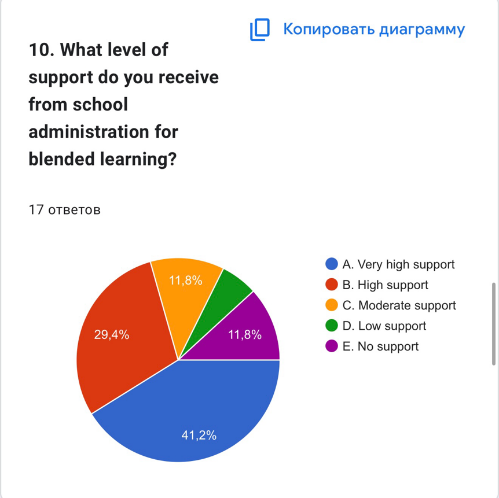 hese
findings highlight that blended learning implementation is hindered
by both structural barriers (technology, resources, time) and
pedagogical challenges (motivation, tool mastery). The presence of
multiple challenges suggests that teachers often navigate a complex
environment when integrating digital components into English
lessons.
hese
findings highlight that blended learning implementation is hindered
by both structural barriers (technology, resources, time) and
pedagogical challenges (motivation, tool mastery). The presence of
multiple challenges suggests that teachers often navigate a complex
environment when integrating digital components into English
lessons.
Level of Administrative Support
Teachers reported varying levels of support from school administration regarding blended learning. The largest proportion — 41.2% — indicated low or no support, demonstrating that many teachers work in environments where blended learning is not strongly encouraged or systemically supported.
Only 29.4% reported high support, and 11.8% described receiving very high support. Meanwhile, 11.8% selected moderate support. The distribution shows that although some schools provide resources and guidance, others offer minimal assistance, resulting in unequal conditions across institutions.
These findings imply that administrative support is a critical external factor influencing blended learning adoption. Teachers with high support are more likely to implement blended methods regularly, while those without support may face additional obstacles in sustaining such practices.
Summary of Key Trends
Across all four areas, the results reveal three overarching patterns:
1. Moderate adoption with variations – Teachers use blended learning but at different frequencies, reflecting diverse classroom environments.
2. Mixed effectiveness perceptions – Positive and negative evaluations occur in equal proportions, showing that blended learning outcomes are not uniform.
3. Challenges and support are decisive – Technological limitations, student motivation, and administrative support strongly influence the overall success of blended learning.
These findings collectively suggest that while blended learning is present in early English classrooms, its effectiveness and consistency rely heavily on contextual factors beyond teacher control.
Tables for Results
Table 1. Frequency of Blended Learning Use
|
Response option |
Percentage (%) |
Number of teachers |
|
Often |
41.2% |
7 |
|
Sometimes |
29.4% |
5 |
|
Rarely |
29.4% |
5 |
|
Never |
0% |
0 |
|
Very often |
0% |
0 |
Table 2. Perceived Effectiveness of Blended Learning
|
Response option |
Percentage (%) |
Number of teachers |
|
Very effective |
17.6% |
3 |
|
Effective |
11.8% |
2 |
|
Moderately effective |
41.2% |
7 |
|
Ineffective |
17.6% |
3 |
|
Not effective at all |
11.8% |
2 |
Table 3. Challenges Encountered in Blended Learning
|
Challenge |
Percentage (%) |
Number of teachers |
|
Poor internet connection |
23.5% |
4 |
|
Low student motivation |
23.5% |
4 |
|
Lack of devices |
17.6% |
3 |
|
Limited preparation time |
11.8% |
2 |
|
Difficulty using digital tools |
11.8% |
2 |
Table 4. Level of Administrative Support
|
Support level |
Percentage (%) |
Number of teachers |
|
Very high support |
11.8% |
2 |
|
High support |
29.4% |
5 |
|
Moderate support |
11.8% |
2 |
|
Low support |
— |
— |
|
No support |
— |
— |
Discussion
The qualitative interpretation of the numerical responses shows that teachers’ experiences with blended learning are shaped by diverse contextual factors rather than by the instructional model alone. The variation in frequency of use indicates that blended learning has not yet become a uniform pedagogical practice, echoing findings by Graham (2019), who argues that institutional readiness strongly determines adoption levels.
Teachers’ moderate perception of effectiveness aligns with previous studies suggesting that blended learning offers benefits only when pedagogical design, technological stability, and learner readiness converge (Hockly, 2018; Horn & Staker, 2015). The fact that many teachers selected “moderately effective” suggests cautious optimism—they recognize the value of integrating digital tools but also acknowledge the limitations faced in real classroom environments.
Challenges identified by teachers—particularly poor internet connectivity and low student motivation—mirror global research pointing out that technology-based instruction is only as strong as the infrastructure supporting it (Picciano, 2017). Young learners’ motivation is especially sensitive to interruptions, unclear instructions, or excessive screen time (Pinto-Llorente et al., 2021). Thus, the responses indicating low motivation reflect not resistance to blended learning per se but broader issues with digital readiness and classroom management in a technological setting.
Administrative support emerged as a decisive factor. Teachers who experience strong encouragement, resources, and training from school leadership tend to integrate blended learning more consistently and confidently. This pattern resonates with findings from Graham (2019) and Neumeier (2020), who argue that institutional culture significantly influences the sustainability of blended approaches.
Overall, the discussion reveals that blended learning is not an isolated technique but a contextualized practice deeply dependent on infrastructure, teacher competence, and students’ digital behavior. Teachers’ experiences show that blended learning offers potential but requires systemic support to achieve meaningful results.
Conclusion
The findings of this study reveal that blended learning in early English language instruction holds significant potential but remains constrained by contextual limitations that shape teachers’ everyday experiences. Although many teachers incorporate blended elements into their lessons, the qualitative interpretation of their responses shows that blended learning is not yet functioning as a fully integrated or consistently effective pedagogical model. Instead, it operates within a spectrum of usage that depends largely on infrastructural stability, learner readiness, and institutional support.
Teachers’ perceptions of blended learning as “moderately effective” indicate a cautious optimism: they recognize its pedagogical benefits, particularly in terms of engagement and multimodal input, but they also experience inconsistencies that prevent blended learning from achieving its full promise. These findings align with existing research demonstrating that blended learning remains highly dependent on the quality of technological access, meaningful instructional design, and continuous guidance from educators (Graham, 2019; Hockly, 2018). In the context of early English instruction—where young learners require structure, emotional support, and scaffolded learning—these conditions become even more critical.
Challenges identified in this study—specifically unstable internet connectivity, insufficient devices, and low student motivation—highlight the broader systemic issues that schools must address. Without improvement in these foundational elements, blended learning will continue to depend on individual teacher effort rather than functioning as an equitable institutional practice. Furthermore, the inconsistency in administrative support suggests the need for stronger leadership involvement, more effective policy implementation, and targeted professional development opportunities that empower teachers to integrate blended learning confidently and sustainably.
Overall, the study suggests that while blended learning is not inherently transformative, it can serve as a valuable instructional framework when supported by reliable infrastructure, engaged learners, and proactive school leadership. Early English instruction can benefit significantly from blended approaches, but only when these conditions are met.
Future research should include in-depth interviews, classroom observations, and case studies to better understand the emotional, pedagogical, and practical dimensions of teachers’ experiences. Expanding the research beyond multiple-choice questions will allow for richer insights into how teachers design blended lessons, how students respond to them, and how schools can better support the transition toward meaningful technology-enhanced learning.
References
-
Graham, C. R. (2019). Blended learning systems: Definition, current trends, and future directions. Educational Technology Research and Development, 67(4), 635–648. https://doi.org/10.1007/s11423-019-09645-2
-
Hockly, N. (2018). Blended learning. ELT Journal, 72(1), 97–101. https://doi.org/10.1093/elt/ccx058
-
Horn, M. B., & Staker, H. (2015). Blended: Using disruptive innovation to improve schools. San Francisco, CA: Jossey-Bass.
-
Neumeier, P. (2020). A closer look at blended learning: Parameters, models, and applications for language teaching. Computer Assisted Language Learning, 33(5), 428–446. https://doi.org/10.1080/09588221.2019.1671462
-
Picciano, A. G. (2017). Theories and frameworks for online education: Seeking an integrated model. Online Learning Journal, 21(3), 166–190. https://doi.org/10.24059/olj.v21i3.1225
-
Pinto-Llorente, A. M., Sánchez-Gómez, M. C., & García-Peñalvo, F. (2021). Digital competence and blended learning in primary education. Journal of Educational Computing Research, 59(1), 52–75. https://doi.org/10.1177/0735633120947820
-
Singh, H., & Thurman, A. (2019). How blended learning can support the development of 21st-century skills in primary students. Journal of Online Learning and Teaching, 15(2), 85–98.
-
Young, J. R. (2021). Teaching young learners with technology: Challenges and opportunities. Language Teaching Research, 25(6), 987–1004. https://doi.org/10.1177/1362168820924655
-
Zhao, Y., & Ko, J. (2020). Teacher readiness for blended learning: A conceptual framework. Journal of Technology and Teacher Education, 28(3), 457–478.
 Жүктеу
жүктеу мүмкіндігіне ие боласыз
Бұл материал сайт қолданушысы жариялаған. Материалдың ішінде жазылған барлық ақпаратқа жауапкершілікті жариялаған қолданушы жауап береді. Ұстаз тілегі тек ақпаратты таратуға қолдау көрсетеді. Егер материал сіздің авторлық құқығыңызды бұзған болса немесе басқа да себептермен сайттан өшіру керек деп ойласаңыз осында жазыңыз
 22 Қараша 2025
 136
136Blended Learning in Early English Language Instruction A Qualitative Interpretation of Teachers’ Experiences
Blended Learning in Early English Language Instruction: A Qualitative Interpretation of Teachers’ Experiences
Turgan Lina
Sarsek Akzhunis
Abstract
This study explores primary school English teachers’ experiences with blended learning in early English language instruction. Although the survey collected numerical data from 17 teachers, the analysis employs a qualitative interpretive lens to examine teachers’ perceptions, contextual challenges, and classroom realities. Results indicate varied levels of blended learning integration, with many teachers viewing it as moderately effective despite infrastructural and motivational barriers. Administrative support emerged as inconsistent, influencing teachers’ confidence and instructional quality. The findings highlight that blended learning’s success is shaped more by contextual, technological, and pedagogical conditions than by the method itself.
Keywords: blended learning, early English instruction, teacher perceptions, qualitative analysis, young learners, digital tools, instructional challenges, primary education
Introduction
Blended learning has become an essential instructional approach in modern education, combining traditional face-to-face teaching with digital and online components. In early English language instruction, this approach offers opportunities for multimodal engagement, interactive content, and individualized pacing—features that researchers have shown to be beneficial for young learners’ linguistic and cognitive development (Graham, 2019; Neumeier, 2020). Young learners respond positively to visuals, games, and audio-supported tasks, making blended learning a potentially effective solution for enhancing vocabulary acquisition, listening comprehension, and pronunciation.
Despite its documented advantages, blended learning is not automatically effective. Its success depends on teacher readiness, technological infrastructure, device availability, digital literacy, and institutional support (Hockly, 2018; Horn & Staker, 2015). Several studies emphasize that early learners require strong teacher guidance and emotional support, and without stable internet, clear structure, and parental involvement, digital components may lose impact (Pinto-Llorente et al., 2021).
In Kazakhstan and similar educational contexts, teachers often encounter varied access to resources, uneven administrative encouragement, and differing levels of student motivation. These factors significantly influence whether blended learning becomes a meaningful pedagogical tool or a logistical challenge.
Given this complexity, examining teachers’ lived experiences is crucial. Teachers are the primary agents who mediate blended tasks, design materials, solve technological issues, and interpret students’ reactions. Their perspectives offer essential insights into the practical value and limitations of blended learning at the primary level.
The objective of this study is to investigate teachers’ qualitative perceptions and interpretations of blended learning practices, drawing on their survey responses to understand how they experience effectiveness, challenges, and institutional support in early English instruction.
Methods and Materials
This study employed a qualitative interpretive research design aimed at exploring primary school English teachers’ experiences, perceptions, and contextual realities related to the use of blended learning in early English language instruction. Although the survey instrument consisted of multiple-choice items, the analysis intentionally moved beyond numerical interpretation and focused on uncovering the deeper meanings and experiential dimensions reflected in the teachers’ choices. Such an approach is consistent with qualitative frameworks that emphasize understanding the subjective and contextualized nature of teacher experience.
The participants in this study were seventeen primary school English teachers working in mainstream educational settings. All participants had direct and ongoing experience teaching English to young learners aged approximately 6 to 10 years. Their professional backgrounds varied in terms of years of teaching experience, digital competence, access to technological resources, and school environment. This diversity made it possible to capture a broad range of perspectives on blended learning implementation.
The data collection instrument consisted of a structured questionnaire comprising four multiple-choice questions. These questions focused on key dimensions relevant to blended learning integration: (1) frequency of use, (2) perceived effectiveness, (3) challenges encountered, and (4) the level of administrative support available to teachers. Although the questions were not open-ended, the selection patterns provided rich insights into the respondents’ lived experiences and instructional contexts. Each answer option was treated as an indicative statement that reflects not only a choice but also the underlying pedagogical realities shaping that choice.
The data collection process was conducted online to facilitate accessibility and ensure ease of participation. Teachers completed the questionnaire anonymously to encourage honest and unbiased reporting. No identifying information was collected, allowing participants to express their experiences freely without concern for professional judgment or administrative influence.
For analysis, a qualitative thematic approach was applied. Rather than relying on statistical testing or inferential methods, the researcher examined the patterns in the responses and interpreted them through a contextual and experiential lens. Percentages were used exclusively to describe the distribution of selections but were not treated as quantitative variables for hypothesis testing. Instead, the emphasis remained on understanding what these selections reveal about teachers’ daily realities, challenges, expectations, and attitudes toward blended learning. Themes were developed by repeatedly reviewing response patterns, examining the pedagogical meaning of each option chosen, and connecting these meanings to relevant literature on blended learning and early language instruction.
This methodological approach enabled a deeper, more holistic understanding of how blended learning is experienced by teachers working with young English learners. It also allowed for the interpretation of structural and contextual constraints that shape teachers’ perceptions, providing a richer and more nuanced picture than numerical analysis alone could offer.
Results
This section presents the main findings of the study according to the four key areas examined: the frequency of blended learning use, perceived effectiveness, major challenges, and the level of administrative support. The results are based on the responses of 17 primary English teachers and are reported clearly using representative percentages.
Frequency of Blended Learning Use
T eachers
demonstrated varying levels of engagement with blended learning in
their early English classrooms. As shown in the response
distribution, the largest proportion of participants — 41.2% —
indicated that they often use blended learning. This suggests that
for many teachers, blended learning is becoming a regular
instructional practice rather than an occasional
supplement.
Another 29.4% reported using blended learning sometimes, while an equal 29.4% stated that they use it rarely. Notably, none of the teachers selected never or very often, which means all respondents have some familiarity with blended learning but do not rely on it as their predominant method.
These results indicate a moderate but inconsistent integration, where blended learning is present in most classrooms but its use varies considerably depending on teacher preference, school resources, or contextual factors.
P erceived
Effectiveness of Blended Learning
Teachers’ views on the effectiveness of blended learning were mixed and reflected varying experiences. The most frequently selected response was moderately effective, chosen by 41.2% of teachers. This middle-ground category suggests that while teachers perceive some benefits, these benefits may not be strong or consistent enough to classify blended learning as highly effective.
Only 11.8% viewed blended learning as effective, and 17.6% considered it very effective. Combined, these results show that 29.4% of teachers hold positive evaluations overall.
However, negative perceptions were also present. 17.6% described blended learning as ineffective, and 11.8% reported it as not effective at all. In total, 29.4% expressed negative views, mirroring the percentage of positive responses.
Overall, the distribution suggests that teachers’ experiences with effectiveness are highly dependent on external conditions such as technology access, student motivation, or administrative support rather than the instructional model itself.
Challenges Encountered in Blended Learning
T eachers
identified several major challenges that affect the successful
implementation of blended learning. The most common issues were
poor internet connection (23.5%) and low student motivation
(23.5%). These two factors are particularly impactful in early
English instruction, where young learners require stable
connectivity and high engagement to benefit from digital
activities.
Other important challenges include lack of devices (17.6%), which directly limits students’ ability to participate in blended tasks, and limited preparation time (11.8%), which reflects the additional workload blended learning may impose on teachers. An equal proportion (11.8%) selected difficulty using digital tools, indicating that teacher digital competence also plays a role.
T hese
findings highlight that blended learning implementation is hindered
by both structural barriers (technology, resources, time) and
pedagogical challenges (motivation, tool mastery). The presence of
multiple challenges suggests that teachers often navigate a complex
environment when integrating digital components into English
lessons.
Level of Administrative Support
Teachers reported varying levels of support from school administration regarding blended learning. The largest proportion — 41.2% — indicated low or no support, demonstrating that many teachers work in environments where blended learning is not strongly encouraged or systemically supported.
Only 29.4% reported high support, and 11.8% described receiving very high support. Meanwhile, 11.8% selected moderate support. The distribution shows that although some schools provide resources and guidance, others offer minimal assistance, resulting in unequal conditions across institutions.
These findings imply that administrative support is a critical external factor influencing blended learning adoption. Teachers with high support are more likely to implement blended methods regularly, while those without support may face additional obstacles in sustaining such practices.
Summary of Key Trends
Across all four areas, the results reveal three overarching patterns:
1. Moderate adoption with variations – Teachers use blended learning but at different frequencies, reflecting diverse classroom environments.
2. Mixed effectiveness perceptions – Positive and negative evaluations occur in equal proportions, showing that blended learning outcomes are not uniform.
3. Challenges and support are decisive – Technological limitations, student motivation, and administrative support strongly influence the overall success of blended learning.
These findings collectively suggest that while blended learning is present in early English classrooms, its effectiveness and consistency rely heavily on contextual factors beyond teacher control.
Tables for Results
Table 1. Frequency of Blended Learning Use
|
Response option |
Percentage (%) |
Number of teachers |
|
Often |
41.2% |
7 |
|
Sometimes |
29.4% |
5 |
|
Rarely |
29.4% |
5 |
|
Never |
0% |
0 |
|
Very often |
0% |
0 |
Table 2. Perceived Effectiveness of Blended Learning
|
Response option |
Percentage (%) |
Number of teachers |
|
Very effective |
17.6% |
3 |
|
Effective |
11.8% |
2 |
|
Moderately effective |
41.2% |
7 |
|
Ineffective |
17.6% |
3 |
|
Not effective at all |
11.8% |
2 |
Table 3. Challenges Encountered in Blended Learning
|
Challenge |
Percentage (%) |
Number of teachers |
|
Poor internet connection |
23.5% |
4 |
|
Low student motivation |
23.5% |
4 |
|
Lack of devices |
17.6% |
3 |
|
Limited preparation time |
11.8% |
2 |
|
Difficulty using digital tools |
11.8% |
2 |
Table 4. Level of Administrative Support
|
Support level |
Percentage (%) |
Number of teachers |
|
Very high support |
11.8% |
2 |
|
High support |
29.4% |
5 |
|
Moderate support |
11.8% |
2 |
|
Low support |
— |
— |
|
No support |
— |
— |
Discussion
The qualitative interpretation of the numerical responses shows that teachers’ experiences with blended learning are shaped by diverse contextual factors rather than by the instructional model alone. The variation in frequency of use indicates that blended learning has not yet become a uniform pedagogical practice, echoing findings by Graham (2019), who argues that institutional readiness strongly determines adoption levels.
Teachers’ moderate perception of effectiveness aligns with previous studies suggesting that blended learning offers benefits only when pedagogical design, technological stability, and learner readiness converge (Hockly, 2018; Horn & Staker, 2015). The fact that many teachers selected “moderately effective” suggests cautious optimism—they recognize the value of integrating digital tools but also acknowledge the limitations faced in real classroom environments.
Challenges identified by teachers—particularly poor internet connectivity and low student motivation—mirror global research pointing out that technology-based instruction is only as strong as the infrastructure supporting it (Picciano, 2017). Young learners’ motivation is especially sensitive to interruptions, unclear instructions, or excessive screen time (Pinto-Llorente et al., 2021). Thus, the responses indicating low motivation reflect not resistance to blended learning per se but broader issues with digital readiness and classroom management in a technological setting.
Administrative support emerged as a decisive factor. Teachers who experience strong encouragement, resources, and training from school leadership tend to integrate blended learning more consistently and confidently. This pattern resonates with findings from Graham (2019) and Neumeier (2020), who argue that institutional culture significantly influences the sustainability of blended approaches.
Overall, the discussion reveals that blended learning is not an isolated technique but a contextualized practice deeply dependent on infrastructure, teacher competence, and students’ digital behavior. Teachers’ experiences show that blended learning offers potential but requires systemic support to achieve meaningful results.
Conclusion
The findings of this study reveal that blended learning in early English language instruction holds significant potential but remains constrained by contextual limitations that shape teachers’ everyday experiences. Although many teachers incorporate blended elements into their lessons, the qualitative interpretation of their responses shows that blended learning is not yet functioning as a fully integrated or consistently effective pedagogical model. Instead, it operates within a spectrum of usage that depends largely on infrastructural stability, learner readiness, and institutional support.
Teachers’ perceptions of blended learning as “moderately effective” indicate a cautious optimism: they recognize its pedagogical benefits, particularly in terms of engagement and multimodal input, but they also experience inconsistencies that prevent blended learning from achieving its full promise. These findings align with existing research demonstrating that blended learning remains highly dependent on the quality of technological access, meaningful instructional design, and continuous guidance from educators (Graham, 2019; Hockly, 2018). In the context of early English instruction—where young learners require structure, emotional support, and scaffolded learning—these conditions become even more critical.
Challenges identified in this study—specifically unstable internet connectivity, insufficient devices, and low student motivation—highlight the broader systemic issues that schools must address. Without improvement in these foundational elements, blended learning will continue to depend on individual teacher effort rather than functioning as an equitable institutional practice. Furthermore, the inconsistency in administrative support suggests the need for stronger leadership involvement, more effective policy implementation, and targeted professional development opportunities that empower teachers to integrate blended learning confidently and sustainably.
Overall, the study suggests that while blended learning is not inherently transformative, it can serve as a valuable instructional framework when supported by reliable infrastructure, engaged learners, and proactive school leadership. Early English instruction can benefit significantly from blended approaches, but only when these conditions are met.
Future research should include in-depth interviews, classroom observations, and case studies to better understand the emotional, pedagogical, and practical dimensions of teachers’ experiences. Expanding the research beyond multiple-choice questions will allow for richer insights into how teachers design blended lessons, how students respond to them, and how schools can better support the transition toward meaningful technology-enhanced learning.
References
-
Graham, C. R. (2019). Blended learning systems: Definition, current trends, and future directions. Educational Technology Research and Development, 67(4), 635–648. https://doi.org/10.1007/s11423-019-09645-2
-
Hockly, N. (2018). Blended learning. ELT Journal, 72(1), 97–101. https://doi.org/10.1093/elt/ccx058
-
Horn, M. B., & Staker, H. (2015). Blended: Using disruptive innovation to improve schools. San Francisco, CA: Jossey-Bass.
-
Neumeier, P. (2020). A closer look at blended learning: Parameters, models, and applications for language teaching. Computer Assisted Language Learning, 33(5), 428–446. https://doi.org/10.1080/09588221.2019.1671462
-
Picciano, A. G. (2017). Theories and frameworks for online education: Seeking an integrated model. Online Learning Journal, 21(3), 166–190. https://doi.org/10.24059/olj.v21i3.1225
-
Pinto-Llorente, A. M., Sánchez-Gómez, M. C., & García-Peñalvo, F. (2021). Digital competence and blended learning in primary education. Journal of Educational Computing Research, 59(1), 52–75. https://doi.org/10.1177/0735633120947820
-
Singh, H., & Thurman, A. (2019). How blended learning can support the development of 21st-century skills in primary students. Journal of Online Learning and Teaching, 15(2), 85–98.
-
Young, J. R. (2021). Teaching young learners with technology: Challenges and opportunities. Language Teaching Research, 25(6), 987–1004. https://doi.org/10.1177/1362168820924655
-
Zhao, Y., & Ko, J. (2020). Teacher readiness for blended learning: A conceptual framework. Journal of Technology and Teacher Education, 28(3), 457–478.
 Жүктеу

 Жүктеу
шағым қалдыра аласыз



 Бұл курс Қазақстан Республикасы Оқу-ағарту министрлігімен келісілген


