ЖИ көмекші


жүктеу мүмкіндігіне ие боласыз
Бұл материал сайт қолданушысы жариялаған. Материалдың ішінде жазылған барлық ақпаратқа жауапкершілікті жариялаған қолданушы жауап береді. Ұстаз тілегі тек ақпаратты таратуға қолдау көрсетеді. Егер материал сіздің авторлық құқығыңызды бұзған болса немесе басқа да себептермен сайттан өшіру керек деп ойласаңыз осында жазыңыз
 01 Маусым 2026
 0
0
CAN ARTIFICIAL INTELLIGENCE REPLACE AN ENGLISH TEACHER?
Идрисова Саида Акильбековна
Ақтөбе қаласы, «Әл-Фараби атындағы №21 мамандандырылған гимназия»
Ағылшын тілі пәні мұғалімі
CAN ARTIFICIAL INTELLIGENCE REPLACE AN ENGLISH TEACHER?
Abstract
Artificial Intelligence (AI) has become one of the most influential innovations in modern education. AI-powered tools such as ChatGPT, Duolingo Max, Grammarly, and various language-learning applications are transforming the way students learn English. This article examines the potential of AI in language education and discusses whether artificial intelligence can fully replace English teachers. By analyzing educational research, classroom experiences, and technological developments, the paper argues that AI can significantly support language learning but cannot replace the human qualities that effective teaching requires.
Keywords: artificial intelligence, English teaching, ChatGPT, educational technology, language learning, digital education

Introduction
The rapid development of artificial intelligence has sparked an important debate in education: Can AI replace teachers?
Today, students can ask ChatGPT grammar questions, practice speaking with AI-powered applications, receive instant feedback on writing, and even generate essays within seconds. These technologies provide learning opportunities that were unimaginable just a decade ago.
As AI becomes increasingly sophisticated, some educators worry that technology may eventually replace human teachers. Others view AI as a powerful tool that can enhance learning without replacing the teacher's role.
The question is particularly relevant in English language education, where technology is already deeply integrated into daily learning practices.
What AI Can Do Better Than Humans
Artificial intelligence offers several advantages that make it highly valuable in English language learning.
AI
can:
— provide immediate feedback;
— personalize
learning materials;
— operate 24 hours a day;
— analyze
student performance quickly;
— generate unlimited practice
activities.
For example, applications such as Grammarly instantly identify grammar mistakes and suggest corrections. ChatGPT can explain complex grammar structures, generate vocabulary exercises, and provide writing support within seconds.
One student preparing for an English examination used ChatGPT daily to practice writing tasks. The system corrected errors, suggested vocabulary improvements, and provided model answers. As a result, the student's writing performance improved significantly.
Such examples demonstrate the remarkable efficiency of AI-based learning tools.
Educational researcher John Hattie emphasizes that timely feedback is one of the strongest influences on student achievement. AI systems can provide this feedback instantly.
What AI Cannot Replace
Despite its impressive capabilities, artificial intelligence still lacks essential human qualities that define effective teaching.
Teaching
is not only about delivering information. It also involves:
—
emotional support;
— motivation;
— empathy;
—
classroom management;
— understanding individual needs.
A teacher can recognize when a student feels discouraged, anxious, or unmotivated. AI may analyze performance data, but it cannot truly understand emotions in the same way humans do.
Educational psychologist Lev Vygotsky argued that learning is fundamentally a social process. Students develop knowledge through interaction with others, especially more experienced individuals.
Human relationships remain central to education.
A classroom example illustrates this difference. A student who consistently performed poorly in speaking activities was not struggling because of grammar difficulties. The real issue was low confidence. Through encouragement, praise, and personal support, the teacher gradually helped the learner become more active.
No algorithm could fully replicate that human connection.
AI as a Teaching Assistant
Rather than replacing teachers, AI may be more accurately described as a teaching assistant.
Teachers
can use AI to:
— create lesson plans;
— generate
quizzes;
— design speaking activities;
— personalize
assignments;
— provide additional practice materials.
For example, many English teachers now use ChatGPT to create discussion questions, role-play scenarios, and differentiated worksheets for learners with different ability levels.
This reduces preparation time and allows teachers to focus more on interaction and communication during lessons.
According to educational researcher Michael Fullan, technology becomes effective when it enhances human teaching rather than attempting to replace it.
The most successful classrooms are likely to combine technological efficiency with human expertise.
The Future of English Teaching
The future of education will probably involve collaboration between teachers and artificial intelligence rather than competition between them.
Students increasingly expect personalized and technology-rich learning environments. AI can provide instant support, while teachers offer guidance, motivation, and real-world communication experiences.
Research indicates that students learn best when cognitive and emotional needs are addressed simultaneously. AI can support cognitive learning, but emotional development remains largely dependent on human interaction.
Therefore, the teacher's role may change, but it is unlikely to disappear.
Future English teachers may spend less time delivering information and more time mentoring, coaching, and facilitating communication.
Conclusion
Artificial intelligence is transforming English language education and providing powerful tools for learners and teachers alike. AI can deliver immediate feedback, personalize instruction, and offer unlimited learning opportunities.
However, teaching involves much more than information delivery. Effective education depends on empathy, encouragement, motivation, and human relationships—qualities that artificial intelligence cannot fully replicate.
Therefore, the question is not whether AI will replace English teachers, but how teachers and AI can work together to improve learning outcomes.
In conclusion, artificial intelligence is likely to become one of the most valuable assistants in education, but the human teacher will remain at the heart of the learning process.
References
Hattie, J. Visible Learning. Routledge, 2009.
Vygotsky, L. Mind in Society. Harvard University Press, 1978.
Fullan, M. Stratosphere: Integrating Technology, Pedagogy, and Change Knowledge. Pearson, 2013.
Harmer, J. The Practice of English Language Teaching. Pearson Education, 2015.
Luckin, R. Machine Learning and Human Intelligence. UCL Institute of Education Press, 2018.
Holmes, W., Bialik, M., & Fadel, C. Artificial Intelligence in Education. Center for Curriculum Redesign, 2019.
Richards, J. C. Communicative Language Teaching Today. Cambridge University Press, 2006.

 Жүктеу


 Жүктеу
шағым қалдыра аласыз
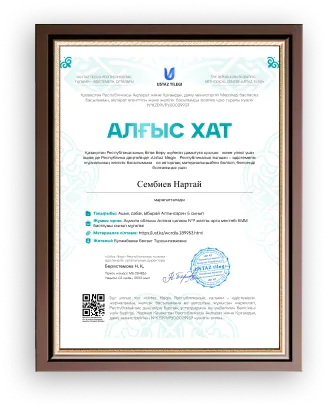
 Бұл курс Қазақстан Республикасы Оқу-ағарту министрлігімен келісілген