ЖИ көмекші


 Қауіпсіз төлем

жүктеу мүмкіндігіне ие боласыз
Бұл материал сайт қолданушысы жариялаған. Материалдың ішінде жазылған барлық ақпаратқа жауапкершілікті жариялаған қолданушы жауап береді. Ұстаз тілегі тек ақпаратты таратуға қолдау көрсетеді. Егер материал сіздің авторлық құқығыңызды бұзған болса немесе басқа да себептермен сайттан өшіру керек деп ойласаңыз осында жазыңыз
 12 Желтоқсан 2024
 156
156
1 жыл бойы шексіз жүктеңіз
Daily routine 5th grade
Short term plan: term 2
|
Unit3: Values |
|
||
|
School |
|
||
|
Teacher name: |
|
||
|
Date: |
|
||
|
Grade: 5 |
Number present: |
absent: |
|
|
Lesson title |
Use of English: Present Simple |
||
|
Learning objectives |
5. 5. 3. 1 write specific details with the support of the teacher, describing people, places and objects at the text level; 5. 6. 1. 1 appropriate use of appropriate countable and uncountable nouns, including common phrases describing time and location, on a number of familiar general and educational topics; |
||
|
Lesson objectives |
Learners will be able to: - present the present simple affirmative and understand its use for routines/habits, repeated actions and permanent states -consolidate the spelling rules of the third person singular in the present simple -practise using the present simple to talk about daily routines |
||
|
Values and its purpose: |
Justice and Responsibility For any type of service or activity take responsibility |
||
|
Plan |
|||
|
Stages / Time |
Teachers actions |
Students actions |
Assessment criteria |
Resources |
||||
|
Beginning of the lesson Warming-up
3 min Pre-learning «Brainstorming» method 7 min. |
Organization moment : 1.Greeting. Ask about the weather. Warm up Word ladders The aim of this game is to start with one word and aim to get to another by only changing one letter at a time. For example, you could write the word ‘rope’ on the board and tell learners that they’re trying to get to the word ‘pile’. Lead – In
Ex:1 P:36 Present the present simple. Say: I live in Madrid. Write it on the board. Underline live and explain that this verb is in the present simple. Point to a S and say: You live in Madrid. Then write it on the board. Underline live. |
Learners read the given sentences on the board and guess the topic and share with their ideas Students' attention is drawn to the lesson. Learners talk about daily routines previous lesson vocabulary Determines the topic and purpose of the lesson Students say different words from the picture |
Teacher controles the process, gives feedback and asks additional questions if it’s nessasery. Teacher evaluate pupils with phrases like: “Good job! Well done!” Formative Assessment
Good job!
|
Pictures worksheet Student’s book |
||||
|
Middle of the lesson Presentation part. 30 min |
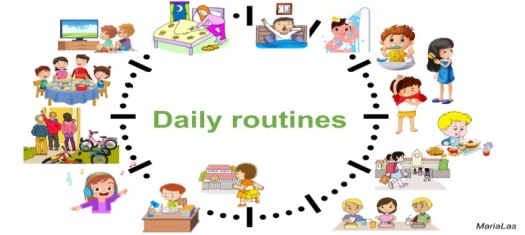
Point to a male S and say: He lives in Madrid. Then write it on the board. Underline lives. Explain that the third person singular usually takes an -s. Present the other persons in the same way. Explain the spelling rules of the third person singular by writing the verbs miss, finish, watch, mix, go, cry on the board. Stress the difference between the spelling of play and cry. Ex: 2 P: 36 Explain the task and any unknown verbs. Alternatively, Ss can look up the verbs in the Word List or in their dictionaries. • Allow Ss a few minutes to complete the task and check Ss' answers on the board. Ex: 3 P: 36 Explain the task. Draw Ss' attention to the diagram and direct Ss to picture 1 and read the example sentence aloud. Go through the phrases in the box or ask Ss to look up the meanings of these phrases in the Word List, then tell Ss to make sentences for each of the activities 2-11 in the diagram using these phrases. Ex: 3 P: 36 Ss work in pairs and tell each other their daily routines. Monitor the activity around the class and then ask some Ss to tell their daily routine to the class. Ask Ss to use then, after that to link their idea. Conclusion during the lesson some tasks differentiated by outcomes of the students and by their abilities. |
Pupils read the table. Say the examples in your language. ANSWERS Students’ own answer Pupils write the 3rd person singular. ANSWERS 2 he leaves 3 he watches 4 he runs 5 he says 6 he works 7 he goes 8 he washes •Pupils look at the pictures. What does Kevin do in the morning, afternoon, evening? ANSWERS 2 Kevin has breakfast in the morning. 3 Kevin goes to school in the morning. 4 Kevin has lunch in the afternoon. 5 Kevin does his homework in the afternoon. 6 Kevin goes to the gym in the afternoon. 7 Kevin plays computer games in the afternoon. 8 Kevin meets his friends in the afternoon. 9 Kevin has dinner in the evening. 10 Kevin watches TV in the evening. 11 Kevin goes to bed in the evening. Pupils tell your partner. What about you? ANSWERS I get up early in the morning. Then, I have breakfast. After that I go to school. In the afternoon I do my homework and play on my computer. In the evening I have dinner and then I watch a DVD. Then, I go to bed. |
Descriptor: - read the table -know the 3rd form Total: 2 point
Descriptor: -write the 3rd person singular Total: 2 point
pupils are evaluated by collecting colour pencils Descriptor: -say about Kevin’s daily routine Total: 3 point
Descriptor: - tell your partner about you Total: 3 point
-Make CCQ questions Yes / No Total: 10 point |
Card Worksheet Students book |
||||
|
End of the lesson 5 min |
FEEDBACK Learners provide feedback on what they have learned at the lesson. Ex: Home task:
|
What worked well for you in today’s class? What could we have done differently to make today’s class better for you? What are you wondering about after today’s lesson? What did you find difficult about today’s lesson? |
Poster Success
|
|||||
|
Additional information |
|
|
||||||
|
Differentiation– how do you plan to give more support? How do you plan to challenge fast finishers? Fast finishers: Ask students to note down what the exact name of each subject is. Answers
baking technology management |
Assessment – how are you planning to check students’ learning? Oral feedback Positive reinforcement |
|
||||||
|
Reflection Were the lesson objectives/learning objectives realistic? Did all the learners achieve lesson objectives/learning objectives? If not, why? Did my planned differentiation work well? Did I stick to timings? What changes did I make from my plan and why? |
Use the space below to reflect on your lesson. Answer the most relevant questions from the box on the left about your lesson? |
|
||||||
|
Summary evaluation What two things went really well? Consider both teaching and learning. 1. 2. What two things would have improved the lesson? Consider both teaching and learning. 1. 2. What have I learned from this lesson about the class or an individual student that will inform my next lesson? |
|
|||||||















 Бұл курс Қазақстан Республикасы Оқу-ағарту министрлігімен келісілген