
 ЖИ көмекші


 Қауіпсіз төлем

жүктеу мүмкіндігіне ие боласыз
Бұл материал сайт қолданушысы жариялаған. Материалдың ішінде жазылған барлық ақпаратқа жауапкершілікті жариялаған қолданушы жауап береді. Ұстаз тілегі тек ақпаратты таратуға қолдау көрсетеді. Егер материал сіздің авторлық құқығыңызды бұзған болса немесе басқа да себептермен сайттан өшіру керек деп ойласаңыз осында жазыңыз
 24 Мамыр 2026
 58
58
1 жыл бойы шексіз жүктеңіз
Grammatical structures and rules in English
ТҮРКІСТАН ОБЛЫСЫНЫҢ БІЛІМ БАСҚАРМАСЫ
САУРАН АУДАНЫНЫҢ БІЛІМ БӨЛІМІ
«№2 жалпы білім беретін мектеп» кмм-сі
Құлахмет Сүнәтұлла Рүстембекұлы
GRAMMATICAL STRUCTURES AND RULES IN ENGLISH
Әдістемелік құрал
2026 жыл
Құлахмет Сүнәтұлла Рүстембекұлы/«Grammatical structures and rules in English» /әдістемелік құрал /Сауран ауданы 2026 жыл/ 86бет;
The methodological tool "Grammatical structures and rules in English" is aimed at developing students’ knowledge of English grammar. It covers key grammar topics such as tenses, sentence structure, parts of speech, modal verbs, and prepositions. The methodological tool includes exercises and communicative tasks to enhance practical usage of grammar in speaking and writing. It is designed to improve students’ overall language competence and accuracy.
@Құлахмет Сүнәтұлла Рүстембекұлы
INTRODUCTION
The present the methodological tool entitled “Grammatical structures and rules in English” is designed for secondary school learners of Grades 5–9 studying English as a foreign language. The programme is developed as a 34-hour unified module, intended to be integrated into the existing curriculum as a supplementary academic component. The content and methodology of the tool reflect modern requirements of language education that combine mastery of grammatical accuracy with functional use of grammar in content-based and communicative contexts. Following current educational priorities, the tool partially incorporates CLIL principles by linking grammatical structures to meaningful topics and subject-based micro-contexts without shifting the primary goal away from explicit grammar instruction.
The relevance of this tool is conditioned by the increasing complexity of academic and communicative tasks required from secondary school learners in Kazakhstan and globally. Traditional approaches often limit grammar teaching to mechanical rule learning or isolated sentence-level drills, which do not ensure transfer into real usage. Simultaneously, purely communicative approaches risk leaving learners without a clear systematic understanding of English grammar. This author’s programme proposes a balanced alternative, combining explicit and inductive presentation of grammar, contextualised practice, and controlled transition towards production, supported by cross-disciplinary input and CLIL-framed micro-tasks.
The tool t covers he full set of core grammatical structures necessary for successful school-level academic progression: the tense system, modal verbs, passive voice, conditional sentences, reported speech, articles, pronouns and quantifiers, comparatives, and sentence-level syntax devices. The chosen order of units follows a principled spiral progression: simpler grammatical foundations are revisited at higher complexity through new contexts and functional tasks appropriate for higher grades. Each lesson cycle includes pre-presentation activation, guided noticing, controlled practice, semi-free application and reflective checking of grammatical decisions, ensuring gradual and confident acquisition.
Methodologically, the tool is based on a synthesis of close grammar reading, rule consciousness-raising, task-supported practice, short-form CLIL infusion, and assessment for learning. The structure enables teachers to implement the tool in diverse instructional settings and supports learners with varying proficiency within the same classroom by offering layered task options. As an methodological tool, it allows adaptation and integration into existing syllabi while preserving its conceptual integrity and the system of grammatical competences it seeks to develop.
Aims
The tool aims to:
-
Develop stable grammatical competence based on explicit understanding and conscious application of core English structures.
-
Enable learners to use grammar functionally in real and academic communication across subjects and discourse types.
-
Integrate grammar learning with elements of CLIL to strengthen cross-disciplinary thinking and language transfer.
-
Support long-term retention of grammatical knowledge through spiral revision and scaffolded progression.
-
Prepare learners for school-based, national, and international assessment formats requiring accurate grammatical control.
Objectives
In order to achieve its aims, the tool sets the following tasks:
-
To introduce, systematise and deepen key grammatical structures required in Grades 5–9.
-
To develop learners’ ability to notice grammar in authentic and adapted texts.
-
To provide controlled, semi-controlled and communicative grammar practice in varied task formats.
-
To support independent grammar monitoring and self-correction strategies.
-
To incorporate CLIL-based micro-contexts for meaningful reinforcement of grammar.
-
To build readiness for grammar use in academic writing, oral response, and assessment situations.
Direction
This project belongs to the innovative and academically oriented direction in foreign language pedagogy, where grammar is treated not as a closed set of fixed norms but as a cognitive, communicative and interdisciplinary system. Its central purpose is to employ grammar instruction as a medium for developing functional literacy, critical reasoning, and advanced communicative competence.
This direction situates grammar at the intersection of linguistics, logic, discourse analysis, and academic writing. Students do not merely “apply a rule”; they evaluate alternatives (e.g., whether to use passive for depersonalization, a conditional to express hypothetical reasoning, or a modal to infer probability), and thus exercise analytical judgment. In doing so, grammar learning integrates with other disciplines: history texts illustrate past tense narration; science reports show passive constructions; civic discourse reveals modality and hedging; debates rely on conditional logic and reported claims.
The direction aligns with 21st-century skills frameworks by embedding grammar into tasks requiring collaboration (peer editing), creativity (recasting texts in new grammatical frames), critical thinking (evaluating form–meaning fit), and communication (oral justification). Digital tools and AI-powered assistants can further assist learners in testing alternatives, checking patterns, and comparing authentic usage in corpora. This fosters autonomy and real-world applicability.
Relevance
The relevance of the tool is rooted in the growing academic and communicative demands placed on learners in modern secondary education, where English grammar is not only a linguistic component but a cognitive tool for structuring thought, argument, evidence, and subject content. In the context of multilingual schooling and internationalisation of education, students must demonstrate not only the ability to recognise grammatical rules but to apply them deliberately in reading, writing, speaking and subject-based reasoning tasks.
Research in applied linguistics shows that purely communicative exposure does not guarantee grammatical development, while decontextualised rule teaching often fails to transfer into performance. This tool addresses that methodological gap through a dual-focus approach: grammar is taught explicitly, but practiced through meaningful content fragments, mini-texts, and cross-curricular micro-scenarios aligned with CLIL principles. Thus, grammar functions as both a linguistic objective and an instrument for accessing content.
Another key relevance factor is continuity: schools frequently face fragmentation in grammar instruction, where each school year restarts with similar topics instead of deepening them. This methodological tool ensures spiral consistency across Grades 5–9 by structuring sequences in which earlier forms are revisited with increasing cognitive load and broader discourse contexts, building a stable long-term grammatical competence.
Novelty
The novelty of this project lies in its reconceptualization of grammar not as a static inventory of prescriptive rules but as a dynamic cognitive–communicative system that mediates reasoning, audience design, and discourse functions across academic and real-life contexts. Unlike traditional grammar instruction that isolates forms and penalizes deviation, this model treats grammatical structures as choices shaped by intent, register, and genre — thus making grammar instruction explanatory, strategic, and socially contextualized. The project also innovates by embedding grammar into interdisciplinary and CLIL-oriented tasks, where learners observe grammar functioning in authentic historical, scientific, civic, or media texts rather than artificial sentences.
A further novelty is the integration of metalinguistic justification into assessment: students are not only required to produce correct forms but to articulate the reason for their choice, thereby converting implicit competence into explicit cognitive control. The use of digital tools and AI-assisted comparative analysis introduces a research-based, data-informed dimension into school grammar work, enabling learners to test hypotheses and verify usage through real English, rather than rely on intuition. Finally, the project reframes grammar as an equity-centered practice that legitimizes multiple Englishes and emphasizes intelligibility and appropriacy over imitation, breaking with deficit-based approaches and fostering confidence, agency, and academic voice.
THEORETICAL PART
-
chapter. Theoretical and methodological basis of th program
The tool is firmly grounded in contemporary theories of second and foreign language acquisition (SLA), which advocate a balanced integration of explicit grammatical knowledge and meaningful communicative practice. Rather than treating grammar as an isolated system of rules to be memorized, this framework positions grammatical structures as dynamic tools that enable learners to construct meaning, negotiate interactions, and achieve communicative goals across diverse contexts. The theoretical foundation synthesizes four complementary domains, each contributing uniquely to the programme’s design, progression, and pedagogical efficacy.
First, Consciousness-Raising and Explicit Instruction Theory draws from seminal work by Rod Ellis (2002) and Richard Schmidt’s (1990) Noticing Hypothesis. Schmidt argues that learners must consciously notice linguistic forms in input for acquisition to occur, particularly for features that are infrequent or perceptually subtle. In this programme, explicit instruction begins with noticing activities—such as underlining target structures in short authentic texts (e.g., identifying present perfect in a social media post about life experiences)—followed by concise, metalanguage-light rule formulation. For example, instead of technical jargon like “anteriority in aspect,” the rule is simplified: “Use have/has + past participle to connect past actions to now.” This approach is supported by meta-analyses (Norris & Ortega, 2000) showing that explicit instruction yields large effect sizes (d > 1.0) for grammar gains, especially when paired with immediate guided practice. Teachers model the structure, elicit examples from learners, and provide corrective feedback, ensuring awareness leads to proceduralization rather than mere declarative knowledge.
Additional Noticing Activities with Step-by-Step Examples
1. Article Noticing in Menus (A1–A2)
|
Input Text |
A simplified restaurant menu: “Pizza Margherita – tomato sauce, mozzarella cheese, basil. The best pizza in town!” |
|
Activity: |
|
|
|
|
Teacher Prompt |
Why ‘a pizza’ but ‘the best pizza’?” |
|
Rule Co-Construction |
“Use ‘a/an’ for new things. Use ‘the’ when we know which one.” |
|
Guided Practice |
Rewrite menu items switching articles incorrectly → peer correction. |
2. Modal Verbs in Advice Columns (B1)
|
Input Text |
Teen magazine: “You should study every day. You mustn’t use your phone in class. You don’t have to wear a uniform.” |
|
Activity: |
Bold obligation modals (must, have to). |
|
Italicize non-obligation/advice (should, don’t have to). |
|
|
Timeline Visual |
must/have to → should → don’t have to |
|
Rule: |
Must/have to = rules. Should = good idea. Don’t have to = not necessary |
|
Immediate Practice |
“School Rules” role-play: Principal (must), Teacher (should), Student (don’t have to). |
3. Third Conditional in Regret Stories (B2)
|
Input Text: |
Podcast transcript: “If I had studied medicine, I would have become a doctor. But I didn’t, so I wouldn’t have met my wife.” |
|
Activity |
Step 1: Highlight If…had…would have… in red. |
|
Step 2: Rewrite one sentence in past simple → discuss meaning change |
|
|
Rule Board |
If + had + V3 , would + have + V3 → Impossible past |
|
Guided Production |
Student 1: “If I **had learned** English earlier…” |
|
Student 2: “…I **would have traveled to London…” |
4. Passive Voice in News Headlines (B1–B2)
|
Input |
BBC Kids: *“New school **was opened** by mayor. 50 trees **have been planted** by students.”* |
|
Activity |
Convert to active: *“Mayor opened new school.”* Discuss: “Why passive in news?” → Focus on event, not agent. |
|
Rule |
Use passive when the action matters more than who did it.”* |
|
Practice |
Rewrite sports news: Active: “Messi scored two goals.” Passive: “Two goals were scored by Messi.” → Headline style. |
5. Reported Speech in Celebrity Interviews (A2–B1)
|
Input |
YouTube clip transcript: Interviewer: “Do you like Kazakh food?” Star: “Yes, I love beshbarmak!” |
|
Activity |
Direct speech → quote bubbles. Convert: She said she loved beshbarmak |
|
Backshift Chart |
Present → Past “I am” → she said she was “I can” → she said she could |
|
Game |
“Telephone” – whisper direct quote → final student reports. |
Follow- Up Guided Practice Activities
|
Grammar Auction |
Teacher reads sentences (some correct, some wrong). Groups bid “money” on correct ones. |
|
Error Correction Relay |
Teams fix one error per round on whiteboard. |
|
Dictogloss |
Teacher reads short text at normal speed → learners reconstruct → compare with original → notice gaps |
|
Rule Flashcards |
Learners create visual rule cards (icon + example + translation) for peer teaching. |
These activities ensure noticing → understanding → application in under 15 minutes, leaving time for communicative production while maintaining explicit focus.
Second, Task-Supported Grammar Teaching aligns with Task-Based Language Teaching (TBLT) principles (Willis & Willis, 2007; Long, 2015). Grammar is embedded within meaningful tasks along a controlled → freer continuum. Controlled tasks include sentence-level drills (e.g., transforming active to passive voice in isolated sentences), semi-controlled tasks involve structured dialogues (e.g., information-gap activities requiring modals of obligation), and freer tasks demand authentic output (e.g., debating environmental issues using conditionals). Crucially, grammatical accuracy is a task success criterion, preventing the fluency-over-accuracy imbalance in pure communicative approaches. Pre-task priming exposes learners to models, on-task monitoring offers recasts, and post-task reports include explicit form-focused reflection. This ensures grammar supports communication without dominating it, fostering pushed output (Swain, 2005) where learners stretch their interlanguage to meet communicative needs. Six full task cycles (one per major grammar area), each with pre-task, task, and post-task phases, target structure, CEFR level, timing, and accuracy checkpoints.
1. Present Simple vs. Present Continuous – “Daily Vlogger” (A1–A2)
Target: Distinguish routines (present simple) vs. current actions (present continuous) Time: 45 min Group: 4–5 students
|
Phase |
Activity |
Grammar Focus |
Accuracy Check |
|
Pre-task (8 min) |
Watch 30-sec TikTok: “I wake up at 7. Right now, I’m eating breakfast.” Highlight verbs on whiteboard. |
Color-code: blue = routine, green = now |
Teacher models: “I play football every Saturday.” |
|
Task (20 min) |
Controlled: Sentence cards – sort into “always” vs. “now.” Semi-controlled: Information gap – Partner A has routine schedule, Partner B has live photo. Ask/answer: “What do you usually do at 8? What are you doing now?” Freer: Record 15-sec vlog: “This is my morning. I usually… Right now, I’m…” |
Must use 3 simple + 3 continuous correctly |
Peer checklist: ✓ 6 correct verbs |
|
Post-task (17 min) |
Upload vlogs to class Padlet. Class votes “Most Realistic.” Teacher replays errors → recast: “I’m usually play → ?” Reflection: “When do we use -ing?” |
Written reflection: 1 sentence each |
80% accuracy required for “Vlogger Badge” |
2. Modals of Obligation – “School Rule Reform” (B1)
Target: must / have to / should / don’t have to Time: 50 min Group: 3
|
Phase |
Activity |
Grammar Focus |
Accuracy Check |
|
Pre-task (10 min) |
Read school rules poster. Underline modals. Rank from “strict” to “flexible.” |
must → don’t have to |
Teacher elicits: “Must = no choice.” |
|
Task (25 min) |
Controlled: Match rules to modals. Semi-controlled: Role-play committee meeting – propose 3 new rules using must/should. Freer: Write class petition: “Students mustn’t… Teachers should…” |
Minimum 2 must, 2 should, 1 don’t have to |
Peer editing: Highlight errors in red |
|
Post-task (15 min) |
Present petition to “principal” (teacher). Vote. Teacher gives recast slips: “You said ‘Students must to wear…’ → ?” |
Grammar auction: Bid on correct sentences |
Final draft: 90% modal accuracy |
3. Past Simple vs. Past Continuous – “Witness Statement” (A2–B1)
Target: Interrupted actions Time: 40 min Pair work
|
Phase |
Activity |
Grammar Focus |
Accuracy Check |
|
Pre-task (7 min) |
Comic strip: “While I was walking, my phone rang.” Timeline on board. |
was/were + -ing + when + past |
Model sentence building |
|
Task (20 min) |
Controlled: Reorder jumbled sentences. Semi-controlled: Picture description – one student sees crime scene photo, describes: “The thief was running when…” Freer: Write police statement (100 words) |
4 interrupted actions |
Teacher monitors: recast “When he walk → ?” |
|
Post-task (13 min) |
Read statements aloud. Class guesses photo. Error log: “I was sleep → ?” |
Self-correction sheet |
85% accuracy = “Detective” stamp |
4. Conditionals (1st & 2nd) – “Future City Planner” (B1–B2)
Target: Real (1st) vs. hypothetical (2nd) Time: 60 min Group: 4
|
Phase |
Activity |
Grammar Focus |
Accuracy Check |
|
Pre-task (12 min) |
Video: “Astana in 2050?” Brainstorm: “If we build… we will…” vs. “If we built… we would…” |
will vs. would |
Visual: If → then arrow |
|
Task (30 min) |
Controlled: Match problems/solutions. Semi-controlled: City council role-play – propose 3 ideas. Freer: Design poster: “If Astana reduces cars, air quality will improve. If it built more parks, people would be happier.” |
3 first + 3 second conditionals |
Rubric: 1 pt per correct clause |
|
Post-task (18 min) |
Gallery walk. Vote best city. Teacher feedback: “If we will build → ?” |
Reflection: “Which is more realistic?” |
Final poster: 100% conditional accuracy |
5. Passive Voice – “Invention Timeline” (B1)
Target: Focus on process, not agent Time: 45 min Individual → Pair
|
Phase |
Activity |
Grammar Focus |
Accuracy Check |
|
Pre-task (8 min) |
Timeline: “Telephone → invented by Bell in 1876.” Convert 3 active → passive. |
was/were + V3 |
Rule: “Who? → not important” |
|
Task (25 min) |
Controlled: Gap-fill invention facts. Semi-controlled: Two-way info gap – Student A has inventors, B has dates. Freer: Write 5-sentence invention bio in passive |
6 passives |
Teacher circulates: recast |
|
Post-task (12 min) |
Peer swap → underline passives. Class timeline on wall. |
Error spotlight: “was invent → ?” |
80% = “Inventor” certificate |
6. Reported Speech – “Gossip Chain” (A2–B1)
Target: Backshift, reporting verbs Time: 35 min Whole class
|
Phase |
Activity |
Grammar Focus |
Accuracy Check |
|
Pre-task (5 min) |
Teacher whispers: “I saw Aigerim with Timur!” → Student 1 reports to 2. |
said/told + past |
Chart: “I am → he said he was” |
|
Task (20 min) |
Controlled: Convert 5 direct quotes. Semi-controlled: Interview partner: “What did you do yesterday?” → report to group. Freer: Write class gossip column: “Ali told me that…” |
4 reported statements |
Peer fact-check |
|
Post-task (10 min) |
Read column. Original speakers confirm/deny. Teacher recasts. |
Reflection: “What changed?” |
Final version: 100% backshift |
Universal Post-Task Reflection Template (for all cycles)
-
Grammar Target: I used ___ correctly ___ times.
-
One Mistake: I wrote ___ → should be ___.
-
Next Time: I will remember ___.
These task cycles ensure grammar is noticed, practiced, and produced in context, with accuracy as a non-negotiable success metric. Teachers track progress via digital portfolios (Google Sites, Seesaw) for longitudinal data.
Third, CLIL-Infused Language Education incorporates elements of Content and Language Integrated Learning (Coyle et al., 2010) to enhance cognitive depth. Grammar is taught through disciplinary micro-contexts: present simple in science (“Plants photosynthesize using sunlight”), past perfect in history (“By 1920, women had gained voting rights”), or relative clauses in geography (“The Amazon, which covers 7 million km², is the world’s largest rainforest”). This dual-focus activates 4Cs (Content, Cognition, Communication, Culture), promoting transfer to academic subjects and reducing the “grammar island” effect. For Grades 5–9, content aligns with the Kazakhstani curriculum, using visuals, infographics, and simplified texts to scaffold comprehension while targeting linguistic forms.
CLIL framework with 10 full micro-lessons (one per subject/grammar pairing), each including:
-
Subject & Grade
-
Grammar Target
-
Content Objective
-
4Cs Integration
-
Materials
-
Step-by-Step Procedure (15–30 min)
-
Language Output
-
Assessment
1. Science – Present Simple (Grade 5, A1)
Topic: Water Cycle
Grammar: Present simple (3rd person -s)
Objective: Describe the 4 stages of the water cycle 4Cs:
-
Content: Evaporation, condensation, precipitation, collection
-
Cognition: Sequence processes
-
Communication: Label diagram
-
Culture: Water conservation in Kazakhstan
Materials: Water cycle infographic, sentence strips Procedure:
-
Input (5 min): Show infographic. Teacher reads: “The sun heats the water. The water evaporates. It rises into the sky.”
-
Noticing (5 min): Highlight verbs → “What ending do we add for ‘it’?” → -s
-
Controlled (7 min): Match sentence strips to diagram.
-
Production (8 min): Write 4-sentence paragraph: “Water ___ in rivers. The sun ___ it. It ___ into clouds…” Output: Labeled poster Assessment: ✓ 4 correct -s verbs
2. History – Past Perfect (Grade 7, B1)
Topic: Abai Kunanbaiuly’s Life
Grammar: Past perfect (had + V3)
Content objective: Sequence events before a key moment 4Cs:
-
Content: Birth, education, poetry, death
-
Cognition: Cause-effect
-
Communication: Timeline narration
-
Culture: Kazakh literary heritage
Materials: Timeline cards, biography snippet Procedure:
-
Pre-reading (5 min): “By 1890, what had Abai done?”
-
Text (8 min): Read: “By the time he was 40, Abai had written 170 poems and had translated Russian literature.”
-
Guided (7 min): Fill timeline gaps: “1845: born. 1860: ___ school.” → had finished
-
Output (10 min): Record voice note: “Before he died in 1904, Abai had…” Assessment: Rubric: 3 correct past perfect = full marks
3. Geography – Relative Clauses (Grade 6, A2)
Topic: Aral Sea Disaster
Grammar: Defining relative clauses (which, who, where)
Content Objective: Explain causes and effects 4Cs:
-
Content: Over-irrigation, shrinkage, dust storms
-
Cognition: Problem-solution
-
Communication: Fact file
-
Culture: Environmental awareness in Central Asia
Materials: Before/after satellite images Procedure:
-
Visual input (5 min): Compare 1960 vs. 2020 images.
-
Model (5 min): “The Aral Sea, which was once the 4th largest lake, has nearly disappeared.”
-
Scaffold (8 min): Complete: “Farmers ___ used water from rivers ___ feed the sea.”
-
Freer (7 min): Write 3-sentence fact: “The Aral, which…, is a place where…” Assessment: Peer checklist: ✓ 2 correct relative clauses
4. Biology – Passive Voice (Grade 8, B1)
Topic: Photosynthesis
Grammar: Present simple passive
Content Objective: Describe the process scientifically 4Cs:
-
Content: Chlorophyll, sunlight, glucose, oxygen
-
Cognition: Process analysis
-
Communication: Lab report
-
Culture: Food security
Materials: Leaf diagram, experiment video Procedure:
-
Demo (6 min): “Glucose is produced in leaves. Oxygen is released.”
-
Transformation (7 min): Active → Passive: “Plants make glucose.” → “Glucose ___ by plants.”
-
Lab write-up (12 min): “In our experiment, CO₂ was absorbed…” Assessment: Scientific accuracy + passive use
5. Literature – Reported Speech (Grade 7, B1)
Topic: “Kyz Zhibek” Epic
Grammar: Reported statements/questions
Content Objective: Retell key dialogue 4Cs:
-
Content: Love story, conflict, resolution
-
Cognition: Character motives
-
Communication: Drama retelling
-
Culture: Oral tradition
Materials: Comic strip version Procedure:
-
Direct speech (5 min): Tulegen: “Will you marry me?”
-
Convert (8 min): Tulegen asked Zhibek if she would marry him.
-
Role-play (12 min): Interview characters → report: “Zhibek told me that…”
Assessment: Backshift accuracy in script
6. Mathematics – Zero & First Conditionals (Grade 6, A2)
Topic: Geometric Shapes
Grammar: If + present, present / will
Content Objective: State properties and predict 4Cs:
-
Content: Triangle (3 sides), quadrilateral (4 sides)
-
Cognition: Classification
-
Communication: Rule poster
-
Culture: Symmetry in Kazakh ornaments
Procedure:
-
Rule (5 min): “If a shape has 3 sides, it is a triangle.”
-
Predict (7 min): “If you add one side, it will have 4 angles.”
-
Design (10 min): Draw ornament → label: “If it is symmetric, it will look balanced.”
Assessment: 3 correct conditional sentences
7. Physical Education – Present Perfect (Grade 5, A1)
Topic: Sports Achievements
Grammar: have/has + V3 (ever/never)
Content Objective: Talk about experiences 4Cs:
-
Content: Football, volleyball, kokpar
-
Cognition: Comparison
-
Communication: Survey
-
Culture: National sports
Procedure:
-
Survey (8 min): “Have you ever played kokpar?”
-
Graph (7 min): Class bar chart: “12 students have played…”
-
Report (10 min): “Our class has tried 5 sports. Nobody has ridden a horse in kokpar.”
Assessment: Oral presentation rubric
8. Art – Comparatives & Superlatives (Grade 6, A2)
Topic: Traditional Ornaments
Grammar: -er/-est, more/most
Content Objective: Compare patterns 4Cs:
-
Content: Symmetry, color, complexity
-
Cognition: Evaluation
-
Communication: Gallery guide
-
Culture: Shanyrak, tus kiiz
Procedure:
-
Display (5 min): 5 ornaments.
-
Compare (8 min): “Pattern A is simpler than B. Pattern C is the most colorful.”
-
Guide (12 min): Write museum label.
Assessment: 4 accurate comparisons
9. Ecology – Second Conditional (Grade 8, B2)
Topic: Caspian Seal Protection
Grammar: If + past, would Content Objective: Propose solutions 4Cs:
-
Content: Pollution, fishing nets, population decline
-
Cognition: Hypothetical reasoning
-
Communication: Campaign poster
-
Culture: Caspian biodiversity
Procedure:
-
Problem (6 min): Infographic: “Seal population: 1M → 100K.”
-
Brainstorm (10 min): “If we banned nets, seals would survive.”
-
Poster (14 min): “If people recycled oil, the sea would be cleaner.”
Assessment: Creativity + grammar accuracy
10. Informatics – Future Forms (Grade 9, B2)
Topic: AI in Education
Grammar: will, be going to, present continuous (future)
Content Objective: Predict tech impact 4Cs:
-
Content: Chatbots, VR, grading algorithms
-
Cognition: Forecasting
-
Communication: Podcast script
-
Culture: Digital Kazakhstan 2050
Procedure:
-
Input (7 min): “Next year, we are launching AI tutors.”
-
Distinguish (8 min): will (prediction), going to (plan), present cont. (arrangement)
-
Script (15 min): “By 2030, AI will grade essays. We are meeting developers next week.”
Assessment: Recorded podcast + transcript check
CLIL Integration Toolkit for Teachers
|
Tool |
Purpose |
Example |
|
Content-First Scaffold |
Simplify subject text |
Replace “photosynthesis” → “plants make food” |
|
Visual Grammar Anchors |
Link form to meaning |
Photosynthesis → is produced (arrow to glucose) |
|
Bilingual Glossaries |
Reduce cognitive load |
Kazakh-English science terms |
|
4Cs Reflection Grid |
Post-lesson evaluation |
|
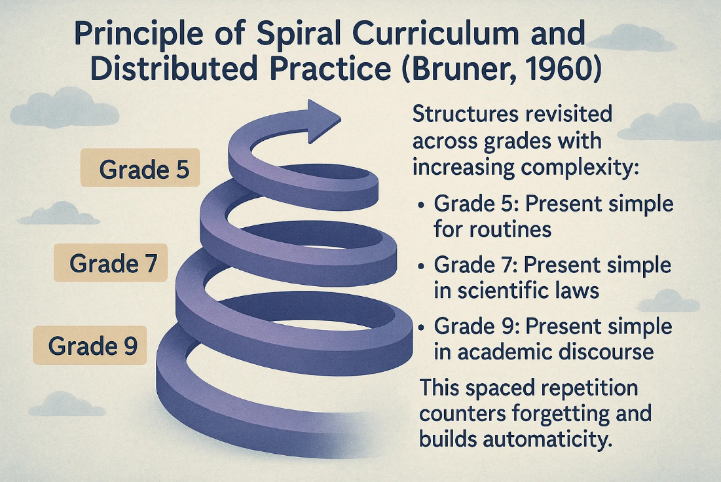
Fourth, Spiral Curriculum and Vertical Progression (Bruner, 1960) structures the programme as a cumulative trajectory. Structures recycle with escalating complexity: Grade 5 introduces basic present simple for routines; Grade 7 extends it to habitual actions with adverbs of frequency in narratives; Grade 9 applies it in formal expositions. This prevents forgetting (Ebbinghaus curve) and builds automaticity through distributed practice. Assessment integrates formative loops, ensuring progression is data-driven and individualized.
Methodologically, cycles include inductive discovery, scaffolded production, peer feedback, and reflective journals, creating a cohesive, evidence-based pathway to grammatical mastery
Assessment integrates continuous formative loops (diagnostic checks, progress trackers, digital portfolios), making progression visible, data-driven, and individualized. 5-year spiral matrix for 8 core structures, followed by 10 spiral-linked activities (one per grade transition), each with:
SPIRAL CURRICULUM MATRIX: 8 CORE STRUCTURES ACROSS GRADES 5–9
|
Structure |
Grade 5 (A1) |
Grade 6 (A2) |
Grade 7 (B1) |
Grade 8 (B1+) |
Grade 9 (B2) |
|
Present Simple |
Routines (I play football.) |
+ Frequency adverbs (I usually play…) |
+ General truths (Water boils…) |
+ Passive (Football is played…) |
+ Academic register (Research suggests…) |
|
Present Perfect |
Experiences (I’ve visited Astana.) |
+ Ever/never (I’ve never seen snow.) |
+ For/since (I’ve lived here since 2018.) |
+ Present perfect passive (The bridge has been built.) |
+ Discourse markers (Having studied…) |
|
Past Simple |
Finished actions (I went to Almaty.) |
+ Regular/irregular verbs |
+ Narrative sequencing |
+ Past perfect contrast |
+ Reported historical events |
|
Conditionals |
— |
Zero (If you heat water, it boils.) |
First (If I study, I’ll pass.) |
Second (If I were rich…) |
Mixed (If I had studied, I would be…) |
|
Articles |
a/an vs. the |
+ Zero article (plurals) |
+ Geographic names |
+ Abstract nouns |
+ Advanced exceptions |
|
Relative Clauses |
— |
who/which (subject) |
where/whose |
Non-defining |
Reduced clauses |
|
Modals |
can (ability) |
must (obligation) |
should (advice) |
might/could (possibility) |
Semi-modals (be able to, have to) |
|
Passive Voice |
— |
Present simple passive |
Past simple passive |
Present perfect passive |
All tenses + modals |
Spiral linked activities
1. Grade 5 → 6: Present Simple + Adverbs of Frequency – “Routine Radar”
CEFR: A1 → A2 New Layer: Adverbs (always, usually, often, sometimes, never) Activity (30 min):
-
Recall (5 min): Draw daily routine mind map (Grade 5).
-
Upgrade (10 min): Add frequency: “I usually brush my teeth.” → Use adverb dice (roll to insert).
-
Output (15 min): Create Routine Radar Chart (pie chart):
“I always (100%) eat breakfast. I sometimes (30%) play games.”
Assessment: Digital chart (Google Sheets) + 5 correct placements
2. Grade 6 → 7: Present Simple → General Truths – “Science Law Lab”
CEFR: A2 → B1 New Layer: Scientific facts (CLIL link) Activity (40 min):
-
Input (8 min): Read: “Planets orbit the sun. Metal expands when heated.”
-
Bridge (10 min): Convert routine → law:
“I drink water.” → “Water is essential for life.”
-
Experiment (22 min): Groups test 3 laws (ice melts, plants grow toward light). Write: “If you freeze water, it becomes ice.” Assessment: Lab sheet: 4 correct present simple truths
3. Grade 7 → 8: Present Perfect → Present Perfect Passive – “Kazakhstan Firsts”
CEFR: B1 → B1+ New Layer: Passive form (has been + V3) Activity (45 min):
-
Timeline (10 min): “Astana has hosted EXPO 2017.”
-
Transformation (12 min): Active → Passive:
“Kazakhs invented yurt.” → “The yurt has been used for centuries.”
-
Museum Exhibit (23 min): Design poster:
“Oil has been extracted since 1899. The Baikonur Cosmodrome has launched over 1,500 rockets.” Assessment: Poster rubric: 3 accurate passives
4. Grade 5 → 6: Articles – “My City Guide”
CEFR: A1 → A2 New Layer: Zero article with plurals/geography Activity (35 min):
-
Grade 5 Recall: “I see a dog. I see the sun.”
-
New Rule (8 min): “We don’t use articles with cities: Almaty, not the Almaty.”
-
Guidebook (20 min): Write:
“Visit __ Astana. See __ museums and __ Baiterek Tower.” Assessment: Peer edit: ✓ zero article with proper nouns
5. Grade 6 → 7: Zero → First Conditional – “If… Then…” Science
CEFR: A2 → B1 New Layer: Future result (will) Activity (40 min):
-
Zero Recall (5 min): “If you mix blue and yellow, you get green.”
-
Extend (10 min): “If you heat ice, it will melt.” → Timeline: now → future
-
Prediction Lab (25 min): Experiment:
“If we add salt to water, the boiling point will increase.” Assessment: Prediction sheet: 3 correct first conditionals
6. Grade 7 → 8: First → Second Conditional – “Dream School”
CEFR: B1 → B1+ New Layer: Hypothetical (would) Activity (50 min):
-
Real Plan (10 min): “If we study, we’ll pass.”
-
Dream Shift (12 min): “If our school had a pool, we would swim every day.”
-
Architect Pitch (28 min): Design ideal school → present:
“If we built a VR lab, students would learn faster.” Assessment: Video pitch + conditional accuracy (4/5)
7. Grade 8 → 9: Second → Mixed Conditional – “Life Choices Debate”
CEFR: B1+ → B2 New Layer: Past condition → present result Activity (60 min):
-
Model (10 min): “If I had learned coding, I would be a programmer now.”
-
Regret Chain (20 min): Pass sentence around class.
-
Debate (30 min): “If Kazakhstan had invested in renewables earlier, we would have less pollution today.” Assessment: Debate scorecard: 2 mixed conditionals used correctly
8. Grade 6 → 7: Can → Must/Should – “Survival Island”
CEFR: A2 → B1 New Layer: Obligation/advice Activity (45 min):
-
Ability (8 min): “I can swim.”
-
Rules (12 min): “You must make a fire. You should boil water.”
-
Role-play (25 min): Stranded on island → write survival guide. Assessment: Guide: 3 modals accurately used
9. Grade 7 → 8: Relative Clauses (Defining) → Non-Defining – “Hero Biography”
CEFR: B1 → B1+ New Layer: Extra information (commas) Activity (40 min):
-
Defining (8 min): “The man who invented the internet changed the world.”
-
Non-defining (10 min): “Tim Berners-Lee, who was born in 1955, invented the web.”
-
Biography (22 min): Write about Kazakh hero (e.g., Bauyrzhan Momyshuly). Assessment: 1 defining + 1 non-defining clause
10. Grade 8 → 9: Passive (Simple) → Modal Passive – “Future City Report”
CEFR: B1+ → B2 New Layer: must/should/can + be + V3 Activity (50 min):
-
Recall (8 min): “The park was built in 2020.”
-
Future Rules (12 min): “Garbage must be recycled. Parks should be protected.”
-
UN Report (30 min): “By 2050, renewable energy can be used in all homes.” Assessment: Formal report: 3 modal passives
Spiral assessment and tracking system
|
Tool |
Purpose |
Example |
|
Grammar Passport |
Visual progress tracker |
Stamp per structure mastery |
|
Digital Portfolio |
Longitudinal evidence |
Google Sites: Grade 5 routine → Grade 9 exposition |
|
Spiral Quiz (Termly) |
Measure retention |
10 items: 2 from each prior grade |
|
Reflection Journal |
Metacognition |
“I used to say ‘I go yesterday’. Now I use past simple automatically.” |
Methodologically, the programme employs a synthesis of close grammar reading, guided discovery, rule articulation, scaffolded practice, inductive noticing, micro-production, feedback loops, and reflective self-monitoring. Assessment for learning practices are integrated into cycles rather than isolated at endpoints
-
chapter. Structure and content scope of the program
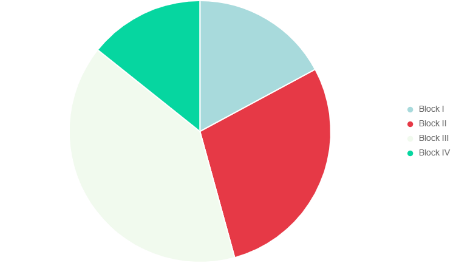
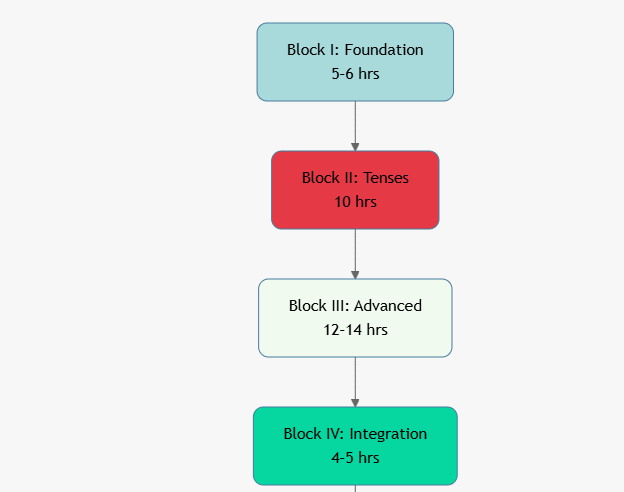
The programme content is organised on a spiral progression principle in four consecutive blocks:
Block I — Foundational Grammar
Awareness (5–6 hours)
Focus: renewal and alignment of baseline grammatical concepts
across Grades 5–9.
Contents include:
-
functions of grammar in meaning-making
-
sentence-level word order (S–V–O and expansions)
-
parts of speech with functional focus
-
time reference and aspect awareness (pre-tense noticing)
-
controlled diagnostic practice for levelling and alignment
Block II — Core Tense System (10 hours)
Focus: functional mastery of
time and aspect relationships in English.
Contents include:
-
Present Simple vs Continuous (state vs activity)
-
Past Simple vs Past Continuous (narration and backgrounding)
-
Present Perfect vs Past Simple (relevance and result)
-
Future forms (will, going to, present for future)
-
Integrated tense contrast tasks in reading and micro-production
Block III — Advanced
Grammatical Structures (12–14
hours)
Focus: structures required for school-level academic and extended
discourse.
Contents include:
-
Modal verbs of ability, obligation, deduction
-
Passive voice in academic reporting
-
Conditionals (Zero–Second) with real and hypothetical frames
-
Reported speech (statements and questions)
-
Articles, quantifiers, pronouns in controlled precision tasks
-
Comparative constructions and complex sentence building
Block IV — Integration,
Application and Assessment (4–5
hours)
Focus: functional transfer of grammatical control into integrated
tasks.
Contents include:
-
CLIL-infused micro-readings with grammar annotation
-
Guided rewriting and transformation for accuracy
-
Short argumentative and factual writing with grammar targets
-
Oral structured responses with monitored accuracy
-
Summative assessment and reflective metacognitive review
Expected outcomes and competency results
Upon completing the 34-hour programme, learners are expected to demonstrate the following competencies:
Linguistic and Structural Outcomes
-
Recognise and accurately identify key grammatical structures in written and spoken input.
-
Apply core tense forms appropriately to express time, sequence, and relevance.
-
Use modal verbs, passive voice, conditionals and reported speech in controlled and semi-free production tasks.
-
Maintain sentence-level accuracy through correct choice of articles, pronouns, quantifiers and comparatives.
Functional and Communicative Outcomes
-
Produce grammatically coherent short written texts (narrative, factual, argumentative) aligned with grade-level tasks.
-
Reformulate sentences and short paragraphs to adjust perspective, voice, modality or tense.
-
Demonstrate controlled grammatical accuracy in oral responses to academic prompts.
-
Integrate grammatical knowledge when interacting with content-based (CLIL) micro-texts.
Cognitive and Metalinguistic Outcomes
-
Explain the functional reasons behind a selected grammatical choice when prompted.
-
Detect and correct grammar errors in peer or model sentences using explicit criteria.
-
Transfer grammar awareness across school subjects when engaging with English-medium materials.
-
Monitor and adjust one’s own output through conscious grammar self-checking strategies.
CONTENT ORGANISATION AND DISTRIBUTION BY HOURS
|
Block |
Focus |
Hours |
Core Components |
|
I |
Foundational alignment |
5–6 |
Grammar functions, word order, PoS, baseline test |
|
II |
Core tenses |
10 |
Present/Past/Perfect/Future contrasts in use |
|
III |
Advanced structures |
12–14 |
Modals, Passive, Conditionals, Reported speech, Articles, Quantifiers |
|
IV |
Integration & assessment |
4–5 |
CLIL texts, rewriting, production, summative assessment |
BLOCK I: FOUNDATIONAL ALIGNMENT
Focus: Build grammatical awareness, establish baseline, align with prior knowledge Hours: 5–6 CEFR: A1–A2 Spiral Link: Revisits Grade 4 basics (nouns, be/have, simple sentences)
|
Core Components |
Details |
|
Grammar Functions |
Subject-verb-object (SVO), question formation, negation |
|
Word Order |
Declarative, interrogative, imperative |
|
Parts of Speech (PoS) |
Noun, verb, adjective, adverb, pronoun, preposition |
|
Baseline Diagnostic |
Pre-test to identify gaps (error types, fossilized mistakes) |
Target Grammar
|
Structure |
Example |
Function |
|
Simple sentences |
She runs fast. |
Basic statements |
|
Yes/No questions |
Do you like tea? |
Information seeking |
|
Be/Have |
I am happy. She has a cat. |
Description, possession |
Key Activities (6 hours)
|
Activity |
Time |
Description |
|
1. Grammar Detective Hunt |
45 min |
Students highlight PoS in a short story (e.g., “The brave explorer found a golden treasure.”) |
|
2. Sentence Builder Blocks |
60 min |
Use magnetic tiles: Subject → Verb → Object/Adjective → “The big dog chases cats.” |
|
3. Baseline Test |
30 min |
20-item diagnostic: gap-fill, error correction, sentence transformation |
|
4. Class Grammar Profile |
45 min |
Teacher graphs results → personalized learning paths |
Materials
-
Printable PoS flashcards
-
Interactive whiteboard (Jamboard)
-
Diagnostic test (Google Forms)
-
Student grammar passports (portfolio starters)
Assessment
-
Formative: Observation checklist (PoS identification accuracy)
-
Diagnostic: Pre-test score → grouped into A1/A2 tracks
-
Reflection: “I know verbs show action. I need help with questions.”
BLOCK II: CORE TENSES
-
Focus: Master time-aspect system for narrative and real-world use
-
Hours: 10 CEFR: A2–B1
-
Spiral Link: Present simple (Grade 5) → contrasts with continuous/perfect
|
Core Components |
Details |
|
Tense Contrasts |
Present vs. Past, Simple vs. Continuous, Perfect introduction |
|
Timeline Visualization |
Past ← Now → Future |
|
Narrative Sequencing |
Stories, personal experiences |
|
Error Correction |
Common L1 interference (Kazakh/Russian tense use) |
Target Grammar

|
Tense |
Form |
Use |
Example |
|
Present Simple |
Base + s |
Routines, facts |
I eat dombra. |
|
Present Continuous |
am/is/are + ing |
Now, temporary |
I’m eating now. |
|
Past Simple |
V2 / -ed |
Finished past |
I ate yesterday. |
|
Past Continuous |
was/were + ing |
Background |
I was eating when… |
|
Present Perfect |
have/has + V3 |
Experience, recent |
I’ve just eaten. |
Key Activities (10 hours)
|
Activity |
Time |
Description |
|
1. Tense Timeline Race |
90 min |
Groups build giant floor timeline → place event cards (“born 2010”, “eating now”) |
|
2. Life Experience Bingo |
60 min |
“Find someone who has visited Astana.” → Present perfect questions |
|
3. Interrupted Stories |
120 min |
Comic strip: “While I was sleeping, the phone rang.” → Past continuous + simple |
|
4. Yesterday vs. Ever |
60 min |
Dual-column journal: Yesterday (past) / In my life (perfect) |
Materials
-
Tense timeline posters
-
Event cards (laminated)
-
Digital journal (Notion/Seesaw)
-
Authentic input: vlogs, news clips
Assessment
-
Formative: Tense quiz (gap-fill)
-
Production: 100-word “My Weekend” story (3 tenses)
-
Peer Feedback: “You used past continuous correctly!”
BLOCK III: ADVANCED STRUCTURES
Focus: Expand expressive range for academic and hypothetical language Hours: 12–14 CEFR: B1–B2 Spiral Link: Modals (Grade 6) → nuanced meaning; Passive (Grade 7) → all tenses
|
Core Components |
Details |
|
Modal Logic |
Obligation, possibility, deduction |
|
Voice Shift |
Active ↔ Passive across tenses |
|
Hypotheticals |
Real vs. unreal conditionals |
|
Reported Forms |
Direct → indirect speech |
|
Precision Tools |
Articles, quantifiers, connectors |
Target Grammar
|
Structure |
Form |
Example |
|
Modals |
must, should, might |
You must wear a helmet. |
|
Passive |
be + V3 |
The law was passed. |
|
Conditionals |
If + tense, result |
If I study, I’ll pass. |
|
Reported Speech |
said/told + past |
She said she was tired. |
|
Articles |
a/an, the, Ø |
Ø Water is essential. |
|
Quantifiers |
some, many, few |
Few students failed. |
Key Activities (14 hours)
|
Activity |
Time |
Description |
|
1. Modal Strength Line |
90 min |
Rank modals on a line: must → should → might → role-play rules |
|
2. Passive Newsroom |
120 min |
Rewrite active headlines → passive: “Scientists discover…” → “New planet has been discovered…” |
|
3. Conditional Chain |
90 min |
*“If I win the lottery…” → 2nd conditional story circle |
|
4. Gossip Reporter |
60 min |
Interview → report: “He said he would come.” |
|
5. Article Surgery |
60 min |
Edit text with wrong articles → justify |
Materials
-
Modal cards
-
News article bank
-
Conditional dice
-
Reporting verb list
Assessment
-
Transformation Test: 15 items (active → passive, direct → reported)
-
Debate: Use 3 modals + 2 conditionals
-
Error Log: Track and correct own mistakes
BLOCK IV: INTEGRATION & ASSESSMENT
Focus: Apply grammar in authentic, interdisciplinary contexts; evaluate mastery Hours: 4–5 CEFR: B1+–B2 Spiral Link: All prior structures → synthesis in CLIL projects
|
Core Components |
Details |
|
CLIL Texts |
Science, history, geography input |
|
Rewriting Tasks |
Genre transformation (story → report) |
|
Extended Production |
Essays, presentations, digital stories |
|
Summative Assessment |
Portfolio + oral defense |
Materials
-
CLIL texts (simplified)
-
Rubric templates
-
Recording devices
-
Portfolio template (Canva)
Assessment
-
Portfolio (60%): 5 artifacts + reflection
-
Oral Presentation (30%): Fluency + accuracy
-
P
 ost-Test
(10%): Compare with Block I
diagnostic
ost-Test
(10%): Compare with Block I
diagnostic
SPIRAL PROGRESSION TABLE (Sample: Present Perfect)
|
Grade |
Focus |
Context |
Output |
|
5 |
Experience |
Personal |
I’ve been to Almaty. |
|
6 |
Ever/Never |
Survey |
I’ve never flown. |
|
7 |
For/Since |
Timeline |
I’ve lived here for 5 years. |
|
8 |
Passive |
News |
The park has been cleaned. |
|
9 |
Discourse |
Essay |
Having studied grammar, I now… |
Final Outcome: Learners exit with a digital grammar portfolio, CEFR-aligned certificate, and transferable skills for academic English, exams, and global communication.
-
chapter. Innovative Strategies for Teaching Grammar
Principle and rationale aims to combine form-focused instruction with tasks that promote meaningful use and proceduralization. Innovations draw on retrieval practice, interleaving, multimodal input, and learner autonomy to accelerate retention and transfer.
-
Core strategies (with classroom steps)
Guided Discovery + Micro‑explanations
-
Steps: present 4–6 contrasting sentences, ask learners to notice differences (2–3 min), then scaffold a concise rule and example.
-
Use: good for introducing tense/aspect, article rules, passive.
-
Quick check: ask students to produce one original sentence and one “why” statement.
-
Retrieval Practice & Interleaving
-
Steps: start each lesson with 2–3 retrieval prompts mixing recent targets (e.g., choose past simple/present perfect). Space revisits across days and alternate related structures.
-
Use: turn short-term learning into durable memory; prevent context-bound knowledge.
-
Classroom tip: use 90‑second low-stakes quizzes, mini whiteboards or digital polling.
-
Input Enhancement + Short Input Floods
-
Steps: provide a 200–300 word authentic excerpt with highlighted target forms; follow with 5 focused comprehension/notice questions.
-
Use: raises salience without explicit heavy-handed explanation; effective for collocations and grammatical markers.
-
Task‑Supported Form Focus (TBL hybrid)
-
Steps: pre-task brief (noticing + 5 minute drill), task (info-gap or problem solving), post-task focused feedback and short corrective drills based on observed error patterns.
-
Use: ensures accuracy-first then function, preserving communicative authenticity.
-
Technology‑Enabled Practice and Corpora
-
Steps: use concordance lines from a simple corpus or corpus tool to show frequency and collocational patterns; assign short concordance hunts as homework. Incorporate spaced‑repetition flashcards (SRS) for exemplar sentences.
-
Use: advanced learners benefit from distributional evidence and exemplar memorization.
-
Gamification and Challenge Cycles
-
Steps: design short competitive rounds (sentence building relays, transformation races) with clear criteria; alternate timed accuracy rounds with collaborative open tasks.
-
Use: raises engagement and encourages repeated, varied practice.
Methodological principles and instructional approach
The programme adheres to a set of methodological principles that ensure both systematic acquisition and functional transfer of grammatical competence. These principles are rooted in evidence-based second language acquisition (SLA) research and are designed to create a cohesive, learner-centered, and outcome-oriented instructional framework for Grades 5–9.
-
Principle of Explicit-to-Implicit Progression
Grammar instruction begins with conscious awareness (Schmidt, 1990) through noticing tasks, metalanguage-light rule formulation, and visual anchors (e.g., tense timelines). This explicit phase transitions seamlessly into implicit use via guided practice, scaffolded production, and communicative tasks. For example, after learning present perfect via a life-experience survey, learners produce vlogs (“I’ve just finished my homework”), embedding the structure in meaningful output.
2. Principle of Form-Meaning-Use Integration (Larsen-Freeman, 2014)
Every structure is taught across three dimensions:
Form: Accurate construction (have/has + past participle)
Meaning: Semantic function (connection between past and present)
Use: Pragmatic appropriateness (formal vs. informal contexts) This triad prevents rote learning and ensures transferability. A B2 lesson on reported speech includes:
Form: backshift rules Meaning: distancing from original statement Use: formal summaries vs. casual retelling
3. Principle of Task-Supported Language Teaching (Willis & Willis, 2007)
Grammar is not an end but a means to task success. Tasks follow a controlled → freer continuum, with grammatical accuracy as a non-negotiable criterion. In a Grade 7 environmental debate, students must use second conditionals (“If we recycled more, pollution would decrease”) to propose solutions—fluency alone is insufficient.
4. Principle of Spiral Curriculum and Distributed Practice (Bruner, 1960)
Structures are revisited across grades with increasing complexity:
-
Grade 5: Present simple for routines
-
Grade 7: Present simple in scientific laws
-
Grade 9: Present simple in academic discourse This spaced repetition counters forgetting and builds automaticity.
5. Principle of CLIL-Infused Contextualization
Grammar is embedded in disciplinary micro-contexts (Coyle et al., 2010):
-
Passive voice in history reports
-
Relative clauses in geography descriptions
-
Modals in science safety rules This dual-focus enhances cognitive engagement and cross-curricular transfer.
6. Principle of Assessment for Learning (Black & Wiliam, 1998)
Assessment is continuous, diagnostic, and formative:
-
Pre-unit diagnostics identify gaps
-
In-task recasts provide immediate feedback
-
Post-task reflections promote metacognition
-
Digital portfolios track longitudinal progress Summative evaluations (e.g., transformation tests, oral defenses) measure mastery, not memorization.
7. Principle of Inclusivity and Differentiation
Activities include multiple entry points:
-
Visual learners: infographics, mind maps
-
Kinesthetic learners: role-plays, grammar games
-
High achievers: extension tasks (e.g., writing formal letters)
-
Struggling learners: simplified input, peer scaffolding Universal Design for Learning (UDL) ensures accessibility.
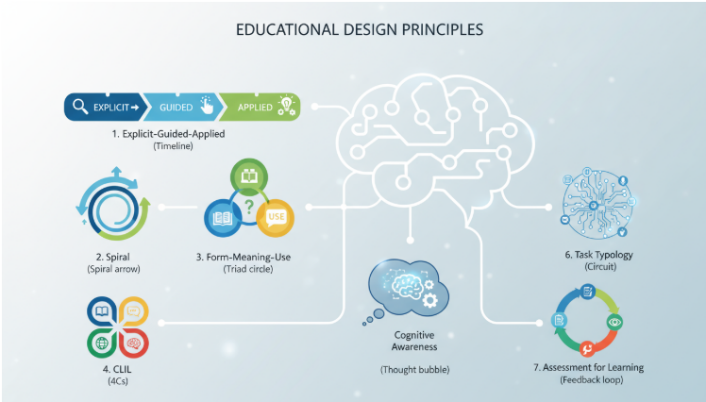
1) Explicit–Guided–Applied Sequence
Grammar is first made conscious (through explanation or guided noticing), then stabilised via controlled tasks, and finally transferred into functional production. This principle structures learning as a three-stage process (Norris & Ortega, 2000): Explicit (awareness), Guided (accuracy), Applied (fluency). First, grammar is made conscious through guided noticing—e.g., underlining have/has + V3 in a travel blog—or metalanguage-light rules: “Use present perfect for life experiences.” Visual timelines anchor meaning.
Next, controlled tasks stabilize form: gap-fills, sentence matching, or pair drills (“Have you ever…?”). Errors are corrected via recasts.
Finally, functional production transfers grammar into real use: recording a “My Adventures” vlog or debating future plans.
 Example: Present perfect
→ “I’ve climbed Tarbagatai, but
I’ve never seen Baikonur.” Teacher
Tip: Use QR codes
linking
to model videos.
Example: Present perfect
→ “I’ve climbed Tarbagatai, but
I’ve never seen Baikonur.” Teacher
Tip: Use QR codes
linking
to model videos.
2) Spiral Progression
Previously introduced structures reappear at higher cognitive levels and in new discourse contexts, preventing one-time exposure and ensuring cumulative competence. The programme adopts Bruner’s Spiral Curriculum (1960), ensuring structures recycle across Grades 5–9 with increasing complexity, cognitive demand, and discourse variety. This distributed practice combats the Ebbinghaus forgetting curve (1885) and builds automaticity.
|
Grade |
Present Simple Example |
Context |
|
5 (A1) |
I play football. |
Personal routine |
|
6 (A2) |
I usually play after school. |
Habit + adverb |
|
7 (B1) |
Water boils at 100°C. |
Scientific truth |
|
8 (B1+) |
Football is played worldwide. |
Passive in reports |
|
9 (B2) |
Research suggests… |
Academic writing |
Each revisit adds a new layer:
-
Function: From stating facts to hedging in research
-
Register: Informal → formal
-
Genre: Diary → lab report → essay
Spiral Activity Example:
-
Grade 7: Convert routine → scientific law (“I drink water” → “Water is essential”)
-
Grade 8: Rewrite in passive (“Water is consumed daily…”)
3) Form–Meaning–Use Triad
Every grammar item is treated not only in its rule form but also in its meaning function and conditions of pragmatic use, preventing “rule without application”. Based on Larsen-Freeman’s grammaring (2014), every structure is taught as a three-dimensional system:
-
Form: Morphological/syntactic accuracy
-
Meaning: Semantic function
-
Use: Pragmatic and sociocultural appropriateness
This prevents rule-without-application errors. Example: Second Conditional
|
Dimension |
Focus |
Example Activity |
|
Form |
If + past, would + base |
Sentence builder: If I had wings, I would fly. |
|
Meaning |
Unreal/hypothetical |
Visual: Reality vs. Dream (photo of bird → student) |
|
Use |
Advice, regret, imagination |
Role-play: “If I were president…” (formal) vs. “If I won the lottery…” (casual) |
Triad Cycle:
-
Form: Match clauses on cards
-
Meaning: Sort into possible vs. impossible
-
Use: Write formal letter (“If action were taken”) and casual text (“If I had cash”)
Assessment Rubric:
|
Form (3 pts) |
Meaning (3 pts) |
Use (4 pts) |
Total |
|
Accurate clauses |
Correct logic |
Appropriate register |
/10 |
4) CLIL-Infused Contextualisation
Grammar practice is periodically embedded in micro-texts and tasks with subject-content references, supporting academic thinking and cross-domain language transfer. Learners develop metalinguistic control through self-monitoring and rule justification, essential for exam success and academic writing (Verspoor & Behney, 2021).
Training Sequence:
-
Error Awareness: Study common L1 interference (e.g., article omission)
-
Decision Log: After writing, students complete:
“I used ‘the’ because ___.” “I avoided article because ___ (zero article rule).”
-
Grammar Court: Peer trial — defend or correct a sentence
Activity: “Grammar Diary”
Weekly entry:
Sentence written
Rule applied
Justification
Example: “I wrote: ‘The sun rises in east.’ → Corrected to ‘the east’ because compass points take ‘the’.”
Assessment: Metacognitive Rubric
|
Self-Correction |
Rule Stated |
Justification |
Score |
|
✓ |
✓ |
Clear & accurate |
3/3 |
5) Cognitive Grammar Awareness
Learners are explicitly trained to self-monitor grammar decisions and justify them, which builds metalinguistic control necessary for exams and academic writing.
6) Balanced Task Typology
Instruction alternates between input-based noticing tasks, controlled drills, semi-free transformation, and short free production to maximise retention and application.
Instruction cycles through four task types to maximize input, practice, and output (Ellis, 2003):
|
Type |
Purpose |
Example |
|
Input-Based |
Noticing |
Highlight past continuous in comic |
|
Controlled |
Accuracy |
Gap-fill: “While I ___ (sleep)…” |
|
Semi-Free |
Fluency + Accuracy |
Information gap: describe photo |
|
Free |
Automaticity |
Record personal story |
Activity: “4-Station Grammar Circuit”
-
Station 1: Read dialogue → underline target
-
Station 2: Transform sentences
-
Station 3: Role-play interruption
-
Station 4: Record 30-sec vlog
Time: 12 min per station (48 min total)
Assessment: Circuit Passport
-
Stamp per station
-
Final vlog: 3 correct uses = “Grammar Athlete” badge
7) Assessment for Learning
Monitoring is not postponed to the end; formative checks, micro-rubrics and peer review are integrated into instructional cycles, supporting immediate correction. Assessment is formative, cyclical, and immediate (Black & Wiliam, 1998). Monitoring occurs during, not after, learning.
Cycle:
-
Diagnostic (pre-task)
-
Formative (in-task recasts, peer checks)
-
Reflective (post-task journal)
Tools:
-
Micro-Rubrics: 3-point scales on sticky notes
-
Traffic Light Cards: Green = confident, Yellow = unsure, Red = need help
-
Digital Portfolio: Seesaw entries with before/after versions
Activity: “Live Edit Wall”
-
Students post draft sentences on wall
-
Peers add sticky note feedback: “Good passive! Fix: ‘was build’ → ‘was built’”
-
Author revises → reposts
-
Teacher final recast stamp
Assessment: Growth Tracker
|
Draft 1 |
Feedback |
Draft 2 |
Growth |
|
2 errors |
2 notes |
0 errors |
+2 pts |
7 Principles in Action
|
№ |
Principle |
Key Visual |
Core Activity |
Output |
|
1 |
Explicit–Guided–Applied |
Timeline |
Rule → Rap |
Video |
|
2 |
Spiral |
Spiral arrow |
Time Machine |
Report |
|
3 |
Form–Meaning–Use |
Triad circle |
Modal Menu |
Rules |
|
4 |
CLIL |
4Cs |
Volcano Report |
Poster |
|
5 |
Cognitive Awareness |
Thought bubble |
Grammar Judge |
Diary |
|
6 |
Task Typology |
Circuit |
Obstacle Course |
Vlog |
|
7 |
Assessment for Learning |
Feedback loop |
Live Edit |
Portfolio |
Types of tasks and classroom formats
The programme uses a diversified set of grammar-oriented task types including:
-
Noticing tasks (underline, classify, compare, reconstruct)
Purpose: To heighten learners’ awareness of grammatical forms and patterns without immediate production pressure. Noticing is the foundational stage in Schmidt’s (1990) Noticing Hypothesis, where conscious attention to form-meaning mappings accelerates acquisition.
Sub-types and Examples:
-
Underline: Students receive a short authentic text (e.g., a BBC news snippet) and underline all instances of the present perfect continuous (“has been raining,” “have been studying”).
-
Classify: Provide 15 sentences; learners sort them into active vs. passive voice or countable vs. uncountable nouns.
-
Compare: Contrast two paragraphs—one in simple past, one in past perfect—and list differences in timeline signaling.
-
Reconstruct: Give a jumbled paragraph with key grammatical markers removed; students rebuild coherence using relative clauses or connectives.
Classroom Format:
-
Individual (5–7 mins): Silent reading + underlining.
-
Pair-check (3 mins): Peer validation.
-
Whole-class (5 mins): Teacher elicits patterns on interactive whiteboard (IWB).
-
Controlled production (gap-fill with constraints, guided transformations)
Purpose: To ensure accuracy under structured guidance before freer practice. Constraints reduce cognitive overload while scaffolding output.
Examples:
-
Gap-fill with constraints:
“The meeting ___ (hold) online since 2020, but next year it ___ (return) to in-person.” Constraints: Use present perfect passive + will.
-
Guided transformations:
Active → Passive: “Scientists discovered the particle.” → “The particle ___ by scientists.” Direct → Reported: “I’ll help,” she said → She said (that) ___ .
Classroom Format:
-
Individual worksheet (8 mins).
-
Pair dictation: One reads the original; partner transforms.
-
Digital quiz (Kahoot!/Quizlet Live): Instant feedback.
-
Sentence combining and rewriting (to train word order, cohesion, voice)
Purpose: To develop syntactic maturity and textual cohesion—key markers of B2+ proficiency.
Examples:
-
Combining:
-
Input: “The storm destroyed the village. The villagers rebuilt it. They used sustainable materials.” Output: “After the storm destroyed the village, the villagers rebuilt it using sustainable materials.” (relative clause + participle)
-
Rewriting for cohesion: Rewrite a choppy paragraph using discourse markers (however, moreover, as a result).
-
Classroom Format:
-
Group competition (4 groups): Each combines 5 sentences; fastest + most accurate wins.
-
Gallery walk: Post rewritten paragraphs; peers vote with sticky notes.
-
Micro-dictations and guided note-taking (accuracy under processing pressure)
Purpose: To simulate real-time language processing (listening + writing) while maintaining grammatical precision.
Procedure:
-
Teacher reads a 60-word CLIL text at natural speed (e.g., “The Amazon rainforest absorbs 2 billion tons of CO₂ annually…”).
-
Students write in guided skeleton notes (gaps for verb forms, prepositions).
-
Self-check against transcript projected after 3 attempts.
Classroom Format:
-
Whole-class listening → individual writing.
-
Pair reconstruction: If notes are incomplete, partners co-fill gaps.
-
Tech integration: Use VoiceThread or Microsoft Immersive Reader for repeated playback.
-
CLIL mini-texts with grammar extraction (history, science, geography snippets)
Purpose: Content and Language Integrated Learning (CLIL) contextualizes grammar in disciplinary discourse, enhancing transferability.
Example (Geography + Passive Voice):
“The Himalayas were formed when the Indian plate collided with the Eurasian plate 50 million years ago. The region is still rising by 5 mm annually.”
Tasks:
-
Extract all passives.
-
Transform to active (“The Indian plate collides…” — discuss meaning shift).
-
Create a timeline using past simple vs. present perfect.
Classroom Format:
-
Jigsaw reading: Each group gets a different CLIL snippet (Volcanoes, Renaissance, Water Cycle); becomes “expert.”
-
Expert mingling: Teach peers using target grammar.
-
Short written outputs (factual, narrative, argumentative paragraphs)
Purpose: To bridge accuracy and fluency in extended discourse. These tasks transition learners from sentence-level control to paragraph-level coherence, integrating target grammar into authentic genres. Writing scaffolds (word limits, prompts, checklists) reduce anxiety while promoting genre awareness, lexical precision, and grammatical range—hallmarks of CEFR B1–C1 descriptors.
|
Genre |
Prompt |
Grammar Focus |
Model Structure |
Success Criteria (out of 10) |
Extension (optional) |
|
Factual |
“Describe a renewable energy source.” |
Present passive, relative clauses |
1. Definition & importance 2. Process (passive) 3. Advantages (relative clauses) 4. Concluding fact |
• 2+ passives • 2+ relative clauses • Topic sentences • 80–100 words |
Create an infographic using Canva with 3 key sentences. |
|
Narrative |
“A day when everything went wrong.” |
Past perfect, connectors (sequencing + contrast) |
1. Opening scene (setting) 2. 3–4 events (past perfect for backstory) 3. Climax + resolution 4. Reflection |
• 3+ past perfect • 4+ connectors (before, after, although, suddenly) • Varied sentence length • 90–110 words |
Record a 60-second audio retelling (VoiceThread). |
|
Argumentative |
“Social media does more harm than good.” |
Modals of obligation/probability, concessive clauses, nominalization |
1. Opinion statement 2. Reason 1 + example (modal) 3. Reason 2 + counterargument (although…) 4. Conclusion with recommendation |
• 3+ modals (should, must, might) • 1+ concessive clause • 2+ nominalized forms (addiction, restriction) • 100–120 words |
Prepare a 2-minute rebuttal speech for debate. |
Detailed Task Implementation
1. Factual Paragraph: “Describe a renewable energy source.”
Level: B1 Time: 25 mins Materials: Prompt card, peer checklist
Procedure:
-
Input (5 mins): Show 30-sec solar panel video + 3 model sentences on IWB:
-
“Solar energy is generated by photovoltaic cells, which are made of silicon…”
-
Planning (5 mins): Mind-map: Definition → Process → Benefits → Fact.
-
Writing (10 mins): 80–100 words.
-
Peer Edit (3 mins): Swap → Check 2 passives + 2 relative clauses.
-
Rewrite (2 mins): Final version.
Sample Output
Solar energy, which is one of the cleanest renewables, is produced by panels that convert sunlight into electricity. The panels, which are installed on rooftops, are made of silicon cells. Electricity is generated when photons hit the cells, a process known as the photovoltaic effect. Unlike fossil fuels, solar power is not depleted and produces no emissions. In Germany, over 50 GW are installed, enough to power millions of homes.
2. Narrative Paragraph: “A day when everything went wrong.”
Level: B1+ Time: 30 mins Materials: Story starter slips
Procedure:
-
Hook (3 mins): Teacher narrates own “bad day” opener using past perfect.
-
Timeline Planning (5 mins): Draw 5-box comic strip; label with past perfect backstory.
-
Draft (12 mins): 90–110 words.
-
Connector Hunt (5 mins): Highlight 4 connectors; add one more if missing.
-
Gallery Walk (5 mins): Post paragraphs; vote “Most Dramatic” with sticky notes.
Sample Output
I had overslept because my alarm hadn’t rung. By the time I had dressed, the bus had already left. Although I had revised all night, I had forgotten my exam notes at home. Suddenly, it started raining, and my phone, which I had dropped earlier, stopped working. After I had arrived late, the teacher refused entry. However, she had seen my effort and allowed a retake the next day.
3. Argumentative Paragraph: “Social media does more harm than good.”
Level: B2 Time: 35 mins Materials: For/Against T-chart, rubric
Procedure:
-
Brainstorm (5 mins): Pairs fill T-chart: Harm (addiction, fake news) vs. Good (connectivity).
-
Model Analysis (5 mins): Dissect sample paragraph for modals and concession.
-
Writing (15 mins): 100–120 words; must include counter + refutation.
-
Self-Checklist (3 mins): □ 3 modals □ 1 although □ 2 nominalizations
-
Peer Feedback (5 mins): “Two stars and a wish.”
-
Final Polish (2 mins).
Sample Output
Social media should be restricted for teenagers because addiction is rising rapidly. Although platforms must connect people globally, excessive use might lead to anxiety and sleep deprivation. Cyberbullying, which affects one in three users, cannot be ignored. Governments ought to enforce age limits and education on digital wellness. Despite claims that restriction limits freedom, protection of mental health is paramount. In conclusion, regulated use would reduce harm while preserving benefits.
Assessment Rubric (Simplified):
|
Band |
Grammar (4) |
Coherence (3) |
Task Achievement (3) |
|
3 |
All targets accurate & varied |
Logical flow + topic sentences |
Fully on-task, word count |
|
2 |
Minor errors, targets used |
Mostly coherent |
Minor deviation |
|
1 |
Frequent errors, limited range |
Choppy |
Off-task or under-length |
Differentiation:
-
A2/B1: Provide sentence starters + word bank.
-
B2/C1: Add rhetorical question or conditionals as bonus targets.
-
Integration with Other Tasks:
-
Use factual output as input for CLIL grammar extraction.
-
Transform narrative into reported speech in spoken practice.
-
Extend argumentative into full debate with inversion structures.
-
Spoken grammar practice (structured oral responses with grammar targets)
Spoken Grammar Practice (Structured oral responses with grammar targets)
Purpose: To build real-time fluency while embedding target grammar in meaningful speech. Structured prompts reduce hesitation, promote automaticity, and allow self-monitoring. Tasks progress from controlled drills to semi-spontaneous discourse, aligning with CEFR B1–C1 speaking descriptors (accuracy, range, interaction, coherence).
Scaffolded Sequence (60–90 seconds per response): Each task includes prompt type, grammar target, model response, success criteria, and follow-up activity.
|
Level |
Prompt Type |
Grammar Target |
Model Response (60 sec) |
Success Criteria (out of 10) |
Follow-Up |
|
B1 |
Describe & Explain |
Present simple + frequency adverbs |
“I usually wake up at 7 a.m. I always check my phone first, which helps me stay organized…” |
3+ present simple 2+ adverbs (always, often) 1 relative clause |
Record via Flipgrid → Peer “adverb count” feedback. |
|
B1+ |
Narrate Past Events |
Past simple + past continuous + connectors |
“While I was walking to school, it started raining. I had left my umbrella at home…” |
• 3+ past continuous • 2+ connectors (while, when) • Clear sequence |
4/3/2 fluency drill with 3 partners. |
|
B2 |
Give Advice / Hypothetical |
Modals of advice + 2nd conditional |
“If I were you, I would study abroad. You should choose a country where English is spoken…” |
• 3+ modals (should, ought to, had better) • 1 conditional • Polite intonation |
Role-play: Student A = confused teen; B = advisor. |
|
B2+ / C1 |
Debate / Justify Opinion |
Inversion + concessive clauses + cleft sentences |
“Not only does AI improve efficiency, but it also creates jobs. Although some fear unemployment, what matters most is reskilling…” |
• 2+ inversions (Never have I…, Under no circumstances…) • 1 cleft (What I mean is…) • 1 although |
Live debate → Audience votes via Mentimeter. |
Detailed Task Implementation
1. B1: Describe & Explain (Present Simple + Adverbs)
Time: 15 mins Materials: Prompt cards, timer
Procedure:
-
Model (2 mins): Teacher performs 60-sec monologue on IWB.
-
Prep (3 mins): Students get card: “Describe your morning routine.” Fill 3 verbs + 2 adverbs.
-
Speak (8 mins): Pairs → A speaks 60 sec; B times & counts targets. Swap.
-
Feedback (2 mins): “I heard 4 adverbs—great!”
Sample Prompt Card:
Verbs: wake / eat / go Adverbs: always / sometimes / never
2. B1+: Narrate Past Events (Past Simple + Continuous)
Time: 20 mins Materials: Photo prompts
Procedure:
-
Input (3 mins): Show chaotic photo (e.g., spilled coffee, late train).
-
Timeline (4 mins): Draw 4-box sequence; label with was/were + -ing.
-
4/3/2 Drill (10 mins):
-
4 mins → Partner 1
-
3 mins → Partner 2
-
2 mins → Partner 3 (faster, smoother)
-
-
Reflection (3 mins): “My past continuous improved because…”
3. B2: Give Advice / Hypothetical (Modals + 2nd Conditional)
Time: 25 mins Materials: Dilemma cards
Procedure:
-
Role-Play Setup (5 mins): A = stressed student; B = mentor.
-
Model Dialogue (3 mins):
-
A: “I failed my exam.” B: “If I were in your shoes, I would create a study plan…”
-
Practice (12 mins): 3 rounds with new dilemmas.
-
Record & Transcribe (5 mins): Use phone → Highlight modals.
4. B2+/C1: Debate / Justify (Inversion + Cleft)
Time: 35 mins Materials: Motion slips, rubric
Procedure:
-
Prep (8 mins): Teams of 3; assign FOR / AGAINST. Brainstorm 2 inversions.
-
Debate (15 mins):
-
Speaker 1 (2 mins) → Not only… but also…
-
Speaker 2 (2 mins) → Although… + rebuttal
-
Speaker 3 (1 min) → What we need is…
-
Vote & Feedback (12 mins): Audience QR-code poll + “Best inversion” award.
Sample Motion: “Homework should be banned.”
Assessment Rubric (Speaking):
|
Band |
Grammar (4) |
Fluency (3) |
Interaction (3) |
|
3 |
All targets accurate & natural |
No hesitation |
Engages partner |
|
2 |
Minor slips |
Some pauses |
Basic responses |
|
1 |
Frequent errors |
Long pauses |
Minimal interaction |
Differentiation:
-
B1: Provide sentence starters.
-
C1: Require emphatic do + fronting (Rarely do we see…).
-
Error analysis and self-editing (diagnostic and reflective)
Purpose: To develop metalinguistic awareness, autonomy, and reflective learning. Learners identify, categorize, correct, and prevent errors—transforming mistakes into learning opportunities. Tasks move from teacher-led diagnosis to peer/self-correction, fostering long-term accuracy.
Scaffolded Sequence: Each task includes error type, tool, procedure, and reflection prompt.
|
Level |
Error Focus |
Tool |
Procedure (Time) |
Reflection Prompt |
|
B1 |
Subject-verb agreement + articles |
Color-coded error sheet |
1. Highlight errors in red/blue 2. Correct in margin 3. Rewrite sentence (12 mins) |
“I confused ___ because…” |
|
B1+ |
Tense consistency (narrative) |
Timeline checklist |
1. Read own story 2. Draw tense timeline 3. Fix shifts (15 mins) |
“My biggest tense error was…” |
|
B2 |
Preposition + collocation |
Corpus lookup (e.g., SkELL) |
1. Underline 5 prepositions 2. Check online 3. Revise (18 mins) |
“I will remember ___ by…” |
|
B2+/C1 |
Advanced structures (participle clauses, nominalization) |
Editing checklist + peer conference |
1. Self-edit with rubric 2. 5-min peer talk 3. Final version (25 mins) |
“My writing improved in ___ due to…” |
Detailed Task Implementation
1. B1: Subject-Verb + Articles
Time: 15 mins Materials: Diagnostic paragraph (teacher-written with 8 errors)
Procedure:
-
Distribute (2 mins):
-
“My sister live in London. She work in a big company…”
-
Color-Code (5 mins): Red = S-V; Blue = articles.
-
Correct & Rewrite (6 mins): Full sentences.
-
Mini-Lesson (2 mins): Rule on board.
2. B1+: Tense Consistency
Time: 20 mins Materials: Student’s own narrative draft
Procedure:
-
Timeline (5 mins): Draw horizontal line; mark past simple (●) and past perfect (▲).
-
Spot Shifts (8 mins): Circle inconsistencies.
-
Fix & Justify (5 mins): “I wrote ‘had went’ → should be ‘had gone’.”
-
Partner Check (2 mins).
3. B2: Prepositions & Collocations
Time: 25 mins Materials: Laptop/tablet
Procedure:
-
Underline (5 mins): 6 prepositions in essay.
-
Corpus Check (10 mins): Type “depend _” → see on.
-
Revise & Log (8 mins): Error notebook: Wrong: depend in → Correct: depend on.
-
Quiz (2 mins): Partner tests 3 items.
4. B2+/C1: Advanced Structures
Time: 30 mins Materials: Rubric, highlighters
Procedure:
-
Self-Edit (10 mins): Use checklist: □ Participle clauses (Having finished…) □ Nominalization (decide → decision)
-
Peer Conference (8 mins): “I changed ‘When I finished’ to ‘Having finished’—smoother!”
-
Final Draft (10 mins).
-
Portfolio Entry (2 mins): Paste before/after.
Sample Before → After:
Before: “I decided to study. I was motivated.” After: “My decision to study stemmed from being motivated by the scholarship.”
Classroom Integration:
-
Spoken → Written: Record spoken practice → Transcribe → Self-edit for error analysis.
-
Error → Noticing: Common class errors → Input for next noticing task.
-
Digital Portfolio: Use Google Docs revision history to track progress.
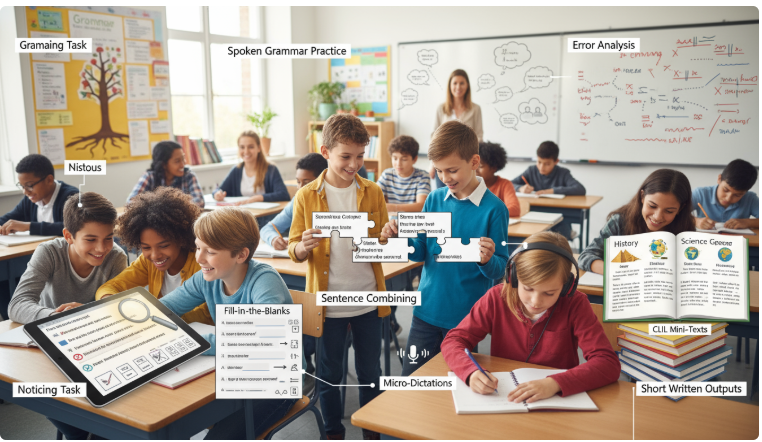
-
chapter. Assessment and eevaluation framework
Assessment within this programme is designed as an integrated, multi-format system aligned with the aims of accuracy, transfer and conscious control of grammar. Evaluation is not confined to final testing but embedded throughout the instructional cycle.
1) Formative Assessment (Throughout Instruction)
-
micro-quizzes after presentation phases
-
guided self-checking using mini-rubrics
-
peer correction of model sentences and short outputs
-
teacher feedback on transformation and rewriting tasks
-
oral monitoring during structured speaking tasks
2) Diagnostic Assessment (Block I)
-
baseline grammar screening to identify learner starting points
-
miscue classification to determine instructional priorities
-
placement of learners in differentiated task pathways if needed
3) Interim Assessment (After Blocks II and III)
-
short cumulative tasks on tenses and advanced structures
-
CLIL-based comprehension with grammar extraction
-
rewriting and reformulation tasks to check functional use
-
annotated error analysis to ensure awareness, not only correctness
4) Summative Assessment (Block IV)
-
integrated grammar task set (mixed structures)
-
short written production with accuracy rubric
-
oral response on an academic prompt with grammar-weighting
-
reflective metacognitive note on grammar decisions taken
5) Criteria and Rubrics
Evaluation prioritises:
-
Correctness (structure is formed accurately)
-
Appropriacy (chosen structure suits the meaning)
-
Transfer (used in connected text, not in isolation)
-
Awareness (can explain or justify a choice when prompted)
The assessment design rejects single-mode measurement and emphasises sustained, conscious, repeated demonstration of grammatical competence in varied contexts.
-
Principles of implementation
The implementation of this author’s programme in classroom conditions follows a set of operational principles ensuring that the conceptual intentions translate into real instructional practice:
-
Integration into Existing Curriculum, Not Replacement
The programme is designed to be layered onto the existing English syllabus without cancelling or duplicating mandatory curriculum content. Each unit can be inserted as reinforcement or extension. The programme functions as a grammar enhancement layer—never a substitute. It slots into the mandated syllabus as reinforcement modules (10–25 mins) or extension challenges, preserving textbook sequence, vocabulary themes, and national assessment objectives.
Pedagogical Rationale
-
Curriculum Fidelity: Teachers retain 80–90% of textbook time; programme inserts boost grammatical precision within existing topics (e.g., “Health,” “Travel,” “Technology”).
-
Zero Duplication: Tasks reuse textbook input texts (dialogues, readings) as raw material for noticing and transformation.
-
Administrative Ease: No need for curriculum overhaul—programme appears as supplementary worksheets or digital warm-ups.
Integration Toolkit
|
Tool |
Format |
How to Use |
Example (Grade 6, Unit: “Cities”) |
|
Curriculum Mapping Grid |
3-column table |
Completed in 15 mins during planning |
Textbook: “Dubai is a modern city…” → Insert: Passive transformation + 80-word description |
|
Slot Identifier Icons |
? ✍️ ?️ ✅ |
Placed in textbook margin |
? = Noticing in reading ✍️ = Controlled gap-fill |
|
Modular Task Cards |
A5 laminated |
3–5 tasks per unit |
Card 1: Underline passives in textbook Card 3: Write 3-sentence extension |
Three Integration Models
|
Model |
Time |
Placement |
Sample Procedure |
|
A. Warm-Up Booster |
10 mins |
Lesson start |
1. Project textbook sentence 2. 60-sec noticing race 3. Pair-check |
|
B. Mid-Task Upgrade |
15 mins |
After reading |
1. Textbook Qs → Programme transformation 2. Output feeds textbook writing |
|
C. Homework Bridge |
20 mins |
Post-lesson |
1. Textbook vocab + programme grammar 2. 80-word paragraph |
Sample Integration Sequence (Grade 7, Textbook Unit: “Inventions”)
Textbook Text (input):
“Alexander Fleming discovered penicillin in 1928. Doctors use it to treat infections…”
Programme Layer (15 mins):
-
Noticing (3 mins): Underline past passive forms in yellow.
-
Controlled (5 mins):
“Penicillin ___ (discover) in 1928. It ___ (use) to treat ___ since then.”
-
Semi-Free (7 mins):
Write 3 sentences: “An invention that ___ (change) the world…”
Assessment: Programme output = 20% of unit writing score.
Digital Integration Layer
-
Google Classroom: Upload textbook page → annotated PDF with programme tasks.
-
QR Codes in Textbook: Scan → opens Kahoot! grammar quiz based on page content.
-
Shared Drive: Folder per unit: Textbook Extract → Programme Tasks → Answer Key.
Teacher Script (Integration)
“Today we’re using page 52 of your textbook. First, read the dialogue silently. Now, underline every past simple verb in blue. Great! Let’s transform three of them into passives on your mini-whiteboards…”
-
One Programme — Multi-Grade Adaptation
Although the programme is unified for Grades 5–9, task layers and cognitive load allow differentiation: younger grades focus on controlled awareness and basic transfer, while upper grades execute extended output with the same grammar targets in more complex contexts. A single grammatical spine (e.g., passives, conditionals) runs from Grade 5 to 9. Task layering adjusts input complexity, cognitive demand, and output length—enabling one lesson plan, five delivery versions.
Pedagogical Rationale
-
Economies of Scale: One teacher prepares one core resource pack; differentiation via handout variants.
-
Vertical Coherence: Grade 5 builds foundations; Grade 9 applies in disciplinary discourse.
-
Inclusion: Same objective → different pathways (scaffolded vs. enriched).
Multi-Grade Differentiation Matrix (Target: Relative Clauses)
|
Grade |
Input Text Length |
Cognitive Load |
Task Type |
Output |
Support / Challenge |
|
5 |
50 words |
Low |
Sort + gap-fill |
3 sentences |
Picture + word bank |
|
6 |
80 words |
Low–Medium |
Combine + define/non-define |
60-word description |
Sentence starters |
|
7 |
100 words |
Medium |
Transform + extract |
80-word factual |
Checklist |
|
8 |
120 words |
Medium–High |
Rewrite + reduce |
100-word report |
Peer edit |
|
9 |
150 words |
High |
Error correction + transfer |
120-word argumentative |
Open rubric + bonus |
Sample Multi-Grade Lesson (50 mins, Same Room, Mixed or Parallel Classes)
Topic: “Famous Scientists” Grammar: Defining/Non-defining relative clauses
|
Time |
All Grades |
Grade 5 |
Grade 9 |
|
0–5 |
Core Text Reveal (projected) |
“Marie Curie, who discovered radium…” |
Same + 2 embedded clauses |
|
5–15 |
Noticing |
Sort 6 clauses (defining vs. non) |
Identify + justify punctuation |
|
15–30 |
Controlled Practice |
Gap-fill with pictures |
Transform active → passive + relative |
|
30–45 |
Output |
3-sentence poster |
120-word argumentative paragraph |
|
45–50 |
Reflection |
Traffic lights |
“My relative clause improved because…” |
Differentiation Strategies
|
Strategy |
Low-Ability (Grades 5–6) |
High-Ability (Grades 8–9) |
|
Input |
Shorter texts, bolded targets |
Longer authentic extracts |
|
Scaffolding |
Word banks, sentence frames |
Open-ended prompts |
|
Output |
3–5 sentences |
100–150 words |
|
Challenge |
Add one relative clause |
Use reduced relatives + inversion |
Mixed-Grade Peer Teaching (Optional, 10 mins)
-
Grade 8 → Grade 6: “Teach your partner one non-defining clause trick.”
-
Grade 7 → Grade 5: “Help them build a 3-sentence scientist profile.”
Outcome: Leadership + revision.
Assessment Alignment (CEFR & National Standards)
|
Grade |
CEFR Target |
Programme Output |
Textbook Alignment |
|
5 |
A1–A2 |
3 accurate sentences |
“Can describe people simply” |
|
7 |
B1 |
80-word coherent paragraph |
“Can write factual texts” |
|
9 |
B2 |
120-word argument |
“Can write clear, detailed text” |
Portfolio Entry: One output per structure → tracked in student grammar passport.
Digital Adaptation Layer
-
Google Docs Template:
-
Grade 5: Locked text + dropdown gaps
-
Grade 9: Comment mode + revision history
-
-
Adaptive Quiz (Quizizz):
-
Same 10 items → difficulty auto-adjusts per student response.
-
Teacher Script (Multi-Grade)
“Everyone, look at the screen. Grade 5 and 6, you’ll work with the short text and pictures. Grade 7, 8, and 9, you have the longer version with extra challenges. Same grammar—relative clauses—but different tasks. Let’s start with underlining…”
-
Short Structured Cycles per Lesson
Each instructional hour maintains a predictable
cycle:
→ Activation / Noticing
→ Explicit focus / Guided rule articulation
→ Controlled transformation
→ Semi-free application
→ Micro-feedback / Reflection
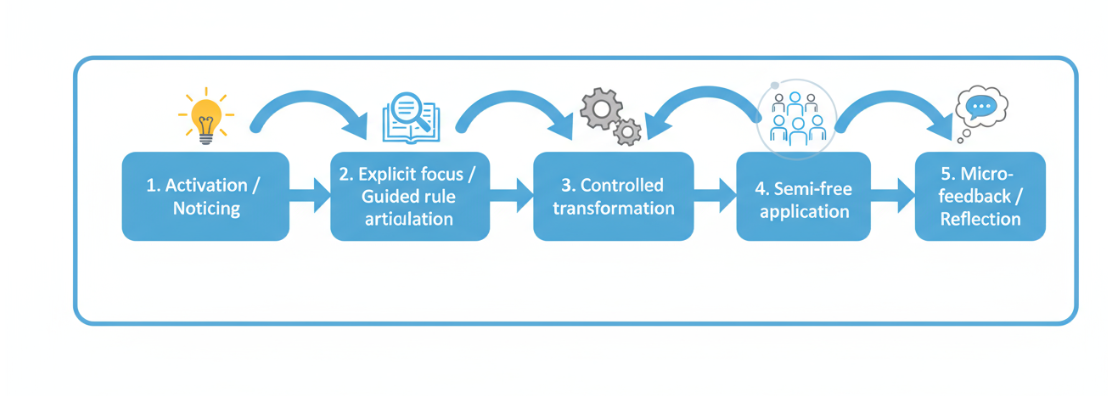
-
CLIL in Micro-Doses, not Full Immersion
Subject content appears as short authentic or adapted inserts, not as full subject lessons, preserving grammar as the primary learning objective.
Classroom Procedure (15 mins)
-
Silent Read (1 min): Project text + visual.
-
Extraction (5 mins):
-
Underline targets in green.
-
Label on visual (e.g., “chlorophyll → is located”).
-
-
Transfer (7 mins):
-
Grade 6: 3-sentence summary.
-
Grade 9: Rewrite in active voice → discuss meaning shift.
-
-
Exit Ticket (2 mins): “One fact + one grammar example.”
Teacher Script
“This 70-word text is from a real science site. Your job isn’t to memorize photosynthesis—it’s to hunt passives. Ready? Underline every is/are + -ed in green. Go!”
Digital CLIL Layer
-
Padlet Wall: Post micro-text → students drag grammar tags.
-
Genially Interactive: Clickable diagram → pop-up sentences.
-
Teacher as Mediator and Evaluator of Awareness
Purpose: Shift teacher role from rule‑giver to facilitator of noticing, reasoning and metalinguistic reflection
Teacher moves (actionable)
-
Elicit before explaining: ask students to produce and compare examples ("What do you notice? Why did you choose that form?").
-
Use guided discovery tasks: present contrasting sentences, ask students to label differences and hypothesize rules.
-
Probe reasoning: ask “What made you choose the past simple here instead of present perfect?”
-
Scaffold meta‑language: provide short prompts and sentence frames for reflection (see Templates).
-
Provide focused feedback: use brief error codes (e.g., G = grammar, W = word choice, T = tense) and a short written comment asking a reflective question (e.g., “Why G here?”).
-
Teach self‑assessment: quick reflection checklists and “two stars + one wish” (2 strengths + 1 target).
Formative checks
-
Mini whiteboard diagnostic: show 3 sentences, students write correction and a one‑line reason.
-
Exit slip: “One thing I noticed about X; one rule I would state.”
Classroom management tips
-
Use pair think time (60–90s) before whole class answers.
-
Rotate tasks between teacher‑led, peer mediating, and independent reflection to maintain engagement.
Typical pitfalls & quick checks
-
Pitfall: teacher rescues too early — wait for peer attempts. Quick check: set a 90s timer for peer discussion.
-
Pitfall: students memorize rules without reasoning — require a “why” statement for each rule.
-
Productive Drift from Accuracy to Function
The lesson always begins in accuracy mode and gradually transitions to communicative use; never the opposite (free-talk first, correction later). Principle
Start in accuracy mode (form, controlled practice), gradually drift to functional/communicative use (fluency, meaning). Never begin with free production then correct forms afterward.
Typical staged lesson (50–60 min)
-
Lead‑in / Context (5 min): brief contextual prompt that activates meaning.
-
Presentation / Noticing (8–10 min): contrasting examples, guided discovery, teacher mediates.
-
Controlled practice (10–12 min): gap‑fills, sentence transformations—focus on accurate production.
-
Guided production (8–10 min): pair role plays with restricted options, teacher monitors and gives corrective prompts.
-
Communicative task (10–12 min): open task where meaning is primary (dialogues, problem solving), teacher adopts facilitator role and delays corrective focus until task ends.
-
Focused feedback + reflection (5–8 min): selective error correction, recycling of target language, short meta‑discussion.
Monitoring and feedback strategy
-
During communicative phase: use selective notation (codes), note recurring errors for whole‑class feedback.
-
After communicative task: conduct targeted micro‑teaching—replay 2 student examples, highlight accurate use and one recurring error, ask class to suggest fixes.
Example (target: present perfect for experiences)
-
Presentation: timeline and examples; students infer use for life experience vs past simple.
-
Controlled practice: complete sentences with present perfect.
-
Guided production: pair interview using scripted prompts (“Have you ever…?”).
-
Communicative task: design a top‑5 experiences list for a fictional character and justify choices using present perfect.
-
Sustainability and Revision
Key forms reappear repeatedly, not once. The programme intentionally returns to structures in later lessons to fix them in long-term memory.
Spaced recycling schedule (classroom practical)
-
Immediate: end‑of‑lesson retrieval (2–5 min quiz).
-
Short term: revisit within 48–72 hours (warm‑up activity).
-
Medium term: revisit week later with a different task (2–3 items).
-
Long term: revisit after 3–6 weeks and again at unit exam; include blended retrieval across grammar points (interleaving).
-
Activities for recycling
-
Quick retrieval cards: 1 sentence to correct + 1 explanation line.
-
Cumulative quizzes: 5 items mixing several past targets.
-
Project checkpoints: students submit drafts where targeted structures must appear; teacher marks use and provides feedback.
-
Peer‑teaching: small groups teach the form to another group using mini‑lessons.
-
Tools & classroom routines
-
Weekly “Language Bank” wall where target forms and exemplar sentences are pinned.
-
Short SRS flashcards for errors and example sentences (digital or paper).
-
Homework: low‑stakes retrieval tasks (2 sentences, 1 reason).
-
Pitfalls & quick checks
-
Pitfall: recycling looks identical → students do rote repetition. Fix: vary modality (speaking/writing/reading/listening).
-
Pitfall: no record of recycled instances. Fix: maintain simple tracker (spreadsheet or notebook) of when/how a structure was revisited.
Assessment / Rubric (mini)
Use this for guided/communicative tasks.
Criteria (3‑point scale)
Accuracy (form and correct morphology)
3: Few/no errors; structures correct and controlled.
2: Some systematic errors; meaning clear.
1: Frequent errors disrupting meaning.
Function (appropriate use for purpose)
3: Language fits register and communicative goal.
2: Generally fits but occasional mismatches.
1: Inappropriate form for task.
Classroom management & teacher notes
Use timers to protect accuracy phase from drifting prematurely.
During communicative tasks, circulate and record errors rather than interrupt.
For large classes, use peer feedback protocols (structured checklists) to distribute evaluation.
METHODOLOGICAL INFORMATIONAL PART
Chapter 5. Practical grammar for meaning-making: elective spiral course.
The "Practical Grammar for Meaning-Making: Elective Spiral Course" is designed as an elective program for intermediate English language learners (CEFR levels B1–B2) who seek to deepen their understanding of English grammar not merely as a set of rigid rules, but as a dynamic tool for effective communication and meaning construction. This course emphasizes the theme of "Structures and Rules in English," focusing on how grammatical elements interact to convey ideas in various contexts, including everyday narratives, academic writing, and Content and Language Integrated Learning (CLIL) scenarios such as science, history, and professional planning.
Adopting a spiral block structure, the course progressively builds knowledge by layering concepts: starting with input and awareness, moving to guided practice and output, incorporating reflection, and spiraling back to review and integrate previous elements in new applications. This approach ensures retention and practical application, making grammar a meaningful resource rather than an isolated skill. The course spans 34 weeks, with a blend of in-class activities, digital tools, and self-directed tasks, suitable for adult learners in ESP (English for Specific Purposes) or EAP (English for Academic Purposes) settings. By the end, participants will confidently use English structures to express complex ideas, analyze texts, and produce coherent outputs.
Teaching Methods
The course employs a variety of interactive and learner-centered methods aligned with the spiral structure:
-
Diagnostic and Guided Noticing: Initial assessments and pair/group discussions to highlight grammar in context (e.g., error-tagging in authentic texts).
-
Modeling and Rewriting: Teacher-led demonstrations followed by scaffolded exercises like sentence unscrambling, reformulation, and transformations.
-
Categorization and Comparison Tasks: Digital tools (e.g., drag-and-drop, timelines) for labeling parts of speech, contrasting tenses, and justifying choices.
-
Controlled and Semi-Free Practice: Gap-fills, narrative rewrites, scenario-based role-plays, and prompt-driven oral/written production.
-
CLIL Integration: Micro-texts from subjects like science or history for applying grammar in meaningful contexts.
-
Collaborative and Digital Activities: Peer explanations, jigsaw tasks, rotations, and tools like Google Docs, interactive quizzes, and recording apps (e.g., Flipgrid) for outputs.
-
Reflective Sessions: Self-evaluation rubrics, portfolio reviews, and metacognitive discussions to close learning loops. These methods emphasize progression from controlled to freer practice, with differentiation for varying proficiency levels (e.g., scaffolds for weaker learners, extensions for stronger ones).
Course Schedule
The course follows a 34-week spiral structure, with each week building on prior content. Sessions are assumed to be 1-2 hours weekly, with homework for output completion.
|
Week |
Content Focus |
Format of Work |
Output Form |
|
1 |
Grammar as meaning-making, baseline alignment |
Diagnostic test + guided noticing |
Baseline sheet + 150-word reflection |
|
2 |
Sentence structure and word order |
Teacher modeling + guided rewriting |
10 structured sentences in a short paragraph |
|
3 |
Parts of speech in function |
Categorization + micro-text extraction |
Color-coded paragraph + 5 functional examples |
|
4 |
Time & aspect awareness (pre-tense logic) |
Timeline comparison + reformulation |
10 contrast sentence pairs |
|
5–6 |
Present Simple vs Continuous |
Controlled gap-fill + CLIL micro-text |
150-word factual paragraph |
|
7–8 |
Past Simple vs Continuous |
Narrative input + guided rewriting |
200-word micro-story |
|
9–10 |
Present Perfect vs Past Simple |
Timeline tasks + justification |
200-word contrast composition |
|
11 |
Future forms (will/going to/present continuous) |
Scenario cards + plan writing |
150-word plan paragraph |
|
12–13 |
Modal verbs (obligation/ability/deduction) |
Graded sentence building + rule co-construction |
Rule explanation note + 10 original sentences |
|
14–15 |
Passive voice in academic register |
Subject-to-object shift + CLIL report |
200-word passive rewrite |
|
16–17 |
Conditionals (Zero–Second) |
If-clause jigsaw + micro-dialogues |
3 conditional micro-dialogues |
|
18–19 |
Reported speech (statements/questions) |
Direct-to-indirect conversion + CLIL news |
150-word reported news rewrite |
|
20–21 |
Articles and quantifiers |
Precision editing + CLIL data description |
Error-coded sheet + 100-word quantified paragraph |
|
22–23 |
Pronouns & comparatives |
Substitution chains + sentence combining |
150-word comparison paragraph |
|
24–26 |
Integrated contrast practice |
Mixed transformation stations |
250-word integrated text rewrite |
|
27–29 |
CLIL-infused application |
Subject micro-text analysis + skeleton planning |
Annotated essay skeleton |
|
30–31 |
Semi-free production (oral + written) |
Prompt-based talk + Q&A |
Recorded oral defense + 200-word written version |
|
32–33 |
Summative grammar task set |
Integrated assessment (written + oral) |
Portfolio submission + 3-min oral justification |
|
34 |
Reflective session & metacognitive report |
Portfolio review + self-evaluation |
300-word reflection sheet |
Lesson Plan
Title: Sentence Structure and Word Order
Course: Practical Grammar for Meaning-Making (Elective Spiral Block)
Week: 2 (60–90 minutes)
Level: B1–B2 (CEFR)
Spiral Links: Revisits Week 1 baseline errors (word order, fragments); previews Week 3 POS functions
CLIL Thread: Daily routines & urban life (EAP/ESP alignment)
Learning Objectives
By the end of the lesson, students will be able to:
-
Identify the SVOCA (Subject–Verb–Object–Complement–Adverbial) pattern in authentic sentences.
-
Reconstruct jumbled sentences into correct word order using SVOCA.
-
Produce a coherent 100-word paragraph with 8+ accurate SVOCA sentences.
-
Use AI tools to generate, diagnose, and refine sentence structures.
Materials & Tools
|
Type |
Tool |
Purpose |
|
Core |
Interactive Whiteboard (IWB) / Google Slides |
Modeling SVOCA |
|
AI |
ChatGPT / Grok (via prompt cards) |
Generate jumbled sentences & feedback |
|
AI |
Grammarly / LanguageTool |
Real-time error tagging |
|
AI |
QuillBot Paraphraser |
Rewriting practice |
|
Digital |
Padlet |
Collaborative sentence wall |
|
Digital |
Mentimeter |
Live polling & unscrambling |
|
Handout |
SVOCA color-coded cards (print/digital) |
Tactile manipulation |
Lesson Phases (90-minute version)
1. Warm-Up & Diagnostic Review (8 min)
Activity: AI-Powered Error Hunt
-
Input: Project 3 error-seeded sentences from Week 1 baseline (e.g., “Every morning coffee I drink quickly.”)
-
AI Task: Students paste into Grok/ChatGPT with prompt:
-
“Correct this sentence and explain the word order error using SVOCA labels.”
-
Output: Students screenshot AI response → share on Padlet.
-
Teacher Role: Highlight recurring issues (e.g., adverb placement).
2. Explicit Modeling: SVOCA Framework (12 min)
Activity: AI + Teacher Co-Modeling
-
Teacher displays model sentence:
“Urban planners carefully design sustainable cities in coastal areas every year.” → Color-code: S (blue) | V (red) | O (green) | C (yellow) | A (purple)
-
AI Task: Use Grok to generate 3 similar sentences:
Prompt: “Generate 3 academic sentences about urban life using SVOCA structure. Label each part.”
-
Students drag-and-drop AI-generated parts on Google Slides to verify order.
3. Guided Practice: AI Jumble Challenge (20 min)
Activity: AI-Generated Sentence Unscramble
-
Step 1: AI creates jumbled sentences:
-
Prompt: “Create 10 jumbled sentences about daily routines (B1 level). Include 2 adverbs, 1 object, 1 adverbial of place/time. Provide answer key.”
-
Step 2: Students work in pairs on Mentimeter (live unscramble):
-
Vote on correct order → instant class heatmap.
-
-
Step 3: Grammarly check: Paste final version → highlight residual errors.
-
Differentiation:
-
Weaker: Pre-highlighted chunks (S / V / O).
-
Stronger: Add a second clause with conjunction.
-
4. Controlled Production: AI Sentence Builder (15 min)
Activity: QuillBot Rewriting Chain
-
Students write 1 simple sentence about their routine:
“I study English.”
-
AI Task: Paste into QuillBot → choose “Formal” mode → expand with adverbials:
“Every evening, I diligently study English grammar at the library.”
-
Repeat 3x → collect 4 versions → select best SVOCA fit.
-
Post final sentence to Padlet “Sentence Wall”.
5. Semi-Free Production: Paragraph Assembly (20 min)
Activity: AI-Scaffolded Paragraph
-
Prompt: “Write a 100-word paragraph about a sustainable city routine using 8+ SVOCA sentences.”
-
AI Support:
-
Grok generates 5 starter sentences → students select 3.
-
LanguageTool checks draft → students fix 3 flagged issues.
-
-
Output: Submit to Google Docs (teacher comments enabled).
-
Peer Feedback: 1-star, 1-wish via Padlet.
6. Reflection & Metacognition (10 min)
Activity: AI Reflection Buddy
-
Prompt for Grok:
-
“Student wrote: [paste paragraph]. Highlight 2 strengths and 1 area for improvement in word order. Suggest 1 rewrite.”
-
Students compare AI feedback with self-assessment (rubric).
-
Exit Ticket (Mentimeter):
AI Integration Summary
|
AI Tool |
Role |
Prompt Example |
|
Grok/ChatGPT |
Content generation, feedback |
“Generate 5 jumbled SVOCA sentences about urban planning.” |
|
Grammarly |
Error diagnosis |
Real-time word order flags |
|
QuillBot |
Expansion & style |
“Make this sentence more formal with adverbials.” |
|
LanguageTool |
Final proofreading |
Batch check for fragments/run-ons |
Assessment & Evaluation
|
Task |
Criteria (Rubric) |
Weight |
|
Unscrambled Sentences (Mentimeter) |
8/10 correct SVOCA order |
Formative |
|
Paragraph (Google Docs) |
• 8+ accurate SVOCA sentences (40%) • Logical flow (30%) • AI tool use evidence (30%) |
5% (portfolio) |
|
AI Reflection Screenshot |
Depth of comparison with self-feedback |
Formative |
Homework (Spiral Preview)
-
AI Task: Use Grok to generate 5 sentences about your city. Label SVOCA.
-
Record a 30-second Flipgrid explanation of one sentence’s word order.
-
Bring 1 authentic text (news/article) with 3 highlighted SVOCA examples → Week 3 POS link.
Differentiation Table
|
Level |
Support |
Challenge |
|
B1 (Weaker) |
Pre-cut SVOCA cards, cloze templates |
Add 1 adverb |
|
B2 (Stronger) |
No scaffolds |
Combine 2 sentences with relative clause |
Lesson Plan
Title: Present Perfect vs Past Simple
Course: Practical Grammar for Meaning-Making
Duration: 45 minutes (condensed single session) Level: B1–B2 (CEFR)
Spiral Links:
-
Backward: Weeks 7–8 (Past narrative)
-
Forward: Week 11 (Future evidence)
-
CLIL Thread: Personal life events (quick biography)
Learning Objectives (45-min focus)
-
Map 5 life events on a timeline to choose PP or PS.
-
Write 6 contrast sentences with justification.
-
Produce a 100-word mini-composition with 5+ accurate uses.
-
Use AI to generate, check, and justify tense choices.
Materials (All Digital – 1 Link)
|
Tool |
Purpose |
|
Grok / ChatGPT |
Generate timelines & error texts |
|
Grammarly |
Instant tense check |
|
Canva AI |
30-sec timeline image |
|
Google Docs |
Shared writing & comments |
|
Mentimeter |
Live polling & exit |
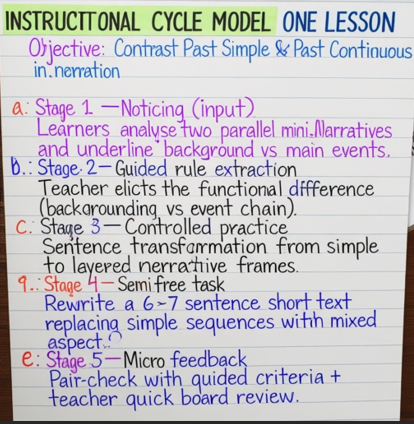
SAMPLE TASK TYPES (READY FOR DIRECT USE)
A. Noticing /
Identification
Underline only the verbs that show background rather than main
action.
B. Transformation
Rewrite: “He cooked dinner.
The phone rang.” → “He was cooking dinner when the phone
rang.”
C. Justification
Prompt
Explain why was cooking is more appropriate than
cooked in that context.
D. CLIL Micro-Infusion
Task
Short history text with timeline — learners convert key events to
Past Simple vs Past Continuous.
E. Productive
Output
Write 5–7 sentences narrating an accident scene using both forms
correctly.
24. ASSESSMENT SAMPLE BLOCK (CONTRAST ASSESSMENT)
Part A —
Controlled
Choose correct form: When he ___ (walk) home, he
___ (see) a fire.
Part B —
Semi-controlled
Rewrite the paragraph adding background
actions.
Part C —
Applied
Describe a real or imagined incident using both
forms.
Part D —
Awareness
One sentence justification of a tense
decision.
Block II — Hour-by-Hour Micro-Structure
|
Hour |
Focus |
Core activity |
Output |
|
1 |
Present Simple vs Continuous |
Noticing in paired examples |
Underline & explain |
|
2 |
Present S vs C |
Guided transformation |
Mini-dialogue rewrite |
|
3 |
Past Simple vs Continuous |
Background vs main events |
Narrative reformulation |
|
4 |
Past S vs C |
CLIL micro-text (history clip) |
Annotated timeline |
|
5 |
Present Perfect vs Past Simple |
Relevance vs finished past |
Contrast sentences |
|
6 |
P. Perfect vs Past Simple |
Diagnostic check |
Short contrast paragraph |
|
7 |
Future forms (will / going to / present) |
Scenario-based choice |
Plan paragraph |
|
8 |
Integrated tense contrast |
Mixed extraction |
Rewrite integrated text |
|
9 |
Pre-assessment |
Controlled + semi-free |
Written micro-output |
|
10 |
Reflection & correction |
Error analysis |
Justification note |
Main Task Frames for Block II
TASK TYPE A —
Noticing
Circle which sentence shows temporary action and which shows
general fact.
TASK TYPE B —
Transformation
Rewrite “I clean my room
now” →
“I am
cleaning my room now.”
TASK TYPE C — CLIL
infusion
History fact: “In 1914 the war
began.” — Identify tense +
reason.
TASK TYPE D —
Semi-free
Write 5–6 lines about your weekend mixing Past Simple &
Continuous.
TASK TYPE E —
Justification
Write: “I used Past Continuous here
because…”
Assessment in Block II
Formative: every lesson via
contrast tasks
Intermediate: at Hour 6 & 9
Criteria: correctness, appropriacy, justification,
transfer
Rubric (core tenses):
|
Criterion |
High |
Medium |
Low |
|
Choice accuracy |
consistent |
occasional errors |
frequent errors |
|
Structural form |
correct forms |
1–2 errors |
mostly incorrect |
|
Transfer to text |
used in short text |
used partly |
not used |
|
Awareness |
clear reason |
vague reason |
no reason |
A — PRESENT SIMPLE vs PRESENT CONTINUOUS
Task A1 —
Classify
Mark G
= general fact
/ T
= temporary
now
-
He works at a bank.
-
He is working late tonight.
-
Water boils at 100°C.
-
We are having lunch right now.
Task A2 —
Transform
Rewrite with correct form:
-
Look! The baby (sleep).
-
My father (drive) to work every day.
-
I usually (not watch) TV in the morning.
-
Be quiet! I (try) to study.
Task A3 — Why?
(Awareness)
Complete: “I used Present Continuous in sentence 1
because…”
B — PAST SIMPLE vs PAST CONTINUOUS
Task B1 — Choose
-
I (walked / was walking) home when I saw him.
-
They (watched / were watching) TV all evening.
-
We (played / were playing) football when it started to rain.
Task B2 —
Rewrite
a) He cooked dinner. The
phone rang. → While he was cooking, the
phone rang.
Task B3 —
Micro-narrative
Write 5–6 lines describing an accident scene using both
forms.
C — PRESENT PERFECT vs PAST SIMPLE
Task C1 — Decide
why
Mark R
= relevant now
/ F
= finished
past
-
I have lost my keys.
-
I lost my keys yesterday.
-
She has visited Paris three times.
-
She visited Paris last year.
Task C2 — Gap-fill
-
I ______ (never try) sushi before.
-
We ______ (finish) the project yesterday.
-
He ______ (just arrive).
-
They ______ (not see) this film before.
Task C3 —
Awareness
Write: “I used Present
Perfect in sentence 1
because…”
D — FUTURE FORMS (will / going to / present)
Task D1 — Match to
meaning
A — plan decided before / B — decision now / C — scheduled
future
-
I’m going to study medicine.
-
The lesson starts at 8:00.
-
I’ll help you with that.
Task D2 —
Scenario
You see dark clouds: write 2 sentences with
going
to
E — INTEGRATED MIXED PRACTICE (TENSE CONTRAST)
Task E1 —
Extract
Underline all verbs in the text and label: PS (Present Simple), PC
(Present Continuous), PaS (Past Simple), PrP (Present Perfect), F
(Future).
Task E2 —
Rewrite
Change the text to another time frame (e.g. from past to
present).
Task E3 — Short
production
Write one paragraph (6–8 lines) about a real situation mixing at
least 3 tense types correctly.
Task E4 —
Justification
Write one sentence:
“I chose the tense for sentence 3
because…”
BLOCK III — UNIFIED LESSON PLAN (Advanced Grammar Block, 12–14 hours)
Subject:
English
Grade:
5–9
Block
topic: Advanced Grammatical Structures for Academic and Functional
Use
Duration:
12–14
hours
Learning
objectives:
Learners will be able to
correctly form and apply modal verbs, passive voice, conditional
sentences (0–2), reported speech, articles, quantifiers, and
comparative structures in controlled and semi-free tasks, and
transfer them into short academic texts.
Assessment criteria:
-
uses target structures in controlled rewriting tasks
-
transforms sentences between active/passive or direct/reported forms correctly
-
selects correct modal meaning (ability / duty / deduction)
-
applies articles and quantifiers with accuracy in context
-
integrates structures into short writing or spoken response
Methodology: guided discovery, structured drills, rewriting, conditional scenarios, CLIL snippets, analytic reflection
Resources: transformation sheets, mini-texts (history/science), error-coded texts, timeline and scenario cards
BLOCK III — HOUR-BY-HOUR STRUCTURE
|
Hour |
Focus |
Core activity |
Output |
|
1 |
Modal verbs (can / must / may) |
function-matching tasks |
micro-dialogues |
|
2 |
Modals of deduction (must / might / can't) |
evidence-based choice |
justification line |
|
3 |
Passive voice (present/past) |
active → passive rewrite |
academic sentence |
|
4 |
Passive in CLIL text |
extract & convert |
fact rewrite |
|
5 |
Conditionals Zero–First |
cause–result frames |
rule-based sentences |
|
6 |
Conditionals Second |
hypothetical scenarios |
written scenarios |
|
7 |
Reported speech (statements) |
direct → reported |
conversion sheet |
|
8 |
Reported speech (questions) |
wh/yes-no conversion |
Q→RS practice |
|
9 |
Articles & quantifiers |
precision tasks |
correction sheet |
|
10 |
Comparative forms |
sentence combining |
contrast writing |
|
11–12 |
Integrated advanced mix |
multi-structure tasks |
short academic text |
|
13–14 |
Pre-assessment & correction |
mixed grammar test |
reflection notes |
BLOCK III — SAMPLE TASK FRAMES
1) Modal deduction
reasoning
Text: “The lights are on but no one answers.”
Write: He must … / He might
… / He can’t …
2) Passive
voice
Rewrite: Scientists
discovered a new element. → A new element was
discovered…
3) Conditional
scenario
“If water freezes, …” (Zero)
“If I study, …” (First)
“If I had wings, …” (Second)
4) Reported
speech
Direct: “I am tired,” she said. → She said (that) she was
tired.
5) Articles &
quantifiers
Correct: I bought ___ apple
and ___ milk. There were ___ people but not ___
chairs.
6) Comparative
writing
Write 4 sentences comparing cities / climates / systems using -er /
more / less.
BLOCK III — RUBRIC (Advanced)
|
Criterion |
High |
Medium |
Low |
|
Structural accuracy |
correct in most items |
some errors |
many errors |
|
Transformation |
consistent & correct |
partly correct |
not controlled |
|
Functional choice |
justified correctly |
vague justification |
no reasoning |
|
Transfer to text |
integrated clearly |
partially used |
not used |
BLOCK III — TASK BANK (Ready)
MODALS
Rewrite with correct meaning:
-
He ___ (must/might/can’t) be at home — the lights are on.
-
You ___ wear a helmet — it’s the rule.
-
I ___ speak German when I was little.
PASSIVE
Make passive:
-
People grow rice in Asia.
-
They built the bridge in 2010.
-
Someone stole my phone.
BLOCK IV — INTEGRATION & ASSESSMENT BLOCK (4–5 hours)
Purpose of the
block:
To transfer previously learned grammatical structures into
integrated, meaningful, semi-authentic tasks that simulate academic
and communicative situations.
Learning
outcomes:
Learners will demonstrate grammar control
in:
-
integrated CLIL mini-texts
-
short argumentative and factual writing
-
structured oral responses
-
final cumulative assessment
BLOCK IV — HOUR STRUCTURE
|
Hour |
Focus |
Activity type |
Output |
|
1 |
Grammar in CLIL micro-reading |
Extract & annotate |
labelled text |
|
2 |
Integrated rewriting |
Correct & reformulate |
improved version |
|
3 |
Written production |
Short factual/argument text |
8–10 lines |
|
4 |
Oral structured response |
Prompt-based mini-speech |
monitored speech |
|
5 |
Summative assessment |
Mixed test + reflection |
test + meta-note |
Summative Assessment Template (Integrated)
PART A —
Controlled
Choose correct forms (tenses / modals / passives / articles /
conditionals) — 10 items
PART B — Transformation
Rewrite:
-
active → passive
-
direct → reported
-
real → hypothetical conditional
PART C — Short
Writing
Write 8–10 lines on one topic (e.g. “Online learning”, “City vs
village life”, “Science and risk”) using at least 4 grammar
targets.
PART D —
Awareness
Write 2 sentences explaining 2 grammar choices you
made.
Summative Rubric
|
Criterion |
High |
Medium |
Low |
|
Accuracy |
mostly correct |
noticeable errors |
frequent errors |
|
Function |
forms match meaning |
partly appropriate |
inappropriate |
|
Integration |
used in connected text |
partly used |
isolated or absent |
|
Awareness |
clear reason |
unclear |
no justification |
CLIL MICRO-TEXTS FOR BLOCK IV
Science text (Passive +
Tenses)
The vaccine was
developed in 2020. It is produced in several countries and it is
used to prevent infection.
Tasks: underline passive verbs, rewrite in active, explain why passive is used.
History text (Past +
Reported speech)
In 1945, the war
ended. Leaders said peace must be kept.
Tasks: change to reported speech, add causal conditional (“If peace is broken…”)
Geography fact (Articles +
Quantifiers)
Asia is the largest
continent and it has many climate zones.
Tasks: remove articles → rewrite correctly.
6 chapter. Practical applications in the classroom
This section outlines practical activities and instructions for implementing the English Structures and Rules elective course, alongside assessment tasks to evaluate student learning. The activities are designed to foster active engagement, reinforce grammar through meaningful contexts (including CLIL), and promote metacognitive awareness. Each activity aligns with the spiral block structure, ensuring that previously learned structures are revisited and applied in new contexts. Assessment tasks are varied to measure both productive (writing, speaking) and receptive (analysis, reflection) skills, with clear evaluation criteria.
Practical Activities and Instructions
The activities below are structured to progress from teacher-led input to guided practice, semi-free production, and reflective tasks. They incorporate collaborative, digital, and CLIL-based approaches, with differentiation for varying proficiency levels (B1–B2 CEFR). Instructions are provided for each activity type, with examples tied to specific weeks from the course plan.
-
Diagnostic and Guided Noticing (Week 1) Activity: Baseline Grammar Diagnostic and Pair Noticing Instructions:
-
Administer a 20-minute diagnostic test (e.g., 10 sentences with common errors in word order, tense, or articles). Students tag errors individually, then discuss in pairs to identify patterns (e.g., misuse of present perfect vs. past simple).
-
Provide an authentic text (e.g., a short science article on ecosystems). In groups, students highlight grammar structures (e.g., present simple for facts) and discuss their function.
-
Differentiation: Weaker learners use a provided glossary; stronger learners justify choices in writing.
-
Tools: Google Docs for tagging, Jamboard for group annotations.
-
Example: Students tag “The sun rise every day” as incorrect, correct to “rises,” and explain the rule (Week 1 spiral link).
-
Modeling and Rewriting (Week 2) Activity: Sentence Structure Rewriting Instructions:
-
Teacher models SVOCA (Subject-Verb-Object-Complement-Adverbial) structure on an interactive whiteboard using a sentence like “Scientists carefully study ecosystems annually.”
-
Students unscramble 5 jumbled sentences (e.g., “every day / exercises / she / in the park”) and rewrite them in a 100-word paragraph about a routine.
-
Differentiation: Provide sentence frames for weaker learners; stronger learners create complex sentences with conjunctions.
-
Tools: Padlet for sharing rewrites, Quizlet for SVOCA practice.
-
Example: Output is a paragraph like “She exercises in the park every day, improving her health” (Week 2 spiral link to Week 1 word order errors).
-
Categorization and Comparison Tasks (Week 3) Activity: Parts of Speech Labeling and Tense Comparison Instructions:
-
Students use a digital drag-and-drop tool (e.g., Nearpod) to categorize words in a CLIL text (e.g., a history excerpt on the Industrial Revolution) into nouns, verbs, adjectives, etc.
-
In pairs, students compare two sentences (e.g., “Factories polluted rivers” vs. “Factories were polluting rivers”) and explain aspect differences.
-
Differentiation: Weaker learners label with a word bank; stronger learners write new sentences using identified POS.
-
Tools: Google Slides for drag-and-drop, Edpuzzle for video-based labeling.
-
Example: Students label “rapidly” as an adverb modifying “grew” and write a sentence using it (Week 3 spiral link to Week 2 sentence frames).
-
Controlled and Semi-Free Practice (Weeks 5–6, 7–8) Activity: Gap-Fill and Narrative Rewrite Instructions:
-
For Present Simple vs. Continuous (Weeks 5–6), students complete a gap-fill quiz (e.g., “The earth ___ (rotate) daily, but it ___ (move) closer to the sun this month”). Then, they write a 150-word CLIL paragraph describing a process (e.g., photosynthesis).
-
For Past Simple vs. Continuous (Weeks 7–8), students listen to an audio story (e.g., a historical event) and rewrite it, adding interruptions (e.g., “While workers were building the railway, a storm started”).
-
Differentiation: Weaker learners use cloze templates; stronger learners add adverbs or modals.
-
Tools: Kahoot for gap-fills, Voicethread for audio narration.
-
Example: Output is a paragraph like “While plants absorb sunlight, they produce oxygen” (spiral link to Week 4 aspect awareness).
-
CLIL Integration (Weeks 14–15, 27–29) Activity: Passive Voice Report and Annotated Essay Skeleton Instructions:
-
For Passive Voice (Weeks 14–15), students transform active sentences (e.g., “Scientists conducted experiments”) into passive (e.g., “Experiments were conducted by scientists”) in a CLIL context (e.g., lab report). They rewrite a 200-word report.
-
For CLIL Application (Weeks 27–29), students analyze a science/history micro-text (e.g., climate change impacts) and create an essay skeleton, labeling grammar structures (e.g., passives, conditionals).
-
Differentiation: Weaker learners use a provided skeleton; stronger learners integrate additional structures (e.g., perfect tenses).
-
Tools: Google Docs for collaborative editing, Canva for visual essay skeletons.
-
Example: Output is a report like “The data was analyzed using software” (spiral link to Week 12–13 modals).
-
Collaborative and Digital Activities (Weeks 16–17, 30–31) Activity: Conditional Dialogues and Oral Defence
Instructions:
-
For Conditionals (Weeks 16–17), students complete a jigsaw task, matching if-clauses to results (e.g., “If water is heated, it boils”). In pairs, they create micro-dialogues (e.g., discussing recycling benefits).
-
For Semi-Free Production (Weeks 30–31), students prepare a 2-minute TED-style talk on a CLIL topic (e.g., renewable energy) and defend their grammar choices in a Q&A.
-
Differentiation: Weaker learners use scripted prompts; stronger learners improvise Q&A responses.
-
Tools: Flipgrid for recording dialogues, Mentimeter for peer feedback.
-
Example: Dialogue output: “If we recycle, waste decreases” (spiral link to Week 14–15 passive reports).
-
Reflective Sessions (Week 34) Activity: Portfolio Review and Metacognitive Report Instructions:
-
Students participate in a gallery walk, reviewing peers’ portfolios (Weeks 1–33 outputs). They complete a self-evaluation rubric scoring their progress in accuracy, fluency, and complexity.
-
Students write a 300-word metacognitive report, graphing their progress (e.g., error reduction in tenses) and setting future goals.
-
Differentiation: Weaker learners use a guided reflection template; stronger learners analyze error patterns quantitatively.
-
Tools: Google Forms for rubrics, Excel for progress graphs.
-
Example: Report includes “I reduced article errors by 50% since Week 1” (spiral link to Week 1 baseline).
Assessment Tasks for Evaluating Student Learning
Assessment tasks are designed to measure students’ ability to apply grammar in context, justify choices, and reflect on progress. They align with the course’s portfolio-based approach, summative tasks, and metacognitive focus. Each task includes clear evaluation criteria.
-
Baseline Sheet and Reflection (Week 1) Task: Students submit a diagnostic error-tagged sheet and a 150-word reflection on their grammar strengths/weaknesses.
Criteria:
-
Accuracy (40%): Correct identification of 8+ errors in the diagnostic.
-
Analysis (30%): Clear explanation of error patterns (e.g., “I confuse past simple with present perfect”).
-
Reflection (30%): Specific goals (e.g., “I will focus on tense consistency”).
-
Weight: 5% of final grade.
-
Structured Sentence Output (Week 2) Task: Students submit a 100-word paragraph with 10 SVOCA-structured sentences
Criteria:
-
Accuracy (50%): Correct SVOCA order in 8+ sentences.
-
Cohesion (30%): Logical flow using connectors (e.g., “and,” “because”).
-
Clarity (20%): Clear meaning in context.
-
Weight: 5% of final grade.
-
CLIL Micro-Text Paragraph (Weeks 5–6) Task: Students write a 150-word factual paragraph (e.g., water cycle) using Present Simple/Continuous.
Criteria:
-
Grammar Use (40%): 8+ correct uses of target tenses.
-
Content Accuracy (30%): Factually correct CLIL content.
-
Structure (30%): Clear paragraph organization (topic sentence, details, conclusion).
-
Weight: 10% of final grade.
-
Micro-Story Output (Weeks 7–8) Task: Students submit a 200-word narrative with 6+ Past Simple/Continuous structures.
Criteria:
-
Grammar Use (40%): Accurate use of target tenses in narrative context.
-
Creativity (30%): Engaging story with logical interruptions.
-
Cohesion (30%): Use of time markers (e.g., “while,” “when”).
-
Weight: 10% of final grade.
-
Contrast Composition (Weeks 9–10) Task: Students write a 200-word composition contrasting Present Perfect and Past Simple (e.g., life experiences vs. specific events).
Criteria:
-
Contrast Accuracy (40%): Clear distinction between tenses in 6+ examples.
-
Justification (30%): Explanation of tense choices in footnotes or peer discussion.
-
Coherence (30%): Logical flow with time expressions.
-
Weight: 10% of final grade.
-
Passive Report Rewrite (Weeks 14–15) Task: Students rewrite a 200-word CLIL report (e.g., experiment procedure) in passive voice.
Criteria:
-
Grammar Accuracy (40%): 8+ correct passive constructions.
-
Academic Style (30%): Formal tone and vocabulary.
-
Clarity (30%): Clear description of process.
-
Weight: 10% of final grade.
-
Conditional Micro-Dialogues (Weeks 16–17) Task: Students submit three 50-word dialogues using Zero–Second Conditionals. Criteria:
-
Grammar Use (40%): Accurate conditional structures in each dialogue.
-
Context (30%): Relevant CLIL or daily life scenarios.
-
Interaction (30%): Natural dialogue flow.
-
Weight: 10% of final grade.
-
Oral Defence and Written Version (Weeks 30–31) Task: Students deliver a 2-minute recorded talk and submit a 200-word written version on a CLIL topic. Criteria:
-
Grammar Accuracy (40%): Use of 10+ structures from prior weeks.
-
Fluency/Clarity (30%): Clear pronunciation (oral) and organization (written).
-
Content (30%): Relevant CLIL integration.
-
Weight: 15% of final grade.
-
Summative Grammar Task Set (Weeks 32–33) Task: Students submit a portfolio of revised outputs and complete a 3-minute oral justification of grammar choices. Criteria:
-
Portfolio Quality (40%): Evidence of progress (error reduction, complexity).
-
Oral Justification (30%): Clear explanation of 5+ grammar choices.
-
Integration (30%): Use of multiple structures in context.
-
Weight: 25% of final grade.
-
Metacognitive Report (Week 34) Task: Students submit a 300-word reflection with a progress graph. Criteria:
-
Reflection Depth (40%): Specific examples of progress (e.g., error reduction).
-
Goal Setting (30%): Clear, realistic future goals.
-
Visual Analysis (30%): Accurate progress graph with annotations.
-
Weight: 15% of final grade.
Course Schedule Integration
The activities and assessments are embedded in the 34-week spiral block structure (as previously provided). Key milestones:
-
Weeks 1–4: Diagnostic and foundational skills (sentence structure, POS, aspect).
-
Weeks 5–11: Tense contrasts (Present, Past, Future) with CLIL integration.
-
Weeks 12–19: Advanced structures (modals, passives, conditionals, reported speech).
-
Weeks 20–26: Precision and integration (articles, pronouns, mixed transformations).
-
Weeks 27–33: CLIL application and summative production.
-
Week 34: Reflection and metacognitive closure.
Notes for Implementation
-
Differentiation: Scaffolds (e.g., word banks, templates) support weaker learners; extensions (e.g., complex structures, improvisation) challenge stronger ones.
-
Digital Tools: Use Google Workspace, Flipgrid, and Kahoot for engagement and feedback.
-
CLIL Contexts: Rotate science (e.g., ecosystems), history (e.g., Industrial Revolution), and professional topics (e.g., career planning).
-
Portfolio: Students maintain a digital portfolio (Google Drive/SharePoint) for all outputs, reviewed in Weeks 24–26 and 34.
-
Feedback: Weekly teacher feedback (via rubrics) and peer feedback (via digital tools) ensure continuous improvement.
This framework ensures that students actively apply grammar in meaningful, interdisciplinary contexts while developing self-awareness and fluency. The spiral structure reinforces learning through iterative practice, and assessments provide a comprehensive evaluation of progress.
CONCLUSION
In conclusion, the study of grammatical structures and rules in English serves as the foundational backbone of effective communication, enabling learners to construct meaning with precision, clarity, and nuance. Throughout this elective course, we have explored a spiral block structure that progressively builds from baseline awareness to integrated application, incorporating diagnostic tools, guided practice, and CLIL-infused tasks to foster real-world relevance. By contrasting tenses, mastering sentence order, and applying advanced forms like modals and conditionals, students not only rectify common errors but also develop metacognitive skills for lifelong language proficiency.
The journey through the grammatical structures and rules of English, as meticulously mapped in this elective course, transcends mere mechanical accuracy to become a profound exercise in meaning-making, critical thinking, and authentic expression. From the diagnostic baseline in Week 1 to the summative oral defenses and metacognitive reflections in Week 34, the spiral block design has ensured that no structure is taught in isolation. Instead, each element—whether sentence order, tense contrasts, passive constructions, or conditional logic—reappears in layered contexts, reinforcing retention and deepening functional understanding. This iterative reinforcement mirrors how language is naturally acquired and refined: not through rote memorization, but through repeated, meaningful engagement.
The integration of CLIL (Content and Language Integrated Learning) has been pivotal. By embedding grammar within substantive topics—scientific processes, historical narratives, environmental challenges, and personal aspirations—students do not merely learn grammar; they use it to explore the world. A Present Perfect timeline is no longer an abstract exercise but a tool to articulate life experiences with relevance to the present. A passive-voice lab report becomes a vehicle for precise academic discourse. This contextual anchoring transforms grammar from a peripheral skill into a core competency for interdisciplinary communication, essential in an era where English serves as the lingua franca of science, technology, business, and global citizenship.
Moreover, the course’s emphasis on metacognition—evident in reflective sessions, justification tasks, and portfolio reviews—cultivates autonomous learners. Students exit not just with corrected errors but with the ability to diagnose, justify, and self-correct. The final reflection sheet, where learners graph their progress from Week 1 misplacements to Week 33 fluency, is more than assessment—it is evidence of growth, a tangible record of linguistic and cognitive maturation.
The incorporation of digital and AI-enhanced tools—from Grammarly diagnostics to AI-generated timelines and prompt-driven justifications—positions this curriculum at the forefront of 21st-century language pedagogy. Far from replacing human interaction, these tools amplify it, offering personalized scaffolding, instant feedback, and creative prompts that free teachers to focus on higher-order guidance. This human-AI synergy models a future where technology supports, rather than supplants, deep learning.
Looking ahead, the principles of this course lay a robust foundation for advanced linguistic exploration. Learners are now primed to tackle complex areas such as discourse grammar (cohesion across paragraphs), pragmatic functions (politeness in modals), or contrastive analysis with their L1. They are also better equipped to engage with English for Specific Purposes (ESP)—whether drafting research abstracts, delivering TED-style presentations, or negotiating in multicultural workplaces.
In essence, mastering grammatical structures and rules in English is not an end in itself but a liberating beginning. It grants learners the architectural blueprints to build ideas with clarity, persuade with precision, and connect with authenticity. As they step beyond this course, they carry not just rules, but a dynamic toolkit for thought and expression—one that will evolve with every conversation, text, and idea they encounter. In a world increasingly shaped by communication, this grammatical fluency is not merely functional; it is empowering, expansive, and enduring.
LIST OF LITERATURE
For Teachers
-
Azar, B. S., & Hagen, S. A. (2016). Understanding and Using English Grammar. Pearson.
-
Celce-Murcia, M., & Larsen-Freeman, D. (1999). The Grammar Book. Heinle.
-
Folse, K. (2016). Keys to Teaching Grammar to English Language Learners. University of Michigan Press.
-
Gardner, R. C. (1985). Social Psychology and Second Language Learning: The Role of Attitudes and Motivation. Edward Arnold.
-
Larsen-Freeman, D. (2014). Teaching Language: From Grammar to Grammaring. Heinle.
-
Long, M. H. (1991). Focus on form: A design feature in language teaching methodology. In Foreign Language Research in Cross-Cultural Perspective. John Benjamins.
-
Nassaji, H., & Fotos, S. (2011). Teaching Grammar in Second Language Classrooms. Routledge.
-
Phillipson, R. (1992). Linguistic Imperialism. Oxford University Press.
-
Quirk, R., Greenbaum, S., Leech, G., & Svartvik, J. (1985). A Comprehensive Grammar of the English Language. Longman.
-
Thornbury, S. (1999). How to Teach Grammar. Longman.
-
Ur, P. (2012). Grammar Practice Activities. Cambridge University Press.
-
Widdowson, H. G. (1996). Linguistics. Oxford University Press.
-
Zamel, V., & Spack, R. (1998). Negotiating Academic Literacies: Teaching and Learning Across Languages and Cultures. Routledge.
For Children
-
Crystal, D. (2003). The Cambridge Encyclopedia of the English Language. Cambridge University Press.
-
Jenkins, J. (2009). World Englishes: A Resource Book for Students. Routledge.
-
McArthur, T. (2002). The Oxford Guide to World English. Oxford University Press.
-
McCrum, R., Cran, W., & MacNeil, R. (1986). The Story of English. Viking.
-
Seidlhofer, B. (2011). Understanding English as a Lingua Franca. Oxford University Press.
-
Swan, M. (2005). Practical English Usage. Oxford University Press.
-
Yule, G. (2010). The Study of Language. Cambridge University Press.
-
Yule, G. (2020). Explaining English Grammar. Oxford University Press.
For Parents
-
Baker, C. (2011). Foundations of Bilingual Education and Bilingualism. Multilingual Matters.
-
Kachru, B. B. (1990). The Alchemy of English: The Spread, Functions, and Models of Non-native Englishes. University of Illinois Press.
-
Trudgill, P., & Hannah, J. (2008). International English: A Guide to Varieties of Standard English. Routledge.
-
Wardhaugh, R. (2010). An Introduction to Sociolinguistics. Wiley-Blackwell.
CONTENT
INTRODUCTION………………………………………………………………....3
THEORETICAL PART
-
Theoretical and methodological basis of th program………………………..7
-
Chapter. Structure and content scope of the program……………………...23
-
Chapter. Innovative Strategies for Teaching Grammar……………………31
-
Chapter. Assessment and evaluation framework………………...…………49
METHODOLOGICAL INFORMATIONAL PART
5 chapter. Practical grammar for meaning-making: elective spiral course……….58
6 chapter. Practical applications in the classroom………………………………...74
CONCLUSION…………………………………………………………………...81
LIST OF LITERATURE………………………………………………………….83
«№2 жалпы білім беретін мектеп» кмм-сі
Құлахмет Сүнәтұлла Рүстембекұлы
GRAMMATICAL STRUCTURES AND RULES IN ENGLISH
Әдістемелік құрал
Басуға қол қойылған күні: -------------------Пішімі
60х84 1\16 қағазы офсеттік. Офсеттік басылым.
Баспа табағы 3,75 таралым сұраныс бойынша
----------------------- - 2026 жыл









 Бұл курс Қазақстан Республикасы Оқу-ағарту министрлігімен келісілген










