
 ЖИ көмекші

 Көп таңдалатын


 Ең тиімді
15 890₸ үнемдейсіз


жүктеу мүмкіндігіне ие боласыз
Бұл материал сайт қолданушысы жариялаған. Материалдың ішінде жазылған барлық ақпаратқа жауапкершілікті жариялаған қолданушы жауап береді. Ұстаз тілегі тек ақпаратты таратуға қолдау көрсетеді. Егер материал сіздің авторлық құқығыңызды бұзған болса немесе басқа да себептермен сайттан өшіру керек деп ойласаңыз осында жазыңыз
 20 Қараша 2023
 607
607
Lesson plan 9 grade Mountain types
|
Unit 3: Earth and our place on it |
School: |
|
|
Date: |
Teacher`s name: |
|
|
Grade: |
Number present: |
Number absent: |
|
Theme of the lesson: |
Types of mountain |
|
|
Learning objectives(s) that this lesson is contributing to (link to the Subject programme) |
9.C3 respect differing points of view 9.C6 organise and present information clearly to others 9.L3 understand the detail of an argument in unsupported extended talk on a wide range of general and curricular topics, including talk on a limited range of unfamiliar topics 9.L5 recognise the attitude or opinion of the speaker(s) in unsupported extended talk on a wide range of general and curricular topics, including talk on a limited range of unfamiliar topics 9.R3 understand the detail of an argument- both explicitly stated and implied - in extended texts on a wide range of familiar general and curricular topics, and some unfamiliar topics 9.S7 use appropriate subject-specific vocabulary and syntax to talk about a range of general and curricular topics |
|
|
Lesson objectives |
All learners will be able to: Recognize and use vocabulary by the topic Identify the meaning of the text about Mountain types Most learners will be able to: Analyze a text and fill the gaps with the missing words Some learners will be able to: Express their ideas about mountains importance Prepare and perform a table by the text |
|
|
Part of the lesson/Time |
Teacher’s activity |
Student’s activity |
Assessment |
Resources |
|
Beginning of the lesson Warming-up Team work 5-7 min.
|
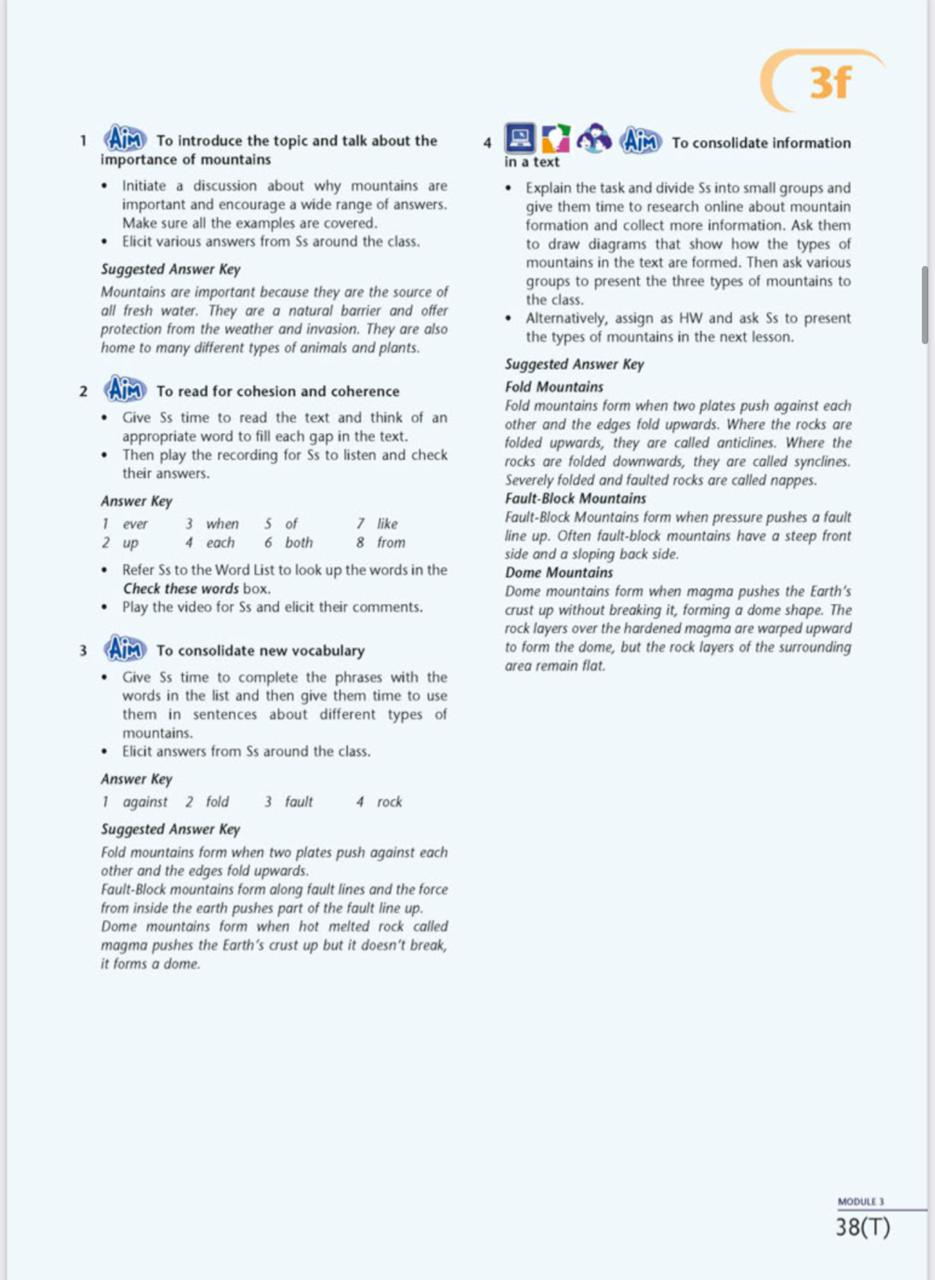
Organization moment: 1.Greeting. Ask about the weather and date. To introduce the topic and talk about the importance of mountains 1. To ask about mountains` definition and why mountains are important and encourage a wide range of answers. Make sure all the examples are covered 2.Elicit a various answers from Ss around the class |
“I wish….” method helps to start the lesson with telling supporting words to each other. Answer the questions. Suggested answers: Mountains are important because they are the source of all fresh water. They are a natural barrier and offer protection from the weather and invasion. They are also home to many different types of animals, birds and plants. |
At the organization moment T tries to award active Ss.«The praise» method is used to evaluate Ss with phrases like: “Good job! Well done!” |
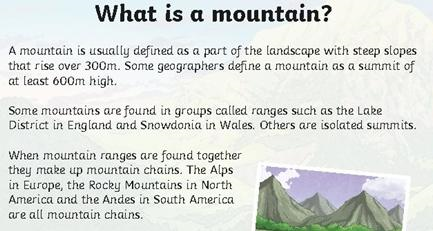
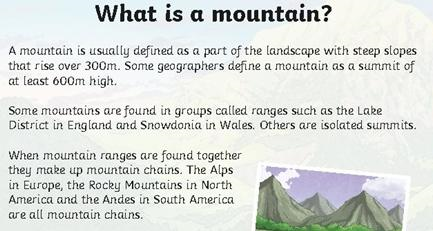
Card 1 the definition of mountain |
|
Pre-learning «Brainstorming» method 10-13 min. |
To read for cohesion and coherence T.:
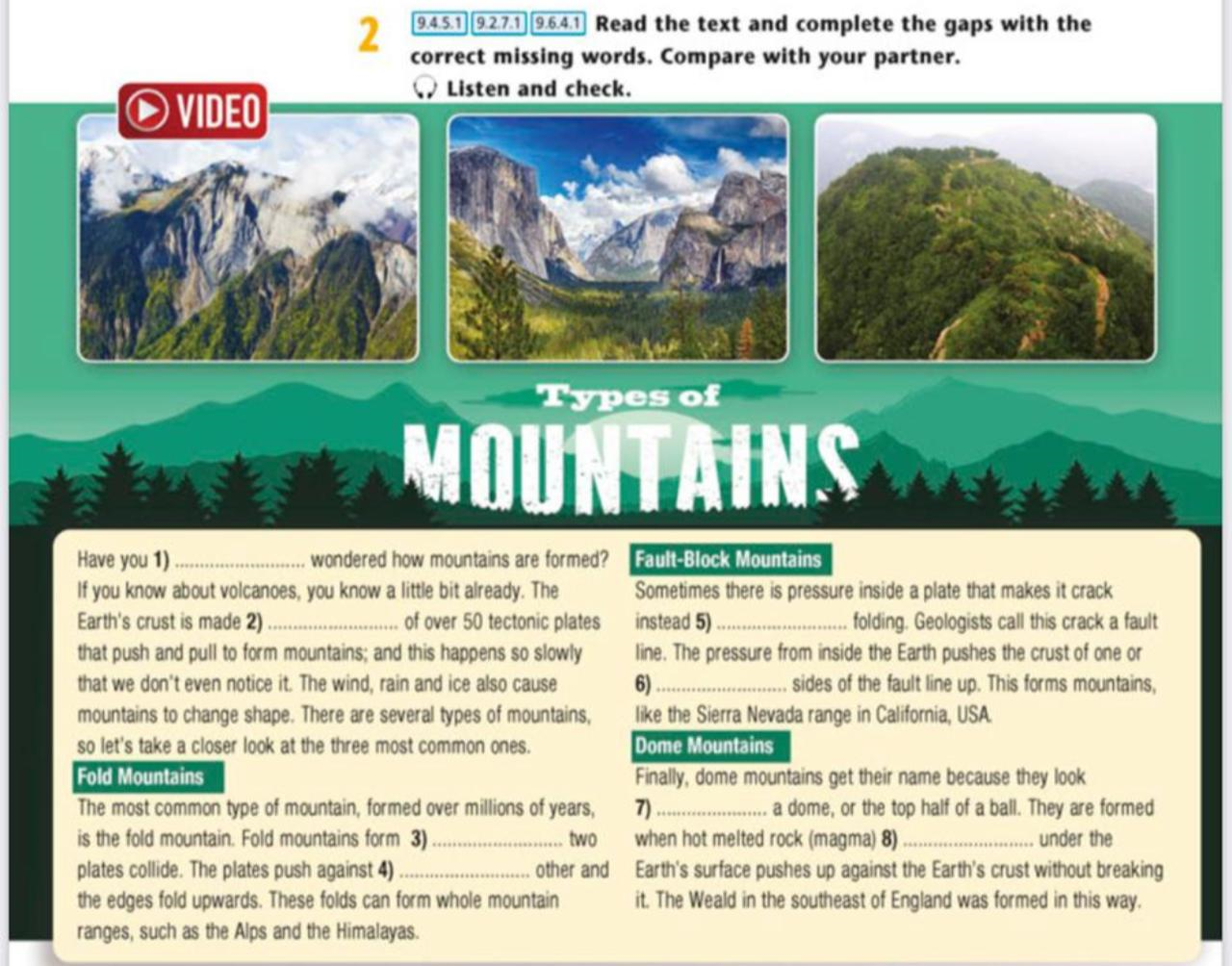
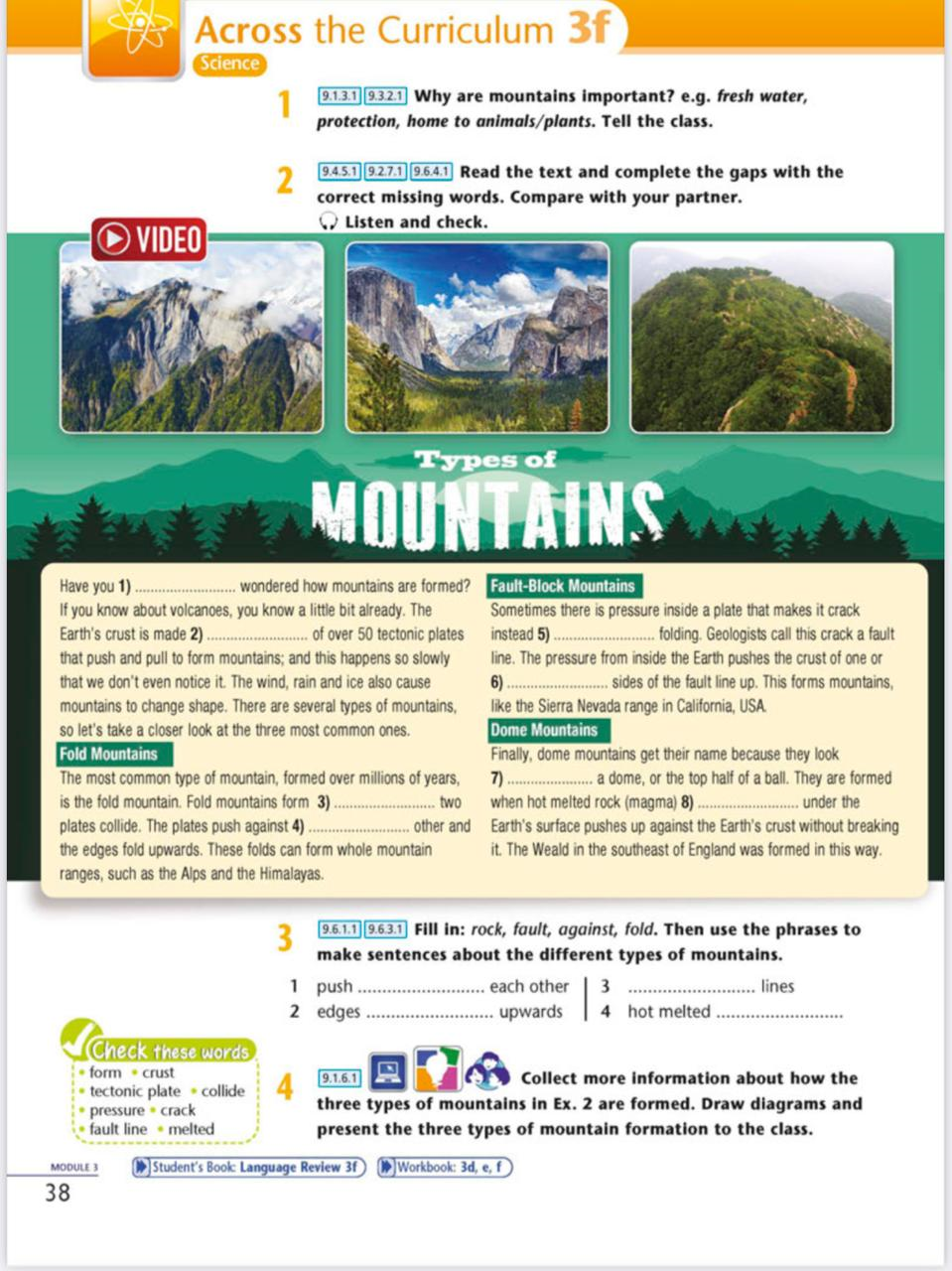
Answer key: 1. ever 2. up 3. when 4. each 5. of 6. both 7. like 8. from |
|
Descriptor:
|
Student’s book page 38, ex.2 (card 2) https://www.youtube.com/watch?v=3reDEdCRLs8 |
|
Middle of the lesson 8-10 min.
|
To consolidate new vocabulary T.: give Ss time to complete the phrases with the words in the list and then give them time to use them in sentences about different types of mountains. Elicit answers from Ss around the class. |
-fill in words correctly - make sentences about different types of mountains using these phrases. Answer Key 1 against 2 fold 3 fault 4 rock Suggested Answer Key Fold mountains form when two plates push against each other and the edges fold upwards. Fault-Block mountains form along fault lines and the force from inside the earth pushes part of the fault line up. Dome mountains form when hot melted rock called magma pushes the Earth's crust up but it doesn't break, it forms a dome. |
Descriptor: --fill in words correctly - make sentences about different types of mountains using these T praise active Ss with phrases such as: “Good job! Well done!” “One more time, please” |
Student’s book p.38., ex.3 |
|
pair work 10 min. Speaking task
|
To consolidate information in a text • Explain the task and divide Ss into small groups and give them time to research online about mountain formation and collect more information. Ask them to draw diagrams that show how the types of mountains in the text are formed. Then ask various groups to present the three types of mountains to the class. Alternatively, assign as HW and ask Ss to present the types of mountains in the next lesson. |
Suggested Answer Key Fold Mountains Fold mountains form when two plates push against each other and the edges fold upwards. Where the rocks are folded upwards, they are called anticlines. Where the rocks are folded downwards, they are called synclines. Severely folded and faulted rocks are called nappes. Fault-Block Mountains Fault-Block Mountains form when pressure pushes a fault line up. Often fault-block mountains have a steep front side and a sloping back side. Dome Mountains Dome mountains form when magma pushes the Earth's crust up without breaking it, forming a dome shape. The rock layers over the hardened magma are warped upward to form the dome, but the rock layers of the surrounding area remain flat. |
|
|
|
End of the lesson. Reflection 5 min. |
|
Ss use their stickers to show their knowledge according to the lesson Green- I understood Yellow-I have some questions Red-I need a help. Aim: To know how many Ss got the theme. Efficiency: Ss can use colors to show how much do they remember. Differentiation:«Conclusion» method is used to finish the lesson. |
Descriptor: Speak on the topic Mountains and types of mountains -can identify types of mountains Ss evaluate each other and encourage classmate with phrases like: Well done! Brilliant! Good job! I like it! |
Whiteboard Pupils Book Poster: Success Ladder. |
|
Hometask |
|
|
|
|
Card 1
Card 2









 Бұл курс Қазақстан Республикасы Оқу-ағарту министрлігімен келісілген










