ЖИ көмекші


жүктеу мүмкіндігіне ие боласыз
Бұл материал сайт қолданушысы жариялаған. Материалдың ішінде жазылған барлық ақпаратқа жауапкершілікті жариялаған қолданушы жауап береді. Ұстаз тілегі тек ақпаратты таратуға қолдау көрсетеді. Егер материал сіздің авторлық құқығыңызды бұзған болса немесе басқа да себептермен сайттан өшіру керек деп ойласаңыз осында жазыңыз
 21 Ақпан 2025
 86
86
My Country. Abay Qunanbayuli.
|
Unit 5 Reading for pleasure
|
Lesson 56 |
||
|
School |
T.Amandosova |
||
|
Teacher name: |
Koshtaeva Zh. |
||
|
Date: |
24/01/2025 |
||
|
Grade: 9 d |
Number present: |
absent: |
|
|
Lesson title |
My Country. Abay Qunanbayuli. |
||
|
Learning objectives |
9.2.7.1 recognize typical features at word, sentence and text level of a range of spoken genres 9.3.7.1 use appropriate subject-specific vocabulary and syntax to talk about an increased range of general and curricular topics 9.4.5.1 deduce meaning from context in short texts on a limited range of familiar general and curricular topics |
||
|
Lesson objectives |
Learners will be able to: - Read a text about Abai Qunanbaiuli. - Learn compound nouns. - Write a paragraph about a Kazakh writer. |
||
|
Value links |
"Law and Order" Know the basics of the legal system and human rights |
||
|
Plan |
|||
|
Stages / Time |
Teachers’ actions |
Students’ actions |
Assessment criteria |
Resources |
|
Beginning of the lesson 3 min |
1.Greeting. Ask about the weather. Warm-up Closed books. Ask students to brainstorm Kazakh writers both contemporary and from the past. Tell students to add the genre of writing they are famous for Lead – In
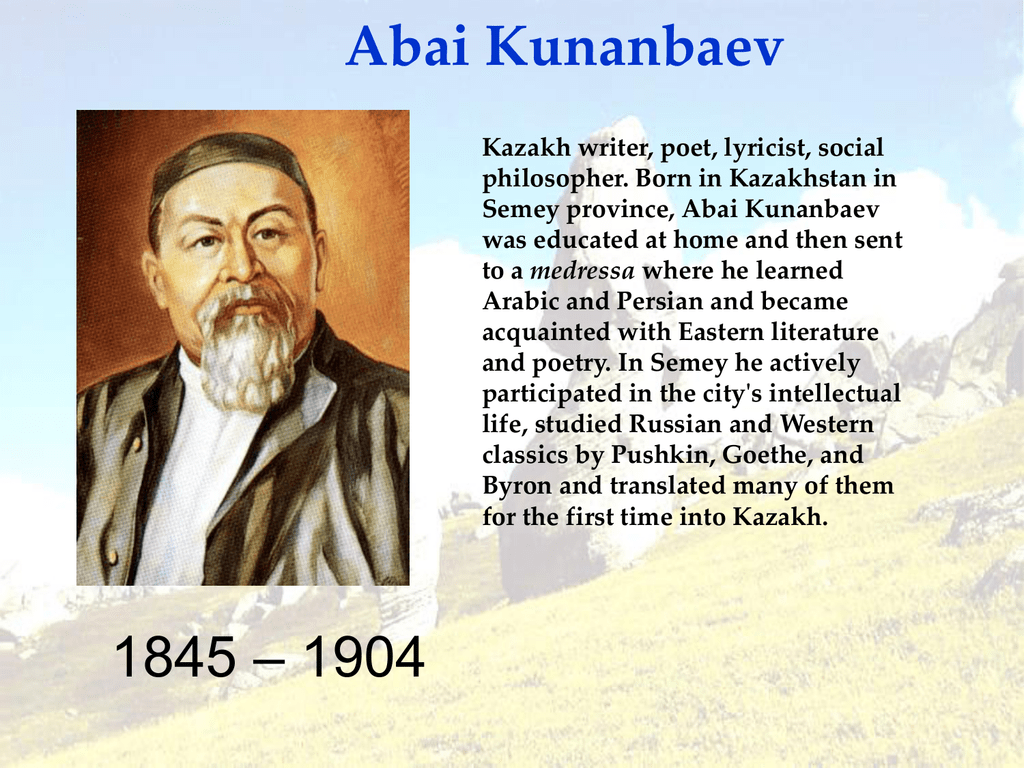
Abay Kunanbaev (1845-1904). Abay was born in 1845 at the bottom of the Chingiz Mountain in the today's Abai district (former Karkaraly) located in Eastern Kazakhstan region (formerly, the Semipalatinsk region). |
The aim: To develop Ss speaking skills and create friendly atmosphere Efficiency: By telling the wishes they show their appreciations .
Students express their ideas
|
At the organization moment T tries to award active Ss. «The praise» method is used to evaluate Ss with phrases like: “Good job! Well done!” |
|
|
Middle of the lesson Presentation part. 30 min |
Ex:1 P:64 Draw students’ attention to the photo. Ask who the statue is of to elicit Abai Qunanbaiuli. Put students in small groups to discuss what they know about him and what his most famous book is. Ask students if they have ever read any of the book or if they know what it is about Differentiation: «Verbal support» method is used to help Students use new words in the text. Ex: 2 P:64 Students read the questions individually. In a stronger class, you may want to play the recording without students reading the text at the same time to gauge how much they understand. Students answer the questions while listening or listening and reading. Allow them a few minutes at the end to go back and reread the text to find any answers they missed. Ex: 3 P:64 Students read all the questions before rereading. In a stronger class, you might want to see how much they can remember before they reread. Students check their answers in pairs. Check answers as a class. Ask students if there is anything they find remarkable or surprising about the information. Ex:4 P:64 Draw students’ attention to the words. Ask them what other compounds they have seen in the unit. Students work individually to find the compounds in the text |
Students discuss about Kazakh great poet. What do you know about Abai Kunanbaiuli? What is his most famous book called? ANSWERS:
Students’ own answers. The Book of
Words
Students read and listen to the text. Are the sentences true or false? ANSWERS: 1 False. He studied them at secondary school. 2 True. 3 True. 4 False. He was thirty-one when he wrote Summer. 5 False. He translated fifty books from Russian into Kazakh. 6 True Students read the text again and answer the questions. ANSWERS: 1 He studied Oriental classical literature and read Russian literature. 2 He wanted to study literature. 3 When he was twelve. 4 He translated Tolstoy, Dostoyevsky, Puskin and Turgenev. 5 It’s a non-fiction book on his philosophical thoughts Students look at the text to find the other half of the compound nouns ANSWERS: 1 school 2 literature 3 community 4 the family 5 man 6 leader |
Descriptor: - discuss about Kazakh great poet - answer the question
2 p Descriptor: - read and listen to the text. - write true or false -Make CCQ questions Yes / No
2 p
Descriptor: - read the text again 1 p - answer the questions
3 p
Descriptor: - look at the text - find the other half of the compound nouns 2p |
Cards Student’s book Worksheet Student’s book |
|
End of the lesson 2 min |
Giving the hometask. Ex: 4 P:36 wb Self-reflection
|
Peer-assessment. Two stars and a wish.
Maybe you could ... |
Students use their stickers to show their knowledge according to the lesson. |
Poster Success
|
|
|
|
|
|
|


 Жүктеу


 Жүктеу
шағым қалдыра аласыз

 Бұл курс Қазақстан Республикасы Оқу-ағарту министрлігімен келісілген