ЖИ көмекші


жүктеу мүмкіндігіне ие боласыз
Бұл материал сайт қолданушысы жариялаған. Материалдың ішінде жазылған барлық ақпаратқа жауапкершілікті жариялаған қолданушы жауап береді. Ұстаз тілегі тек ақпаратты таратуға қолдау көрсетеді. Егер материал сіздің авторлық құқығыңызды бұзған болса немесе басқа да себептермен сайттан өшіру керек деп ойласаңыз осында жазыңыз
 19 Ақпан 2025
 207
207
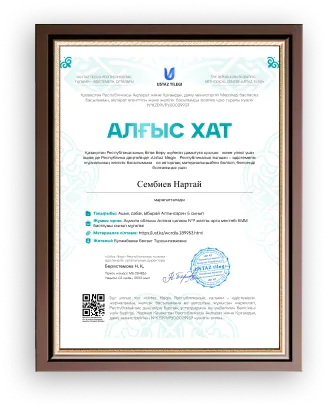
NEW WAY OF TEACHING FOREIGN LANGUAGES IN KAZAKHSTANI SCHOOLS: STORYTELLING
NEW WAY OF TEACHING FOREIGN LANGUAGES IN KAZAKHSTANI SCHOOLS: STORYTELLING
TAISHIKOVA OLIMPIYA BAZAROVNA
English language teacher, master of pedagogical sciences,
Comprehensive school No.7, Turkestan region, Maktaaral district, Atakent village.
Abstract
This article discusses one of the modern methods of teaching foreign languages with augmented reality tools - digital or multimedia storytelling. This method is used in secondary education in Kazakhstan as a way to influence students through digital stories with different goals to form their foreign language intercultural communicative competence. We give a general concept of the term storytelling, presented by various authors. However, we also considered the types of storytelling and their didactic potential in the educational process. A technology for teaching a foreign language based on short stories with a fascinating plot and animations presented during the communicative interaction of a teacher with students based on special applications is proposed. The key practical aspects of this technology are considered. The universality of storytelling as an effective tool in teaching all types of speech activity is demonstrated.
Keywords: storytelling, advantages, types, didactic use, storytelling apps, digital story.
INTRODUCTION
THEORETICAL FRAMEWORK
The global economy is inevitably moving towards digitalization. Digitalization has rapidly become a global trend. We have become accustomed to such words as “generation Z”, “network generation”, “clip thinking”, “digital natives”, etc. life. In Kazakhstan, the digitalization of school education is one of the leading trends in the process of its reform. A modern teacher of a foreign language faces the question of the competent choice and use of digital resources for the formation of foreign language communicative competence. As part of the priority direction of modern education, the digitalization of education, digital storytelling (English digital storytelling - "digital storytelling") is becoming one of the effective innovative pedagogical techniques that implement the formation of foreign language communicative competence using digital tools in the process of teaching foreign languages.
A new method of reading “storytelling” is being actively introduced in education. This method was first presented by the head of one of the US corporations, David Armstrong. Pyatkova (2018) considers storytelling in education is the creation of emotional connections with which you can control the attention of students, place the right accents, focusing on important things. “Storytelling (as a technique for captivating storytelling) responds to the mechanisms of human thinking, psychology and the consumer position of modern society, and therefore is actively used in various areas of human life.” (Bulayeva, 2015). Novichkova, Voskresenskaya (2017) consider storytelling as “a way of transferring information and knowledge, as well as inciting desired actions with the help of instructive stories”, “a management method by transmitting values”, an impact tool that performs propaganda, unifying, communicative, motivating and utilitarian functions (Chugunova). Nevertheless, Manyaykina and Nadtocheva (2015) believe that digital storytelling attracts the attention of teachers as a combined teaching tool that combines visual, figurative, musical and verbal components. Digital storytelling can be implemented in the form of a video, presentation or HTML pages with multimedia content (Grushevskaya (2017). Digital storytelling combines the art of storytelling with various digital media such as image, audio, and video. Almost all digital stories combine some mixture of digital graphics, text, recorded audio narration, video, and music to present information about a particular topic" (Robin, B. R. (2008).
The storytelling method has a high didactic potential and can be used to solve a number of pedagogical tasks: transferring information, increasing student motivation and developing communication and ICT competencies. The use of the digital storytelling method in the educational process requires finding a technological basis, a design method, an analysis of the technology and methods for creating digital storytelling itself, the development of a methodology and the identification of students' skills when using this method.
Digital storytelling attracts the attention of educators as a combined learning tool that combines visual, figurative, musical and verbal components. Digital storytelling in the classroom contributes to the development of universal learning skills:
-
think creatively and critically
-
set learning objectives and solve them
-
work with information using digital technologies (not only find, but also create your own content),
-
be attentive to details
-
learn from what you read correctly
-
select and use the sound range,
-
navigate and work with ICT,
-
create design work, etc.
The advantages of digital storytelling include the following: great opportunity for experimentation; fast feedback; bright, reasonable, visualized format for presenting information; active involvement of students in educational and cognitive activities; individualization of education; a huge amount of resources; automation of primitive but time-consuming duties of a teacher; instant access to the necessary information; the formation of digital literacy - the most important skill of an educated person of our time.
TYPES OF STORYTELLING AND DIDACTIC USE OF APPS
Storytelling is divided into oral, written, digital or multimedia, each of which has its own characteristics. Oral storytelling is an integral part of public speaking. Written storytelling, its basic principles and techniques are used for written storytelling. Digital storytelling includes a wide range of tools. This technique can be presented in different formats: as a presentation, a video clip, an electronic publication with digital content, infographics, etc (Sadrieva, 2020).
Bagretsova (2020) gives other types of storytelling, which can be realized in the classroom for different purposes. Digital or computer storytelling- presentation of stories using multimedia tools (graphics, video, animation, etc.). Sandwich storytelling, which results in a sandwich story, involves enriching the storyline of the teacher with creative inserts that students make, for example, when teaching creative writing. Multi-voice storytelling - if two students help the teacher to tell a story. Digital stories can be given in the native language; in a foreign language; bilingual stories; in mixed language telling. Receptive storytelling is based on reception story, i.e. its listening/reading/visual comprehension, and using it as a basis for subsequent communicative practice. Productive storytelling is the creation of stories by the students themselves directly in the classroom: orally and in writing; independently and with the help of a teacher; individually / in pairs / in small groups / as a whole class.
Stories can be completely improvised by students if their intellectual and linguistic level allows, or they can be created according to supports that set a ready-made plot frame, such as keywords, visual supports and guiding questions.
The possibilities for using digital storytelling are endless. One example is the Guru app for museums, aquariums and zoos - it's one of the storytelling tools that bring things to life. This application has augmented reality, which allows viewers to immerse themselves in the paintings and events of the museum, feeling as if they are inside them.
iSpring programs allow you to create and implement a system of educational materials with "live" characters, audio and video, as well as share with the audience, not limited to one study group, city or even country.
Slidestory allows you to create digital stories using slideshows along with voice narration. Each picture from the digital story can be accompanied by an MP3 voice-over, text captions and optional tags. To use SlideStory, you need to register for free and download the Creator client program, connect a microphone to the system and record an audio file for each slide. It remains to add the title, description and tags. The completed story can be uploaded to the SlideStory website.
The Plotagon program allows you to make your own films by simply writing a script, and virtual actors will bring it to life. The program is in beta testing and is free to download. Although, additional scenes and actors will have to be bought. While the user writes his script, the program gives him the opportunity to choose "actors" from a small list, as well as the area where everything will take place. The author can indicate how a particular remark should be pronounced: in a sad voice, cheerful, alert, etc.
To create animated storytelling, a video is created and voiced, all visual elements of which are in motion. To quickly create educational projects in this style, it is advisable to use online services that offer ready-made libraries of characters, clipart and animation effects and all the necessary tools (Powtoon, GoAnimate - goanimate.com).
Digital storytelling also allows you to create comics. The easiest way to create them is with the Pixton online service (www.pixton.com), which has numerous scene templates and a clipart library that allows you to create your own characters, adjust their poses, facial expressions, gestures and create your own scenes. The resulting images and compositions can be viewed as small independent projects or used as working materials for creating presentations and videos.
Additional online storytelling tools:
1. Voicethread, Vocaroo - audio recording of history.
2. Befunky - creating collages, a series of pictures.
3. Superlame - creating clouds with text.
4. Wordcloud - creating clouds with words.
5. Zimmertwins - creating an animated story.
6. Toondoo - creating comics.
7. Storybird - creating a story in the form of a book.
8. Slidestory - sound overlay on the picture.
9. Storify.com - development of elements of educational content.
10. Toontastic - creation of animated stories (cartoons) with voice overlay.
11. Puppet pals - quick creation of animated stories (cartoons) with voice overlay. 12. Photo puppet - quick creation of animated stories, but instead of the faces of the characters, a real photo is added.
13. Sock puppets - quick creation of animated stories (cartoons) with voice overlay. Heroes are sock puppets.
14. Comics head - creating comics with voice overlay.
15. Story creator - creation of an electronic book with voice overlay.
16. Glogster - creating collages with voiceover.
17. Llittle story creator - creating an e-book with voice overlay.
18. Tele story: create short videos (news, TV shows, etc.)
19. Voki for education - creation of short videos - animated monologue messages, stories.
20. Closr - creates stories based on images.
21. Powtoon.com is a service for creating animated videos and presentations.
22. UtellStory is an online service for creating digital stories based on images, audio and video.
23. ZooBurst is a digital storytelling tool that lets you create your own 3D pop-up book.
24. StoryJumper is a handy tool to help you write and illustrate stories.
Digital stories can be used to introduce, reinforce, organize the practice of using linguistic material, and also be used to assess the level of communication skills of students.
Madrid, M.D. and McLaren, N. (2014) proposed the following criteria for storytelling use in the classroom.
1. Compliance with the content of the story: the topic of the lesson, the goals and objectives of learning; age of students and their intellectual level.
2. Correspondence of the language of history to the language level of students.
3. Presence in history of repeating predictable language patterns.
4. The presence of visual aids that help understanding the content.
PRACTICAL FRAMEWORK
To learn a foreign language and use digital storytelling in the classroom, students are encouraged to create a digital story using various multimedia applications and augmented reality tools. But, they need to follow a work plan to create their story:
-
Choose the genre for your story.
-
Describe your main character.
-
Choose the location of the action.
-
Describe what happens to the main character.
-
Describe what happens at the end of the story.
Main character + possibly other "support" characters. Each story should have at least one key figure with whom the reader will somehow associate himself, empathize with her and put himself in the place of this character. Any mythical character can act as the main character.
The location/environment in which events unfold. Here we are talking even more about the context of the event described in the story. You need a link to reality, and these are always details and additional circumstances.
Clear purpose, moral of the story. What you want to lead the reader to is the idea that can be traced through the entire text. You need to motivate the reader to act through the story, push him to the right conclusion. Storytelling is even more about psychology: you need to influence the mind of a person and lead him to certain thoughts.
Plot. Everything seems to be clear here: even a short story should have a logical chain and a structure that links all the elements together.
Outcome. Every good story must have a logical conclusion. We need a conclusion that draws a line under everything and everyone.
To conduct this type of lesson, you will need short stories in english for storytelling on various topics.
Make up a story - the teacher shows a picture with the characters of the story in order to draw their attention to the characters and their actions. Ask students “what is the name of this or that character”, “what does he do?” etc.
Finish the sentences - take sentences from the story and remove the ending.
For example:
This is a story of a little ______. His name is______________ He lives with his ______________ in a _____________________ They are ____________________ They have got a ____________ but the ___________ doesn't make any ____.
Describe the picture- such an activity will easily help you repeat the vocabulary you have learned, for example, describe clothes, appearance, weather.
Reading and miming - select a specific fragment from the book, where the largest number of characters and changes in emotions. Read it out, after which, ask the students to describe with gestures, facial expressions all the feelings and actions of the characters.
Gapped story - provide students with a gapped story, ask them to imagine what words might be missing, and provide a list of words to choose from.
Story map - prepare the scenes from the story and ask the students to put the pictures in the correct order and describe what is happening in them.
To be continued… - ask your students to come up with a story or even draw illustrations on their own.
Another way to involve students in the learning process is to create a small video project on a given topic using online services that offer many spectacular templates with animated characters, built-in animation and the necessary tools (SparkolPro, PowToon, Moovly, GoAnimate, Plotagon, etc.)
The third effective tool for practicing language material is augmented reality applications, such as Quiver. Students color in their drawings. Then the received images are “revitalized” using the application, working out the necessary lexical or grammatical material.
DISCUSSION
The results of this study indicate strong support for the use of storytelling as a teaching and learning method. The purpose of this research was to investigate and document how storytelling as a teaching and learning method has an impact on the learning and information retention of pupils at comprehensive school. The ability of the learner to retain and recall the information learned was measured by survey questions and the results of the pre and post-test. The ability of the learner to retain the information taught through storytelling overlaps somewhat with their ability to transfer learning to the workplace.
CONCLUSION
In conclusion, digital
storytelling is an effective didactic tool that contributes both to
the formation of foreign language intercultural competence and the
development of digital skills. It covers almost all aspects of
learning and having tried to make a digital story once, children
will fall in love with this type of activity that will motivate
them in the right direction. Digital storytelling in the classroom
makes students to find and actively use the connection of
electronic resources and learning English, working in physical
reality and in the digital
environment.
REFERENCES
Kolikova, Ye.G., Babin, Ye.N. (2017). Integration of classroom and extracurricular activities in the subject area "Technology" // Scientific and methodical electronic journal «Concept», № 5 (May). — P. 171–176. — URL: http://e-koncept.ru/2017/170118.htm
Pyatkova, O.S. (2018). Storytelling method in education /School technologies. P. 41-45.
Bulaeva, M.N. (2015). Multimedia longread as a new journalistic format / Journalistic yearbook. No. 4. – P.121–123.
Novichkova, A. V., Voskresenskaya, Yu. V. (2014). Storytelling as a modern tool for personnel management [Eleсtronic resource] // Internet-journal «Naukovedenie». № 6 (25). http://naukovedenie.ru/PDF/39EVN614.pdf
Chugunova, A. (23.01.2017) "Ordinary stories". [Electronic resource]. Access mode: http://www.sostav.ru.
Manyaykina, N. V., Nadtocheva E. S. (2015). Digital storytelling: from theory to practice // Pedagogic education in Russia. № 10. – P. 60–64.
Grushevskaya, V.Yu. (2017) Applying digital storytelling method in project activity of student. ICT in education. P.38-44
Robin, B. R. (2008). Digital storytelling: A powerful technology tool for the 21st century classroom. Theory into practice, 47(3), 220-228.
Sadrieva, G.A. (2020). Digital storytelling in teaching foreign languages. II-International Scientific-Practical Conference. P.316-320 Journal “New Impulses for Development: Research Issues”.
Bagretsova, N.V. (2020). Storytelling in teaching a foreign language: key aspects. Pedagogy and Psychology of Education. No. 2. ISSN 2500-297X. P.25-38
Madrid, M.D., McLaren, N. (2014). TEFL in primary education. Granada.

 Жүктеу


 Жүктеу
шағым қалдыра аласыз
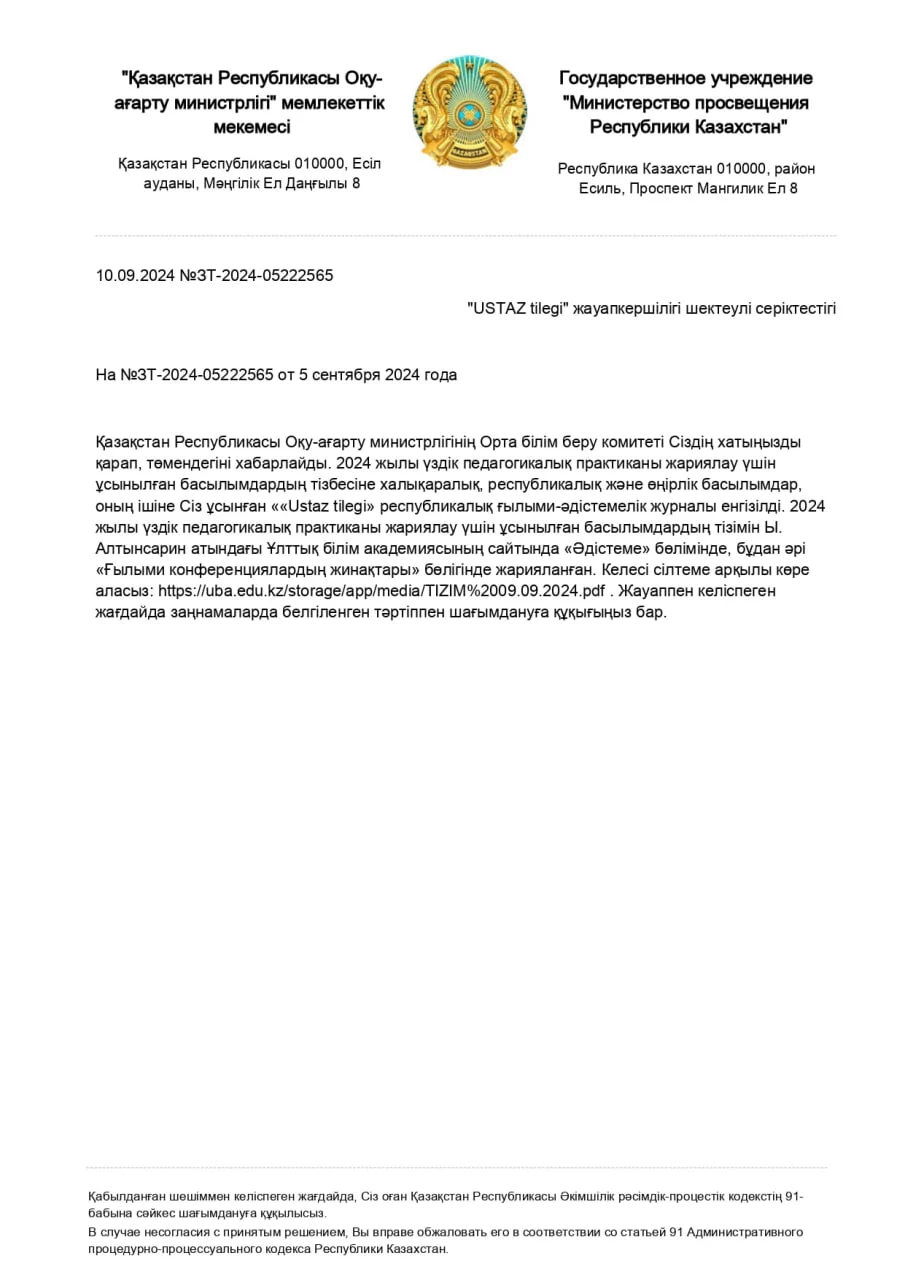

 Бұл курс Қазақстан Республикасы Оқу-ағарту министрлігімен келісілген