
 ЖИ көмекші


жүктеу мүмкіндігіне ие боласыз
Бұл материал сайт қолданушысы жариялаған. Материалдың ішінде жазылған барлық ақпаратқа жауапкершілікті жариялаған қолданушы жауап береді. Ұстаз тілегі тек ақпаратты таратуға қолдау көрсетеді. Егер материал сіздің авторлық құқығыңызды бұзған болса немесе басқа да себептермен сайттан өшіру керек деп ойласаңыз осында жазыңыз
 12 Қазан 2020
 2629
2629
Open lesson 8th grade "Travel and transport"
Lesson plan
|
LESSON: Unit 7 Travel and transport |
School: №37 |
|||||||||||||||||||||
|
Date: |
Teacher name: Turgenbaeva Aisulu |
|||||||||||||||||||||
|
CLASS: 8 |
Number present: 12 |
absent:- |
||||||||||||||||||||
|
Theme of the lesson: The future of transport |
||||||||||||||||||||||
|
Learning objectives(s) that this lesson is contributing to |
8.1.2.1 Use speaking and listening skills to provide sensitive feedback to peers 8.2.8.1 Understand extended narratives on a wide range of general and curricular topics 8.5.8.1 Spell most high frequency vocabulary accurately for a range of familiar general and curricular topics 8.6.9.1 Use appropriately a variety of active and passive simple present and past forms and past perfect simple forms in narrative and reported speech on a range of familiar general and curricular topics |
|||||||||||||||||||||
|
Lesson objectives |
All learners will be able to: - listen to the text about The future of transport - answer the pre, while and post-listening questions with SOME support - use verbs describing movement with support - provide feedback to peers - write spelling of the words correctly with prompts Most learners will be able to: - discuss forms of transport in a radio programme - answer the pre, while and post-listening questions with LITTLE support Some learners will be able to: - make up a story about the future of transport |
|||||||||||||||||||||
|
Assessment criteria: |
Learners have met the learning objective, if they can: - apply speaking and listening skills to give feedback - identify stories according to the theme - write correctly new vocabulary according to the topic - apply grammar rules correctly in practice |
|||||||||||||||||||||
|
Value links: |
Economic growth based on industrialization and innovation. |
|||||||||||||||||||||
|
Cross-curricular links: |
Economic. |
|||||||||||||||||||||
|
ICT skills: |
Smart board, slides, speakers. |
|||||||||||||||||||||
|
Previous learning: |
Ls know types of transport. |
|||||||||||||||||||||
|
PLAN |
||||||||||||||||||||||
|
Planned timings |
Planned activities |
Resources |
||||||||||||||||||||
|
Start 5 min Middle 10 min 8 min 8 min 7 min End 3 min |
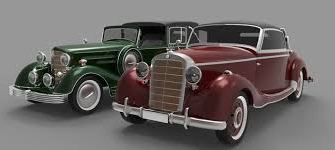
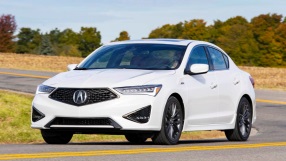
Organizational moment: (T-S) (W) Teacher greets Ls and sets the learning objectives. To create a warm learning atmosphere T uses a warm up activity. Warm-up: (T-S) (W) Teacher uses strategy “What’s the difference?” T shows learners two different images and asks them to explore the difference between them. Ss respond these questions and make discussion.
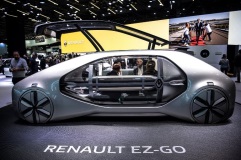
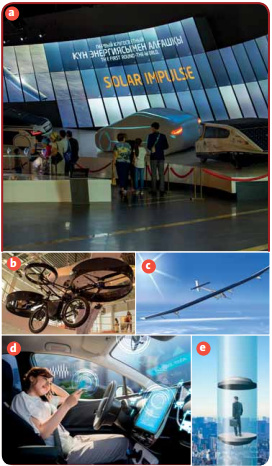
Possible questions: 1. What are the difference between these pictures? 2. Would you like to travel by these cars? 3. Which of these cars would you like to travel? 4. Which of them is comfortable to use? This warm up activity helps to identify the theme of the lesson. Ss identify the theme of the lesson and T divides Ss into 3 groups of: 1st “New model transport” 2nd “Old model transport” 3rd “Future model Transport” Task 1 (T-S) (S-S) (W) Teacher uses the strategy ‘Pre and post-listening’ where Ss do different tasks according to stages. Ss listen to the audio file and do tasks. In pre-listening: T asks questions according to the pictures. What can you see on these pictures?
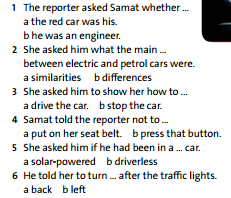
In post-listening: Ss do the task and choose the correct words.
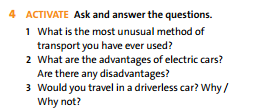
Task 2 (T-S) (S-S) (G) T uses strategy “Popcorning” where Ss discuss about tranports.
AfL: “applause”
Task 3 (S-S) (P) T uses strategy “Walking dictation”. T sticks on the wall a paper with a text for walking dictation. Ss work in pairs, one of them is Reader and the other is Writer. Learner A walks, reads and dictates, learner B writes it. Future transport There is no doubt, that transport plays a significant role in our everyday life. In the 17th and 18th centuries, the majority of people have never dared to think and dream about traveling farther than a few miles. A great bulk of humans, wherever they would like to go, had to reach their destinations on horseback or by carriage. Nowadays, nobody is able to imagine our modern world without different means of transport. Hundreds and thousands of people travel every day either on business or simply for pleasure. These humans have a possibility to travel by air, rails, road or by sea. Unfortunately, if supplies of oil run out in the nearest future, it will be pretty much impossible to do. Frankly speaking, in conclusion, I could admit, there is probably no clear–cut answer to this question, because there is a variety of choices and options. Nonetheless, everyone could agree, those future ways of transportation depend on many factors like government, the welfare of one particular nation, development level etc. So many men, so many minds. Our future is a great mystery and nobody knows what will be tomorrow.
AfL: “pair-assessment” with traffic lights
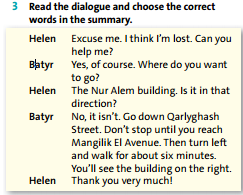
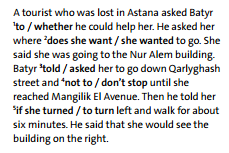
Task 4 (S-T) (I) T uses the strategy “Grammar gaming”, where Ss work individually. Ss read the dialogue and choose correct words.
AfL: “Blob tree” self-assessment
Plenary (S-T) (I) At the end of the lesson, students reflect on KWL chart: -What do you know? -What do you want to know? -What have you learnt?
| |||||||||||||||||||||

 Жүктеу



 Бұл курс Қазақстан Республикасы Оқу-ағарту министрлігімен келісілген










