
 ЖИ көмекші


жүктеу мүмкіндігіне ие боласыз
Бұл материал сайт қолданушысы жариялаған. Материалдың ішінде жазылған барлық ақпаратқа жауапкершілікті жариялаған қолданушы жауап береді. Ұстаз тілегі тек ақпаратты таратуға қолдау көрсетеді. Егер материал сіздің авторлық құқығыңызды бұзған болса немесе басқа да себептермен сайттан өшіру керек деп ойласаңыз осында жазыңыз
 21 Ақпан 2025
 189
189
ҚМЖ ағылшын тілі 11-сынып New Destination 4-тоқсан
New Destinations for Kazakhstan Humanities
11 grade
IV- TERM
School – gymnasium №__ named after ______________
Short term plan: term 4
Lesson title: A successful career
Unit: 8 |
Self - expression and options for future careers |
|||||||
|
Teacher’s name: |
|
|||||||
|
Date: |
|
|||||||
|
Class: |
Number present: |
Number absent: |
||||||
|
Theme of the lesson |
A successful career |
|||||||
|
Learning objective (s) |
11.1.10 - use talk or writing as a means of reflecting on and exploring a range of perspectives on the world 11.3.6 - navigate talk and modify language through paraphrase and correction in talk on a wide range of familiar and some unfamiliar general and curricular topics |
|||||||
|
Lesson objectives |
|
|||||||
|
Plan |
||||||||
|
Stages of the lesson |
Teacher’s activities |
Students’ activities |
Assessment |
Resources |
||||
|
Greeting |
Greet students; students respond to greeting and take their places. Hello, boys and girls! How are you? |
|
|
|
||||
|
Warm-up |
Free Talk.Discuss.
|
Own opinions |
|
Pictures |
||||
|
Presentation Practice |
Introduce the topic of the module and activate Ss’background knowledge to present the learning objectives of the module
like to pursue? If yes, why did you choose this career? If not, how are you going to make up your mind?
picture on the page and ask them to tell youwhat they think the module will be about.Elicit answers.
|
Suggested answers• I think a successful career is one that you enjoy. Money is important, but I think a successful career is one that allows you to be creative and constantly gives you new opportunities to keep you motivated. • I would be willing to work hard and sacrifice my spare time to gain skills and knowledge in order to have a successful career. |
Verbal Assessment |
Textbook |
||||
|
Practicein readingfor gist.
module you will… section.
Draw Ss’ attention to the value of the module and discuss the importance of it.
In this module you will... • discuss topics relating to your personality and your future career options • learn how to express reason, purpose, result and concession using appropriate clauses learn to report statements, questions, commands and requests • learn to write a covering letter |
KEY Get to know yourself: by the time we finish school we are supposed to know exactly what we want to do with our professional career. In order to make the best possible choice we need to discover our likes and dislikes, talents and what we are or aren’t good at |
Peer Assessment |
Handouts |
|||||
|
Identifying the topic. Using pictures
related to the text for prediction. Sequencing
events Descriptor: A learner:
uses appropriate syntax and vocabulary. |
Students think critically, developing, evaluating and making choices about their own and others’ ideas answers and speak a short discussion |
Verbal Assessment
Group Assessment |
Textbook |
|||||
|
Ending the lesson
Feedback |
||||||||
|
Peer Quizzes Peer Quizzes: Students can write their own questions about the content and then quiz each other. They would also spend time going through the incorrect answers with each other to heighten their understanding. |
||||||||
|
Homework |
Ex B,C wb |
|||||||
|
Additional Information |
||||||||
|
Differentiation - how do you plan to give more support? How do you plan to challenge the more able learners? |
Assessment - how are you planning to check learners` learning? |
Health and safety check ICT links |
||||||
|
More support will be given to weaker learners by giving them a modified worksheets in some tasks with greater support |
-through questioning and the redirecting of questioning in feedback activities -through observation in group and end performance activities -through formative task
|
-White board and video is used no more than 10 minutes -Use water based pens -Health promoting techniques -Breaks and physical activities used. -Points from Safety rules used at this lesson. |
||||||
|
REFLECTION |
Answer the most relevant questions to reflect on your lesson. Were the lesson objectives/learning objectives realistic? What did the learners learn? What did/didn’t you like? What was difficult? |
|||||||


School – gymnasium №__ named after ______________
Short term plan: term 4
Lesson title: Reading: A walk through The forest
Unit: 8 |
Self - expression and options for future careers |
|
|||||||||||||||
|
Teacher’s name: |
|
|
|||||||||||||||
|
Date: |
|
|
|||||||||||||||
|
Class: |
Number present: |
Number absent: |
|
||||||||||||||
|
Theme of the lesson |
Reading: A walk through The forest |
|
|||||||||||||||
|
Learning objective (s) |
11.3.3 - explain and justify own and others point of view on a range of general and curricular topics including some unfamiliar topics 11.4.2 - understand specific information and detail in extended texts on a wide range of familiar and some unfamiliar general and curricular topics |
|
|||||||||||||||
|
Lesson objectives |
provide and support ideas with arguments and examples practice analyzing a personality quiz make assumptions based on information from a text |
|
|||||||||||||||
|
Plan |
|
||||||||||||||||
|
Stages of the lesson |
Teacher’s activities |
Students’ activities |
Assessment |
Resources |
|
||||||||||||
|
Greeting |
Greet students; students respond to greeting and take their places. Hello, boys and girls! How are you? |
|
|
|
|
||||||||||||
|
Warm-up |
Free Talk. Discuss.
|
Own opinions |
|
Pictures |
|
||||||||||||
|
Presentation Practice |
Practice in following instructions and responding to the demands of a task to present vocabulary, structures and functions in the context of a quiz
point out that there are no right or wrong answers. Encourage Ss to note down their answers without thinking about them too long.
and explain to Ss that they are going to understand a lot about their personality by walking through the forest.
(The Forest) and pause after each question so that Ss can note down their answer.
of the parts. Ask Ss to underline anyunknown words at the same time.
responses reveal about them. Encourage them to guess. Do not correct Ss at this stage. |
Students think critically, developing, evaluating and making choices about their own and others’ ideas answers and speak a short discussion. |
Verbal Assessment |
Pictures
Textbook |
|
||||||||||||
|
Practicein readingfor gist.
and ask them what it means and what the rest of the text is about (an analysis giving feedback on the reader’s results).
of their answers and see if they represent them.Initiate a class discussion. • Explain any unknown words. • To challenge higher-performing Ss you may ask them to think of alternative words to replace some of the words they have underlined in the text. |
Open answers
|
Peer Assessment |
Handouts |
|
|||||||||||||
|
Detailed reading. Discuss personality traits
And Daulet have given.
and try to understand their personality.
second part of the personality quiz (The Interpretation).
finish, ask them to compare their answers with their partners’.
answers. Reading for specific information
and check their understanding.
is an introvert. She is shy and she usually spends time alone. Encourage Ss to deduce the meaning of the words extrovert and introvert. You can ask Ss if they think they are introverts or extroverts.
Descriptor: A learner:
|
Suggested answersAmina is sincere, and other people enjoy her company. She has a very good relationship with her sister. Daulet is quiet and reserved. People find him interesting, but at times he becomes more introverted.
Key: 1. D 2. D 3. B 4. A 5. N 6. A
|
Verbal Assessment
Group Assessment |
Textbook |
|
|||||||||||||
|
Ending the lesson
Feedback |
|
||||||||||||||||
|
Peer Quizzes Peer Quizzes: Students can write their own questions about the content and then quiz each other. They would also spend time going through the incorrect answers with each other to heighten their understanding. |
|
||||||||||||||||
|
Homework |
Ex A,C wb |
|
|||||||||||||||
|
Additional Information |
|
||||||||||||||||
|
Differentiation - how do you plan to give more support? How do you plan to challenge the more able learners? |
Assessment - how are you planning to check learners` learning? |
Health and safety check ICT links |
|
||||||||||||||
|
More support will be given to weaker learners by giving them a modified worksheets in some tasks with greater support |
-through questioning and the redirecting of questioning in feedback activities -through observation in group and end performance activities -through formative task
|
-White board and video is used no more than 10 minutes -Use water based pens -Health promoting techniques -Breaks and physical activities used. -Points from Safety rules used at this lesson. |
|
||||||||||||||
|
REFLECTION |
Answer the most relevant questions to reflect on your lesson. Were the lesson objectives/learning objectives realistic? What did the learners learn? What did/didn’t you like? What was difficult? |
|
|||||||||||||||
|
Unit: 8 |
Self - expression and options for future careers |
||||||||||||||||
|
Teacher’s name: |
|
||||||||||||||||
|
Date: |
|
||||||||||||||||
|
Class: |
Number present: |
Number absent: |
|||||||||||||||
|
Theme of the lesson |
Grammar: Clauses of purpose, result, concession and reason |
||||||||||||||||
|
Learning objective (s) |
11.4.2 - understand specific information and detail in extended texts on a wide range of familiar and some unfamiliar general and curricular topics 11.5.3 - write with grammatical accuracy on a wide range of familiar general and curricular topics; |
||||||||||||||||
|
Lesson objectives |
|
||||||||||||||||
|
Plan |
|||||||||||||||||
|
Stages of the lesson |
Teacher’s activities |
Students’ activities |
Assessment |
Resources |
|||||||||||||
|
Greeting |
Greet students; students respond to greeting and take their places. Hello, boys and girls! How are you? |
|
|
|
|||||||||||||
|
Warm-up |
Predicting and Guessing. Start thinking.
|
Open Answer |
|
|
|||||||||||||
|
Presentation
Practice
Ending the lesson
Reflection |
Revise /present clauses of purpose, result, concession and reason
Ask Ss to tell you what this sentence expresses (concession). Point out to Ss that clauses of concession express contrast or opposition. • Tell Ss to look at the blue box and ask them what these words/phrases have in common (They all express concession.). Ask them to tell you what difference they notice between so and such. Elicit the answer that the main difference is that such is always followed by a noun, while so is used before adverbs/adjectives. • Write the following sentence on the board, underlining the word shoes: They are such expensive shoes |
Key: 1. a. Since b. due to, because of They express reason. 2. a. in order to b. so that c. in case They express purpose. 3. a. Though, While b. In spite of c. nevertheless, however They express concession. 4. a. such b. so…that c. therefore d. too They express result. |
Oral Assessment |
Grammar Section Workbook |
|||||||||||||
|
Matching task. Practice in using clauses of purpose, result, concession and reason in context
Expand your Grammar skills!
Descriptor: A learner:
|
KEY 1. reading the daily news 2. Sally is shy, she gave the presentation 3. case I forget about the meeting order to remind me about the meeting / so that I don’t/won’t forget about the meeting / in order not to/ so as not to forget about the meeting 4. a lot of studying that he doesn’t know what to do
|
Peer -assessment
|
Textbook
Highlighted expressions |
||||||||||||||
|
• Put students into small groups. Try to do activity "Five finger". give to each group the picture of five finger that filled with the such questions that can help to summarize or elaborate on the topic of the text ( |
Descriptor 4-5 Open answers with grammar accuracy - Excellent 2-3 Open answers with some mistakes - Good Less 2 answers - Try again! |
||||||||||||||||
|
Homework |
Ex C,A wb |
||||||||||||||||
|
Additional Information |
|
||||||||||||||||
|
Differentiation - how do you plan to give more support? How do you plan to challenge the more able learners? |
Assessment - how are you planning to check learners` learning? |
Health and safety check ICT links |
|
||||||||||||||
|
More support will be given to weaker learners by giving them a modified worksheets in some tasks with greater support |
-through questioning and the redirecting of questioning in feedback activities -through observation in group and end performance activities -through formative task |
-White board and video is used no more than 10 minutes -Use water based pens -Health promoting techniques -Breaks and physical activities used. -Points from Safety rules used at this lesson |
|
||||||||||||||
|
REFLECTION
|
Answer the most relevant questions to reflect on your lesson. Were the lesson objectives/learning objectives realistic? What did the learners learn? What did/didn’t you like? What was difficult? |
|
|||||||||||||||
School – gymnasium №__ named after ______________
Short term plan: term 4
Lesson title: Vocabulary: Compound adjective
|
Unit: 8 |
Self - expression and options for future careers |
|||||||
|
Teacher’s name: |
|
|||||||
|
Date: |
|
|||||||
|
Class: |
Number present: |
Number absent: |
||||||
|
Theme of the lesson |
Vocabulary: Compound adjective |
|||||||
|
Learning objective (s) |
11.3.3 - explain and justify own and others point of view on a range of general and curricular topics including some unfamiliar topics 11.4.2 - understand specific information and detail in extended texts on a wide range of familiar and some unfamiliar general and curricular topics |
|||||||
|
Lesson objectives |
|
|||||||
|
Plan |
||||||||
|
Stages of the lesson |
Teacher’s activities |
Students’ activities |
Assessment |
Resources |
||||
|
Greeting |
Greet students; students respond to greeting and take their places. Hello, boys and girls! How are you? |
|
|
|
||||
|
Warm-up
Presentation
Practice
Feedback |
Brainstorming.
could be a sign that you are temporarily going through a rough period. |
Open answer |
|
|
||||
|
Conveying the meaning of new words. Practice in identifying idioms to help Ss deduce the meaning of these idioms through a matching activity • Ask Ss to look at the sentences 1-6 and the definitions a-f. • Read the first sentence aloud and ask Ss to tell you the idiom they have to underline. Elicit answers (pulling my leg). • Then ask Ss to read the sentence again and try to find its definition. You can tell Ss to choose between c and f. This will build lower-performing Ss’ confidence. • Follow the same procedure for the rest of the sentences. |
Key: 1. pulling my leg, c 2. raised a few eyebrows, f 3. putting on a brave face, d 4. out of hand, a 5. follow in her footsteps, b 6. on the tip of my tongue, e |
Verbal Assessment |
Textbook
Grammar Reference |
|||||
|
Practice in reading for gist. Introduce Ss to the notion of compound adjectives
captions.
understand the difference in meaning. Elicit answers. Ask Ss to justify their answers.(a man who is eating shark).
made up of. Read the following sentences aloud, and ask Ss to think of a compound adjective to express the same meaning: She behaves well. She is……. These memory techniques will help you save time. These are ……….. techniques. • Elicit answers (She is well-behaved. These are time-saving memory techniques.). Familiarize Ss with compound adjectives formed with the prefixes well- and self- with the prefixes
Practice in forming compound adjectives and using them in context • Ask Ss to have a look at the sentences 1-5 and check their understanding. • Have Ss do the activity. • Check the answers with the class. • Then have Ss ask and answer these questions in pairs. Descriptor Learner
|
KEY A man-eating shark refers to a shark that kills and eats human beings, while a man eating shark refers to a man who is eating shark (meat). Man-eating is an adjective which describes what kind of shark we are talking about, while a man eating shark is a reduced relative clause
Key: 1. self-centered (to think only about yourself) 2. self-taught (having learnt sth on your own) 3. self-employed (working for yourself nd not for sb else or a company) 4. well informed (having sufficient knowledge about sth) 5. self-confident (not having doubts about yourself) 6. well-mannered (behaving and acting appropriately)
KEY 1. long-lasting 2. strong-willed 3. good-humored, bad-tempered 4. tongue-tied 5. last-minute |
Oral Assessment
Verbal Assessment
Peer Assessment |
Handouts
Prefixes
Worksheets
Handouts |
|||||
|
|
Have students write or talk about 3 things they learned, 2 things they still want to learn, and 1 question they have. |
|||||||
|
Homework |
Ex C,D wb |
|||||||
|
Additional Information |
||||||||
|
Differentiation - how do you plan to give more support? How do you plan to challenge the more able learners? |
Assessment - how are you planning to check learners` learning? |
Health and safety check ICT links |
||||||
|
More support will be given to weaker learners by giving them a modified worksheets in some tasks with greater support |
-through questioning and the redirecting of questioning in feedback activities -through observation in group and end performance activities -through formative task
|
-White board and video are used no more than 10 minutes -Use water-based pens -Health promoting techniques -Breaks and physical activities used. -Points from Safety rules used at this lesson. |
||||||
|
REFLECTION |
Answer the most relevant questions to reflect on your lesson. Were the lesson objectives/learning objectives realistic? What did the learners learn? What did/didn’t you like? What was difficult? |
|||||||

School – gymnasium №__ named after ______________
Short term plan: term 4
Lesson title: Talking about work-related issues
|
Unit: 8 |
Self - expression and options for future careers |
||||||||
|
Teacher’s name: |
|
||||||||
|
Date: |
|
||||||||
|
Class: |
Number present: |
Number absent: |
|||||||
|
Theme of the lesson |
Talking about work-related issues |
||||||||
|
Learning objective (s) |
11.1.8 - develop intercultural awareness through reading and discussion clearly to others; 11.4.2 - understand specific information and detail in extended texts on a wide range of familiar and some unfamiliar general and curricular topics |
||||||||
|
Lesson objectives |
|
||||||||
|
Plan |
|||||||||
|
Stages of the lesson |
Teacher’s activities |
Students’ activities |
Assessment |
Resources |
|||||
|
Greeting |
Picture Description
|
Open answer |
|
Pictures |
|||||
|
Warm-up
Presentation
Practice
Ending the lesson Feedback |
Prepare Ss for the listening activity by activating their background knowledge
Practice in listening for specific information
|
Suggested answer I’d like to enroll on the carpentry and woodworking workshop/course because giving form to wood is very creative and rewarding. It is also very useful because you can make furniture and decorative items for your house. Additionally, I’d be interested in enrolling on the jewelry making workshop/course because it is also very creative. Besides, you can create some beautiful personalized gifts for your family and friends. |
Oral Assessment |
Pictures of Balls
Grammar Section in the Workbook. |
|||||
|
Pair work. Asking and answering
|
KEY In the first picture, we see a pastry chef and in the second picture we see a long-distance lorry driver. Both professionals face a number of difficulties. To begin with, the job of a chef requires him/her to be on his/her feet for many hours and work under constant pressure, especially if he/she works at a popular and expensive restaurant. Being a chef requires cooperation and at the same time you have to show that you are in charge… |
Verbal Assessment |
Textbook
|
||||||
|
Formative Assessment. Discuss: Student B: Answer the following question. Which of these two jobs would you prefer to do? Why? Student B: The two photographs show different working environments. Compare the photographs and answer the question below Descriptor: A learner:
|
|
Self- assessment
|
CD
|
||||||
|
|
|||||||||
|
Homework |
Ex A,C wb |
||||||||
|
Additional Information |
|
||||||||
|
Differentiation - how do you plan to give more support? How do you plan to challenge the more able learners? |
Assessment - how are you planning to check learners` learning? |
Health and safety check ICT links |
|
||||||
|
More support will be given to weaker learners by giving them a modified worksheets in some tasks with greater support |
-through questioning and the redirecting of questioning in feedback activities -through observation in group and end performance activities -through formative task
|
-White board and video are used no more than 10 minutes -Use water-based pens -Health promoting techniques -Breaks and physical activities used. -Points from Safety rules used at this lesson. |
|
||||||
|
REFLECTION |
Answer the most relevant questions to reflect on your lesson. Were the lesson objectives/learning objectives realistic? What did the learners learn? What did/didn’t you like? What was difficult? |
|
|||||||

School – gymnasium №__ named after ______________
Short term plan: term 4
Lesson title: Reading: Release your creativity
|
Unit: 8 |
Self - expression and options for future careers |
|||||||
|
Teacher’s name: |
|
|||||||
|
Date: |
|
|||||||
|
Class: |
Number present: |
Number absent: |
||||||
|
Theme of the lesson |
Reading: Release your creativity |
|||||||
|
Learning objective (s) |
11.4.4 - read a wide range of extended fiction and non-fiction texts on a variety of more complex and abstract, general and curricular topics 11.4.7 - recognize patterns of development in lengthy texts [inter- paragraph level] on a range of more complex and abstract, general and curricular topics |
|||||||
|
Lesson objectives |
|
|||||||
|
Plan |
||||||||
|
Stages of the lesson |
Teacher’s activities |
Students’ activities |
Assessment |
Resources |
||||
|
Greeting |
Greet students; students respond to greeting and take their places. Hello, boys and girls! How are you? |
|
|
|
||||
|
Warm-up
Presentation
Practice
Ending the lesson Reflection |
Prediction based on the title, pictures. Skimming. Discuss. • Why do people create works of art? • What is the purpose of art? Does it have the power to change people’s lives? • How do you think each of the activities below helps people express themselves? |
Open answers |
|
Pictures
|
||||
|
Present functions, structures and vocabulary in context to give Ss practice in reading for gist
them to guess what the texts are about.
answer the question in the rubric. Ask Ss to underline any unknown words at the same time. Elicit answers. Ask Ss why A is not the correct answer. Elicit answers (Talgat Kenesov is still studying. |
KEY B, C and D
|
Verbal Assessment |
Picture Dictionary |
|||||
|
Identifying specific information in a text
through questions 1-9 and try to find the answers concerning the person in text A.
read the questions again in order to find the ones corresponding to the second text.
the texts.
Identify the meaning of unknown words/phrases from context
words/phrases in the texts and their meanings a–g.
activity.
may ask them to think of alternative words to replace some of the words they have underlined in the text.
Give Ss the opportunity to elaborate on the topic of the texts
discussion.
E. Discuss.
Descriptor: A learner:
|
Key: 1. B 2. D 3. A 4. C 5. A 6. D 7. B 8. A 9. C
KEY 1. e 2. c 3. a 4. f 5. d 6. b 7. g
Suggested answer I believe creativity can be learnt. Although many people claim that it is a talent that only some people have, I think it’s a skill that can be taught. Everybody can be creative and generate new and innovative ideas. By trying new things and using our imagination, we can all be creative.
|
Peer Assessment
Group Assessment
|
Handouts
Worksheets
Handouts |
|||||
|
Self-assessment. How well do I understand? 4 - I can do this and explain it to someone else. 3 - I understand and can do this by myself. 2 - I need more practice. 1 - I don't understand this yet. |
|
Self-assessment. |
|
|||||
|
Homework |
Ex A,D wb |
|||||||
|
Additional Information |
||||||||
|
Differentiation - how do you plan to give more support? How do you plan to challenge the more able learners? |
Assessment - how are you planning to check learners` learning? |
Health and safety check ICT links |
||||||
|
More support will be given to weaker learners by giving them a modified worksheets in some tasks with greater support |
-through questioning and the redirecting of questioning in feedback activities -through observation in group and end performance activities -through formative task
|
-White board and video are used no more than 10 minutes -Use water-based pens -Health promoting techniques -Breaks and physical activities used. -Points from Safety rules used at this lesson. |
||||||
|
REFLECTION |
Answer the most relevant questions to reflect on your lesson. Were the lesson objectives/learning objectives realistic? What did the learners learn? What did/didn’t you like? What was difficult? |
|||||||
School – gymnasium №__ named after ______________
Short term plan: term 4
Lesson title: Grammar: Reported Speech (statements), Special Introductory Verbs
|
Unit: 8 |
Self - expression and options for future careers |
|||||||
|
Teacher’s name: |
|
|||||||
|
Date: |
|
|||||||
|
Class: |
Number present: |
Number absent: |
||||||
|
Theme of the lesson |
Grammar: Reported Speech (statements), Special Introductory Verbs |
|||||||
|
Learning objective (s) |
11.4.2 - understand specific information and detail in extended texts on a wide range of familiar and some unfamiliar general and curricular topics 11.5.3 - write with grammatical accuracy on a wide range of familiar general and curricular topics |
|||||||
|
Lesson objectives |
|
|||||||
|
Plan |
||||||||
|
Stages of the lesson |
Teacher’s activities |
Students’ activities |
Assessment |
Resources |
||||
|
Greeting |
Greet students; students respond to greeting and take their places. Hello, boys and girls! How are you? |
|
|
|
||||
|
Warm-up
Presentation
Practice
Ending the lesson
|
Discuss.
|
Open Answer |
|
|
||||
|
Revise the use of Reported Speech (statements)
and check their understanding. Help Ss understand that these sentences are examples of Reported Speech.
an indirect object. Said is used when there is no indirect object, and said to is used with an indirect object. |
KEY 1. I will hold an exhibition with my latest paintings 2. Samat is auditioning for a role today . |
Oral Assessment
|
Grammar Reference Section
|
|||||
|
Sentence completion task.
their understanding.
Pronunciation task. • Play the CD and pause after each word so that Ss can repeat. Tell Ss to listen for the difference in pronunciation. Elicit the answer: the first set of words has a /ʃ/ sound, the second set of words has a /s/sound and the third set of words has a /tʃ/sound. Draw Ss’ attention to the TIP and explain it. Revise Reported Questions• Have Ss read through the examples and help Ss understand that these are reported questions. • Have Ss do the activity. • Check the answers with the class. • Refer Ss to the Grammar Reference in the Workbook. • Have Ss come up with their own examples and provide any further explanations. Revise Reported Commands and Requests
has a reported request and the second dialogue has a reported command.
Descriptor: A learner:
|
KEY
Present Simple Past Simple Present Continuous Past Continuous Past Simple Past Perfect Simple Present Perfect Simple Past Perfect Simple Present Perfect Continuous Past Perfect Continuous
KEY 1. ‘Why did you apply for the job?’ ‘Do you speak French?’ 2. They begin with the words why and if/ whether. 3. They are in the affirmative form.
KEY 1. The verb told. 2. The verb asked. 3. It changes to to + base form. 4. It changes to not to + base form.
|
Peer Assessment
Self-Assessment
Peer Assessment
|
Pictures
Handouts
Worksheets
Posters |
|||||
|
Homework |
Ex A,B wb |
|||||||
|
Additional Information |
||||||||
|
Differentiation - how do you plan to give more support? How do you plan to challenge the more able learners? |
Assessment - how are you planning to check learners` learning? |
Health and safety check ICT links |
||||||
|
More support will be given to weaker learners by giving them a modified worksheets in some tasks with greater support |
-through questioning and the redirecting of questioning in feedback activities -through observation in group and end performance activities -through formative task |
-White board and video are used no more than 10 minutes -Use water-based pens -Health promoting techniques -Breaks and physical activities used. -Points from Safety rules used at less on. |
||||||
|
REFLECTION |
Answer the most relevant questions to reflect on your lesson. Were the lesson objectives/learning objectives realistic? What did the learners learn? What did/didn’t you like? What was difficult? |
|||||||
School – gymnasium №__ named after ______________
Short term plan: term 4
Lesson title: Vocabulary: Phrasal verbs with get and verbs starting with -re
|
Unit: 8 |
Self - expression and options for future careers |
|||||||
|
Teacher’s name: |
|
|||||||
|
Date: |
|
|||||||
|
Class: 11 |
Number present: |
Number absent: |
||||||
|
Theme of the lesson |
Vocabulary: Phrasal verbs with get and verbs starting with -re |
|||||||
|
Learning objective (s) |
11.5.7 - use independently appropriate layout at text level on a wide range of general and curricular topics 11.6.5 - use a range of transitive and intransitive verb complementation patterns on a wide range of general and curricular topics |
|||||||
|
Lesson objectives |
|
|||||||
|
Plan |
||||||||
|
Stages of the lesson |
Teacher’s activities |
Students’ activities |
Assessment |
Resources |
||||
|
Greeting |
Greet students; students respond to greeting and take their places. Hello, boys and girls! How are you? |
|
|
|
||||
|
Warm-up
Presentation
|
• Start thinking. Ask Ss some questions: Read the sentences and match the phrasal verbs 1-7 with the definitions a-g. |
Open answers |
|
|
||||
|
Practice in deducingthe meaning of these phrasal verbs from context
by in text C, p.223.
try to deduce the meaning of the phrasal
verbs with get. Accept all logical answers.
and the definitions a-g and check their understanding.
|
KEY 1. e 2. a 3. c 4. b 5. f 6. d 7. g |
Peer Assessment |
Textbook
Dialogues
CD |
|||||
|
Practice
Ending the lesson
Feedback |
Practice identifying the meaning ofverbs starting with re- incontext
• Tell Ss:
• Tell them:
with the prefix re- mean to do sth again. • Draw Ss’ attention to the note and provide them with further explanations.
Practicein identifying the meaningof verbs starting with re- incontext
Practice in listening for specific information
words.
Formative Assessment Post-reading. • Ask Ss:
your goal? Descriptor: A learner:
|
KEY 1. c 3. a 5. d 6. f 7. b 9. e
Key: recharge, rethink, redo, recreate, redesign, rewrite
KEY 1. got stuck in traffic 2. history 3. patience 4. tiring 5. 95% 6. volunteer 7. working nights
|
Self- Assessment
Peer Assessment |
Handouts
Textbook
Pictures
CD |
||||
|
Expressing opinion about the lesson In my opinion…. |
|
|||||||
|
Homework |
Ex A,C wb |
|||||||
|
Additional Information |
||||||||
|
Differentiation - how do you plan to give more support? How do you plan to challenge the more able learners? |
Assessment - how are you planning to check learners` learning? |
Health and safety check ICT links |
||||||
|
More support will be given to weaker learners by giving them a modified worksheets in some tasks with greater support |
-through questioning and the redirecting of questioning in feedback activities -through observation in group and end performance activities -through formative task
|
-White board and video are used no more than 10 minutes -Use water-based pens -Health promoting techniques -Breaks and physical activities used. -Points from Safety rules used at this lesson. |
||||||
|
REFLECTION |
Answer the most relevant questions to reflect on your lesson. Were the lesson objectives/learning objectives realistic? What did the learners learn? What did/didn’t you like? What was difficult? |
|||||||
School – gymnasium №__ named after ______________
Short term plan: term 4
Lesson title: Writing A covering letter
|
Unit: 8 |
Self - expression and options for future careers |
|||||||
|
Teacher’s name: |
|
|||||||
|
Date: |
|
|||||||
|
Class: |
Number present: |
Number absent: |
||||||
|
Theme of the lesson |
Writing A covering letter |
|||||||
|
Learning objective (s) |
11.4.7 - recognize patterns of development in lengthy texts [inter- paragraph level] on a range of more complex and abstract, general and curricular topics ; 11.5.3 - write with grammatical accuracy on a wide range of familiar general and curricular topics; |
|||||||
|
Lesson objectives |
|
|||||||
|
Plan |
||||||||
|
Stages of the lesson |
Teacher’s activities |
Students’ activities |
Assessment |
Resources |
||||
|
Greeting |
Greet students; students respond to greeting and take their places. Hello, boys and girls! How are you? |
|
|
|
||||
|
Warm-up
Presentation
|
•Picture Description.
|
Openanswers
|
|
|
||||
|
Provide Ss with a sample covering letter to give Ss practice in reading for gist
and ask them what it is about (It’s about applying to a company for the position of the interior designer.).
to read through the advertisement and the letter and answer the question. You can ask them to underline any unknown words at the same time.
Familiarize Ss with the conventions of a covering letter to prepare Ss for the writing activity • Tell Ss to look at the sentences a-d. • Explain that when they write a covering letter they have to follow certain steps so as not to omit important information. • Ask Ss to have a look at the first paragraph and tell you what information is included (The candidate mentions where she saw the job advertisement and states that she is interested.). • Then have Ss look at the sentences a-d and choose the correct answer. • Follow the same procedure for the rest of the paragraphs. |
KEY Alexandra is suitable for the job because her studies and her work experience match the requirements of the job. Also, she has all the necessary personal qualities and skills needed for the position
Key:
a. 2 b. 4 c. 1 d. 3 |
Oral Assessment
Peer Assessment
|
Grammar Section in the Workbook.
Rules
Grammar Section in the Workbook.
|
|||||
|
Practice |
Familiarize Ss with theregister of a covering letter to prepare Ss for the writing activity • Ask Ss to read through the words/phrases 1-12 and check understanding. • Remind Ssthat when they write a covering letter they have to use formal language. • Have Ss do the activity. • Check the answers with the class. |
KEY 1. (particularly) suits 2. objectives 3. at present 4. assisted 5. acquired 6. effectively 7. Regarding 8. highly 9. demonstrated |
Peer Assessment
|
Handouts
|
||||
|
Ending the lesson
Feedback |
Prepare Ss for the writing activity
Formative Assessment.
Descriptor Learner
|
KEY: 1. h, i 2. d 3. g 4. j 5. f 6. a 7. k 8. c 9. b 10. e
|
Peer Assessment |
Worksheets
Posters
|
||||
|
Traffic Cards: Students create index cards with a large green marker circle on one side and red on the other. If they are following along and understanding the lesson, the green side of their card is upright and visible to you. When they do not understand something and need clarification, they flip the card to show you the red side. |
|
|
||||||
|
Homework |
Get Writing |
|||||||
|
Additional Information |
||||||||
|
Differentiation - how do you plan to give more support? How do you plan to challenge the more able learners? |
Assessment - how are you planning to check learners` learning? |
Health and safety check ICT links |
||||||
|
More support will be given to weaker learners by giving them a modified worksheets in some tasks with greater support |
-through questioning and the redirecting of questioning in feedback activities -through observation in group and end performance activities -through formative task
|
-White board and video are used no more than 10 minutes -Use water-based pens -Health promoting techniques -Breaks and physical activities used. -Points from Safety rules used at this |
||||||
|
REFLECTION |
Answer the most relevant questions to reflect on your lesson. Were the lesson objectives/learning objectives realistic? What did the learners learn? What did/didn’t you like? What was difficult? |
|||||||
School – gymnasium №__ named after ______________
Short term plan: term 4
Lesson title: Culture page: Driving: on the LEFT OR on the RIGHT?
|
Unit: 8 |
Self - expression and options for future careers |
|||||||
|
Teacher’s name: |
|
|||||||
|
Date: |
|
|||||||
|
Class: |
Number present: |
Number absent: |
||||||
|
Theme of the lesson |
Culture page: Driving: on the LEFT OR on the RIGHT? |
|||||||
|
Learning objective (s) |
11.3.3 - explain and justify own and others point of view on a range of general and curricular topics including some unfamiliar topics 11.4.2 - understand specific information and detail in extended texts on a wide range of familiar and some unfamiliar general and curricular topics |
|||||||
|
Lesson objectives |
|
|||||||
|
Plan |
||||||||
|
Stages of the lesson |
Teacher’s activities |
Students’ activities |
Assessment |
Resources |
||||
|
Greeting |
Greet students; students respond to greeting and take their places. Hello, boys and girls! How are you? |
|
|
|
||||
|
Warm-up
Presentation
|
Discovery activity. Picture Description.
|
Open answers
|
Verbal Assessment |
|
||||
|
Familiarise Ss with certain aspects of the culture of English- speaking countries Print the British and the American flagand stick them on the board. Tell Ss that they are going to talk aboutsome of the main differences between theway people live in the UK and the US. Use the flags as mind maps to write Ss’answers. Alternatively, you can give themthe following hints and have Ss comeup with the differences: what they likedrinking, how they write the date, what their houses and cars look like. Have Ss work in pairs and allow them some time to think of their answer |
UK• Drink a lot oftea US • Drink mostly coffee • Cars are small • Cars are bigger • Average houses are smaller • Average houses tend to be about double the size • It is rare to see drive-throughfast foodrestaurants • There areloads ofdrive-through restaurants • Dates arewritten as day/ month/year • Dates are written as month /day/year Houses have aletter box builtinto the front Door • Houses have mailboxes |
Oral Assessment |
Textbook |
|||||
|
|
Identifying the topic
|
Key: In medieval times, an often violent period of history, people used horsesas a means of transport and it made more sense for them to travel on the left side because that meant that their right hand, the hand they used their sword with, would be on the side facing an opponent travelling towards them. |
Peer Assessment |
Textbook |
||||
|
Practice
Ending the lesson |
Detailed reading. Answering questions. Which countries, apart from the UK, alsodrive on the left side of the road? Ireland,Australia, New Zealand, and South Africa,as well as countries in Asia, Africa and theCaribbean that used to be British colonies Why was it convenient for the driver to sit onthe left side? Because his right hand couldhold the whip he used to keep the horsesmoving. Which side of the road did the driver keepto? the right side When did the US start driving on the right?after it gained its independence fromEngland and decided to go against theEnglish practice
Detailed reading. True/false statementsHave Ss do the activity. Check the answers with the class. Ask Ss to correct the false sentences. This will challenge higher-performing Ss. Project Work
Descriptor: A learner:
|
Students read again and answer the questions.
KEY 1. T 2. F 3. F 4. T 5. T
Students work in groups to do the project work. |
Self-Assessment
Group Assessment |
Handouts
Worksheets
Handouts |
||||
|
Homework |
Project Work |
|||||||
|
Additional Information |
||||||||
|
Differentiation - how do you plan to give more support? How do you plan to challenge the more able learners? |
Assessment - how are you planning to check learners` learning? |
Health and safety check ICT links |
||||||
|
More support will be given to weaker learners by giving them a modified worksheets in some tasks with greater support |
-through questioning and the redirecting of questioning in feedback activities -through observation in group and end performance activities -through formative task
|
-White board and video are used no more than 10 minutes -Use water-based pens -Health promoting techniques -Breaks and physical activities used. -Points from Safety rules used at this lesson. |
||||||
|
REFLECTION |
Answer the most relevant questions to reflect on your lesson. Were the lesson objectives/learning objectives realistic? What did the learners learn? What did/didn’t you like? What was difficult? |
|||||||
School – gymnasium №__ named after ______________
Short term plan: term 4
Lesson title: Shopping for clothes
|
Unit: 9 |
Clothes journeys |
|||||||
|
Teacher’s name: |
|
|||||||
|
Date: |
|
|||||||
|
Class: |
|
|
||||||
|
Theme of the lesson |
Shopping for clothes |
|||||||
|
Learning objective (s) |
11.2.5 - recognize the attitude or opinion of the speaker(s) in unsupported extended talk on a wide range of general and curricular topics including talk on a growing range of unfamiliar topics 11.3.6 - navigate talk and modify language through paraphrase and correction in talk on a wide range of familiar and some unfamiliar general and curricular topics |
|||||||
|
Lesson objectives |
|
|||||||
|
Plan |
||||||||
|
Stages of the lesson |
Teacher’s activities |
Students’ activities |
Assessment |
Resources |
||||
|
Greeting |
Greet students; students respond to greeting and take their places. Hello, boys and girls! |
|
|
|
||||
|
Warm-up |
Talk in Pairs.
Why? / Why not? |
|
Oral Assessment |
Pictures
|
||||
|
Presentation
Practice
Ending the lesson
Feedback |
Conveying the meaning of new words. Prediction based on the title, pictures. Reading for gist. Discuss:
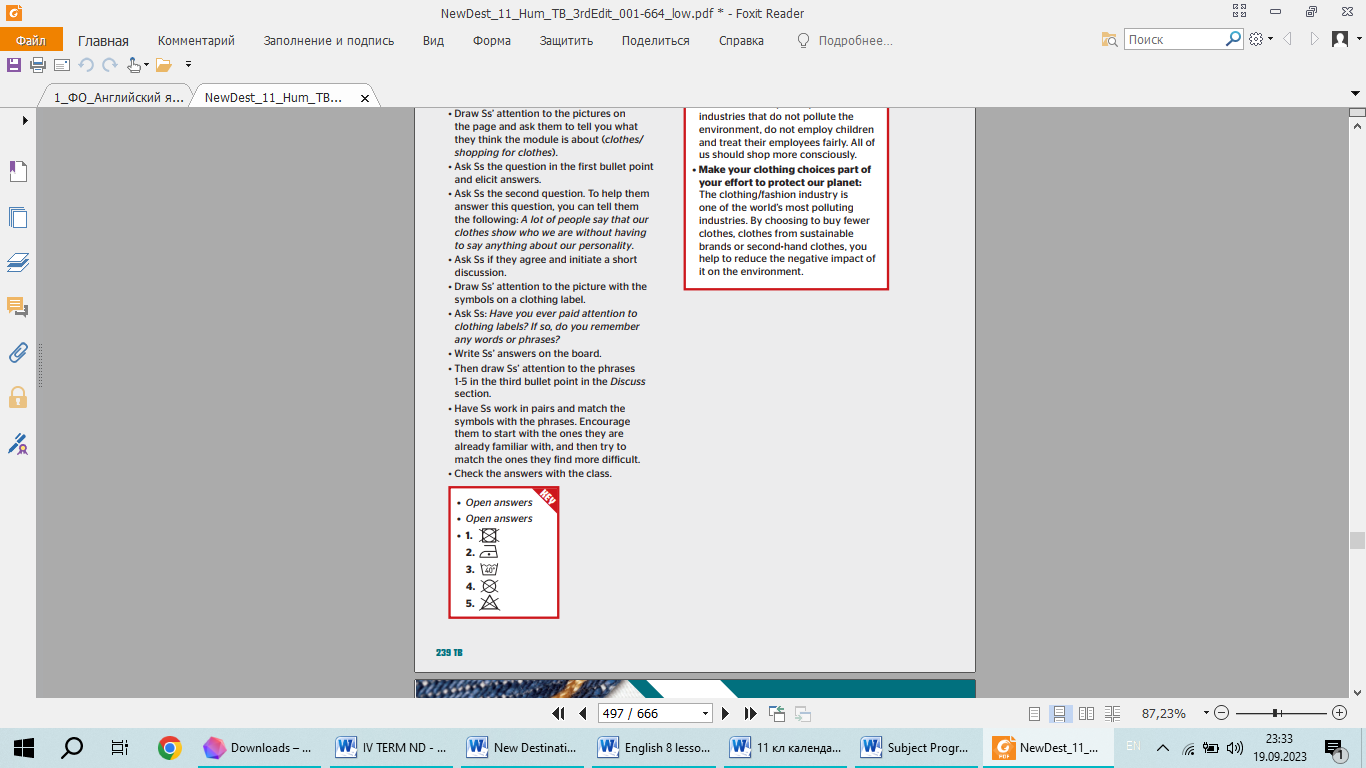
labels mean? Look at the symbols in the picture and match them with the phrases 1-5.
|
Students look at the picture accompanying the conversation and ask them the questions in the rubric
|
|
Pictures |
||||
|
Introduce the topic of the module and activate Ss’ background knowledge to present the learning objectives of the module
Think. Pair and Share
module and discuss the importance of them. Descriptor: A learner:
|
Studentspay attention to the pictures on the page and tell what they think the module is about
Suggested
answers |
Peer assessment
Self- assessment |
Worksheets
Pictures
Key Words |
|||||
|
Self-reflection. Students attach their boat in the appropriate area of the map that reflects their emotions and mood after the lesson. |
|
|
|
|||||
|
Homework |
Ex C wb |
|||||||
|
Additional Information |
||||||||
|
Differentiation - how do you plan to give more support? How do you plan to challenge the more able learners? |
Assessment - how are you planning to check learners` learning? |
Health and safety check ICT links |
||||||
|
More support will be given to weaker learners by giving them a modified worksheets in some tasks with greater support |
-through questioning and the redirecting of questioning in feedback activities -through observation in group and end performance activities -through formative task
|
-White board and video are used no more than 10 minutes -Use water-based pens -Health promoting techniques -Breaks and physical activities used. -Points from Safety rules used at this lesson. |
||||||
|
REFLECTION |
Answer the most relevant questions to reflect on your lesson. Were the lesson objectives/learning objectives realistic? What did the learners learn? What did/didn’t you like? What was difficult? |
|||||||
School – gymnasium №__ named after ______________
Short term plan: term 4
Lesson title: Reading: The journey of your jeans from the cotton field to High street
|
Unit: 9 |
Clothes journeys |
|||||||
|
Teacher’s name: |
|
|||||||
|
Date: |
|
|||||||
|
Class: |
Number present: |
Number absent: |
||||||
|
Theme of the lesson |
Reading: The journey of your jeans from the cotton field to High street |
|||||||
|
Learning objective (s) |
11.1.8 - develop intercultural awareness through reading and discussion clearly to others; 11.4.5 - deduce meaning from context in extended texts on a wide range of familiar and unfamiliar general and curricular topics; |
|||||||
|
Lesson objectives |
|
|||||||
|
Plan |
||||||||
|
Stages of the lesson |
Teacher’s activities |
Students’ activities |
Assessment |
Resources |
||||
|
Greeting |
Greet students; students respond to greeting and take their places. Hello, boys and girls! |
|
|
|
||||
|
Warm-up |
Discuss. Do you wear jeans? If yes, what kind (baggy, tight, torn, flared)? If no, why not? Do you consider jeans to be casual wear? Would you wear them to a wedding, a get-together, an interview? How many pairs of jeans do you or your friends have? How often do you or your friends go shopping for jeans? |
Open answers
|
|
|
||||
|
Presentation
Practice
Ending the lesson Feedback |
Introduce the topic by activating Ss’ background knowledge Write the words baggy, tight, tornand flared on the board. Print thecorresponding photos (alternatively, youcan find them online) and ask Ss to matchthe pictures with the words. • Then ask Ss the first question. Elicit answers • Ask Ss the next two questions. Encourage Ss to express themselves without worrying about making mistakes. Allow a limited use of L1. This will help lower-performing Ss. Have Ss share their answers with the class and initiate a short discussion |
Open
answers |
Verbal assessment |
Digital Resources |
||||
|
Pair work. Sentence completion task.
Draw Ss’ attention to
the title of the text
Ask Ss some comprehension questions: When did denim jeans
start being sold? How many pairs of
jeans does an average What are jeans made of? Cotton
Where was the natural dye taken from in How many individual
pieces of fabric are What is the last
paragraph about? the How much water is
required to grow the |
Students complete the task
KEY 1. g 2. c 3. a 4. f 5. b 6. d
|
Peer assessment |
Worksheets |
|||||
|
Formative
Assessment. Descriptor: A learner: scans the text to identify what event is likely to occur next; explains answers giving arguments using textual evidence. |
Key: 3.
the yarn is dyed / yarn dyeing
|
Group assessment
|
Handouts
Worksheets |
|||||
|
Self-assessment. “Five”. Children draw a picture of their hand and write the most important things about the lesson on each finger. The thumb - something interesting, the index finger - something difficult, the middle one - something that was not enough, the ring finger - the mood, the little finger - the suggestions |
|
|||||||
|
Homework |
w/b 9A Ex B/Cp118 |
|||||||
|
Additional Information |
||||||||
|
Differentiation - how do you plan to give more support? How do you plan to challenge the more able learners? |
Assessment - how are you planning to check learners` learning? |
Health and safety check ICT links |
||||||
|
More support will be given to weaker learners by giving them a modified worksheets in some tasks with greater support |
-through questioning and the redirecting of questioning in feedback activities -through observation in group and end performance activities -through formative task |
-White board and video are used no more than 10 minutes -Use water-based pens -Health promoting techniques -Breaks and physical activities used. -Points from Safety rules used at the lesson |
||||||
|
REFLECTION |
Answer the most relevant questions to reflect on your lesson. Were the lesson objectives/learning objectives realistic? What did the learners learn? What did/didn’t you like? What was difficult? |
|||||||

School – gymnasium №__ named after ______________
Short term plan: term 4
Lesson title: Grammar: Conditional Sentences Alternatives to if
|
Unit: 9 |
Clothes journeys |
|||||||
|
Teacher’s name: |
|
|||||||
|
Date: |
|
|||||||
|
Class: |
Number present: |
Number absent: |
||||||
|
Theme of the lesson |
Grammar: Conditional Sentences Alternatives to if |
|||||||
|
Learning objective (s) |
11.3.2 - ask and respond with appropriate syntax and vocabulary to open - ended higher order thinking questions on a range of general and curricular topics including some unfamiliar topics 11.5.6 - write coherently at text level using a variety of connectors on a wide range of familiar general and curricular topics; |
|||||||
|
Lesson objectives |
|
|||||||
|
Plan |
||||||||
|
Stages of the lesson |
Teacher’s activities |
Students’ activities |
Assessment |
Resources |
||||
|
Greeting |
Greet students; students respond to greeting and take their places. Hello, boys and girls! |
|
|
|
||||
|
Warm-up |
Brainstorming. 1.
If you wash jeans too many
times, their colour fades. |
Open answers
|
|
|
||||
|
Presentation
Practice
Ending the lesson
Feedback |
Present the formation of Conditional Sentences Types Zero and 1 • Ask Ss to read through the incomplete rules and check their understanding. • Have Ss do the activity. • Check the answers with the class. • For further practice, ask Ss to come up with their own examples of Conditional Sentences Types Zero and 1. Present other expressions used to introduce Conditional Sentences • Ask Ss to read through the examples in the box and check their understanding. • Draw Ss’ attention to the words in blue and help them understand that these are expressions used to introduce Conditional Sentences instead of If. • Draw Ss’ attention to the questions that follow and check their understanding. • Ask Ss the questions. • Check the answers with the class. • For further practice, ask Ss to come up with their own examples of Conditional Sentences introduced with other expressions instead of If.. |
Students identify the grammar task
KEY If/When + Present Simple Э Present Simple If + Present Simple Э will, can, must, may, might, should + base form Э imperative
KEY 1. as long as / so long as / provided (that) / providing (that) /on condition (that) 2.Suppose/Supposing 3. unless 4. In case of
|
Verbal assessment
Peer assessment
|
Grammar Workbook Section
Digital Resources |
||||
|
Practice in using Conditional Sentences and expressions in context
Present Conditional Sentences Types 2 and 3
examples of Conditional Sentences Types 2 and 3 respectively.
and check their understanding.
provide Ss with any further explanations when necessary. |
1.
Unless you book the tickets
now,you won’t find any. / You won’t find Key: a.
4-6 |
Peer assessment
Oral assessment
|
Worksheets |
|||||
|
Formative Assessment. Present the formation of Conditional Sentences Types 2 and 3 Ask Ss to read through the rules and check their understanding. Have Ss complete the rules by referring to the examples in the previous activity. Check the answers with the class. For further practice, ask Ss to come up with their own examples of Conditional Sentences Types 2 and 3. Refer Ss to the Grammar Reference in the Workbook Descriptor: A learner: completes the dialogues using Conditional Sentences Alternatives to if discusses questions and answers the questions within groups
|
Students look at the table and decide
Conditional Sentences Type 2If + Past Simple Э would, could, might +base form Conditional Sentences Type 3 If + Past Perfect Simple Э would, could, might + have + past participle
|
Group assessment
|
Handouts
Worksheets |
|||||
|
Two stars Peer-assessment. Two stars and a wish. • You did a really good job on ... • I really like how you ... • Maybe you could and a wish. • You did a really good job on ... • I really like how you ... |
|
|||||||
|
Homework |
Ex B/Cwb |
|||||||
|
Additional Information |
||||||||
|
Differentiation - how do you plan to give more support? How do you plan to challenge the more able learners? |
Assessment - how are you planning to check learners` learning? |
Health and safety check ICT links |
||||||
|
More support will be given to weaker learners by giving them a modified worksheets in some tasks with greater support |
-through questioning and the redirecting of questioning in feedback activities -through observation in group and end performance activities -through formative task |
-White board and video are used no more than 10 minutes -Use water-based pens -Health promoting techniques -Breaks and physical activities used. -Points from Safety rules used at the lesson |
||||||
|
REFLECTION |
Answer the most relevant questions to reflect on your lesson. Were the lesson objectives/learning objectives realistic? What did the learners learn? What did/didn’t you like? What was difficult? |
|||||||
School – gymnasium №__ named after ______________
Short term plan: term 4
Lesson title: Vocabulary: Describing clothes
|
Unit: 9 |
Clothes journeys |
|||||||
|
Teacher’s name: |
|
|||||||
|
Date: |
|
|||||||
|
Class: |
Number present: |
Number absent: |
||||||
|
Theme of the lesson |
Vocabulary: Describing clothes |
|||||||
|
Learning objective (s) |
11.3.5 - interact with peers to make hypotheses and evaluate alternative proposals on a range of familiar and some unfamiliar general and curricular topics 11.4.6 - recognize the attitude, opinion or tone of the writer in extended texts on a range of more complex and abstract, general and curricular topics |
|||||||
|
Lesson objectives |
|
|||||||
|
Plan |
||||||||
|
Stages of the lesson |
Teacher’s activities |
Students’ activities |
Assessment |
Resources |
||||
|
Greeting |
Greet students; students respond to greeting and take their places. Hello, boys and girls! |
|
|
|
||||
|
Warm-up |
Brainstorming.
|
Open answers
|
|
|
||||
|
Presentation
Practice
Feedback |
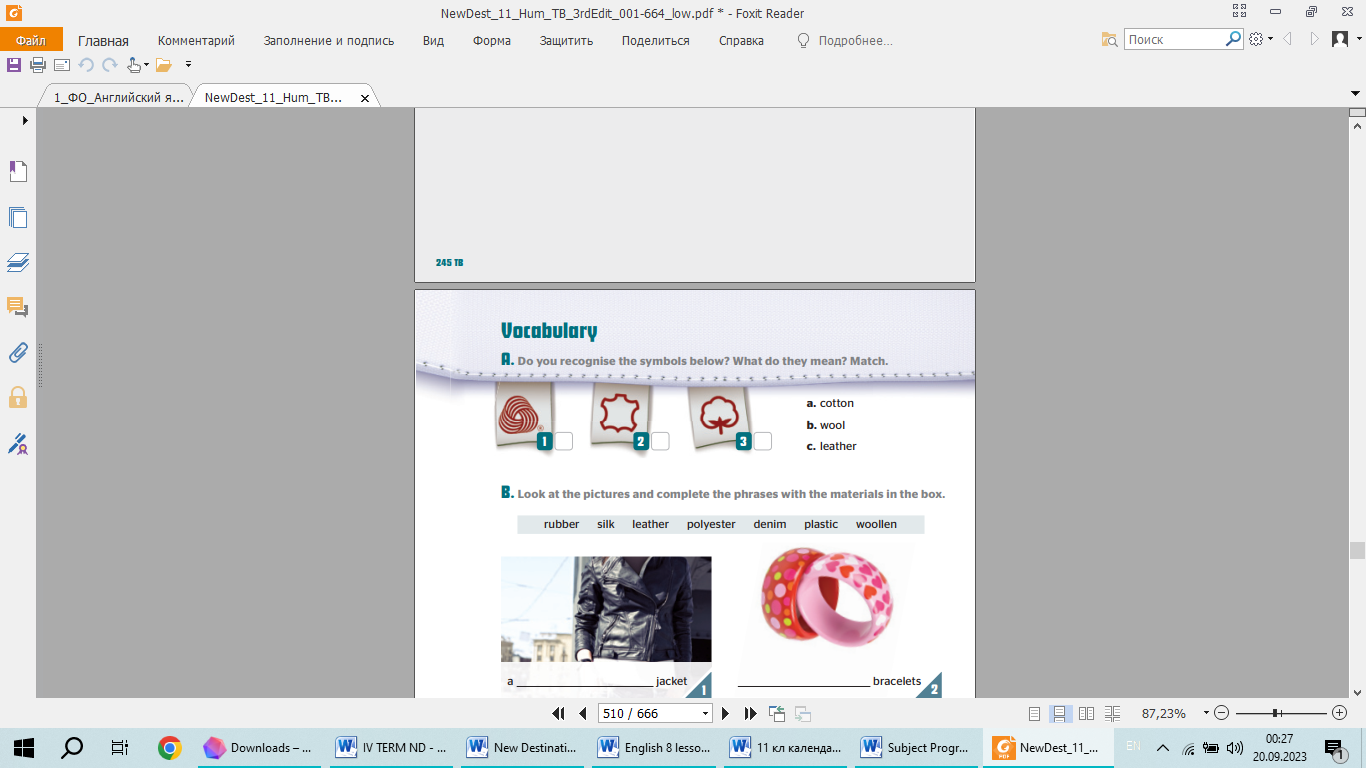
Conveying the meaning of new items. Use of dictionaries. Reading for gist • Draw Ss’ attention to the pictures and the words in the box. Explain to Ss what theyhave to do. • Encourage them to start with the ones they are already familiar with. • Have Ss do the activity. • Check the answers with the class. |
KEY 1. leather 2. plastic 3. polyester 4. denim 5. woollen 6. silk 7. rubber |
Verbal assessment |
Pictures
Key Words
|
||||
|
Practice in describing clothes in terms of design and pattern
• Ask Ss:
fashion? Practice in describing clothes and accessories in terms of design, pattern and material
Descriptor: A learner: describes the pictures
|
KEY 1. checked 2. striped 3. tight 4. baggy 5. torn 6. flared 7. floral 8. patterned 9. sparkly 10. spotted
KEY
shirt: a floral cotton shirt dress: a blue spotted dress trousers: checked baggy trousers jumper: striped woollen jumper boots: black leather boots
Key:
1. b 2. b 3. c 4. a 5. b 6. c
|
Self Assessment
Peer Assessment
Self -assessment
|
Worksheets
Question Cards
Handouts
|
|||||
|
|
|
Self-assessment. |
|
|||||
|
Homework |
Ex A wb |
|||||||
|
Additional Information |
||||||||
|
Differentiation - how do you plan to give more support? How do you plan to challenge the more able learners? |
Assessment - how are you planning to check learners` learning? |
Health and safety check ICT links |
||||||
|
More support will be given to weaker learners by giving them a modified worksheets in some tasks with greater support |
-through questioning and the redirecting of questioning in feedback activities -through observation in group and end performance activities -through formative task
|
-White board and video are used no more than 10 minutes -Use water-based pens -Health promoting techniques -Breaks and physical activities used. -Points from Safety rules used at this lesson. |
||||||
|
REFLECTION |
Answer the most relevant questions to reflect on your lesson. Were the lesson objectives/learning objectives realistic? What did the learners learn? What did/didn’t you like? What was difficult? |
|||||||
 o you
recognise the symbols below? What do they mean? Match
o you
recognise the symbols below? What do they mean? Match
School – gymnasium №__ named after ______________
Short term plan: term 4
Lesson title: Listening & Speaking: Fashion Blog
|
Unit: 9 |
Clothes journeys |
|||||||
|
Teacher’s name: |
|
|||||||
|
Date: |
|
|||||||
|
Class: |
Number present: |
Number absent: |
||||||
|
Theme of the lesson |
Listening & Speaking: Fashion Blog |
|||||||
|
Learning objective (s) |
11.3.5 - interact with peers to make hypotheses and evaluate alternative proposals on a range of familiar and some unfamiliar general and curricular topics 11.4.6 - recognize the attitude, opinion or tone of the writer in extended texts on a range of more complex and abstract, general and curricular topics |
|||||||
|
Lesson objectives |
|
|||||||
|
Plan |
||||||||
|
Stages of the lesson |
Teacher’s activities |
Students’ activities |
Assessment |
Resources |
||||
|
Greeting |
Greet students; students respond to greeting and take their places. Hello, boys and girls! |
|
|
|
||||
|
Warm-up |
Discuss. Use some of the words /phrases in the box. Read the quotes. What are they trying to say about fashion?
|
Open answers
|
|
|
||||
|
Presentation
Practice
Ending the lesson
Feedback |
Prepare Ss for the listeningactivity by activating theirbackground knowledgeto engage Ss with questionsrequiring personal response • Draw Ss’ attention to the picture and ask them what they can see (sb browsing through a fashion blog). Ask Ss: Do you enjoy reading fashion blogs? • Explain to Ss that the topic of theirdiscussion will be fashion. • DivideSs into small groups, and draw their attention to the questions. Makesure they understand everything. • Read the words/phrases in the box aloud, and tell Ss to try to use as many aspossible in their answers. • Explain to Ss that it’s not necessary to agree with the other Ss in the group, butthey should be polite and allow eachspeaker to express their opinion. • Also, tell them that if someone in the group cannot find the word he/shewants to use, the other Ss can help them.This will build lower-performing Ss’confidence to take part in the discussion. • Have Ss do the activity, and go round theclass helping them when necessary. • Choose several groups to present theiranswers and provide constructivefeedback
Practice in listening for specific information • Draw Ss’ attention to the questions 1-6. • Explain to Ss that they will listen to three different extracts. • Give Ss a minute to silently read the questions and the options. • Have Ss do the activity. • Check the answers with the class.
|
Suggestedanswers I don’t like trends. They tend to make everybody look the same: Nowadays, everybody wants to follow the latest fashion trends. Young people are influenced by the social media a lotand they think that looking the same as everybody else is a way to be accepted by their peer group. However, there are people who want to be unique and they don’t want to follow the crowd. They want to stand out by developing their personal style and have the tendency to avoid following trends. True beauty comes from within: It doesn’t matter if somebody is in fashion or not. The most important thing is to be yourself and stand out because of your qualities and personality, not because of what you wear. This is something that we tend to forget given the fact that we live in a materialistic society which mostly cares about image and social status. 1. b 2. b 3. c 4. a 5. b 6. c |
Verbal assessment
Self-assessment |
Pictures
Key Words
CD
CD |
||||
|
Work in pairs. Look at the pictures and discuss the questions.
Descriptor: A learner: describes the pictures
|
|
Group Assessment
|
Worksheets
|
|||||
|
Self-reflection. "Message". Pupils write 15 words of the greatest importance for the topic of the lesson. |
|
. |
|
|||||
|
Homework |
Ex A,Bwb |
|||||||
|
Additional Information |
||||||||
|
Differentiation - how do you plan to give more support? How do you plan to challenge the more able learners? |
Assessment - how are you planning to check learners` learning? |
Health and safety check ICT links |
||||||
|
More support will be given to weaker learners by giving them a modified worksheets in some tasks with greater support |
-through questioning and the redirecting of questioning in feedback activities -through observation in group and end performance activities -through formative task
|
-White board and video are used no more than 10 minutes -Use water-based pens -Health promoting techniques -Breaks and physical activities used. -Points from Safety rules used at this lesson. |
||||||
|
REFLECTION |
Answer the most relevant questions to reflect on your lesson. Were the lesson objectives/learning objectives realistic? What did the learners learn? What did/didn’t you like? What was difficult? |
|||||||
School – gymnasium №__ named after ______________
Short term plan: term 4
Lesson title: Reading: Working conditions and work ethic
|
Unit: 9 |
Clothes journeys |
|||||||
|
Teacher’s name: |
|
|||||||
|
Date: |
|
|||||||
|
Class: |
Number present: |
Number absent: |
|
|||||
|
Theme of the lesson |
Reading: Working conditions and work ethic |
|||||||
|
Learning objective (s) |
11.4.7 - recognize patterns of development in lengthy texts [inter- paragraph level] on a range of more complex and abstract, general and curricular topics 11.3.2 - ask and respond with appropriate syntax and vocabulary to open - ended higher order thinking questions on a range of general and curricular topics including some unfamiliar topics |
|||||||
|
Lesson objectives |
|
|||||||
|
Plan |
||||||||
|
Stages of the lesson |
Teacher’s activities |
Students’ activities |
Assessment |
Resources |
||||
|
Greeting |
Greet students; students respond to greeting and take their places. Hello, boys and girls! |
|
|
|
||||
|
Warm-up |
Talk in pairs
|
Open answers
|
|
Table Structure |
||||
|
Presentation
Practice
Ending the lesson |
Present vocabulary, functions and structures in the context of a text give Ss practice in reading for gist
texts.
each text and tell you what each text is.
from a novel, the second one is anewspaper article and the third onea letter.).
Practice in reading for specific information • Draw Ss’ attention to the questions 1-5 and check their understanding. • Explain to Ss that questions 1-3 refer to texts A-C respectively, but questions 4-5 may refer to two or more texts. • Have Ss do the activity. • Check the answers with the class. • Tell Ss to provide justifications for their answers by referring to specific parts of the texts. |
Key:
They are talking about poor workingconditions and the negative effect theyhave on workers’ health
Students underline all the examples
1. d 2. b 3. c 4. b 5. a.
|
Oral Assessment
Self assessment |
Pictures
Grammar Section in the Workbook.
|
||||
|
Practice in deducingthe meaning of unknown words/phrases from context • Draw Ss’ attention to the words/phrases
|
KEY 1. c 2. d 3. e 4. a 5. b |
Self assessment |
Worksheets |
|||||
|
Elaborate on the topic ofthe reading activity through aspeaking activity
and check their understanding.
the following on the board |
Open Answer |
Peer Assessment |
Worksheets |
|||||
|
Project Work
industry in that country. Descriptor: A learner:
|
Students talk in pairs, read the prompts below and try to discuss. |
Group assessment |
Prompts
Tables |
|||||
|
Homework |
w/b Ex C |
|||||||
|
Additional Information |
||||||||
|
Differentiation - how do you plan to give more support? How do you plan to challenge the more able learners? |
Assessment - how are you planning to check learners` learning? |
Health and safety check ICT links |
||||||
|
More support will be given to weaker learners by giving them a modified worksheets in some tasks with greater support |
-through questioning and the redirecting of questioning in feedback activities -through observation in group and end performance activities -through formative task
|
-White board and video are used no more than 10 minutes -Use water-based pens -Health promoting techniques -Breaks and physical activities used. -Points from Safety rules used at this lesson. |
||||||
|
REFLECTION |
Answer the most relevant questions to reflect on your lesson. Were the lesson objectives/learning objectives realistic? What did the learners learn? What did/didn’t you like? What was difficult? |
|||||||
School – gymnasium №__ named after ______________
Short term plan: term 4
Lesson title:
|
Unit: 9 |
Clothes journeys |
|||||||
|
Teacher’s name: |
|
|||||||
|
Date: |
|
|||||||
|
Class: |
Number present: |
Number absent: |
|
|||||
|
Theme of the lesson |
Grammar: Unreal Past |
|||||||
|
Learning objective (s) |
11.1.6 - organise and present information clearly to others; 11.5.3 - write with grammatical accuracy on a wide range of familiar general and curricular topics; |
|||||||
|
Lesson objectives |
unreal past
|
|||||||
|
Plan |
||||||||
|
Stages of the lesson |
Teacher’s activities |
Students’ activities |
Assessment |
Resources |
||||
|
Greeting |
Greet students; students respond to greeting and take their places. Hello, boys and girls! |
|
|
|
||||
|
Warm-up |
Talk in pairs
|
Open answers
|
|
Table Structure |
||||
|
Presentation
Practice
Ending the lesson
|
Present wish/if only in the present/future and the past to present other forms of unreal past
something?
you wish you hadn’t?
following the tenses used in these sentences (e.g. I wish I were more talentedat writing stories., I wish I hadn’t shoutedat my sister., etc.). In order to help Ss, youcan answer these questions first, and thenencourage Ss to do the same.
questions 1-5. Ask Ss the questions and elicit answers.
Point out to Ss that we use wish/if only + could + bare infinitive to express regretabout sth we cannot do at present andwish/if only + would + bare infinitive toexpress annoyance or irritation about apresent situation.
Practice in using wish/if only/would rather/as if/ as though/it’s time in context
|
Students read through the first example in the grammar box.
1. He/She lives somewhere else other than Paris. 2. He/She doesn’t like it. 3. It is followed by the Past Simple. 4. It refers to the present/future. 5. If only I lived in Paris, the fashion centre of the world
KEY 6.The second sentence. 7. It is different from the subject of wish.
8. Yes, he/she did. 9. He/She regrets having done it. 10. It is followed by the Past Perfect Simple. 11. It refers to the past. 12. I wish I hadn’t bought that bag! Now I’d have the money for my rent.
Students underline all the examples |
Oral Assessment
Verbal Assessment
|
Pictures
Grammar Section in the Workbook.
Grammar Rules |
||||
|
Sentence completion.
Descriptor: A learner:
|
KEY 1. was invented 2. is produced 3. were built 4. was written 5. are sold 6. are bought |
Self assessment |
Worksheets |
|||||
|
Homework |
w/b Exc,D |
|||||||
|
Additional Information |
||||||||
|
Differentiation - how do you plan to give more support? How do you plan to challenge the more able learners? |
Assessment - how are you planning to check learners` learning? |
Health and safety check ICT links |
||||||
|
More support will be given to weaker learners by giving them a modified worksheets in some tasks with greater support |
-through questioning and the redirecting of questioning in feedback activities -through observation in group and end performance activities -through formative task
|
-White board and video are used no more than 10 minutes -Use water-based pens -Health promoting techniques -Breaks and physical activities used. -Points from Safety rules used at this lesson. |
||||||
|
REFLECTION |
Answer the most relevant questions to reflect on your lesson. Were the lesson objectives/learning objectives realistic? What did the learners learn? What did/didn’t you like? What was difficult? |
|||||||
School – gymnasium №__ named after ______________
Short term plan: term 4
Lesson title:
|
Unit: 9 |
Clothes journeys |
|||||||
|
Teacher’s name: |
|
|||||||
|
Date: |
|
|||||||
|
Class: |
Number present: |
Number absent: |
||||||
|
Theme of the lesson |
Vocabulary:Misfortunes |
|||||||
|
Learning objective (s) |
11.3.7 - use appropriate subject-specific vocabulary and syntax to talk about range of familiar and some unfamiliar general and curricular topics 11.5.5 - develop with minimal support coherent arguments supported when necessary by examples and reasons for a range of written genres in familiar general and curricular topics; |
|||||||
|
Lesson objectives |
|
|||||||
|
Plan |
||||||||
|
Stages of the lesson |
Teacher’s activities |
Students’ activities |
Assessment |
Resources |
||||
|
Greeting |
Greet students; students respond to greeting and take their places. Hello, boys and girls! How are you? |
|
|
|
||||
|
Warm-up
Presentation
|
Predicting and Guessing.
|
Open answers
|
|
Pictures |
||||
|
Presentvocabulary related to ailments/misfortunes • Draw Ss’ attention to the words in the box and the dialogues 1-7. • Have Ss use their dictionaries to look up any unknown words. • Have Ss do the activity. • Check the answers with the class. |
KEY 1. fractured 2. sprained, crutches 3. plaster, blood 4. pale, virus 5. strain, neck 6. burnt 7. muscle, aches |
Verbal Assessment
|
Textbook
Pictures |
|||||
|
Practice
Ending the lesson Feedback |
Recognition exercise.Practice in distinguishing between easily confused words
B. Aim: to give Ss practice in identifyingspecific information in it
Post-reading Aim: to give Ss the opportunity to expandon the topic of the reading activity
Descriptor: A learner:
|
KEY 1hurting 2. collapsed 3. injured 4. wounded 5. harm 6. infection 7. disease 8. sickness 9. illness 10. weakness 11. get over 12. treated, heal 13. recovered 14. cured 15. overcome |
Oral Assessment
Oral Assessment
Group Assessment
|
Handouts
Worksheets |
||||
|
Self-reflection. "Message". Pupils write 11 words of the greatest importance for the topic of the lesson. |
|
|||||||
|
Homework |
w/b Ex A/B |
|||||||
|
Additional Information |
||||||||
|
Differentiation - how do you plan to give more support? How do you plan to challenge the more able learners? |
Assessment - how are you planning to check learners` learning? |
Health and safety check ICT links |
||||||
|
More support will be given to weaker learners by giving them a modified worksheets in some tasks with greater support |
-through questioning and the redirecting of questioning in feedback activities -through observation in group and end performance activities -through formative task
|
-White board and video are used no more than 10 minutes -Use water-based pens -Health promoting techniques -Breaks and physical activities used. -Points from Safety rules used at this lesson. |
||||||
|
REFLECTION |
Answer the most relevant questions to reflect on your lesson. Were the lesson objectives/learning objectives realistic? What did the learners learn? What did/didn’t you like? What was difficult? |
|||||||
School – gymnasium №__ named after ______________
Short term plan: term 4
Lesson title:
|
Unit: 9 |
Clothes journeys |
|||||||
|
Teacher’s name: |
|
|||||||
|
Date: |
|
|||||||
|
Class: |
Number present: |
Number absent: |
||||||
|
Theme of the lesson |
Listening:Fashion Industry |
|||||||
|
Learning objective (s) |
11.1.2- use speaking and listening skills to provide sensitive feedback to peers 11.3.7 - use appropriate subject-specific vocabulary and syntax to talk about range of familiar and some unfamiliar general and curricular topics |
|||||||
|
Lesson objectives |
|
|||||||
|
Plan |
||||||||
|
Stages of the lesson |
Teacher’s activities |
Students’ activities |
Assessment |
Resources |
||||
|
Greeting |
Greet students; students respond to greeting and take their places. Hello, boys and girls! How are you? |
|
|
|
||||
|
Warm-up
Presentation
Practice
|
A. Discovery activity. Discuss. |
Open answer |
|
Tables |
||||
|
Prepare Ss for the listeningactivity by activating Ss’background knowledge • Write on the board: Girls enjoy spending endless hours shopping while boys hate it. • See how Ss react and explain that this is a stereotype and it is not always the case. • Draw Ss’ attention to the questions. • Initiate a class discussion.
Practice in listeningfor gist • Draw Ss’ attention to the rubric and ask them to read it. • Explain to Ss that they shouldn’t try to understand every detail. They should focus on the main idea. • Have Ss do the activity. • Check the answers with the class. She thinks it’s a negative thing. Practice in listeningfor specific information • Ask Ss to read through questions 1-5 and check their understanding. • Alternatively, to challenge higher-performing Ss, you may modifythis activity from multiple choice toopen-ended questions. Write questions1-5 on the board (without the options)and ask Ss to close their books, listenand answer the questions (for questions1 and 5, write the following open-endedquestions on the board: 1. What is Tina’sdefinition of fast fashion? 5. What doesTina advise shoppers to do?). To helplower-performing Ss, you may eliminateone incorrect option. • Have Ss do the activity. • Check the answers with the class. |
Open answers Suggested answer I usually buy new clothes when the ones I have don’t fit me or when I get bored of what I already have. Open answers Suggested answers I really admire the clothes models wear on the catwalk. Most of them are pieces of art and I wish I could afford to buy some items that I truly like. / I am not into clothes worn by models on the catwalk since they are made especially for celebrities and are so extravagant and eccentric. Open answers
KEY 1. a 2. c 3. b 4. a 5. b . |
Verbal Assessment
Oral Assessment |
Textbook
Grammar Section in the Workbook
CD |
|||||
|
D. Discuss.
the fast-fashion industry? Formative Assessment
Work in pairs. A magazine
article has used the pictures below todepict different ways in
which the fashion industry affects teenagers.Speaking anorexia/bulimia,
photoshop, fake image, make people feel uglyunrealistic body
image Descriptor Learner
|
Students speak in a form of discussion
|
Oral Assessment
Self- Assessment
|
Handouts |
|||||
|
Reflection |
“Cinquain” is a five-line poem based on the content of the material under the study. Line 1 – One-word title. Line 2 – Two adjectives for describing that word. Line 3 – Three verbs. Line 4 – Four feeling words. Line 5 – A synonym for the title word. |
|
|
|
||||
|
Homework |
Ex C wb |
|||||||
|
Additional Information |
||||||||
|
Differentiation - how do you plan to give more support? How do you plan to challenge the more able learners? |
Assessment - how are you planning to check learners` learning? |
Health and safety check ICT links |
||||||
|
More support will be given to weaker learners by giving them a modified worksheets in some tasks with greater support |
-through questioning and the redirecting of questioning in feedback activities -through observation in group and end performance activities -through formative task
|
-White board and video are used no more than 10 minutes -Use water-based pens -Health promoting techniques -Breaks and physical activities used. -Points from Safety rules used at this lesson. |
||||||
|
REFLECTION |
Answer the most relevant questions to reflect on your lesson. Were the lesson objectives/learning objectives realistic? |
|||||||
School – gymnasium №__ named after ______________
Short term plan: term 4
Lesson title:
|
Unit: 9 |
Clothes journeys |
|||||||
|
Teacher’s name: |
|
|||||||
|
Date: |
|
|||||||
|
Class: |
Number present: |
Number absent: |
||||||
|
Theme of the lesson |
Writing A letter (to the editor) expressing an opinion |
|||||||
|
Learning objective (s) |
11.5.6 - write coherently at text level using a variety of connectors on a wide range of familiar general and curricular topics; 11.5.9 - punctuate written work at text level on a wide range of general and curricular topics with a good degree of accuracy |
|||||||
|
Lesson objectives |
|
|||||||
|
Plan |
||||||||
|
Stages of the lesson |
Teacher’s activities |
Students’ activities |
Assessment |
Resources |
||||
|
Greeting |
Greet students; students respond to greeting and take their places. Hello, boys and girls! |
|
|
|
||||
|
Warm-up |
Discuss.
|
Open Answer |
|
|
||||
|
Presentation
Practice
Ending the lesson
Feedback |
Provide Ss with a sample letter to the editor expressing an opinion and give Ss practice in readingfor gist
the magazine article silently.
question in the rubric.
|
KEY The writer is strongly againstunhealthily underweightmodels in advertisement s |
Peer Assessment |
Handouts |
||||
|
Familiarize Ss with some of the stylistic features of a letter expressing an opinion to prepare Ss for the writing activity
Practice in techniques used to avoid repetition
tell you what is wrong with it.
naturally because there’s a lot of repetition.).
finish, ask Ss to read the paragraph again so that they can understand that the paragraph flows better.
Practice in writing a letter to the editor expressing an opinion
check their understanding.
to follow.
Formative Assessment
Descriptor: A learner:
uses a wide range of correct grammar structures;
|
KEY 2, 3, 4, 5, and 8
Key: the picture Э it The editor and photographer Э They photoshop the picture Э do this the editor and photographer Э they the editor and photographer’s Э their and the viewer Э who
GREETING ending. Yours truly, Yours sincerely, • Sign underneath and print your full namebelowyoursignature |
Self- Assessment
Oral Assessment
Self- Assessment
|
Worksheets
Guide for writing
TIPS
Grammar tables |
|||||
|
Self-reflection. Self-reflection. "Message". Pupils write 5 words of the greatest importance for the topic of the lesson |
|
|
|
|||||
|
Homework |
Get Writing |
|||||||
|
Additional Information |
||||||||
|
Differentiation - how do you plan to give more support? How do you plan to challenge the more able learners? |
Assessment - how are you planning to check learners` learning? |
Health and safety check ICT links |
||||||
|
More support will be given to weaker learners by giving them a modified worksheets in some tasks with greater support |
-through questioning and the redirecting of questioning in feedback activities -through observation in group and end performance activities -through formative task
|
-White board and video are used no more than 10 minutes -Use water-based pens -Health promoting techniques -Breaks and physical activities used. -Points from Safety rules used at this lesson. |
||||||
|
REFLECTION |
Answer the most relevant questions to reflect on your lesson. Were the lesson objectives/learning objectives realistic? What did the learners learn? What did/didn’t you like? What was difficult? |
|||||||
School – gymnasium №__ named after ______________
Short term plan: term 4
Lesson title:
|
Unit: 9 |
Clothes journeys |
|||||||
|
Teacher’s name: |
|
|||||||
|
Date: |
|
|||||||
|
Class: |
Number present: |
Number absent: |
||||||
|
Theme of the lesson |
Culture Page 9 Traditional Kazakh Dress |
|||||||
|
Learning objective (s) |
11.4.5 - deduce meaning from context in extended texts on a wide range of familiar and unfamiliar general and curricular topics 11.3.2 - ask and respond with appropriate syntax and vocabulary to open - ended higher order thinking questions on a range of general and curricular topics including some unfamiliar topics |
|||||||
|
Lesson objectives |
|
|||||||
|
Plan |
||||||||
|
Stages of the lesson |
Teacher’s activities |
Students’ activities |
Assessment |
Resources |
||||
|
Greeting |
Greet students; students respond to greeting and take their places. Hello, boys and girls! |
|
|
|
||||
|
Warm-up |
Brainstorming. Ask students:
Does anyone in your family have
any traditional Kazakh clothing items? When do people generally
wear |
Open Answer |
|
|
||||
|
Presentation
Practice
Ending the lesson
Feedback |
Familiarize Ss with certain |
Students look atthe title of the text and speak Openanswers |
Peer Assessment |
Handouts
Pictures
|
||||
|
Predicting and Guessing.
|
-Summer kalpak, bashlyk Winter tymak, bashlyk, borik Other saukele / takiya / kimes |
Oral Assessment |
Pictures
Textbook |
|||||
|
Detailed Reading. Asking and answering the questions. Ask Ss some comprehension questions:
(traditional robes) and wide leather belts over their regular clothing to keep warm andcomfortable while travelling.
more decorations, such as owl feathers or silver coins.
kimeshek? She was allowed to wear that hatafter she had her first child.
Sentence Completion Task
Discuss. Project Work
Descriptor: A learner:
finds the meanings of the words in the text. |
Studentsdivide into two groups andask and some comprehension questions.
Key: 1. c 2. b 3. b 4. a
Students give the explanation of any unknown words by using dictionaries and read the text aloud and answer the questions, discuss.
|
Group Assessment
Self- Assessment
Group Assessment
|
Worksheets
Handouts |
|||||
|
Group assessment. Stars and a wish.
|
|
|
|
|||||
|
Homework |
Retell the text |
|||||||
|
Additional Information |
||||||||
|
Differentiation - how do you plan to give more support? How do you plan to challenge the more able learners? |
Assessment - how are you planning to check learners` learning? |
Health and safety check ICT links |
||||||
|
More support will be given to weaker learners by giving them a modified worksheets in some tasks with greater support |
-through questioning and the redirecting of questioning in feedback activities -through observation in group and end performance activities -through formative task
|
-White board and video are used no more than 10 minutes -Use water-based pens -Health promoting techniques -Breaks and physical activities used. -Points from Safety rules used at this lesson. |
||||||
|
REFLECTION |
Answer the most relevant questions to reflect on your lesson. Were the lesson objectives/learning objectives realistic? What did the learners learn? What did/didn’t you like? What was difficult? |
|||||||

 Жүктеу


 Жүктеу
шағым қалдыра аласыз

 Бұл курс Қазақстан Республикасы Оқу-ағарту министрлігімен келісілген










