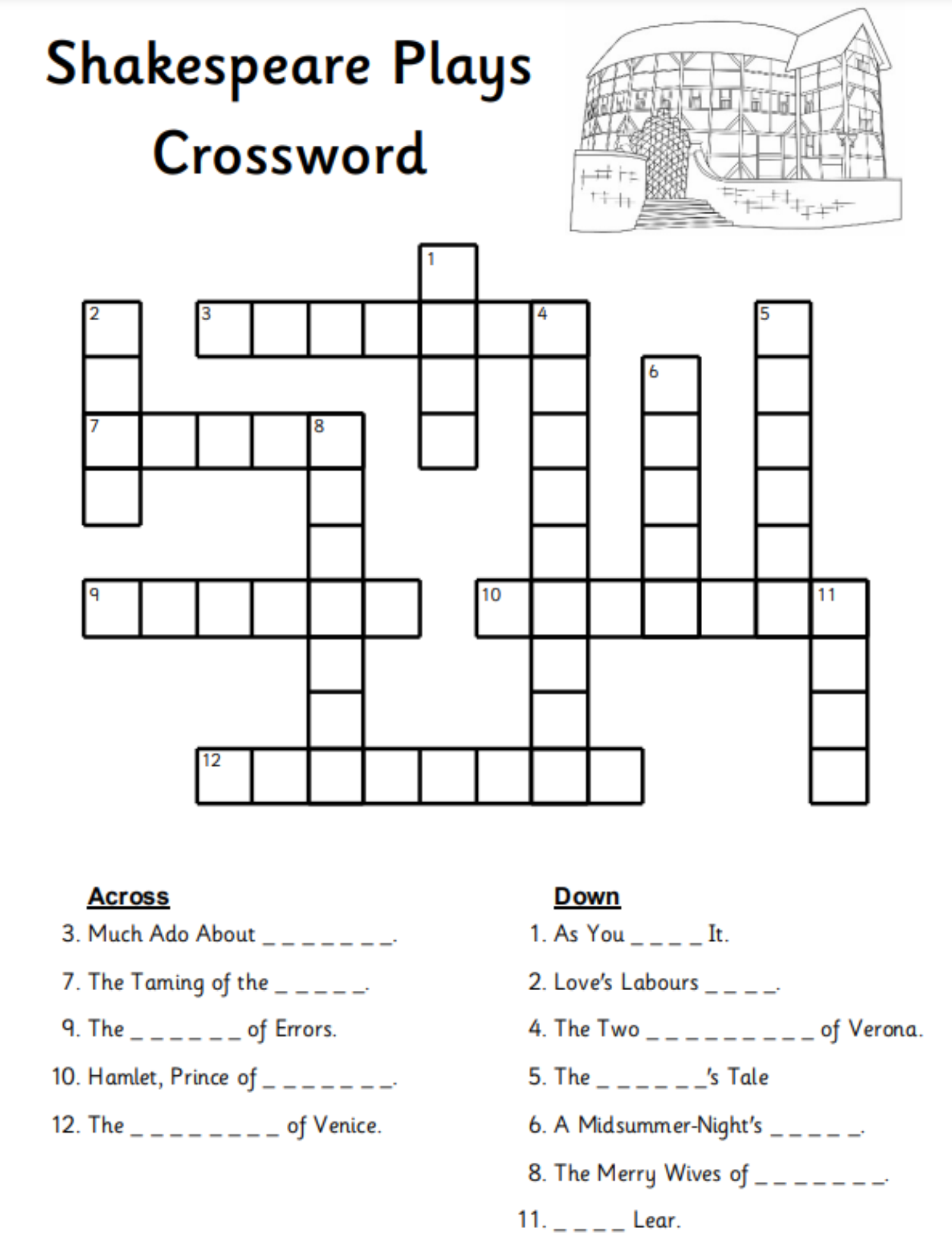
"Шекспиртану" авторлық бағдарламасы

Тақырып бойынша 31 материал табылды

"Шекспиртану" авторлық бағдарламасы

Материал туралы қысқаша түсінік
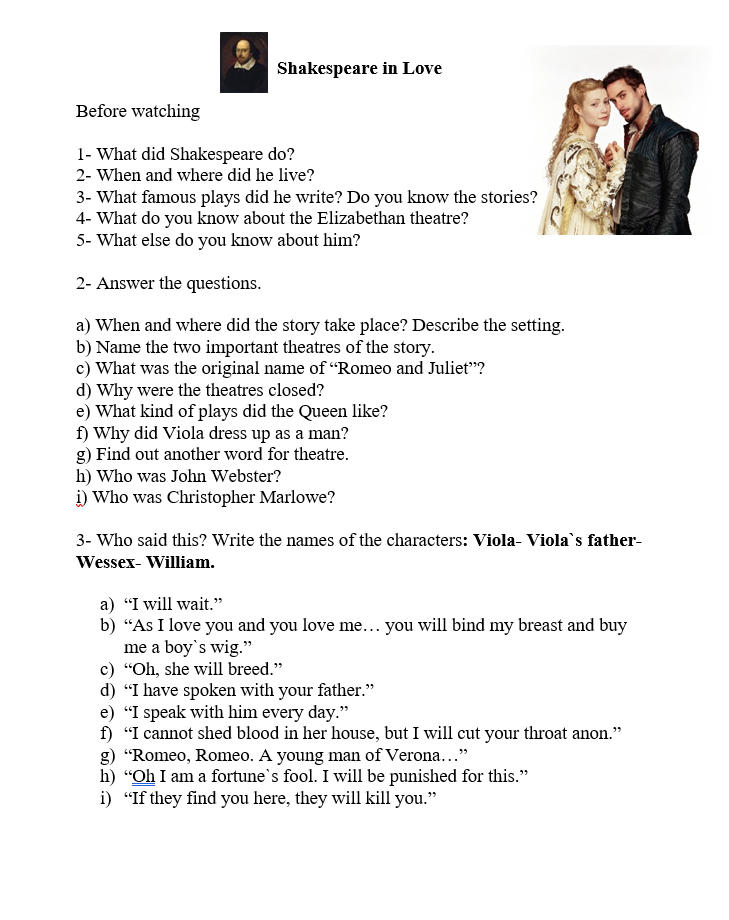
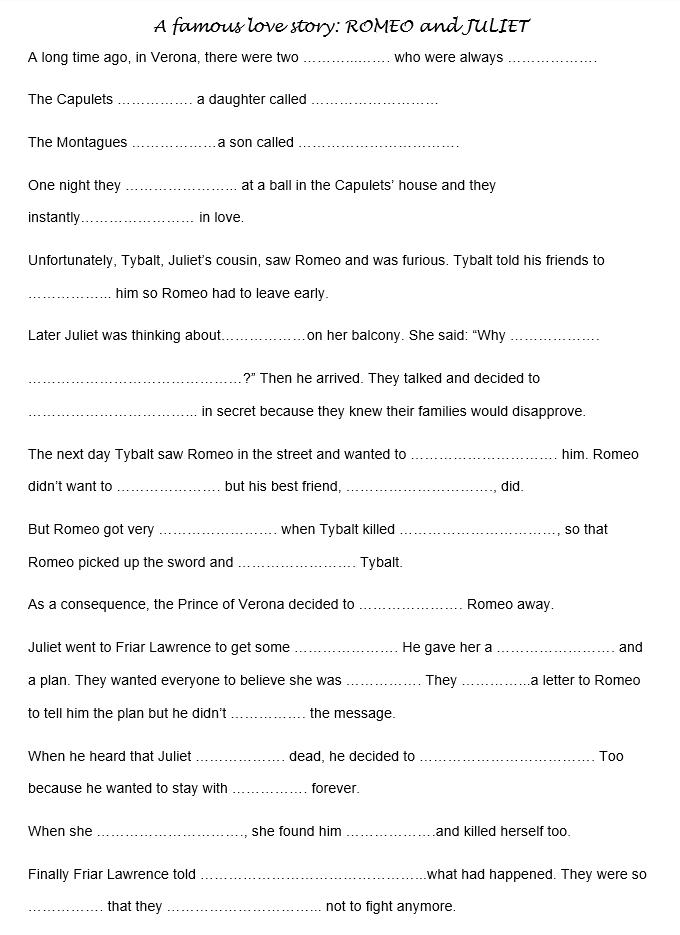
Бұл авторлық бағдарлама ағылшын тілі мен әдебиетін тереңдетіп оқитын оқушыларға арналған. Курс барысында Уильям Шекспирдің өмірі, шығармашылық мұрасы, драмалары мен сонеттері талданып, оның адамзат мәдениетіне қосқан үлесі зерттеледі. Бағдарламаның мақсаты — оқушылардың әдеби талдау дағдысын қалыптастыру, ағылшын тіліндегі түпнұсқамен жұмыс істеу арқылы тілдік және мәдени құзыреттерін дамыту. Курс зерттеу, шығармашылық және жобалық жұмыстарды қамтиды.
Материалдың қысқаша нұсқасы

Авторлық бағдарлама


ШЕКСПИРТАНУ


Бағдарлама жалпы орта білім беретін

мектептің 10-11 сынып оқушыларына

арналған.


Байзақ ауданы 2024ж


Жамбыл облысы әкімдігінің Білім басқармасы Байзақ ауданының

білім бөлімінің №2 орта мектебі КММ


ШЕКСПИРТАНУ


Бағдарлама жалпы орта білім беретін

мектептің 10-11 сынып оқушыларына

арналған.


Бағдарламаны әзірлеуші ағылшын тілі

пәнінің мұғалімі Байкеева Дана

Онгарбаевна


Байзақ ауданы 2024ж

«Шекспиртану»

10-11 сыныптар

Байкеева Дана Онгарбаевна


ҚАЗАҚСТАН РЕСПУБЛИКАСЫ

«ÓRKENIET» ҒЫЛЫМИ-ӘДІСТЕМЕЛІКТІҢ БАСПАСЫНА ҰСЫНЫЛДЫ



Рецензент:

Рецензенттер: «Órkenіet» ғылыми-әдістемелік орталығының аға ғылыми қызметкері
О.О.
Мұқатаев


Құрастырған: Жамбыл облысы, Байзақ ауданы №2 орта мектебінің ағылшын тілі пәні мұғалімі Байкеева Дана Онгарбаевна


© Қазақстан Республикасы «Órkenіet» ҚР ҒӘО, 2022ж.


3

Аңдатпа


Бұл авторлық бағдарлама ағылшын тілі мен әдебиетін тереңдетіп оқитын оқушыларға арналған. Курс барысында Уильям Шекспирдің өмірі, шығармашылық мұрасы, драмалары мен сонеттері талданып, оның адамзат мәдениетіне қосқан үлесі зерттеледі. Бағдарламаның мақсаты — оқушылардың әдеби талдау дағдысын қалыптастыру, ағылшын тіліндегі түпнұсқамен жұмыс істеу арқылы тілдік және мәдени құзыреттерін дамыту. Курс зерттеу, шығармашылық және жобалық жұмыстарды қамтиды.


Аннотация


Данная авторская программа предназначена для учащихся, углублённо изучающих английский язык и литературу. В ходе курса рассматриваются жизнь и творчество Уильяма Шекспира, анализируются его драмы и сонеты, а также их влияние на мировую культуру. Цель программы — развитие у учащихся навыков литературного анализа, формирование языковой и культурной компетенции через работу с оригинальными текстами. Курс включает исследовательские и творческие проекты.


Abstract


This author’s course is designed for students who study English language and literature in depth. It explores the life and works of William Shakespeare, focusing on his plays and sonnets as well as their impact on world culture. The main goal is to develop students’ analytical and critical thinking skills, enhance linguistic and cultural competence through original texts, and foster creativity through research and project-based learning.


Түсінік хат


Енгізу қажеттілігі мен өзектілігі

Қазіргі жаһандану дәуірінде ағылшын тілі мен мәдениетін терең меңгеру – әлемдік өркениетпен тең дәрежеде даму кепілі. Уильям Шекспир шығармалары – ағылшын тілінің көркемдік әлеуетін танытатын, адамзаттық құндылықтарды дәріптейтін мәңгілік мұра. Мектеп бағдарламасында Шекспирдің еңбектері шектеулі түрде қарастырылатындықтан, бұл авторлық курс оқушылардың әдеби және тілдік көкжиегін кеңейтуге, мәдениетаралық түсіністікті арттыруға бағытталған. Курс оқушылардың сыни ойлау, талдау және шығармашылық қабілеттерін дамыту қажеттілігінен туындаған.

Бағдарлама мақсаты:

Уильям Шекспирдің өмірін, пьесаларын, поэзиясын және прозасын зерттеу, сонымен қатар оның шығармаларында қолданған әдеби әдістерін анықтау.

Бағдарлама міндеттері:

  • Оқушыларды ұлы ағылшын драматургі У.Шекспирдің өмірбаяны мен шығармашылық жолының фактілерімен таныстыру.

  • Оқушыларды классикалық әдебиеттің жоғары үлгілерімен таныстыру.

  • Оқушылардың өз бетінше (зерттеу) жұмысқа деген ұмтылысын қолдау және дамыту.

  • Шекспир шығармашылығының әлем әдебиеті үшін маңызын анықтау.

Материалдарды жинақтау мен құрылымдаудың негізгі қағидаттары

«Шекспиртану» курсының материалдары оқушылардың жас ерекшеліктері мен танымдық мүмкіндіктеріне сай іріктелді. Курсты құрастыру барысында ғылыми негізділік, жүйелілік, сабақтастық және қолжетімділік қағидаттары басшылыққа алынды.

  1. Ғылыми негізділік – материалдар қазіргі шекспиртанудың жетістіктері мен әдебиеттану ғылымының талаптарына сүйене отырып таңдалды.

  2. Жүйелілік пен бірізділік – сабақтар тақырыптық және хронологиялық тәртіпте орналасып, біртіндеп күрделене түседі.

  3. Сабақтастық – курс мазмұны жалпы білім беретін мектеп бағдарламасындағы ағылшын тілі мен әдебиет сабақтарымен өзара байланыста қарастырылды.

  4. Қолжетімділік – оқушылардың деңгейіне сәйкес тілдік және мазмұндық материалдар пайдаланылды.

  5. Интерактивтілік пен шығармашылық бағыттылық – оқыту процесінде талдау, пікірталас, көрініс қою, эссе жазу сияқты әдістер арқылы оқушылардың қызығушылығы мен белсенділігі арттырылады.

Бұл қағидаттар курстың оқу-танымдық құндылығын арттырып, оқушылардың әдеби талдау дағдыларын дамытуды мақсат етеді.


Оқыту әдістері:
«Шекспиртану» курсын өткізу барысында оқушылардың шығармашылық және

сыни ойлау қабілеттерін дамытуға бағытталған заманауи әдістер қолданылады.

Атап айтқанда:

  • проблемалық және зерттеушілік әдістер;

  • жобалық жұмыс әдісі;

  • дебат және пікірталас технологиялары;

  • рөлдік және сахналық ойындар;

  • мәтінмен жұмыс, әдеби талдау және интерпретация әдістері;

  • топтық және жұптық жұмыс, «дөңгелек үстел» форматы.

Оқыту түрлері:

  • Дәріс және әңгімелеу сабағы – жаңа ақпаратпен таныстыру, тарихи және

  • мәдени контексті түсіндіру;

  • Семинар және практикалық сабақтар – талдау, салыстыру, пікір алмасу;

  • Шығармашылық сабақтар – эссе, сахналық көріністер, бейнежоба немесе

  • мультимедиялық таныстырылымдар дайындау;

  • Зерттеу және жобалық жұмыс – оқушылардың өз бетінше ізденісін

  • дамытуға бағытталған.

Оқу режимі:
Курс аптасына
1 рет, әр сабақтың ұзақтығы 40–45 минут. Жалпы көлемі – 34 сағат (1 оқу жылы).
Оқыту тілі –
ағылшын тілі

Сабақтар интерактивті тақта, мультимедиялық ресурстар мен онлайн платформаларды пайдалану арқылы өткізіледі.

Күтілетін нәтижелер:
«Шекспиртану» курсын аяқтаған соң оқушылардан келесі нәтижелер күтіледі:

  1. Білімдік нәтижелер:

    • Уильям Шекспирдің өмірі мен шығармашылығы туралы тереңірек білім алады;

    • Негізгі драмалары мен сонеттерінің мазмұны мен идеялық ерекшеліктерін талдай алады;

    • Шекспир шығармаларының ағылшын және әлем әдебиетіндегі рөлін түсінеді.

  2. Құзыреттік нәтижелер:

    • Әдеби мәтінді талдау, салыстыру және өз ойын дәлелдеп жеткізу дағдысын қалыптастырады;

    • Ағылшын тіліндегі түпнұсқамен жұмыс істей отырып, тілдік және мәдени құзыреттерін жетілдіреді;

    • Шығармашылық және зерттеу жобаларын өздігінен орындауға бейімделеді.

  3. Тәрбиелік нәтижелер:

    • Әлемдік мәдениетке құрмет, эстетикалық талғам, адамгершілік құндылықтар қалыптастырады;

    • Командалық жұмыс пен өзара ынтымақтастық дағдыларын дамытады.

Оқыту нәтижесін бағалау құралдары:
Бағалау жүйесі оқушылардың оқу жетістіктерін кешенді түрде анықтауға бағытталған:

  • ағымдық және жиынтық бағалау;

  • өзін-өзі бағалау және өзара бағалау парақтары;

  • тест тапсырмалары мен сұхбат әдісі;

  • шығармашылық жұмыстар (эссе, көрініс, бейнежоба, презентация);

  • зерттеу және жобалық жұмыстардың қорғауы;

  • портфолио (оқушы жетістіктерінің жеке жинағы).

Бағалау барысында оқушының жеке даму динамикасы, сыни және шығармашылық ойлау белсенділігі басты назарға алынады.


Бағдарламаның мазмұны

«Шекспиртану» курсының мазмұны оқушылардың ағылшын әдебиеті тарихындағы ең көрнекті тұлғаның өмірі мен шығармашылығын жан-жақты тануына бағытталған. Бағдарлама төрт тақырыптық бөлімнен тұрады:


I бөлім. Уильям Шекспир және оның дәуірі (3 сағат)

Бұл бөлімде оқушылар Уильям Шекспирдің өмірі мен шығармашылығымен танысады. Элизавет дәуірінің мәдениеті мен ағылшын Ренессансының ерекшеліктері

қарастырылады. Негізгі мақсат – оқушылардың қызығушылығын арттырып,

Шекспир шығармашылығын тереңірек зерттеуге негіз қалайды.

Негізгі дағдылар: тарихи контексті түсіну, сөздік қорды дамыту, пікірталас

мәдениеті.

II бөлім. Шекспир тілі мен тұрақты тіркестері (12 сағат)

Бұл бөлімде оқушылар Шекспирдің тіл ерекшеліктері мен оның енгізген тұрақты

тіркестерімен танысады. Сабақтар барысында мәтінді талдау, драма элементтерін

қолдану және цитаталардың мағынасын ашу жұмыстары жүргізіледі.

Негізгі дағдылар: мәтінді түсіну, идиомаларды қолдану, шығармашылықпен ойлау, рөлдік ойын.

III бөлім. Адам эмоциялары мен моральдық құндылықтар (10 сағат)

Бұл бөлімде Шекспир шығармаларындағы жалпыадамзаттық эмоциялар –

сүйіспеншілік, қызғаныш, кінә, мейірімділік және өршілдік тақырыптары қарастырылады. Оқушылар кейіпкерлердің моральдық таңдауларын талдап, қазіргі өмірмен байланыстырады.

Негізгі дағдылар: эмпатия, моральдық пайымдау, мәтіннен дәлел келтіру, мәнерлеп сөйлеу.

IV бөлім. Билік, қызғаныш және адам табиғаты (6 сағат)

Бұл бөлімде Шекспир кейіпкерлерінің билікке ұмтылысы, ішкі қайшылығы мен

қызғаныш сезімдері зерттеледі. Оқушылар бұл тақырыптарды өмірлік

жағдайлармен байланыстырып, пікірталас пен салыстыру әдістерін қолданады.

Негізгі дағдылар: сыни ойлау, салыстыру, аргументтеу, ауызша және жазбаша пікір білдіру.

V бөлім. Шекспир мұрасы және қорытынды (3 сағат)

Қорытынды бөлімде оқушылар Шекспирдің әлем әдебиетіне қосқан үлесін

талдайды. Оның сөздері мен идеяларының қазіргі өнер мен мәдениетке әсері

қарастырылады. Соңында шығармашылық жоба немесе рефлексиялық жұмыс

жасалады.

Негізгі дағдылар: қорытынды жасау, шығармашылық ойлау, өз ойын еркін жеткізу.

Әдістемелік нұсқаулар

1. Жалпы әдістемелік бағыт

«Шекспиртану» курсы пәнаралық және құндылыққа бағытталған тәсілге сүйенеді. Курсты өткізу барысында оқушылардың сыни ойлау, шығармашылық талдау және эстетикалық қабылдау қабілеттерін дамыту көзделеді. Негізгі әдістемелік ұстанымдар: тұлғалық-бағдарлы оқыту, коммуникативтік тәсіл және жобалық жұмыс. Мұғалім курсты жүргізу кезінде оқушылардың қызығушылығын арттыру үшін көркем мәтінмен жұмыс, пікірталас, сахналық қойылымдар және мультимедиалық құралдарды қолдану ұсынылады.

2. Кеңестер мен ұсыныстар

Сабақ басында оқушылардың фондық білімін анықтау үшін қысқа сұрақтар немесе ойын элементтерін қолданыңыз.

Әр бөлімде тарихи контексті көрнекілік арқылы көрсету маңызды (бейнефильм, сурет, карта, театр сызбалары).

Драмалық шығармаларды оқуда рөлдік ойын, сахналық көрініс әдістері тиімді.

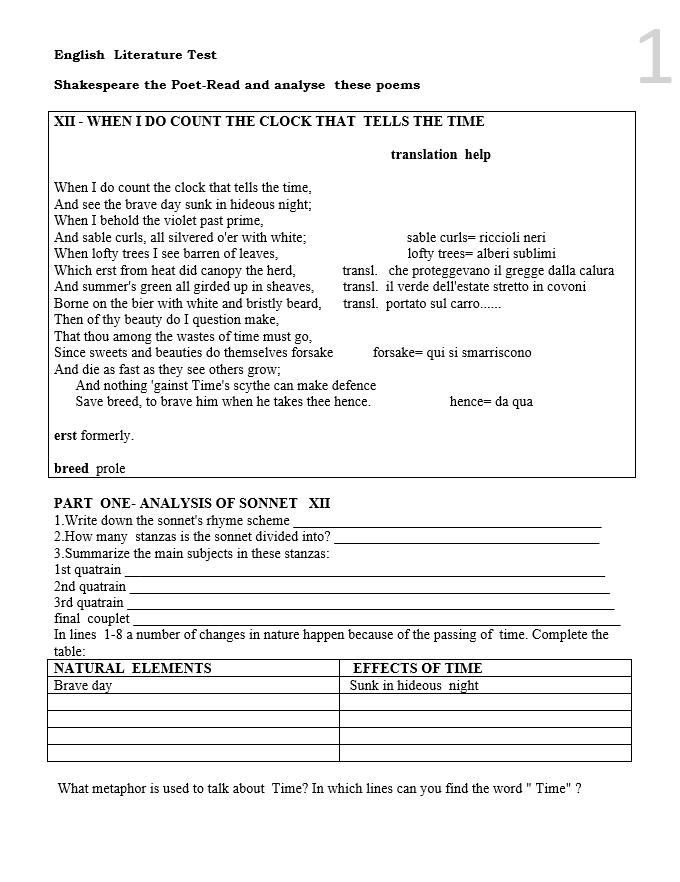
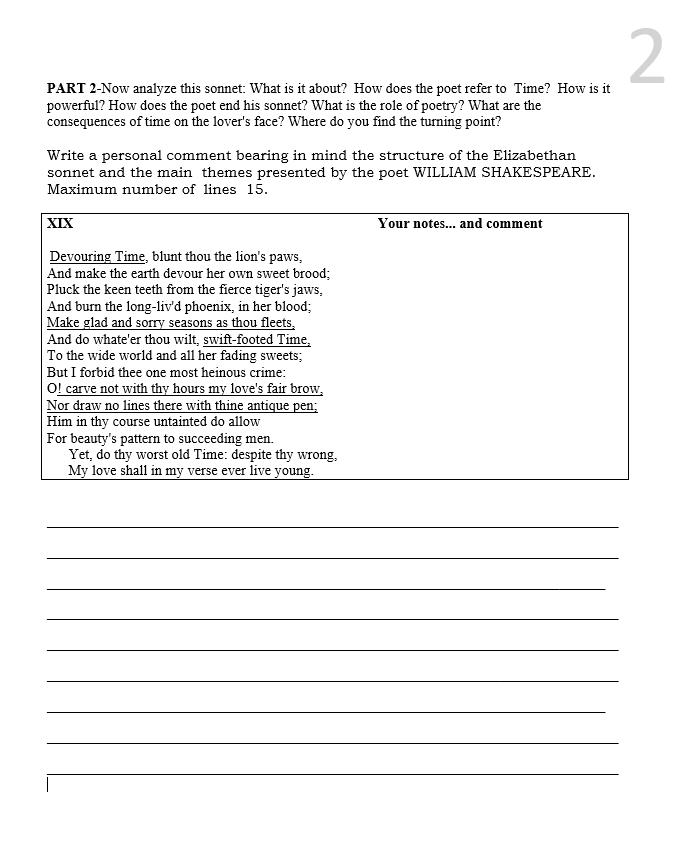
Сонеттерді талдауда сөздік қорды кеңейту және аударма талдау жұмысын ұйымдастыру ұсынылады.

Курстың соңында оқушылар өз жобаларын немесе көріністерін көпшілік алдында қорғауы керек – бұл шығармашылық еркіндік пен сенімділік дағдысын қалыптастырады.

3. Білім беру үдерісін ұйымдастыру құралдары

АКТ құралдары: интерактивті тақта, презентациялар, аудио және бейнематериалдар.

Оқыту платформалары: Wordwall, Quizizz, Padlet, Canva — интерактивті тест және постер әзірлеуге.

Әдеби материалдар: Шекспирдің түпнұсқа және бейімделген шығармалары, қазақ тіліндегі аудармалар, театр бейнежазбалары.

Бағалау құралдары: бақылау парақтары, өзін-өзі бағалау және топтық талқылау парақтары.

4. Сабақ түрлері

Дәріс-сабақ: жаңа тақырыпты теориялық тұрғыдан түсіндіру.

Семинар: мәтінді талдау және пікір алмасу.

Практикалық сабақ: сахналық көрініс, рөлдік ойындар, эссе жазу.

Зерттеу сабағы: кейіпкерлер мен тақырыптарды салыстырмалы талдау.

Жобалық сабақ: шығармашылық жұмыстар мен зерттеу жобаларын таныстыру.

Қорытынды сабақ: конференция, поэзия кеші немесе театр қойылымы түрінде өткізіледі.

5. Дидактикалық материалдар

Көркем мәтін үзінділері (драмалар мен сонеттер).

Сахналық репликалар мен диалогтар үлгілері.

Грамматикалық және лексикалық тапсырмалар.

Сюжеттік карталар мен кейіпкер талдау парақтары.

Дебат және талдау сұрақтары (мысалы: «Гамлеттің шешімсіздігі – әлсіздік пе, әлде парасат белгісі ме?»).

Жобаларға арналған нұсқаулықтар және бағалау рубрикалары.

Өзектілігі мен жаңалығы

Қазіргі білім беру жүйесінде әлемдік мәдениетті, рухани құндылықтарды және тұлғалық дамуды үйлестіре оқыту басты міндеттердің бірі болып табылады. Сол тұрғыдан алғанда, Уильям Шекспир шығармашылығын терең зерделеу — оқушылардың адамгершілік, эстетикалық және мәдени құзыреттілігін арттырудың тиімді жолы. «Шекспиртану» курсының өзектілігі — оқушыларды әлем әдебиетінің классикалық үлгілерімен таныстыру арқылы олардың тілдік дағдыларын жетілдіру, сыни және шығармашылық ойлау қабілеттерін дамыту, адамзаттық құндылықтарға негізделген тұлға қалыптастыру болып табылады. Курстың мазмұны оқушыны әдебиетті тек оқу пәні ретінде емес, өмірді түсінудің және өзін-өзі танытудың құралы ретінде қабылдауға жетелейді. Бағдарламаның жаңалығы — дәстүрлі әдеби талдауды заманауи педагогикалық технологиялармен және цифрлық ресурстармен ұштастыруында. Курста интерактивті әдістер, бейнежобалар, рөлдік ойындар, дебаттар мен мультимедиалық платформалар кеңінен қолданылады. Сонымен қатар, курс мазмұнында ағылшын және қазақ тілдеріндегі мәтіндерді салыстырмалы талдау, Шекспир шығармаларының қазіргі мәдениеттегі интерпретациясын зерттеу элементтері қамтылған. Осы арқылы бағдарлама оқушылардың тілдік, мәдени және коммуникативтік құзыреттіліктерін дамыта отырып, жаһандық ойлау мәдениетіне бейім тұлға қалыптастыруға бағытталған.

Ғылымилығы

«Шекспиртану» курсы мазмұны мен құрылымы жағынан ғылымилық қағидасына негізделген. Бағдарлама ағылшын және әлем әдебиетінің классикалық зерттеулеріне, әдебиеттану мен мәдениеттану ғылымдарының қазіргі бағыттарына сүйенеді. Курс материалы әдебиет тарихы, драматургия теориясы, поэтика және мәтінтану негіздері сияқты ғылыми ұғымдарды түсінуге мүмкіндік береді. Әр тақырып оқушылардың жас ерекшелігіне сай бейімделіп, көркем шығармаларды талдауда ғылыми ұстанымдарға — тарихи-салыстырмалы талдау, көркем бейне мен идеялық мазмұнды жүйелі қарастыру тәсілдеріне сүйенеді. Бағдарламада Шекспир шығармашылығын зерттеген әлемдік ғалымдардың (мысалы, Сэмюэл Джонсон, Гарольд Блум, Александр Аникст және т.б.) тұжырымдары ішінара ескеріліп, ғылыми көзқарасты оқушылардың зерттеу дағдыларымен ұштастыру мақсаты көзделген. Курс барысында оқушылар көркем мәтінді талдау, дәлел келтіру, салыстыру және қорытынды жасау сияқты зерттеушілік дағдыларды меңгереді. Бұл тәсіл оқушылардың әдеби білімін тереңдетіп қана қоймай, олардың логикалық, аналитикалық және мәдени танымдық ойлауын дамытады.

Мақсатқа бағытталуы

«Шекспиртану» курсы білім беру үдерісінің негізгі мақсаттарына сәйкес әзірленген және оқушылардың тілдік, мәдени және тұлғалық дамуын қамтамасыз етуге бағытталған. Бағдарламаның басты мақсаты — оқушылардың әлем әдебиетінің көрнекті өкілі Уильям Шекспирдің шығармашылығын терең танып, оны қазіргі өмірмен байланыстыра білу дағдыларын қалыптастыру. Курс мазмұны оқушылардың пәндік, зерттеушілік, коммуникативтік және мәдени құзыреттерін дамытуға бағытталған.
Осы мақсатқа жету үшін келесі міндеттер көзделеді:

  • Шекспир шығармалары арқылы адамгершілік, рухани және эстетикалық құндылықтарды түсіндіру;

  • Көркем мәтінді талдау және өз пікірін дәлелмен жеткізу дағдыларын дамыту;

  • Әдеби және мәдени мұраға құрметпен қарауды қалыптастыру;

  • Қазақ және ағылшын тілдерінде салыстырмалы талдау жүргізу арқылы тілдік дағдыларды жетілдіру;

  • Театр мәдениеті мен драмалық өнерге қызығушылықты арттыру.

Бағдарламаның мақсатқа бағытталуы оқушылардың шығармашылық ойлауын, өзіндік көзқарасын және әдебиетке деген жеке қатынасын қалыптастыруға мүмкіндік береді. Нәтижесінде оқушылар тек Шекспир шығармаларын танумен шектелмей, жалпыадамзаттық құндылықтарды түсініп, өз өмірінде қолдануға бейімделеді. «Шекспиртану» курсы оқушылардың теориялық білімдерін практикалық әрекет арқылы бекітуге және өмірлік тәжірибеде қолдануға бағытталған. Бағдарлама барысында оқушылар тек шығармаларды талдап қана қоймай, сол туындылардың идеяларын, кейіпкерлердің мінез-құлықтарын және өмірлік ұстанымдарын өз өмір тәжірибесімен байланыстырып үйренеді.

Курс мазмұны оқушылардың шығармашылық қабілеттерін дамытуға, коммуникативтік дағдыларын жетілдіруге және өмірлік құндылықтарды түсінуге бағытталған. Теориялық сабақтар мен практикалық жұмыстар (сахналық көріністер, дебаттар, эссе жазу, бейнежоба дайындау, зерттеу жобалары) арқылы оқушылар өз идеяларын еркін жеткізуге және топпен тиімді жұмыс істеуге дағдыланады.

Тәжірибеге бағытталған тәсіл оқушылардың:

  • әдеби мәтінді өмірмен байланыстыра талдауға;

  • көркем бейнелерді заманауи көзқарас тұрғысынан түсіндіруге;

  • театр мәдениеті мен шығармашылық ойлауға жақындасуына мүмкіндік береді.

Курс соңында ұйымдастырылатын «Менің Шекспирім» атты шығармашылық кеш пен жобалық конференция оқушылардың алған білімдерін тәжірибе жүзінде көрсетуіне жағдай жасайды. Осылайша, бағдарлама оқу процесін

өмірмен ұштастырып, оқушыларды белсенді, мәдениетті және ойлы тұлға ретінде қалыптастыруға ықпал етеді.

Жүйелілігі мен сабақтастығы

«Шекспиртану» курсы мазмұны жағынан жүйелі құрылымға ие және оқу процесінің логикалық бірізділігін қамтамасыз етеді. Бағдарлама бөлімдері мен тақырыптары бір-бірімен өзара сабақтасып, оқушылардың білімін біртіндеп тереңдетуге бағытталған. Курс құрылымы «қарапайымнан күрделіге», «теориядан тәжірибеге» қағидатына негізделген. Алғашқы бөлімдерде оқушылар Шекспирдің өмірі мен дәуірін танып-білсе, келесі кезеңдерде оның шығармаларының идеялық-көркемдік табиғатын талдауға және жеке шығармашылық жұмысқа көшуге мүмкіндік алады.

Сабақтастық қағидасы келесі бағыттарда көрініс табады:

  • Мазмұндық сабақтастық: әр бөлім алдыңғы тақырыптың логикалық жалғасы ретінде жоспарланып, оқушылардың әдеби-мәдени дүниетанымын кеңейтеді.

  • Әдістемелік сабақтастық: курстың барлық кезеңдерінде зерттеу, талдау, салыстыру және шығармашылық әдістері жүйелі қолданылады.

  • Тәрбиелік сабақтастық: Шекспир шығармалары арқылы адамгершілік, әділдік, жауапкершілік, сүйіспеншілік сияқты құндылықтар бірізді қалыптасады.

Осылайша, бағдарлама оқушылардың әдеби білімін тереңдетіп қана қоймай, олардың өмірлік және мәдени байланыстарды түсіну қабілеттерін жүйелі дамытуға ықпал етеді. Курстың мазмұны мектеп бағдарламасымен үйлесімде болып, жоғары сыныптардағы шетел әдебиеті мен тіл сабақтарымен табиғи байланыс орнатады.

Мақсатқа сәйкестігі және нәтижеге бағытталуы

«Шекспиртану» курсының мазмұны қойылған мақсаттар мен міндеттерге толық сай келеді және оқушылардың танымдық, рухани және шығармашылық дамуын қамтамасыз ететін барлық қажетті материалдарды қамтиды. Бағдарлама құрылымы Уильям Шекспирдің өмірі мен шығармашылығын жан-жақты танып-білуге, әдеби талдау дағдыларын қалыптастыруға және оқушылардың өздік ойлау қабілеттерін дамытуға бағытталған. Курс мазмұнына тарихи-мәдени контекст, көркем мәтінді талдау, драма және поэзия жанрларының ерекшеліктері, сондай-ақ шығармашылық жобалар енгізілген. Бұл элементтер оқушылардың теориялық білімін тәжірибемен ұштастырып, сыни ойлау, талдау және өз көзқарасын дәлелдей алу дағдыларын қалыптастыруға мүмкіндік береді.

Бағдарламаның нәтижеге бағытталуы оқыту соңында нақты оқу жетістіктерін айқындайды. Курс аяқталған соң оқушылар:

  • Шекспирдің өмірі мен шығармашылығы туралы жүйелі білімге ие болады;

  • Шекспир шығармаларындағы идеялар мен адамгершілік құндылықтарды түсініп, өмірлік тәжірибемен байланыстырады;

  • Көркем мәтінді талдай және салыстыра алады;

  • Әдебиетке деген қызығушылығы мен шығармашылық қабілеті артады;

  • Өз ойын еркін жеткізіп, мәдени коммуникация дағдыларын меңгереді.

Осылайша, курс мазмұны мен құрылымы оқушылардың тұлғалық дамуына және әлемдік мәдениетке құрметпен қарауына ықпал ететін нақты нәтижелерге қол жеткізуді көздейді.

Оқушылардың жасына сәйкестігі және мақсаттар мен нәтижелердің шынайылығы

«Шекспиртану» курсы 10-11 сынып оқушыларының жас ерекшеліктеріне сәйкес әзірленген. Бағдарлама мазмұны мен әдістемелік тәсілдері оқушылардың танымдық деңгейі, психологиялық қабылдауы және қызығушылық ерекшеліктері ескеріліп құрылды. Курс барысында оқушыларға күрделі әдеби ұғымдар біртіндеп, өмірмен және көркем бейнелермен байланыстыра түсіндіріледі. Шекспир шығармаларының негізгі тақырыптары — достық, адалдық, махаббат, әділдік, ар мен намыс — жасөспірімдер үшін түсінікті әрі тәрбиелік мәні зор құндылықтар болып табылады.

Оқу үдерісінде қолданылатын әдістер (диалог, пікірталас, рөлдік ойын, көрініс қою, шығармашылық эссе жазу) оқушылардың белсенділігін арттырып, өз ойын еркін жеткізуіне мүмкіндік береді. Көркем мәтіндерді бейімделген нұсқада пайдалану, бейне және аудиоматериалдармен жұмыс істеу балалардың қабылдау деңгейіне сай келеді және оқу үдерісін қызықты етеді.

Қойылған мақсаттар мен міндеттер оқушылардың даму деңгейіне сай, нақты және қолжетімді сипатқа ие.
Бағдарлама соңында күтілетін
нәтижелер де шынайы:

  • оқушылар әдебиетке деген қызығушылығын арттырады;

  • көркем мәтінді түсініп, өз пікірін білдіру қабілетін дамытады;

  • мәдени және адамгершілік құндылықтарды бойына сіңіреді;

  • топпен жұмыс істеу және шығармашылық өзін-өзі таныту дағдыларын меңгереді.

Осылайша, бағдарлама оқушылардың жасына лайық білім беру мазмұнын ұсына отырып, тұлғалық және шығармашылық әлеуетін ашуға жағдай жасайды.

«Шекспиртану» курсының мазмұны және мәтіндік материалдары оқушылардың жас ерекшелігіне сәйкес қазақ тілінің орфография, пунктуация және стиль нормаларына сай дайындалған. Бағдарламалық мәтіндер айқын, түсінікті және ғылыми тілде баяндалған, сонымен бірге көркем әдебиет ерекшеліктерін сақтай отырып ұсынылған.

Курс барысында қолданылатын тапсырмалар мен мәтіндер оқушылардың тілдік құзыреттілігін дамытуға бағытталған:

  • әдеби мәтінді талдау кезінде сөздік қорын кеңейту;

  • әдебиеттану және драматургияға қатысты терминологияны меңгеру;

  • өз ойын жазбаша және ауызша дұрыс жеткізу;

  • шығармашылық тапсырмаларда тілдік сауаттылық пен стильдік үйлесімділікті сақтау.

Сонымен қатар, мәтіндерді ағылшын тілінен аудару және салыстырмалы талдау жүргізу оқушылардың шет тілін меңгеру дағдыларын арттыруға мүмкіндік береді.
Барлық материалдар мектеп бағдарламасының талаптарына және заманауи әдістемелік стандарттарға сай құрылып, тілдік нормаларды сақтау арқылы білім беру үдерісінің сапасын қамтамасыз етеді.


«Шекспиртану» курсының тақырыптық-күнтізбелік жоспары

(34 сағат)

Оқу жылы: 2025–2026

Аптасына: 1 сағат

Барлығы: 34 сағат

Lesson Topic

Hours

Lesson Objective

Expected Outcomes

Teaching Methods / Activities

Resources

1

Introductory lesson

1

Introduce students to the course and William Shakespeare’s legacy.

Students understand course objectives and show curiosity about Shakespeare’s life and works.

Discussion, brainstorming, quiz

Presentation, posters

2

As Dead as a Doornail

2

Understand idiom meaning and origin in Shakespeare’s works.

Students explain and use the idiom correctly in sentences.

Vocabulary work, role play

Worksheet, video

3

Greek to Me

2

Explore the concept of misunderstanding and idiomatic expressions.

Students interpret the idiom’s meaning and context through examples.

Pair work, translation challenge

Handout, dictionary

4

Wild-Goose Chase

2

Identify idioms related to futile efforts or pursuits.

Students act out short dialogues to express the idiom.

Role play, storytelling

Pictures, video

5

All That Glisters Is Not Gold

2

Analyze the theme of appearances vs. reality.

Students explain the proverb’s moral through examples.

Discussion, creative writing

Poster, worksheet

6

I'll Send Him Packing

2

Recognize idiomatic expressions related to dismissal or rejection.

Students use the idiom in modern conversation.

Pair work, skit performance

Cards, projector

7

A Pound of Flesh

2

Discuss justice, revenge, and morality through Shakespeare’s phrases.

Students explain the moral meaning of the idiom in context.

Debate, role play

Text extract, video clip

8

A Fool's Paradise

2

Explore the meaning of false happiness and illusions.

Students analyze and dramatize situations showing false hopes.

Creative role play, discussion

Worksheet, props

9

Not Budge an Inch

2

Learn about determination and stubbornness through language.

Students act out a scene using idiom-based dialogue.

Pair activity, improvisation

Handout, flashcards

10

I Must Be Cruel, Only to Be Kind

2

Interpret moral dilemmas in Shakespeare’s lines.

Students explain paradoxical meanings in literature.

Critical discussion, text analysis

Extract from Hamlet

11

Wear My Heart on My Sleeve

2

Understand openness and emotional honesty in characters.

Students write and present short monologues.

Creative writing, drama

Notebook, stage props

12

What's Done Is Done

2

Examine the concept of guilt and acceptance.

Students connect the phrase to modern contexts of responsibility.

Group discussion, reflection

Video, whiteboard

13

The Green-Eyed Monster

2

Analyze jealousy as a destructive emotion.

Students identify examples of jealousy in literature and life.

Debate, storytelling

Slides, text excerpts

14

The World's Mine Oyster

2

Explore opportunity and ambition in Shakespeare’s language.

Students discuss personal dreams inspired by this phrase.

Motivational talk, reflection

Visual aids, worksheet

15

A Tower of Strength

2

Study symbols of strength and resilience in literature.

Students describe strong characters and create posters.

Group work, presentation

Poster paper, markers

16

Spotless Reputation

2

Explore honor and moral integrity in Shakespeare’s plays.

Students reflect on the importance of reputation in society.

Discussion, essay writing

Notebook, handout

17

Shakespeare and Comedy / Final Lesson

2

Summarize course learning and celebrate Shakespeare’s creativity.

Students perform scenes and present reflections on their learning.

Performance, peer feedback

Costumes, stage, certificates


Қысқа мерзімді жоспар үлгілері

Theme of the Lesson: As dead as a doornail


Aims: Students will…

  • practise listening for gist and detail in the context of a short animation about Shakespeare’s life, language and plays.

  • understand the meaning, use and form of the phrase as dead as a doornail.

  • be able to understand and use further idioms using the word 'dead'.

Expected result:

All students: Tells the theme and reveals the main idea Majority of students: Performs tasks of a creative nature Some students: Draws conclusions on the topic

Plan

The stages of the lesson

Student actions in the classroom

Resource s

The beginning of the lesson 5 minutes


Lead in


  • Introduce students to the characters Will (William Shakespeare) and Thomas Swann and explain that they are going to watch a short animation starring Will and Thomas.

  • Start and pause the video at 00.11 seconds with Will writing and Thomas hammering. Put students into groups to discuss what they can see in this opening scene.

  • Feedback and elicit key vocab: a hammer, a nail, DIY, fix, a play, a playwright.


http://w ww.bbc.
co.uk/lea rningeng lish/engli sh/course /shakesp eare/unit
-
1/session
-3

Physical minute

The middle of the lesson 30 minutes


Task A: Gist

Set this gist question for students to answer as they watch the animation:


How does Thomas help Will with his new play?

  • Play video from beginning to end.

  • Ask students to compare their answers in pairs then check answer as a class.


7


Answer Will sees Thomas hammering a nail into a door and it gives him the idea for the phrase as dead as a doornail, which he uses in his play Henry VI part II. Task B: Detail

  • Hand out worksheets (pages three-five of this lesson plan). Give students a few minutes to read the questions in Task B and then play the video again.

  • Students discuss answers in pairs and give reasons. Then check answers together as a class.


Answers

1) What kind of play is William Shakespeare writing? A history play.

  1. What is Thomas Swann’s job? He’s an actor. (He’s building, but this is not his job.)

  1. How is Shakespeare's character, Jack Cade, feeling?

Weak and hungry.

4) What does Jack Cade threaten to do to his enemies? He threatens to kill them.

He says he will leave them all as dead as a doornail!

  1. Where are William and Thomas going at the end of this
    video?
    To the Duck and Whistle their favourite pub.


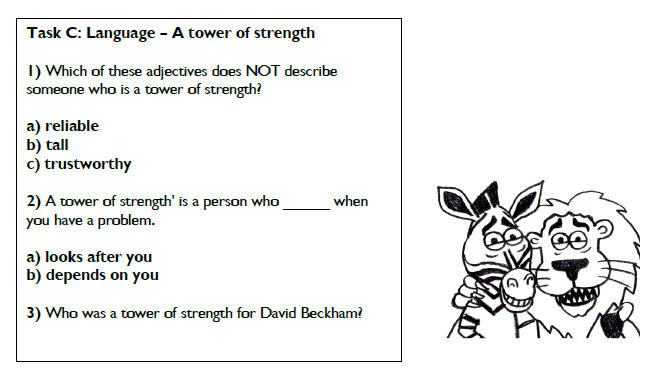
Task C: Language As dead as a doornail

  • Give students a few minutes to discuss answers to Task C in pairs.

  • Play the narrator section from 02.23 to 03.05 for students to check answers. Check as class.


Answers

The phrase as dead as a doornail

  1. had the same meaning in Shakespeare’s day as it has today. True

  1. means: nearly dead. False

  1. can only be used to describe people. False

  1. can also be used for electrical items that don't work.

True


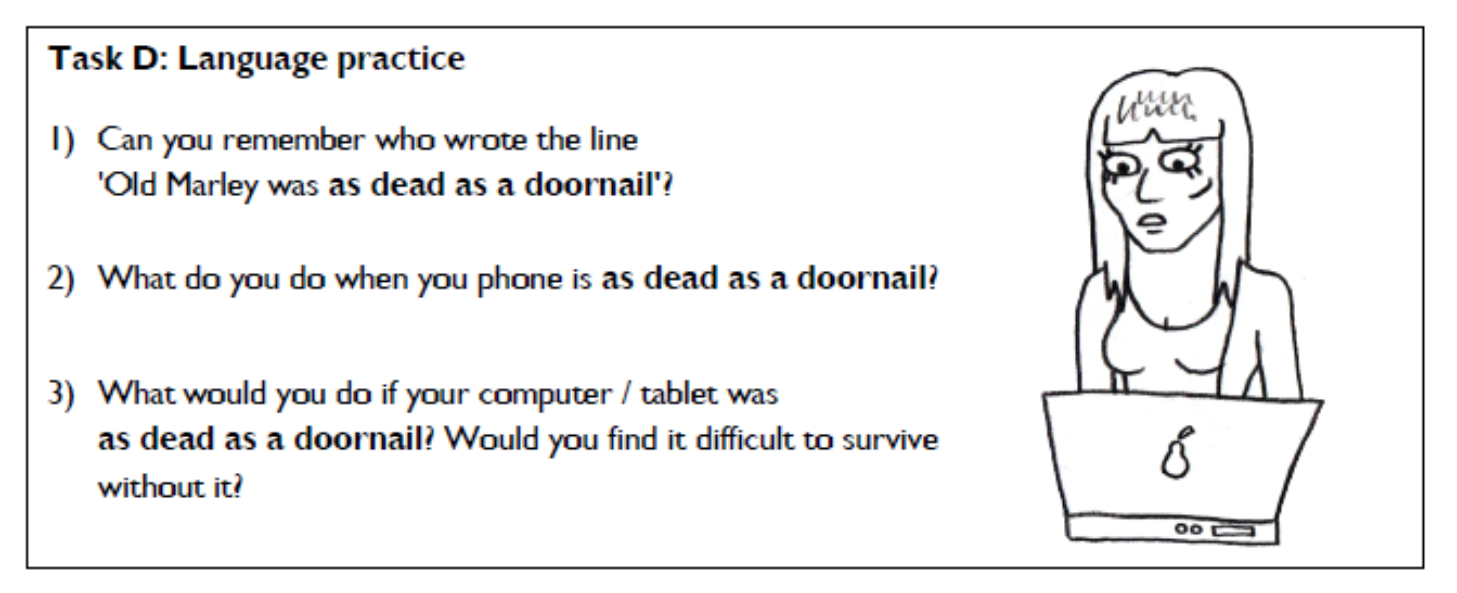
Task D: Practice

  • Students change partners and discuss questions in pairs / small groups.

  • Check students are using as dead as a doornail correctly. In feedback you could highlight that this is a simile and elicit other examples of similes. (as good as gold, as white as snow)


8


Task E: Reading

  • Students read the conversation and then discuss the gist question with their partner.


Answer They are chatting about Alice’s new boyfriend. Task F: Dead idioms

  • Put students into new pairs to match the 'dead' idioms with the definitions. Encourage students to use the context of the dialogue to help them.

  • Check answers and ask concept check questions to clarify meaning. Answers


1B 2E 3D 4C 5A


The end of the lesson 5 minutes

Extra practice ideas

  • Practise the 'dead' idioms with a game from Eight Vocabulary Activities.

  • Students to read the conversation aloud with their partner and then from memory.


Task G: Discussion

  • Students mingle around the classroom and ask classmates these questions. Encourage students to give reasons for answers. Tell them to try and find at least one person who has the same answer as them and to ask follow-up questions.

  • Students share interesting answers. Focus on any good examples of language and any errors you wish to correct with the class.


Theme of the Lesson: Greek to me


Aims: Students will…

  • listen for gist and detail in the context of a video about Shakespeare’s life, language and plays.

  • understand the meaning, use and form of the idiom Greek to me.Shape1

  • be able to understand and use phrases to talk about understanding and not understanding.

Expected result:

All students: Tells the theme and reveals the main idea Majority of students: Performs tasks of a creative nature


9


Some students: Draws conclusions on the topic

Plan

The stages of the lesson

Student actions in the classroom

Resources

The beginning of the lesson 5 minutes


Task A: Lead in and gist

  • Play the video on mute from the start to 00:38 and ask students to discuss in pairs what is happening at the fair.

  • Pause video on 00:38 and elicit what is happening and key vocabulary ('fortune teller' and 'have fortune told'.) Ask students to discuss if they have ever had their fortune told.

  • Students then predict what the fortune teller is telling Daughter in this scene. Elicit ideas.

  • Set the gist question and then play the video from start to end for students to answer:


Why is Daughter looking unhappy while she is having her fortune told?

  • Students check answers in pairs and then as a class.


Answer Daughter doesn't understand what the fortune teller is saying because of her strange accent.

http://ww
w.bbc.co. uk/learnin genglish/e nglish/cou rse/shakes peare/unit
-
1/session-22

Physical minute

The middle of the lesson 30 minutes


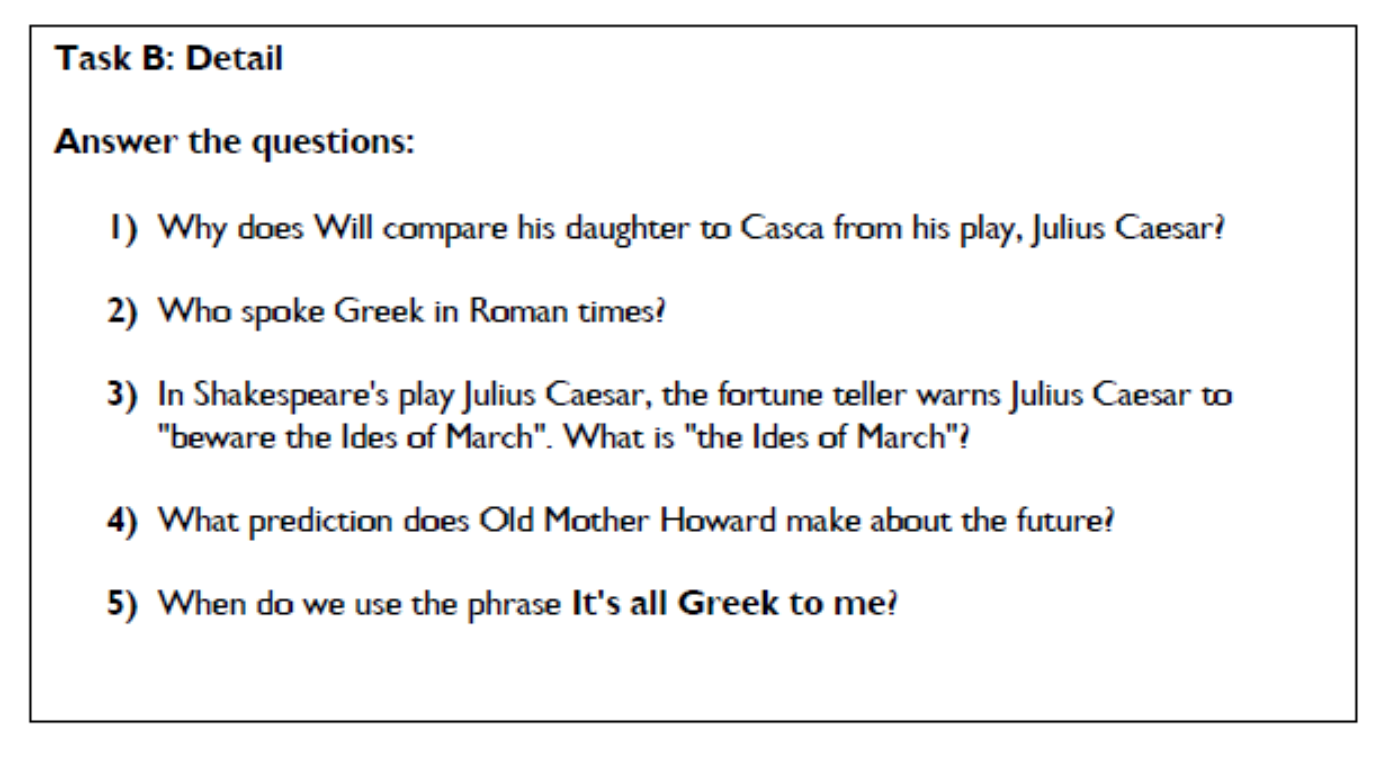
Task B: Detail

  • Give students a few minutes to read the detailed questions in task B and then play the video again for students to answer the questions.

  • Students discuss answers in pairs and then check answers as a class.


Answers

1) Why did Will compare his daughter to Casca from his play, Julius Caesar? Because they both had difficulty understanding someone.

  1. Who spoke Greek in Roman times? People with an education.

  1. In Shakespeare's play Julius Caesar, the fortune teller warns Julius Caesar to "beware the Ides of March". What is "the Ides of March"? The day Julius Caesar was killed by his friends.


10


  1. What prediction does Old Mother Howard make about the future? Was she correct? William Shakespeare is going to be very famous one day. Yes, she was correct!


  1. When do we use the phrase 'It's all Greek to me'? When we have difficulty understanding something or
    someone.

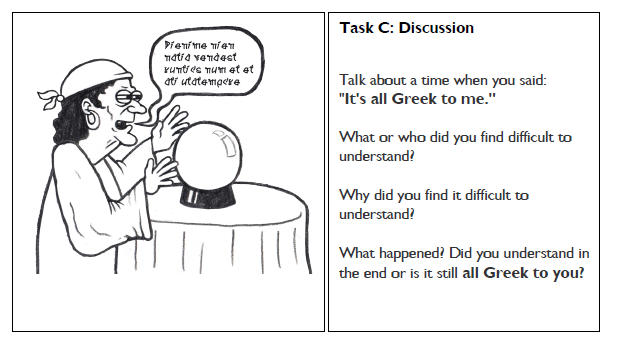
Task C: Discussion

  • Ask concept check questions to ensure students

have understood the phrase it was all Greek to me. Clarify that it is used when we don't understand something - not only for foreign languages. You can play the narrator section of video again if necessary.

  • Give students time to make notes on the topic and then put students into groups to discuss.

  • Focus on any good examples of language and any errors to correct.


Task D: Country / city / nationality idioms

  • Tell students that each idiom includes a country, city or nationality. The meaning of the idiom / phrase is given in brackets. In pairs they predict what word goes in each space.

  • Play the audio on this page and students complete the sentences with the words they hear.
    http://www.bbc.co.uk/learningenglish/english/cours e/shakespeare/unit-1/session-7/activity-3

  • Check answers and clarify the meaning and pronunciation of each phrase.


Answers 1) I can’t let you pay for the whole bill, let’s go Dutch 2) I’m so sorry I’m late; I couldn’t get away from Lara. She can talk for England! 3) I don't normally have a sleep after lunch, but when in Rome ... 4) I’m not ready for the winter; I hope we have an Indian summer again this year. 5) Excuse my French, but Tom's a complete idiot! 6) Before Max gave the speech he had a couple of drinks for Dutch courage.

  • Encourage students to repeat the phrases after the audio to practise pronunciation.

  • Play a revision game from the handout 'Eight
    Vocabulary activities' to practise the phrases. Task E: Sayings and expressions


11


  • Put students into small groups and give each group a set of seven cards with one expression on each card. (Expressions can be found in table below.)

  • Students work together to separate phrases into two piles one for phrases meaning 'I understand' and one for phrases meaning 'I don't understand'.

  • Then play audio from this page for students to listen and find out:
    http://www.bbc.co.uk/learningenglish/english/cours e/shakespeare/unit-1/session-22/activity-3

  • Students discuss in pairs: which people are saying they understand and which are saying they didn't understand?


The end of the lesson 5 minutes

Further practice

Put students into small groups and ask them to discuss the following topics:

  1. A set of instructions which you couldn't make head nor tail of.

  1. A subject at school that went completely over your head.

  1. A story that you got the gist of.

  1. A piece of information you received which was crystal clear

  1. Something which is complete gobbledygook to you.

  • Share interesting stories as a class.

  • Focus on any good examples of language and any errors to correct.


Theme of the Lesson: Wild-goose chase


Aims: Students will…

  • listen for gist and detail in the context of a video on Shakespeare’s life, language and plays.

  • understand the meaning, use and form of the phrase wild-goose chase.

  • be able to understand and use a range of animal idioms.

Expected result:

All students: Tells the theme and reveals the main idea Majority of students: Performs tasks of a creative nature Some students: Draws conclusions on the topic

Plan


12


The stages of the lesson

Student actions in the classroom

Resources

The beginning of the lesson 5 minutes

Task A: Lead in and gist

  • Put students into small groups and tell them to discuss what they know about Romeo and Juliet. Then share answers as a class.

  • Set this gist task: As you watch the video, decide who is in love and who isn't.

  • Play the video from beginning to end.

  • Students check answers in pairs before comparing as a class.

Answer Daughter has a crush on Robert, but it doesn't look like Robert feels the same way. Will is hopefully in love with Mrs Shakespeare, but we don't learn about his love life in this video!

http://ww
w.bbc.co. uk/learnin genglish/e nglish/cou rse/shakes peare/unit
-
1/session-8

Physical minute

The middle of the lesson 30 minutes


Task B: Detail

  • Give students a few minutes to read the questions and then play the video again for students to choose true or false. Encourage them to note down reasons for their choices

  • Students discuss choices in pairs and then check answers as a class.


Answers

  1. Robert enjoys adventure sports. True

  1. In Shakespeare's time, a wild-goose chase involved chasing geese. False it was a horse race.

  1. In a wild-goose chase, riders had to try to overtake the horse in the lead. False (they had to keep up with it.)

  1. In the scene from Romeo and Juliet, Romeo and Mercutio compete to find out who is stronger. False

  1. Romeo is more intelligent and is funnier than Mercutio. True


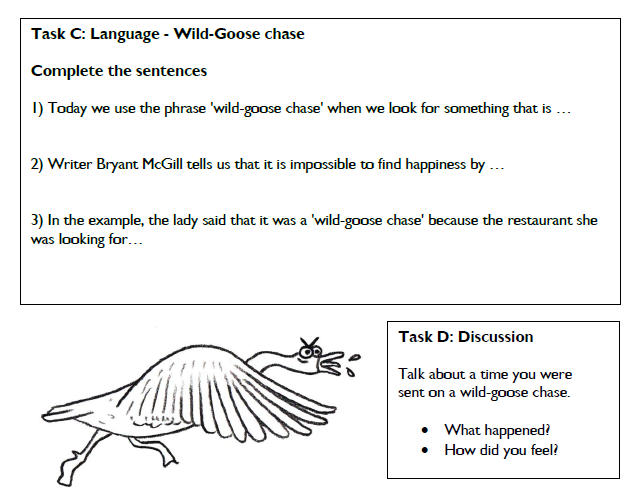
Task C: Language

  • Give students a few minutes to read Task C and discuss the answers in pairs.

  • Play the narrator section for students to check their answers. Then check as a class.


Answers


13


  1. Today we use the phrase 'wild goose chase' when we look for something that is impossible to find.

  1. Writer Bryant McGill tells us that it is impossible to find happiness by having lots of possessions.

  1. In the example, the woman said that it was a 'wild- goose chase' because the restaurant she was looking for

didn't exist / had closed down.


Task D: Discussion

  • Give students time to prepare and then put them into new groups to share stories.

  • Feedback answers and focus on any good examples of language as well as error correction.


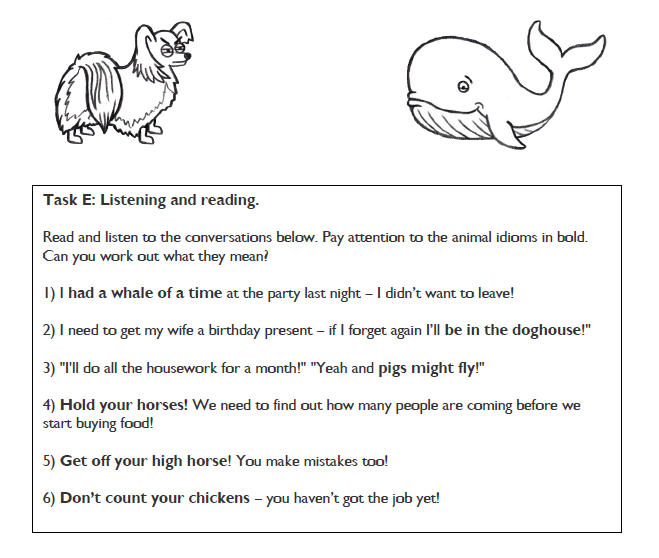
Task E: Listening and reading

  • Put students into new groups and ask them to share any other animal idioms they know (you could introduce rat race as an example).

  • Play the audio from this webpage (or ask students to read aloud).
    http://www.live.bbc.co.uk/learningenglish/english/ course/shakespeare/unit-1/session-8/activity-3

  • Students listen to and read the conversations and then discuss the meaning of the idioms in groups
    (don't
    check answers at this point check after task F).


Task F: Animal idioms

  • Students work alone to match the idioms to the definitions, using the dialogues to help.

  • Check answers in pairs and then as a class and ask further concept questions.

Answers 1F, 2D, 3B, 4C, 5A, 6E


The end of the lesson 5 minutes

Task G: Writing and speaking

In new pairs, students write their own dialogue using the animal idioms and then perform it for the class
(from
memory if possible). Students can vote on the best dialogue.

Carry out error correction and praise good language.

Extra task: students look at the animals on worksheet two and try to remember the idioms.


14


Theme of the Lesson: All that glisters is not gold Aims: Students will…

  • listen for gist and detail in the context of a video on Shakespeare’s life, language and plays.

  • understand the meaning, use and modern form of the phrase All that glitters is not gold.

  • be able to understand and use idioms and phrases relating to appearance.

Expected result:

All students: Tells the theme and reveals the main idea Majority of students: Performs tasks of a creative nature Some students: Draws conclusions on the topic

Plan

The stages of the lesson

Student actions in the classroom

Resources

The beginning of the lesson 5 minutes

Task A: Lead in and gist

  • Start video at 01.24 and pause it. In pairs students describe the three boxes on the screen and discuss which one they would choose to open and why.

  • Elicit answers from the class and check the adjectives 'gold', 'silver' and 'lead'.

  • Hand out worksheet (pages three and four of this document) and give students some time to read Task A. Check students understand the meaning of
    'bargain'
    and 'deceiving'.

  • Play the video from beginning to end and students choose the best summary and why.

  • Students check answers in pairs before comparing as a class.


Answer: B) Appearances can be deceiving. Shakespeare’s daughter and the Prince of Morocco both learn that just because something looks valuable, it doesn’t mean that it really is.

http://ww
w.bbc.co. uk/learnin genglish/e nglish/cou rse/shakes peare/unit
-
1/session-5

Physical minute

The middle of the lesson 30 minutes


Task B: Detail

  • Give students a few minutes to read the questions and then play the video again for students to mark true or false. Encourage them to also note down why.

  • Students discuss answers in pairs and then check answers as a class


Answers


15


  1. Shakespeare’s daughter bought an expensive gold ring.

False (She bought the ring from the market, because it was cheaper than the gold merchant.)

  1. Shakespeare thinks his daughter is a little naive. True
    (Will says 'My dear daughter, you have a lot to learn.')

  1. Shakespeare’s daughter is attracted to things which look beautiful. True (Daughter chooses the gold box because it’s the most beautiful.)


  1. In Shakespeare's play, The Merchant of Venice, Portia hides inside one of three boxes. False (There’s a picture of Portia in the box - not the lady herself!)

  1. In Shakespeare's play, the Prince of Morocco chooses the right box, so he can marry Portia. False (The prince chooses the wrong box so he cannot marry Portia.) Task C: Language: All that glitters is not gold

  • Students read the sentences and discuss answers in pairs from memory.

  • Play the narrator section from 02.25 to 03.04 for students to check answers. Answers

  1. 'All that glitters is not gold' means that not everything that glitters is gold.

  1. 'All that glitters is not gold' warns us that: Things that look good on the surface are not always good on the inside.

  1. All that glitters is not gold’ can be used to talk about people and things.

  1. Glisters is NOT normally used by modern English speakers.


The end of the lesson 5 minutes

Task D: Discussion

  • Give students time to prepare and then put them into new groups to share stories.

  • Feedback answers and focus on any good examples of language and any errors to correct


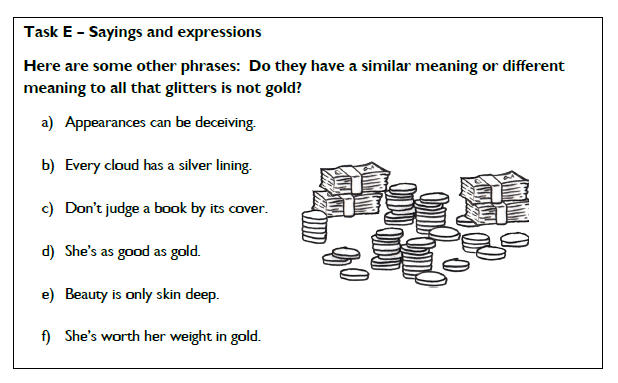
Task E: Vocabulary Extension

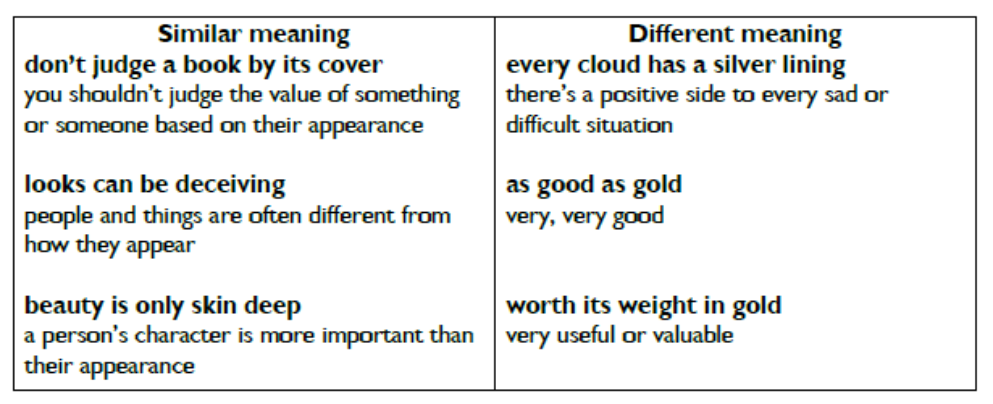
  • Tell students that you are going to explore some more English sayings. Students work in groups to decide which phrases have a similar meaning to all that glitters is not gold.

  • Check answers as a class and then students discuss in groups the other sayings.


16


Theme of the Lesson: I'll send him packing


Aims: Students will…

  • practise listening for gist and detail in the context of a short animation about Shakespeare’s life, language and plays.

  • understand and practise the meaning, pronunciation and form of I’ll send him packing.

  • understand and practise phrases to send someone away.

Expected result:

All students: Tells the theme and reveals the main idea Majority of students: Performs tasks of a creative nature Some students: Draws conclusions on the topic

Plan

The stages of the lesson

Student actions in the classroom

Resources

The beginning of the lesson 5 minutes


Task A: Prediction and gist

  • Start and pause video at 00.11. Ask students to discuss these questions in pairs:


Where is this? What do you think is happening inside the building?

  • Ask students to share predictions as a class and then play video from beginning to end

  • for students to answer the two questions.

  • Ask students to compare their answers in pairs then check answer as a class.


Answer

The building in the picture is the Globe Theatre in London. Inside, William Shakespeare and his actors are rehearsing. Check students understand the meaning of to rehearse and stage.

http://ww
w.bbc.co. uk/learnin genglish/e nglish/cou rse/shakes peare/unit
-
1/session-4


17


Physical minute

The middle of the lesson 30 minutes


Task B: Detail

  • Hand out worksheet (pages three and four of this document.) Give students a few minutes to read the sentences in Task B.

  • Play the video again for students to circle the correct answers.

  • Students discuss answers in pairs and then check answers as a class.

Answers


  1. Gravity has come to deliver a message.

  1. Prince Hal and Falstaff want Gravity to go away.

  1. Prince Hal and Falstaff want Gravity to leave because

they are having fun.

  1. Falstaff is popular because he is funny.

  1. Prince Hal prefers to spend time with criminals. Task C: Language - I'll send him packing

  • Put students into new pairs and ask them to complete the sentences in Task C about the phrase

I'll send him packing.

  • Play the narrator section from 02.42 to 03.22 for students to check answers. Then check answers as a class.


Answers

1) We use the phrase 'I'll send him packing' when we want someone to leave.

  1. The phrase 'I'll send him packing' means: I'm going to make this person go away.

  1. We can also use 'I'll send him packing' in sport to say we will beat an opponent."

  1. Complete the sentence: My boyfriend said he didn't want to get married - so I sent him packing.

  1. She was always late for work - so I had to send her packing."

  1. We're going to beat the other team, we'll send them packing."

Drill the pronunciation and different forms of the phrase I’ll send him packing.


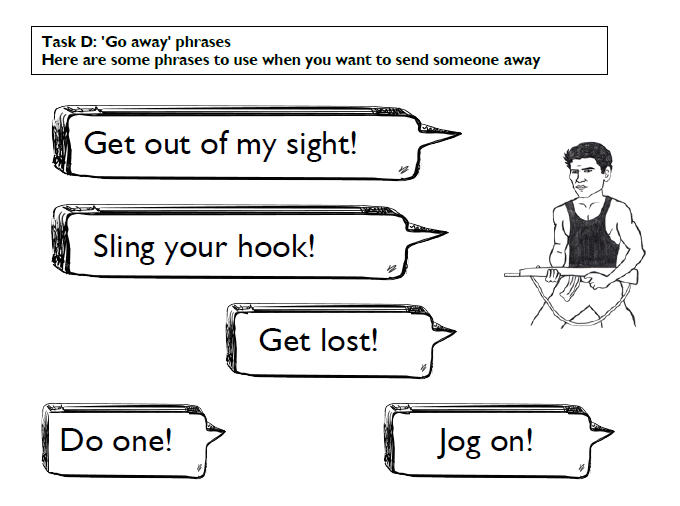
Task D: 'Go away' phrases

  • Elicit from students different ways to say 'go away'.


18


  • Students turn over worksheet to find out some ways to send someone packing. Practise the pronunciation together as a class.

  • If you have access to the audio on BBC Learning English site, use it to model pronunciation.
    (http://www.bbc.co.uk/learningenglish/english/cour se/shakespeare/unit-1/session-4/activity-3)

  • Put students into pairs and tell them to practise the phrases by telling each other to go away. Remind them to sound annoyed!


The end of the lesson 5 minutes

Task E: Discussion

  • Tell students to read the instructions in Task E. Give them time to think about their story and prepare what they want to talk about.

  • Put students into two groups and ask them to stand up. Have half the class make a small ring in the middle, with their backs to the centre, and have the other half find a partner in this ring and stand facing them (so the outside ring are facing the centre of the circle.) Students tell their story to the person facing them. After a few minutes move the outer circle round one space and the students now tell their story to their new partner. Continue until everyone has had the chance to tell their story a few times.

  • Feedback by praising good language and correcting errors as a class.


Theme of the Lesson: A pound of flesh


Aims: Students will…

  • listen for gist and detail in the context of a video on Shakespeare’s life, language and plays.

  • understand the meaning, use and form of the idiom a pound of flesh.

  • be able to understand and use phrases for talking about revenge.

Expected result:

All students: Tells the theme and reveals the main idea Majority of students: Performs tasks of a creative nature Some students: Draws conclusions on the topic

Plan

The stages of the lesson

Student actions in the classroom

Resources


19


The beginning of the lesson 5 minutes


Task A: Lead in and gist

  • Write on the board Shakespeare's famous quote from Hamlet: "Neither a borrower nor a lender be," and ask students to discuss what they think it
    means?
    And who they would and wouldn't feel comfortable lending money to or borrowing money from.

  • Share some ideas as a class and then hand out the worksheets (pages three to five of this document).

  • Students read the gist task. Play video from beginning to end for students to answer the question.

  • They then check in pairs and as a class.


Answer: C) Antonio borrowed money from Shylock, but he didn't return it. Antonio now owes Shylock a pound of flesh!

http://ww
w.bbc.co. uk/learnin genglish/e nglish/cou rse/shakes peare/unit
-1

Physical minute

The middle of the lesson 30 minutes


Task B: Detail and language

  • Give students a few minutes to read the questions and then play the video again for students to choose the correct options.

  • Students discuss answers in pairs and then check answers as a class.


Answers

1) Antonio and Shylock made this agreement: if Antonio doesn't return Shylock's money Shylock can cut a pound of flesh from Antonio's body.
2)
The court agreed that Shylock was allowed to take a pound of flesh from Antonio's body, but it also said he could not take any blood.
3)
Therefore, Shylock didn't take his pound of flesh from Antonio, and Antonio survived.
4)
Nowadays, if a person demands their 'pound of flesh', they want something which is owed to them, but in a way that seems unfair and more like revenge.

Task C: Prediction

  • Tell students that they are going to watch a video discussion about two real-life news stories using the phrase pound of flesh.


20


  • Tell students that the two sentences are taken from the two news stories. In pairs, students look at the sentences and images and discuss what they think the two stories are about. Share ideas as a class but
    don't
    confirm at this stage if they are correct.

  • Play the video for students to find out if their predictions were correct. The video can be found on this page:
    http://www.bbc.co.uk/learningenglish/english/cours e/shakespeare/unit-1/session-17/activity-2

  • Share ideas as a class. Task D: Listening

  • Tell the students that they are going to watch the video again, but first they need to read the questions.

  • Play the video from beginning to end for students to answer the questions.

  • Students discuss their answers in pairs and then as a class.


Answers

1. The first story has the headline, "California get $5m pound of flesh from Samsung, LG, others in price-fix scandal." In this story, who committed a crime?

Technology companies such as Samsung and LG.
(Check students have understood price-fixing. This means that they agreed between themselves to keep prices high.)

  1. How much do the technology companies have to pay as punishment? Five million dollars.

  1. Why is this amount referred to as a 'pound of flesh'?

Because it's an unfair amount and this seems more like revenge than justice.

  1. According to the second story, where do the rugby players receive the lowest pay? Wales.

  1. True or false? Rugby players in professional clubs in the Premiership get paid more, but they have to work extra hard. True.

  1. Why does the rugby official say that "professional clubs in the Premiership want their pound of flesh"? The phrase 'pound of flesh' is used here because they are asking for something which is owed to them, but it will be difficult to provide.


The end of the lesson

Task E: Vocabulary and Listening

Tell students not to look at worksheet three yet.


21


  1. minutes

Tell students that they will now listen to six short clips of people talking about revenge. For each clip they need to decide if the speaker thinks that revenge is a good idea or a bad idea.

Play the audio from here (transcript can be found below):

http://www.bbc.co.uk/learningenglish/english/course/shak espeare/unit-1/session-17/activity-3


Students discuss answers in pairs and then as a class.

Answer: All of the speakers think that revenge is a good idea, except the last one. He says that it's better to forgive and forget.

Students can now turn over their sheets and work in pairs to complete the revenge phrases that they
heard in the audio. They read the definition and then fill in the gaps in the phrase.

Play the audio again for students to check their own answers and fill in any missing words.

Check answers and comprehension and drill the phrases to practise pronunciation.

Answers 1) I’ll get my own back one day.


2) Well, don’t get mad, get even
3) Revenge is a dish best served cold!
4) It’s payback time 5) Revenge is sweet. 6) I think you should just forgive and forget.


Theme of the Lesson: A fool's paradise


Aims: Students will…

  • listen for gist and detail in the context of a video about Shakespeare’s life, language and plays.

  • explore the meaning, use and form of the phrase a fool's paradise.

  • be able to understand and use expressions for talking about reality and fantasy.

Expected result:

All students: Tells the theme and reveals the main idea Majority of students: Performs tasks of a creative nature Some students: Draws conclusions on the topic

Plan

The stages of the lesson

Student actions in the classroom

Resources


22


The beginning of the lesson 5 minutes


Task A: Lead in and gist

  • Tell students to think about what things they disagreed about with their parents when they were teenagers (if they are teenagers, they can talk about disagreements they have now.)

  • Students discuss the topic together in small groups and then share some ideas with the class.

  • Tell students that in the video they are going to watch, actor Robert Harley is playing the role of Romeo. As they watch they need to answer this question:

What similarities are there between Robert Harley’s situation and Romeo’s?

  • Play the video from beginning to end.

  • Students compare answers in pairs and then check as a class.


Answer Robert wants to marry Janet, but Janet's mother thinks that Robert can't be trusted. In Romeo and Juliet, Romeo wants to marry Juliet, but Juliet's nurse thinks that Romeo can't be trusted.

http://ww
w.bbc.co. uk/learnin genglish/e nglish/cou rse/shakes peare/unit
-1/

Physical minute

The middle of the lesson 30 minutes


Task B: Detail

  • Hand out worksheet (pages three and four of this document.) Students read the questions and two options for each question.

  • Play video again for students to complete the information about the episode.

  • Students discuss answers in pairs and give reasons. Then check answers as a class.


Answers

  1. Mary doesn't trust Robert Harley because she thinks he wants to have sex with Janet.

  1. Janet hasn't got a baby. 3. Robert has been interested in Janet for about a week.


  1. William Shakespeare's wife was pregnant when they got married.

Check tricky vocabulary in feedback: have your way with someone (have sex with someone - informal), do right by someone (treat someone well and fairly).


23


Task C: Language a fool's paradise

  • Give students a few minutes to read Task C and discuss the answers in pairs.

  • Play the narrator section from 02.40 to 03.20 for students to check their answers.


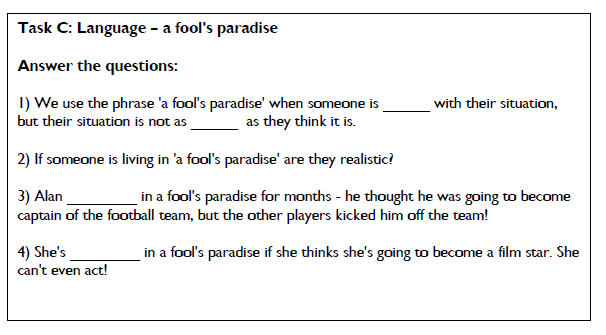
Answers 1) We use the phrase 'a fool's paradise' when someone is happy with their situation, but their situation is not as good as they think it is.

  1. If someone is living in 'a fool's paradise' are they realistic? No, they are unrealistic.

  1. Alan lived in a fool's paradise for months - he thought he was going to become captain of the football team, but the other players kicked him off the team!

  1. She's living in a fool's paradise if she thinks she's going to become a film star.


The end of the lesson 5 minutes

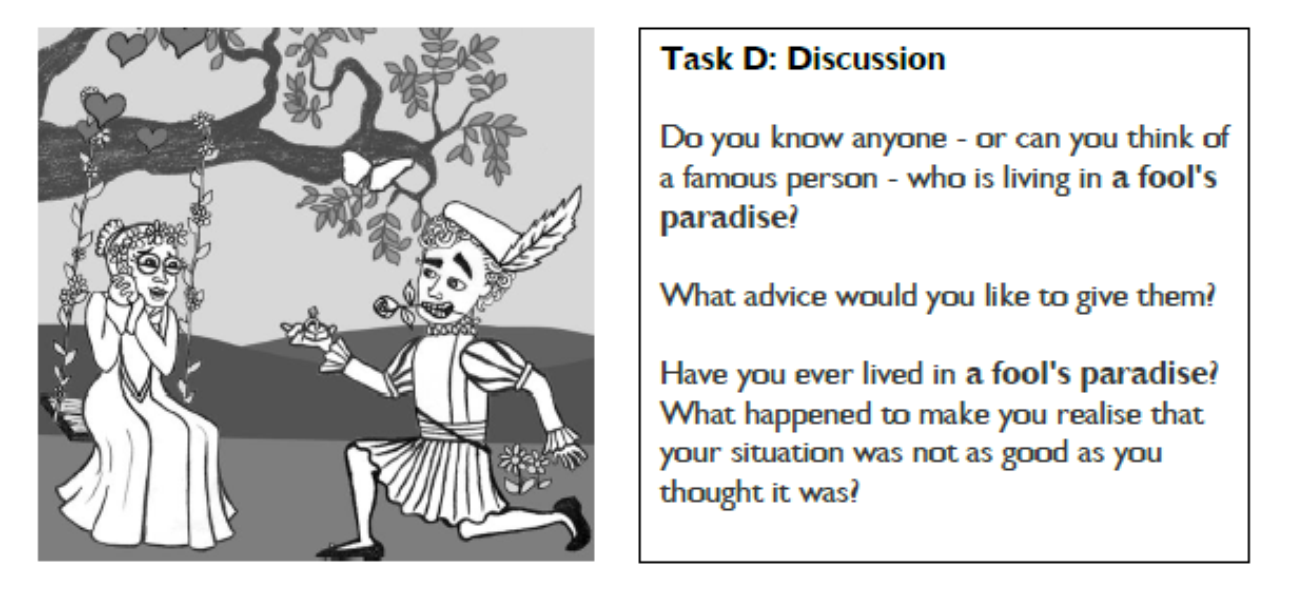
Task D: Discussion

  • Give students a few minutes to prepare what they are going to talk about.

  • Students mingle around the classroom and discuss the questions with each other.

  • Feedback interesting answers and focus on any good language and any errors to correct.


Task E: Vocabulary reality or fantasy?

  • Elicit from students what phrase we use if someone has been living in a fool's paradise and they are suddenly made to accept reality again.


Answer: to come back to earth (with a bump.)

  • Students look at the phrases and decide in pairs which of the phrases describe someone/something who IS realistic and which of these phrases describe someone/something who ISN'T realistic.

  • Check answers as a class and drill the pronunciation of the phrases.


Answer: See answers and definitions on page six of this document.
Practise
the phrases with a game from Eight Vocabulary Activities.


Task F: Discussion


24


  • Students plan what they are going to say for at least two of the questions. Encourage them to use the phrases they've just learnt.

  • Then rearrange groups so they can tell their stories to different people.

  • Feedback by praising good language and correcting errors as a class.


Theme of the Lesson: Not budge an inch


Aims: Students will…

  • listen for gist and detail in the context of a video on Shakespeare’s life, language and plays.

  • understand the meaning, use and form of the phrase not budge an inch.

  • learn useful responses for when they are asked to do something they don’t want to do.

Expected result:

All students: Tells the theme and reveals the main idea Majority of students: Performs tasks of a creative nature Some students: Draws conclusions on the topic

Plan

The stages of the lesson

Student actions in the classroom

Resources

The beginning of the lesson 5 minutes

Task A: Lead in and gist

  • Check students understand the meaning of
    'stubborn'
    and then put students into small groups to discuss whether they think it's a good or bad thing to be stubborn and why.

  • Tell students that in the video they are about to watch, Will and Thomas are arguing.

  • As they watch, they need to answer this gist question:

  • What are Will and Thomas arguing about?

  • Then play the video from start to end for students to answer the question.

  • Students check answers in pairs and then as a class.

Answer Thomas and Will are arguing because Will doesn't like the way Thomas is reading his lines. Thomas is refusing to do what Will wants.

http://ww
w.bbc.co. uk/learnin genglish/e nglish/cou rse/shakes peare/unit
-1

Physical minute

The middle of the lesson 30 minutes


Task B: Detail and Language


25


  • Handout the worksheets (pages three to five of this document) and ask students to read the questions.

  • Play the video again for students to mark 'true' or
    'false'
    encourage them to give reasons for their answers.

  • Students discuss answers in pairs and then check answers as a class.


Answers

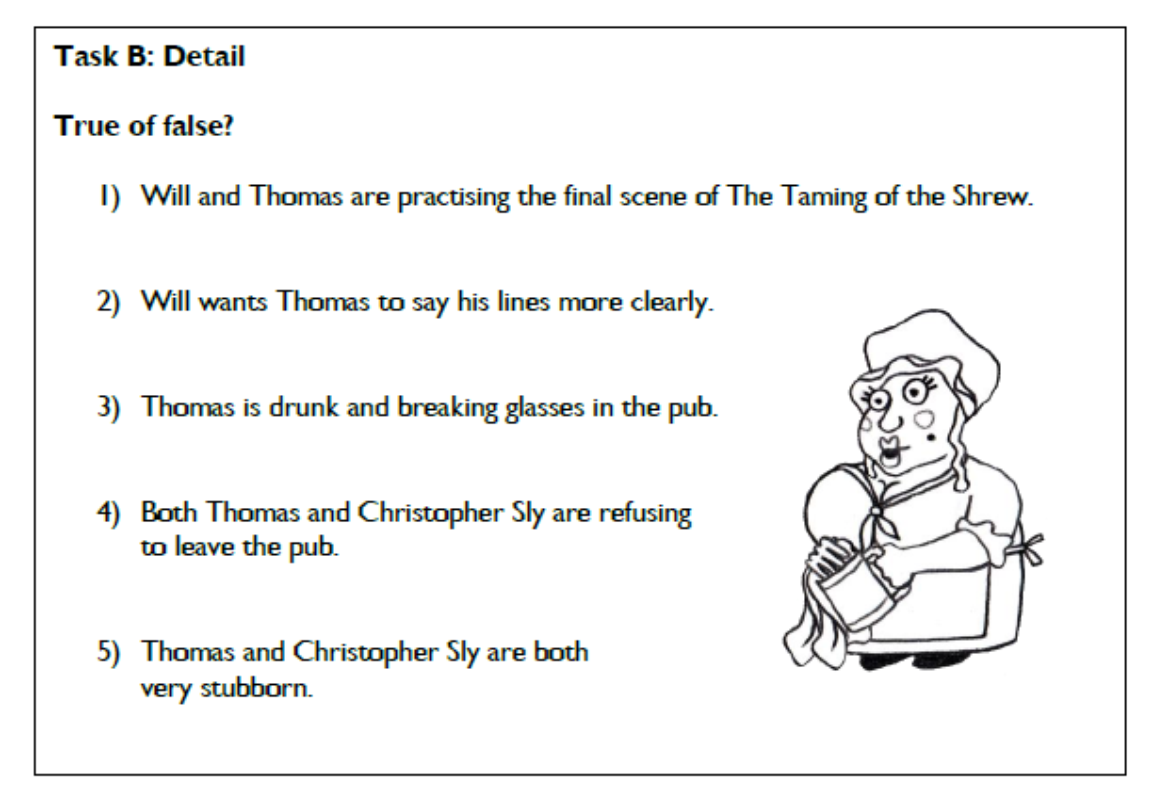
  1. Will and Thomas are practising the final scene of The Taming of the Shrew. False -


they are rehearsing the opening scene - the first scene.
2)
Will wants Thomas to say his lines more clearly. True - Thomas is pretending to be drunk while he reads the lines, but Will wants him to speak more clearly, so the audience can actually understand the words.


  1. Thomas is drunk and breaking glasses in the pub. False

  • the character, Christopher Sly, is drunk. Thomas the actor isn't drunk - yet!

  1. Both Thomas and Christopher Sly are refusing to leave the pub. False - Christopher Sly is refusing to leave the pub, not Thomas.

  1. Thomas and Christopher Sly are both very stubborn.

True - a stubborn person refuses to change their ideas or behaviour. Thomas is refusing to say his lines in the way Will wants him to, and Christopher Sly is refusing to leave the pub.

Task C: Language not budge an inch

  • Give students a few minutes to discuss the answers to Task C in pairs.

  • Play the narrator section from 02.38 to 03.25 for students to check answers. Then check answers as a class.


Answers

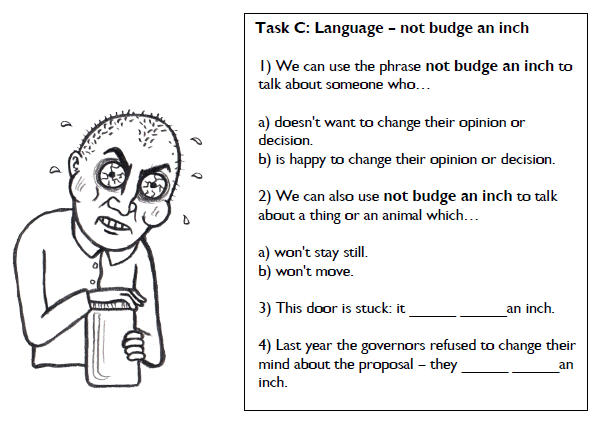
  1. We can use the phrase 'not budge an inch' to talk about someone who doesn't want to change their opinion or decision.

  1. We can also use 'not budge an inch' to talk about a thing or an animal which won't move.

  1. This door is stuck: it won't budge an inch. 4) Last year the governors refused to change their mind about the proposal they wouldn't budge an inch.


26


The end of the lesson 5 minutes

Task D: Listening and vocabulary

  • Elicit/teach the phrase 'stand your ground', meaning
    'refuse
    to change your opinion or behaviour, even when other people disagree with you'.

  • Tell students that they are going to listen to people being asked to do something they don't want to do. For each person they need to decide if they 'refuse to budge an inch', like Thomas, or if they back down and agree to do it?

  • Play the audio from here:
    http://www.bbc.co.uk/learningenglish/english/cours e/shakespeare/unit-1/session-19/activity-3

  • Students check in pairs and then as class.


Answer: The last two speakers gave in and agreed to do what they were asked. The other speakers all stood their ground.

  • Students turn over their worksheets and in pairs try to complete the responses from memory.

  • Play audio again for them to check their answers then check answers as a class.


Answers 1) No way! 2) not even if you paid me! 3) No, it's out of the question!

  1. No, not in a million years 5) Oh go on then 6) I suppose so

  • Play the audio again and tell students to repeat the phrases, focusing on intonation. Remind them to sound determined for sentences one to four.

  • Play one of the vocabulary revision games from the worksheet Eight Vocabulary Activities to practise the phrases.

  • Set up a mingle task in which students walk around room asking each other to do things

  • (For example: " Will you do my homework for me this evening?")

  • They can then either refuse or agree reluctantly using the phrases they've just learnt.


(For example: "No Way! Do it yourself.") Task E: Quiz


27


  • Tell students that they are going to do a fun quiz to find out if they are stubborn.

  • Students complete the quiz in pairs, asking questions and circling their partner's answers.

  • Tell students to add up the number of As and Bs; the more As they have the more stubborn they are.

  • Students discuss their quiz score - do they agree or not and why?


Task F: Discussion

  • Give students time to prepare and then put them into new groups to discuss the questions.

  • Share some answers and focus on any good examples of language and any errors to correct


Theme of the Lesson: I must be cruel, only to be kind


Aims: Students will…

  • listen for gist and detail in the context of a video on Shakespeare’s life, language and plays.

  • understand the meaning and modern form of I must be cruel, only to be kind.

  • be able to understand and use six synonyms of cruel - and the nouns that go with them.

Expected result:

All students: Tells the theme and reveals the main idea Majority of students: Performs tasks of a creative nature Some students: Draws conclusions on the topic

Plan

The stages of the lesson

Student actions in the classroom

Resources

The beginning of the lesson 5 minutes


Task A: Lead in and gist

  • Put students into small groups and tell them to write down as many famous Shakespeare quotes as they can. What do they mean? Which do they think is the most famous?

  • Share answers and discuss Shakespeare's most famous quote: ''To be, or not to be: that is the question'' from Hamlet.

  • Play the video from the start and tell students to answer this gist question:

http://ww
w.bbc.co. uk/learnin genglish/e nglish/cou rse/shakes peare/unit
-1/


28


Why is the Queen taking away King James' wine? Is she being unkind?

They discuss answers in pairs and then check as a class.

Answer:


The Queen isn't being unkind: she is taking King James' wine away because the doctor says that it's bad for his health.


Physical minute

The middle of the lesson 30 minutes


Task B: Detail

  • Give students a few minutes to read the questions and then play the video again for students to mark
    'true'
    or 'false'. Encourage them to also note down reasons why.

  • Students discuss answers in pairs and then check answers as a class.


Answers

  1. After Hamlet's father died, Hamlet's mother quickly married the uncle of Hamlet's father. False, Hamlet's mother married Claudius, the brother of Hamlet's father.

  1. Hamlet is certain that his mother and his uncle, Claudius, killed his father. False, Hamlet suspects that his mother and Claudius killed his father - but he doesn't know for certain.

  1. Hamlet says horrible things to his mother because he hates her. False, Hamlet hopes that if he makes his mother realise that her marriage is wrong, she will leave her new husband and become a better person.


  1. Hamlet's mother listened to Hamlet and left her
    husband.
    False, Hamlet's mother didn't follow Hamlet's advice.

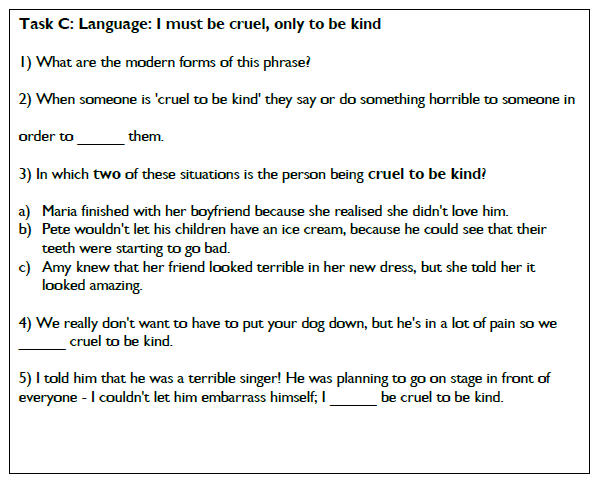
Task C: Language: I must be cruel, only to be kind

  • Students read the sentences and discuss the answers in pairs from memory.

  • Play the narrator section from 02.18 to 03.16 for
    students to check answers and then check as a class. Answers 1) What are the modern forms of this phrase? I must be cruel to be kind or I have to be cruel to be kind. 2) When someone is 'cruel to be kind' they say or do

something horrible to someone in order to help them. 3) In


29


which of these situations is the person being cruel to be kind? a) and b). 4) We really don't want to have to put your dog down, but he's in a lot of pain so we must be/have to be cruel to be kind. 5) I couldn't let him embarrass himself; I had to be cruel to be kind.


The end of the lesson 5 minutes


Task C: Discussion

  • Give students time to prepare and then put them into new groups to share stories.

  • Share interesting answers and focus on good examples of language, and errors to correct.

Task D: vocabulary cruel collocations

  • Ask students to work in small groups and think of different synonyms for 'cruel'.

  • They then look at the scroll on the worksheet to find out six synonyms for cruel.

  • Tell students that the words on the left collocate with the words on the right. They work in pairs to match the adjectives with the nouns.

  • Play the audio on this page to check answers:

http://www.bbc.co.uk/learningenglish/english/cours
e/shakespeare/unit-1/session-20/activity-3


Answers: vicious circle, tough love, cold-blooded killer, nasty look, harsh punishment, mean streak


Theme of the Lesson: Wear my heart on my sleeve


Aims: Students will…

  • listen for gist and detail in the context of a video on Shakespeare’s life, language and plays.

  • understand the meaning, use and form of the idiom wear my heart on my sleeve.

  • be able to understand and use phrases for talking about revealing - or hiding - your feelings and plenty more heart idioms.

Expected result:

All students: Tells the theme and reveals the main idea Majority of students: Performs tasks of a creative nature Some students: Draws conclusions on the topic

Plan

The stages of the lesson

Student actions in the classroom

Resources


30


The beginning of the lesson 5 minutes


Task A: Lead in and gist

  • Ask students to discuss what they know about American actress Kristen Stewart and what they can remember about Shakespeare's daughter and Iago from Othello. Set the question: Do you think they hide their feelings well? Or are they very open and honest about their feelings?

  • Play the video from the start and tell students to find

out if they are correct. They discuss in pairs and then check as a class.


Answer Shakespeare's daughter and Kristen Stewart are both very open about their feelings - they wear their hearts on their sleeves! Iago pretends to show his
feelings,
but really he hides his feelings - he says "I am not what I am."

http://ww
w.bbc.co. uk/learnin genglish/e nglish/cou rse/shakes peare/unit
-1/

Physical minute

The middle of the lesson 30 minutes


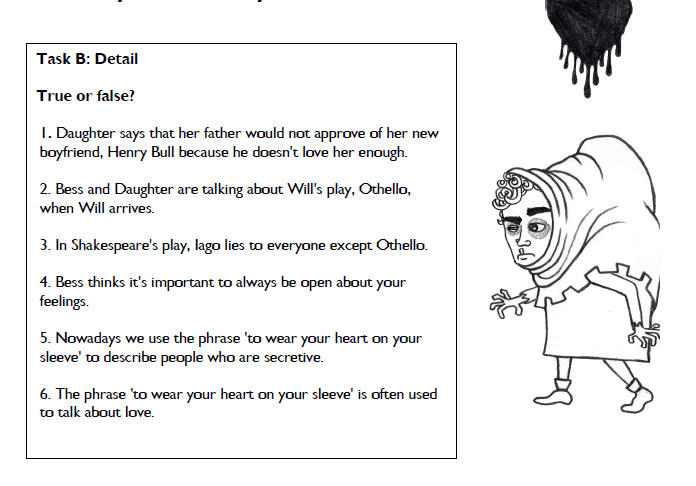
Task B: Detail

  • Give students a few minutes to read the questions and then play the video again for students to mark true or false. Encourage them to also note down why.

  • Students discuss answers in pairs and then check answers as a class.


Answers

  1. Daughter says that her father would not approve of her new boyfriend, Henry Bull because he doesn't love her enough. False Henry doesn't have much money.

  1. Bess and Daughter are talking about Will's play, Othello, when Will arrives. False they are talking about Henry Bull.

  1. In Shakespeare's play, Iago lies to everyone except Othello. False he lies to Othello too.

  1. Bess thinks it's important to always be open about your feelings. False she thinks daughter should hide her feelings.

5. Nowadays we use the phrase 'to wear your heart on your sleeve' to describe people who are secretive. False we use it to talk about people who are honest and open.


31


  1. The phrase 'to wear your heart on your sleeve' is often used to talk about love. True.


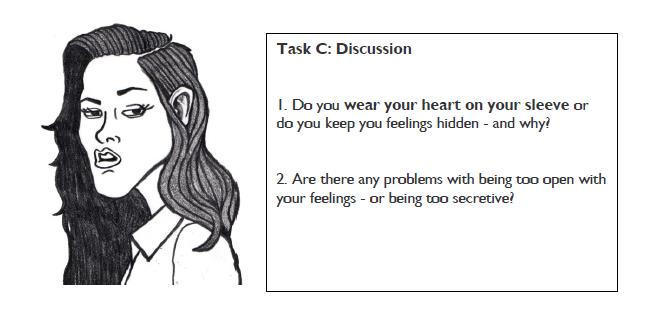
Task C: Discussion

Give students time to prepare and then put them into new groups to share stories.

Share interesting answers and focus on good examples of language, and errors to correct.


Task D: Listening

  • Tell students they are going to look at some phrases to describe how well people keep their feelings hidden.

  • Tell students you will play a recording about eight people and they need to decide if the people being described are open, like Daughter, or dishonest, like Iago.

  • Play the recording from this page:

  • http://www.bbc.co.uk/learningenglish/english/cours e/shakespeare/unit-1/session-21/activity-2

  • Students discuss in pairs but don't check answers as a class at this stage.

  • Then direct students to task D and tell them to complete the missing phrases.

  • Play the audio again for students to check their answers.


Answers :

  1. Phillipe laid all his cards on the table and let her know how he was feeling.

  1. Milllie tends to bend the truth, so I don’t think she was in as much danger as she made us think she was!

  1. Maria’s an open book you can always see what she’s thinking.

  1. The new leader was being very economical with the truth when he said that he was going to create jobs for everyone.

  1. Li’s very upfront about her intentions. She just wants to make lots of money and then leave.

  1. Put on your best poker face we can’t let anyone know how bad the situation really is!

  1. The deal was all above board.

  1. I never know what Aki is going to do next. She keeps her cards close to her chest.


32


The end of the lesson 5 minutes

Task F: Heart idioms

  • Write on the board the following sentences: If someone has a kind and generous character, we say they have a heart of g . And if someone has an unfriendly and unkind character, we say they have a heart of s .

  • Students discuss the missing words in pairs and as a class.

  • Answer: a heart of gold and a heart of steel.

  • Tell students to look at sentences 1-5 and the list of heart idioms A-E underneath it. In each sentence, the words in bold can be replaced with a heart idiom from the list. They need to decide which heart phrase goes in which sentence remind them to pay attention to the context!

  • Check answers in pairs and as a class.


Answers: 1C, 2D, 3B, 4E, 5A

  • Check understanding of the phrases and practise pronunciation.

  • Practise the phrases with a game from the worksheet Eight Vocabulary Activities.


Theme of the Lesson: What's done is done


Aims: Students will…

  • listen for gist and detail in the context of a video about Shakespeare’s life, language and plays.

  • understand the meaning, use and form of the phrase what's done is done.

  • be able to understand and use expressions relating to guilt.

Expected result:

All students: Tells the theme and reveals the main idea Majority of students: Performs tasks of a creative nature Some students: Draws conclusions on the topic

Plan

The stages of the lesson

Student actions in the classroom

Resources

The beginning of the lesson 5 minutes


Task A: Lead in and gist

  • Students discuss what superstitions there are in their country and if they know any superstitions about the theatre. (For example, saying 'break a leg' rather than 'good luck'.) Elicit which Shakespeare

http://ww
w.bbc.co. uk/learnin genglish/e nglish/cou rse/shakes

33


play it is bad luck to say the name of in the theatre
(Macbeth)
and discuss what they know about this play and its themes.

  • Elicit / tell students that one of the main themes in Macbeth is guilt and set this gist question for students to answer as they watch the video:


Who is feeling guilty in this video - and why?

  • Play the video from beginning to end.

  • Students compare answers in pairs and then check as a class.


Answer Mary is feeling guilty because she put pepper in Nell's fruit pies and Macbeth is feeling guilty for killing the King! We also find out that Lady Macbeth feels guilty by the end of the play.

peare/unit
-1/

Physical minute

The middle of the lesson 30 minutes


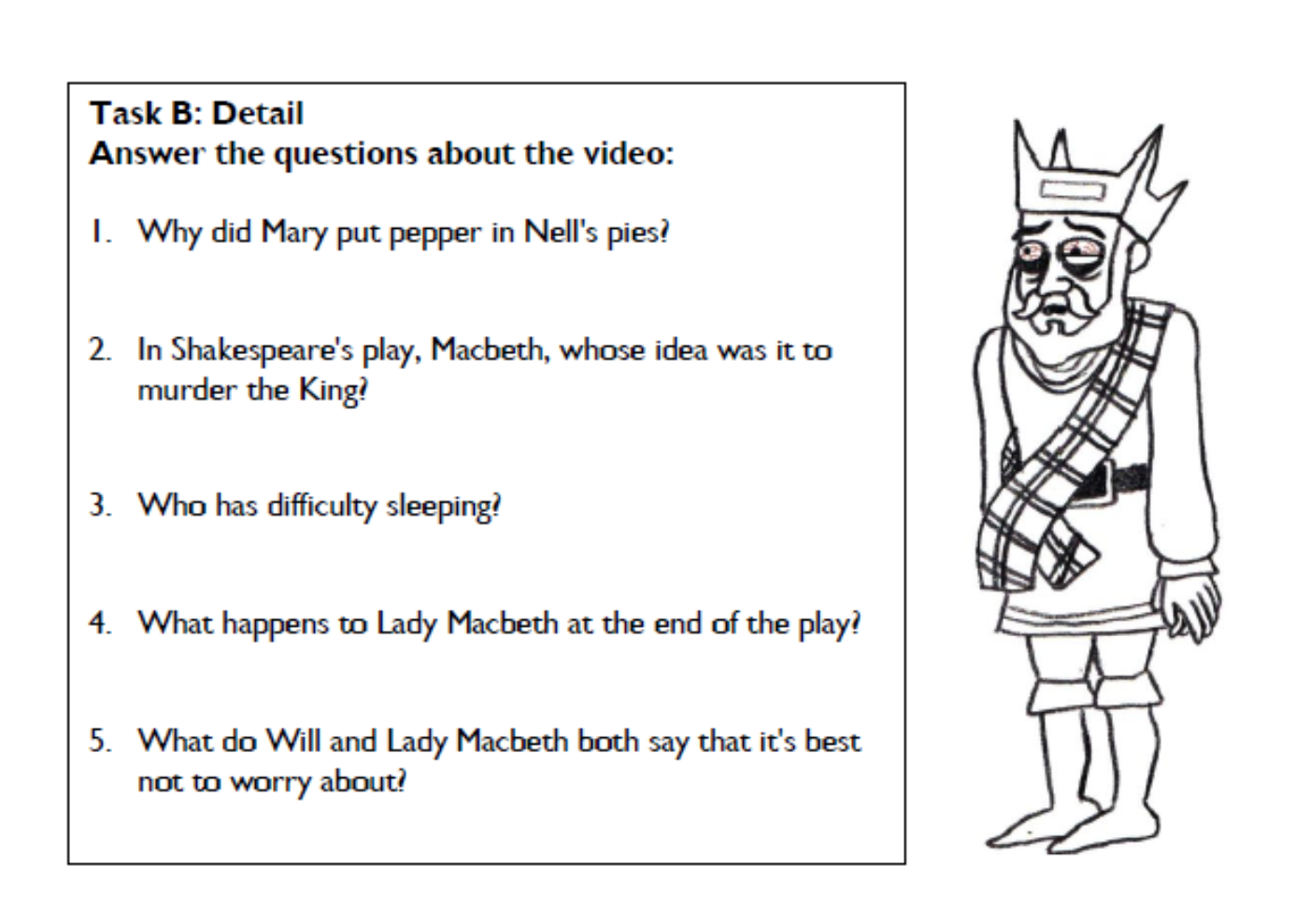
Task B: Detail

  • Hand out worksheet (pages three and four of this document.) Students read the questions.

  • Play video again for students to answer the questions about the video.

  • Students discuss answers in pairs and give reasons. Then check answers as a class.


Answers

1. Why did Mary put pepper in Nell's pies? Because she thinks Nell was admiring Mary's husband, George.

Note: Nell had her eye on George. 'To have your eye on someone' means: to be interested in someone - normally in a sexual context.

  1. In Shakespeare's play, Macbeth, whose idea was it to murder the King? Lady Macbeth's.

  1. Who has difficulty sleeping? Macbeth - he has nightmares.


  1. What happens to Lady Macbeth at the end of the play?

She goes mad with guilt.

  1. What do Will and Lady Macbeth both say that it's best not to worry about? The past.

Task C: Language What's done is done

  • Give students a few minutes to read Task C and discuss the answers in pairs.


34


  • Play the narrator section from 02.46 to 03.30 for students to check their answers.


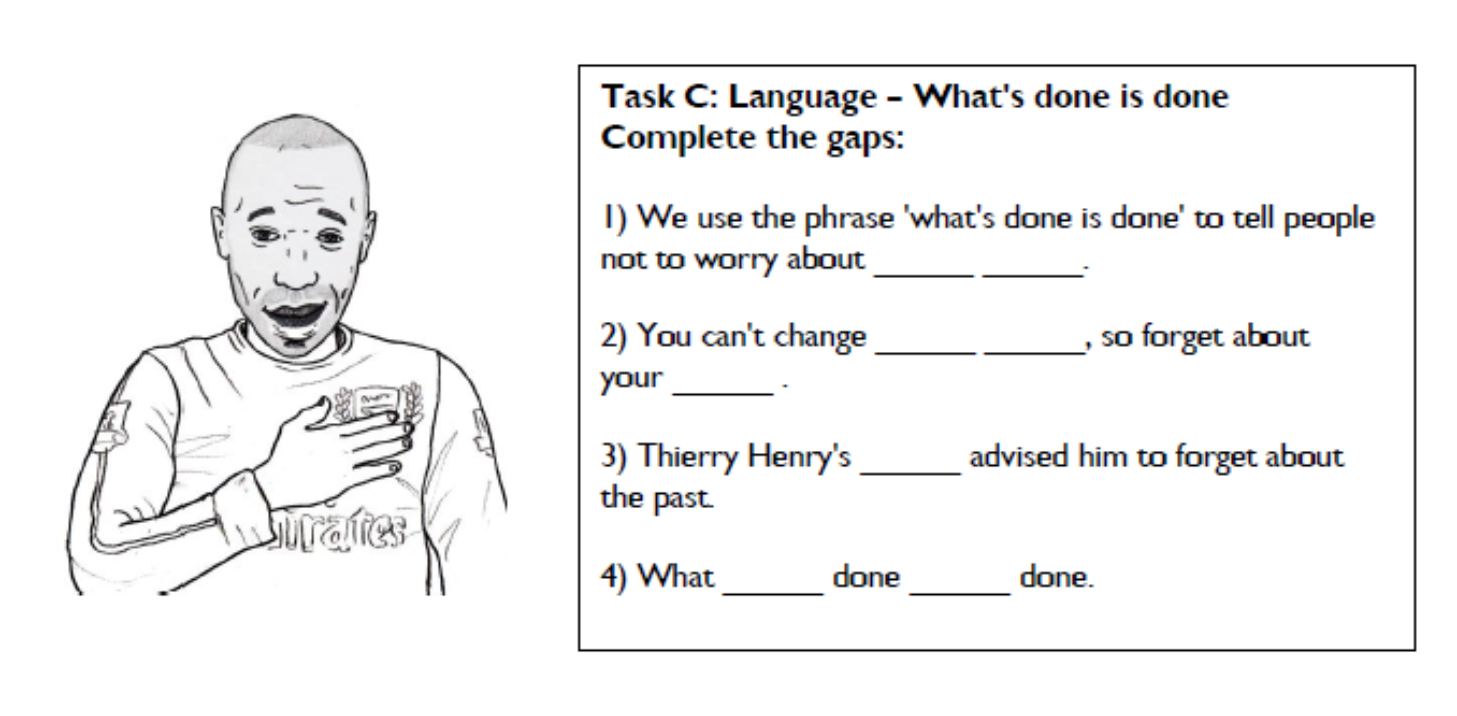
Answers 1) We use the phrase 'what's done is done' to tell people not to worry about the past.

2) You can't change the past so forget about your mistakes.
3)
Thierry Henry's father advised him to forget about the past.

  1. What is done is done. Task D: Guilt phrases

  • Tell students they will now explore some phrases containing the word guilt or guilty.

  • Students work in small groups. They read the sentences and decide what the phrases mean.


Task E: Meaning of guilt phrases

Students use the examples in Task D to help match the meaning of the guilt phrase.


Answers 1A, 2C, 3B, 4D.

  • Check students have understood the meaning of these phrases and elicit examples of guilty pleasures
    (reality
    TV, cheesy music) and examples of guilt- free food / activities.

  • Check the form of these phrases and drill the phrases to practise the pronunciation.


The end of the lesson 5 minutes

Task F: Discussion

  • Tell students to read the instructions in Task F. Give them time to think about their story and prepare what they want to talk about.

  • Put students into two groups and ask them to stand up. Have half the class make a small ring in the middle, with their backs to the centre, and have the other half find a partner in this ring and stand facing them (so the outside ring are facing the centre of the circle.) Students tell their story to the person facing them. After a few minutes move the outer circle round one space and the students now tell their story to their new partner. Continue until everyone has had the chance to tell their story a few times.

  • Feedback interesting stories and focus on any good language and any errors to correct.


35


  • Play one of the vocab revision games from the worksheet Eight Vocabulary Activities.


Theme of the Lesson: The green-eyed monster Aims: Students will…

  • listen for gist and detail in the context of a video on Shakespeare’s life, language and plays.

  • understand the meaning, use and form of the idiom the green-eyed monster.

  • be able to understand and use further colour idioms.

Expected result:

All students: Tells the theme and reveals the main idea Majority of students: Performs tasks of a creative nature Some students: Draws conclusions on the topic

Plan

The stages of the lesson

Student actions in the classroom

Resources

The beginning of the lesson 5 minutes


Aims: Students will…

  • listen for gist and detail in the context of a video on Shakespeare’s life, language and plays.

  • understand the meaning, use and form of the idiom the green-eyed monster.

  • be able to understand and use further colour idioms.


Task A: Lead in and gist

  • Pause the video on the image of Will and Thomas Swann drinking (03.34) and ask students to predict in pairs why they are getting so drunk.

  • Play the video from the start and tell students to answer the question: Why are Will and Thomas getting drunk? They discuss in pairs and then check as a class.


Answer Thomas is drowning his sorrows because he thinks that his wife is cheating on him. Will is being a loyal friend and keeping him company or maybe he doesn't want to go home!

http://ww
w.bbc.co. uk/learnin genglish/e nglish/cou rse/shakes peare/unit
-1/

Physical minute

The middle of the lesson 30 minutes


Task B: Detail

  • Give students a few minutes to read the questions and then play the video again for students to mark


36


true or false. Encourage them to also note down why.

  • Students discuss answers in pairs and then check answers as a class.


Answers

1) Bess the barmaid is annoyed by Thomas's behaviour. True. He's scaring away her customers.

  1. Thomas saw his wife with another man. False Robert Harley told Thomas Swann that he saw Mrs Swann with another man. Thomas is angry about what he heard, not what he saw.

  1. Thomas's jealousy is more extreme than Othello's. False Othello murdered Desdemona, his wife. Thomas Swann gets angry and makes threats - but he doesn't kill Mrs Swann.

  1. Shakespeare's character, Iago, is a loyal friend to

Othello. False Iago lies to Othello. He says that Othello's wife is cheating on him, because he knows how destructive jealousy can be.

Task C: Language: The green-eyed monster

Students read the sentences and discuss the answers in pairs from memory.

Play the narrator section from 02.44 to 03.22 for students to check answers. Answers

  1. The phrase 'the green-eyed monster' describes how jealousy can destroy people.

  1. We normally use 'the green-eyed monster' to describe jealousy in relationships.

  1. What causes Ronan Keating to have an attack of 'the green-eyed monster'? His wife going out without him.


Task C: Discussion

  • Give students time to prepare and then put them into new groups to share stories.

  • Share interesting answers and focus on good examples of language, and errors to correct.


Task D: Colour idioms

  • Ask students what emotions the colours blue and red are normally associated with. Answer: If you see red you become very angry. If you feel blue you feel sad.

  • Tell students that they are now going to learn some more colour idioms. They turn over the worksheet


37


and work in pairs to complete each phrase with a colour. Warn them that one of the expressions is not actually the name of a colour!

  • Check answers as a class:


Answers

  1. Omar's teacher saw him take the money. She caught him red-handed.

  1. Jean told a small lie to avoid hurting Sacha's feelings. It was just a little white lie.

  1. My brother passed his exams easily. He passed with flying colours.

  1. I was surprised to see her out of the blue.

  1. The grass isn't always greener on the other side.

  1. He's the black sheep of the family.

  1. The green-eyed monster rears its ugly head.


  • Check understanding of the idioms and practise pronunciation. Highlight to students the use of the set phrase in number 7) 'The green-eyed monster rears its ugly head'.

  • Practise the idioms with a game from the worksheet Eight Vocabulary Activities.


The end of the lesson 5 minutes

Task E: Find someone who…

  • Give students time to read the sentences and check they know how to form the questions. Then demonstrate the task by doing an example with a confident student.

  • Students stand up, mingle and try to write a
    (different)
    name for each sentence. Encourage them to ask follow-up questions to find out more information and record it on their sheets.

  • After ten minutes, share interesting answers and carry out error correction as a class.


Theme of the Lesson: The world's mine oyster


Aims: Students will…

  • listen for gist and detail in the context of a video about Shakespeare’s life, language and plays.

  • explore the meaning, use and form of the phrase the world's mine oyster.

  • be able to understand and use idioms with the word world.

Expected result:


38


All students: Tells the theme and reveals the main idea Majority of students: Performs tasks of a creative nature Some students: Draws conclusions on the topic

Plan

The stages of the lesson

Student actions in the classroom

Resources

The beginning of the lesson 5 minutes


Task A: Lead in and gist

  • Students watch the complete video to find out and answer this gist question:

  • What kind of person do you think the Queen is? What relationship do you think Will has with the Queen?

  • Play the video from beginning to end.

  • Students compare answers in pairs and then check as a class.


Answer Queen Elizabeth is an assertive, confident woman who demands respect. Will is a bit scared of her - so he does exactly what she tells him to do.

http://ww
w.bbc.co. uk/learnin genglish/e nglish/cou rse/shakes peare/unit
-1/

Physical minute

The middle of the lesson 30 minutes


Task B: Detail

  • Hand out worksheet (pages three and four of this document.) Students read the questions and three options for each question.

  • Play video again for students to complete the information about the video,

  • Students discuss answers in pairs and give reasons. Then check answers as a class.


Answers

  1. In The Merry Wives of Windsor, Falstaff tries to make two ladies keep a secret from their husbands. Falstaff tries to trick the ladies into giving him money behind their husbands' backs. If you do something 'behind someone's back' you keep it secret from them.

  1. Will is impressed that pearls originally come from the sea.

  1. Shakespeare's character, Pistol, becomes angry because Falstaff won't give him money.

  1. The Merry Wives of Windsor is a comedy about

normal people in England.

Task C: Language the world's mine oyster


39


  • Give students a few minutes to read Task C and discuss the answers in pairs.

  • Play the narrator section from 02.36 to 03.30 for students to check their answers.


Answers 1) How have the meaning and form of the world is mine oyster changed since Shakespeare's time? The meaning is more positive today. The form has changed from 'mine oyster' to 'my oyster'.

  1. If the world is your oyster, do you feel free or trapped?

Free and with opportunites.

3) In what situations do people often feel like the world is their oyster? For example, when they pass an exam, win money or finish school.

Task D: Discussion

  • Give students a few minutes to prepare what they are going to talk about.

  • Students mingle around the classroom to share their stories and ask each other questions.

  • Feedback interesting answers and focus on any good language and any errors to correct.


Task E: Listening

  • Students listen to the conversation and answer the question: what is the relationship between Tom and Kate?

  • Conversation is available here:


http://www.bbc.co.uk/learningenglish/english/course/shak espeare/unit-1/session-10/activity-3

Answer: they are old school friends.

Students read the conversation in Task E and discuss what they think the idioms mean.

Task F: ‘World’ idioms

  • In pairs students complete the matching task using the conversation to help. Check answers:


Answers 1E, 2C, 3A, 4D, 5B

Check understanding of the meaning, form and pronunciation of the phrases.


The end of the lesson 5 minutes

Extra practice ideas

  • Practise the 'world' idioms with a game from Eight Vocabulary Activities.


40


  • Students to read the conversation in Task E aloud with their partner and then from memory.


Task G: Discussion

  • Students choose one or two topics to talk about. Then rearrange groups so they can tell their stories in new groups.

  • Feedback by praising good language and correcting errors as a class.


Theme of the Lesson: A tower of strength


Aims: Students will…

  • listen for gist and detail in the context of a video on Shakespeare’s life, language and plays.

  • understand the meaning, use and form of the phrase A tower of strength.

  • be able to understand and use phrases to describe people you can depend on.

Expected result:

All students: Tells the theme and reveals the main idea Majority of students: Performs tasks of a creative nature Some students: Draws conclusions on the topic

Plan

The stages of the lesson

Student actions in the classroom

Resources

The beginning of the lesson 5 minutes


Task A: Lead in and gist

  • If students are familiar with Shakespeare's plays, put them into groups and ask them to come up with as many Shakespearean baddies as they can. If they have difficulty, you can widen it to include baddies in other books/films.

  • Elicit ideas from the class and tell them they are going to find out about King Richard one of Shakespeare's greatest baddies.

  • Hand out worksheet (pages three and four of this document) and give students some time to read Task A. Tell students that while they watch the episode, they need to decide if this summary is correct, and if not, to correct it.

  • Play the video from beginning to end.

  • Students check answers in pairs before comparing as a class.

http://ww
w.bbc.co. uk/learnin genglish/e nglish/cou rse/shakes peare/unit
-1/s

41


Answer The summary is incorrect: King Richard is confident about going into battle, because he has a bigger army than his enemy, and, more importantly, his name - King Richard - makes him strong and powerful.


Physical minute

The middle of the lesson 30 minutes


Task B: Detail

  • Give students a few minutes to read the questions and then play the video again for students to answer the questions.

  • Students discuss answers in pairs and then check answers as a class.


Answers

  1. How much bigger is King Richard's army than the opposing army? Three times bigger.

  1. How does Will encourage Thomas to say the line, "the
    King's
    name is a tower of strength"? Confidently.


  1. Why does the narrator call Richard III 'the Mafia play'?

Because there are many murders in it.

  1. Why did Richard murder so many people? To gain power.


  • Extra task: students practise saying Thomas's line
    "the
    King's name is a tower of strength." Who in the class can say the line the most confidently?

  • Task C: Language: A tower of strength

  • Students read the sentences and discuss answers in pairs from memory.

  • Play the narrator section from 02.27 to 03.19 for students to check answers.


Answers

  1. Which of these adjectives does NOT describe someone who is a tower of strength? Tall.

  1. A tower of strength' is a person who looks after you when you have a problem.

  1. Who was a tower of strength for David Beckham? Alex Ferguson.


Task D: Supportive phrases

  • Elicit from students different ways to say that someone is supportive and dependable.


42


  • Students turn over worksheet and complete the phrases in task D with the missing words.

  • Check answers and practise the pronunciation together as a class. Answers

  1. He sticks with me through thick and thin.

  1. I can count on her.

  1. She stands by me.

  1. He's got my back.

  1. He's my rock.

  1. She's there for me.


Play one or two of the vocab revision games from the worksheet Eight Vocabulary Activities.


The end of the lesson 5 minutes

Task E: Discussion

  • Give students time to prepare what they are going to talk about and then put them into new groups to share stories.

  • Students in each group vote on who is the best
    'tower of strength' in each group.

  • Focus on any good examples of language and any errors to correct.


Theme of the Lesson: Spotless reputation


Aims: Students will…

  • listen for gist and detail in the context of a video on Shakespeare’s life, language and plays.

  • understand the meaning, use and modern form of the idiom spotless reputation.

  • be able to understand and use expressions for talking about good and bad reputations.

Expected result:

All students: Tells the theme and reveals the main idea Majority of students: Performs tasks of a creative nature Some students: Draws conclusions on the topic

Plan

The stages of the lesson

Student actions in the classroom

Resources

The beginning of the lesson 5 minutes


Task A: Lead in and gist

  • Write a list of five crimes on the board (for example, dropping litter, murder, armed robbery and under-age drinking) and ask students to order

http://ww
w.bbc.co. uk/learnin genglish/e nglish/cou

43


them from most to least serious. They then choose an appropriate punishment for each crime.

  • Tell students that Queen Elizabeth is not happy today and wants to punish someone. Play the video from start to finish and students need to find out the answer to this gist question:


Why is Queen Elizabeth so angry?

They discuss in pairs and then check as a class. Answer: The Queen is angry with the Earl of Essex for plotting to kill her. She is also annoyed with Will because he performed his play, Richard II, for the Earl of Essex.

rse/shakes peare/unit
-1/

Physical minute

The middle of the lesson 30 minutes


Task B: Detail

  • Give students a few minutes to read the questions and then play the video again for students to mark true or false. Ask them to note down the reasons for their answers.

  • Students discuss answers in pairs and then check answers as a class. Answers


  1. Queen Elizabeth doesn't want anyone to know that she has sentenced the Earl of Essex to death. False; she wants everyone to know that she sentenced him to death.

  1. The Earl of Essex failed to murder Queen Elizabeth.

True; the Earl of Essex planned to kill her, but he got caught before he could carry out his plan.

  1. Queen Elizabeth doesn't worry about what people think of her. False; the Queen's reputation is very important to her. She wants people to love and fear her. 4) Shakespeare published other writers' work, and said that it was his own. False; other writers’ work was published under Shakespeare’s name.

  1. Will and his actors are worried about their upcoming performance of Richard II. True; they are performing for the Queen and are worried that if she doesn’t enjoy it, they will be sent to the tower.

Task C: Language: Spotless reputation

  • Students read the sentences and discuss the answers in pairs from memory.

  • Play the narrator section from 02.26 to 03.33 for students to check answers. Answers

  1. The adjective 'spotless' means: completely clean.


44


  1. Your 'reputation' is what other people believe about your character.

  1. A person who has a 'spotless reputation' always behaves in a honest way.

  1. In the example, the athlete has damaged her spotless reputation by taking drugs.


Task D: Discussion

  • Give students time to prepare and then put them into new groups to share stories.

  • Share interesting answers and focus on good examples of language and errors to correct.


Task E: Expressions for talking about good - and bad reputation

  • Before class put the following six expressions up on the wall outside the classroom. One expression per piece of paper. 1) Her reputation has been tarnished. 2) She has a good track record. 3) He's squeaky clean. 4) Her name is mud around here.

  1. He lost face with his staff. 6) It gave the company a bad name.

  • Put students into pairs and tell that they are going to do a running dictation to learn some more expressions for talking about reputations.

  • Students take it in turns to run outside, remember as much as they can of the sentence and dictate it for their partner to write down. They can run back as many times as necessary for each sentence, until they have written all six.

  • Check written work and help students to correct their sentences.

  • Students record the phrases in the appropriate columns on the table in Task E.

Answers: see page five of this document for completed table and definitions.


Practise the idioms with a game from the worksheet Eight Vocabulary Activities.


The end of the lesson 5 minutes

Task F: Discussion

  • Give students time to prepare and then put them into new groups to share ideas; encourage them to use the new expressions they've learnt in this lesson.


45


  • Share interesting answers and focus on good examples of language and errors to correct.


Theme of the Lesson: Shakespeare and comedy Aims: Students will…

  • To develop students’ ability to identify and use topic sentences

  • To develop students’ knowledge of comedy and humour-related lexis

  • To develop students’ awareness of the features of Shakespearean comedy

Expected result:

All students: Tells the theme and reveals the main idea Majority of students: Performs tasks of a creative nature Some students: Draws conclusions on the topic

Plan

The stages of the lesson

Student actions in the classroom

Resources

The beginning of the lesson 5 minutes

Procedure

Warmer Types of joke (10 mins)

  • Begin by telling the class your favourite joke in English. Explain that this lesson is going to be all about comedy, in particular Shakespeare’s comedy. Ask students if they think that sixteenth-century people would have found your joke funny or not and encourage them to give reasons for their answers. Ask students: Do you think that comedy has changed a lot since the sixteenth century? Why/Why not?

  • Organise students into groups of five.

  • Distribute the cards, so that each student has one.

  • Focus students’ attention on the sentences and ask them to take it in turns to read the comedy cards aloud to the rest of their group and match the cards (A–E) with the examples on the worksheet (1–5).

  • Give students a minute to think of definitions for the words in bold on the worksheet. Conduct class feedback and write students’ definitions on the
    board.


Answers: 1 d 2 e 3 b 4 c 5 a

Pun: a joke which is based on two words which sound similar but mean different things

Earthy sense of humour: a kind of humour which involves sex and the body


46


Practical jokes: tricks played on people to annoy them and make them look silly

Slapstick: a kind of comedy which is based on clumsy and embarrassing actions and mild comic violence

Witty banter: amusing conversation


Physical minute

The middle of the lesson 30 minutes

Task 1 Reading: making predictions (5 mins)

  • Tell students that they are going to read a blog post about Shakespeare’s comedies.

  • Focus students’ attention on the list. Give them a few moments to tick the items they think they will read about.

  • Ask a couple of students to tell you about their predictions.


Task 2 Reading a blog post (5 mins)

  • Focus students’ attention on the blog post. Ask them to read it quickly and see whether their predictions were correct.

  • Conduct class feedback.


Answers: All of the items on the list feature in the blog post. An earthy sense of humour is not mentioned in these exact words, but sexual innuendo is a feature of this type of humour.

Task 3 Reading: topic sentences (5 mins)

  • Read the topic sentences aloud to your students.

  • Ask students to read the text again more slowly and insert the sentences in the correct places.

  • Allow students to compare their answers with a partner before conducting class feedback. Elicit the effect which the topic sentences have on the text
    (they
    help the reader follow the text more easily, as they make it clear what the paragraph is going to be about).


Answers: 1 e 2 a 3 d 4 c 5 b


Task 4 Writing: topic sentences (10 mins)

Note as Task 4 deals with topic sentences, rather than the blog post, you may prefer to go straight to Task 5 at this point, and to return to Task 4 later, or set it as homework.


47


Organise students into pairs. Ask them to read the paragraphs together, decide what they are about and write an appropriate topic sentence for each.

Nominate a few students to read their topic sentences aloud to the rest of the class. Write the best topic sentences on the board.


Suggested answers:

  1. I’ve loved Shakespeare ever since I was a child

  1. Shakespeare’s work can be unpopular with young people

Task 5 Reading: checking your understanding (10 mins)

  • Ask students to read the text again and answer the questions.

  • Organise students into small groups to discuss their answers.

  • Monitor as students do this, offering support where necessary.

  • Briefly check answers around the class.


Answers:

  1. He thinks his mum should relax because most contemporary comedies are inspired by Shakespeare, and so are not too far away from his studies.

  1. They both make a mess of their duties, but also do good in the end. They speak words of truth to the audience.

  1. Absurd humour, puns (Bottom and ass) and earthy humour (Bottom and ass)

  1. With marriage


The end of the lesson 5 minutes

Task 6 Vocabulary (10 mins)

  • Focus students’ attention on the sentences and ask them to match these with the words in bold in the text

  • Allow students to check their answers with a partner before conducting class feedback.


Answers: a. romcom b. serenades c. obstacles d. inadequate e. screws up f. witty banter g. sexual innuendo
h. chuckling i. prototype

Task 7 Vocabulary practice (10 mins)

  • Ask students to complete the sentences using words from Task 6. Stress that students need to use the correct forms of the word.


48


  • Monitor as students complete this task, offering support where necessary.

  • Check answers around the class.


Answers: a. chuckling b. serenading c. sexual innuendo d. screwed up e. inadequate f. obstacles g. romcom h. witty banter i. Prototype


Task 8 Creating a Shakespearean comedy (25 mins)

As a class, brainstorm the ingredients of a Shakespearean comedy, e.g.:

  • puns

  • earthy humour

  • fools

  • ending in marriage

  • singing and dancing

  • etc.

  • Organise students into groups. Tell them that they have five minutes to think of their own idea for a romantic comedy film which features these ingredients. Ask students to use the questions on their worksheets to help them.

  • Ask students to choose one scene from their film to act out to the rest of the class. Give them five minutes to prepare and practise their scene.

  • The groups should then take it in turns to act out their plays. After each performance, discuss which features of Shakespearean comedy the scene contained.


49

Жұмыс дәптері

Theme of the Lesson: As dead as a doornail


Aims: Students will…

  • practise listening for gist and detail in the context of a short animation about Shakespeare’s life, language and plays.

  • understand the meaning, use and form of the phrase as dead as a doornail.

  • be able to understand and use further idioms using the word 'dead'.

Expected result:

All students: Tells the theme and reveals the main idea Majority of students: Performs tasks of a creative nature Some students: Draws conclusions on the topic


50

Shape2


Theme of the Lesson: Greek to me


Aims: Students will…

  • listen for gist and detail in the context of a video about Shakespeare’s life, language and plays.

  • understand the meaning, use and form of the idiom Greek to me.

  • be able to understand and use phrases to talk about understanding and not understanding.

Expected result:

All students: Tells the theme and reveals the main idea Majority of students: Performs tasks of a creative nature Some students: Draws conclusions on the topic


51


Shape3


Shape4

Theme of the Lesson: Wild-goose chase


Aims: Students will…

  • listen for gist and detail in the context of a video on Shakespeare’s life, language and plays.

  • understand the meaning, use and form of the phrase wild-goose chase.


52
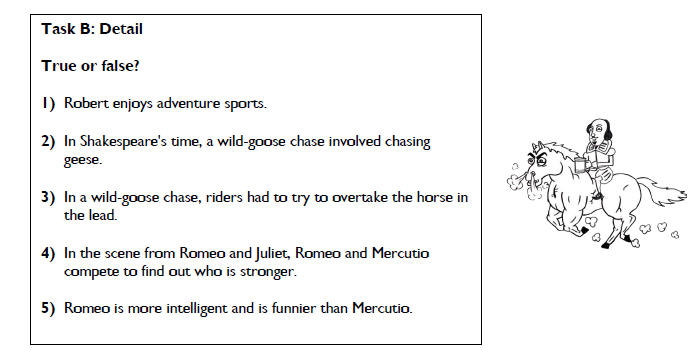

  • be able to understand and use a range of animal idioms.

Expected result:

All students: Tells the theme and reveals the main idea Majority of students: Performs tasks of a creative nature Some students: Draws conclusions on the topic


53


Shape5


Shape6

Theme of the Lesson: All that glisters is not gold Aims: Students will…

  • listen for gist and detail in the context of a video on Shakespeare’s life, language and plays.

  • understand the meaning, use and modern form of the phrase All that glitters is not gold.

  • be able to understand and use idioms and phrases relating to appearance.

Expected result:

All students: Tells the theme and reveals the main idea Majority of students: Performs tasks of a creative nature Some students: Draws conclusions on the topic


54
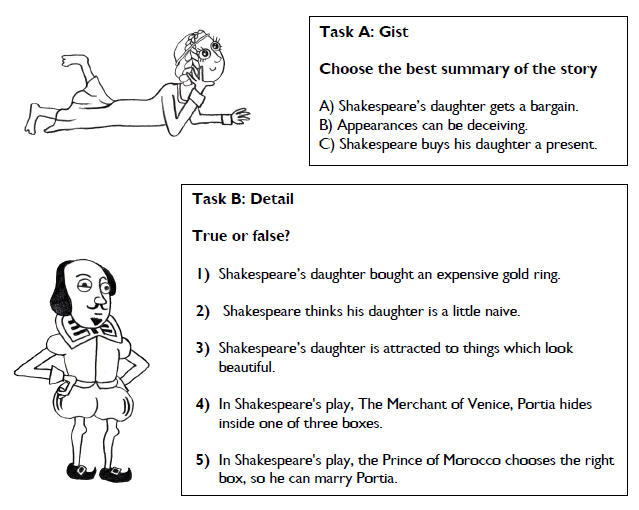


Shape7


55


Shape8


Shape9

Theme of the Lesson: I'll send him packing


Aims: Students will…

  • practise listening for gist and detail in the context of a short animation about Shakespeare’s life, language and plays.

  • understand and practise the meaning, pronunciation and form of I’ll send him packing.

  • understand and practise phrases to send someone away.

Expected result:

All students: Tells the theme and reveals the main idea Majority of students: Performs tasks of a creative nature Some students: Draws conclusions on the topic


56
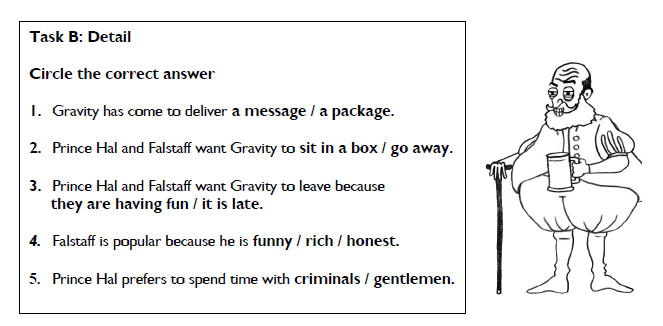


Shape10


57


Shape11


Shape12

Theme of the Lesson: A pound of flesh


Aims: Students will…

  • listen for gist and detail in the context of a video on Shakespeare’s life, language and plays.

  • understand the meaning, use and form of the idiom a pound of flesh.

  • be able to understand and use phrases for talking about revenge.

Expected result:

All students: Tells the theme and reveals the main idea Majority of students: Performs tasks of a creative nature Some students: Draws conclusions on the topic


58
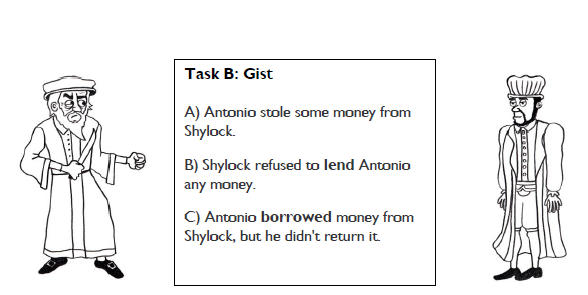


Shape13


59


Theme of the Lesson: A fool's paradise


Aims: Students will…

  • listen for gist and detail in the context of a video about Shakespeare’s life, language and plays.

  • explore the meaning, use and form of the phrase a fool's paradise.

  • be able to understand and use expressions for talking about reality and fantasy.

Expected result:

All students: Tells the theme and reveals the main idea Majority of students: Performs tasks of a creative nature Some students: Draws conclusions on the topic


60

Shape14


Theme of the Lesson: Not budge an inch


Aims: Students will…

  • listen for gist and detail in the context of a video on Shakespeare’s life, language and plays.

  • understand the meaning, use and form of the phrase not budge an inch.

  • learn useful responses for when they are asked to do something they don’t want to do.

Expected result:

All students: Tells the theme and reveals the main idea Majority of students: Performs tasks of a creative nature Some students: Draws conclusions on the topic

61


Shape15


Shape16

Theme of the Lesson: I must be cruel, only to be kind


Aims: Students will…

  • listen for gist and detail in the context of a video on Shakespeare’s life, language and plays.

  • understand the meaning and modern form of I must be cruel, only to be kind.

  • be able to understand and use six synonyms of cruel - and the nouns that go with them.

Expected result:

All students: Tells the theme and reveals the main idea Majority of students: Performs tasks of a creative nature Some students: Draws conclusions on the topic


62
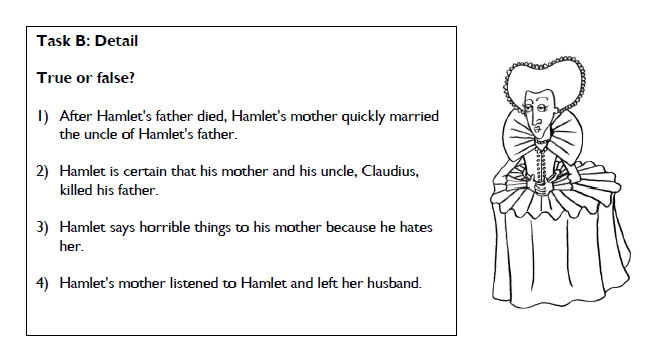


Shape17


63


Theme of the Lesson: Wear my heart on my sleeve


Aims: Students will…

  • listen for gist and detail in the context of a video on Shakespeare’s life, language and plays.

  • understand the meaning, use and form of the idiom wear my heart on my sleeve.

  • be able to understand and use phrases for talking about revealing - or hiding - your feelings and plenty more heart idioms.

Expected result:

All students: Tells the theme and reveals the main idea Majority of students: Performs tasks of a creative nature Some students: Draws conclusions on the topic


64


Theme of the Lesson: What's done is done


Aims: Students will…

  • listen for gist and detail in the context of a video about Shakespeare’s life, language and plays.

  • understand the meaning, use and form of the phrase what's done is done.

  • be able to understand and use expressions relating to guilt.

Expected result:

All students: Tells the theme and reveals the main idea Majority of students: Performs tasks of a creative nature Some students: Draws conclusions on the topic


65

Shape18


Theme of the Lesson: The green-eyed monster Aims: Students will…

  • listen for gist and detail in the context of a video on Shakespeare’s life, language and plays.

  • understand the meaning, use and form of the idiom the green-eyed monster.

  • be able to understand and use further colour idioms.

Expected result:

All students: Tells the theme and reveals the main idea Majority of students: Performs tasks of a creative nature Some students: Draws conclusions on the topic


66


Shape19


Shape20

Theme of the Lesson: The world's mine oyster


Aims: Students will…

  • listen for gist and detail in the context of a video about Shakespeare’s life, language and plays.

  • explore the meaning, use and form of the phrase the world's mine oyster.

  • be able to understand and use idioms with the word world.

Expected result:

All students: Tells the theme and reveals the main idea Majority of students: Performs tasks of a creative nature Some students: Draws conclusions on the topic


67
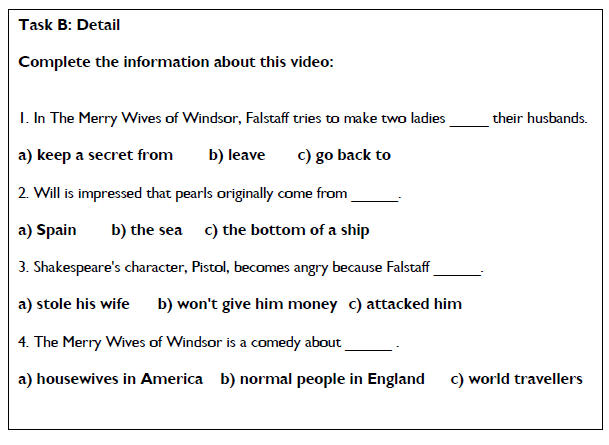


Shape21


68


Theme of the Lesson: A tower of strength


Aims: Students will…

  • listen for gist and detail in the context of a video on Shakespeare’s life, language and plays.

  • understand the meaning, use and form of the phrase A tower of strength.

  • be able to understand and use phrases to describe people you can depend on.

Expected result:

All students: Tells the theme and reveals the main idea Majority of students: Performs tasks of a creative nature Some students: Draws conclusions on the topic


69


Shape22


Shape23

Theme of the Lesson: Spotless reputation


Aims: Students will…

  • listen for gist and detail in the context of a video on Shakespeare’s life, language and plays.

  • understand the meaning, use and modern form of the idiom spotless reputation.

  • be able to understand and use expressions for talking about good and bad reputations.

Expected result:

All students: Tells the theme and reveals the main idea Majority of students: Performs tasks of a creative nature Some students: Draws conclusions on the topic


70
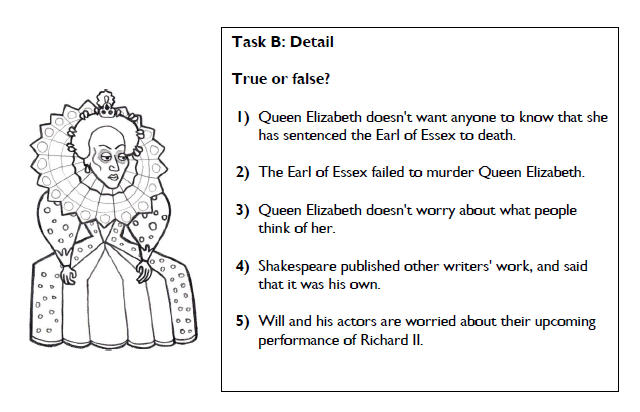


Shape24


71


Theme of the Lesson: Shakespeare and comedy Aims: Students will…

  • To develop students’ ability to identify and use topic sentences

  • To develop students’ knowledge of comedy and humour-related lexis

  • To develop students’ awareness of the features of Shakespearean comedy


Expected result:

All students: Tells the theme and reveals the main idea Majority of students: Performs tasks of a creative nature Some students: Draws conclusions on the topic


72

Қосымша материалдар


Shape25


73


74


75


Shape26


76


Shape27


77


Shape28


78


Shape29


79


Shape30


80


Shape31


81


Shape32


82


Shape33


83


Shape34


84


Shape35


85


Shape36


86


Shape37


87


Shape38


88


Shape39


89


Shape40


90


Shape41


91


Shape42


92


Shape43


93


Shape44


94


Shape45


95


Shape46


96


Shape47


97


Shape48


98


Shape49


99


Shape50


100


Shape51


101


Shape52


102


Shape53


103


Shape54


104


Shape55


105


Shape56


106


Shape57


107


Shape58


108


Shape59


109


110


ҚАЗАҚСТАН РЕСПУБЛИКАСЫ
«ӨРКЕНИЕТ» ҒЫЛЫМИ-ӘДІСТЕМЕЛІК ОРТАЛЫҒЫ
РЕСПУБЛИКА КАЗАХСТАН
НАУЧНО-МЕТОДИЧЕСКИЙ ЦЕНТР «ӨРКЕНИЕТ»


Электрондық почта: kabinet-2020@mail.ru Байланыс телефоны: 87768438855


111


112

Жүктеу
bolisu
Бөлісу
ЖИ арқылы жасау
Файл форматы:
docx
18.11.2025
45
Жүктеу
ЖИ арқылы жасау
Бұл материалды қолданушы жариялаған. Ustaz Tilegi ақпаратты жеткізуші ғана болып табылады. Жарияланған материалдың мазмұны мен авторлық құқық толықтай автордың жауапкершілігінде. Егер материал авторлық құқықты бұзады немесе сайттан алынуы тиіс деп есептесеңіз,
шағым қалдыра аласыз
Қазақстандағы ең үлкен материалдар базасынан іздеу
Сіз үшін 400 000 ұстаздардың еңбегі мен тәжірибесін біріктіріп, ең үлкен материалдар базасын жасадық. Төменде керек материалды іздеп, жүктеп алып сабағыңызға қолдана аласыз
Материал жариялап, аттестацияға 100% жарамды сертификатты тегін алыңыз!
Ustaz tilegi журналы министірліктің тізіміне енген. Qr коды мен тіркеу номері беріледі. Материал жариялаған соң сертификат тегін бірден беріледі.
Оқу-ағарту министірлігінің ресми жауабы
Сайтқа 5 материал жариялап, тегін АЛҒЫС ХАТ алыңыз!
Қазақстан Республикасының білім беру жүйесін дамытуға қосқан жеке үлесі үшін және де Республика деңгейінде «Ustaz tilegi» Республикалық ғылыми – әдістемелік журналының желілік басылымына өз авторлық материалыңызбен бөлісіп, белсенді болғаныңыз үшін алғыс білдіреміз!
Сайтқа 25 материал жариялап, тегін ҚҰРМЕТ ГРОМАТАСЫН алыңыз!
Тәуелсіз Қазақстанның білім беру жүйесін дамытуға және білім беру сапасын арттыру мақсатында Республика деңгейінде «Ustaz tilegi» Республикалық ғылыми – әдістемелік журналының желілік басылымына өз авторлық жұмысын жариялағаны үшін марапатталасыз!
Министірлікпен келісілген курстар тізімі