
 ЖИ көмекші



Берікқызы Санагүл
Ағылшын тілі пәні мұғалімі, педагог
«Жамбыл облысы әкімдігінің білім басқармасы Тараз қаласының білім бөлімінің Валерий Чкалов атындағы орта мектебі» КММ
THE ROLE OF DIGITAL TOOLS IN DEVELOPING COMMUNICATIVE COMPETENCE IN ENGLISH LANGUAGE LEARNING
Abstract
This methodological article explores the role of digital tools in developing communicative competence in English language learning. The relevance of the research is determined by the rapid digitalization of education and the growing need for learners who are able to communicate effectively in English. The article analyzes theoretical and methodological foundations, describes practical classroom applications, evaluates effectiveness, and presents recommendations for teachers. The findings confirm that systematic integration of digital tools enhances motivation, interaction, learner autonomy, and overall communicative competence.
Keywords: digital tools; communicative competence; English language teaching; ICT; blended learning.
INTRODUCTION
In the modern educational context, digital technologies have become an inseparable part of teaching and learning processes. English language education, in particular, has undergone significant changes due to the integration of digital tools, online platforms, and multimedia resources. The primary goal of English language teaching today is the development of communicative competence, which enables learners to use language appropriately and effectively in real-life situations. Traditional teaching approaches, however, often focus on grammar and memorization, providing limited opportunities for meaningful communication.
The relevance of this article is closely connected with current educational reforms and global trends in digital learning. Digital tools create interactive environments where learners can practice speaking, listening, reading, and writing in authentic contexts. Research conducted by international and national scholars highlights that technology-enhanced learning increases learner motivation, supports collaboration, and fosters independent learning. In Kazakhstan, the integration of digital technologies into secondary education has been identified as a priority, particularly in foreign language instruction.
The purpose of this article is to examine the role of digital tools in developing communicative competence in English language learning and to analyze their methodological and practical value. The objectives of the article are:
-
to define communicative competence and its components;
-
to describe methodological principles of using digital tools;
-
to demonstrate practical classroom applications;
-
to analyze the results, advantages, and limitations of digital tools; and;
-
to provide recommendations for teachers.
METHODOLOGY
This methodological study is based on a qualitative approach that combines theoretical analysis, pedagogical observation, and reflective teaching practice. The methodological framework relies on Communicative Language Teaching (CLT), Task-Based Learning (TBL), and blended learning principles, which emphasize meaningful interaction, learner-centeredness, and authentic communication.
Digital tools are integrated into the teaching methodology as essential instructional resources rather than supplementary materials. The key methodological principles include interactivity, accessibility, authenticity, flexibility, and continuous feedback. These principles guide the selection and use of digital tools in English language lessons.
The methodology follows a structured sequence: preparation, implementation, interaction, monitoring, and evaluation. During the preparation stage, teachers select appropriate digital tools based on lesson objectives and learners’ needs. The implementation stage involves integrating digital tools into communicative tasks such as discussions, role-plays, and projects. Interaction is promoted through pair and group work using online platforms. Monitoring includes observing learner participation and progress, while evaluation focuses on communicative outcomes and learner feedback.
The study analyzes widely used digital tools such as Quizlet, Kahoot, Google Classroom, YouTube, Padlet, and Google Docs. These tools were selected due to their pedagogical value, accessibility, and effectiveness in supporting language skills development.
PRACTICAL APPLICATION
The practical application of digital tools was implemented in English lessons at the secondary school level. Digital tools were used at different stages of the lesson to support communicative competence development.
In speaking and listening activities, authentic video materials from YouTube and TED-Ed were used. Students listened to real-life conversations, interviews, and short lectures, followed by discussions and role-play activities. These tasks helped learners improve pronunciation, fluency, and comprehension.
Vocabulary and grammar practice was conducted using Quizlet and Kahoot. These tools allowed students to practice language forms interactively and receive immediate feedback. Competitive elements increased motivation and engagement.
Writing skills were developed through collaborative tasks in Google Docs. Students worked in groups to write essays, reports, and project descriptions, providing peer feedback and revising their work. Padlet was used for brainstorming and opinion sharing, encouraging active participation.
Project-based tasks combined several digital tools. For example, students researched topics online, discussed findings, prepared presentations, and reflected on their learning. Such tasks integrated all four language skills and promoted learner autonomy.
The analysis of results showed positive outcomes: increased participation, improved fluency, enhanced confidence, and higher motivation. However, challenges such as technical issues, unequal access to devices, and varying digital literacy levels were also identified.
Table 1. Digital Tools Used in English Language Teaching
|
Digital Tool |
Skill Focus |
Educational Benefit |
|
Quizlet |
Vocabulary |
Retention and accuracy |
|
Kahoot |
Grammar |
Motivation and engagement |
|
YouTube |
Listening/Speaking |
Authentic input |
|
Google Docs |
Writing |
Collaboration |
|
Padlet |
Speaking/Writing |
Idea sharing |
F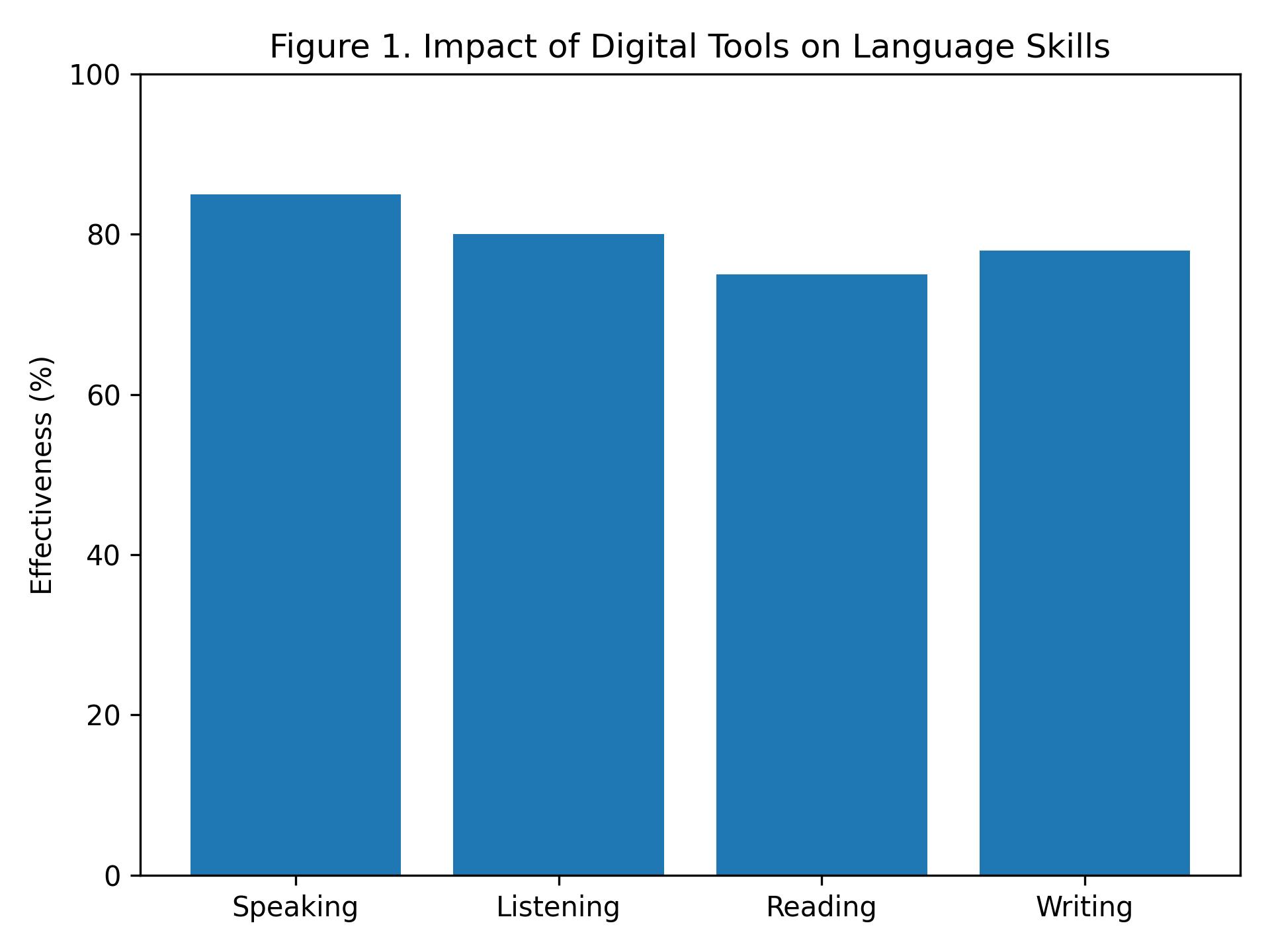 igure 1
presents the impact of digital tools on the development of language
skills. The diagram demonstrates that speaking and listening skills
show the highest improvement.
igure 1
presents the impact of digital tools on the development of language
skills. The diagram demonstrates that speaking and listening skills
show the highest improvement.
RECOMMENDATIONS
To successfully implement digital tools in English language teaching, teachers should follow several practical recommendations. First, digital tools should be selected according to learning objectives and learner needs. Second, teachers should combine digital activities with communicative tasks to ensure meaningful language use. Third, technical readiness and digital literacy should be considered to avoid learning barriers. Fourth, continuous feedback and assessment should be provided. Finally, teachers should balance digital and traditional teaching methods to maintain pedagogical effectiveness.
CONCLUSION
In conclusion, this study confirms that digital tools play a vital role in developing communicative competence in English language learning. The integration of technology into the teaching process transforms traditional classrooms into interactive, learner-centered environments where students actively use language for real communication. Digital tools provide authentic input, encourage collaboration, and create meaningful opportunities for speaking, listening, reading, and writing practice.
The findings demonstrate that when digital tools are used methodologically and purposefully, they significantly enhance learner motivation, engagement, and confidence. Students become more willing to participate in discussions, express opinions, and interact with peers. Moreover, digital platforms support differentiated instruction and learner autonomy, allowing students to progress at their own pace and take responsibility for their learning.
At the same time, the study reveals that the effectiveness of digital tools depends on teachers’ methodological competence and careful lesson planning. Technical challenges, unequal access to devices, and varying levels of digital literacy may limit the successful implementation of technology. However, these challenges can be addressed through professional development, proper preparation, and balanced integration of digital and traditional teaching methods.
Overall, digital tools should not replace pedagogical principles but rather enhance them. Their value lies in supporting communicative language teaching and task-based learning approaches. Therefore, the systematic and thoughtful use of digital technologies should be considered an essential component of modern English language education. By integrating digital tools effectively, teachers can foster communicative competence and prepare learners for real-life communication in a globalized digital world.
REFERENCES
-
Harmer J. How to Teach English. — London: Longman, 2015. — 288 p.
-
Richards J. C. Communicative Language Teaching Today. — Cambridge: Cambridge University Press, 2006. — 48 p.
-
Warschauer M. Technology and Language Learning. — London: Routledge, 2004. — 221 p.
-
Dudeney G., Hockly N. How to Teach English with Technology. — London: Pearson Education, 2012. — 192 p.
-
UNESCO. ICT in Education: A Critical Review. — Paris: UNESCO Publishing, 2017. — 95 p.
-
Dörnyei Z. Motivation in Second Language Learning. — Cambridge: Cambridge University Press, 2001. — 170 p.
-
Nation I. S. P. Teaching ESL/EFL Listening and Speaking. — New York: Routledge, 2009. — 195 p.
-
Oxford R. L. Teaching and Researching Language Learning Strategies. — London: Pearson Education, 2011. — 368 p.
-
Richards J. C., Rodgers T. S. Approaches and Methods in Language Teaching. — Cambridge: Cambridge University Press, 2014. — 410 p.
-
Davies G. ICT and Language Learning. — London: Palgrave Macmillan, 2012. — 230 p.
 Жүктеу
жүктеу мүмкіндігіне ие боласыз
Бұл материал сайт қолданушысы жариялаған. Материалдың ішінде жазылған барлық ақпаратқа жауапкершілікті жариялаған қолданушы жауап береді. Ұстаз тілегі тек ақпаратты таратуға қолдау көрсетеді. Егер материал сіздің авторлық құқығыңызды бұзған болса немесе басқа да себептермен сайттан өшіру керек деп ойласаңыз осында жазыңыз
 20 Желтоқсан 2025
 52
52THE ROLE OF DIGITAL TOOLS IN DEVELOPING COMMUNICATIVE COMPETENCE IN ENGLISH LANGUAGE LEARNING
Берікқызы Санагүл
Ағылшын тілі пәні мұғалімі, педагог
«Жамбыл облысы әкімдігінің білім басқармасы Тараз қаласының білім бөлімінің Валерий Чкалов атындағы орта мектебі» КММ
THE ROLE OF DIGITAL TOOLS IN DEVELOPING COMMUNICATIVE COMPETENCE IN ENGLISH LANGUAGE LEARNING
Abstract
This methodological article explores the role of digital tools in developing communicative competence in English language learning. The relevance of the research is determined by the rapid digitalization of education and the growing need for learners who are able to communicate effectively in English. The article analyzes theoretical and methodological foundations, describes practical classroom applications, evaluates effectiveness, and presents recommendations for teachers. The findings confirm that systematic integration of digital tools enhances motivation, interaction, learner autonomy, and overall communicative competence.
Keywords: digital tools; communicative competence; English language teaching; ICT; blended learning.
INTRODUCTION
In the modern educational context, digital technologies have become an inseparable part of teaching and learning processes. English language education, in particular, has undergone significant changes due to the integration of digital tools, online platforms, and multimedia resources. The primary goal of English language teaching today is the development of communicative competence, which enables learners to use language appropriately and effectively in real-life situations. Traditional teaching approaches, however, often focus on grammar and memorization, providing limited opportunities for meaningful communication.
The relevance of this article is closely connected with current educational reforms and global trends in digital learning. Digital tools create interactive environments where learners can practice speaking, listening, reading, and writing in authentic contexts. Research conducted by international and national scholars highlights that technology-enhanced learning increases learner motivation, supports collaboration, and fosters independent learning. In Kazakhstan, the integration of digital technologies into secondary education has been identified as a priority, particularly in foreign language instruction.
The purpose of this article is to examine the role of digital tools in developing communicative competence in English language learning and to analyze their methodological and practical value. The objectives of the article are:
-
to define communicative competence and its components;
-
to describe methodological principles of using digital tools;
-
to demonstrate practical classroom applications;
-
to analyze the results, advantages, and limitations of digital tools; and;
-
to provide recommendations for teachers.
METHODOLOGY
This methodological study is based on a qualitative approach that combines theoretical analysis, pedagogical observation, and reflective teaching practice. The methodological framework relies on Communicative Language Teaching (CLT), Task-Based Learning (TBL), and blended learning principles, which emphasize meaningful interaction, learner-centeredness, and authentic communication.
Digital tools are integrated into the teaching methodology as essential instructional resources rather than supplementary materials. The key methodological principles include interactivity, accessibility, authenticity, flexibility, and continuous feedback. These principles guide the selection and use of digital tools in English language lessons.
The methodology follows a structured sequence: preparation, implementation, interaction, monitoring, and evaluation. During the preparation stage, teachers select appropriate digital tools based on lesson objectives and learners’ needs. The implementation stage involves integrating digital tools into communicative tasks such as discussions, role-plays, and projects. Interaction is promoted through pair and group work using online platforms. Monitoring includes observing learner participation and progress, while evaluation focuses on communicative outcomes and learner feedback.
The study analyzes widely used digital tools such as Quizlet, Kahoot, Google Classroom, YouTube, Padlet, and Google Docs. These tools were selected due to their pedagogical value, accessibility, and effectiveness in supporting language skills development.
PRACTICAL APPLICATION
The practical application of digital tools was implemented in English lessons at the secondary school level. Digital tools were used at different stages of the lesson to support communicative competence development.
In speaking and listening activities, authentic video materials from YouTube and TED-Ed were used. Students listened to real-life conversations, interviews, and short lectures, followed by discussions and role-play activities. These tasks helped learners improve pronunciation, fluency, and comprehension.
Vocabulary and grammar practice was conducted using Quizlet and Kahoot. These tools allowed students to practice language forms interactively and receive immediate feedback. Competitive elements increased motivation and engagement.
Writing skills were developed through collaborative tasks in Google Docs. Students worked in groups to write essays, reports, and project descriptions, providing peer feedback and revising their work. Padlet was used for brainstorming and opinion sharing, encouraging active participation.
Project-based tasks combined several digital tools. For example, students researched topics online, discussed findings, prepared presentations, and reflected on their learning. Such tasks integrated all four language skills and promoted learner autonomy.
The analysis of results showed positive outcomes: increased participation, improved fluency, enhanced confidence, and higher motivation. However, challenges such as technical issues, unequal access to devices, and varying digital literacy levels were also identified.
Table 1. Digital Tools Used in English Language Teaching
|
Digital Tool |
Skill Focus |
Educational Benefit |
|
Quizlet |
Vocabulary |
Retention and accuracy |
|
Kahoot |
Grammar |
Motivation and engagement |
|
YouTube |
Listening/Speaking |
Authentic input |
|
Google Docs |
Writing |
Collaboration |
|
Padlet |
Speaking/Writing |
Idea sharing |
F igure 1
presents the impact of digital tools on the development of language
skills. The diagram demonstrates that speaking and listening skills
show the highest improvement.
RECOMMENDATIONS
To successfully implement digital tools in English language teaching, teachers should follow several practical recommendations. First, digital tools should be selected according to learning objectives and learner needs. Second, teachers should combine digital activities with communicative tasks to ensure meaningful language use. Third, technical readiness and digital literacy should be considered to avoid learning barriers. Fourth, continuous feedback and assessment should be provided. Finally, teachers should balance digital and traditional teaching methods to maintain pedagogical effectiveness.
CONCLUSION
In conclusion, this study confirms that digital tools play a vital role in developing communicative competence in English language learning. The integration of technology into the teaching process transforms traditional classrooms into interactive, learner-centered environments where students actively use language for real communication. Digital tools provide authentic input, encourage collaboration, and create meaningful opportunities for speaking, listening, reading, and writing practice.
The findings demonstrate that when digital tools are used methodologically and purposefully, they significantly enhance learner motivation, engagement, and confidence. Students become more willing to participate in discussions, express opinions, and interact with peers. Moreover, digital platforms support differentiated instruction and learner autonomy, allowing students to progress at their own pace and take responsibility for their learning.
At the same time, the study reveals that the effectiveness of digital tools depends on teachers’ methodological competence and careful lesson planning. Technical challenges, unequal access to devices, and varying levels of digital literacy may limit the successful implementation of technology. However, these challenges can be addressed through professional development, proper preparation, and balanced integration of digital and traditional teaching methods.
Overall, digital tools should not replace pedagogical principles but rather enhance them. Their value lies in supporting communicative language teaching and task-based learning approaches. Therefore, the systematic and thoughtful use of digital technologies should be considered an essential component of modern English language education. By integrating digital tools effectively, teachers can foster communicative competence and prepare learners for real-life communication in a globalized digital world.
REFERENCES
-
Harmer J. How to Teach English. — London: Longman, 2015. — 288 p.
-
Richards J. C. Communicative Language Teaching Today. — Cambridge: Cambridge University Press, 2006. — 48 p.
-
Warschauer M. Technology and Language Learning. — London: Routledge, 2004. — 221 p.
-
Dudeney G., Hockly N. How to Teach English with Technology. — London: Pearson Education, 2012. — 192 p.
-
UNESCO. ICT in Education: A Critical Review. — Paris: UNESCO Publishing, 2017. — 95 p.
-
Dörnyei Z. Motivation in Second Language Learning. — Cambridge: Cambridge University Press, 2001. — 170 p.
-
Nation I. S. P. Teaching ESL/EFL Listening and Speaking. — New York: Routledge, 2009. — 195 p.
-
Oxford R. L. Teaching and Researching Language Learning Strategies. — London: Pearson Education, 2011. — 368 p.
-
Richards J. C., Rodgers T. S. Approaches and Methods in Language Teaching. — Cambridge: Cambridge University Press, 2014. — 410 p.
-
Davies G. ICT and Language Learning. — London: Palgrave Macmillan, 2012. — 230 p.
 Жүктеу

 Жүктеу
шағым қалдыра аласыз


 Бұл курс Қазақстан Республикасы Оқу-ағарту министрлігімен келісілген


