
 ЖИ көмекші


жүктеу мүмкіндігіне ие боласыз
Бұл материал сайт қолданушысы жариялаған. Материалдың ішінде жазылған барлық ақпаратқа жауапкершілікті жариялаған қолданушы жауап береді. Ұстаз тілегі тек ақпаратты таратуға қолдау көрсетеді. Егер материал сіздің авторлық құқығыңызды бұзған болса немесе басқа да себептермен сайттан өшіру керек деп ойласаңыз осында жазыңыз
 03 Ақпан 2025
 222
222
The Role of English as a Global Lingua Franca
Тақырыбы: The Role of English as a
Global Lingua Franca
Introduction
In today’s globalized world, English has transformed from a language spoken predominantly in the United Kingdom and the United States to the most widely used lingua franca across the globe. A "lingua franca" refers to a common language that enables communication between people whose native languages are different. English, as the current global lingua franca, is the primary language of business, education, diplomacy, and technology. This article explores the role of English as a global lingua franca, examining its historical roots, impact in various sectors, advantages, challenges, and its influence on cultural and linguistic diversity.
Historical Development of English as a Lingua Franca
The rise of English as a global lingua franca can be traced back to a combination of historical, political, and cultural factors. The British Empire played a major role in spreading the English language across the world during the colonial era, from the 16th to the 20th century. Through its empire-building efforts, the British introduced English to regions such as North America, India, Africa, and the Caribbean, where it was used as the primary means of administration, education, and trade.
However, it was during the 20th century, particularly after World War II, that English’s global dominance solidified. The political, economic, and military power of the United States, along with the increasing reach of American culture through Hollywood films, television, music, and later the internet, made English the de facto language of global communication. As the world became more interconnected, English was increasingly adopted in international diplomacy, trade, and scientific collaboration. The widespread influence of American culture and technology, alongside the rise of global organizations where English was the working language, further propelled the status of English as a global lingua franca.
English in International Business and Diplomacy
In the business world, English is the primary language of international trade, finance, and corporate communication. Multinational companies use English as their corporate language, facilitating communication among employees and stakeholders from different linguistic backgrounds. For instance, in global corporations with employees from various countries, English often serves as the medium for meetings, documents, and digital communication. The use of English allows for the streamlining of communication and increases efficiency in international transactions.
Furthermore, English is crucial in international diplomacy and relations. Major global organizations, such as the United Nations, the European Union, the World Trade Organization, and the International Monetary Fund, all use English as an official or working language. English thus serves as a neutral ground for negotiations, ensuring that representatives from different countries can communicate effectively, avoiding potential misunderstandings that could arise from the use of less universally spoken languages. In diplomatic settings, English’s role as a global lingua franca is indispensable, simplifying communication and fostering cooperation across nations.
English in Education and Academia
English has become the dominant language of academia. Many of the world’s top universities and research institutions teach their programs in English, attracting students from around the world. The global demand for higher education often requires English proficiency, particularly for students seeking opportunities in countries like the United States, the United Kingdom, Canada, and Australia. This has led to the increasing prominence of English-language universities and courses available internationally.
In academic research, English is the language of choice for publishing scientific articles, presenting findings at international conferences, and sharing academic knowledge globally. According to recent studies, the majority of academic journals, particularly in the fields of science, technology, and social sciences, are published in English. Researchers and scholars worldwide often publish their work in English, ensuring wider dissemination and recognition in the global academic community. This has made English a universal medium for knowledge exchange, further promoting the spread of ideas and innovations across borders.
Cultural Impact of English as a Global Lingua Franca
The spread of English has also had profound effects on global culture. English-language media—films, television shows, music, and literature—have dominated global entertainment, shaping modern pop culture in unprecedented ways. Hollywood, the center of the global film industry, produces films in English that are distributed worldwide, making English synonymous with modernity, creativity, and global appeal. Music, too, with the rise of English-language songs in genres like pop, rock, and hip-hop, has reinforced the dominance of English as a cultural tool for expression.
Moreover, the increasing prevalence of the English language in global media has led to the incorporation of English phrases and expressions into many non-English speaking cultures. While English-language media has brought many cultural innovations and has helped bridge diverse cultural gaps, it has also raised concerns about the marginalization of indigenous languages and cultures. As more people across the world embrace English for its perceived economic and social advantages, there is a risk of losing local languages, traditions, and cultural practices. This phenomenon is often referred to as "linguistic imperialism," where the dominance of English threatens the vitality of other languages and the richness of cultural diversity.
Advantages of English as a Global Lingua Franca
The role of English as a global lingua franca comes with several advantages. First, English facilitates communication between speakers of different native languages, making it easier for individuals from diverse linguistic backgrounds to engage in trade, diplomacy, and cultural exchange. It serves as a common ground for communication, promoting collaboration, mutual understanding, and the exchange of ideas.
Second, the use of English opens up a vast range of opportunities for non-native speakers. Proficiency in English is often a key requirement for international job markets, access to prestigious educational institutions, and participation in global conferences and forums. English serves as an important tool for economic mobility, as it is closely linked with access to better employment opportunities and the ability to work in multinational organizations.
Furthermore, English provides access to a wealth of knowledge across various fields, such as science, technology, medicine, and engineering. Given that much of the world’s research is published in English, being proficient in the language allows individuals to stay informed about the latest developments in their fields. English thus plays a crucial role in advancing global education and innovation.
Challenges of English as a Global Lingua Franca
While English serves as a unifying language in many spheres, its dominance also poses several challenges. One significant concern is the potential for linguistic inequality. While English may open doors for those who speak it fluently, those who do not face significant barriers to participation in global discussions. The increasing demand for English proficiency has led to educational inequalities in non-English-speaking countries, where access to high-quality English education may be limited.
Another challenge lies in the potential erosion of linguistic diversity. As more people learn and use English, the status of local languages can diminish. In some regions, the younger generations may prioritize learning English over preserving their native languages, leading to the extinction of lesser-spoken languages. According to the United Nations Educational, Scientific and Cultural Organization (UNESCO), approximately one language disappears every two weeks, and many of these languages are being replaced by dominant languages like English.
The variability of English as a lingua franca also presents communication difficulties. English is spoken by millions of non-native speakers, and there are significant differences in pronunciation, vocabulary, and grammar between native English speakers and non-native speakers. The rise of "English as a Lingua Franca" (ELF) has led to a growing acceptance of diverse forms of English, but this can sometimes result in miscommunication, especially in international contexts where clarity is crucial.
Conclusion
English’s role as a global lingua franca has transformed the way people communicate, collaborate, and share knowledge across the globe. It serves as the language of business, diplomacy, academia, and culture, providing significant opportunities for economic mobility, educational access, and global collaboration. However, the widespread dominance of English also brings challenges related to linguistic inequality and the preservation of cultural and linguistic diversity. As English continues to play a central role in the global landscape, it is important to balance the benefits of a shared language with the need to protect and celebrate the linguistic and cultural heritage of smaller languages and communities.
References
-
Crystal, D. (2003). English as a Global Language (2nd ed.). Cambridge University Press.
-
Graddol, D. (2006). English Next: Why Global English May Mean the End of 'English as a Foreign Language'. British Council.
-
Jenkins, J. (2009). English as a Lingua Franca: Interpretations and Attitudes. World Englishes, 28(2), 200-217.
-
Seidlhofer, B. (2011). Understanding English as a Lingua Franca. Oxford University Press.
-
Phillipson, R. (1992). Linguistic Imperialism. Oxford University Press.
-
Holliday, A. (2005). The Struggle to Teach English as an International Language. Oxford University Press.
-
Canagarajah, S. (2007). Lingua Franca English, Multilingual Communities, and Language Acquisition. The Modern Language Journal, 91(6), 927-938.

 Жүктеу


 Жүктеу
шағым қалдыра аласыз
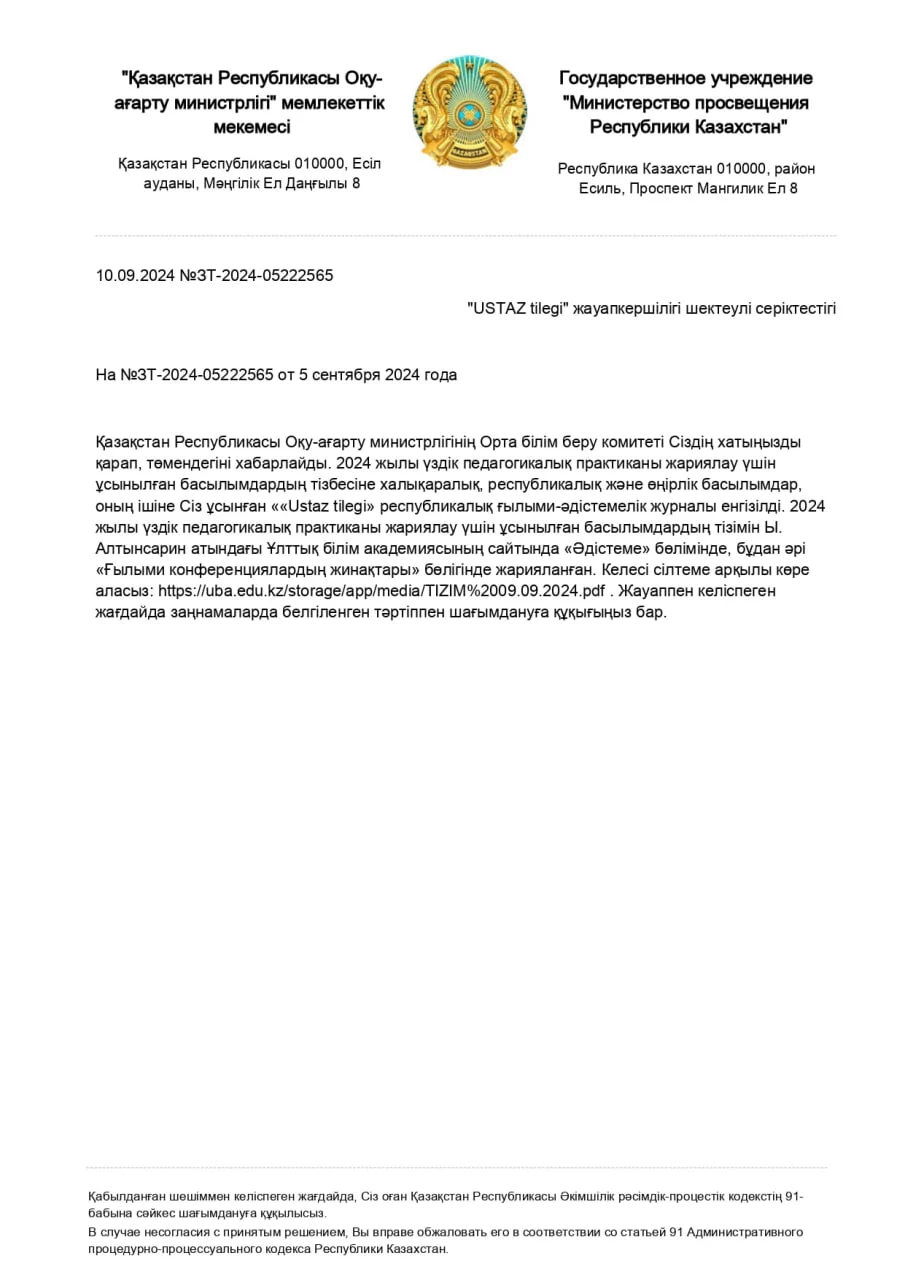

 Бұл курс Қазақстан Республикасы Оқу-ағарту министрлігімен келісілген










