
 ЖИ көмекші


 Қауіпсіз төлем

жүктеу мүмкіндігіне ие боласыз
Бұл материал сайт қолданушысы жариялаған. Материалдың ішінде жазылған барлық ақпаратқа жауапкершілікті жариялаған қолданушы жауап береді. Ұстаз тілегі тек ақпаратты таратуға қолдау көрсетеді. Егер материал сіздің авторлық құқығыңызды бұзған болса немесе басқа да себептермен сайттан өшіру керек деп ойласаңыз осында жазыңыз
 24 Ақпан 2026
 15
15
1 жыл бойы шексіз жүктеңіз
Topic: The Pearl of Kazakhstan
Ministry of Education of the Republic of Kazakhstan
School № 6 after Mukhamedgali Suzhikov
Бекітемін________________________
LESSON PLAN
Topic: The Pearl of Kazakhstan
|
Stages/ Time |
Teachers’ actions |
Students’ actions |
Assessment criteria |
Resources |
|
Beginning of the lesson 2 min “Action song” activity |
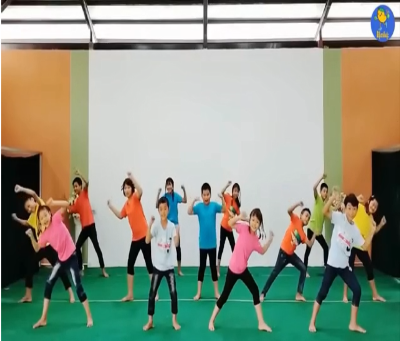
1.Greeting students with the action song “Hello to all the children of the world”. |
The aim: -to encourage students to actively participate in greetings through a fun and engaging song, helping them develop confidence in speaking, improve listening skills, and create a positive classroom environment. |
At the organization moment T tries to praise students for their participation. “Good job! Well done!” “Assyk” award ` Descriptor: -Students will be welcomed with a lively and engaging “Hello to all the children of the world” action song; -Students repeat after the video movements. Participate in discussions and add details to their classmates’ answers. |
https://www.youtube.com/watch?v=FbkoMBDvO3k Assyk award |
|
Checking-up homework 3 min |
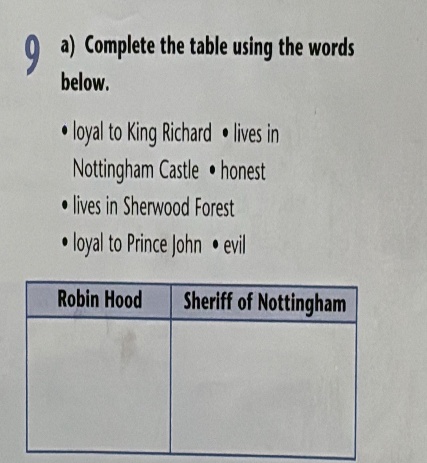
Briefly discuss previously leant materials. The teacher asks Ss to complete the table using the words. |
The aim: -improve reading comprehension by analyzing character traits; -develop categorization skills by matching attributes to the correct character. -reinforce knowledge of the Robin Hood story and its themes of justice, loyalty, and morality. Students complete the table using the words below. |
Descriptor: -Students must complete the table by correctly assigning characteristics to either Robin Hood or the Sheriff of Nottingham using the provided words. Total: 1 point, “assyk” award
|
Poster |
|
Warm up “Waka waka” action song 3 min |
T introduces the action song. Play a short demonstration of the song (audio/video) to help students get familiar with the tune. Model the actions while singing the lyrics, encouraging students to follow along. Repeat the song with students joining in, correcting movements if necessary. Encourage full participation and enthusiasm by praising students’ efforts. |
The aim: -energize students; -create a positive classroom atmosphere; and introduce movement-based learning. Listen attentively to the song. Observe and imitate the teacher’s actions. Sing along while performing the corresponding movements. Participate actively, demonstrating enthusiasm and engagement. |
Formative assessment: Observe students’ participation, enthusiasm, and ability to follow the actions correctly. “Good job! Well done!” Praising method.
Descriptor: -Briefly explain the purpose of the warm-up and encourage students to participate actively; -Show a few basic dance moves; -Play the song and have students follow along with the movements. Encourage them to express themselves freely; -Praise students for their enthusiasm and transition smoothly into the lesson.
|
video recording of the action song; Open space for movement. |
|
Lead – In 3 min “Name the place” picture guess |
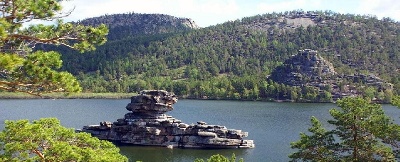
Display a picture. Encourage students to observe the picture and think about what they see. Ask guiding questions like: "What do you see in this picture?" "What kind of place do you think this is?" "Have you been to a place like this?" Provide hints if needed and reveal the correct answer. |
The aim: - to activate students’ prior knowledge and introduce the lesson topic by engaging them in a guessing game where they identify places based on clues. This helps build curiosity, set the context for learning, and encourage participation. Look at the picture carefully and identify key details. Discuss with a partner or as a class what they think the place is. Answer the teacher’s questions using short sentences. Try to guess the place and justify their answer (e.g., "I think it’s a park because I see …….") Ss determine the topic and purpose of the lesson |
Informal assessment through student participation. Observe how well students describe and guess the places. Give positive feedback and corrections where necessary. Encourage the use of complete sentences and correct vocabulary. T tries to praise students for their speaking skills. “Good job!, Well done!” etc. Descriptor: -students will see an image; -listen to hints; -read short descriptions about various places (e.g., school, park, shopping mall, beach). -they will guess the name of the place, leading into the main topic of the lesson.
|
Led screen A picture |
|
Middle of the lesson Pre-learning 7 min Picsart app |
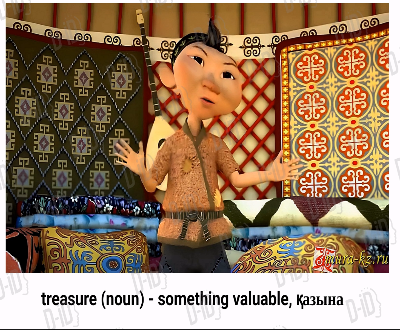
New vocabulary Present a set of new words related to the lesson. T uses D-ID AI to generate an engaging video of a virtual character pronouncing and using the new words in simple sentences. Play the video and encourage students to listen carefully. Pause the video at key moments to highlight pronunciation, meaning, and usage. |
The aim: -to introduce and familiarize students with new vocabulary through an AI-generated video, enhancing their comprehension, pronunciation, and contextual understanding before engaging in deeper learning activities.
Watch the AI-generated video and take notes on new words.
Repeat the words after the virtual character to practice pronunciation.
Work in pairs or small groups to guess the meanings of words based on the video context. |
Formative Assessment: Listen to students' pronunciation and correct mistakes. Ask students to use the words in sentences. Descriptor: -Students will be introduced to key vocabulary through an engaging AI-generated video using D-ID. -The AI avatar will present the target words with definitions.
T tries to praise students for their speaking skills. “Good job!, Well done!” etc.
|
Student’s book Classroom Smartboard/Projector (to display AI-generated videos) |
|
Presentation part. “The Pearl of Kazakhstan” video 5 min |
Ex: 2 p80 Introduce the topic and set the context for the video. Ask students to predict what the video will be about based on the title or an image from the video. Play the video, ensuring students focus on key details. Pause at important moments to explain vocabulary, key ideas, or ask guiding questions. Summarize the main points of the video and relate them to the lesson objective. |
The aim: -to engage students and set the context. Listen and watch attentively. Take notes on key points or specific vocabulary. Answer pre-watching or during-watching questions. Participate in a short discussion about the video content. Share their thoughts or summarize what they understood. |
Formative assessment: Ask comprehension questions about the video. Peer discussion: Have students share their understanding in pairs or small groups. Descriptor: -Play a short, visually engaging video about one of Kazakhstan’s natural wonders; -While watching, students should: write down 3 interesting facts. -Note any new English words they hear. Total: 1 point, “assyk” award |
Video material Projector or smartboard. |
|
Dividing into 3 groups Puzzle Activity 5 min |
1. Introduction (Entering of Aldar Kose) A student in costume enters as Aldar Kose, greeting students in a lively and engaging manner. Briefly tells a short, humorous story or riddle about Aldar Kose to capture students’ attention. 2. Group Division Aldar Kose distributes cut-out pieces of three different pictures (related to the theme of the lesson). Gives instructions: Students must find peers with matching pieces to complete the picture and form a group. Once groups are formed, the teacher confirms they are correct and introduces the next activity. |
Aim: -to engage students in the lesson by introducing the character of Aldar Kose and to divide them into groups through a puzzle-based activity. Listen attentively to the character introduction. Work collaboratively to match their puzzle pieces with others. Form groups based on their completed picture. |
Descriptor: -Students will be able to recognize Aldar Kose, participate in group formation, and collaborate with peers to complete a puzzle. Formative Assessment (Observation-based): Participation in the puzzle activity. Ability to work collaboratively to form correct groups.
|
Aldar Kose costume (optional). Cut-out puzzle pieces (3 different pictures). |
|
Practice part Answering the questions Group work 5 min |
Ex:3 P:81 Provide students with a set of comprehension questions related to the text. Model how to find answers by referring to key parts of the text. Encourage students to underline or highlight relevant information. Monitor students' progress by walking around the classroom and offering guidance. Facilitate a discussion where students share their answers and justify them using evidence from the text. |
The aim: -to enhance students' reading comprehension skills by encouraging critical thinking, extracting key information, and interpreting the meaning of the text through targeted questions. Read the text carefully to understand the main ideas and details. Identify the answers to the questions within the text. Write responses in complete sentences. Participate in a group discussion to compare answers. Share answers with the class and explain reasoning. ANSWERS: 1.They were sad because they had no mountains, lakes, forests, etc. 2. Aldar-Kosse was very kind and didn’t like to see the Kazakhstani people so miserable. 3.He asked for some mountains. 4.The Creator kept his treasures in a sack. 5.He made a hole in the sack. 6. He was a cheeky man. |
Formative assessment: Teacher observes students' engagement and understanding during the activity. Provides feedback on sentence structure and accuracy. Descriptor: -Students demonstrate comprehension of the text; -Answer specific questions and identify key details, Total: 2 points, “assyk” award |
Student’s book A whiteboard or projector with digital comprehension questions |
|
Practice part “Note completion“activity Pair work 4 min |
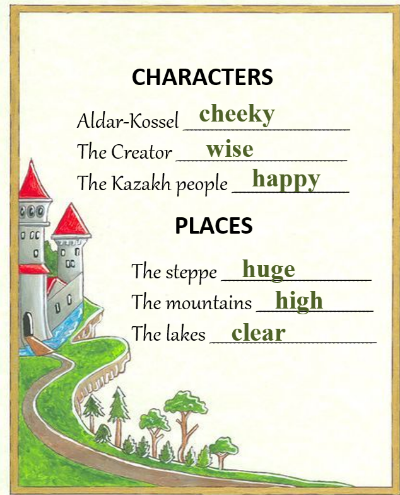
Ex:5 P81 Provides students with a worksheet or interactive task containing notes of characters and places with missing adjectives. Gives clear instructions on how to complete the gaps. Models an example by completing one sentence together with the class. Monitors students’ progress and provides hints or explanations if needed. Conducts feedback by reviewing answers as a class and discussing any mistakes. |
The aim: -this activity enhances students' vocabulary, reading comprehension, and analytical skills. Read the sentences carefully and identify the missing words. Use their knowledge of vocabulary or grammar rules to complete the gaps. Work in pairs to discuss and check their answers. Participate in reviewing answers, explaining their choices, and correcting mistakes if necessary. |
Descriptor: -Students will identify the adjectives used by the writer to describe characters, settings, and objects. -They will then categorize these adjectives into a graphic organizer, grouping them based on different aspects such as emotions, appearance, size, and quality. Total: 3 points “assyk” award
|
A whiteboard or projector |
|
Individual work 5 min |
Ex: 4 P81 Provides students with a worksheet or interactive task containing a text with missing words. Gives clear instructions on how to complete the gaps. Models an example by completing one sentence together with the class. Monitors students’ progress and provides hints or explanations if needed. Conducts feedback by reviewing answers as a class and discussing any mistakes. |
Aim: to enhance students’ vocabulary, spelling, and understanding of sentence structure by providing contextual practice in completing sentences with appropriate word. Ss complete the sentences with the words below. |
Teacher checks students’ answers through oral feedback or by collecting worksheets. Self-correction can be used for formative assessment. Teacher provides feedback on common mistakes and reinforces correct usage. Total: 3 points, “assyk” award |
Digital worksheets with gap-fill exercises. |
|
End of the lesson Reflection 3 min |
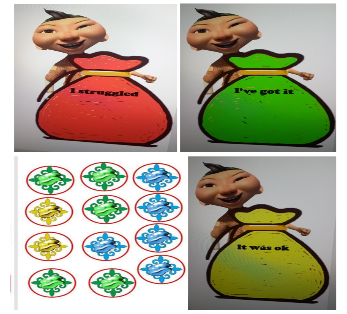
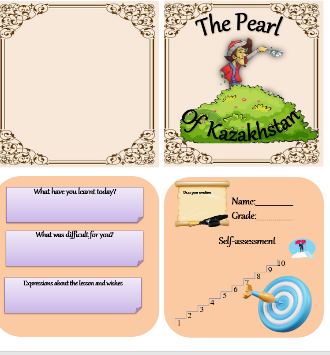
T asks a few students to share their thoughts. Summarize key points from the lesson; Encourage students to continue exploring different film genres outside class. Giving the homework. Ex:7 In groups draw the story in twelve photos. Self-reflection |
The aim: -to encourage students to think critically about their learning process, recognize areas for growth, and develop self-regulation skills through reflection and self-assessment. Assess their learning progress through a self-assessment sheet. Students complete the self-assessment sheet by rating their understanding and answering reflection questions. . |
Descriptor: -Students reflect on their learning experience by identifying key takeaways from the lesson; -Discuss challenges they faced, and express their thoughts and wishes for improvement; -They also engage in self-assessment to evaluate their progress and understanding.
|
Pens or pencils Self-assessment sheets |



Мұғалімнің қолы________________________








 Бұл курс Қазақстан Республикасы Оқу-ағарту министрлігімен келісілген










