ЖИ көмекші


 Қауіпсіз төлем




1 жыл бойы шексіз жүктеңіз
Accessible transportation for all ПРЕЗЕНТАЦИЯ

#1 слайд
Department: “Foreign languages”
PRESENTATION
Theme: Accessible transportation for all
Shymkent 20 99 Prepared by:
Group:
Checked by:
1 слайд
Department: “Foreign languages” PRESENTATION Theme: Accessible transportation for all Shymkent 20 99 Prepared by: Group: Checked by:
#2 слайд
CONTENT
I. Introduction
II. Main part
III. Conclusion
IV. Used literature 1. What is a transportation
2. Types of transport
3. Propose improvements transportation
2 слайд
CONTENT I. Introduction II. Main part III. Conclusion IV. Used literature 1. What is a transportation 2. Types of transport 3. Propose improvements transportation
#3 слайд
Transport (in British English) or transportation (in American English) is the intentional movement of humans, animals, and
goods from one location to another. The field can be divided into infrastructure, vehicles, and operations. Transport
enables human trade, which is essential for the development of civilizations.
Transport infrastructure consists of both fixed installations, including roads, railways, airways, waterways, canals, and
pipelines, and terminals such as airports, railway stations, bus stations, warehouses, trucking terminals, refueling depots
(including fuel docks and fuel stations), and seaports. Terminals may be used both for the interchange of passengers and
cargo and for maintenance.
Means of transport are any of the different kinds of transport facilities used to carry people or cargo. They may include
vehicles, riding animals, and pack animals. Vehicles may include wagons, automobiles, bicycles, buses, trains, trucks,
helicopters, watercraft, spacecraft, and aircraft. Introduction
3 слайд
Transport (in British English) or transportation (in American English) is the intentional movement of humans, animals, and goods from one location to another. The field can be divided into infrastructure, vehicles, and operations. Transport enables human trade, which is essential for the development of civilizations. Transport infrastructure consists of both fixed installations, including roads, railways, airways, waterways, canals, and pipelines, and terminals such as airports, railway stations, bus stations, warehouses, trucking terminals, refueling depots (including fuel docks and fuel stations), and seaports. Terminals may be used both for the interchange of passengers and cargo and for maintenance. Means of transport are any of the different kinds of transport facilities used to carry people or cargo. They may include vehicles, riding animals, and pack animals. Vehicles may include wagons, automobiles, bicycles, buses, trains, trucks, helicopters, watercraft, spacecraft, and aircraft. Introduction
#4 слайд
Transport facilitates trade activities by
creating utilization places for goods by
removing distance barriers between
production and consumption.
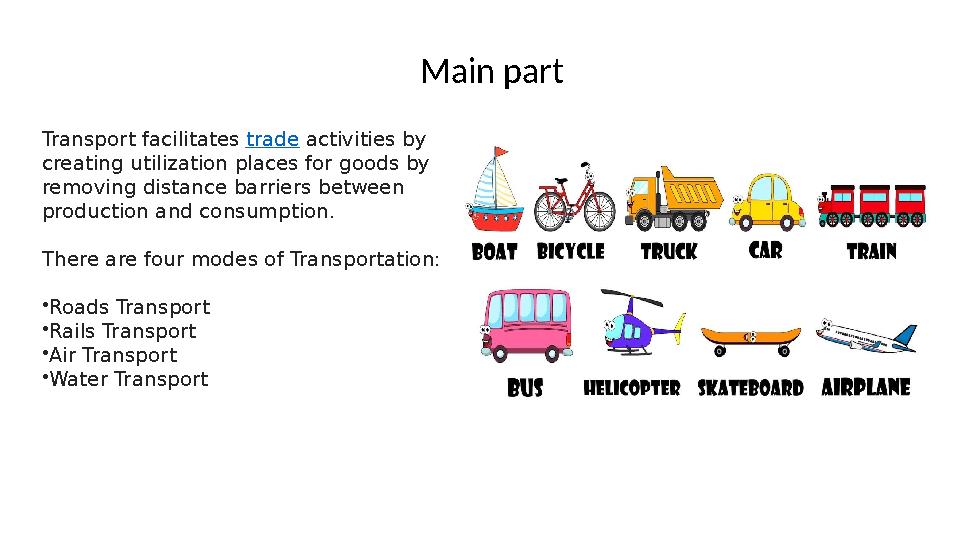
There are four modes of Transportation:
•
Roads Transport
•
Rails Transport
•
Air Transport
•
Water Transport Main part
4 слайд
Transport facilitates trade activities by creating utilization places for goods by removing distance barriers between production and consumption. There are four modes of Transportation: • Roads Transport • Rails Transport • Air Transport • Water Transport Main part
#5 слайд
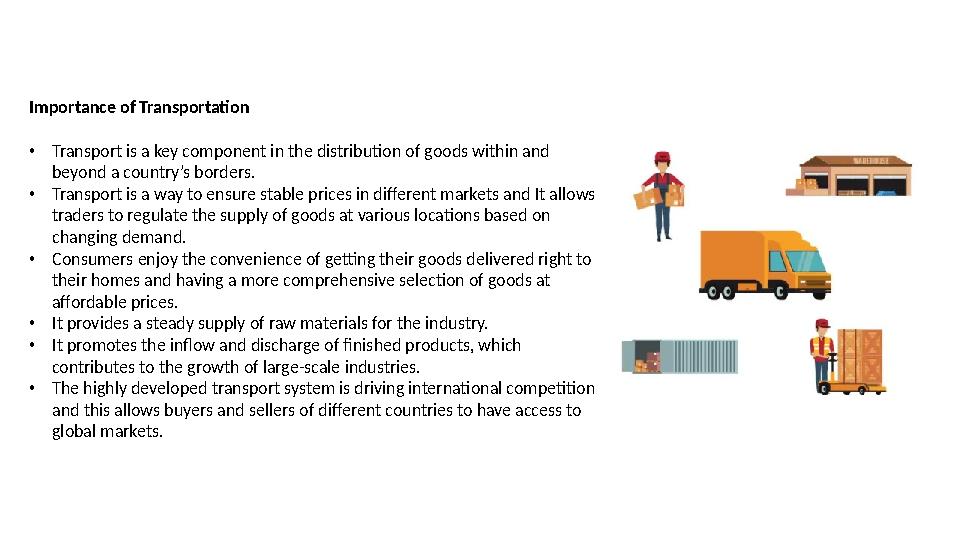
Importance of Transportation
•
Transport is a key component in the distribution of goods within and
beyond a country’s borders.
•
Transport is a way to ensure stable prices in different markets and It allows
traders to regulate the supply of goods at various locations based on
changing demand.
•
Consumers enjoy the convenience of getting their goods delivered right to
their homes and having a more comprehensive selection of goods at
affordable prices.
•
It provides a steady supply of raw materials for the industry.
•
It promotes the inflow and discharge of finished products, which
contributes to the growth of large-scale industries.
•
The highly developed transport system is driving international competition
and this allows buyers and sellers of different countries to have access to
global markets.
5 слайд
Importance of Transportation • Transport is a key component in the distribution of goods within and beyond a country’s borders. • Transport is a way to ensure stable prices in different markets and It allows traders to regulate the supply of goods at various locations based on changing demand. • Consumers enjoy the convenience of getting their goods delivered right to their homes and having a more comprehensive selection of goods at affordable prices. • It provides a steady supply of raw materials for the industry. • It promotes the inflow and discharge of finished products, which contributes to the growth of large-scale industries. • The highly developed transport system is driving international competition and this allows buyers and sellers of different countries to have access to global markets.
#6 слайд
Road transport is usually done by animals (horses, camels, and donkeys), animal-drawn vehicles
(bullock-carts), or motor vehicles (vans, trucks, etc.). Nowadays, animals and vehicles drawn
from animals are only used in rural areas and vans are only used for local transport within the
city and trucks are convenient, safe, and inexpensive for goods transport.
Rail transport refers primarily to the movement of passengers and goods by train on rail tracks.
Rails and Trains can transport large quantities of goods and high-capacity goods over long
distances and is safe and affordable and is the most used mode of goods traffic.
Water transport is the transportation of goods and people on waterways by various modes such
as boats, steamers, or launches. This may be done within the country or between countries.
To transport goods and people on rivers and canals, inland water transport uses boats, barges,
launchers, streamers, and barges. These routes are known as inland waterways and they carry
bulky goods and can be used for domestic or home trade.
Ocean transport is the movement of goods or passengers via ships using ocean waterways. It
plays an essential role in international trade growth and transporting goods and passengers to
and from coastal areas.
6 слайд
Road transport is usually done by animals (horses, camels, and donkeys), animal-drawn vehicles (bullock-carts), or motor vehicles (vans, trucks, etc.). Nowadays, animals and vehicles drawn from animals are only used in rural areas and vans are only used for local transport within the city and trucks are convenient, safe, and inexpensive for goods transport. Rail transport refers primarily to the movement of passengers and goods by train on rail tracks. Rails and Trains can transport large quantities of goods and high-capacity goods over long distances and is safe and affordable and is the most used mode of goods traffic. Water transport is the transportation of goods and people on waterways by various modes such as boats, steamers, or launches. This may be done within the country or between countries. To transport goods and people on rivers and canals, inland water transport uses boats, barges, launchers, streamers, and barges. These routes are known as inland waterways and they carry bulky goods and can be used for domestic or home trade. Ocean transport is the movement of goods or passengers via ships using ocean waterways. It plays an essential role in international trade growth and transporting goods and passengers to and from coastal areas.
#7 слайд
Mode
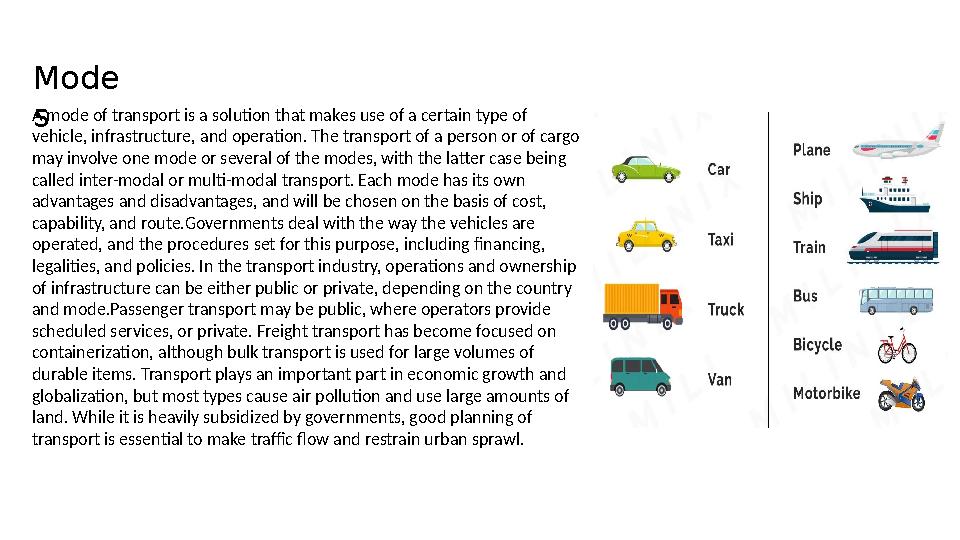
sA mode of transport is a solution that makes use of a certain type of
vehicle, infrastructure, and operation. The transport of a person or of cargo
may involve one mode or several of the modes, with the latter case being
called inter-modal or multi-modal transport. Each mode has its own
advantages and disadvantages, and will be chosen on the basis of cost,
capability, and route.Governments deal with the way the vehicles are
operated, and the procedures set for this purpose, including financing,
legalities, and policies. In the transport industry, operations and ownership
of infrastructure can be either public or private, depending on the country
and mode.Passenger transport may be public, where operators provide
scheduled services, or private. Freight transport has become focused on
containerization, although bulk transport is used for large volumes of
durable items. Transport plays an important part in economic growth and
globalization, but most types cause air pollution and use large amounts of
land. While it is heavily subsidized by governments, good planning of
transport is essential to make traffic flow and restrain urban sprawl.
7 слайд
Mode sA mode of transport is a solution that makes use of a certain type of vehicle, infrastructure, and operation. The transport of a person or of cargo may involve one mode or several of the modes, with the latter case being called inter-modal or multi-modal transport. Each mode has its own advantages and disadvantages, and will be chosen on the basis of cost, capability, and route.Governments deal with the way the vehicles are operated, and the procedures set for this purpose, including financing, legalities, and policies. In the transport industry, operations and ownership of infrastructure can be either public or private, depending on the country and mode.Passenger transport may be public, where operators provide scheduled services, or private. Freight transport has become focused on containerization, although bulk transport is used for large volumes of durable items. Transport plays an important part in economic growth and globalization, but most types cause air pollution and use large amounts of land. While it is heavily subsidized by governments, good planning of transport is essential to make traffic flow and restrain urban sprawl.
#8 слайд
Accessible transportation for all is a crucial aspect of ensuring equal opportunities and inclusion for
individuals with disabilities and other mobility challenges. Here are several key considerations and
initiatives for achieving accessible transportation:
1. Legal Framework : Governments need to enact and enforce laws and regulations that mandate
accessible transportation services. This includes provisions in legislation such as the Americans with
Disabilities Act (ADA) in the United States or similar laws in other countries.
2. Public Transportation : Public transportation systems should be designed to accommodate
people with disabilities. This involves ensuring that buses, trains, subways, and other modes of
public transit are wheelchair accessible, have ramps or lifts, priority seating, and other features that
make them usable for individuals with various disabilities.
3. Accessible Infrastructure : Sidewalks, crosswalks, and pedestrian pathways should be designed
to accommodate individuals with mobility challenges. This includes features like curb cuts, ramps,
tactile paving, and audible signals at crosswalks.
4. Accessible Vehicles : Transportation providers should offer accessible vehicles equipped with
ramps or lifts, securement systems for wheelchairs, and other features to accommodate passengers
with disabilities. This applies to taxis, ride-sharing services, paratransit services, and other private
transportation providers.
5. Training and Sensitization : Transportation staff should undergo training to interact respectfully
with passengers with disabilities and assist them as needed. This includes training on operating
accessibility features on vehicles, understanding disability etiquette, and providing appropriate
assistance.
6. Information and Communication : Transportation providers should ensure that information
about schedules, routes, and accessibility features is readily available and accessible to all
passengers. This includes providing information in multiple formats such as Braille, large print, and
electronic formats.
8 слайд
Accessible transportation for all is a crucial aspect of ensuring equal opportunities and inclusion for individuals with disabilities and other mobility challenges. Here are several key considerations and initiatives for achieving accessible transportation: 1. Legal Framework : Governments need to enact and enforce laws and regulations that mandate accessible transportation services. This includes provisions in legislation such as the Americans with Disabilities Act (ADA) in the United States or similar laws in other countries. 2. Public Transportation : Public transportation systems should be designed to accommodate people with disabilities. This involves ensuring that buses, trains, subways, and other modes of public transit are wheelchair accessible, have ramps or lifts, priority seating, and other features that make them usable for individuals with various disabilities. 3. Accessible Infrastructure : Sidewalks, crosswalks, and pedestrian pathways should be designed to accommodate individuals with mobility challenges. This includes features like curb cuts, ramps, tactile paving, and audible signals at crosswalks. 4. Accessible Vehicles : Transportation providers should offer accessible vehicles equipped with ramps or lifts, securement systems for wheelchairs, and other features to accommodate passengers with disabilities. This applies to taxis, ride-sharing services, paratransit services, and other private transportation providers. 5. Training and Sensitization : Transportation staff should undergo training to interact respectfully with passengers with disabilities and assist them as needed. This includes training on operating accessibility features on vehicles, understanding disability etiquette, and providing appropriate assistance. 6. Information and Communication : Transportation providers should ensure that information about schedules, routes, and accessibility features is readily available and accessible to all passengers. This includes providing information in multiple formats such as Braille, large print, and electronic formats.
#9 слайд
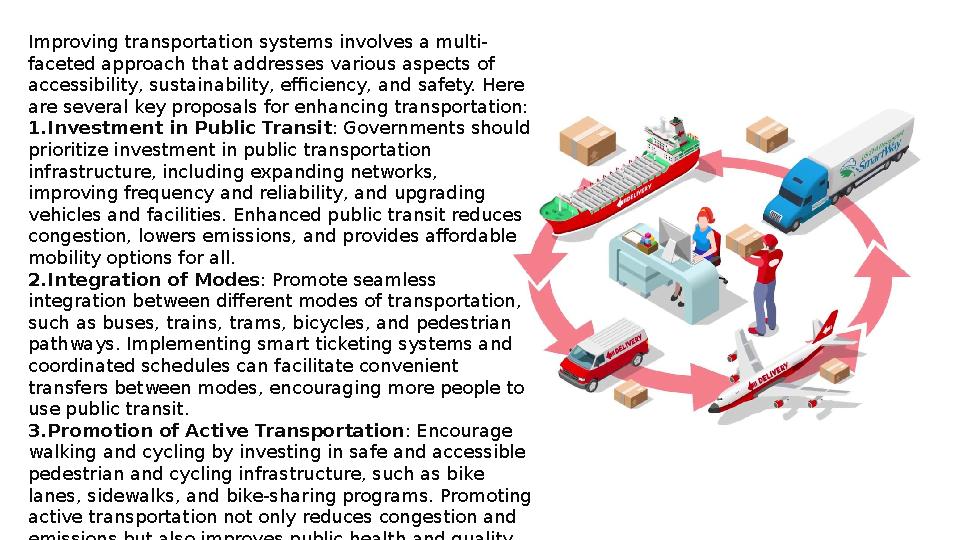
Improving transportation systems involves a multi-
faceted approach that addresses various aspects of
accessibility, sustainability, efficiency, and safety. Here
are several key proposals for enhancing transportation:
1. Investment in Public Transit : Governments should
prioritize investment in public transportation
infrastructure, including expanding networks,
improving frequency and reliability, and upgrading
vehicles and facilities. Enhanced public transit reduces
congestion, lowers emissions, and provides affordable
mobility options for all.
2. Integration of Modes : Promote seamless
integration between different modes of transportation,
such as buses, trains, trams, bicycles, and pedestrian
pathways. Implementing smart ticketing systems and
coordinated schedules can facilitate convenient
transfers between modes, encouraging more people to
use public transit.
3. Promotion of Active Transportation : Encourage
walking and cycling by investing in safe and accessible
pedestrian and cycling infrastructure, such as bike
lanes, sidewalks, and bike-sharing programs. Promoting
active transportation not only reduces congestion and
emissions but also improves public health and quality
of life.
9 слайд
Improving transportation systems involves a multi- faceted approach that addresses various aspects of accessibility, sustainability, efficiency, and safety. Here are several key proposals for enhancing transportation: 1. Investment in Public Transit : Governments should prioritize investment in public transportation infrastructure, including expanding networks, improving frequency and reliability, and upgrading vehicles and facilities. Enhanced public transit reduces congestion, lowers emissions, and provides affordable mobility options for all. 2. Integration of Modes : Promote seamless integration between different modes of transportation, such as buses, trains, trams, bicycles, and pedestrian pathways. Implementing smart ticketing systems and coordinated schedules can facilitate convenient transfers between modes, encouraging more people to use public transit. 3. Promotion of Active Transportation : Encourage walking and cycling by investing in safe and accessible pedestrian and cycling infrastructure, such as bike lanes, sidewalks, and bike-sharing programs. Promoting active transportation not only reduces congestion and emissions but also improves public health and quality of life.
#10 слайд
Conclusion
In conclusion, while public transportation serves as a vital lifeline for many individuals, its accessibility remains a pressing
concern. Evaluating the accessibility of public transportation reveals significant gaps and challenges that need to be
addressed to ensure equal access for all members of society, including those with disabilities and mobility
limitations.Proposed improvements encompass a wide range of strategies, including investing in accessible infrastructure
and vehicles, promoting integration between different modes of transportation, adopting green technologies, enhancing
rural and remote connectivity, and fostering innovation in mobility solutions. Additionally, prioritizing community
engagement and collaboration, as well as integrating transportation planning with land use planning, are essential steps
toward creating more inclusive and sustainable transportation systems.By implementing these improvements, public
transportation can become more accessible, efficient, and equitable, enabling individuals of all abilities to participate
fully in their communities and access essential services, opportunities, and experiences. Ultimately, achieving truly
accessible public transportation requires a concerted effort from policymakers, transportation authorities, communities,
and stakeholders to prioritize accessibility and equity in transportation planning and decision-making processes.
10 слайд
Conclusion In conclusion, while public transportation serves as a vital lifeline for many individuals, its accessibility remains a pressing concern. Evaluating the accessibility of public transportation reveals significant gaps and challenges that need to be addressed to ensure equal access for all members of society, including those with disabilities and mobility limitations.Proposed improvements encompass a wide range of strategies, including investing in accessible infrastructure and vehicles, promoting integration between different modes of transportation, adopting green technologies, enhancing rural and remote connectivity, and fostering innovation in mobility solutions. Additionally, prioritizing community engagement and collaboration, as well as integrating transportation planning with land use planning, are essential steps toward creating more inclusive and sustainable transportation systems.By implementing these improvements, public transportation can become more accessible, efficient, and equitable, enabling individuals of all abilities to participate fully in their communities and access essential services, opportunities, and experiences. Ultimately, achieving truly accessible public transportation requires a concerted effort from policymakers, transportation authorities, communities, and stakeholders to prioritize accessibility and equity in transportation planning and decision-making processes.
#11 слайд
Used literature
1. https://en.wikipedia.org/wiki/Transport#:~:text=Transport
2. https://seekdigitally.medium.com/what-is-transportation-meaning-and-importance-563c3eaa1222
3. https://getuplearn.com/blog/what-is-transportation/
4. https://www.linkedin.com/pulse/basic-definitions-transportation-industry-viswam-nair
5. https://thinkdifferentnetwork.com/what-is-transportation-types-and-importance/
11 слайд
Used literature 1. https://en.wikipedia.org/wiki/Transport#:~:text=Transport 2. https://seekdigitally.medium.com/what-is-transportation-meaning-and-importance-563c3eaa1222 3. https://getuplearn.com/blog/what-is-transportation/ 4. https://www.linkedin.com/pulse/basic-definitions-transportation-industry-viswam-nair 5. https://thinkdifferentnetwork.com/what-is-transportation-types-and-importance/









 Бұл курс Қазақстан Республикасы Оқу-ағарту министрлігімен келісілген