
 ЖИ көмекші





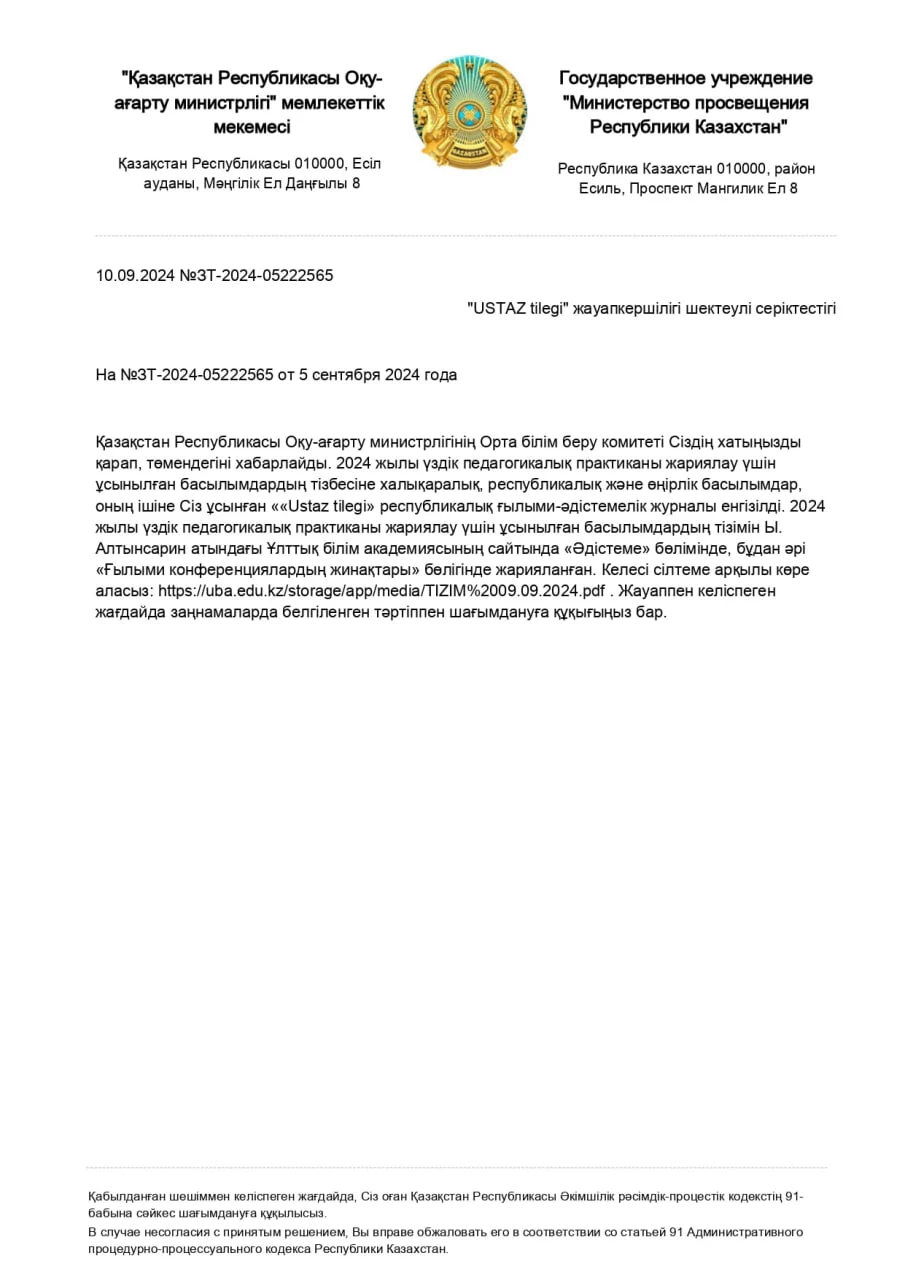
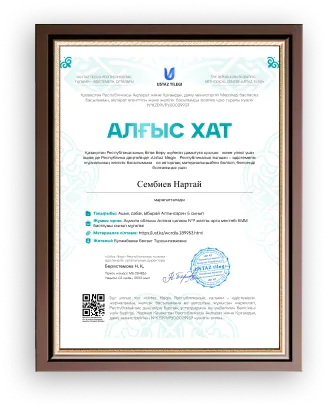
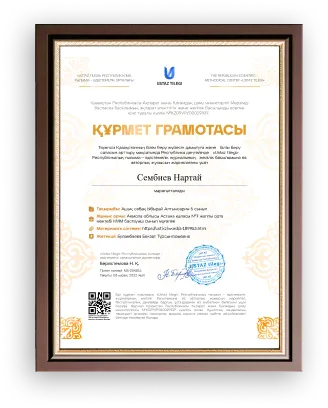
Ашық сабақ "Phrasal Verbs" 9 сынып


 Жүктеу
#1 слайд
Mastering Phrasal Verbs:
Unlocking Natural English
1 слайд
Mastering Phrasal Verbs: Unlocking Natural English
#2 слайд
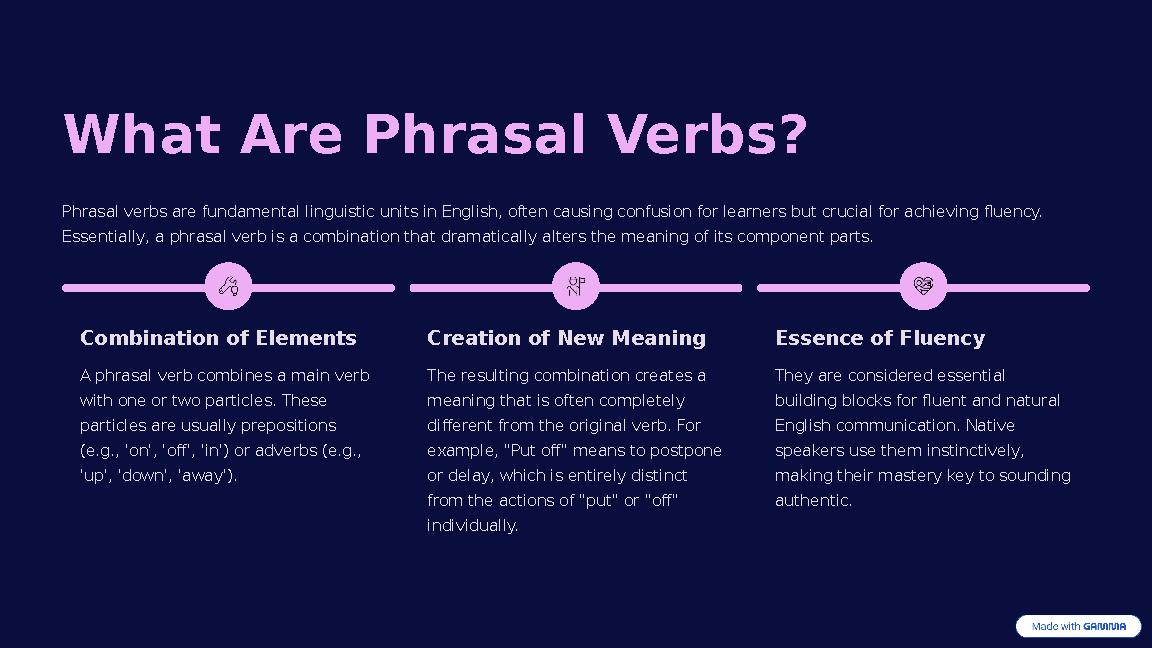
What Are Phrasal Verbs?
Phrasal verbs are fundamental linguistic units in English, often causing confusion for learners but crucial for achieving fluency.
Essentially, a phrasal verb is a combination that dramatically alters the meaning of its component parts.
Combination of Elements
A phrasal verb combines a main verb
with one or two particles. These
particles are usually prepositions
(e.g., 'on', 'off', 'in') or adverbs (e.g.,
'up', 'down', 'away').
Creation of New Meaning
The resulting combination creates a
meaning that is often completely
different from the original verb. For
example, "Put off" means to postpone
or delay, which is entirely distinct
from the actions of "put" or "off"
individually.
Essence of Fluency
They are considered essential
building blocks for fluent and natural
English communication. Native
speakers use them instinctively,
making their mastery key to sounding
authentic.
2 слайд
What Are Phrasal Verbs? Phrasal verbs are fundamental linguistic units in English, often causing confusion for learners but crucial for achieving fluency. Essentially, a phrasal verb is a combination that dramatically alters the meaning of its component parts. Combination of Elements A phrasal verb combines a main verb with one or two particles. These particles are usually prepositions (e.g., 'on', 'off', 'in') or adverbs (e.g., 'up', 'down', 'away'). Creation of New Meaning The resulting combination creates a meaning that is often completely different from the original verb. For example, "Put off" means to postpone or delay, which is entirely distinct from the actions of "put" or "off" individually. Essence of Fluency They are considered essential building blocks for fluent and natural English communication. Native speakers use them instinctively, making their mastery key to sounding authentic.
#3 слайд
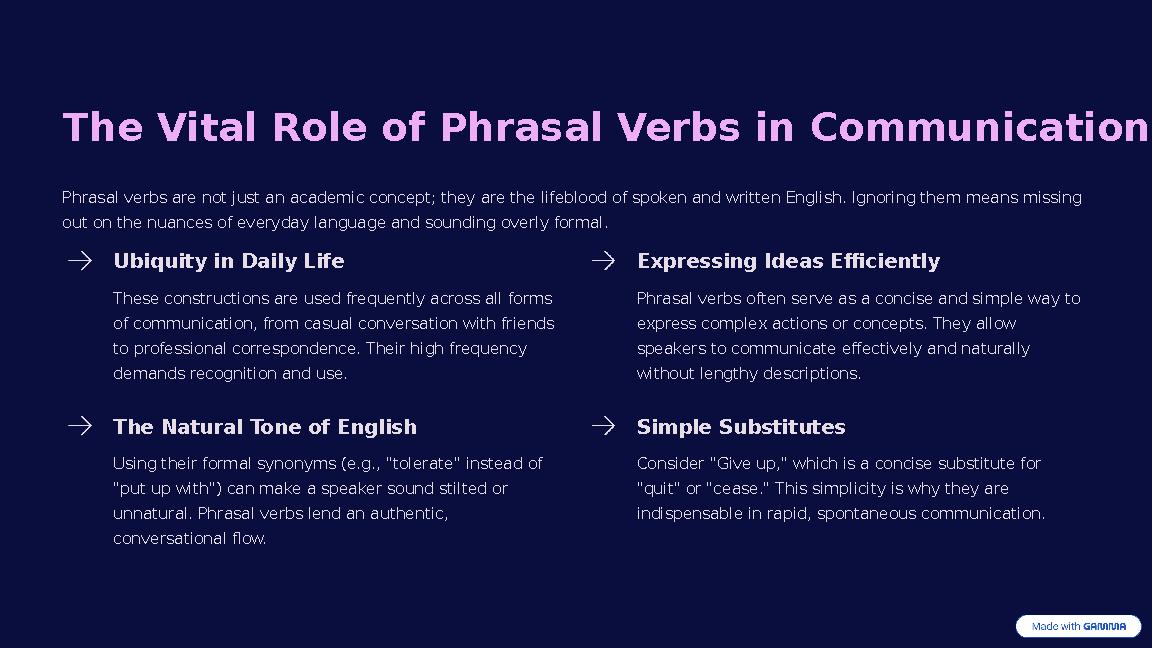
The Vital Role of Phrasal Verbs in Communication
Phrasal verbs are not just an academic concept; they are the lifeblood of spoken and written English. Ignoring them means missing
out on the nuances of everyday language and sounding overly formal.
Ubiquity in Daily Life
These constructions are used frequently across all forms
of communication, from casual conversation with friends
to professional correspondence. Their high frequency
demands recognition and use.
Expressing Ideas Efficiently
Phrasal verbs often serve as a concise and simple way to
express complex actions or concepts. They allow
speakers to communicate effectively and naturally
without lengthy descriptions.
The Natural Tone of English
Using their formal synonyms (e.g., "tolerate" instead of
"put up with") can make a speaker sound stilted or
unnatural. Phrasal verbs lend an authentic,
conversational flow.
Simple Substitutes
Consider "Give up," which is a concise substitute for
"quit" or "cease." This simplicity is why they are
indispensable in rapid, spontaneous communication.
3 слайд
The Vital Role of Phrasal Verbs in Communication Phrasal verbs are not just an academic concept; they are the lifeblood of spoken and written English. Ignoring them means missing out on the nuances of everyday language and sounding overly formal. Ubiquity in Daily Life These constructions are used frequently across all forms of communication, from casual conversation with friends to professional correspondence. Their high frequency demands recognition and use. Expressing Ideas Efficiently Phrasal verbs often serve as a concise and simple way to express complex actions or concepts. They allow speakers to communicate effectively and naturally without lengthy descriptions. The Natural Tone of English Using their formal synonyms (e.g., "tolerate" instead of "put up with") can make a speaker sound stilted or unnatural. Phrasal verbs lend an authentic, conversational flow. Simple Substitutes Consider "Give up," which is a concise substitute for "quit" or "cease." This simplicity is why they are indispensable in rapid, spontaneous communication.
#4 слайд
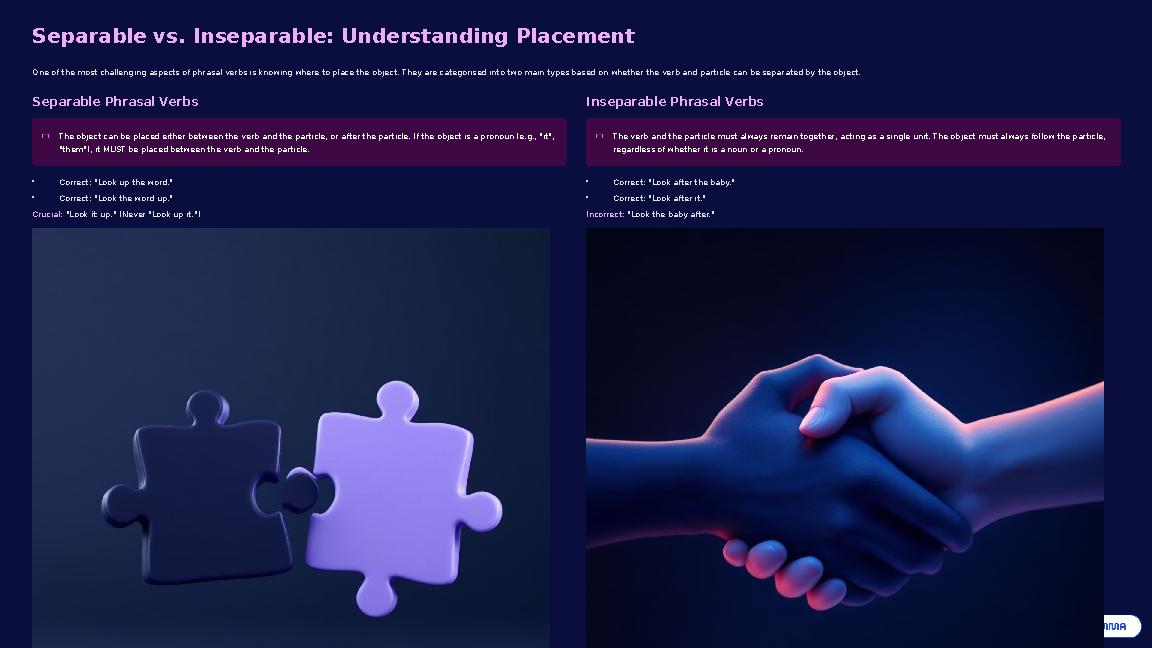
Separable vs. Inseparable: Understanding Placement
One of the most challenging aspects of phrasal verbs is knowing where to place the object. They are categorised into two main types based on whether the verb and particle can be separated by the object.
Separable Phrasal Verbs
The object can be placed either between the verb and the particle, or after the particle. If the object is a pronoun (e.g., "it",
"them"), it MUST be placed between the verb and the particle.
• Correct: "Look up the word."
• Correct: "Look the word up."
Crucial: "Look it up." (Never "Look up it.")
Inseparable Phrasal Verbs
The verb and the particle must always remain together, acting as a single unit. The object must always follow the particle,
regardless of whether it is a noun or a pronoun.
• Correct: "Look after the baby."
• Correct: "Look after it."
Incorrect: "Look the baby after."
4 слайд
Separable vs. Inseparable: Understanding Placement One of the most challenging aspects of phrasal verbs is knowing where to place the object. They are categorised into two main types based on whether the verb and particle can be separated by the object. Separable Phrasal Verbs The object can be placed either between the verb and the particle, or after the particle. If the object is a pronoun (e.g., "it", "them"), it MUST be placed between the verb and the particle. • Correct: "Look up the word." • Correct: "Look the word up." Crucial: "Look it up." (Never "Look up it.") Inseparable Phrasal Verbs The verb and the particle must always remain together, acting as a single unit. The object must always follow the particle, regardless of whether it is a noun or a pronoun. • Correct: "Look after the baby." • Correct: "Look after it." Incorrect: "Look the baby after."
#5 слайд
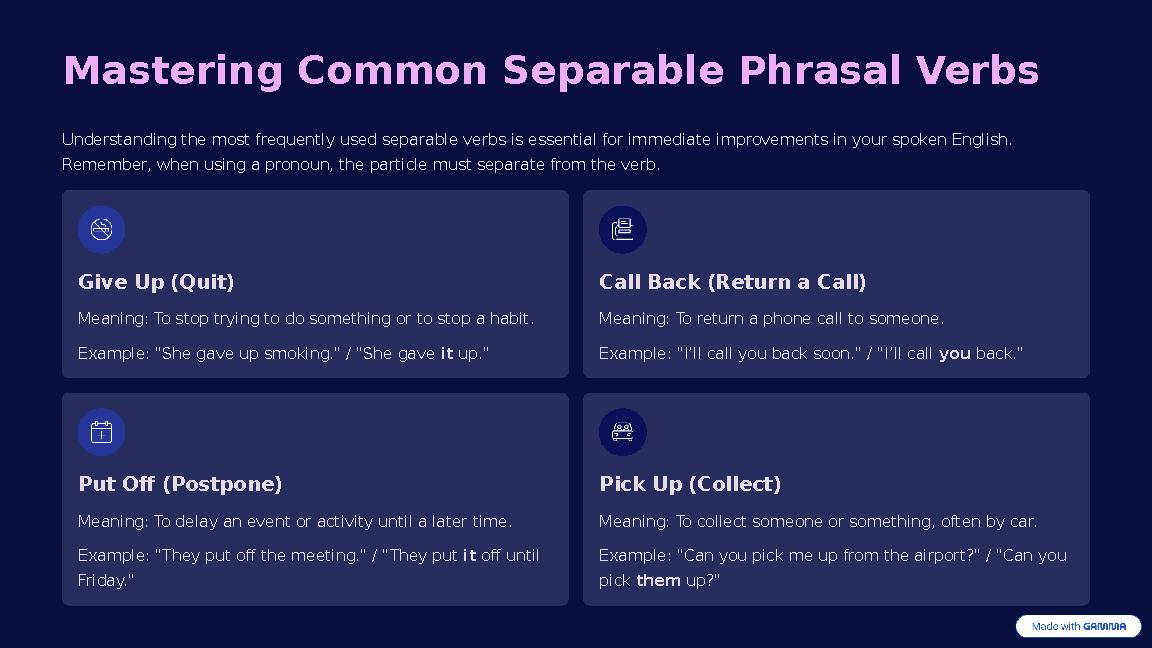
Mastering Common Separable Phrasal Verbs
Understanding the most frequently used separable verbs is essential for immediate improvements in your spoken English.
Remember, when using a pronoun, the particle must separate from the verb.
Give Up (Quit)
Meaning: To stop trying to do something or to stop a habit.
Example: "She gave up smoking." / "She gave it up."
Call Back (Return a Call)
Meaning: To return a phone call to someone.
Example: "I’ll call you back soon." / "I’ll call you back."
Put Off (Postpone)
Meaning: To delay an event or activity until a later time.
Example: "They put off the meeting." / "They put it off until
Friday."
Pick Up (Collect)
Meaning: To collect someone or something, often by car.
Example: "Can you pick me up from the airport?" / "Can you
pick them up?"
5 слайд
Mastering Common Separable Phrasal Verbs Understanding the most frequently used separable verbs is essential for immediate improvements in your spoken English. Remember, when using a pronoun, the particle must separate from the verb. Give Up (Quit) Meaning: To stop trying to do something or to stop a habit. Example: "She gave up smoking." / "She gave it up." Call Back (Return a Call) Meaning: To return a phone call to someone. Example: "I’ll call you back soon." / "I’ll call you back." Put Off (Postpone) Meaning: To delay an event or activity until a later time. Example: "They put off the meeting." / "They put it off until Friday." Pick Up (Collect) Meaning: To collect someone or something, often by car. Example: "Can you pick me up from the airport?" / "Can you pick them up?"
#6 слайд
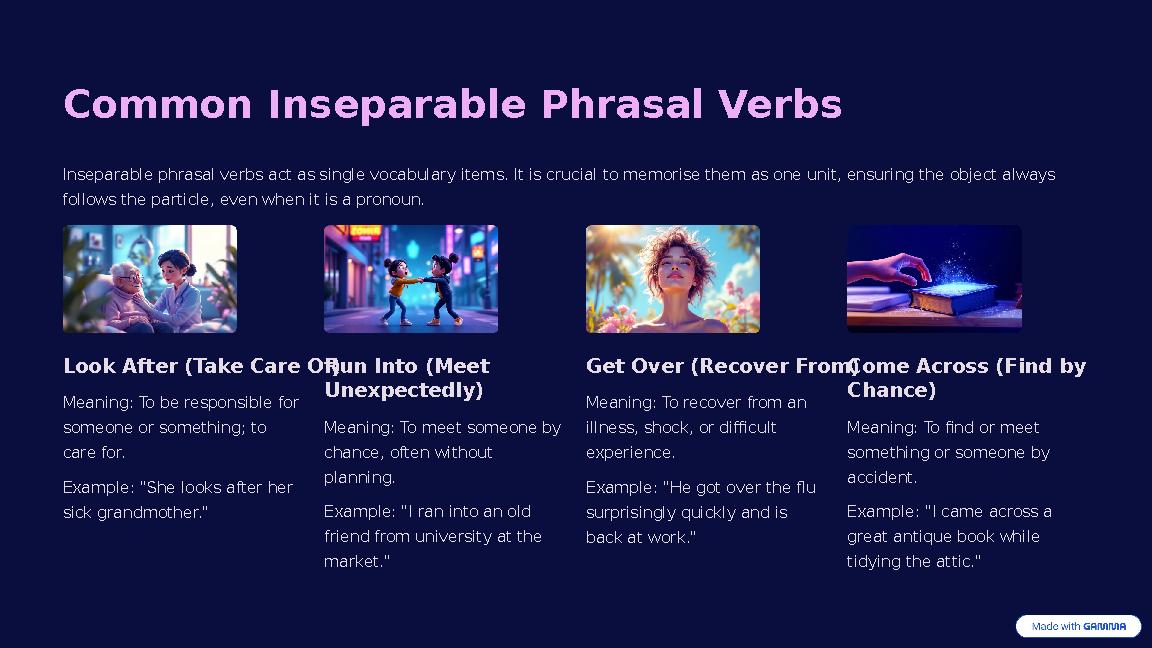
Common Inseparable Phrasal Verbs
Inseparable phrasal verbs act as single vocabulary items. It is crucial to memorise them as one unit, ensuring the object always
follows the particle, even when it is a pronoun.
Look After (Take Care Of)
Meaning: To be responsible for
someone or something; to
care for.
Example: "She looks after her
sick grandmother."
Run Into (Meet
Unexpectedly)
Meaning: To meet someone by
chance, often without
planning.
Example: "I ran into an old
friend from university at the
market."
Get Over (Recover From)
Meaning: To recover from an
illness, shock, or difficult
experience.
Example: "He got over the flu
surprisingly quickly and is
back at work."
Come Across (Find by
Chance)
Meaning: To find or meet
something or someone by
accident.
Example: "I came across a
great antique book while
tidying the attic."
6 слайд
Common Inseparable Phrasal Verbs Inseparable phrasal verbs act as single vocabulary items. It is crucial to memorise them as one unit, ensuring the object always follows the particle, even when it is a pronoun. Look After (Take Care Of) Meaning: To be responsible for someone or something; to care for. Example: "She looks after her sick grandmother." Run Into (Meet Unexpectedly) Meaning: To meet someone by chance, often without planning. Example: "I ran into an old friend from university at the market." Get Over (Recover From) Meaning: To recover from an illness, shock, or difficult experience. Example: "He got over the flu surprisingly quickly and is back at work." Come Across (Find by Chance) Meaning: To find or meet something or someone by accident. Example: "I came across a great antique book while tidying the attic."
#7 слайд
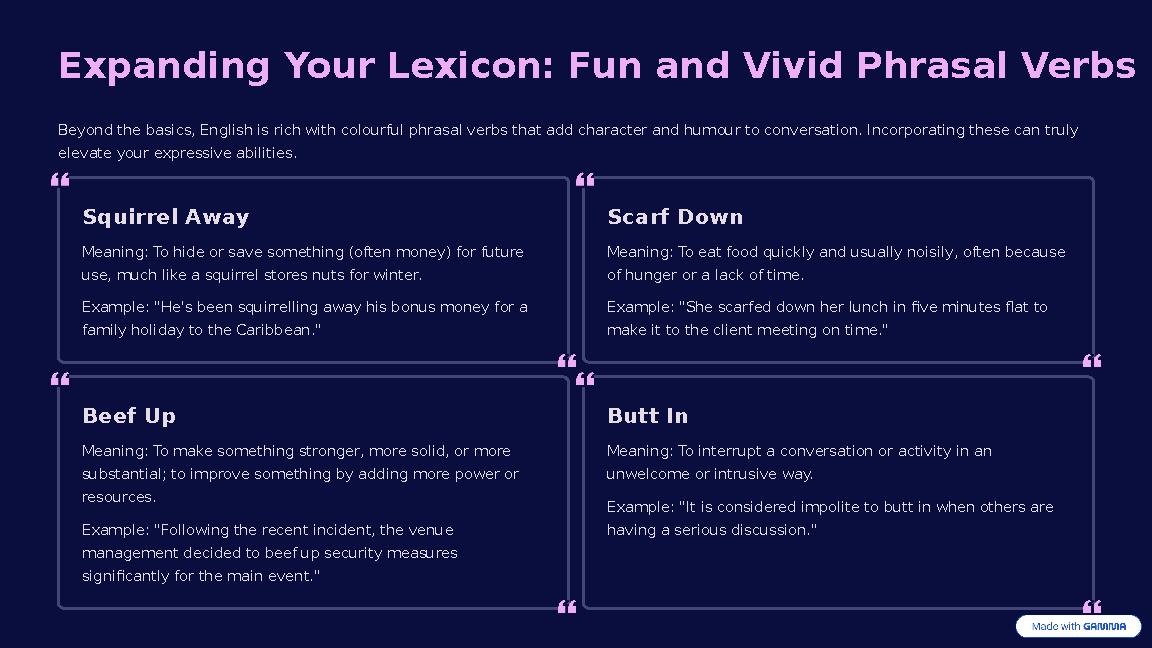
Expanding Your Lexicon: Fun and Vivid Phrasal Verbs
Beyond the basics, English is rich with colourful phrasal verbs that add character and humour to conversation. Incorporating these can truly
elevate your expressive abilities.
Squirrel Away
Meaning: To hide or save something (often money) for future
use, much like a squirrel stores nuts for winter.
Example: "He's been squirrelling away his bonus money for a
family holiday to the Caribbean."
Scarf Down
Meaning: To eat food quickly and usually noisily, often because
of hunger or a lack of time.
Example: "She scarfed down her lunch in five minutes flat to
make it to the client meeting on time."
Beef Up
Meaning: To make something stronger, more solid, or more
substantial; to improve something by adding more power or
resources.
Example: "Following the recent incident, the venue
management decided to beef up security measures
significantly for the main event."
Butt In
Meaning: To interrupt a conversation or activity in an
unwelcome or intrusive way.
Example: "It is considered impolite to butt in when others are
having a serious discussion."
7 слайд
Expanding Your Lexicon: Fun and Vivid Phrasal Verbs Beyond the basics, English is rich with colourful phrasal verbs that add character and humour to conversation. Incorporating these can truly elevate your expressive abilities. Squirrel Away Meaning: To hide or save something (often money) for future use, much like a squirrel stores nuts for winter. Example: "He's been squirrelling away his bonus money for a family holiday to the Caribbean." Scarf Down Meaning: To eat food quickly and usually noisily, often because of hunger or a lack of time. Example: "She scarfed down her lunch in five minutes flat to make it to the client meeting on time." Beef Up Meaning: To make something stronger, more solid, or more substantial; to improve something by adding more power or resources. Example: "Following the recent incident, the venue management decided to beef up security measures significantly for the main event." Butt In Meaning: To interrupt a conversation or activity in an unwelcome or intrusive way. Example: "It is considered impolite to butt in when others are having a serious discussion."

#8 слайд
Effective Strategies for Phrasal Verb Acquisition
Memorising lists is inefficient. For lasting retention and automatic recall, you must integrate phrasal verbs into your daily language use
through systematic practice.
Contextual Learning
Avoid learning definitions in isolation. Always learn phrasal
verbs within a full sentence or situational context. This helps
you grasp the nuance of meaning and appropriate usage.
Thematic Grouping
Organise them by particle (e.g., all verbs using "out" like 'find
out', 'drop out') or by theme (e.g., relationship phrasal verbs
like 'break up', 'make up'). This creates mnemonic links.
Active Practice and Integration
Write your own sentences and actively try to use new phrasal
verbs in real conversations. This moves them from passive
recognition to active production.
Reinforce with Tools
Utilise digital flashcards, spaced repetition apps, or language
exchange partners to continuously reinforce your memory and
challenge yourself to recall the verbs correctly.
8 слайд
Effective Strategies for Phrasal Verb Acquisition Memorising lists is inefficient. For lasting retention and automatic recall, you must integrate phrasal verbs into your daily language use through systematic practice. Contextual Learning Avoid learning definitions in isolation. Always learn phrasal verbs within a full sentence or situational context. This helps you grasp the nuance of meaning and appropriate usage. Thematic Grouping Organise them by particle (e.g., all verbs using "out" like 'find out', 'drop out') or by theme (e.g., relationship phrasal verbs like 'break up', 'make up'). This creates mnemonic links. Active Practice and Integration Write your own sentences and actively try to use new phrasal verbs in real conversations. This moves them from passive recognition to active production. Reinforce with Tools Utilise digital flashcards, spaced repetition apps, or language exchange partners to continuously reinforce your memory and challenge yourself to recall the verbs correctly.
#9 слайд
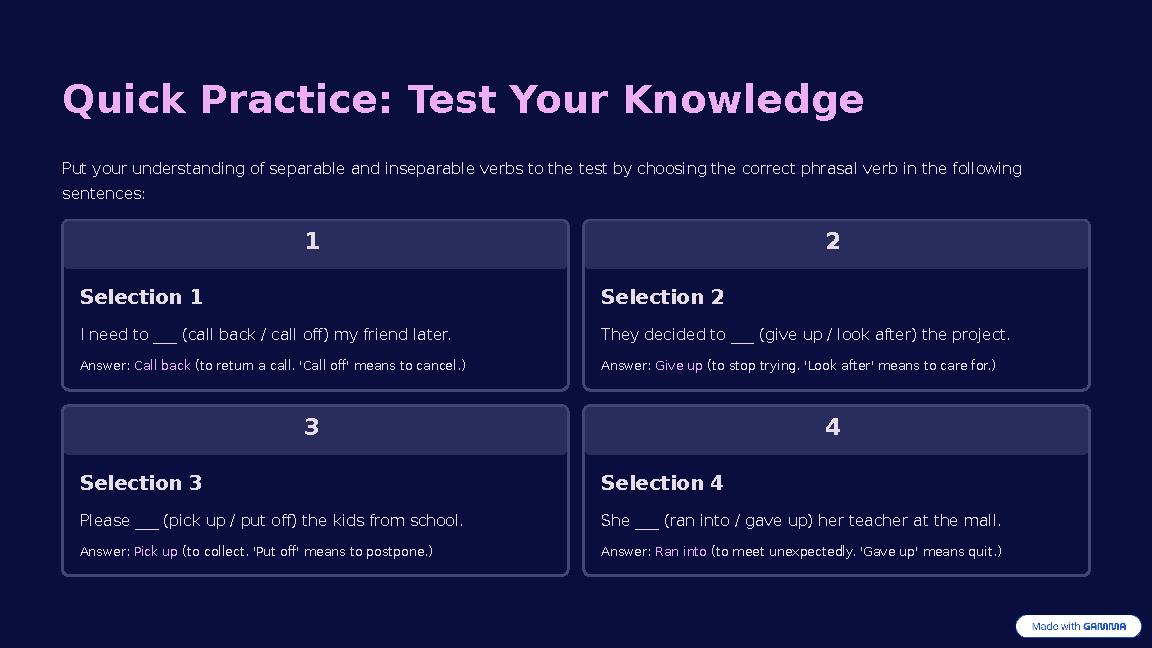
Quick Practice: Test Your Knowledge
Put your understanding of separable and inseparable verbs to the test by choosing the correct phrasal verb in the following
sentences:
1
Selection 1
I need to ___ (call back / call off) my friend later.
Answer: Call back (to return a call. 'Call off' means to cancel.)
2
Selection 2
They decided to ___ (give up / look after) the project.
Answer: Give up (to stop trying. 'Look after' means to care for.)
3
Selection 3
Please ___ (pick up / put off) the kids from school.
Answer: Pick up (to collect. 'Put off' means to postpone.)
4
Selection 4
She ___ (ran into / gave up) her teacher at the mall.
Answer: Ran into (to meet unexpectedly. 'Gave up' means quit.)
9 слайд
Quick Practice: Test Your Knowledge Put your understanding of separable and inseparable verbs to the test by choosing the correct phrasal verb in the following sentences: 1 Selection 1 I need to ___ (call back / call off) my friend later. Answer: Call back (to return a call. 'Call off' means to cancel.) 2 Selection 2 They decided to ___ (give up / look after) the project. Answer: Give up (to stop trying. 'Look after' means to care for.) 3 Selection 3 Please ___ (pick up / put off) the kids from school. Answer: Pick up (to collect. 'Put off' means to postpone.) 4 Selection 4 She ___ (ran into / gave up) her teacher at the mall. Answer: Ran into (to meet unexpectedly. 'Gave up' means quit.)
#10 слайд
Conclusion: Your Path to Fluent English
Phrasal verbs are more than just vocabulary; they are essential tools that bridge the gap between textbook English and the authentic, dynamic language
spoken by natives.
Unlock Natural English
Mastery of these verbs is the key that unlocks a more fluent and less formal style of communication.
Boost Confidence
Using them correctly significantly boosts confidence, allowing you to engage in
conversations without hesitation.
Automatic Recall
Through consistent practice, phrasal verbs will eventually become second nature,
used instinctively without conscious translation.
Speak Like a Native
Start integrating them today! This deliberate practice is your most direct
route to speaking English with genuine fluency and ease.
We encourage you to choose three new phrasal verbs from this presentation and commit to using them at least five times today.
10 слайд
Conclusion: Your Path to Fluent English Phrasal verbs are more than just vocabulary; they are essential tools that bridge the gap between textbook English and the authentic, dynamic language spoken by natives. Unlock Natural English Mastery of these verbs is the key that unlocks a more fluent and less formal style of communication. Boost Confidence Using them correctly significantly boosts confidence, allowing you to engage in conversations without hesitation. Automatic Recall Through consistent practice, phrasal verbs will eventually become second nature, used instinctively without conscious translation. Speak Like a Native Start integrating them today! This deliberate practice is your most direct route to speaking English with genuine fluency and ease. We encourage you to choose three new phrasal verbs from this presentation and commit to using them at least five times today.


 Жүктеу
шағым қалдыра аласыз

 Бұл курс Қазақстан Республикасы Оқу-ағарту министрлігімен келісілген










