ЖИ көмекші





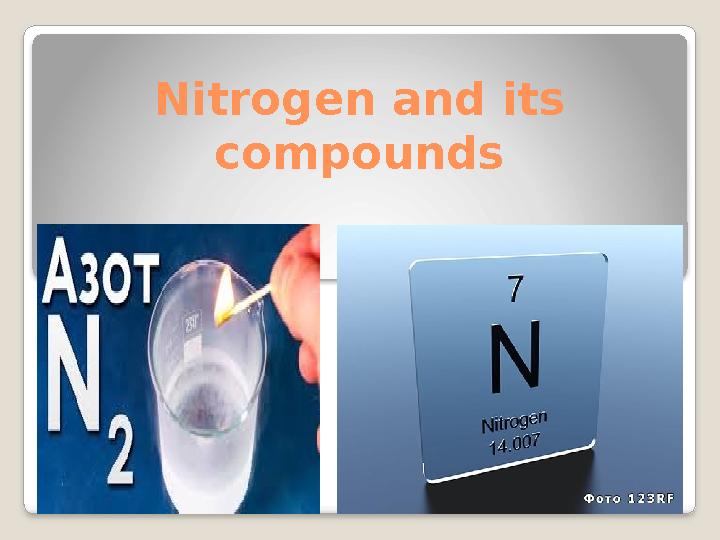
Nitrogen and its compounds
Тақырып бойынша 11 материал табылды
Nitrogen and its compounds
Материал туралы қысқаша түсінік
Nitrogen and its compounds (Азот және оның қосындылары) химия пәнін ағылшын тіілінде жүргізетін мұғалімдерге арналған
Материалдың қысқаша нұсқасы
1 / 13

 Жүктеу
Бөлісу
ЖИ арқылы жасау
Слайдтың жеке беттері
#1 слайд
Nitrogen and its
compounds
1 слайд
Nitrogen and its compounds

#2 слайд
For the first time nitrogen was studied by Daniel Rutherford.
After D. Belk discovered the reaction of the interaction of carbon
dioxide with lime water, Rutherford investigated the changes in
the composition of the air, after it lived and killed the living
entity (in closed volume). After carbon dioxide was absorbed by
alkali, the rest of the gas does not support combustion, and
living beings instantly died. At about the same time, nitrogen
was isolated from the air by chemists G. Cavendish and K. shale,
both of them, unlike D. Rutherford realized that nitrogen is only
part of the aria component. Cavendish wrote: "I converted
ordinary air from one vessel through hot coals into another, then
through fresh burning coal – into the next vessel, absorbing each
time the formed fixed air (carbon dioxide) with lump lime. The
specific gravity of the obtained gas was only slightly different
from the specific gravity of ordinary air: nitrogen is slightly
lighter than air from both gases. It extinguishes the flame and
makes ordinary air unable to excite combustion, as well as fixed
air (CO2), but to a lesser extent"
History of Nitrogen
2 слайд
For the first time nitrogen was studied by Daniel Rutherford. After D. Belk discovered the reaction of the interaction of carbon dioxide with lime water, Rutherford investigated the changes in the composition of the air, after it lived and killed the living entity (in closed volume). After carbon dioxide was absorbed by alkali, the rest of the gas does not support combustion, and living beings instantly died. At about the same time, nitrogen was isolated from the air by chemists G. Cavendish and K. shale, both of them, unlike D. Rutherford realized that nitrogen is only part of the aria component. Cavendish wrote: "I converted ordinary air from one vessel through hot coals into another, then through fresh burning coal – into the next vessel, absorbing each time the formed fixed air (carbon dioxide) with lump lime. The specific gravity of the obtained gas was only slightly different from the specific gravity of ordinary air: nitrogen is slightly lighter than air from both gases. It extinguishes the flame and makes ordinary air unable to excite combustion, as well as fixed air (CO2), but to a lesser extent" History of Nitrogen

#3 слайд
K.Shelle G.Kavendish
D.Rezerford
3 слайд
K.Shelle G.Kavendish D.Rezerford

#4 слайд
Symbol:N
Atomic nuber:7
Atomic mass:14
Electron conf: 2s2 2p3
Melting point:-210.1°C
Boiling point:-195.8°C
Density:1.25*10-³
Ionization energy:1402.3kj
Atomic radius:75pm
Common oxid.state:between
-3;+5
Color: colorless
Physical state at 25°C:gas
Origin and meaning of
name:nitron genes-nitrate
former
Earth's crust
abundences:210*10-³
4 слайд
Symbol:N Atomic nuber:7 Atomic mass:14 Electron conf: 2s2 2p3 Melting point:-210.1°C Boiling point:-195.8°C Density:1.25*10-³ Ionization energy:1402.3kj Atomic radius:75pm Common oxid.state:between -3;+5 Color: colorless Physical state at 25°C:gas Origin and meaning of name:nitron genes-nitrate former Earth's crust abundences:210*10-³

#5 слайд
Physical properties of nitrogen
Under normal conditions, nitrogen-colorless gas, tasteless and odorless, absolutely harmless, a little
lighter than air, little soluble in water. Melting point -210 °C, boiling point -196 °C.Nitrogen gas
consists of diatomic molecules. A triple bond is realized between atoms in the molecule, as a result of
which the nitrogen molecule is extremely strong, the energy of chemical bond is 945 kJ/mol. Even at
3000 °C, the degree of decomposition of the nitrogen molecule into atoms reaches only 0.1 %.The
structure of solid nitrogen is constructed from diatomic molecules bound by weak forces of
intermolecular interaction.
5 слайд
Physical properties of nitrogen Under normal conditions, nitrogen-colorless gas, tasteless and odorless, absolutely harmless, a little lighter than air, little soluble in water. Melting point -210 °C, boiling point -196 °C.Nitrogen gas consists of diatomic molecules. A triple bond is realized between atoms in the molecule, as a result of which the nitrogen molecule is extremely strong, the energy of chemical bond is 945 kJ/mol. Even at 3000 °C, the degree of decomposition of the nitrogen molecule into atoms reaches only 0.1 %.The structure of solid nitrogen is constructed from diatomic molecules bound by weak forces of intermolecular interaction.

#6 слайд
Chemical properties of nitrogen
Due to the presence of a strong triple bond, molecular nitrogen is inactive, and nitrogen
compounds are thermally unstable and relatively easily decompose when heated to form free
nitrogen.
Interaction with metals: Under normal conditions, molecular nitrogen reacts only with some strong
reducing agents, such as lithium:
6Li + N2 = 2li3n.
For the formation of magnesium nitride from simple substances requires heating up to 300°C:
3Mg + N2 = Mg3N2.
Nitrides of active metals are ionic compounds that are hydrolyzed with water to form ammonia.
Interaction with oxygen. Only under the influence of electric discharge nitrogen reacts with oxygen:
O2 + N2 = 2NO.
Hydrogen interaction with. The reaction with hydrogen takes place at a temperature of about 400
° C and a pressure of 200 ATM in the presence of a catalyst-iron:
3H2 + N2 = 2NH3.
Interaction with other non-metals.At high temperatures reacts with other nonmetals, such as
boron:
2B + N2 = 2BN
Nitrogen does not react directly with Halogens and sulfur, but the halides and sulfides can be
obtained by indirect means. Nitrogen does not interact with water, acids and alkalis.
6 слайд
Chemical properties of nitrogen Due to the presence of a strong triple bond, molecular nitrogen is inactive, and nitrogen compounds are thermally unstable and relatively easily decompose when heated to form free nitrogen. Interaction with metals: Under normal conditions, molecular nitrogen reacts only with some strong reducing agents, such as lithium: 6Li + N2 = 2li3n. For the formation of magnesium nitride from simple substances requires heating up to 300°C: 3Mg + N2 = Mg3N2. Nitrides of active metals are ionic compounds that are hydrolyzed with water to form ammonia. Interaction with oxygen. Only under the influence of electric discharge nitrogen reacts with oxygen: O2 + N2 = 2NO. Hydrogen interaction with. The reaction with hydrogen takes place at a temperature of about 400 ° C and a pressure of 200 ATM in the presence of a catalyst-iron: 3H2 + N2 = 2NH3. Interaction with other non-metals.At high temperatures reacts with other nonmetals, such as boron: 2B + N2 = 2BN Nitrogen does not react directly with Halogens and sulfur, but the halides and sulfides can be obtained by indirect means. Nitrogen does not interact with water, acids and alkalis.

#7 слайд
7 слайд

#8 слайд
Nitrogen-Production and
application
In the laboratory nitrogen can be easily obtained by heating
concentrated ammonium nitrite:
NH4NO2 N2 + 2H2O.
The technical method of producing nitrogen based on a pre-
separation of liquid air which is then subjected to distillation.
Free nitrogen is used in many industries: as an inert
environment in various chemical and metallurgical processes,
to fill in space in a mercury thermometer, when pumping
flammable liquids, etc. Liquid nitrogen finds application in
various refrigeration systems. It is stored and transported in
steel Dewar vessels, compressed nitrogen - in cylinders. Many
nitrogen compounds are widely used. The production of fixed
nitrogen began to develop intensively after the 1st world war
and has now reached enormous proportions.
8 слайд
Nitrogen-Production and application In the laboratory nitrogen can be easily obtained by heating concentrated ammonium nitrite: NH4NO2 N2 + 2H2O. The technical method of producing nitrogen based on a pre- separation of liquid air which is then subjected to distillation. Free nitrogen is used in many industries: as an inert environment in various chemical and metallurgical processes, to fill in space in a mercury thermometer, when pumping flammable liquids, etc. Liquid nitrogen finds application in various refrigeration systems. It is stored and transported in steel Dewar vessels, compressed nitrogen - in cylinders. Many nitrogen compounds are widely used. The production of fixed nitrogen began to develop intensively after the 1st world war and has now reached enormous proportions.

#9 слайд
9 слайд

#10 слайд
The presence in the nature.
In nature, nitrogen is in
free form and in the form of
compounds. Free nitrogen
is the main component of
air (78% by volume).
Inorganic nitrogen
compounds are found in
small quantities except for
a large field of sodium
nitrate in Chile. The soil
contains small amounts of
nitrogen in the form of salts
of nitric acid.
10 слайд
The presence in the nature. In nature, nitrogen is in free form and in the form of compounds. Free nitrogen is the main component of air (78% by volume). Inorganic nitrogen compounds are found in small quantities except for a large field of sodium nitrate in Chile. The soil contains small amounts of nitrogen in the form of salts of nitric acid.

#11 слайд
11 слайд

#12 слайд
12 слайд
Файл форматы:

pptx

12.10.2018

463
Жүктеу
ЖИ арқылы жасау
Жариялаған:
Бұл материалды қолданушы жариялаған. Ustaz Tilegi ақпаратты жеткізуші ғана болып табылады. Жарияланған материалдың мазмұны мен авторлық құқық толықтай автордың жауапкершілігінде. Егер материал авторлық құқықты бұзады немесе сайттан алынуы тиіс деп есептесеңіз,
шағым қалдыра аласыз
шағым қалдыра аласыз