ЖИ көмекші





Pectins

 Жүктеу
#1 слайд
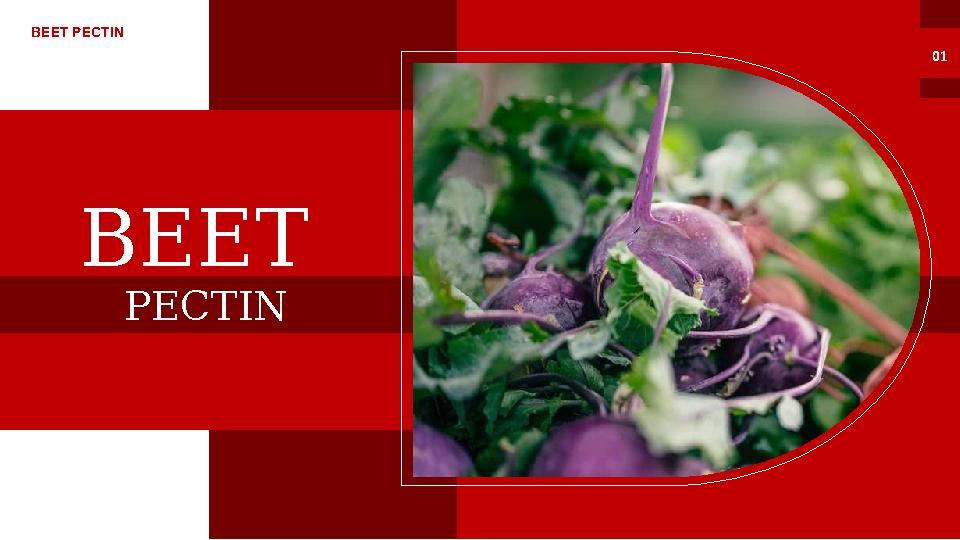
BEET
PECTINBEET PECTIN
01
1 слайд
BEET PECTINBEET PECTIN 01
#2 слайд
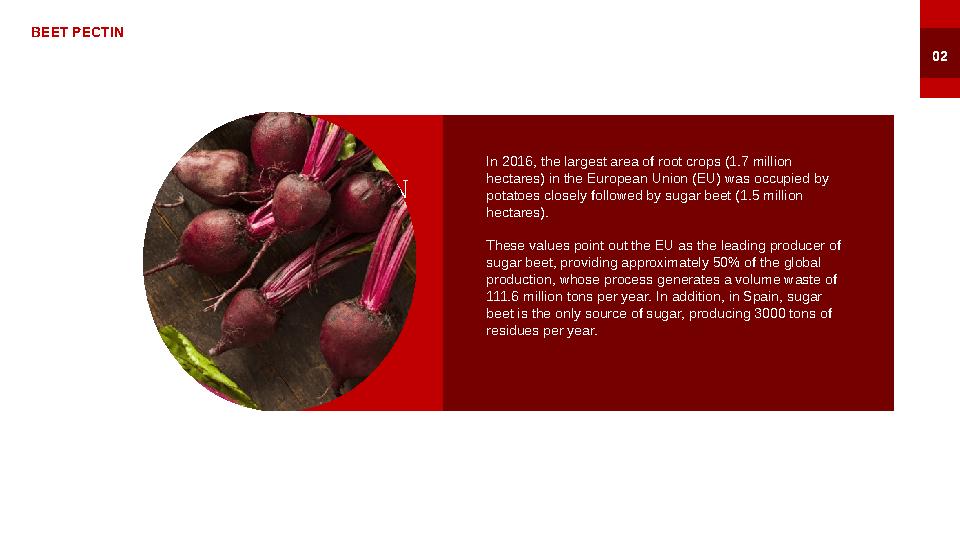
In 2016, the largest area of root crops (1.7 million
hectares) in the European Union (EU) was occupied by
potatoes closely followed by sugar beet (1.5 million
hectares).
These values point out the EU as the leading producer of
sugar beet, providing approximately 50% of the global
production, whose process generates a volume waste of
111.6 million tons per year. In addition, in Spain, sugar
beet is the only source of sugar, producing 3000 tons of
residues per year.MEDISONBEET PECTIN
02
2 слайд
In 2016, the largest area of root crops (1.7 million hectares) in the European Union (EU) was occupied by potatoes closely followed by sugar beet (1.5 million hectares). These values point out the EU as the leading producer of sugar beet, providing approximately 50% of the global production, whose process generates a volume waste of 111.6 million tons per year. In addition, in Spain, sugar beet is the only source of sugar, producing 3000 tons of residues per year.MEDISONBEET PECTIN 02
#3 слайд
BEET PECTIN
0 3
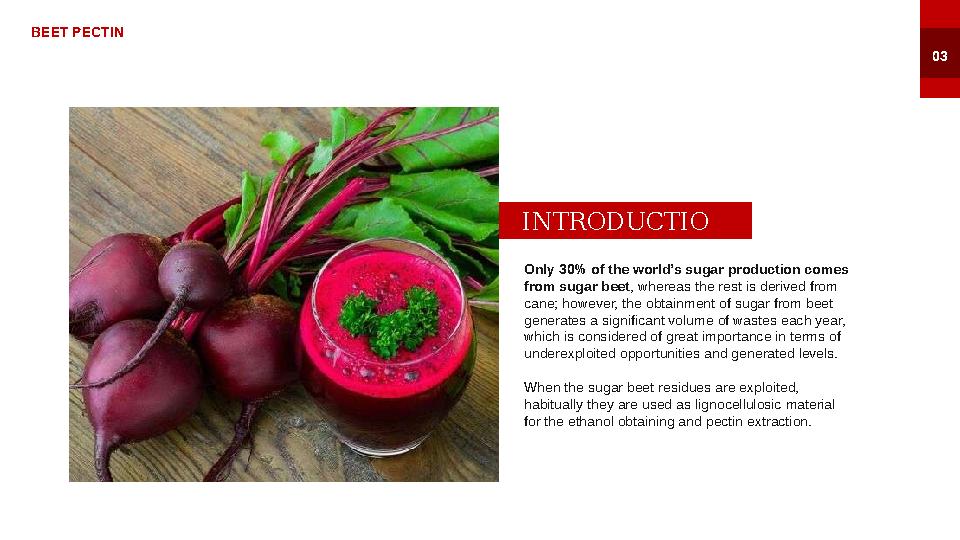
Only 30% of the world’s sugar production comes
from sugar beet , whereas the rest is derived from
cane; however, the obtainment of sugar from beet
generates a significant volume of wastes each year,
which is considered of great importance in terms of
underexploited opportunities and generated levels.
When the sugar beet residues are exploited,
habitually they are used as lignocellulosic material
for the ethanol obtaining and pectin extraction.INTRODUCTIO
N
3 слайд
BEET PECTIN 0 3 Only 30% of the world’s sugar production comes from sugar beet , whereas the rest is derived from cane; however, the obtainment of sugar from beet generates a significant volume of wastes each year, which is considered of great importance in terms of underexploited opportunities and generated levels. When the sugar beet residues are exploited, habitually they are used as lignocellulosic material for the ethanol obtaining and pectin extraction.INTRODUCTIO N
#4 слайд
BEET PECTIN
0 4
PECTIN
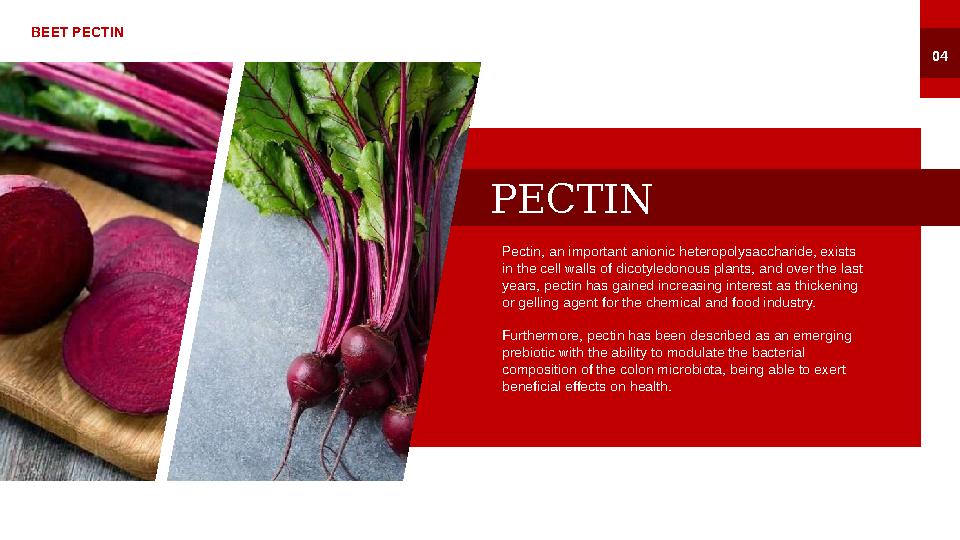
Pectin, an important anionic heteropolysaccharide, exists
in the cell walls of dicotyledonous plants, and over the last
years, pectin has gained increasing interest as thickening
or gelling agent for the chemical and food industry.
Furthermore, pectin has been described as an emerging
prebiotic with the ability to modulate the bacterial
composition of the colon microbiota, being able to exert
beneficial effects on health.
4 слайд
BEET PECTIN 0 4 PECTIN Pectin, an important anionic heteropolysaccharide, exists in the cell walls of dicotyledonous plants, and over the last years, pectin has gained increasing interest as thickening or gelling agent for the chemical and food industry. Furthermore, pectin has been described as an emerging prebiotic with the ability to modulate the bacterial composition of the colon microbiota, being able to exert beneficial effects on health.
#5 слайд
BEET PECTIN
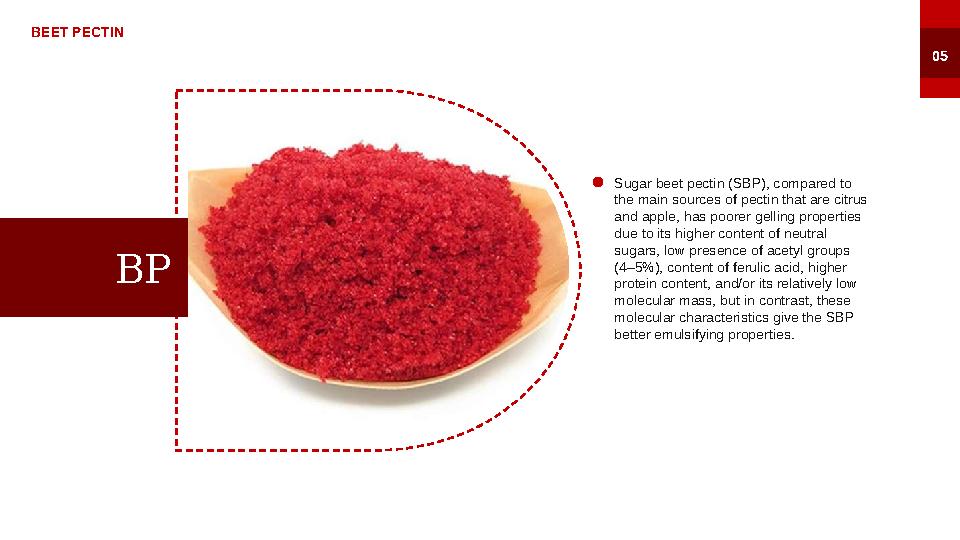
BP Sugar beet pectin (SBP), compared to
the main sources of pectin that are citrus
and apple, has poorer gelling properties
due to its higher content of neutral
sugars, low presence of acetyl groups
(4–5%), content of ferulic acid, higher
protein content, and/or its relatively low
molecular mass, but in contrast, these
molecular characteristics give the SBP
better emulsifying properties. 05
5 слайд
BEET PECTIN BP Sugar beet pectin (SBP), compared to the main sources of pectin that are citrus and apple, has poorer gelling properties due to its higher content of neutral sugars, low presence of acetyl groups (4–5%), content of ferulic acid, higher protein content, and/or its relatively low molecular mass, but in contrast, these molecular characteristics give the SBP better emulsifying properties. 05
#6 слайд
BEET PECTIN
06
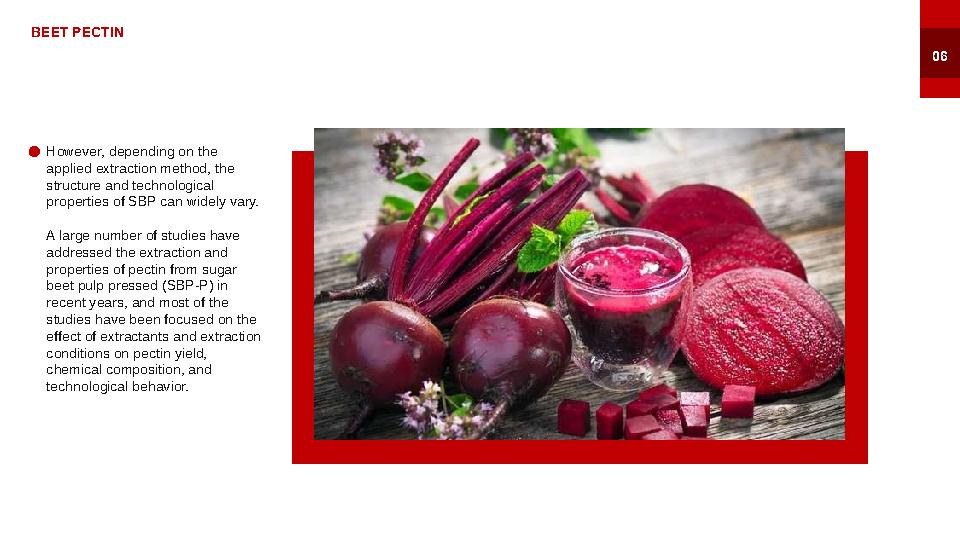
However, depending on the
applied extraction method, the
structure and technological
properties of SBP can widely vary.
A large number of studies have
addressed the extraction and
properties of pectin from sugar
beet pulp pressed (SBP-P) in
recent years, and most of the
studies have been focused on the
effect of extractants and extraction
conditions on pectin yield,
chemical composition, and
technological behavior.
6 слайд
BEET PECTIN 06 However, depending on the applied extraction method, the structure and technological properties of SBP can widely vary. A large number of studies have addressed the extraction and properties of pectin from sugar beet pulp pressed (SBP-P) in recent years, and most of the studies have been focused on the effect of extractants and extraction conditions on pectin yield, chemical composition, and technological behavior.
#7 слайд
BEET PECTIN
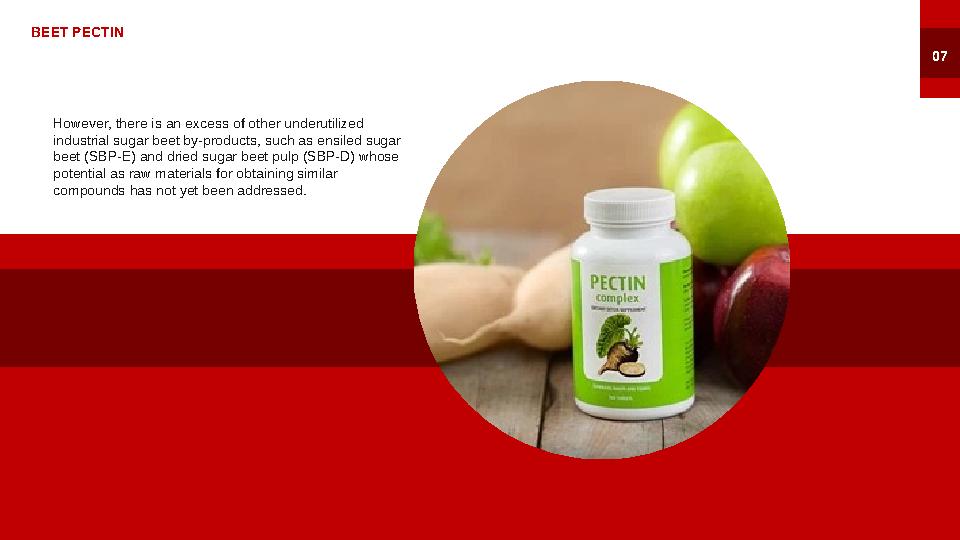
However, there is an excess of other underutilized
industrial sugar beet by-products, such as ensiled sugar
beet (SBP-E) and dried sugar beet pulp (SBP-D) whose
potential as raw materials for obtaining similar
compounds has not yet been addressed. 07
7 слайд
BEET PECTIN However, there is an excess of other underutilized industrial sugar beet by-products, such as ensiled sugar beet (SBP-E) and dried sugar beet pulp (SBP-D) whose potential as raw materials for obtaining similar compounds has not yet been addressed. 07
#8 слайд
BEET PECTIN
08
However, there is an excess of
other underutilized industrial
sugar beet by-products, such
as ensiled sugar beet (SBP-E)
and dried sugar beet pulp
(SBP-D) whose potential as
raw materials for obtaining
similar compounds has not yet
been addressed.
8 слайд
BEET PECTIN 08 However, there is an excess of other underutilized industrial sugar beet by-products, such as ensiled sugar beet (SBP-E) and dried sugar beet pulp (SBP-D) whose potential as raw materials for obtaining similar compounds has not yet been addressed.
#9 слайд
BEET PECTIN
09
Therefore, the main objective of this work was to
explore the potential use of different physico-
chemically characterized sugar beet by-products
(pressed, ensiled, and dried pulp) as efficient
and alternative sources of pectin following its
extraction by acid or enzymatic methods.
Likewise, the potential of the extracted pectins
as thickening or gelling agents is investigated
through their rheological characterization.BP
9 слайд
BEET PECTIN 09 Therefore, the main objective of this work was to explore the potential use of different physico- chemically characterized sugar beet by-products (pressed, ensiled, and dried pulp) as efficient and alternative sources of pectin following its extraction by acid or enzymatic methods. Likewise, the potential of the extracted pectins as thickening or gelling agents is investigated through their rheological characterization.BP
#10 слайд
BEET PECTIN
10
The supernatant was collected and stored
in a refrigerator at 4 °C for subsequent
purification. One volume of supernatant
was precipitated using two volumes of
ethanol 95% for 1 h at room temperature.
The centrifugation was repeated and the
precipitate was washed three times with
ethanol at 70%. After purification, the pectin
was dried by lyophilization, and stored until
its analysis.
After the reaction was completed,
the resulting slurries were cooled
down to 40 °C, and the pH was
adjusted to 4.5 with NH3.H2O 25%
and centrifuged at 2600× g at 4 °C
for 10 min, to separate insoluble
fiber, protein, and other non-pectin
compounds. Pectin
Extraction
Acid Method Pectin was extracted by the
traditional acidifying method optimized by
Neha Babbar et al. [41] with slight
modifications. The sample was mixed with
deionized water (5%, w/v) and the pH was
adjusted to 1.2 with HNO3 12 M. The
suspended samples were heated at 90 °C
with continuous stirring at 200 rpm for 3 h.
10 слайд
BEET PECTIN 10 The supernatant was collected and stored in a refrigerator at 4 °C for subsequent purification. One volume of supernatant was precipitated using two volumes of ethanol 95% for 1 h at room temperature. The centrifugation was repeated and the precipitate was washed three times with ethanol at 70%. After purification, the pectin was dried by lyophilization, and stored until its analysis. After the reaction was completed, the resulting slurries were cooled down to 40 °C, and the pH was adjusted to 4.5 with NH3.H2O 25% and centrifuged at 2600× g at 4 °C for 10 min, to separate insoluble fiber, protein, and other non-pectin compounds. Pectin Extraction Acid Method Pectin was extracted by the traditional acidifying method optimized by Neha Babbar et al. [41] with slight modifications. The sample was mixed with deionized water (5%, w/v) and the pH was adjusted to 1.2 with HNO3 12 M. The suspended samples were heated at 90 °C with continuous stirring at 200 rpm for 3 h.
![BEET PECTIN 11 Enzymatic Method According to the method described by Liew et al. [42], pectin was extracted from sugar beet by](https://api.ust.kz/storage/files/materials/pptx/image/2024/april/d04/171222740335-11.jpeg "BEET PECTIN 11 Enzymatic Method According to the method described by Liew et al. [42], pectin was extracted from sugar beet by")
#11 слайд
BEET PECTIN
11
Enzymatic
Method
According to the method described by Liew et al. [42], pectin was
extracted from sugar beet by-products by dilution of powder samples
in buffer sodium citrate 0.05 M at pH 4.5 (1:20 w/v) and heating with
continuous stirring (125 rpm) with the commercial cellulase
Celluclast®, derived from Trichoderma reesei (Novozymes Corp.,
Bagsvaerd, Denmark. 700 U/g) (1.17 U/g powder sample) at 61 °C
during 102 min. Mixtures were left without stirring at room
temperature during 24 h, to degrade the cellulose; and then, they
were centrifuged at 2600× g at 4 °C for 10 min, to separate insoluble
fiber, protein, and other non-pectin compounds.
11 слайд
BEET PECTIN 11 Enzymatic Method According to the method described by Liew et al. [42], pectin was extracted from sugar beet by-products by dilution of powder samples in buffer sodium citrate 0.05 M at pH 4.5 (1:20 w/v) and heating with continuous stirring (125 rpm) with the commercial cellulase Celluclast®, derived from Trichoderma reesei (Novozymes Corp., Bagsvaerd, Denmark. 700 U/g) (1.17 U/g powder sample) at 61 °C during 102 min. Mixtures were left without stirring at room temperature during 24 h, to degrade the cellulose; and then, they were centrifuged at 2600× g at 4 °C for 10 min, to separate insoluble fiber, protein, and other non-pectin compounds.
#12 слайд
12
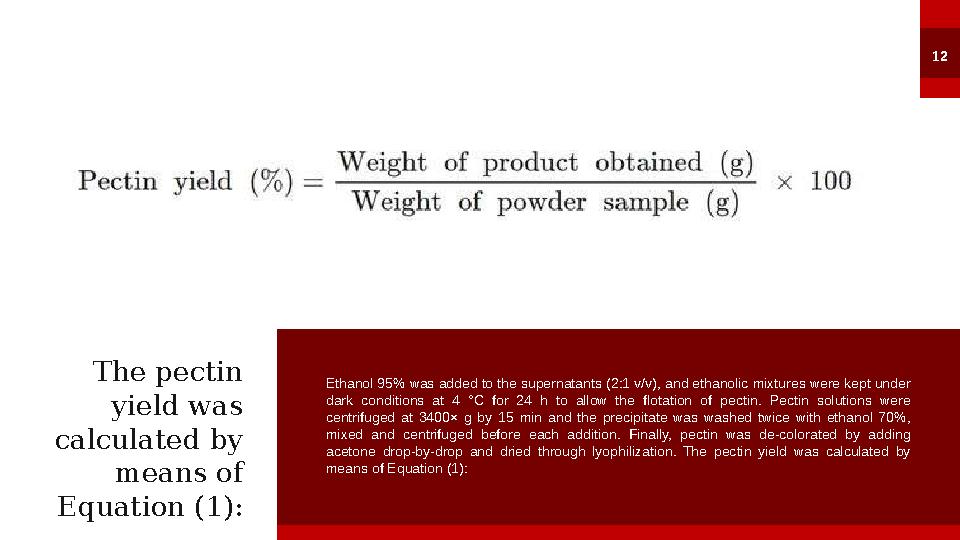
The pectin
yield was
calculated by
means of
Equation (1): Ethanol 95% was added to the supernatants (2:1 v/v), and ethanolic mixtures were kept under
dark conditions at 4 °C for 24 h to allow the flotation of pectin. Pectin solutions were
centrifuged at 3400× g by 15 min and the precipitate was washed twice with ethanol 70%,
mixed and centrifuged before each addition. Finally, pectin was de-colorated by adding
acetone drop-by-drop and dried through lyophilization. The pectin yield was calculated by
means of Equation (1):
12 слайд
12 The pectin yield was calculated by means of Equation (1): Ethanol 95% was added to the supernatants (2:1 v/v), and ethanolic mixtures were kept under dark conditions at 4 °C for 24 h to allow the flotation of pectin. Pectin solutions were centrifuged at 3400× g by 15 min and the precipitate was washed twice with ethanol 70%, mixed and centrifuged before each addition. Finally, pectin was de-colorated by adding acetone drop-by-drop and dried through lyophilization. The pectin yield was calculated by means of Equation (1):
#13 слайд
BEET PECTIN
13
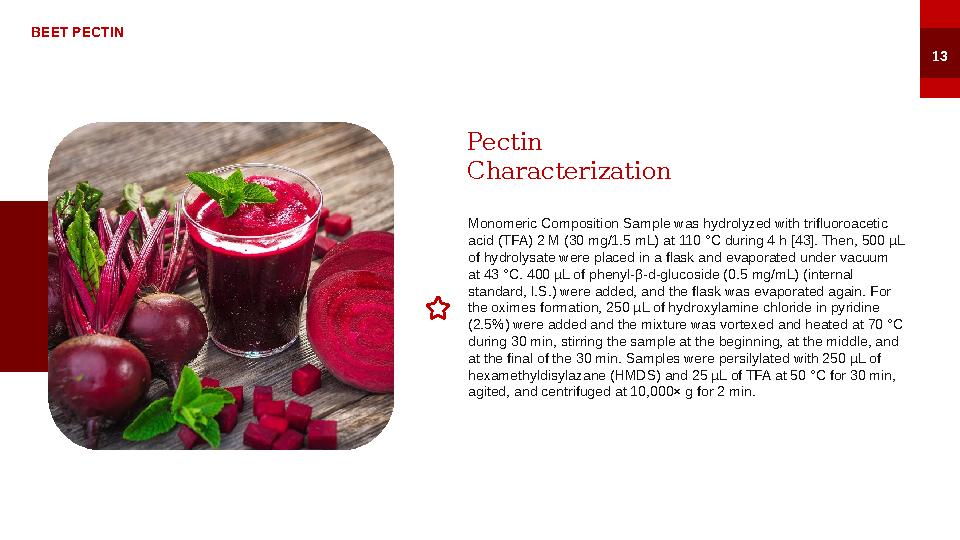
Monomeric Composition Sample was hydrolyzed with trifluoroacetic
acid (TFA) 2 M (30 mg/1.5 mL) at 110 °C during 4 h [43]. Then, 500 µL
of hydrolysate were placed in a flask and evaporated under vacuum
at 43 °C. 400 µL of phenyl-β-d-glucoside (0.5 mg/mL) (internal
standard, I.S.) were added, and the flask was evaporated again. For
the oximes formation, 250 µL of hydroxylamine chloride in pyridine
(2.5%) were added and the mixture was vortexed and heated at 70 °C
during 30 min, stirring the sample at the beginning, at the middle, and
at the final of the 30 min. Samples were persilylated with 250 µL of
hexamethyldisylazane (HMDS) and 25 µL of TFA at 50 °C for 30 min,
agited, and centrifuged at 10,000× g for 2 min.Pectin
Characterization
13 слайд
BEET PECTIN 13 Monomeric Composition Sample was hydrolyzed with trifluoroacetic acid (TFA) 2 M (30 mg/1.5 mL) at 110 °C during 4 h [43]. Then, 500 µL of hydrolysate were placed in a flask and evaporated under vacuum at 43 °C. 400 µL of phenyl-β-d-glucoside (0.5 mg/mL) (internal standard, I.S.) were added, and the flask was evaporated again. For the oximes formation, 250 µL of hydroxylamine chloride in pyridine (2.5%) were added and the mixture was vortexed and heated at 70 °C during 30 min, stirring the sample at the beginning, at the middle, and at the final of the 30 min. Samples were persilylated with 250 µL of hexamethyldisylazane (HMDS) and 25 µL of TFA at 50 °C for 30 min, agited, and centrifuged at 10,000× g for 2 min.Pectin Characterization
#14 слайд
BEET PECTIN
14
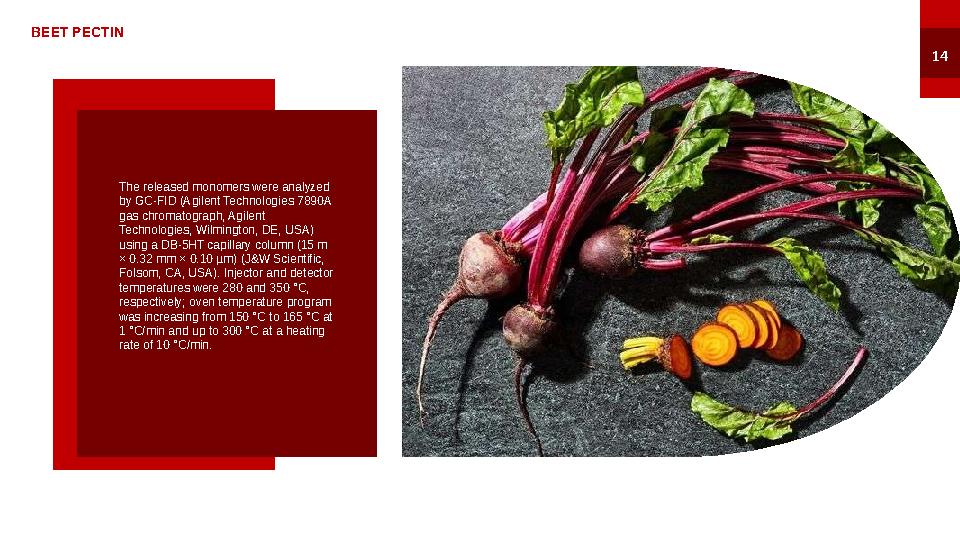
The released monomers were analyzed
by GC-FID (Agilent Technologies 7890A
gas chromatograph, Agilent
Technologies, Wilmington, DE, USA)
using a DB-5HT capillary column (15 m
× 0.32 mm × 0.10 µm) (J&W Scientific,
Folsom, CA, USA). Injector and detector
temperatures were 280 and 350 °C,
respectively; oven temperature program
was increasing from 150 °C to 165 °C at
1 °C/min and up to 300 °C at a heating
rate of 10 °C/min.
14 слайд
BEET PECTIN 14 The released monomers were analyzed by GC-FID (Agilent Technologies 7890A gas chromatograph, Agilent Technologies, Wilmington, DE, USA) using a DB-5HT capillary column (15 m × 0.32 mm × 0.10 µm) (J&W Scientific, Folsom, CA, USA). Injector and detector temperatures were 280 and 350 °C, respectively; oven temperature program was increasing from 150 °C to 165 °C at 1 °C/min and up to 300 °C at a heating rate of 10 °C/min.
#15 слайд
BEET PECTIN
15
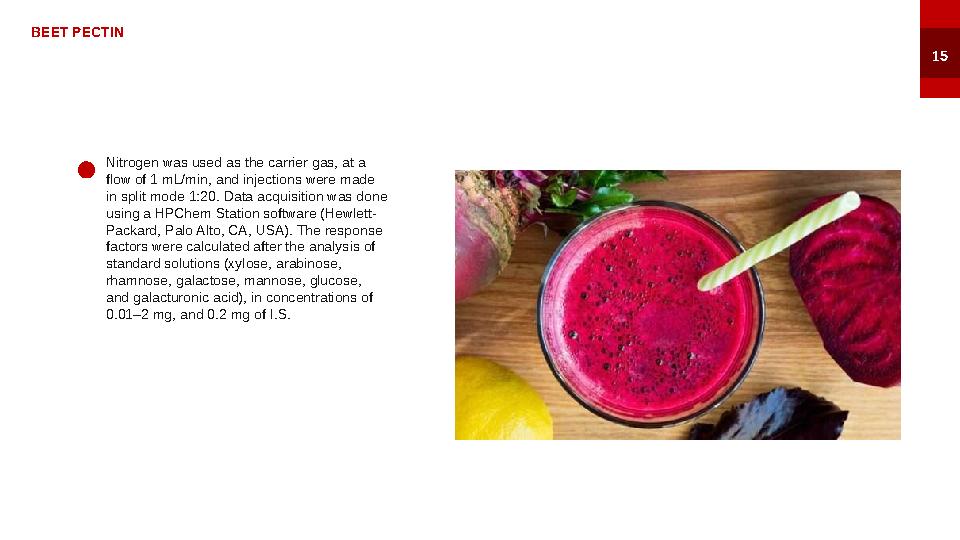
Nitrogen was used as the carrier gas, at a
flow of 1 mL/min, and injections were made
in split mode 1:20. Data acquisition was done
using a HPChem Station software (Hewlett-
Packard, Palo Alto, CA, USA). The response
factors were calculated after the analysis of
standard solutions (xylose, arabinose,
rhamnose, galactose, mannose, glucose,
and galacturonic acid), in concentrations of
0.01–2 mg, and 0.2 mg of I.S.
15 слайд
BEET PECTIN 15 Nitrogen was used as the carrier gas, at a flow of 1 mL/min, and injections were made in split mode 1:20. Data acquisition was done using a HPChem Station software (Hewlett- Packard, Palo Alto, CA, USA). The response factors were calculated after the analysis of standard solutions (xylose, arabinose, rhamnose, galactose, mannose, glucose, and galacturonic acid), in concentrations of 0.01–2 mg, and 0.2 mg of I.S.
![BEET PECTIN 16 BEVERAGE Protein content was determined in all the pectin samples following the Bradford assay [44] using the Bi](https://api.ust.kz/storage/files/materials/pptx/image/2024/april/d04/171222740335-16.jpeg "BEET PECTIN 16 BEVERAGE Protein content was determined in all the pectin samples following the Bradford assay [44] using the Bi")
#16 слайд
BEET PECTIN
16
BEVERAGE
Protein content was determined in all the pectin samples following the
Bradford assay [44] using the Bio-Rad protein assay kit, which includes
Coomasie Blue and bovine serum albumin (BSA) (0–2 mg/mL) for the
calibration curve. The absorbances were measured at 595 nm and
protein content was expressed as g/100 g DW.
16 слайд
BEET PECTIN 16 BEVERAGE Protein content was determined in all the pectin samples following the Bradford assay [44] using the Bio-Rad protein assay kit, which includes Coomasie Blue and bovine serum albumin (BSA) (0–2 mg/mL) for the calibration curve. The absorbances were measured at 595 nm and protein content was expressed as g/100 g DW.
#17 слайд
BEET PECTIN
Conclusions
The present study compared the compositional and rheological properties of sugar
beet pectin, which was efficiently extracted from pressed, ensiled, and dried residues
by acid or enzymatic methods. The silage process caused a reduction in the protein
and insoluble carbohydrates content of sugar beet pulp, as well as an increase in the
fat and soluble dietary fiber amount, likely due to a lactic fermentation process. The
drying process, instead, caused a reduction in the reducing carbohydrates, soluble
fiber and antioxidant capacity. Either the type of sugar beet by-product or the
extraction method had no impact on the degree of methoxylation and molecular
weight of extracted pectin. 17
17 слайд
BEET PECTIN Conclusions The present study compared the compositional and rheological properties of sugar beet pectin, which was efficiently extracted from pressed, ensiled, and dried residues by acid or enzymatic methods. The silage process caused a reduction in the protein and insoluble carbohydrates content of sugar beet pulp, as well as an increase in the fat and soluble dietary fiber amount, likely due to a lactic fermentation process. The drying process, instead, caused a reduction in the reducing carbohydrates, soluble fiber and antioxidant capacity. Either the type of sugar beet by-product or the extraction method had no impact on the degree of methoxylation and molecular weight of extracted pectin. 17
#18 слайд
BEET PECTIN
18
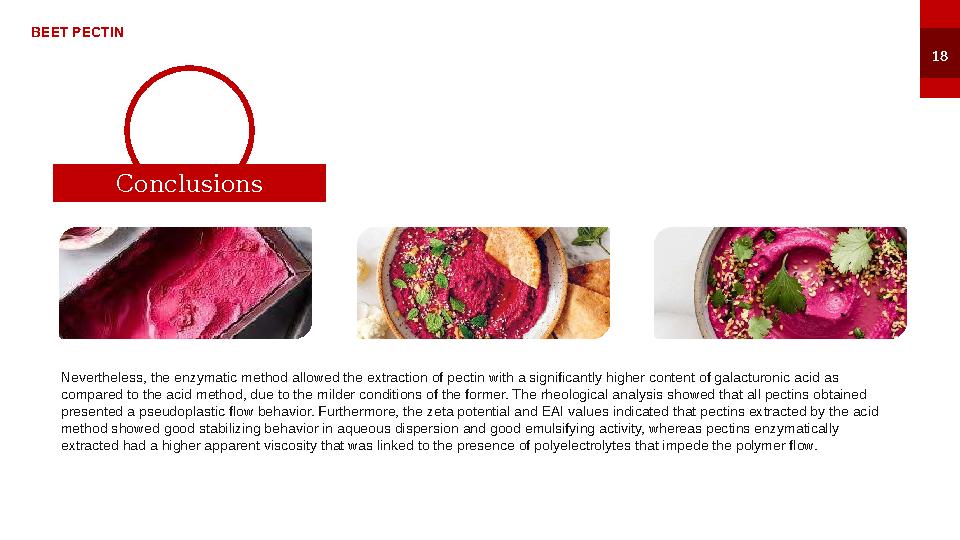
Nevertheless, the enzymatic method allowed the extraction of pectin with a significantly higher content of galacturonic acid as
compared to the acid method, due to the milder conditions of the former. The rheological analysis showed that all pectins obtained
presented a pseudoplastic flow behavior. Furthermore, the zeta potential and EAI values indicated that pectins extracted by the acid
method showed good stabilizing behavior in aqueous dispersion and good emulsifying activity, whereas pectins enzymatically
extracted had a higher apparent viscosity that was linked to the presence of polyelectrolytes that impede the polymer flow. Conclusions
18 слайд
BEET PECTIN 18 Nevertheless, the enzymatic method allowed the extraction of pectin with a significantly higher content of galacturonic acid as compared to the acid method, due to the milder conditions of the former. The rheological analysis showed that all pectins obtained presented a pseudoplastic flow behavior. Furthermore, the zeta potential and EAI values indicated that pectins extracted by the acid method showed good stabilizing behavior in aqueous dispersion and good emulsifying activity, whereas pectins enzymatically extracted had a higher apparent viscosity that was linked to the presence of polyelectrolytes that impede the polymer flow. Conclusions
#19 слайд
CONCLUSION
SBEET PECTIN
19
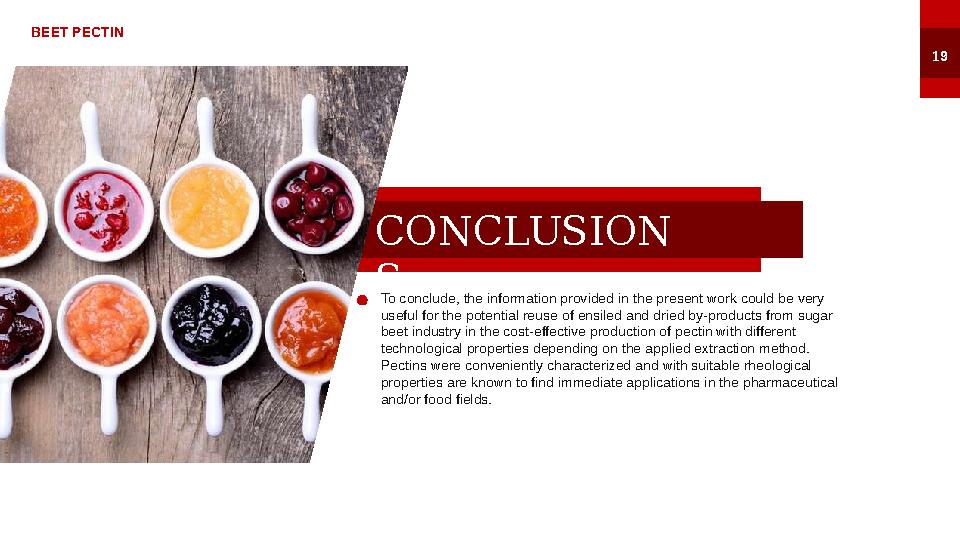
To conclude, the information provided in the present work could be very
useful for the potential reuse of ensiled and dried by-products from sugar
beet industry in the cost-effective production of pectin with different
technological properties depending on the applied extraction method.
Pectins were conveniently characterized and with suitable rheological
properties are known to find immediate applications in the pharmaceutical
and/or food fields.
19 слайд
CONCLUSION SBEET PECTIN 19 To conclude, the information provided in the present work could be very useful for the potential reuse of ensiled and dried by-products from sugar beet industry in the cost-effective production of pectin with different technological properties depending on the applied extraction method. Pectins were conveniently characterized and with suitable rheological properties are known to find immediate applications in the pharmaceutical and/or food fields.
#20 слайд
20
References
1. Eurostat . In: Agriculture, Forestry and Fishery Statistics. 2017th ed. Forti R., editor. Imprimerie Centrale; Luxembourg: 2017. [Google
Scholar]
2. RedCorn R., Fatemi S., Engelberth A.S. Comparing end-Use potential for industrial food-Waste sources. Engineering. 2018;4:371–380. doi:
10.1016/j.eng.2018.05.010. [CrossRef] [Google Scholar]
3. Maravić N., Šereš Z., Vidović S., Mišan A., Milovanović I., Radosavljević R., Pavlić B. Subcritical water hydrolysis of sugar beet pulp towards
production of monosaccharide fraction. Ind. Crops Prod. 2018;115:32–39. doi: 10.1016/j.indcrop.2018.02.014. [CrossRef] [Google Scholar]
4. Agoda-Tandjawa G., Durand S., Gaillard C., Garnier C., Doublier J.L. Properties of cellulose/pectins composites: Implication for structural and
mechanical properties of cell wall. Carbohydr. Polym. 2012;90:1081–1091. doi: 10.1016/j.carbpol.2012.06.047. [PubMed] [CrossRef] [Google
Scholar]
5. Kaya M., Sousa A.G., Crépeau M.-J., Sorensen S.O., Ralet M.-C. Characterization of citrus pectin samples extracted under different
conditions: Influence of acid type and pH of extraction. Ann. Bot. 2014;114:1319–1326. doi: 10.1093/aob/mcu150. [PMC free article] [PubMed]
[CrossRef] [Google Scholar]
6. Ferreira-Lazarte A., Kachrimanidou V., Villamiel M., Rastall R.A., Moreno F.J. In vitro fermentation properties of pectins and enzymatic-
modified pectins obtained from different renewable bioresources. Carbohydr. Polym. 2018;199:482–491. doi: 10.1016/j.carbpol.2018.07.041.
[PubMed] [CrossRef] [Google Scholar]
7. Leroux J., Langendorff V., Schick G., Vaishnav V., Mazoyer J. Emulsion stabilizing properties of pectin. Food Hydrocoll. 2003;17:455–462.
doi: 10.1016/S0268-005X(03)00027-4. [CrossRef] [Google Scholar]
8. Jankovská P., Čopíková J., Sinitsya A. The determination of ferulic acid in sugar beet pulp. Czech J. Food Sci. 2001;19:143–147. doi:
10.17221/6598-CJFS. [CrossRef] [Google Scholar]
9. Levigne S., Ralet M.C., Thibault J.F. Characterisation of pectins extracted from fresh sugar beet under different conditions using an
experimental design. Carbohydr. Polym. 2002;49:145–153. doi: 10.1016/S0144-8617(01)00314-9. [CrossRef] [Google Scholar]
20 слайд
20 References 1. Eurostat . In: Agriculture, Forestry and Fishery Statistics. 2017th ed. Forti R., editor. Imprimerie Centrale; Luxembourg: 2017. [Google Scholar] 2. RedCorn R., Fatemi S., Engelberth A.S. Comparing end-Use potential for industrial food-Waste sources. Engineering. 2018;4:371–380. doi: 10.1016/j.eng.2018.05.010. [CrossRef] [Google Scholar] 3. Maravić N., Šereš Z., Vidović S., Mišan A., Milovanović I., Radosavljević R., Pavlić B. Subcritical water hydrolysis of sugar beet pulp towards production of monosaccharide fraction. Ind. Crops Prod. 2018;115:32–39. doi: 10.1016/j.indcrop.2018.02.014. [CrossRef] [Google Scholar] 4. Agoda-Tandjawa G., Durand S., Gaillard C., Garnier C., Doublier J.L. Properties of cellulose/pectins composites: Implication for structural and mechanical properties of cell wall. Carbohydr. Polym. 2012;90:1081–1091. doi: 10.1016/j.carbpol.2012.06.047. [PubMed] [CrossRef] [Google Scholar] 5. Kaya M., Sousa A.G., Crépeau M.-J., Sorensen S.O., Ralet M.-C. Characterization of citrus pectin samples extracted under different conditions: Influence of acid type and pH of extraction. Ann. Bot. 2014;114:1319–1326. doi: 10.1093/aob/mcu150. [PMC free article] [PubMed] [CrossRef] [Google Scholar] 6. Ferreira-Lazarte A., Kachrimanidou V., Villamiel M., Rastall R.A., Moreno F.J. In vitro fermentation properties of pectins and enzymatic- modified pectins obtained from different renewable bioresources. Carbohydr. Polym. 2018;199:482–491. doi: 10.1016/j.carbpol.2018.07.041. [PubMed] [CrossRef] [Google Scholar] 7. Leroux J., Langendorff V., Schick G., Vaishnav V., Mazoyer J. Emulsion stabilizing properties of pectin. Food Hydrocoll. 2003;17:455–462. doi: 10.1016/S0268-005X(03)00027-4. [CrossRef] [Google Scholar] 8. Jankovská P., Čopíková J., Sinitsya A. The determination of ferulic acid in sugar beet pulp. Czech J. Food Sci. 2001;19:143–147. doi: 10.17221/6598-CJFS. [CrossRef] [Google Scholar] 9. Levigne S., Ralet M.C., Thibault J.F. Characterisation of pectins extracted from fresh sugar beet under different conditions using an experimental design. Carbohydr. Polym. 2002;49:145–153. doi: 10.1016/S0144-8617(01)00314-9. [CrossRef] [Google Scholar]

#21 слайд
BEET PECTIN
21
THAN
K YOU
21 слайд
BEET PECTIN 21 THAN K YOU


 Жүктеу
шағым қалдыра аласыз
 Бұл курс Қазақстан Республикасы Оқу-ағарту министрлігімен келісілген