ЖИ көмекші





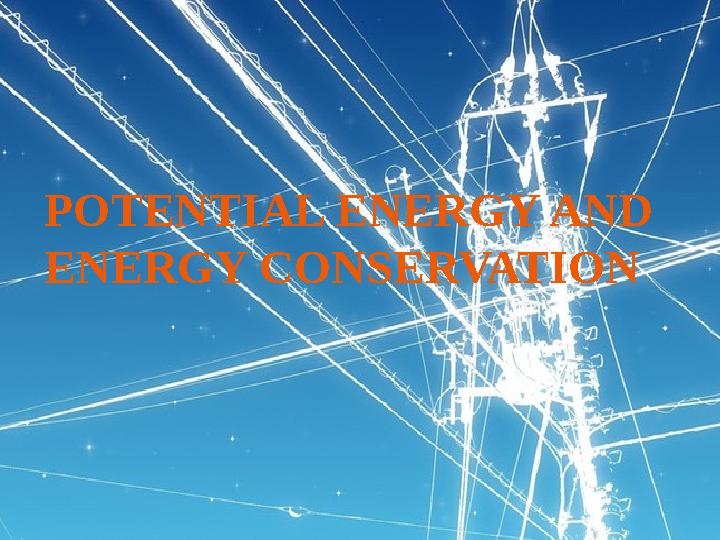
Potential energy and energy conservation
Тақырып бойынша 11 материал табылды
Potential energy and energy conservation
Материал туралы қысқаша түсінік
Potential energy and energy conservation (Потенциальная энергия). Химияны ағылшын тілінде жүргізетін мұғалімдер үшін. Формулалар жиынтығынан, ережелерден тұрады.
Материалдың қысқаша нұсқасы
1 / 11

 Жүктеу
Бөлісу
ЖИ арқылы жасау
Слайдтың жеке беттері
#1 слайд
POTENTIAL ENERGY AND
ENERGY CONSERVATION
1 слайд
POTENTIAL ENERGY AND ENERGY CONSERVATION

#2 слайд
Рarticle gains or loses kinetic energy
because it interacts with other objects
that exert forces on it. During any
interaction, the change in a particle's
kinetic energy is equal to the total
work done on the particle by the
forces that act on it.
In many situations it seems as though
energy has been stored in a system,
to be recovered later. For example,
you must do work to lift a heavy stone
over your head. It seems reasonable
that in hoisting the stone into the air
you are storing energy in the system,
energy that is later convened into
kinetic energy when you let the stone
fall.
2 слайд
Рarticle gains or loses kinetic energy because it interacts with other objects that exert forces on it. During any interaction, the change in a particle's kinetic energy is equal to the total work done on the particle by the forces that act on it. In many situations it seems as though energy has been stored in a system, to be recovered later. For example, you must do work to lift a heavy stone over your head. It seems reasonable that in hoisting the stone into the air you are storing energy in the system, energy that is later convened into kinetic energy when you let the stone fall.

#3 слайд
This example points to the idea of
an energy associated with the
position of bodies in a system.
This kind of energy is a measure
of the potential or possibility for
work to be done: when a stone is
raised into the air. there is a
potential for work to be done on it
by the gravitational force, but
only if the stone is allowed to fall
to the ground.
For this reason, energy associated with position is called
potential energy. Our discussion suggests that there is
potential energy associated with a body's weight and its
height above the ground. We call this gravitational
potential energy (1).
3 слайд
This example points to the idea of an energy associated with the position of bodies in a system. This kind of energy is a measure of the potential or possibility for work to be done: when a stone is raised into the air. there is a potential for work to be done on it by the gravitational force, but only if the stone is allowed to fall to the ground. For this reason, energy associated with position is called potential energy. Our discussion suggests that there is potential energy associated with a body's weight and its height above the ground. We call this gravitational potential energy (1).

#4 слайд
We now have two ways to describe
what happens when a body falls
without air resistance. One way is to
say that gravitational potential
energy decreases and the falling
body's kinetic energy increases. The
other way. which we learned in
Chapter 6, is that a falling body's
kinetic energy increases because the
force of the earth's gravity (the
body's weight) docs work on the
body. Later in this section we'll use
the work-energy theorem to show
that these two descriptions are
equivalent.
To begin with, however, let's derive
the expression for gravitational
potential energy. Suppose a body
with mass m moves along the
(vertical) y-axis. as in fig.2.
4 слайд
We now have two ways to describe what happens when a body falls without air resistance. One way is to say that gravitational potential energy decreases and the falling body's kinetic energy increases. The other way. which we learned in Chapter 6, is that a falling body's kinetic energy increases because the force of the earth's gravity (the body's weight) docs work on the body. Later in this section we'll use the work-energy theorem to show that these two descriptions are equivalent. To begin with, however, let's derive the expression for gravitational potential energy. Suppose a body with mass m moves along the (vertical) y-axis. as in fig.2.

#5 слайд
The forces acting on it are its weight, with
magnitude w= mg, and possibly some other
forces; we call the vector sum (resultant) of all
the Other forces
We'll assume that the body stays close enough to
the earth's surface that the weight is constant.
We want to find the work done by the weight
when the body moves downward from a height y1
above the origin to a lower height y2(Fig. 2a).
The weight and displacement are in the same
direction, so the work Wgrav done on the body
by its weight is positive:
other
f
Wgrav = Fs = w (y1 – y2) = mgy1 – mgy2
5 слайд
The forces acting on it are its weight, with magnitude w= mg, and possibly some other forces; we call the vector sum (resultant) of all the Other forces We'll assume that the body stays close enough to the earth's surface that the weight is constant. We want to find the work done by the weight when the body moves downward from a height y1 above the origin to a lower height y2(Fig. 2a). The weight and displacement are in the same direction, so the work Wgrav done on the body by its weight is positive: other f Wgrav = Fs = w (y1 – y2) = mgy1 – mgy2

#6 слайд
This expression also gives the correct
work when the body moves upward and
y
2 is greater than y
1 (Fig.2b). In that
case the quantity (y
1 - y
2) is negative,
and W
grav is negative because the weight
and displacement are opposite in
direction.
Equation (1) shows that we can express
W
grav in terms of the values of the
quantity mgy at the beginning and end
of the displacement. This quantity, the
product of the weight mg and the height
у above the origin of coordinates, is
called the gravitational potential
energy, U
grav
Ugrav = mgy gravitational potential energy
6 слайд
This expression also gives the correct work when the body moves upward and y 2 is greater than y 1 (Fig.2b). In that case the quantity (y 1 - y 2) is negative, and W grav is negative because the weight and displacement are opposite in direction. Equation (1) shows that we can express W grav in terms of the values of the quantity mgy at the beginning and end of the displacement. This quantity, the product of the weight mg and the height у above the origin of coordinates, is called the gravitational potential energy, U grav Ugrav = mgy gravitational potential energy

#7 слайд
The negative sign in front of ∆U
grav
is essential. When the body
moves up, у increases, the work done by the gravitational force is
negative, and the gravitational potential energy increases (∆U
grav
>
0). When the body moves down, у decreases, the gravitational force
does positive work, and the gravitational potential energy decreases
(∆U
grav
< 0). It's like drawing money out of the bank (decreasing U
grav
)
and spending it (doing positive work). The unit of potential energy is
the joule (J ), the same unit as is used for work.
Is initial value is U
grav,1 = mgy
1 and its final value is U
grav,2 =
mgy
2. The change in U
grav
is the tinal value minus the initial value, or ∆U
grav
= U
grav,2
- U
grav,1
mgy
1 We can express the work W
grav
done by the gravitational
force during the displace
ment from y
1
to y
2
as
7 слайд
The negative sign in front of ∆U grav is essential. When the body moves up, у increases, the work done by the gravitational force is negative, and the gravitational potential energy increases (∆U grav > 0). When the body moves down, у decreases, the gravitational force does positive work, and the gravitational potential energy decreases (∆U grav < 0). It's like drawing money out of the bank (decreasing U grav ) and spending it (doing positive work). The unit of potential energy is the joule (J ), the same unit as is used for work. Is initial value is U grav,1 = mgy 1 and its final value is U grav,2 = mgy 2. The change in U grav is the tinal value minus the initial value, or ∆U grav = U grav,2 - U grav,1 mgy 1 We can express the work W grav done by the gravitational force during the displace ment from y 1 to y 2 as

#8 слайд
8 слайд

#9 слайд
9 слайд

#10 слайд
POTENTIAL ENERGY
Potential energy — scalar physical
quantity, characterizes a stock of
energy of the certain body (or a
material point) which is in a
potential force field which goes for
acquisition (change) of kinetic
energy of a body due to work of
forces of the field.
The term "potential energy" was
entered in the 19th century by the
Scottish engineer and the physicist
William Renkin. A unit of measure
of energy is the joule.
Potential energy is accepted equal to zero for some
configuration of bodies in space which choice is defined by
convenience of further calculations. Process of the choice of
this configuration is called a normalization of potential
energy.
10 слайд
POTENTIAL ENERGY Potential energy — scalar physical quantity, characterizes a stock of energy of the certain body (or a material point) which is in a potential force field which goes for acquisition (change) of kinetic energy of a body due to work of forces of the field. The term "potential energy" was entered in the 19th century by the Scottish engineer and the physicist William Renkin. A unit of measure of energy is the joule. Potential energy is accepted equal to zero for some configuration of bodies in space which choice is defined by convenience of further calculations. Process of the choice of this configuration is called a normalization of potential energy.
Файл форматы:

pptx

12.10.2018

358
Жүктеу
ЖИ арқылы жасау
Жариялаған:
Бұл материалды қолданушы жариялаған. Ustaz Tilegi ақпаратты жеткізуші ғана болып табылады. Жарияланған материалдың мазмұны мен авторлық құқық толықтай автордың жауапкершілігінде. Егер материал авторлық құқықты бұзады немесе сайттан алынуы тиіс деп есептесеңіз,
шағым қалдыра аласыз
шағым қалдыра аласыз