ЖИ көмекші


 Қауіпсіз төлем

жүктеу мүмкіндігіне ие боласыз
Бұл материал сайт қолданушысы жариялаған. Материалдың ішінде жазылған барлық ақпаратқа жауапкершілікті жариялаған қолданушы жауап береді. Ұстаз тілегі тек ақпаратты таратуға қолдау көрсетеді. Егер материал сіздің авторлық құқығыңызды бұзған болса немесе басқа да себептермен сайттан өшіру керек деп ойласаңыз осында жазыңыз
 10 Қаңтар 2024
 398
398
1 жыл бойы шексіз жүктеңіз
11 сынып Action 3 тоқсан ҚМЖ
Құрметті әріптес!
Қазақстан Республикасының «Авторлық құқық және сабақтас құқықтар туралы» заңына сәйкес авторлық құқық заңмен қорғаланатынын ескертеміз. Сатып алған ҚМЖ – ны тарату туралы факт анықталған жағдайда әкімшілік айыппұл салынады.
«USTAZ tilegi» ғылыми әдістемелік орталығының әкімшілігі
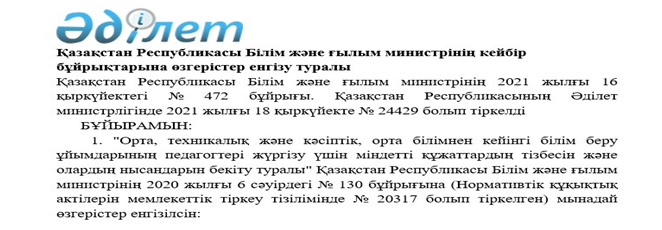
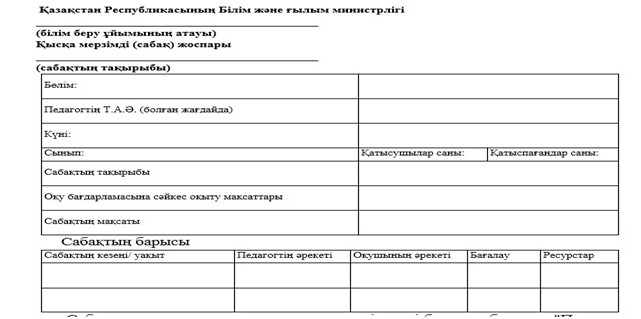
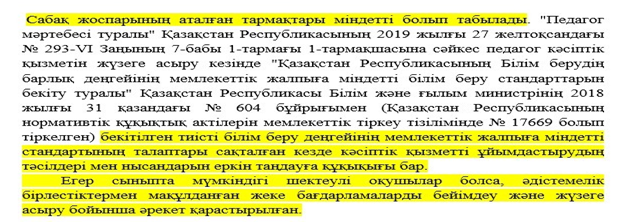
№472 бұйрығы бойынша жасалған ҚМЖ келесі бетте
Бұл ҚМЖ ust.kz сайтында жасалынған. «USTAZ tilegi» ғылыми-әдістемелік орталығының сайтынының ҚМЖ бөлімінде кез-келген пән, кез-келген сынып бойынша ҚМЖ және презентацияны жүктеп ала аласыз. Ол үшін сілтеме арқылы өтіңіз.
Module 5 “Work and Inventions”
|
Lesson 1(49) |
Investigating in the World of Work p.63 |
|||||
|
Date: |
Class: 11 |
|||||
|
Teacher’s name: |
||||||
|
Learning objectives that this lesson is contributing to |
11.4.1- understand complex and abstract main points in extended texts on a wide range of familiar and unfamiliar general and curricular topics; 11.4.3- skim a range of lengthy texts with speed to identify content meriting closer reading on a range of more complex and abstract, general and curricular topics; 11.1.5 - use feedback to set personal learning objectives; 11.1.6- organise and present information clearly to others; 11.1.8- develop intercultural awareness through reading and discussion; 11.2.2- understand specific information in unsupported extended talk on a wide range of general and curricular topics, including talk on a growing range of unfamiliar topics; 11.2.3- understand the detail of an argument in unsupported extended talk on a wide range of general and curricular topics, including talk on a growing range of unfamiliar topics; 11.3.3- explain and justify own and others’ point of view on a range of general and curricular topics, including some unfamiliar topics; 11.3.6- navigate talk and modify language through paraphrase and correction in talk on a wide range of familiar and some unfamiliar general and curricular topics ; 11.3.7 use appropriate subject-specific vocabulary and syntax to talk about a range of familiar and some unfamiliar general and curricular topics; 11.6.1 use a variety of pre- and post- modifying noun structures on a wide range of general and curricular topics; 11.6.5- use a range of transitive and intransitive verb complementation patterns on a wide range of general and curricular topics; 11.1.9- use imagination to express thoughts, ideas, experiences and feelings; 11.5.2- use a wide range of vocabulary, which is appropriate to topic and genre, and which is spelt accurately; 11.5.3- write with grammatical accuracy on a wide range of general and curricular topics 11.5.6-- write coherently at text level using a variety of connectors on a wide range of familiar general and curricular topics |
|||||
|
Lesson objectives |
All learners will be able to: |
|||||
|
provide an overview of the module; learn vocabulary related to investigating the world of work; Most learners will be able to: provide an overview of the module; learn vocabulary related to investigating the world of work, listen for specific information; Some learners will be able to: provide an overview of the module; module; learn vocabulary related to investigating the world of work, listen for specific information, talk about what factors are important in a career |
||||||
|
Vocabulary |
Office personalities: adaptor, workaholic, procrastinator, multitasker, delegator, yes-man; Investigating the world of work: working environment, salary/wage, level of responsibility, supervisor, creativity, general job satisfaction, job recognition, future prospects, collaborative work environment, good job security, extra benefits |
|||||
|
Assessment criteria |
Learners have met the learning objective if they can: provide an overview of the module; module; learn vocabulary related to investigating the world of work, listen for specific information, talk about what factors are important in a career |
|||||
|
Value links |
Explore the world of work |
|||||
|
Cross – curricular links |
Social Science, ICT |
|||||
|
ICT skills |
Using videos & pictures, working with URLs |
|||||
|
Previous learning |
“Timekeeping Devices” |
|||||
|
Plan |
||||||
|
Part of the lesson/Time |
Teacher’s activity |
Student’s activity |
Assessment |
Resources |
|
|
|
Beginning the lesson 5 minutes |
Module Objectives Read the title of the module Work & Inventions and ask Ss to suggest what they think the module will be about (the module is about office personalities, work, success in business, special talents, inventions and big ideas). Go through the objectives list to stimulate Ss’ interest in the module. |
|
Feedback: “The praise” method “Good job! Well done!” |
Whiteboard PPT (With words) Excel Pupils Book |
|
|
|
Main Activties 10 minutes |
Vocabulary Ex.1 p.63 11.4.1- understand complex and abstract main points in extended texts on a wide range of familiar and unfamiliar general and curricular topics; 11.4.3- skim a range of lengthy texts with speed to identify content meriting closer reading on a range of more complex and abstract, general and curricular topics; Aim: to introduce vocabulary related to investigating the world of work • Direct Ss’ attention to the pictures and the speech bubbles, have Ss read what they say and then match the people to the office personalities in the list. • Check Ss’ answers. |
Answer Key 1 A 2 E 3 C 4 B 5 D 6 F • Play the video for Ss and elicit their comments. |
Feedback: “The praise” method “Good job! Well done!” |
Whiteboard PPT (With words) Excel Pupils Book |
|
|
|
|
Listening Ex.2 p.63 11.1.5 - use feedback to set personal learning objectives; 11.1.6- organise and present information clearly to others; 11.1.8- develop intercultural awareness through reading and discussion; 11.2.2- understand specific information in unsupported extended talk on a wide range of general and curricular topics, including talk on a growing range of unfamiliar topics; 11.2.3- understand the detail of an argument in unsupported extended talk on a wide range of general and curricular topics, including talk on a growing range of unfamiliar topics; 11.3.3- explain and justify own and others’ point of view on a range of general and curricular topics, including some unfamiliar topics; 11.3.6- navigate talk and modify language through paraphrase and correction in talk on a wide range of familiar and some unfamiliar general and curricular topics ; 11.3.7 use appropriate subject-specific vocabulary and syntax to talk about a range of familiar and some unfamiliar general and curricular topics; 11.6.1 use a variety of pre- and post- modifying noun structures on a wide range of general and curricular topics; 11.6.5- use a range of transitive and intransitive verb complementation patterns on a wide range of general and curricular topics; Aim: to listen for specific information • Ask Ss to read the list of job benefits and then play the recording. • Ss listen and decide which benefits each speaker’s job offers. • Check Ss’ answers. |
Suggested Answer Key 1 working environment, creativity, general job satisfaction 2 collaborative work environment, general job satisfaction 3 level of responsibility, general job satisfaction |
Feedback: “The praise” method “Good job! Well done!” |
Whiteboard PPT (With words) Pupils Book |
|
|
|
|
OVER TO YOU! p.63 11.1.6- organise and present information clearly to others; 11.1.9- use imagination to express thoughts, ideas, experiences and feelings; 11.3.6- navigate talk and modify language through paraphrase and correction in talk on a wide range of familiar and some unfamiliar general and curricular topics ; 11.3.7 use appropriate subject-specific vocabulary and syntax to talk about a range of familiar and some unfamiliar general and curricular topics; 11.5.2- use a wide range of vocabulary, which is appropriate to topic and genre, and which is spelt accurately; 11.5.3- write with grammatical accuracy on a wide range of general and curricular topics; 11.5.6-- write coherently at text level using a variety of connectors on a wide range of familiar general and curricular topics; 11.6.1 use a variety of pre- and post- modifying noun structures on a wide range of general and curricular topics; 11.6.5- use a range of transitive and intransitive verb complementation patterns on a wide range of general and curricular topics; Aim: to personalise the topic; to express an opinion Read out the question and elicit answers from Ss around the class. |
Suggested Answer Key The most important factor for me in a career is having general job satisfaction. It’s true that having a large salary is very nice, but if y ou don’t enjoy the work or hate the working environment then what’s the point? Personally, I think it’s much better to be happy with what you’re doing, and to have positive working relationships with your colleagues. I can’t think of anything better than a job you love that has a nice collaborative work environment where you feel satisfied and part of a winning team! |
Feedback: “The praise” method “Good job! Well done!” |
Whiteboard PPT (With words) Pupils Book |
|
|
|
|
Aim: to develop research skills; to expand on the topic • Ss research online to find out how people from various countries around the world value employee benefits. Ss present their findings to the class. • Then have the class perform peer assessment and give feedback for Ss to use to improve their performance. |
Suggested Answer Key Different countries have different cultures, so the way people value employee benefits varies from country to country. These are just a few examples of places where employees think differently. In the USA, for example, there is a competitive business culture, so people prefer jobs, which offer lots of future prospects. It is also quite a modern country, so people would rather work under a supervisor who allows them to be flexible and creative with their work. In Australia, the cost of living is quite high, so people definitely need jobs with good salaries. People there are quite relaxed by nature, so they want a collaborative environment where they can share opinions and come up with new ideas. In Japan, careers are considered extremely important, so people look for jobs that offer them responsibility and lots of future prospects. Teamwork is heavily emphasised in workplaces there, too, so people prefer to work in a collaborative environment. When it comes to work, people’s preferences vary a lot. In my opinion, it is the culture of a country that determines an employee’s expectations of a job, as well as what he or she hopes to achieve from working at a particular company. |
Feedback: “The praise” method “Good job! Well done!” |
Whiteboard PPT (With words) Pupils Book |
|
|
|
Ending the lesson 10 minutes |
Aim: to develop research skills; to expand on the topic • Ss research online to find out how people from various countries around the world value employee benefits. Ss present their findings to the class. • Then have the class perform peer assessment and give feedback for Ss to use to improve their performance. |
Suggested Answer Key Different countries have different cultures, so the way people value employee benefits varies from country to country. These are just a few examples of places where employees think differently. In the USA, for example, there is a competitive business culture, so people prefer jobs, which offer lots of future prospects. It is also quite a modern country, so people would rather work under a supervisor who allows them to be flexible and creative with their work. In Australia, the cost of living is quite high, so people definitely need jobs with good salaries. People there are quite relaxed by nature, so they want a collaborative environment where they can share opinions and come up with new ideas. In Japan, careers are considered extremely important, so people look for jobs that offer them responsibility and lots of future prospects. Teamwork is heavily emphasised in workplaces there, too, so people prefer to work in a collaborative environment. When it comes to work, people’s preferences vary a lot. In my opinion, it is the culture of a country that determines an employee’s expectations of a job, as well as what he or she hopes to achieve from working at a particular company. |
Feedback: “The praise” method “Good job! Well done!” |
Whiteboard PPT (With words) Pupils Book |
|
|
Module 5 “Work and Inventions” 5A
|
Lesson 2 (50) |
| ||||









 Бұл курс Қазақстан Республикасы Оқу-ағарту министрлігімен келісілген