
 ЖИ көмекші


 Қауіпсіз төлем

жүктеу мүмкіндігіне ие боласыз
Бұл материал сайт қолданушысы жариялаған. Материалдың ішінде жазылған барлық ақпаратқа жауапкершілікті жариялаған қолданушы жауап береді. Ұстаз тілегі тек ақпаратты таратуға қолдау көрсетеді. Егер материал сіздің авторлық құқығыңызды бұзған болса немесе басқа да себептермен сайттан өшіру керек деп ойласаңыз осында жазыңыз
 06 Мамыр 2025
 310
310
1 жыл бойы шексіз жүктеңіз
4 term short plan 9 English plus Homeschooling
Short term plan: term 4
|
Unit 8 Travel and tourism |
|||
|
Teacher name: |
|
||
|
Date: |
|||
|
Grade: 9 |
Number present: |
absent: |
|
|
Lesson title |
Travel: nouns. |
||
|
Learning objectives |
9.1.4.1 evaluate and respond constructively to feedback from others 9.2.4.1 understand the main points of supported extended talk on a range of general and curricular topics 9.3.3.1 explain and justify their own and others’ point of view on a range of general and curricular topics |
||
|
Lesson objectives |
Learners will be able to: • Learn compound nouns associated with travel. • Complete a dream holiday quiz . • Learn how to extend your vocabular |
||
|
Value links |
Hospitality: Traditionally a nomadic culture, hospitality has always been an important part of Kazakh culture. |
||
|
Plan |
|||
|
Stages / Time |
Teachers’ actions |
Students’ actions |
Assessment criteria |
Resources |
|
Beginning of the lesson 5 min |
Organization moment 1.Greeting. Ask about the weather. The teacher sets the lesson objectives, letting students know what to anticipate from the lesson. Warm-up
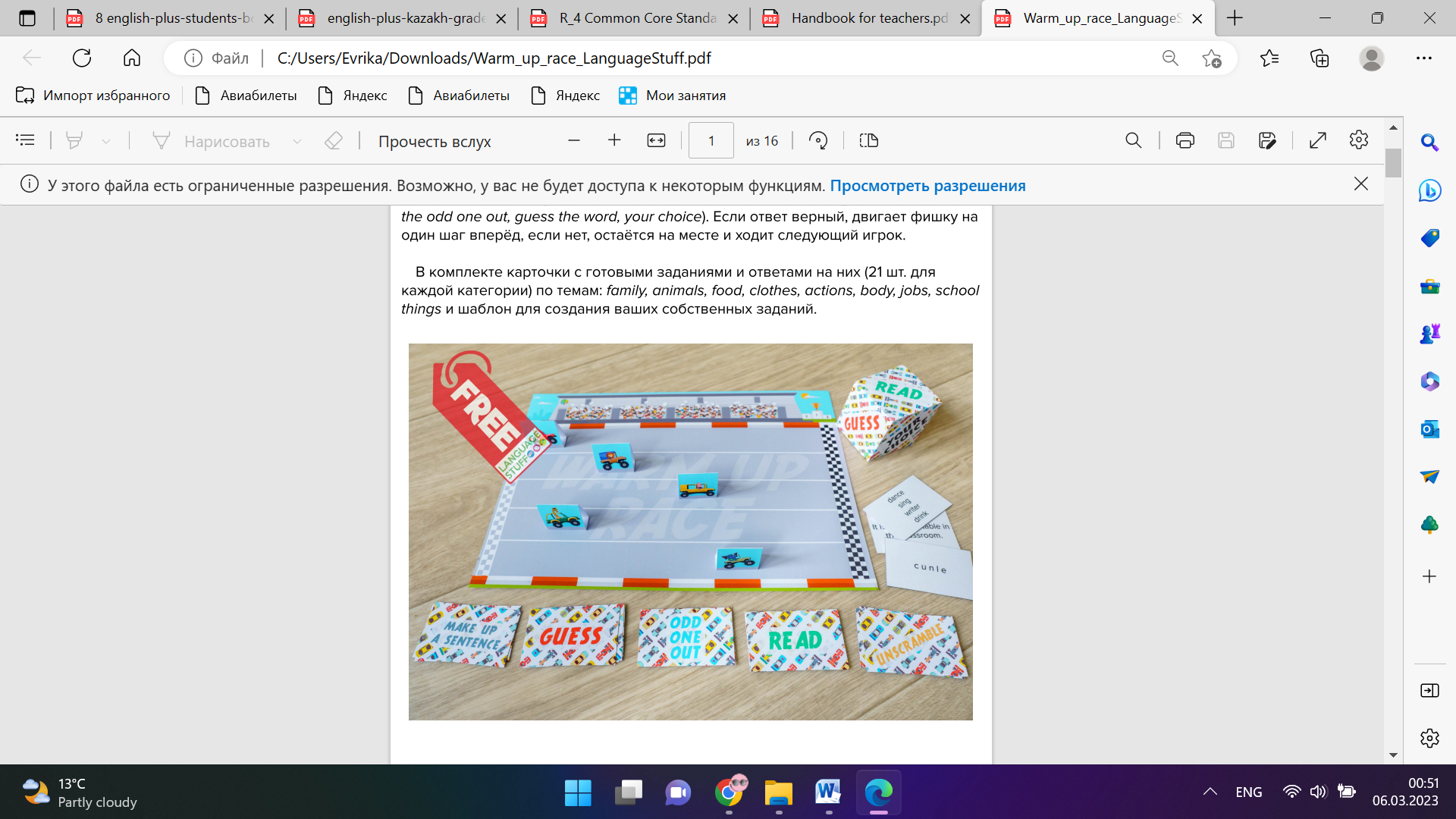
Fasten your seat belts and get ready for the all-round race Lead – In • With books closed, ask students where they usually go on holiday. Elicit some ideas. • Write Dream holiday on the board and elicit the meaning. • Ask: What is your dream holiday? Elicit a range of ideas from the class and write useful vocabulary on the board |
Students' attention is drawn to the lesson. Students discuss the pictures in pairs. Determines the topic and aim of the lesson Students say different words from the picture |
Formative Assessment
Good job! Assessment criteria -Identify detailed information in extended conversation with support |
Pictures Student’s book |
|
Middle of the lesson Presentation part. 35 min |
Ex: 1 P:92 • Read the instructions with the class and make sure students understand what a compound noun is (a noun which is made of two or more words or parts of words). • Students work in pairs to make as many compound nouns as possible. Then they read the text and compare it with their lists. • Check answers and expand the list with any more compound nouns from the text Ex: 2 P:92 • Read the example definition, and elicit a definition of city break (a very short holiday in a city) as a further example. • Allow students time to write their definitions individually and then put students into pairs to test each other. • Ask some students to read their definitions to the class. In a stronger class, check understanding by asking students to put the words into sentences. Ex: 3 P:92 • Students complete the quiz individually, put them into pairs to compare their answers. • Ask some students to tell the class about their partner’s dream holiday. Ex: 4 P:92 • Elicit another combination with tour, e.g. sightseeing. • Put students into pairs to continue writing new combinations. Point out that nouns other than those seen in exercise 1 will need to be used Conclusion during the lesson some tasks differentiated by outcomes of the students and by their abilities. |
Students match the words in the boxes. How many compound nouns can you make? Then look at the My Dream Holiday quiz and compare the compound nouns with your list. Answers: guidebook, return ticket / trip / flight, day trip, suncream, diving equipment, long-haul flight, five-star hotel / accommodation, city break, mosquito net, luxury hotel / accommodation Students write definitions for six of the compound nouns. Work in pairs and test your partner Answers: Students’ own answers. Students do the My Dream Holiday quiz. Do you agree with the results? Why / Why not? Answers: Students’ own answers Students add two nouns from the quiz to each list Answers: 1 sightseeing 2 guided 3 agent 4 brochures |
Descriptor: - work in pairs -compare the compound nouns Total: 1 point Descriptor: - write definitions for six of the compound nouns - work in pairs Total: 1 point Descriptor: - do the quiz - complete the quiz individually Total: 1 point Descriptor: add two nouns from the quiz Total: 1 point |
Cards Worksheets |
|
End of the lesson 5 min |
FEEDBACK Learners provide feedback on what they have learned at the lesson. |
|
Students evaluate each other and encourage classmate with phrases like: Well done! Brilliant! Good job! I like it! . |
Poster
|




Short term plan: term 4
|
Unit 8 Travel and tourism |
|
||
|
Teacher name: |
|
||
|
Date: |
|
||
|
Grade: 9 |
Number present: |
absent: |
|
|
Lesson title |
To be going to |
||
|
Learning objectives |
9.3.4.1 respond with flexibility at both sentence and discourse level to unexpected comments on a range of general and curricular topics 9.5.1.1 plan, write, edit and proofread work at text level independently on a range of general and curricular topics 9.5.3.1 write with grammatical accuracy on a range of familiar general and curricular topics |
||
|
Lesson objectives |
Learners will be able to: • Learn the use of be going to for plans and intentions. • Practise using be going to to talk about plans and intentions |
||
|
Value links |
Tradition: Kazakh traditions and culture have been passed on from one generation to another through oral histories told by traditional Kazakh tribal leaders and elders. |
||
|
Plan |
|||
|
Stages / Time |
Teachers’ actions |
Students’ actions |
Assessment criteria |
Resources |
|
Beginning of the lesson 5 min |
Organization moment 1.Greeting. Ask about the weather. The teacher sets the lesson objectives, letting students know what to anticipate from the lesson. Warm-up
Fasten your seat belts and get ready for the all-round race Lead – In • With books closed, ask students where they usually go on holiday. Elicit some ideas. • Write Dream holiday on the board and elicit the meaning. • Ask: What is your dream holiday? Elicit a range of ideas from the class and write useful vocabulary on the board |
Students' attention is drawn to the lesson. Students discuss the pictures in pairs. Determines the topic and aim of the lesson Students say different words from the picture |
Formative Assessment
Good job! Assessment criteria -Identify detailed information in extended conversation with support |
Pictures Student’s book |
|
Middle of the lesson Presentation part. 35 min |
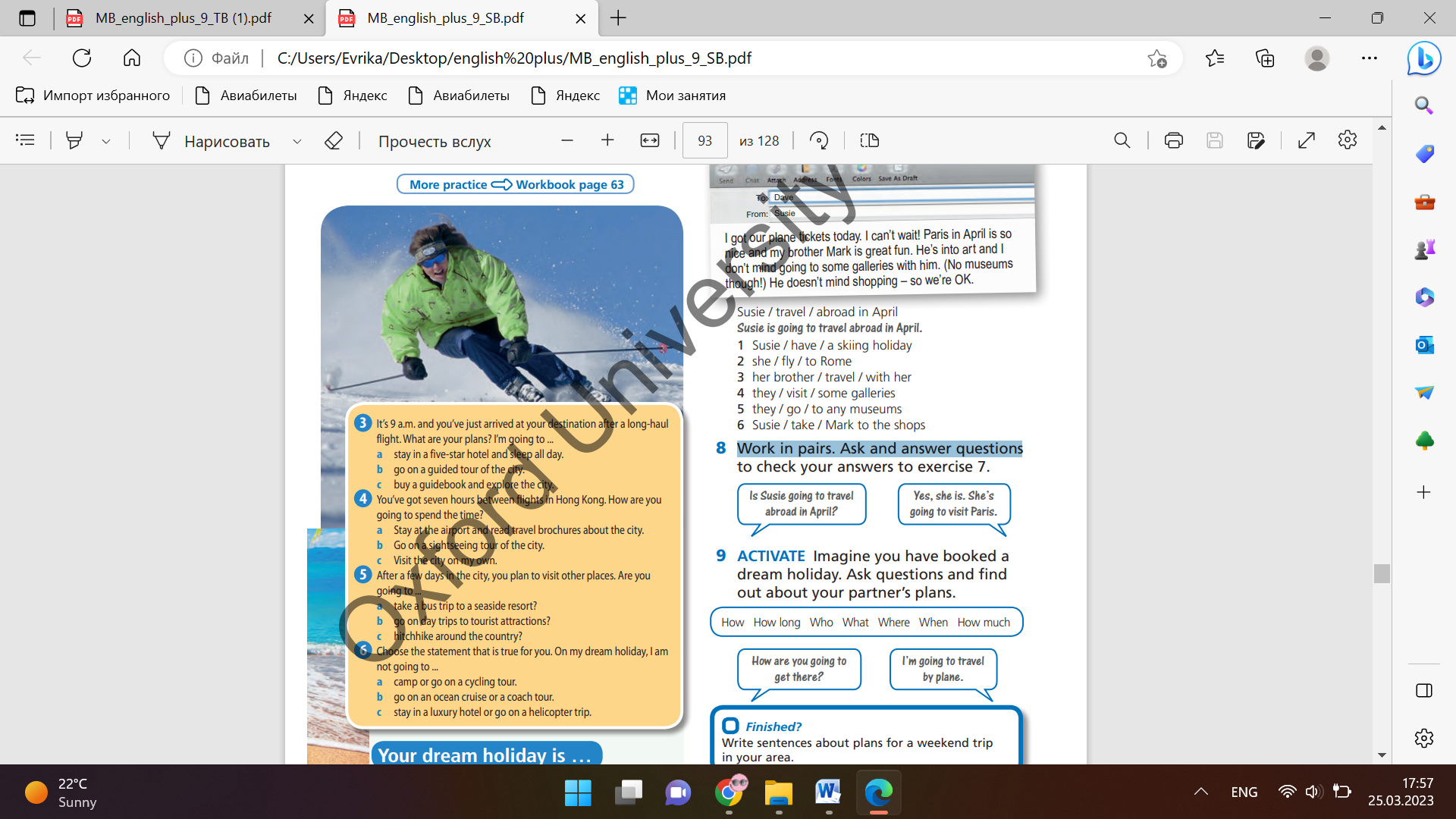
Ex: 5 P:93 • Ask students to read the quiz again and say if it refers to the past, present or future (the future). Ask: Does it talk about someone’s plans? (yes) • Ask students to identify the verb forms that are used to talk about plans, and complete the sentences Ex: 6 P:93 • In a weaker class, ask students to write their answers in pairs. In a stronger class, students write them individually. • Tell students to use the first listening to make notes. Give them time to write sentences, then play the CD again for any answers they missed or were unsure of. • Check answers as a class. Insist on full sentences Ex: 7 P:93 • Students work individually to read the email and complete the sentences. Ex: 8 P:88 • Read the example with the class. Check students know how to form the short answer. • Students ask and answer the rest of the questions
Conclusion during the lesson some tasks differentiated by outcomes of the students and by their abilities. |
Students complete the sentences from the quiz. Then choose two correct words to complete the rule Answers: 1 ’m going to 3 are, going to 2 ‘m not going to 4 Are, going to a intentions and c plan Students read Susie’s email. Then write affirmative and negative sentences using be going to Answers: 1 He’s going to spend one week there. 2 He’s going to travel with Charlie. 3 They are going to stay in a three-star hotel. 4 He’s going to swim in the pool. 5 He’s going to try diving. 6 They’re going to travel there by coach. travel there by coach . Students work in pairs. Ask and answer questions Answers: 1 Susie isn’t going to have a skiing holiday. 2 She isn’t going to fly to Rome. 3 Her brother is going to travel with her. 4 They’re going to visit some galleries 5 They aren’t going to go to any museums. 6 Susie is going to take Mark to the Students work in pairs. Ask and answer questions Answers: Students’ own answers |
Descriptor: - work in pairs - choose two correct words to complete the rule Total: 1 point Descriptor: - read Susie’s email - write affirmative and negative sentences using be going to Total: 1 point Descriptor: - work in pairs - answer the questions Total: 1 point Descriptor: - work in pairs - Ask and answer questions Total: 1 point |
Cards Worksheets |
|
End of the lesson 5 min |
FEEDBACK Learners provide feedback on what they have learned at the lesson. |
|
Students evaluate each other and encourage classmate with phrases like: Well done! Brilliant! |
Poster
|
Short term plan: term 4
|
Unit 8 Travel and tourism |
|
||
|
Teacher name: |
|
||
|
Date: |
|
||
|
Grade: 9 |
Number present: |
absent: |
|
|
Lesson title |
Holiday advice Talking about travelling |
||
|
Learning objectives |
9.2.5.1 recognize the attitude or opinion of the speaker(s) in unsupported extended talk on a wide range of general and curricular topics, including talk on a limited range of unfamiliar topics 9.4.8.1 use a wide range of familiar and unfamiliar paper and digital reference resources to 9.5.1.1 plan, write, edit and proofread work at text level independently on a range of general and curricular topics |
||
|
Lesson objectives |
Learners will be able to: • Read about good ideas for a holiday. • Read for general meaning and specific information. • Express your own opinions about holidays. • Learn about words which are often confused. • Practise using words which are often confused |
||
|
Value links |
Freedom: Freedom is the major value of the civil society being formed in Kazakhstan. This must provide everyone with the possibility of creative self-realization. |
||
|
Plan |
|||
|
Stages / Time |
Teachers’ actions |
Students’ actions |
Assessment criteria |
Resources |
|
Beginning of the lesson 5 min |
Organization moment 1.Greeting. Ask about the weather. The teacher sets the lesson objectives, letting students know what to anticipate from the lesson. Warm-up
Fasten your seat belts and get ready for the all-round race Lead – In • With books closed, ask: What do you usually take with you when you go on holiday? • Put students into pairs to write a list of things they take. • Elicit ideas from the class and write them on the board |
Students' attention is drawn to the lesson. Students discuss the pictures in pairs. Determines the topic and aim of the lesson Students say different words from the picture |
Formative Assessment
Good job! Assessment criteria -Identify detailed information in extended conversation with support |
Pictures Student’s book |
|
Middle of the lesson Presentation part. 35 min |
Ex: 1 P:94 • Look at the title and the headings together. Make sure everyone understands luggage and sports gear. Explain what chat means and establish that in this instance it refers to talking to people on holiday. • In a weaker class, prompt students by giving them some example advice and elicit whether they think it is good or not. Write on the board, e.g. Talk to everyone you meet. Use suncream. • Share ideas as a class. • In a stronger class, ask students to cover the text and listen to see if the same ideas are mentioned in the article Ex: 2 P:94 • Students read the text again and answer the questions individually. • Ask students to compare their answers in pairs before you check with the class Ex: 3 P:94 . • Explain that there are certain words which are easily confused. Tell students to look them up in their dictionaries. Encourage students to record the words with examples of how they are used, so that they can learn them in context. In a weaker class, give brief definitions of the words: a trip involves you going to a place and back again, and it is usually short (but there are exceptions, for example we say round-the-world trip); travel is the most general word and can be used as a noun or a verb; a journey is usually oneway and is more often used when the travelling takes a long time and is difficult; a voyage is a long journey, especially by sea or in space Conclusion during the lesson some tasks differentiated by outcomes of the students and by their abilities. |
Students look at the title and the headings in the text. What advice would you give someone about these things? Read, listen and compare your answers with the text Answers: Students’ own answers. Students read the text again and choose the correct answers Answers: 1 c 2 b 3 b 4 a 5 b 6 b Students check the meaning of the words in the box Answers: 1 journey 2 voyage 3 travel 4 trip 5 travel |
Descriptor: - work in pairs - read, listen and compare your answers with the text Total: 1 point Descriptor: - read the text again - answer the questions individually Total: 1 point Descriptor: - check the meaning of the words in the box Total: 1 point |
Cards Worksheets |
|
End of the lesson 5 min |
FEEDBACK Learners provide feedback on what they have learned at the lesson. |
|
Students evaluate each other and encourage classmate with phrases like: Well done! Brilliant! Good job! I like it! . |
Poster
|
Short term plan: term 4
|
Unit 8 Travel and tourism |
|
||
|
Teacher name: |
|
||
|
Date: |
|
||
|
Grade: 9 |
Number present: |
absent: |
|
|
Lesson title |
Language Focus: Will / to be going to |
||
|
Learning objectives |
9.3.4.1 respond with flexibility at both sentence and discourse level to unexpected comments on a range of general and curricular topics 9.4.7.1 recognize typical features at word, sentence and text level in a wide range of written genres, including some which focus on unfamiliar topics 9.5.3.1 write with grammatical accuracy on a range of familiar |
||
|
Lesson objectives |
Learners will be able to: • Learn the difference between will and be going to. • Practise using will and be going to to talk about predictions, plans and intentions. |
||
|
|
|
||
|
Plan |
|||
|
Stages / Time |
Teachers’ actions |
Students’ actions |
Assessment criteria |
Resources |
|
Beginning of the lesson 5 min |
Organization moment 1.Greeting. Ask about the weather. The teacher sets the lesson objectives, letting students know what to anticipate from the lesson. Warm-up
Fasten your seat belts and get ready for the all-round race Lead – In • Refer students back to the holiday advice text on page 94. Ask: Why shouldn’t you play your mp3 player? Elicit the answer You’ll annoy travel companions. and write it on the board • Write It’s raining. You’re going to get wet. on the board. Ask: Does this refer to the past, present or future? (the future) Does it describe a plan, or a prediction? (a prediction). Point out that this is another function of going to. |
Students' attention is drawn to the lesson. Students discuss the pictures in pairs. Determines the topic and aim of the lesson Students say different words from the picture |
Formative Assessment
Good job! Assessment criteria -Identify detailed information in extended conversation with support |
Pictures Student’s book |
|
Middle of the lesson Presentation part. 35 min |
Ex: 1 P:95 • Students work in pairs to complete the example sentences and the rules. • Check answers with the class. Elicit the examples students have found in the text. LANGUAGE NOTE Students
often overuse will to talk about the future, and so may use it
wrongly instead of going to to talk about plans or predictions
based on things we can see now: Ex: 2 P:95 • Before starting the exercise, you might like to check students are familiar with the negative form won’t by looking back at examples of will they found in the text. • Students work individually to complete the sentences, then they can check answers in pairs and decide which sentences are plans and which are predictions. • If your students need extra practice, you may want to do the activities on page 63 of the Workbook in class. Exercise 3 could be done individually or in pairs. Exercise 4 could be done orally in class. Ex: 3 P:95 • Focus on the example question and answer. Read the example with the class and elicit one or two more examples from the whole class. Check that students understand in my lifetime. • In a weaker class, allow students time to prepare some notes and questions individually, then ask and answer their questions in pairs. In a stronger class, encourage students to ask and answer spontaneously. • Ask some students to report back on similar and different predictions that they and their partner had. Conclusion during the lesson some tasks differentiated by outcomes of the students and by their abilities. |
Students complete the sentences. Then complete the rules with the correct form of will and be going to. Find more examples in the text Answers: 1 will 2 won’t 3 are going t 4 are, going to 5 are going Rules: 1 will 2 be going to 3 be going to Students complete the sentences with affirmative and negative forms of will and be going to. Which sentences are plans and which are predictions? Answers: 1 she won’t forget (prediction) 2 we aren’t going to have (plan) 3 Are you going to stay (plan) 4 You’re going to spill (prediction) 5 it will have (prediction) 6 we’re going to get (prediction) 7 they will build (prediction) Students complete the questions with will or be going to. Then ask and answer with a partner. Answers: 1 Will people have space holidays in my lifetime? 2 Is your family going to go camping in the holidays? 3 Is our class going to go on a day trip soon? 4 Are you going to visit the USA next year? 5 Are you going to travel around the world in a few years’ time? 6 Will you buy a private jet one day? 7 Will people travel to other planets soon? |
Descriptor: - work in pairs - complete the rules with the correct form Total: 1 point Descriptor: - work individually to complete the sentences - complete the sentences with affirmative and negative forms of will and be going to Total: 1 point Descriptor: - complete the questions with will or be going to. Total: 1 point
|
Cards Worksheets |
|
End of the lesson 5 min |
FEEDBACK Learners provide feedback on what they have learned at the lesson. |
|
Students evaluate each other and encourage classmate with phrases like: Well done! Brilliant! |
Poster
|
Short term plan: term 4
|
Unit 8 Travel and tourism |
|
||
|
Teacher name: |
|
||
|
Date: |
|
||
|
Grade: 9 |
Number present: |
absent: |
|
|
Lesson title |
Travel: verbs |
||
|
Learning objectives |
9.2.1.1 understand the main points in unsupported extended talk on a wide range of general and curricular topics, including talk on a limited range of unfamiliar topics 9.3.3.1 explain and justify their own and others’ point of view on a range of general and curricular topics 9.5.3.1 write with support factual descriptions at text level which describe people, places and objects |
||
|
Lesson objectives |
Learners will be able to: • Learn verbs to talk about travel. • Read a spaceship announcement. • Listen to a travel announcement about a trip into space. • Practise using travel verbs to talk about a trip to the moon. |
||
|
|
|
||
|
Plan |
|||
|
Stages / Time |
Teachers’ actions |
Students’ actions |
Assessment criteria |
Resources |
|
Beginning of the lesson 5 min |
Organization moment 1.Greeting. Ask about the weather. The teacher sets the lesson objectives, letting students know what to anticipate from the lesson. Warm-up
Fasten your seat belts and get ready for the all-round race Lead – In • Focus on the picture and elicit that it shows space travel. Elicit the words moon and planet. • Ask: Do you think more people will travel into space in the future? Do you think people will ever go on holiday to other planets? Elicit a range of ideas. |
Students' attention is drawn to the lesson. Students discuss the pictures in pairs. Determines the topic and aim of the lesson Students say different words from the picture |
Formative Assessment
Good job! Assessment criteria -Identify detailed information in extended conversation with support |
Pictures Student’s book |
|
Middle of the lesson Presentation part. 35 min |
Ex: 1 P:96 • Students use their dictionaries to check the meaning of the verbs and then complete the sentences. In a weaker class, remind them that they are looking for verbs, so for words like book and board, which have several meanings, they must make sure they get the right meaning. This can be useful dictionary skills practice Ex: 2 P:96 • Ask students to read the text through quickly. Ask: Where is the flight going to? (Jupiter) • Play the CD for students to listen and check their answers Ex: 3 P:96 • Tell students to read the options and think about the kind of announcement each person would make. Listen once and check answers. Ex: 4 P:96 • Put students into pairs to discuss the missing information. Elicit what types of words go in the gaps. In a stronger class, students can do both parts of the exercise before you check answers. • Play the CD again for students to listen and check their answers Conclusion during the lesson some tasks differentiated by outcomes of the students and by their abilities. |
Students check the meaning of the words in the box. Then complete the sentences. Answers: 1 fasten 2 set off 3 stop off 4 board 5 turn back 6 come across 7 book 8 check in Students read the spaceship announcement below and choose the correct words. Then listen and check your answers Answers: 1 takes off 2 boarding 3 fasten 4 stop off 5 come across 6 turn back Students listen to another announcement on board the Tourist Special to Jupiter. Who is making the announcement? Answers: c A tourist guide Students read the text and decide what type of information is missing. Then listen again and complete the text Answers: 1 six 2 September 3 moon base 4 Neil Armstrong museum 5 June 6 five 7 two 8 hours 9 aliens |
Descriptor: - use the dictionaries - check the meaning of the verbs Total: 1 point - Descriptor: - read the text by skimming - identify the spaceship Total: 1 point Descriptor: - read the options Total: 1 point Descriptor: -work in pairs - discuss the missing information Total: 1 point |
Cards Worksheets |
|
End of the lesson 5 min |
FEEDBACK Learners provide feedback on what they have learned at the lesson. |
|
Students evaluate each other and encourage classmate with phrases like: Well done! Brilliant! Good job! I like it! . |
Poster
|
Short term plan: term 4
|
Unit 8 Travel and tourism |
|
||
|
Teacher name: |
|
||
|
Date: |
|
||
|
Grade: 9 |
Number present: |
absent: |
|
|
Lesson title |
Present Simple and Continuous for future |
||
|
Learning objectives |
9.1.2.1 use speaking and listening skills to provide sensitive feedback to peers 9.3.7.1 use appropriate subject-specific vocabulary and syntax to talk about a limited range of general topics general and curricular topics 9.5.2.1 write with support a sequence of short sentences in a paragraph on a limited range of familiar general topics 9.6.3.1 use a growing variety of adjectives and regular and irregular comparative and superlative adjectives on a limited range of familiar general and curricular topics |
||
|
Lesson objectives |
Learners will be able to: • Learn the use of the present simple and present continuous to talk about the future. • Learn how to ask about times and timetables. • Practise talking about the future using the present simple and present continuous |
||
|
|
|
||
|
Plan |
|||
|
Stages / Time |
Teachers’ actions |
Students’ actions |
Assessment criteria |
Resources |
|
Beginning of the lesson 5 min |
Organization moment 1.Greeting. Ask about the weather. The teacher sets the lesson objectives, letting students know what to anticipate from the lesson. Warm-up Fasten your seat belts and get ready for the all-round race Lead – In • With books closed, conduct a quick review of the future forms that students have learnt. • If anyone mentions present continuous or present simple for future, include them in your discussion. If not, write two sentences on the board and elicit what time they refer to, past, present or future: The plane leaves at six o’clock this evening. I’m meeting Dave at the airport. Elicit the tenses of the underlined verbs (present simple and present continuous). Tell students they are going to learn about the use of these tenses to talk about the future |
Students' attention is drawn to the lesson. Students discuss the pictures in pairs. Determines the topic and aim of the lesson Students say different words from the picture |
Formative Assessment
Good job! Assessment criteria -Identify detailed information in extended conversation with support |
Pictures Student’s book |
|
Middle of the lesson Presentation part. 35 min |
Ex: 1 P:97 • Students copy and complete the rules. • Check answers with the class. Elicit situations in which we come across schedules and timetables. In a stronger class, remind students that we also use be going to for future plans. The difference is that the present continuous is used to talk about events that have been arranged, especially in the near future, at a specific time or on a particular day. Make sure students understand the difference between plan and arrangement. Ex: 2 P:97 • Read the key phrases with the class, and check that students understand them. • Focus on the timetable and elicit that it shows trains going from Birmingham to Liverpool, via Wolverhampton and Stockport. In a weaker class, check that students know how to say the times, e.g. seven nineteen, nine oh nine. • Students complete the dialogue. • Check answers with the class. Ex: 4 P:97 • Ask students to read the dialogue through quickly, ignoring the gaps. Ask: What’s Frank doing tomorrow? (playing football) • Students complete the dialogue. If necessary, read the rules again as a reminder Ex: 5 P:97 • Allow students to work in pairs to complete the questions. In a weaker class, talk them through and match the verbs to the questions before students work together to complete them with the correct tense. • Check answers Conclusion during the lesson some tasks differentiated by outcomes of the students and by their abilities. |
Students complete the rules with present simple or present continuous. Answers: 1 present simple 2 present continuous Students study the key phrases. Look at the timetable. Imagine that you are in Birmingham station and complete the dialogue Answers: 1 nineteen 4 direct 2 get in 5 change 3 9.09 6 Stockport Students complete the dialogue with the present simple or continuous form of the verbs in brackets. Then listen and check. Answers: 1 are you meetin 2 leaves 3 does the next one go 4 sets off 5 arrives 6 doesn’t start 7 Are you doingn 8 ’m going Students complete the questions about a weekend trip using the present simple or continuous form of the verbs in the box Answers: 1are, visiting 2 are, getting 3 are, leaving 4 does, take 5 do, arrive 6 Are, staying 7 are, seeing 8 are, eating |
Descriptor: - complete the rules with present simple or present continuous Total: 1 point Descriptor: - study the key phrases. - complete the dialogue Total: 1 point Descriptor: - complete the dialogue with the present simple or continuous Total: 1 point Descriptor: - complete the questions about a weekend trip using the present simple or continuous |
Cards Worksheets |
|
End of the lesson 5 min |
FEEDBACK Learners provide feedback on what they have learned at the lesson. |
|
Students evaluate each other and encourage classmate with phrases like: Well done! Brilliant! Good job! I like it! . |
Poster
|
Short term plan: term 4
|
Unit 8 Travel and tourism |
|
||
|
Teacher name: |
|
||
|
Date: |
|
||
|
Grade: 9 |
Number present: |
absent: |
|
|
Lesson title |
Asking for and giving information. |
||
|
Learning objectives |
9.3.3.1 explain and justify their own and others’ point of view on a range of general and curricular topics 9.2.6.1 deduce meaning from context in unsupported extended talk on a wide range of general and curricular topics, including talk on a limited range of unfamiliar topics 9.4.6.1 recognise the attitude or opinion of the writer in extended texts on a wide range of familiar general and curricular topics |
||
|
Lesson objectives |
Learners will be able to: • Listen to a conversation in which people ask for and give information. • Learn key phrases for asking for and giving information. • Learn the use of will for spontaneous decisions. • Practise asking for and giving information |
||
|
|
|
||
|
Plan |
|||
|
Stages / Time |
Teachers’ actions |
Students’ actions |
Assessment criteria |
Resources |
|
Beginning of the lesson 5 min |
Organization moment 1.Greeting. Ask about the weather. The teacher sets the lesson objectives, letting students know what to anticipate from the lesson. Warm-up
Fasten your seat belts and get ready for the all-round race Lead – In • With books closed, tell students to imagine they are on holiday in a place they don’t know. Elicit ideas for how they can find out what there is to do there, e.g. buy a guidebook, look on the internet, find posters and leaflets, go to the tourist information office. |
Students' attention is drawn to the lesson. Students discuss the pictures in pairs. Determines the topic and aim of the lesson Students say different words from the picture |
Formative Assessment
Good job! Assessment criteria -Identify detailed information in extended conversation with support |
Pictures Student’s book |
|
Middle of the lesson Presentation part. 35 min |
Ex: 1 P:98 • Focus on the photo. Elicit that Marie is in a tourist office and she is asking for information. • Ask: What do you think she is saying? Elicit some ideas, but don’t confirm or reject any at this stage. Ex: 2 P:98 • Students read and listen. Ask how much Marie has to pay. Ex: 3 P:98 • In a weaker class, students can find the phrases in the dialogue and complete them before listening to check. In a stronger class, encourage students to complete the key phrases from memory. • Students practise the dialogue in pairs Ex: 5 P:98 • Read through the situations with the class and make sure that students understand them. • Elicit a response to the first situation and then put students into pairs to write the responses and practise the dialogues • Monitor while students are working, and make sure they are using will for spontaneous decisions correctly. • Ask some pairs to perform some of their dialogues for the class Conclusion during the lesson some tasks differentiated by outcomes of the students and by their abilities. |
Students look at the photo. Where is Marie? What do you think she is asking? Answers: Students’ own answers Students listen to the dialogue. How much does Marie have to pay the assistant? Answers: Marie has to pay £8. Students complete the key phrases from the dialogue. Who says them? Listen and check. Then practise the dialogue with a partner Answers: 1 do (Assistant) 2 wondering (Marie) 3 you (Marie) 4 tell (Marie) 5 here (Assistant) 6 book (Marie) Students write responses using will and the verbs in brackets for situations. Then practise the dialogues in pairs. Answers: 1 I’ll carry it for you. 2 I’ll give you one. … 3 I’ll show you 4 I’ll phone him. 5 I’ll have |
Descriptor: - look at the photo and answer the question. Total: 1 point Descriptor: - read and listen to the dialogue Total: 1 point Descriptor: - complete the key phrases from the dialogue Total: 1 point Descriptor: - write responses using will and the verbs in brackets |
Cards Worksheets |
|
End of the lesson 5 min |
FEEDBACK Learners provide feedback on what they have learned at the lesson. |
|
Students evaluate each other and encourage classmate with phrases like: Well done! Brilliant! Good job! I like it! . |
Poster
|
Short term plan: term 4
|
Unit of a long term plan: Unit 8 Travel and tourism |
|
||
|
Teacher name: |
|
||
|
Date: |
|
||
|
Grade: 9 |
Number present: |
absent: |
|
|
Lesson title |
An email about a visit |
||
|
Learning objectives |
9.4.7.1 recognize typical features at word, sentence and text level in a limited range of written genres 9.5.1.1 plan, write, edit and proofread work at text level independently on a range of general and curricular topics 9.3.7.1 use appropriate subject-specific vocabulary and syntax to talk about a limited range of general topics and curricular topics |
||
|
Lesson objectives |
Learners will be able to: • Study a model email. • Learn key phrases for writing about plans for a visit. • Learn about linkers. • Write an email about plans for a visit. |
||
|
|
|
||
|
Plan |
|||
|
Stages / Time |
Teachers’ actions |
Students’ actions |
Assessment criteria |
Resources |
|
Beginning of the lesson 5 min |
Organization moment 1.Greeting. Ask about the weather. The teacher sets the lesson objectives, letting students know what to anticipate from the lesson. Warm-up
Fasten your seat belts and get ready for the all-round race Lead – In • With books closed, ask: What tourist attractions are there in your town / city? • Ask students if friends or relatives ever come from other places to stay. Ask: What do you take them to visit? |
Students' attention is drawn to the lesson. Students discuss the pictures in pairs. Determines the topic and aim of the lesson Students say different words from the picture |
Formative Assessment
Good job! Assessment criteria -Identify detailed information in extended conversation with support |
Pictures Student’s book |
|
Middle of the lesson Presentation part. 35 min |
Ex: 1 P:99 • Allow students to check their answers in pairs before checking answers with the class. Ex: 2 P:99 • Encourage students to complete the key phrases from memory. In a weaker class, allow students to find the phrases in the text and complete them Ex: 3 P:99 • Focus on the words in the box. Ask students to find examples of the words in the text in exercise 1. • In a weaker class, if students are struggling to understand, ask: Which word gives a reason? (because) Which gives a result? (so) Which adds more information? (and) Which gives a contrast? (but) Which gives two alternatives? (either … or). In a stronger class, encourage students to explain the reasons for their choices, and to say why the other options were not suitable. Ex: 4 P:99 • Students think and plan their emails individually. This can be set for homework. • Tell students to check their work to make sure they have started and finished their emails correctly, and used linkers and future forms correctly. • Use correction codes rather than writing corrections on students’ work (for more details on codes to use, see page 37, exercise 4). Conclusion during the lesson some tasks differentiated by outcomes of the students and by their abilities. |
Students read the model text and answer the questions. Answers: 1 c 2 They’re doing a bus tour. 3 They could meet friends, walk around town or go to a museum. 4 They could go on a day trip by bus or train. 5 He wants her to remind him when her train gets in Students complete the key phrases. Then look at the model text and check Answers: 1 just 2 be 3 up 4 expect 5 could 6 remind Students find the words in the box in the model text. Then complete sentences. Which words express a choice? Answers: 1 either, or 2 but 3 because 4 so 5 and either ... or and and express choice Students follow the steps in the writing guide Answers: Students’ own answers |
Descriptor: - read the model text Total: 1 point Descriptor: - complete the key phrases Total: 1 point Descriptor: - find the words in the box Total: 1 point Descriptor: - use the writing guide |
Cards Worksheets |
|
End of the lesson 5 min |
FEEDBACK Learners provide feedback on what they have learned at the lesson. |
|
Students evaluate each other and encourage classmate with phrases like: Well done! Brilliant! Good job! I like it! . |
Poster
|
Short term plan: term 4
|
Unit 8 Travel and tourism |
|
||
|
Teacher name: |
|
||
|
Date: |
|
||
|
Grade: 9 |
Number present: |
absent: |
|
|
Lesson title |
My Country. Travel and tourism |
||
|
Learning objectives |
9.3.7.1 use appropriate subject-specific vocabulary and syntax to talk about a limited range of general topics and curricular topics 9.4.5.1 deduce meaning from context in extended texts on a wide range of familiar general and curricular topics, and some unfamiliar topics 9.5.3.1 write with grammatical accuracy on a range of familiar general and curricular topics |
||
|
Lesson objectives |
Learners will be able to: • Read texts about reasons to visit Kazakhstan. • Understand what topic each text is talking about. • Learn vocabulary to describe new sights and places. • Write texts for tourists visiting students’ hometown. |
||
|
|
|
||
|
Plan |
|||
|
Stages / Time |
Teachers’ actions |
Students’ actions |
Assessment criteria |
Resources |
|
Beginning of the lesson 5 min |
Organization moment 1.Greeting. Ask about the weather. The teacher sets the lesson objectives, letting students know what to anticipate from the lesson. Warm-up
Fasten your seat belts and get ready for the all-round race Lead – In • In pairs, students think about what places and sights they would promote to tourists coming to Kazakhstan. • Tell them to think of eight items. • Encourage students to share their ideas with the class and get a consensus of the most popular attractions. |
Students' attention is drawn to the lesson. Students discuss the pictures in pairs. Determines the topic and aim of the lesson Students say different words from the picture |
Formative Assessment
Good job! Assessment criteria -Identify detailed information in extended conversation with support |
Pictures Student’s book |
|
Middle of the lesson Presentation part. 35 min |
Ex: 1 P:100 • Give out dictionaries if necessary. • Draw students’ attention to the words in the box. Ask which words they know the meanings of. • Tell students to scan the text to find the words and find the context of the sentence and see if they can guess the meaning. • They should then match them to words 1–6 and check the meaning in their dictionaries. • Students check answers in pairs. • Check the answers as a class Ex: 2 P:100 • Give students a minute to read the headings. • In a stronger class, you might want students to listen without reading and match the headings to the texts they hear (1–10). • Play the recording. Students check their answers in pairs. • Check answers as a class. • Do students agree with the selection of reasons Ex: 3 P:100 • Draw students’ attention to the words in blue in the text. • Elicit which of the words are added to sentences to express certainty and which to express that you are not sure. Ex: 5 P:100 • Students. • Allow them to check in pairs, before you check answers as a class Conclusion during the lesson some tasks differentiated by outcomes of the students and by their abilities. |
Students check the meaning of these words in a dictionary. Match them with definitions Answers: 1 ancient 2 quirky 3 major 4 hospitable 5 vast 6 rare Students read and listen to the travel brochure. Match headings with paragraphs Answers: 1 D 2 H 3 F 4 A 5 C 6 I 7 E 8 J 9 B 10 G Students look at the adverbs in blue in the travel brochure. Which adverbs do we use to say we are sure about something? Which ones do we use to say we are not sure? Answers: certainty: definitely, certainly uncertainty: perhaps, probably, maybe Students put the words in the correct order to make sentences. Answers: 1 Maybe we will go camping this weekend. 2 I will definitely book the flights. 3 Perhaps the weather will be better next week. 4 He will certainly win the match. 5 I probably won’t go on holiday this year |
Descriptor: - scan the text to find the words - match them with definitions Total: 1 poin Descriptor: - read and listen to the travel brochure Total: 1 point Descriptor: - use adverbs to say they are sure about something Total: 1 point Descriptor: - work individually to put the sentences in the correct order |
Cards Worksheets |
|
End of the lesson 5 min |
FEEDBACK Learners provide feedback on what they have learned at the lesson. |
|
Students evaluate each other and encourage classmate with phrases like: Well done! Brilliant! Good job! I like it! . |
Poster
|
Short term plan: term 4
|
Unit 8 Travel and tourism |
|||
|
Teacher;s name: |
|
||
|
Date: 17.04.23 |
|||
|
Grade: 9 |
|||
|
Lesson title |
CLIL. Community service. Volunteer holidays |
||
|
Learning objectives |
9.4.6.1 recognize the attitude or opinion of the writer in extended texts on a wide range of familiar general and curricular topics 9.1.4.1 evaluate and respond constructively to feedback from others 9.3.5.1 keep interaction going in basic exchanges on a growing range of general and curricular topics |
||
|
Lesson objectives |
Learners will be able to: • Read about volunteer tourism. • Talk about volunteer work in your country. • Plan and present a volunteer holiday |
||
|
Plan |
|||
|
Stages / Time |
Teachers’ actions |
Students’ actions |
Assessment criteria |
Resources |
|
Beginning of the lesson 5 min |
Organization moment 1.Greeting. Ask about the weather. The teacher sets the lesson objectives, letting students know what to anticipate from the lesson. Warm-up
Fasten your seat belts and get ready for the all-round race Lead – In • With books closed, ask students: Do you go on holiday with your family? Where do you go? What do you do? Elicit a range of answers, encouraging as many students as possible to contribute. • Ask students to think of the possible benefits of tourism to an area, and any negative aspects |
Students' attention is drawn to the lesson. Students discuss the pictures in pairs. Determines the topic and aim of the lesson Students say different words from the picture |
Formative Assessment
Good job! Assessment criteria -Identify detailed information in extended conversation with support |
Pictures Student’s book |
|
Middle of the lesson Presentation part. 35 min |
Ex: 1 P:101 • In a weaker class, brainstorm vocabulary for things in the photos, and write it on the board. Then ask students to make sentences using the vocabulary. In a stronger class, encourage students to describe what they can see, but also to speculate and interpret the pictures. Ask the question and share ideas as a class. Ex: 2 P:101 • Students read and listen to the text and check their guesses from exercise 1 Ex: 3 P:101 In a weaker class, accept shorter answers and direct quotations. In a stronger class, encourage students to give full, complete answers and paraphrase them, rather than simply reading from the text. Ex: 4 P:101 • In a weaker class, do the whole task together, encouraging as many students as possible to contribute to the discussion. Conclusion during the lesson some tasks differentiated by outcomes of the students and by their abilities. |
Students look at the photos. Where are the people and what are they doing? Answers: Students’ own answers. Students read and listen to the text. What is voluntourism? Why is it becoming popular? Answers: Voluntourism means ‘volunteer tourism’. It’s a new type of adventure travel which involves doing volunteer work while you’re on holiday. It’s popular with people wanting a different kind of holiday Students read the text again and answer the questions. Answers: 1 Students or skilled workers, e.g. nurses, used to do volunteer work abroad. 2 Volunteer projects can now be short-term and are organized like holidays 3 Child volunteers can do simple things like cleaning beaches, planting trees or spending time working with local children. 4 Voluntourism can be good for young people because it helps them to learn important values and put into perspective things which they find difficult in their lives, like homework and housework 5 Volunteers hope to help communities by bringing in money and by helping with development projects. 6 Critics say that some voluntourists lack skills and the time to properly understand the problems faced by local people. They may also be taking away work from local people and could be bad for the economy Students answer the questions. Answers: Students’ own answers. |
Descriptor: - make sentences using the vocabulary Total: 1 point Descriptor: - read and listen to the text Total: 1 point Descriptor: - answer the questions. Total: 1 point Descriptor: - contribute to the discussion Total: 1 point |
Cards Worksheets |
|
End of the lesson 5 min |
FEEDBACK Learners provide feedback on what they have learned at the lesson. |
|
Students evaluate each other and encourage classmate with phrases like: Well done! Brilliant! |
Poster
|
Short term plan: term 4
|
Unit 8 Travel and tourism |
|||
|
Teacher’s name: |
|
||
|
Date: |
|
||
|
Grade: 9 |
Number present: |
absent: |
|
|
Lesson title |
Review. Unit 8 Summative assessment for the unit «Travel and Tourism» |
||
|
Learning objectives |
9.3.3.1 give an opinion at sentence level on a limited range of general and curricular topics 9.4.5.1 deduce meaning from context in short texts on a limited range of familiar general and curricular topics 9.2.2.1 Understand most specific information in unsupported extended talk on a wide range of general and curricular topics 9.3.7.1 Use appropriate subject-specific vocabulary and syntax to talk about an increased range of general and curricular topics |
||
|
Lesson objectives |
Learners will be able to: -Use compound nouns associated with travel -Use about words which are often confused |
||
|
Plan |
|||
|
Stages / Time |
Teachers’ actions |
Students’ actions |
Assessment criteria |
Resources |
|
Beginning of the lesson 5 min |
Organization moment 1.Greeting. Ask about the weather. The teacher sets the lesson objectives, letting students know what to anticipate from the lesson. Warm-up
Fasten your seat belts and get ready for the all-round race Lead – In • With books closed, ask students: Do you go on holiday with your family? Where do you go? What do you do? Elicit a range of answers, encouraging as many students as possible to contribute. • Ask students to think of the possible benefits of tourism to an area, and any negative aspects |
Students' attention is drawn to the lesson. Students discuss the pictures in pairs. Determines the topic and aim of the lesson Students say different words from the picture |
Formative Assessment
Good job! Assessment criteria -Identify detailed information in extended conversation with support |
Pictures Student’s book |
|
Middle of the lesson Presentation part. 35 min |
Ex: 1 P:102 • ask students to complete the compound nouns with the words in the box. Check their answers in pairs and write them individually. Ex: 2 P:101 • Ask students to read the example sentences and choose the correct words. Write good examples Summative assessment for the unit «Travel and Tourism» Listening Task 1. Listen and complete the gaps with the correct place from the box. CD2. Tapescript 4. Speaking Task 2. Choose ONE card and answer the questions. You have 1 minute to prepare and 1-2 minutes to talk about it to your partner. Your partner will assess your speaking using the following criteria: Conclusion during the lesson some tasks differentiated by outcomes of the students and by their abilities. |
Students complete the compound nouns with the words in the box. Answers: 1 travel agent 2 guidebook 3 long-haul flight 4 mosquito net 5 climbing equipment 6 five-star hotel 7 ocean cruise 8 coach tour Students choose the correct words Answers: 1 lend 2 journey 3 wear 4 voyage 5 saw 6 spent Students listen and complete the gaps Answers: 1 Cambridge 2 Manchester 3 Oxford 4 Exexter 5 London Students choose ONE card and answer the question Answers: Students’ own answers. |
Descriptor: -complete the compound nouns with the words in the box Total: 1 point Descriptor: - choose the correct words Total: 1 point Descriptor: - Identify specific information in extended talks Total: 1 point |
Cards Worksheets |
|
End of the lesson 5 min |
FEEDBACK Learners provide feedback on what they have learned at the lesson. |
|
Students evaluate each other and encourage classmate with phrases like: Well done! Brilliant! |
Poster
|
Short term plan: term 4
|
Unit 8 Travel and tourism |
|||
|
Teacher’s name: |
|
||
|
Date: |
|
||
|
Grade: 9 |
Number present: |
absent: |
|
|
Lesson title |
Skills Round – up. Welcome – Unit 8 |
||
|
Learning objectives |
9.2.4.1 understand the main points of supported extended talk on a range of general and curricular topics 9.4.5.1 deduce meaning from context in short texts on a limited range of familiar general and curricular topics 9.6.17.1 use if / if only in third conditional structures |
||
|
Lesson objectives |
Learners will be able to: -Listen types of holiday -Talk about planning of holiday. |
||
|
Plan |
|||
|
Stages / Time |
Teachers’ actions |
Students’ actions |
Assessment criteria |
Resources |
|
Beginning of the lesson 5 min |
Organization moment 1.Greeting. Ask about the weather. The teacher sets the lesson objectives, letting students know what to anticipate from the lesson. Warm-up
Fasten your seat belts and get ready for the all-round race Lead – In • With books closed, ask students to think back to the dream holiday quiz at the beginning of Unit 8. What type of holiday did it recommend for them? Elicit a few examples. Ask students whether they think the results were right. Do they enjoy that kind of holiday? • Ask: What is your dream holiday? Where would you go? What would you do? Allow students to discuss their ideas in pairs for a minute before sharing answers as a class |
Students' attention is drawn to the lesson. Students discuss the pictures in pairs. Determines the topic and aim of the lesson Students say different words from the picture |
Formative Assessment
Good job! Assessment criteria -Identify detailed information in extended conversation with support |
Pictures Student’s book |
|
Middle of the lesson Presentation part. 35 min |
Ex: 1 P:103 • Focus students on the photos and elicit what they show (surfing, safari, sightseeing, river cruise). Were any of them mentioned in the warm-up? • Read the questions with the class, and put students into pairs to discuss their answers. • Share answers as a class. Ex: 2 P:103 • Tell students they are going to listen to some people talking about a recent holiday. • They should listen and find the answers to the questions. Check answers with the class. Ex: 3 P:103 • Tell students to read the sentences carefully and prepare to listen again. In a weaker class, go through the sentences and elicit the information that students need to listen for to complete each sentence. Tell students to look at the sentence and decide what type of word goes in the gap, e.g. a day, a number, a place, etc. • Students listen again. Allow them to check their answers in pairs before checking answers as a class. Ex: 4 P:103 • In a weaker class, do the whole task together, encouraging as many students as possible to contribute to the discussion. Conclusion during the lesson some tasks differentiated by outcomes of the students and by their abilities. |
Students look at the photos and answer the questions. Answers: Students’ own answers. Students listen to a conversation. Where has Annie been? Where is Jack planning to go in August? Answers: Annie has been to Kenya. Jack is going to Italy in August Students listen again and complete the sentences. Answers: 1 Saturday 2 safari 3 food 4 nets 5 two 6 Max 7 Rome 8 camping Students Work in pairs and prepare a conversation. Answer the questions. Answers: Students’ own answers. |
Descriptor: - look at the photos and answer the questions. Total: 1 point Descriptor: - listen to a conversation Descriptor: - read the sentences carefully - complete the sentences Total: 1 point Descriptor: - prepare a conversation Total: 1 point |
Cards Worksheets |
|
End of the lesson 5 min |
FEEDBACK Learners provide feedback on what they have learned at the lesson. |
|
Students evaluate each other and encourage classmate with phrases like: Well done! Brilliant! |
Poster
|
Short term plan: term 4
|
Unit 9 Science and technology |
|||
|
Teacher’s name: |
|
||
|
Date: |
|||
|
Grade: 9 |
Number present: |
absent: |
|
|
Lesson title |
A day in cyberspace |
||
|
Learning objectives |
9.3.1.1 provide basic information about themselves and others at sentence level on an increasing range of general topics 9.3.3.1 give an opinion at sentence level on a limited range of general and curricular topics 9.1.3.1 respect differing points of view |
||
|
Lesson objectives |
Learners will be able to: • Learn vocabulary to talk about being online. • Read a text about someone’s morning routine online. |
||
|
Plan |
|||
|
Stages / Time |
Teachers’ actions |
Students’ actions |
Assessment criteria |
Resources |
|
Beginning of the lesson 5 min |
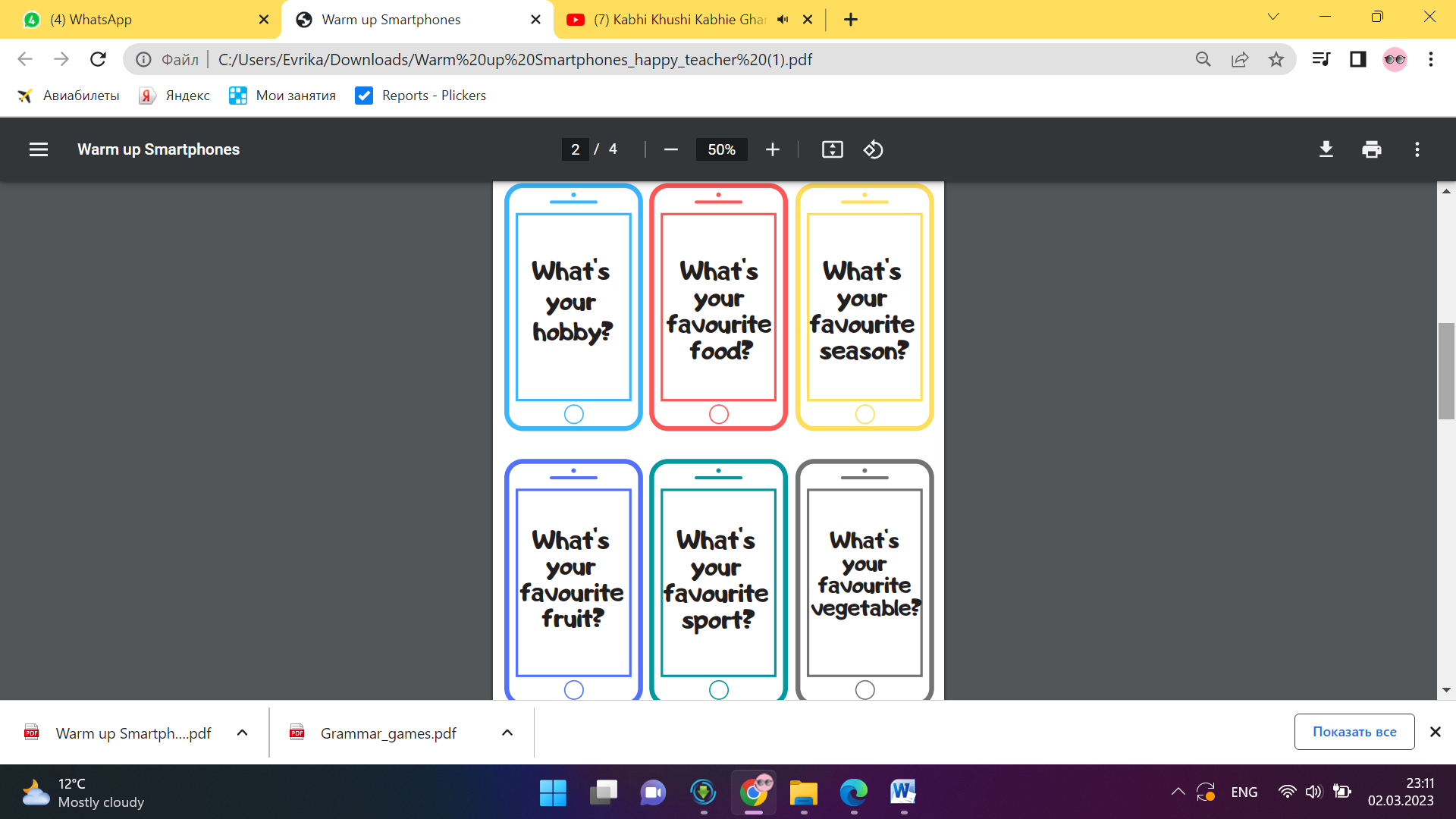
Organization moment 1.Greeting. Ask about the weather. The teacher sets the lesson objectives, letting students know what to anticipate from the lesson. Warm-up Method speaking phone was used to develop speaking skills.
Lead – In • Ask students how their lives would be different if they didn’t have social media to communicate with friends. Would they talk to their friends less or more? • Students discuss the questions in pairs before opening the discussion to the class |
Students' attention is drawn to the lesson. Students discuss the pictures in pairs. Determines the topic and aim of the lesson Students say different words from the picture |
Formative Assessment
Good job! Assessment criteria -Identify detailed information in extended conversation with support |
Pictures Student’s book |
|
Middle of the lesson Presentation part. 35 min |
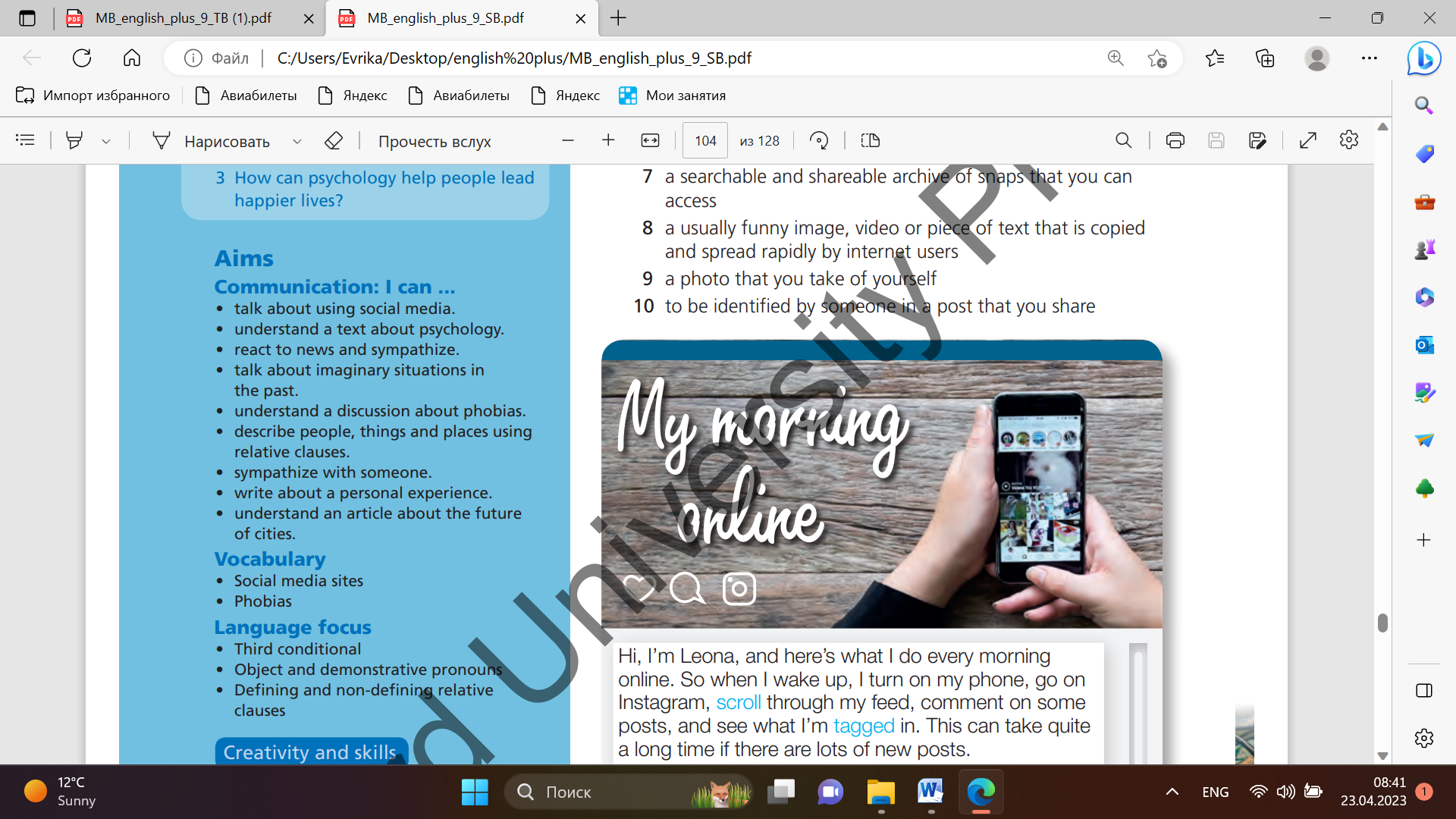
Ex: 1 P:104 • Students read the text and in pairs discuss the similarities and differences in their morning routines. • Does anyone have a routine like Leona’s? • Focus students’ attention on the words in blue. Students work individually to match the words to the definitions. • Students check in pairs, then check the answers as a class
Ex: 2 P:104 • Students study the text again and find the verbs and prepositions. • Check answers as a class. Ex: 3 P:104 • Students look at the sentences and the text again to see where the object of the sentence is put in relation to the preposition with the verbs in exercise 2. • Students work in pairs to complete the rules. • Check the answers as a class Conclusion during the lesson some tasks differentiated by outcomes of the students and by their abilities. |
Students read My morning online. How similar is Leona’s morning to yours? Match the words in blue with definitions 1–10. Answers: 1 streak 2 subscriptions 3 DM 4 scroll 5 poll 6 log out 7 memories 8 memes 9 selfie 10 tagged Students match the verbs and prepositions from My morning online. Answers: 1 wake up 2 go on 3 scroll through 4 comment on 5 tag on 6 post (something) on 7 look at 8 turn (something) on / off 9 open (something) up 10 log in / out Students study the sentences. Then complete the rules. Answers: 1 between 2 after 3 before |
Descriptor: - read the text - match the words in blue with definitions Total: 1 point Descriptor: - read the text again - match the verbs and prepositions Total: 1 point Descriptor: - work in pairs - complete the rules Total: 1 point |
Cards Worksheets |
|
End of the lesson 5 min |
FEEDBACK Learners provide feedback on what they have learned at the lesson. |
|
Students evaluate each other and encourage classmate with phrases like: Well done! Brilliant! |
Poster
|
Short term plan: term 4
|
Unit 9 Science and technology |
|||
|
Teacher’s name |
|
||
|
Date: |
|||
|
Grade: 9 |
|||
|
Lesson title |
Verbs and prepositions. |
||
|
Learning objectives |
9.3.1.1 provide basic information about themselves and others at sentence level on an increasing range of general topics 9.6.8.1 use a variety of future active and passive and future continuous forms range of familiar general and curricular topics 9.1.3.1 respect differing points of view |
||
|
Lesson objectives |
Learners will be able to: • Learn how to use verbs and prepositions. • Practise using verbs and prepositions |
||
|
Plan |
|||
|
Stages / Time |
Teachers’ actions |
Students’ actions |
Assessment criteria |
Resources |
|
Beginning of the lesson 5 min |
Organization moment 1.Greeting. Ask about the weather. The teacher sets the lesson objectives, letting students know what to anticipate from the lesson. Warm-up Method speaking phone was used to develop speaking skills.
Lead – In • Ask students how their lives would be different if they didn’t have social media to communicate with friends. Would they talk to their friends less or more? • Students discuss the questions in pairs before opening the discussion to the class |
Students' attention is drawn to the lesson. Students discuss the pictures in pairs. Determines the topic and aim of the lesson Students say different words from the picture |
Formative Assessment
Good job! Assessment criteria -Identify detailed information in extended conversation with support |
Pictures Student’s book |
|
Middle of the lesson Presentation part. 35 min |
Ex: 4 P:105 • Students work individually to complete the sentences. • Allow students to check in pairs then check answers a a class LANGUAGE NOTE Students often want to know how they can tell where the object goes relative to the verb and preposition. Unfortunately, there is no way of knowing from looking at it. Students will have to learn the pattern of each verb. Ex: 5 P:105 • Students look at the beginnings of sentences 1−6 and think of how they can complete them. If possible, they should use the language in the text, but if they don’t use social media much, they can answer them in other ways. • When students have finished they compare their answers with their partners. They can do this by taking turns to listen to their partner read their sentences aloud and saying what they do after each one. • They could also read their partner’s sentences first and look for any errors, before giving the statements back for their partner to read out Finished? • If there are any fast finishers, they write a few sentences on the advantages and disadvantages of using social media. • In a stronger class, students can work individually. • You may want to give this exercise to the whole class as homework and use it for a discussion in a future lesson Conclusion during the lesson some tasks differentiated by outcomes of the students and by their abilities. |
Students complete the sentences with the verbs and prepositions in the box. Answers: 1 posted, on 2 through 3 on 4 opened 5 commented 6 at 7 turned on 8 wake 9 on Students complete the sentences with your own ideas. Work in pairs and compare your answers with a partner. Answers: Students’ own answers Finished? Write sentences about the benefits and problems with using social media One of the good things about social media is feeling part of a group. |
Descriptor: - work individually - complete the sentences Total: 1 point Descriptor: - work in pairs - complete the sentences with your own ideas Total: 1 point |
Cards Worksheets |
|
End of the lesson 5 min |
FEEDBACK Learners provide feedback on what they have learned at the lesson. |
|
Students evaluate each other and encourage classmate with phrases like: Well done! Brilliant! |
Poster
|
Short term plan: term 4
|
Unit 9 Science and technology |
|||
|
Teacher’s name: |
|
||
|
Date: |
|||
|
Grade: 9 |
Number present: |
absent: |
|
|
Lesson title |
The psychology of "Yes". |
||
|
Learning objectives |
9.1.1.1 use speaking and listening skills to solve problems creatively and cooperatively in groups 9.2.3.1 understand the detail of an argument in unsupported extended talk on a wide range of general and curricular topics, including talk on a limited range of unfamiliar topics 9.6.8.1 use a variety of future active and passive and future continuous forms range of familiar general and curricular topics |
||
|
Lesson objectives |
Learners will be able to: • Read about the Yes Man. • Read for general meaning and specific information. • Express your own opinions on being positive. • Learn about antonyms. |
||
|
Plan |
|||
|
Stages / Time |
Teachers’ actions |
Students’ actions |
Assessment criteria |
Resources |
|
Beginning of the lesson 5 min |
Organization moment 1.Greeting. Ask about the weather. The teacher sets the lesson objectives, letting students know what to anticipate from the lesson. Warm-up Method speaking phone was used to develop speaking skills.
Lead – In • With books closed, write yes and no on the board. Ask: Which word do you say more – yes or no? Elicit some ideas. • Ask: Do you think your life would be different if you always said ‘yes’? How? Would the consequences be good or bad? Elicit a range of ideas. |
Students' attention is drawn to the lesson. Students discuss the pictures in pairs. Determines the topic and aim of the lesson Students say different words from the picture |
Formative Assessment
Good job! Assessment criteria -Identify detailed information in extended conversation with support |
Pictures Student’s book |
|
Middle of the lesson Presentation part. 35 min |
Ex: 1 P:106 • Look at the title and the images and elicit students’ predictions about the text. Ask students to justify their answers. Remind them that scanning the title and photos is a useful strategy when preparing to read Background Danny Wallace is a British film maker, comedian, writer and TV presenter. His book Yes Man was published in 2005 and describes how he spent six months saying ‘yes’ where normally he would have said ‘no’, to make his life more interesting and positive. The book has now been turned into a successful film Ex: 2 P:106 • In a weaker class, encourage students to underline the parts of the text where they find the answers, so that they can refer to them quickly and check they have understood correctly. • In a stronger class, encourage students to give detailed answers. Remind them not to copy the text for their answers, but to paraphrase the meaning. Ex: 3 P:106 • Ask students to complete the summary individually, then compare their answers in pairs and discuss any differences. Ex: 4 P:106 • Elicit that an antonym is a word with an opposite meaning. Check that students understand by writing some simple adjectives on the board (e.g. big, hot) and eliciting the antonyms (small, cold). • Students find the antonyms in the text. In a weaker class, you could ask students to translate the words into their own language. Then encourage them to use the words in example sentences. In a stronger class, ask students to contextualize the words in sentences directly Conclusion during the lesson some tasks differentiated by outcomes of the students and by their abilities. |
Students look at the title of the text and the photos. What do you think the text is about? Read and listen to the text and check your answer. Descriptor: - read and listen to the text Students read the text again and answer the questions. Descriptor: - read the text again - answer the questions Students complete the summary with six of the words in the box. Descriptor: - complete the summary individually Students find antonyms in the text for 1–6. Descriptor: - find antonyms |
-can read and listen to the text Total: 1 point Answers: Students’ own answers. - can answer the questions Total: 1 point Answers: 1 You spend less time thinking about what’s wrong with your life. 2 He spent his free time at home. 3 By texting or phoning them. 4 People without passion always say ‘no’. 5 Because the man’s philosophy interested him. 6 Because he needed change. 7 Because he realized that being optimistic and generous could make a difference to his life. 8 Six months -can complete the summary Total: 1 point Answers: 1 pessimistic 2 a stranger 3 advice 4 positive 5 generous 6 interesting -can find antonyms Total: 1 point Answers: 1 refused 2 simple 3 wealthier 4 generosity 5 unfortunately 6 dul |
Cards Worksheets |
|
End of the lesson 5 min |
FEEDBACK Learners provide feedback on what they have learned at the lesson. |
|
Students evaluate each other and encourage classmate with phrases like: Well done! Brilliant! |
Poster
|
Short term plan: term 4
|
Unit 9 Science and technology |
|||
|
Teacher’s name: |
|
||
|
Date: |
|||
|
Grade: 9 |
Number present: |
absent: |
|
|
Lesson title |
Language Focus. Third conditional. |
||
|
Learning objectives |
9.1.7.1 develop and sustain a consistent argument when speaking or writing 9.2.2.1 understand specific information in unsupported extended talk on a wide range of general and curricular topics, including talk on a limited range of unfamiliar topics 9.6.17.1 use if / if only in third conditional structures |
||
|
Lesson objectives |
Learners will be able to: • Learn the third conditional. • Practise using the third conditional to talk about unreal situations in the past. |
||
|
Plan |
|||
|
Stages / Time |
Teachers’ actions |
Students’ actions |
Assessment criteria |
Resources |
|
Beginning of the lesson 5 min |
Organization moment 1.Greeting. Ask about the weather. The teacher sets the lesson objectives, letting students know what to anticipate from the lesson. Warm-up Method speaking phone was used to develop speaking skills.
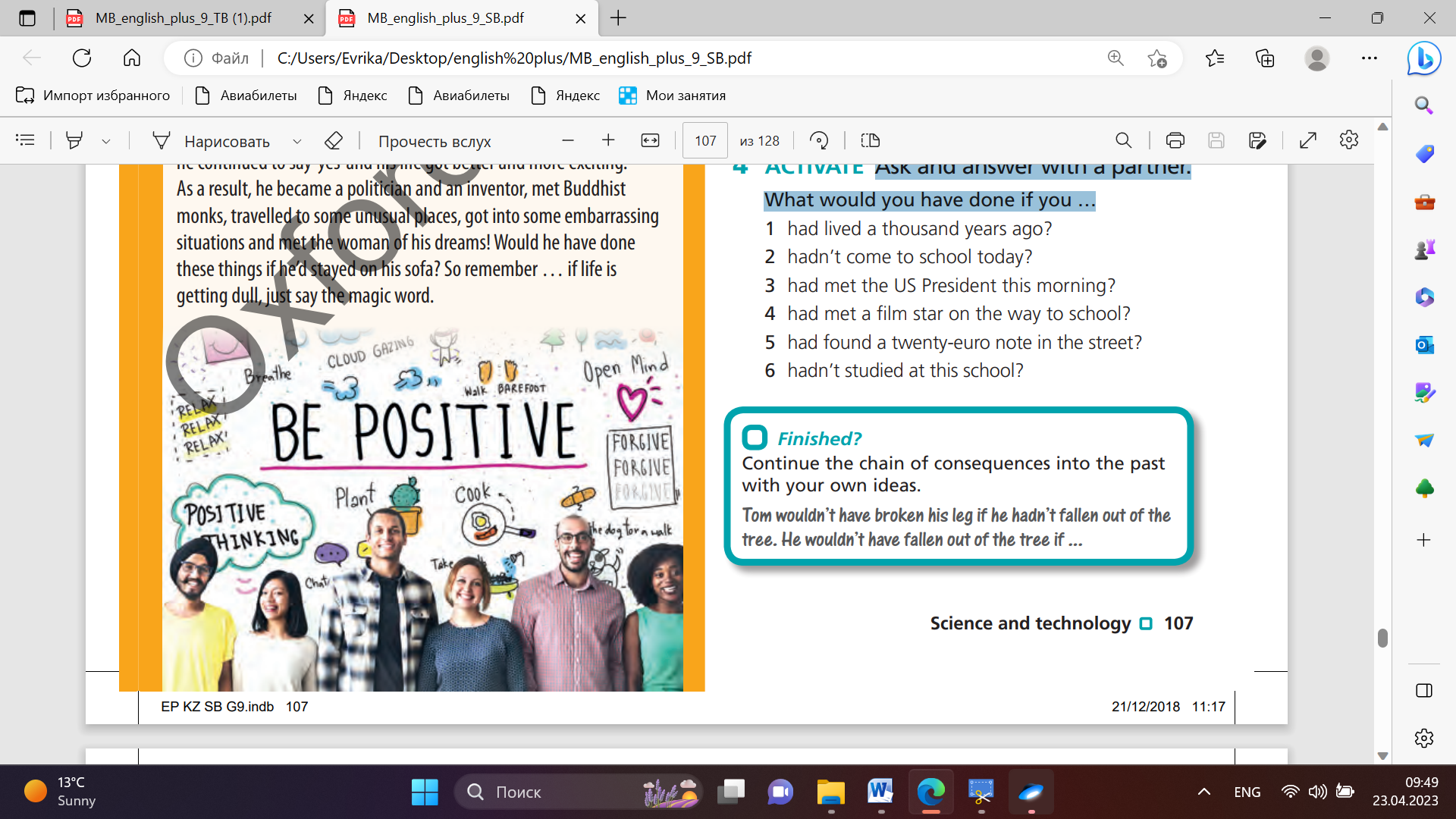
Lead – In • Refer students back to the text on the Yes Man. Ask: What was the day that changed Danny’s life? What happened? Elicit that Danny got on a bus and met a mystery man. • Ask: What if he’d been ill that day? What if he’d stayed at home? Elicit some ideas and then write on the board: If he’d stayed at home, he wouldn’t have met the man. • Ask: Does the sentence refer to the past, present, or future? (the past). Ask: Did it happen or not? (it didn’t happen) • Tell students that this is a third conditional sentence and that we use it to talk about unreal past situations. |
Students' attention is drawn to the lesson. Students discuss the pictures in pairs. Determines the topic and aim of the lesson Students say different words from the picture |
Formative Assessment
Good job! Assessment criteria -Identify detailed information in extended conversation with support |
Pictures Student’s book |
|
Middle of the lesson Presentation part. 35 min |
Ex: 1 P:107 • In a stronger class, encourage students to complete the sentences from memory. • Check answers with the class. Remind students that each conditional sentence consists of two clauses: a condition clause (also called ‘if clause’) and a result clause. LANGUAGE NOTE Students
often make the mistake of using would have in both clauses of third
conditional sentences: If I had stayed at home, I wouldn’t have met
the man. NOT Ex: 2 P:107 • Do the first sentence with the class as an example. , • In a weaker class, allow students to check answers in pairs before checking as a class Conclusion during the lesson some tasks differentiated by outcomes of the students and by their abilities. |
Students complete the sentences from the text. Then choose the correct words in the rules Answers: 1 ‘d / would have 2 wouldn’t have 3 hadn’t 4 wouldn’t have 5 ’d / had Rules 1 past 2 had, past participle Students complete the third conditional sentences. Answers: 1 wouldn’t have met, ‘d / had stayed 2 would be, had got 3 hadn’t said, wouldn’t have known 4 Would, have been, had worked 5 had asked, would have helped 6 Would, have gone, ‘d / had known |
Descriptor: - complete the sentences Total: 1 point Descriptor: - complete the third conditional sentences. Total: 1 point |
Cards Worksheets |
|
End of the lesson 5 min |
FEEDBACK Learners provide feedback on what they have learned at the lesson. |
|
Students evaluate each other and encourage classmate with phrases like: Well done! Brilliant! |
Poster
|
Short term plan: term 4
|
Unit 9 Science and technology |
|||
|
Teacher’s name: |
|
||
|
Date: 04.05.23 |
|||
|
Grade: 9 |
Number present: |
absent: |
|
|
Lesson title |
Language Focus. Third conditional. |
||
|
Learning objectives |
9.1.7.1 develop and sustain a consistent argument when speaking or writing 9.2.2.1 understand specific information in unsupported extended talk on a wide range of general and curricular topics, including talk on a limited range of unfamiliar topics 9.6.17.1 use if / if only in third conditional structures |
||
|
Lesson objectives |
Learners will be able to: • Learn the third conditional. • Practise using the third conditional to talk about unreal situations in the past. |
||
|
Plan |
|||
|
Stages / Time |
Teachers’ actions |
Students’ actions |
Assessment criteria |
Resources |
|
Beginning of the lesson 5 min |
Organization moment 1.Greeting. Ask about the weather. The teacher sets the lesson objectives, letting students know what to anticipate from the lesson. Warm-up Method speaking phone was used to develop speaking skills.
Lead – In • Refer students back to the text on the Yes Man. Ask: What was the day that changed Danny’s life? What happened? Elicit that Danny got on a bus and met a mystery man. • Ask: What if he’d been ill that day? What if he’d stayed at home? Elicit some ideas and then write on the board: If he’d stayed at home, he wouldn’t have met the man. • Ask: Does the sentence refer to the past, present, or future? (the past). Ask: Did it happen or not? (it didn’t happen) • Tell students that this is a third conditional sentence and that we use it to talk about unreal past situations. |
Students' attention is drawn to the lesson. Students discuss the pictures in pairs. Determines the topic and aim of the lesson Students say different words from the picture |
Formative Assessment
Good job! Assessment criteria -Identify detailed information in extended conversation with support |
Pictures Student’s book |
|
Middle of the lesson Presentation part. 35 min |
Ex: 3 P:107 • Read the example with the class. Ask students to underline the verbs in the two sentences. • Point out that the if clause can come either at the beginning or the end of the sentence (e.g. If Hayley hadn’t been tired, she would have gone. = Hayley would have gone if she hadn’t been tired.) Remind students to use a comma when the if clause comes first. Ex: 4 P:107 • In a weaker class, allow students time to prepare some notes individually, then put them into pairs to read their sentences to each other and compare their answers. • In a stronger class, encourage students to ask and answer spontaneously
Conclusion during the lesson some tasks differentiated by outcomes of the students and by their abilities. |
Students rewrite the sentences using the third conditional. Include the words in brackets. Then listen and check. Answers: 1 If John hadn’t felt moody, he would have gone to the party. 2 They wouldn’t have respected the captain if he hadn’t played well. 3 I would have seen you if I had been there. 4 The team wouldn’t have been pessimistic if they hadn’t lost last week. 5 If he hadn’t met his girlfriend, he wouldn’t have given up smoking. 6 He would have been optimistic about passing his exams if he ‘d / had revised more. 7 If she hadn’t had a positive attitude, she wouldn’t have been very successful Students Ask and answer with a partner. What would you have done if you … Answers: Students’ own answers |
Descriptor: - rewrite the sentences using the third conditional Total: 1 point Descriptor: - ask and answer with a partner Total: 1 point |
Cards Worksheets |
|
End of the lesson 5 min |
FEEDBACK Learners provide feedback on what they have learned at the lesson. |
|
Students evaluate each other and encourage classmate with phrases like: Well done! Brilliant! |
Poster
|
Short term plan: term 4
|
Unit 9 Science and technology |
|||
|
Teacher’s name: |
|
||
|
Date: |
|||
|
Grade: 9 |
Number present: |
absent: |
|
|
Lesson title |
Phobias. Discussion about phobias |
||
|
Learning objectives |
9.3.7.1 use appropriate subject-specific vocabulary and syntax to talk about a limited range of general topics 9.4.7.1 recognize typical features at word, sentence and text level in a limited range of written genres 9.5.1.1 plan, write, edit and proofread work at text level with support on a limited range of general and curricular topics |
||
|
Lesson objectives |
Learners will be able to: • Learn words for expressing feelings. • Learn how to understand dictionary entries. • Listen to a radio programme about phobias. • Complete a personal profile |
||
|
Plan |
|||
|
Stages / Time |
Teachers’ actions |
Students’ actions |
Assessment criteria |
Resources |
|
Beginning of the lesson 5 min |
Organization moment 1.Greeting. Ask about the weather. The teacher sets the lesson objectives, letting students know what to anticipate from the lesson. Warm-up Method speaking phone was used to develop speaking skills.
Lead – In • With books closed, write the word phobia on the board and elicit its meaning. If necessary, explain that a phobia is a strong, unreasonable fear of something. • Elicit examples of phobias from the class and find out if anyone suffers from a phobia. Ask students how a phobia makes the sufferer feel and brainstorm words for feelings |
Students' attention is drawn to the lesson. Students discuss the pictures in pairs. Determines the topic and aim of the lesson Students say different words from the picture |
Formative Assessment
Good job! Assessment criteria -Identify detailed information in extended conversation with support |
Pictures Student’s book |
|
Middle of the lesson Presentation part. 35 min |
Ex: 1 P:108 • Read the instructions together and check that everyone understands abbreviation. Ex: 2 P:108 • Ask volunteers to read out the three example sentences in the dictionary entry. • Check that everyone understands what a suffix is, and elicit the two adjective suffixes -ed and -ing. • In a weaker class, give more examples with -ed and -ing adjectives, e.g. They’re bored because the film is boring. They’re confused because the instructions are confusing. Ask: How do they feel? (bored, confused) What is the reason for the feeling? (the film is boring, the instructions are confusing) Ex: 3 P:108 • Make sure everyone understands that the words in the box are verbs. Students must convert them to adjectives. Elicit how they will do this (by adding suffixes). • Students complete the adjective columns. Allow them to work in pairs to look up the noun forms in a dictionary. Remind them to use the abbreviations to help them use the dictionary entries Ex: 4 P:108 • Draw students’ attention to the All about me … profile and ask them to look at the photos. Elicit what they show (a plane, a spider, a snake, a high cliff ). • Tell students they are going to listen to a radio programme about phobias. Ask them to prepare by deciding what phobias the photos represent. • Ask students to listen for which of the things in the photos are mentioned. In a stronger class, ask students to name as many phobias as possible (snakes, flying, heights, small spaces, crowds) Conclusion during the lesson some tasks differentiated by outcomes of the students and by their abilities. |
Students look at the dictionary entry and find the abbreviations for the words in the box. Which phrases in the entry are definitions? Answers: verb – v; somebody – sb; adjective – adj; noun – n Definitions: a sudden feeling of fear, to make sb afraid, afraid, causing fear Students study example sentences in the dictionary entry and match them with adjectives. What are two adjective suffixes? Answers: a 3 b 1 c 2 The two adjective suffixes are -ed and –ing Students complete the table. Make adjectives using the verbs in the box. Then use a dictionary to find the nouns Answers: snakes, flying, heights Students listen to a radio programme about phobias. Which of the things in the photos do the speakers mention? |
Descriptor: - read the instructions - find the abbreviations Total: 1 point Descriptor: - work in pairs - match them with adjectives Total: 1 point - Descriptor: - complete the table. - make adjectives using the verbs Total: 1 point
Descriptor: - listen to a radio programme - name as many phobias as possible Total: 1 point |
Cards Worksheets |
|
End of the lesson 5 min |
FEEDBACK Learners provide feedback on what they have learned at the lesson. |
|
Students evaluate each other and encourage classmate with phrases like: Well done! Brilliant! |
Poster
|
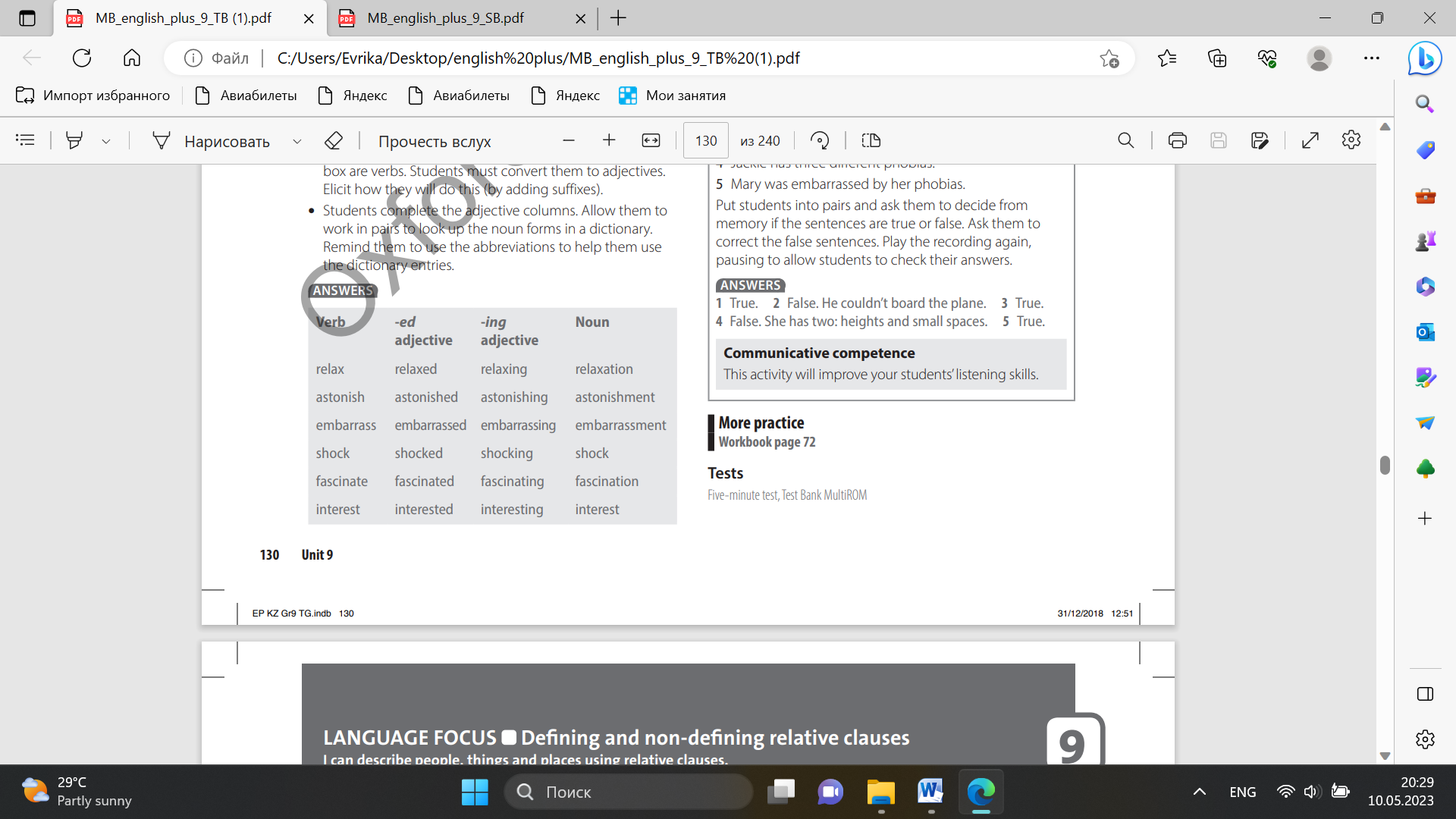
Short term plan: term 4
|
Unit 9 Science and technology |
|
||
|
Teacher’s name: |
|
||
|
Date: |
|||
|
Grade: 9 |
Number present: |
absent: |
|
|
Lesson title |
Language Focus. Defining relative clauses |
||
|
Learning objectives |
9.2.4.1 understand implied meaning in unsupported extended talk on a wide range of general and curricular topics, including talk on a limited range of unfamiliar topics 9.3.8.1 recount extended stories and events on a wide range of general and curricular topics 9.4.3.1 understand the detail of an argument- both explicitly stated and implied - in extended texts on a wide range of familiar general and curricular topics, and some unfamiliar topics |
||
|
Lesson objectives |
Learners will be able to: • Learn about defining and non-defining relative clauses . • Practise using defining and non-defining relative clauses. |
||
|
Plan |
|||
|
Stages / Time |
Teachers’ actions |
Students’ actions |
Assessment criteria |
Resources |
|
Beginning of the lesson 5 min |
Organization moment 1.Greeting. Ask about the weather. The teacher sets the lesson objectives, letting students know what to anticipate from the lesson. Warm-up Method speaking phone was used to develop speaking skills. Lead – In • With books closed, write on the board: What do you remember about the man? Ask students whether they know which man you are talking about. (no) • Now ask students what they remember about the ‘Yes Man’ from the reading text on page 106. Ask: What do you remember about the man who said ‘Yes’ to everything? Elicit some answers and then write the question on the board. Underline the relative clause. • Ask students to look at the two questions and discuss the function of the relative clause. Establish it adds information, so we know which man the question is about |
Students' attention is drawn to the lesson. Students discuss the pictures in pairs. Determines the topic and aim of the lesson Students say different words from the picture |
Formative Assessment
Good job! Assessment criteria -Identify detailed information in extended conversation with support |
Pictures Student’s book |
|
Middle of the lesson Presentation part. 35 min |
Ex: 1 P:109 • Put students into pairs to study the rules and find examples in the text on page 108 Ex: 2 P:109 • Talk through the example, drawing attention to the photo. Establish that the sentence is about a man, and elicit the relative pronouns that can be used in the relative clause (who or that). Ex: 3 P:109 • Look at the chart and ask a volunteer to read the example. Make sure everyone understands how to use the chart. • Students make sentences and explain them to a partner. In a weaker class, they can write the sentences out in full before talking in pairs. In a stronger class, encourage students to make notes rather than writing their answers in full. • Ask a few students to share their sentences with the class.
Conclusion during the lesson some tasks differentiated by outcomes of the students and by their abilities. |
Students read the rules and find examples for each rule in the All about me profile on page 108. Answers: 1 Sentences 1, 2, 4, 5, 6, 9, 10 2 Sentences .3, 8 3 Sentence 7 4 Sentence 2 Students join the sentence halves with where, who, whose and which. Answers: 2 where many high-tech companies are located. 3 which helps you generate and remember passwords? 4 where I can buy smartphone screens? 5 who fixed my hard drive problem. 6 (which) I do far too much of . 7 whose software I often use Students make sentences using the phrases in the chart. Then explain your ideas to a partner Answers: Students’ own answers. |
Descriptor: - read the rules - find examples for each rule Total: 1 point Descriptor: - join the sentence halves with where, who, whose and which. Total: 1 point Descriptor: - make sentences using the phrases Total: 1 point |
Cards Worksheets |
|
End of the lesson 5 min |
FEEDBACK Learners provide feedback on what they have learned at the lesson. |
|
Students evaluate each other and encourage classmate with phrases like: Well done! Brilliant! |
Poster
|
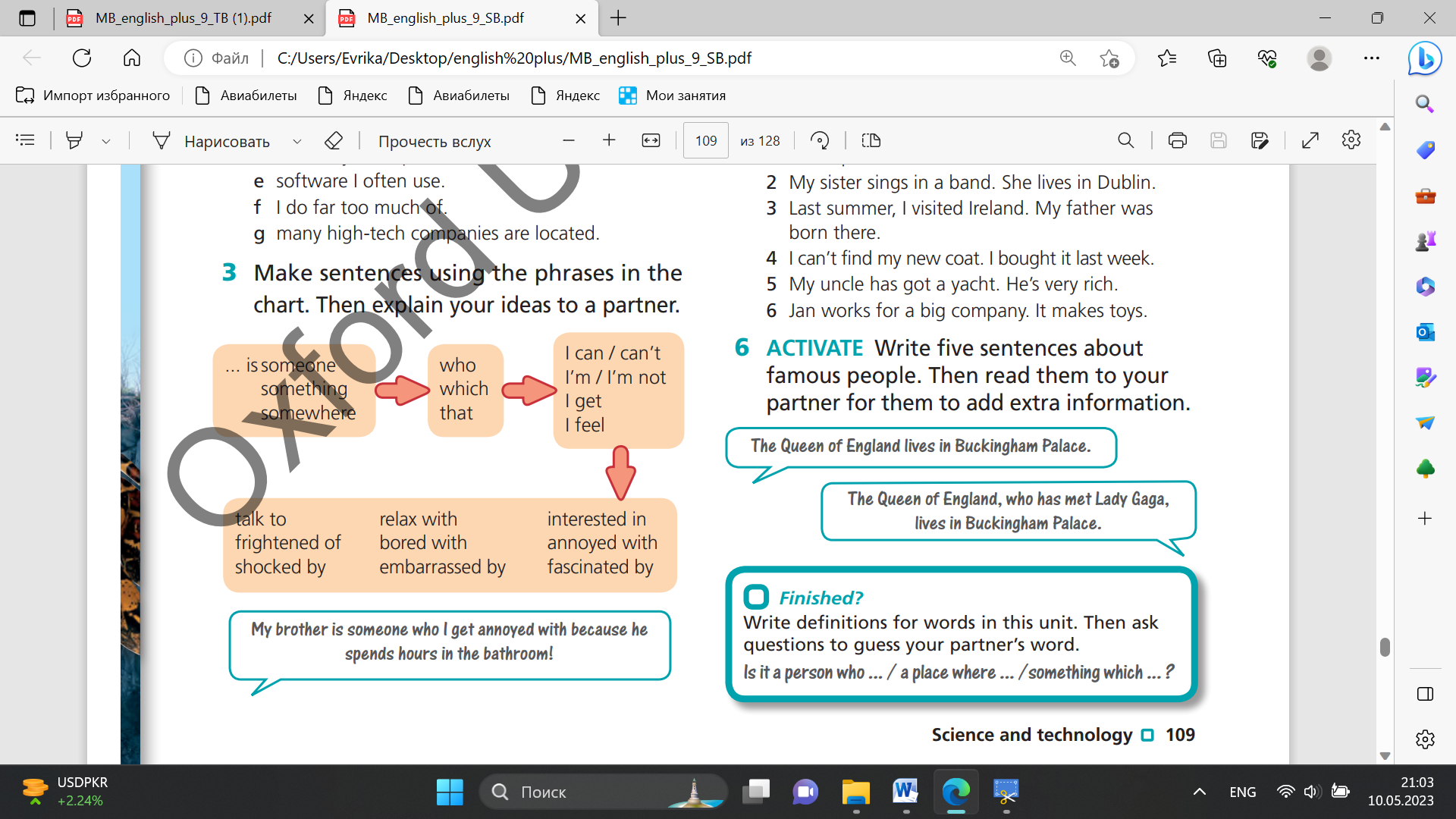
Short term plan: term 4
|
Unit 9 Science and technology |
|||
|
Teacher’s name: |
|
||
|
Date: |
|||
|
Grade: 9 |
Number present: |
absent: |
|
|
Lesson title |
Language Focus. Non - defining relative clauses. Summative assessment for the unit «Science and Technology» |
||
|
Learning objectives |
9.2.5.1 recognize the attitude or opinion of the speaker(s) in unsupported extended talk on a wide range of general and curricular topics, including talk on a limited range of unfamiliar topics 9.3.8.1 recount extended stories and events on a wide range of |
||
|
Lesson objectives |
Learners will be able to: • Learn about defining and non-defining relative clauses . • Practise using defining and non-defining relative clauses. |
||
|
Plan |
|||
|
Stages / Time |
Teachers’ actions |
Students’ actions |
Assessment criteria |
Resources |
|
Beginning of the lesson 5 min |
Organization moment 1.Greeting. Ask about the weather. The teacher sets the lesson objectives, letting students know what to anticipate from the lesson. Warm-up Method speaking phone was used to develop speaking skills.
Lead – In • With books closed, write on the board: What do you remember about the man? Ask students whether they know which man you are talking about. (no) • Now ask students what they remember about the ‘Yes Man’ from the reading text on page 106. Ask: What do you remember about the man who said ‘Yes’ to everything? Elicit some answers and then write the question on the board. Underline the relative clause. |
Students' attention is drawn to the lesson. Students discuss the pictures in pairs. Determines the topic and aim of the lesson Students say different words from the picture |
Formative Assessment
Good job! Assessment criteria -Identify detailed information in extended conversation with support |
Pictures Student’s book |
|
Middle of the lesson Presentation part. 35 min |
Ex: 4 P:109 • Draw students’ attention to the subheading. Point out that they have just learnt about defining relative clauses, and now they are going to learn about non-defining relative clauses. Ask them to think about what the difference might be. Allow them to compare ideas in pairs. • Check answers and ask students to explain the difference between clauses in their own words. Ex: 5 P:109 • Read the example with the class. Write the sentence on the board and draw attention to the pronouns and the punctuation. Rub out the relative clause and ask: Does the sentences still make sense? (yes) • In a weaker class, allow students to work in pairs to combine the sentences. Check answers as a class Summative assessment for the unit «Science and Technology» Reading Task 1. Read the text. Identify what we should and should not do when we search something on the Internet. Write Do if you should and Don`t if you shouldn`t do the actions in statements 1-6. Task 2. Paraphrase the given sentences so it has similar meaning. Use the given beginnings of sentences. Example, Several keywords will help to find better results. Better results_______________________. Answer, Better results can be found by using several keywords. Writing Task 2. Write an essay on the following topic: Do you think modern technology has made life easier and safer? Or do you think that modern technology has made life more difficult and more dangerous? What are the advantages and disadvantages of modern technologies? Conclusion during the lesson some tasks differentiated by outcomes of the students and by their abilities. |
Students study the sentences from the listening. Match sentences with rules. Answers: 1 who is from London University 2 who’ve had similar problems 3 where there are a lot of people 4 where I had a meeting 5 whose job includes travelling Rules: a 2, 3 b 1, 4, 5 Students combine the two sentences to make one sentence. Answers: 1 Marc, whose dad comes from Paris, speaks French. 2 My sister, who lives in Dublin, sings in a band. / My sister, who sings in a band, lives in Dublin. 3 Last summer I visited Ireland, where my father was born. 4 I can’t find my new coat, which I bought last week. 5 My uncle, who is very rich, has got a yacht. / My uncle, who has got a yacht, is very rich. 6 Jan works for a big company, which makes toys Students read the text. . Identify what they should and should not do when they search something on the Internet Answers: Students’ own answers. Students Write an essay on the following topic: Answers: Students’ own answers. |
Descriptor: - draw students’ attention to the subheading - match sentences with rules Total: 1 point Descriptor: - read the example - use a non-defining relative clause with who, which, where and whose Total: 1 point Descriptor: - read the text. Total: 6 point Descriptor: - write an essay Total: 6 point |
Cards Worksheets |
|
End of the lesson 5 min |
FEEDBACK Learners provide feedback on what they have learned at the lesson. |
|
Students evaluate each other and encourage classmate with phrases like:Well done!Brilliant! |
Poster
|
Short term plan: term 4
|
Unit 9 Science and technology |
|||
|
Teacher’s name: |
|
||
|
Date: |
|||
|
Grade: 9 |
Number present: |
absent: |
|
|
Lesson title |
Reacting to news and sympathizing |
||
|
Learning objectives |
9.1.7.1 develop and sustain a consistent argument when speaking or writing 9.2.3.1 understand the detail of an argument in unsupported extended talk on a wide range of general and curricular topics, including talk on a limited range of unfamiliar topics 9.6.17.1 use if / if only in third conditional structures |
||
|
Lesson objectives |
Learners will be able to: • Listen to a conversation in which someone reacts to news and sympathizes with a friend. • Learn key phrases for sympathizing. • Practise listening for detail. • Practise reacting to new and sympathizing with someone. |
||
|
Plan |
|||
|
Stages / Time |
Teachers’ actions |
Students’ actions |
Assessment criteria |
Resources |
|
Beginning of the lesson 5 min |
Organization moment 1.Greeting. Ask about the weather. The teacher sets the lesson objectives, letting students know what to anticipate from the lesson. Warm-up Method speaking phone was used to develop speaking skills.
Lead – In • With books closed, write on the board: A problem shared is a problem halved. Tell students this is an English proverb and ask them what they think it means. Accept suggestions and establish that talking about a problem can help us feel better about it. • Ask students who they talk to when they are feeling upset or worried. |
Students' attention is drawn to the lesson. Students discuss the pictures in pairs. Determines the topic and aim of the lesson Students say different words from the picture |
Formative Assessment
Good job! Assessment criteria -Identify detailed information in extended conversation with support |
Pictures Student’s book |
|
Middle of the lesson Presentation part. 35 min |
Ex: 1 P:110 • Focus on the photo. Ask: What are Marie and Dean doing? How do you think Marie is feeling? Elicit that they are chatting and Marie doesn’t look very happy. Ex: 2 P:110 • Play the CD. Students read and listen. • Elicit the answer to the question Ex: 3 P:110 • In a weaker class, students can find the key phrases in the dialogue and complete them before listening to check. In a stronger class, encourage students to complete the key phrases from memory. • Remind students to listen carefully to the intonation of the key phrases, and to try to convey the same emotion when they practise the dialogue. Ex: 4 P:110 • Allow students time to read the sentences. • Play the CD twice if necessary. Conclusion during the lesson some tasks differentiated by outcomes of the students and by their abilities. |
Students look at the photo. How do you think Marie is feeling? Choose the correct answer. Answers: b Students listen to the dialogue. Is Dean optimistic or pessimistic about Marie’s situation? Answers: Dean is optimistic Students complete the key phrases from the dialogue. Listen and check. Then practise the dialogue with a partner Answers: 1 look 2 hear 3 end 4 badly 5 this 6 up Students listen. Which words do you hear? Answers: 1 weren’t 2 won’t 3 have been 4 stayed 5 wouldn’t |
Descriptor: - look at the photo. - choose the correct answer Total: 1 point Descriptor: - listen to the dialogue - answer to the question Total: 1 point Descriptor: - complete the key phrases - practise the dialogue Total: 1 point , Descriptor: - read the sentences. Total: 1 point |
Cards Worksheets |
|
End of the lesson 5 min |
FEEDBACK Learners provide feedback on what they have learned at the lesson. |
|
Students evaluate each other and encourage classmate with phrases like: Well done! Brilliant! |
Poster
|
Short term plan: term 4
|
Unit 9 Science and technology |
|||
|
Teacher’s name: |
|
||
|
Date: |
|||
|
Grade: 9 |
Number present: |
absent: |
|
|
Lesson title |
Writing: An experience. |
||
|
Learning objectives |
9.2.4.1 understand implied meaning in unsupported extended talk on a wide range of general and curricular topics, including talk on a limited range of unfamiliar topics 9.4.5.1 deduce meaning from context in extended texts on a wide range of familiar general and curricular topics, and some unfamiliar topics 9.5.1.1 plan, write, edit and proofread work at text level with minimal teacher support on a range of general and curricular topics |
||
|
Lesson objectives |
Learners will be able to: • Study a model text. • Learn key phrases for writing about a personal experience.. • Learn about modifying comparatives. • Write about an experience |
||
|
Plan |
|||
|
Stages / Time |
Teachers’ actions |
Students’ actions |
Assessment criteria |
Resources |
|
Beginning of the lesson 5 min |
Organization moment 1.Greeting. Ask about the weather. The teacher sets the lesson objectives, letting students know what to anticipate from the lesson. Warm-up Method speaking phone was used to develop speaking skills.
Lead – In • With books closed, write robotics on the board. Elicit the meaning (designing and operating robots). • Ask whether anyone has experience of robotics, or elicit jobs that are carried out by robots |
Students' attention is drawn to the lesson. Students discuss the pictures in pairs. Determines the topic and aim of the lesson Students say different words from the picture |
Formative Assessment
Good job! Assessment criteria -Identify detailed information in extended conversation with support |
Pictures Student’s book |
|
Middle of the lesson Presentation part. 35 min |
Ex: 1 P:111 • Ask students to look at the title and photos and make predictions about text content. Elicit some ideas. • Students compare their answers in pairs. Ex: 2 P:111 • In a weaker class, students can find the phrases in the dialogue. In a stronger class, encourage students to put the key phrases in order from memory. Ex: 3 P:111 • Elicit that a modifier is a word or expression that makes the meaning of an adjective or adverb stronger or not so strong. • Ask students to identify the adjectives in the sentences (more positive, happier, more optimistic, harder, stressful). Elicit that they are all comparative forms. • Students write the words in the correct order to make sentences. Ask students to identify the modifiers (a bit, much, a lot, slightly, a little, less). Ex: 4 P:111 • Students think and plan their stories individually. This can be set for homework. • Use correction codes rather than writing corrections on students’ work (for more details on codes to use, see page 37, exercise 4). Allow students time to correct the mistakes themselves, using the codes. Conclusion during the lesson some tasks differentiated by outcomes of the students and by their abilities. |
Students read the model text and answer the questions Descriptor: -read the model tex. - answer the questions Students study the key phrases. Put the key phrases in the order of the text. Then check your answers Descriptor: - study the key phrases - put the key phrases in the order Students study the examples. Then order the words Descriptor: - study the examples - order the words Students follow the steps in the writing guide |
-can answer the questions Total: 1 point Answers: 1 Failing a science exam 2 Paragraph 2 3 He won a robotics competition. 4 He felt more useful and sociable. 5 Paragraph 3 -can put the key phrases in the order Total: 1 point Answers: Things weren’t going too well for me. Everything changed for me … … made me realize that … These days, I feel … If I hadn’t …, I’d never have … -can order the words Total: 1 point Answers: 1 Peter was a lot more optimistic . 2 Can you work slightly harder? 3 I’m feeling a bit happier. 4 Please behave a little more respectfully. 5 Life should be much less stressful. |
Cards Worksheets |
|
End of the lesson 5 min |
FEEDBACK Learners provide feedback on what they have learned at the lesson. |
|
Students evaluate each other and encourage classmate with phrases like: Well done! Brilliant! |
Poster
|
Short term plan: term 4
|
Unit 9 Science and technology |
School: |
||
|
Date: |
Teacher name: |
||
|
Grade: 9 |
Number present: |
absent: |
|
|
Lesson title |
Summative Control work for the 4th term. |
||
|
Learning objectives |
9.2.3.1 Understand most of the detail of an argument in unsupported extended talk on a wide range of general and curricular topics 9.4.5.1 Deduce meaning from context in extended texts on a range of familiar general and curricular topics 9.5.7.1 Use independently appropriate layout at text level on a growing range of general and curricular topics 9.3.8.1 Recount extended stories and events on a range of general and curricular topics |
||
|
Lesson objectives |
Learners will be able to: -identify language style, tone and voice of the speaker - compile personal vocabulary lists -use different points of view and roles retelling stories and events |
||
|
Plan |
|||
|
Stages / Time |
Teachers’ actions |
Students’ actions |
Assessment criteria |
Resources |
|
Beginning of the lesson 5 min |
Organization moment 1.Greeting. Ask about the weather. The teacher sets the lesson objectives, letting students know what to anticipate from the lesson. Warm-up Method speaking phone was used to develop speaking skills.
Lead – In |
Students' attention is drawn to the lesson. Students discuss the pictures in pairs. Determines the topic and aim of the lesson Students say different words from the picture |
Formative Assessment
Good job! Assessment criteria -Identify detailed information in extended conversation with support |
Pictures Student’s book |
|
Middle of the lesson Presentation part. 35 min |
LISTENING Task. Listen to two people talking about why they visited or moved to a particular place. Match the sentences (1-2) with their opinion (A – D). There are TWO extra options. CD3 Tapescript4 Task. Listen to the Speaker 3. Replace the underlined words in the sentences 1-3 with the words from the recording. Write ONE WORD ONLY for each case. Use the correct part of speech. CD3 Tapescript 5 READING Task. Read the text and circle the word that can replace the underlined word in the text without changing the meaning Example: (0)
average greedy Task. Match paragraphs A – E to the topic sentences below. WRITING Choose ONE of the topics and write an essay. Topic 1. Travelling has become popular in recent years. What are the advantages and disadvantages of travelling? Topic 2. Technologies are changing the way we live. What are the advantages and disadvantages of advanced technologies? SPEAKING Task. You are given a card with a topic and questions to speak about for 2-3 minutes. Before you speak you have one minute to think about what you are going to say and you can make notes if you wish. Conclusion during the lesson some tasks differentiated by outcomes of the students and by their abilities. |
Students listen to two people talking about why they visited or moved to a particular place Answers: Students read the text and circle the word that can replace the underlined word in the text without changing the meaning Answers: Students choose ONE of the topics and write an essay Answers: Students answer the question Answers: |
Descriptor: - listen to two people - match the sentences Total: 6 point Descriptor: - read the text Total: 6 point - write an essay Total: 6 point Descriptor: -can answer the question Total: 6 point |
Cards Worksheets |
|
End of the lesson 5 min |
FEEDBACK Learners provide feedback on what they have learned at the lesson. |
|
Students evaluate each other and encourage classmate with phrases like: Well done! Brilliant! |
Poster
|
Short term plan: term 4
|
Unit 9 Science and technology |
|
||
|
Teacher’s name: |
|
||
|
Date: |
|
||
|
Grade: 9 |
Number present: |
absent: |
|
|
Lesson title |
My Country. Science and technology. |
||
|
Learning objectives |
9.4.3.1 understand the detail of an argument in extended texts on a range of familiar general and curricular topics, 9.5.6.1 write coherently at text level using a variety of connectors on a growing range of familiar general and curricular topics. 9.6.15.1 use infinitive forms after a growing number of adjectives and verbs; use gerund forms after a growing variety of verbs and prepositions; use an increased variety of prepositional verbs and phrasal verbs on a range of familiar general and curricular topics. |
||
|
Lesson objectives |
Learners will be able to: • Read a text about cities in the future . • Learn vocabulary to talk about cities. • Identify words which can be nouns and verbs. |
||
|
Plan |
|||
|
Stages / Time |
Teachers’ actions |
Students’ actions |
Assessment criteria |
Resources |
|
Beginning of the lesson 5 min |
Organization moment 1.Greeting. Ask about the weather. The teacher sets the lesson objectives, letting students know what to anticipate from the lesson. Warm-up Method speaking phone was used to develop speaking skills.
Lead – In • Ask students if they think cities will look different in the future. • In pairs, ask them to make a list of things that will stay the same and things which will change. • Ask pairs of students to feedback their ideas |
Students' attention is drawn to the lesson. Students discuss the pictures in pairs. Determines the topic and aim of the lesson Students say different words from the picture |
Formative Assessment
Good job! Assessment criteria -Identify detailed information in extended conversation with support |
Pictures Student’s book |
|
Middle of the lesson Presentation part. 35 min |
Ex: 1 P:112 • Give out dictionaries if needed. Students work in pairs and look up the definitions of the words they don’t know. • Tell them to check what part of speech each word is and whether it can be both a verb and noun. • Check the answers as a class. • Ask students if they can think of any more words which can be used for two parts of speech (record, travel, end, start, etc) Ex: 2 P:112 • Give students a minute to read the sentences in A−F . • They read the text and match the sentences to the gaps in the text. Remind them that they should check that the missing information fits with what comes before and after the gap. To do this they need to check the sense and the grammar. • Students check their answers in pairs. Then play the recording for them to check their answers Ex: 3 P:112 • Ask students to give you an example of a first, second and third conditional sentences from the text. • Write them on the board without talking about the grammar. • Focus students’ attention on the table. They complete this individually then check in pairs. • Check the answers with a class Ex: 4 P:112 • Focus students’ attention on the beginnings of the sentences. You may want to give them this exercise as homework as it requires a bit of thinking time. • Students complete the sentences. • In a stronger class, ask them to add why where appropriate. • Go round the class and give help where needed. Conclusion during the lesson some tasks differentiated by outcomes of the students and by their abilities. |
Students check the meaning of these words in a dictionary. What part of speech is each word? Which three words can be both verbs and nouns? Answers: innovative (adj) new way of doing something solution (n) the answer to a problem rapid (adj) quick / fast decline (n, v) a decrease or deterioration, to decrease or deteriorate Students read the article and complete it with the missing sentences. Then listen and check your answers Answers: 1 E 2 B 3 C 4 F 5 A 6 D Students find three conditional sentences in the article and exercise 2. Then complete the table with past, present and future. Answers: 1 present 2 present 3 future 4 past 5 present 6 future 7 present 8 past Students complete the sentences with your own ideas Answers: Students’ own answers |
Descriptor: - check the meaning of these words Total: 1 point Descriptor: - read the article - complete it with the missing sentence Total: 1 point Descriptor: - find three conditional sentences in the article Total: 1 point Descriptor: complete the sentences Total: 1 point |
Cards Worksheets |
|
End of the lesson 5 min |
FEEDBACK Learners provide feedback on what they have learned at the lesson. |
|
Students evaluate each other and encourage classmate with phrases like: Well done! Brilliant! |
Poster
|
Short term plan: term 4
|
Unit 9 Science and technology |
|
||
|
Teacher’s name: |
|
||
|
Date: 29.05.23 |
|
||
|
Grade: 9 |
Number present: |
absent: |
|
|
Lesson title |
CLIL. Physics and chemistry: Satellites and spacecraft |
||
|
Learning objectives |
9.3.1.1 provide basic information about themselves and others at sentence level on an increasing range of general topics 9.4.7.1 recognise typical features at word, sentence and text level in a limited range of written genres 9.5.1.1 plan, write, edit and proofread work at text level with support on a limited range of general and curricular topics 9.2.1.1 understand a sequence of supported classroom instructions |
||
|
Lesson objectives |
Learners will be able to: • Learn vocabulary for satellites and spacecraft. • Read a text about satellites and spacecraft . • Talk about what things will be possible in the future |
||
|
Plan |
|||
|
Stages / Time |
Teachers’ actions |
Students’ actions |
Assessment criteria |
Resources |
|
Beginning of the lesson 5 min |
Organization moment 1.Greeting. Ask about the weather. The teacher sets the lesson objectives, letting students know what to anticipate from the lesson. Warm-up Method speaking phone was used to develop speaking skills.
Lead – In • With books closed, draw a large circle on the board and label it Earth. Check that students understand the meaning, then point to the area around it and ask: What is this? (space) • Ask: What is there in space? Elicit students’ ideas. Ask: Would you like to travel into space? Why? Elicit ideas. Encourage students to join in and give their opinions |
Students' attention is drawn to the lesson. Students discuss the pictures in pairs. Determines the topic and aim of the lesson Students say different words from the picture |
Formative Assessment
Good job! Assessment criteria -Identify detailed information in extended conversation with support |
Pictures Student’s book |
|
Middle of the lesson Presentation part. 35 min |
Ex: 1 P:113 • Students use their dictionaries to check the meaning of the words and match the words with the photos. • In a stronger class, ask students to use the photos and the context to work out the meaning of the words. Point out that a word like weightlessness looks complicated, but they can figure out what it means by breaking it down into three parts: weight (a familiar word), -less (a negative suffix), -ness (a noun suffix) Ex: 2 P:113 • Ask students to read the text quickly and complete it with the words they have just learnt. • Students listen, read and check their answers Ex: 3 P:113 • Students read the text again and decide if the sentences are true or false. Remind them to correct the false sentences. . • Check answers with the class. Ex: 4 P:112 • Allow students time to read the sentences and prepare their ideas. • Put students into pairs or small groups to discuss the sentences. • Ask some students to report back on their discussions, paying attention to the use of tenses. • Conduct a class discussion if there are interesting differences of opinion. Encourage students to join in by expressing their opinions and agreeing and disagreeing with each other Conclusion during the lesson some tasks differentiated by outcomes of the students and by their abilities. |
Students check the meaning of the words in the box. Then match them with in the photos Answers: A weightlessness B space station C space shuttle D satellite E Earth Students complete the text with the words in exercise 1. Then read and listen to the text and check Answers: 1 satellite 2 Earth 3 Space Station 4 space shuttle 5 weightlessness Students read the text again and write true or false. Correct the false sentences.. Answers: 1 True. 2 False. Sputnik 1 was the first artificial satellite. 3 True. 4 False. Teams of researchers have lived in space continuously since November 2000. 5 False. Charles Simonyi has visited space twice. 6 False. Sub-orbital spacecraft reach the boundaries of space. Students read sentences. Work in pairs and discuss whether you think these things are already possible, will be possible in the future or will never be possible. Answers: Students’ own answers |
Descriptor: - check the meaning of the words - match them with in the photos Total: 1 point Descriptor: - complete the text with the words in exercise 1 Total: 1 point Descriptor: - read the text again - write true or false. Total: 1 point Descriptor: - work in pairs - read sentences. Total: 1 point |
Cards Worksheets |
|
End of the lesson 5 min |
FEEDBACK Learners provide feedback on what they have learned at the lesson. |
|
Students evaluate each other and encourage classmate with phrases like: Well done! Brilliant! |
Poster
|









 Бұл курс Қазақстан Республикасы Оқу-ағарту министрлігімен келісілген










