ЖИ көмекші


0 / 1

Барлық 400 000 материалдарды тегін жүктеу үшін
Ұнаған тарифті таңдаңыз
Айлық
Жылдық
1 - күндік
Танысу 690 ₸ / 1 күнге
Таңдау
UstazTilegi AI - ЖИ арқылы тегін ҚМЖ, БЖБ, ТЖБ, тест, презентация, авторлық бағдарлама т.б. 10 материал жасау
Материалдар бөлімі - Барлық 400 000 материалдарды тегін 30 материал жүктеу
Аттестация ПББ тестеріне доступ аласыз шексіз
Жеке ҚМЖ бөлімінде - дайын ҚМЖ-ларды, презентацияларды жүктеу5 файлды тегін жүктеу
Олимпиада, турнир, байқауларға 50% жеңілдік
1 - айлық
Стандарт
2990 ₸ / айына
UstazTilegi AI - ЖИ арқылы тегін ҚМЖ, БЖБ, ТЖБ, тест, презентация, авторлық бағдарлама т.б. жасау 30 материал жасау
Материалдар бөлімі - Барлық 400 000 материалдарды тегін 900 материал жүктеу
Аттестация ПББ тестеріне доступ аласыз шексіз
Жеке ҚМЖ бөлімінде - дайын ҚМЖ-ларды, презентацияларды жүктеу 150 файлды тегін жүктеу
Жинақталған ҚМЖ бөлімінде 10 файлды тегін жүктеу
Олимпиада, турнир, байқауларға 50% жеңілдік
Іс-шаралар (мини-курстар, семинарлар, конференциялар) тегін қатысу
1 - айлық
Шебер 7990 ₸ / айына
Таңдау
UstazTilegi AI - ЖИ арқылы тегін ҚМЖ, БЖБ, ТЖБ, тест, презентация, авторлық бағдарлама т.б. жасау 150 материал жасау
Материалдар бөлімі - Барлық 400 000 материалдарды тегін 900 материал жүктеу
Аттестация ПББ тестеріне доступ аласыз шексіз
Жеке ҚМЖ бөлімінде - дайын ҚМЖ-ларды, презентацияларды жүктеу 300 файлды тегін жүктеу
Жинақталған ҚМЖ бөлімінде 50 файлды тегін жүктеу
Олимпиада, турнир, байқауларға 50% жеңілдік
Іс-шаралар (мини-курстар, семинарлар, конференциялар) тегін қатысу

Назар аударыңыз!
Сіз барлық мүмкіндікті қолдандыңыз.
Қалған материалдарды ертең жүктей аласыз.
Ок
Материалдың қысқаша нұсқасы
Short term plan 6
|
7.3B Natural Disasters (Content with language) |
School: |
|||||
|
Date: |
Teacher’s name: |
|||||
|
Grade 7 __ |
Number present: |
Number absent: |
||||
|
Theme of the lesson: |
Listening “Natural disasters”. Speaking on topic. |
|||||
|
Learning objectives(s) that this lesson is contributing to |
7.S7 use appropriate subject-specific vocabulary and syntax to talk about a limited range of general topics, and some curricular topics 7.S8 recount some extended stories and events on a limited range of general and curricular topics 7.L5 understand most specific information and detail of supported, extended talk on a range general and curricular topics |
|||||
|
Lesson objectives |
All learners will be able to: |
|||||
|
||||||
|
Most learners will be able to: |
||||||
|
||||||
|
Some learners will be able to: |
||||||
|
||||||
|
Language objective |
Use present simple tense when giving the instructions |
|||||
|
Value links |
Responsibility, Global Citizenship |
|||||
|
Cross curricular links |
Physics |
|||||
|
Previous learning |
Reading about natural disasters |
|||||
|
Use of ICT |
Projector or Smart board for showing a presentation |
|||||
|
Intercultural awareness |
Know about different natural disasters and their impact |
|||||
|
Kazakh culture |
Natural disasters in Kazakhstan |
|||||
|
Pastoral Care |
Student centered teaching: respect, support and scaffolding; To create a friendly atmosphere for collaborative work. Promote a sense of self-esteem and self-respect and respect for others among all the learners. |
|||||
|
Health and Safety |
Everyday classroom precautions will ensure that safety measures are provided to prevent the exposure of electrical power cords. |
|||||
|
Planned timings |
Planned activities |
Resources |
||||
|
10 minutes
|
Warm-up On the board teacher writes up the words Natural Disasters and ask learners if they can name any.
Task: (I) Reorder the letters to find these natural disasters. 1. dolof 2. chirunare 3. grouthd 4. Quatehaker Answers: 1. flood 3. drought 2. hurricane 4. earthquake
|
Whiteboard PPP slide 3
|
||||
|
Main part 10 min. 15 min. |
The main part of the lesson
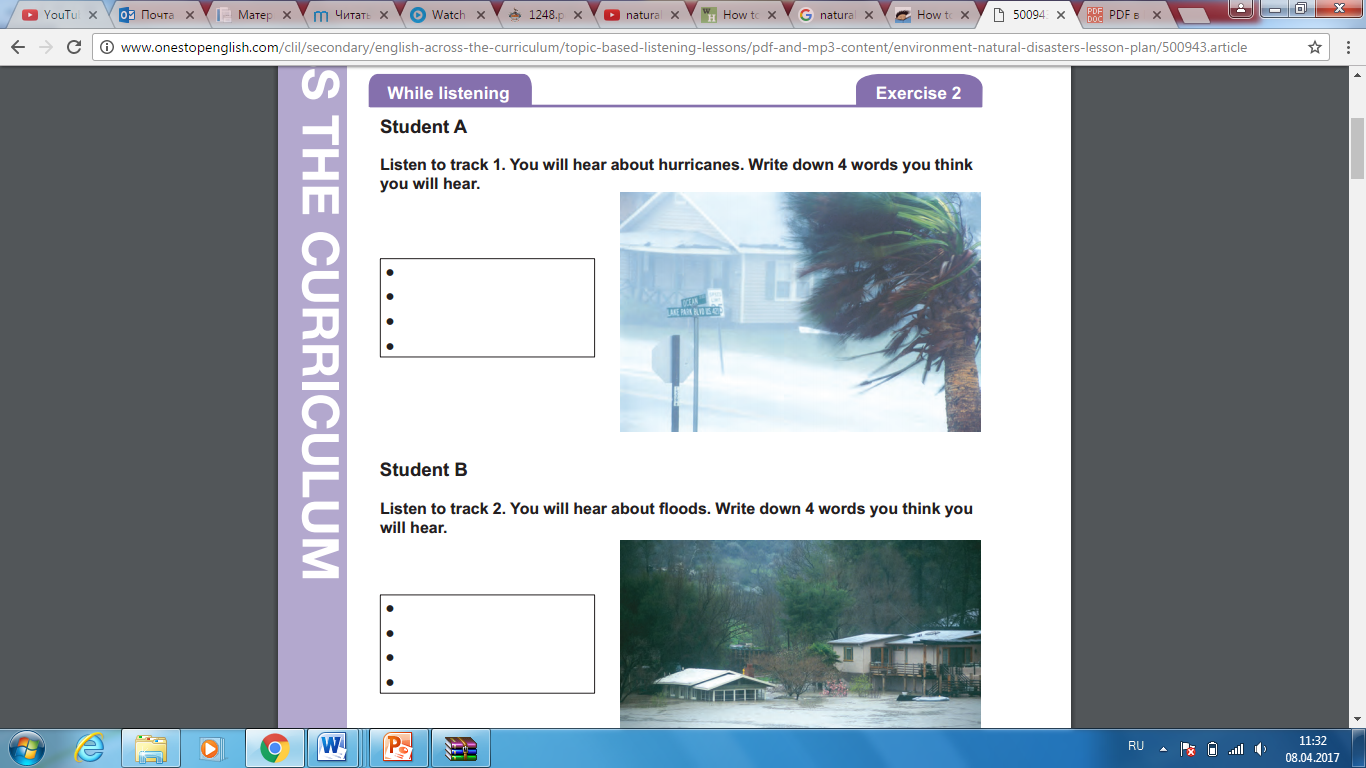
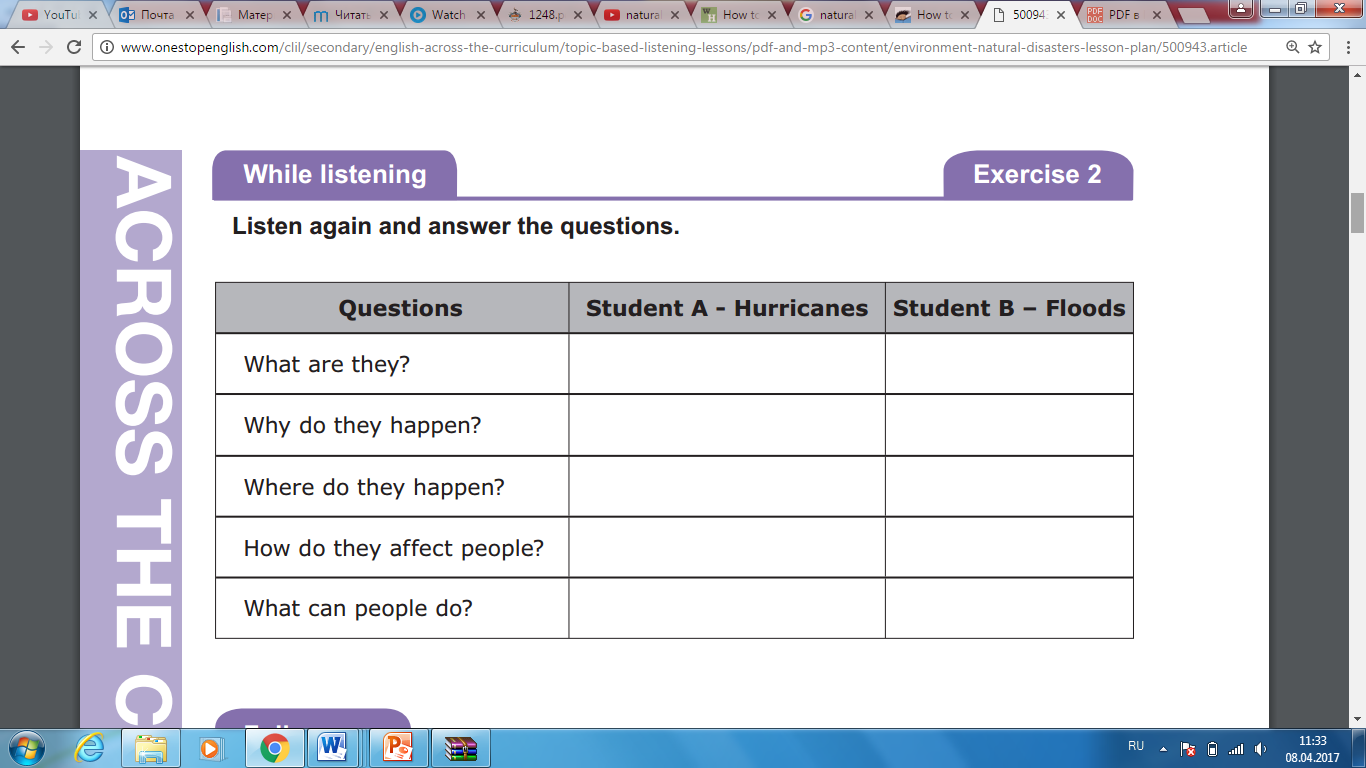
(I) Teacher suggests listening activity to the learners. While listening 1 Teacher divides class into two groups A & B. 2 Teacher takes group A to one classroom & group B to a different classroom (or if working with another teacher/class then swap half your class with each other). 3 Teacher hand out the worksheet and tell group A to complete the box about hurricanes and group B to complete the box about floods. 4 Teacher encourage learners to work in pairs within their groups. 5 Teacher monitor and help where necessary. 6 Next, teacher explains that they will listen to a recording about hurricanes or floods (depending on which group they are in) and they should tick one of their words they hear. 7 Teacher plays the recordings once and then get the learners to compare the words they heard. Task: Student A Listen to track 1. You will hear about hurricanes. Write down 4 words you think you will hear. Student B Listen to track 2. You will hear about floods. Write down 4 words you think you will hear. Answers may vary: Tropical storms, strong winds, typhoons, river, lake, ocean etc. Listening Task 2 1 Teacher hands out the worksheets and asks the learners to read the questions. 2 Teacher puts the students in pairs (they should still be in their groups A & B) and tell them to discuss each question. 3 Teacher plays the recordings (so that group A listen to the recording about hurricanes and group B the one about floods) and get the learners to complete their column of the chart. 4 Teacher puts learners in pairs and get them to compare their answers. 5 Teacher plays the recording again if necessary. 6 Next, teacher brings the two groups together and pair up the students so that one learner A is working with one learner B. 7 Teacher tells the learners to tell their partner the answers to the questions for the natural disaster they listened to and to complete the other column in the chart. 8 Monitor and help where necessary. 9 Finally, check the answers as a class. Task: Listen again and answer the questions.
Questions Student A - Hurricanes Student B – Floods What are they? Why do they happen? Where do they happen? How do they affect people? What can people do? Answers:
Follow up task: Match the words to the correct definition. Blow down (v) Condense (v) Dam (n) Disaster (n) Disrupt (v) Drown (v) Evaporate (v) Reduce (v) Shock (n) Warning (n)
Answers: Blow down (v) - j Condense (v) - e Dam (n) - c Disaster (n) - b Disrupt (v) - h Drown (v) - g Evaporate (v) - f Reduce (v) - i Shock (n) - d Warning (n) – a
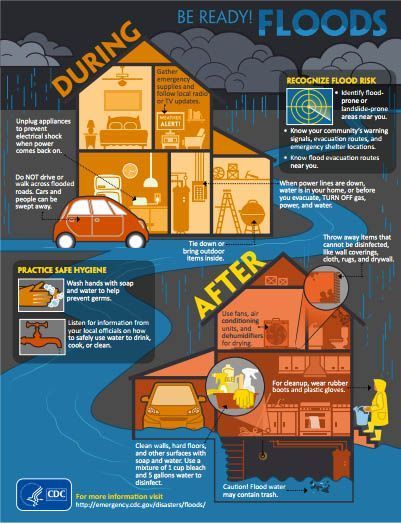
Differentiation: Task for less able learners (G) Teacher suggests developing speaking on topic Natural disasters: “How to Survive a Hurricane?” In a group make a cluster based on previous listening task. Using new words, prepare the information clearly to other groups. Check that you have met all the assessment criteria. Prepare a cluster on an A3 paper (using different colours and fonts). Example:
Task for more able learners: Teacher suggests developing speaking on topic Natural disasters: “How to Survive a Flood?” In a group make a brochure based on previous listening task. Using new words, prepare the information clearly to other groups. Check that you have met all the assessment criteria. Prepare your brochure on an A3 paper (using different colours and fonts). Example:
|
Worksheet with the tasks
|
||||
|
5 min. |
Reflection Students answer the questions: How many types of natural disaster can you name? Which is the worst? What natural disasters are common in your country? Have you ever been through a natural disaster? Tell your group about your experience if it isn’t too traumatic. What is the best / worst natural disaster movie you have seen? Think of three natural disasters. What can you do to stay safe during and after those natural disasters? Do you know that difference between a hurricane, a typhoon, and a cyclone? |
PPP |
||||
|
End 1min |
Feedback: Teacher asks students what task was difficult to them and which pair worked well. |
|
||||
|
Additional information |
||||||
|
Differentiation – how do you plan to give more support? How do you plan to challenge the more able learners? |
Assessment – how are you planning to check learners’ learning? |
Critical thinking |
||||
|
More support:
Make analysis of their work and help weaker ones to arrange information. |
|
Some questions provide critical thinking while answering to them. |
||||
|
Summary evaluation What two things went really well (consider both teaching and learning)? 1: reading task 2: warming up activity What two things would have improved the lesson (consider both teaching and learning)? 1: pay more attention to drilling 2: time management What have I learned from the lesson about this class or individuals that will inform my next lesson? Learners found very creative ways to survive during natural disasters. |
||||||

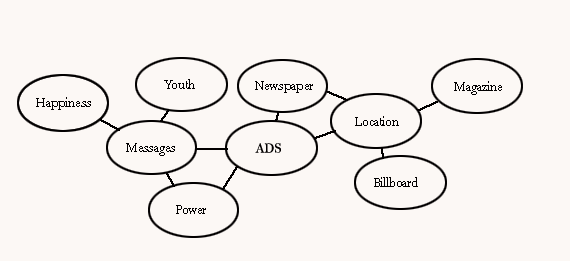
Appendix 1
Listening task
Reorder the letters to fi nd these natural disasters.
1 dolof 2 chirunare
3 grouthd 3 quatehaker
What do you know about each one?
 \
\
Follow up task:
Match the words to the correct definition.
|
a |
Blow down (v) |
b |
Condense (v) |
|
c |
Dam (n) |
d |
Disaster (n) |
|
e |
Disrupt (v) |
f |
Drown (v) |
|
g |
Evaporate (v) |
h |
Reduce (v) |
|
i |
Shock (n) |
j |
Warning (n) |
A statement telling people of a possible problem or danger
A very bad event that causes lots of damage or kills a lot of people
A wall built across a river to stop the water
Something bad that happens unexpectedly and surprises you
The process when a gas changes into a liquid
The process when a liquid (e.g. water) changes into a gas
To go under water and die
To interrupt or prevent something from continuing
To make something smaller or less in size
When a strong wind makes something fall over
Appendix 2
Formative Assessment
Speaking (for less able learners)
|
Unit |
Hobbies and Leisure |
|
Learning Objectives |
7.L1 Understand with little support the main points in extended talk on a limited range of general and curricular topics 7.L4 Understand with little support some of the implied meaning in extended talk on a limited range of general and curricular topics. |
|
Level of thinking skills |
Application Analysis |
|
Assessment criteria |
|
|
“How to Survive a Hurricane?” In a group make a cluster based on previous listening task. Using new words, prepare the information clearly to other groups. Check that you have met all the assessment criteria. Prepare a cluster on an A3 paper (using different colours and fonts). Example:
|
|
|
Descriptor |
A learner |
|
|
|
Appendix 3
Formative Assessment
Speaking (for more able learners)
|
Unit |
Hobbies and Leisure |
|
Learning Objectives |
7.L1 Understand with little support the main points in extended talk on a limited range of general and curricular topics 7.L4 Understand with little support some of the implied meaning in extended talk on a limited range of general and curricular topics. |
|
Level of thinking skills |
Application Analysis |
|
Assessment criteria |
|
|
“How to Survive a Flood?” In a group make a brochure based on previous listening task. Using new words, prepare the information clearly to other groups. Check that you have met all the assessment criteria. Prepare your brochure on an A3 paper (using different colours and fonts). Example:
|
|
|
Descriptor |
A learner |
|
|
|
 Жүктеу
ЖИ арқылы жасау
ЖИ арқылы жасау

Бөлісу
1 - айлық
Материал тарифі-96% жеңілдік
00
05
00
ҚМЖ
Ашық сабақ
Тәрбие сағаты
Презентация
БЖБ, ТЖБ тесттер
Көрнекіліктер
Балабақшаға арнарлған құжаттар
Мақала, Эссе
Дидактикалық ойындар
және тағы басқа 400 000 материал
Барлық 400 000 материалдарды шексіз
жүктеу мүмкіндігіне ие боласыз
жүктеу мүмкіндігіне ие боласыз
1 990 ₸ 49 000₸
1 айға қосылу
Материалға шағымдану
Бұл материал сайт қолданушысы жариялаған. Материалдың ішінде жазылған барлық ақпаратқа жауапкершілікті жариялаған қолданушы жауап береді. Ұстаз тілегі тек ақпаратты таратуға қолдау көрсетеді. Егер материал сіздің авторлық құқығыңызды бұзған болса немесе басқа да себептермен сайттан өшіру керек деп ойласаңыз осында жазыңыз
Жариялаған:
Күзекова Жайна Қуанышқызы 15 Сәуір 2018
 2911
2911Шағым жылдам қаралу үшін барынша толық ақпарат жіберіңіз
7 сынып "Natural disaster" сабақ жоспар
Тақырып бойынша 11 материал табылды
7 сынып "Natural disaster" сабақ жоспар
Материал туралы қысқаша түсінік
материал пән мұғалімдеріне көмек ретінде жиберип отырмын
Материалдың қысқаша нұсқасы
Short term plan 6
|
7.3B Natural Disasters (Content with language) |
School: |
|||||
|
Date: |
Teacher’s name: |
|||||
|
Grade 7 __ |
Number present: |
Number absent: |
||||
|
Theme of the lesson: |
Listening “Natural disasters”. Speaking on topic. |
|||||
|
Learning objectives(s) that this lesson is contributing to |
7.S7 use appropriate subject-specific vocabulary and syntax to talk about a limited range of general topics, and some curricular topics 7.S8 recount some extended stories and events on a limited range of general and curricular topics 7.L5 understand most specific information and detail of supported, extended talk on a range general and curricular topics |
|||||
|
Lesson objectives |
All learners will be able to: |
|||||
|
||||||
|
Most learners will be able to: |
||||||
|
||||||
|
Some learners will be able to: |
||||||
|
||||||
|
Language objective |
Use present simple tense when giving the instructions |
|||||
|
Value links |
Responsibility, Global Citizenship |
|||||
|
Cross curricular links |
Physics |
|||||
|
Previous learning |
Reading about natural disasters |
|||||
|
Use of ICT |
Projector or Smart board for showing a presentation |
|||||
|
Intercultural awareness |
Know about different natural disasters and their impact |
|||||
|
Kazakh culture |
Natural disasters in Kazakhstan |
|||||
|
Pastoral Care |
Student centered teaching: respect, support and scaffolding; To create a friendly atmosphere for collaborative work. Promote a sense of self-esteem and self-respect and respect for others among all the learners. |
|||||
|
Health and Safety |
Everyday classroom precautions will ensure that safety measures are provided to prevent the exposure of electrical power cords. |
|||||
|
Planned timings |
Planned activities |
Resources |
||||
|
10 minutes
|
Warm-up On the board teacher writes up the words Natural Disasters and ask learners if they can name any.
Task: (I) Reorder the letters to find these natural disasters. 1. dolof 2. chirunare 3. grouthd 4. Quatehaker Answers: 1. flood 3. drought 2. hurricane 4. earthquake
|
Whiteboard PPP slide 3
|
||||
|
Main part 10 min. 15 min. |
The main part of the lesson
(I) Teacher suggests listening activity to the learners. While listening 1 Teacher divides class into two groups A & B. 2 Teacher takes group A to one classroom & group B to a different classroom (or if working with another teacher/class then swap half your class with each other). 3 Teacher hand out the worksheet and tell group A to complete the box about hurricanes and group B to complete the box about floods. 4 Teacher encourage learners to work in pairs within their groups. 5 Teacher monitor and help where necessary. 6 Next, teacher explains that they will listen to a recording about hurricanes or floods (depending on which group they are in) and they should tick one of their words they hear. 7 Teacher plays the recordings once and then get the learners to compare the words they heard. Task: Student A Listen to track 1. You will hear about hurricanes. Write down 4 words you think you will hear. Student B Listen to track 2. You will hear about floods. Write down 4 words you think you will hear. Answers may vary: Tropical storms, strong winds, typhoons, river, lake, ocean etc. Listening Task 2 1 Teacher hands out the worksheets and asks the learners to read the questions. 2 Teacher puts the students in pairs (they should still be in their groups A & B) and tell them to discuss each question. 3 Teacher plays the recordings (so that group A listen to the recording about hurricanes and group B the one about floods) and get the learners to complete their column of the chart. 4 Teacher puts learners in pairs and get them to compare their answers. 5 Teacher plays the recording again if necessary. 6 Next, teacher brings the two groups together and pair up the students so that one learner A is working with one learner B. 7 Teacher tells the learners to tell their partner the answers to the questions for the natural disaster they listened to and to complete the other column in the chart. 8 Monitor and help where necessary. 9 Finally, check the answers as a class. Task: Listen again and answer the questions.
Questions Student A - Hurricanes Student B – Floods What are they? Why do they happen? Where do they happen? How do they affect people? What can people do? Answers:
Follow up task: Match the words to the correct definition. Blow down (v) Condense (v) Dam (n) Disaster (n) Disrupt (v) Drown (v) Evaporate (v) Reduce (v) Shock (n) Warning (n)
Answers: Blow down (v) - j Condense (v) - e Dam (n) - c Disaster (n) - b Disrupt (v) - h Drown (v) - g Evaporate (v) - f Reduce (v) - i Shock (n) - d Warning (n) – a
Differentiation: Task for less able learners (G) Teacher suggests developing speaking on topic Natural disasters: “How to Survive a Hurricane?” In a group make a cluster based on previous listening task. Using new words, prepare the information clearly to other groups. Check that you have met all the assessment criteria. Prepare a cluster on an A3 paper (using different colours and fonts). Example:
Task for more able learners: Teacher suggests developing speaking on topic Natural disasters: “How to Survive a Flood?” In a group make a brochure based on previous listening task. Using new words, prepare the information clearly to other groups. Check that you have met all the assessment criteria. Prepare your brochure on an A3 paper (using different colours and fonts). Example:
|
Worksheet with the tasks
|
||||
|
5 min. |
Reflection Students answer the questions: How many types of natural disaster can you name? Which is the worst? What natural disasters are common in your country? Have you ever been through a natural disaster? Tell your group about your experience if it isn’t too traumatic. What is the best / worst natural disaster movie you have seen? Think of three natural disasters. What can you do to stay safe during and after those natural disasters? Do you know that difference between a hurricane, a typhoon, and a cyclone? |
PPP |
||||
|
End 1min |
Feedback: Teacher asks students what task was difficult to them and which pair worked well. |
|
||||
|
Additional information |
||||||
|
Differentiation – how do you plan to give more support? How do you plan to challenge the more able learners? |
Assessment – how are you planning to check learners’ learning? |
Critical thinking |
||||
|
More support:
Make analysis of their work and help weaker ones to arrange information. |
|
Some questions provide critical thinking while answering to them. |
||||
|
Summary evaluation What two things went really well (consider both teaching and learning)? 1: reading task 2: warming up activity What two things would have improved the lesson (consider both teaching and learning)? 1: pay more attention to drilling 2: time management What have I learned from the lesson about this class or individuals that will inform my next lesson? Learners found very creative ways to survive during natural disasters. |
||||||
Appendix 1
Listening task
Reorder the letters to fi nd these natural disasters.
1 dolof 2 chirunare
3 grouthd 3 quatehaker
What do you know about each one?
\
Follow up task:
Match the words to the correct definition.
|
a |
Blow down (v) |
b |
Condense (v) |
|
c |
Dam (n) |
d |
Disaster (n) |
|
e |
Disrupt (v) |
f |
Drown (v) |
|
g |
Evaporate (v) |
h |
Reduce (v) |
|
i |
Shock (n) |
j |
Warning (n) |
A statement telling people of a possible problem or danger
A very bad event that causes lots of damage or kills a lot of people
A wall built across a river to stop the water
Something bad that happens unexpectedly and surprises you
The process when a gas changes into a liquid
The process when a liquid (e.g. water) changes into a gas
To go under water and die
To interrupt or prevent something from continuing
To make something smaller or less in size
When a strong wind makes something fall over
Appendix 2
Formative Assessment
Speaking (for less able learners)
|
Unit |
Hobbies and Leisure |
|
Learning Objectives |
7.L1 Understand with little support the main points in extended talk on a limited range of general and curricular topics 7.L4 Understand with little support some of the implied meaning in extended talk on a limited range of general and curricular topics. |
|
Level of thinking skills |
Application Analysis |
|
Assessment criteria |
|
|
“How to Survive a Hurricane?” In a group make a cluster based on previous listening task. Using new words, prepare the information clearly to other groups. Check that you have met all the assessment criteria. Prepare a cluster on an A3 paper (using different colours and fonts). Example:
|
|
|
Descriptor |
A learner |
|
|
|
Appendix 3
Formative Assessment
Speaking (for more able learners)
|
Unit |
Hobbies and Leisure |
|
Learning Objectives |
7.L1 Understand with little support the main points in extended talk on a limited range of general and curricular topics 7.L4 Understand with little support some of the implied meaning in extended talk on a limited range of general and curricular topics. |
|
Level of thinking skills |
Application Analysis |
|
Assessment criteria |
|
|
“How to Survive a Flood?” In a group make a brochure based on previous listening task. Using new words, prepare the information clearly to other groups. Check that you have met all the assessment criteria. Prepare your brochure on an A3 paper (using different colours and fonts). Example:
|
|
|
Descriptor |
A learner |
|
|
|
 Жүктеу
 Бөлісу
ЖИ арқылы жасау
Файл форматы:

docx

15.04.2018

2911
Жүктеу
ЖИ арқылы жасау
Жариялаған:
Бұл материалды қолданушы жариялаған. Ustaz Tilegi ақпаратты жеткізуші ғана болып табылады. Жарияланған материалдың мазмұны мен авторлық құқық толықтай автордың жауапкершілігінде. Егер материал авторлық құқықты бұзады немесе сайттан алынуы тиіс деп есептесеңіз,
шағым қалдыра аласыз
шағым қалдыра аласыз