ЖИ көмекші


 Қауіпсіз төлем

жүктеу мүмкіндігіне ие боласыз
Бұл материал сайт қолданушысы жариялаған. Материалдың ішінде жазылған барлық ақпаратқа жауапкершілікті жариялаған қолданушы жауап береді. Ұстаз тілегі тек ақпаратты таратуға қолдау көрсетеді. Егер материал сіздің авторлық құқығыңызды бұзған болса немесе басқа да себептермен сайттан өшіру керек деп ойласаңыз осында жазыңыз
 10 Наурыз 2025
 257
257
1 жыл бойы шексіз жүктеңіз
Blood and its element
|
|
«Интердент» жоғары медициналық колледжі |
Құжаттама тәртібі ҚТ-СМЖ-003.3-2020 Әдістемелік қызметті басқару |
Басылым 1 |
Theme: «Endocrine system. Inner secretion iron»
Professional English Language
Teacher: Turmaganbetova G.B
09.11.2020
1. General information’s:
Course: 2
Year of study: 2020-2021
Group: 203
The type of the lesson: Lesson of new knowledge.
The aim of the lesson/ Learning Result: to clarify the meaning of blood, to give the concept of the relationship between the structure and function of blood cells, based on an introduction to the functions of red blood cells and leukocytes to reveal the issues that are important for hygiene education, to give the concept of anemia and replenishment as a protective reaction of the body.
a) Educational: Consider the peculiarities of the structure of the blood form elements in connection with the functions performed and determine why the blood composition is an important characteristic of the body.
b) Pedagogical: to teach students` to get the information, to express their own opinion
c)Developing: develop the ability to highlight the main thing, compare, analyze, make the right conclusions, think logically, find logical connections
Obligations, assessment criteria:
1.1List of professional skills and abilities acquired by students during training sessions: Students will know the basic components of blood, the composition of the blood plasma, its functions; the structure and functions of red blood cells, white blood cells, platelets; conditions of blood clotting.
2. Lesson equipment:
2.1 Educational and methodical manuals, reference literature:
1. Essential English for medical students- A.M.Maslova, Z.I.Winestein, L.S.Plebeyskaya;
2. Английский язык для медицинских колледжей и училищ- Л.Г.Козырева, Т.В.Шадская;
3.Грамматика. Сборник упражнений- Ю.Голицынский, Н.Голицынская
Equipments: Handouts, cards, tape, flipchart, video and presentation, interactive whiteboard.
Procedure of the lesson
|
Lesson stages: |
Teacher's activities |
||||||
|
Beginning of the lesson Warm-up activities |
Good morning, my dear students. I am very glad and happy to see all of you today. How are you? Answer my questions, please. 1. What date is it today? 2. What day of the week is it today? 3. What is the weather like today? |
||||||
|
Checking up the home task: |
Check up the home task: ex. 161-163, p. 130-132 (Грамматика сборник упражнений-Ю.Голицынской) Ex.161 Insert the verb to be in the Past Simple. My aunt ... very depressed last Sunday. The weather ...terrible. It ... cold and rainy. Her husband ... not at home. He ... at hospital because he ... sick. Her children ... not at school. They ... not in the yard, they ... in the living room. The TV ... broken. The children ... not only upset, they ... very angry. The neighbours ... not happy because her children ... too noisy. The house ... not clean. The sink ... broken. There ... dirty dishes on the kitchen table and in the sink. There ... nothing in the fridge. There ... no vegetables for dinner, there ... no juice for her children. There ... not even bread in the house! She ... tired and hungry. She ... just exhausted. |
||||||
|
Discussion point |
One popular book on physiology figuratively says: "At every second in the red sea millions of ships are wrecked and sink to the bottom. But millions of new ships are sailing out of the harbors again... What is meant by the Red Sea, ships? Harbors? Let's start with the Red Sea - is ... So, the theme of our lesson is "Blood". And the French physiologist Claude Bernard called blood "the mirror of the body" - is it really so? Let's take a look at it. What do we need to do for this? Study blood composition Study blood cell structure, blood functions. |
||||||
|
Main part |
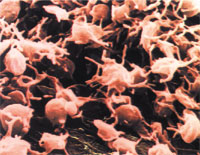
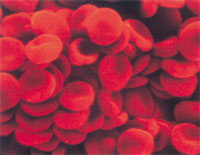
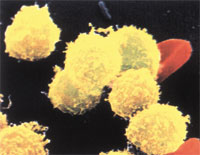
Blood, continuously circulating in a closed system of blood vessels, performs the most important functions in the body: transport, respiratory, regulatory and protective. It provides relative stability of the internal environment of the body. Erythrocytes - nuclear-free red blood cells, which have the form of double concave discs. This form increases the surface of the cell by 1.5 times. erythrocyte cytoplasm contains hemoglobin protein - a complex organic compound consisting of a protein globin and a blood pigment hem, which includes iron. White blood cells - white blood cells that contain nuclei and have no permanent form. In 1 mm3 of human blood they contain 6-8 thousand. Platelets (blood platelets) - colorless, non-nuclear cells of rounded form, which play an important role in blood clotting. In 1 liter of blood is from 180 to 400 thousand platelets. They are easily destroyed when the blood vessels are damaged. Thrombocytes are formed in the red bone marrow. Ex. 1. Match the texts to the drawings
Ex.2 The game "Faith-Not Faith." Read the suggestions. Evaluate their correctness: if the sentence is correct, put "+"; if the sentence is wrong, put "-". 1. Blood is a hard tissue. 2. Blood is liquid connective tissue. 3. Plasma takes 50% of the volume of blood. 4) Erythrocytes have no formal nucleus. Erythrocytes have a protective function. 5. 6. Leukocytes are the largest blood cells. 7. Thrombocytes are involved in the formation of the thrombus. 8. Red blood clot is formed only by red blood cells and thrombocytes. Ex.3, p.101- Read the text “the circulation of the blood”, translate them and put questions to the second paragraph. Ex. 4, p. translate the following sentences: The human heart begins to beat and pump blood quicker than usual during the emotional stress. The human heart makes 60-80 contraction per minute. On physical exertion the heart has a short period of rest and the diastole becomes less. The heart acts as a pump discharge out the blood to peripheral and pulmonary systems. Ten tones of blood are pumped through the heart daily. John Floyer, an English doctor was the first scientist to find out the varying pulse rate in men. |
||||||
|
Conclusive stage Feedback Home task |
Let's go back to Claude Bernard's owls, "Blood is a mirror of the body", is it? (pupils' conclusions) Blood is the river that sustains life and carries it within itself. However, you will not see such a river in any of the natural landscapes... This river flows within each of us. Feedback: - Guys, it's time to sum up the lesson. Let's remember the tasks that the capital has before us: Study blood composition Study the structure of blood cells, study blood functions - Do you think we have coped with the tasks, reached the goal of the lesson? - Now I suggest that you shoot at the "Reflexive Target" .if you score "5" we show 5 fingers, "4", 3, 2 - the corresponding number of fingers.
Home work: ex. 8, p.103 (Essential English for medical students -Маслова А.М) |
 know and
understand
know and
understand







 Бұл курс Қазақстан Республикасы Оқу-ағарту министрлігімен келісілген