
 ЖИ көмекші


жүктеу мүмкіндігіне ие боласыз
Бұл материал сайт қолданушысы жариялаған. Материалдың ішінде жазылған барлық ақпаратқа жауапкершілікті жариялаған қолданушы жауап береді. Ұстаз тілегі тек ақпаратты таратуға қолдау көрсетеді. Егер материал сіздің авторлық құқығыңызды бұзған болса немесе басқа да себептермен сайттан өшіру керек деп ойласаңыз осында жазыңыз
 12 Қазан 2020
 557
557
"Химия сабағында оқушыларды шығармашылыққа баулу" тақырыбында әдістемелік нұсқаулық
На тему:« STUDENT CREATIVITY IN THE TEACHING OF CHEMISTRY»
INTRODUCTION
The relevance of the work. Today in our country there is a complex process of modernization of the education system. Everyone understands that not only the fate of young citizens, but also the future of the state depends on it. The concept of modernization of education formulates the main task of the educational policy of the Republic of Kazakhstan as ensuring the modern quality of education on the basis of preservation of its fundamental nature and compliance with the current and future needs of the individual, society and the state. "The developing society needs modern educated, moral, creative, enterprising people who can independently make responsible decisions, capable of cooperation, mobile and dynamic, responsible for the fate of the country" - so the prospects for the modernization of modern education are defined. According to this perspective, the school should be focused on advanced development. This means that it is necessary to study in schools not only the achievements of the past, but also those methods and technologies that will be useful in the future for their creative development [1-3].
Current education is focused on personal development. Modern society needs a graduate, self-thinking, able to see and creatively solve problems. You want the result of the activity, the student independently came to some conclusions for myself to build up knowledge[8,9]. This task is particularly relevant in the dynamically developing information space. However, students are not always able to navigate the huge flow of new information, extract the necessary facts and data, use them productively in their work. In this regard, the task of familiarizing students to creative, i.e. research activities is particularly relevant.
Research activities of students in chemistry lessons and after school is one of the ways to enhance the creative potential of the individual.
Under the research activity of students today is understood as a form of organization of educational work, which is associated with the decision of students creative, research tasks with a previously unknown result in various fields of science, technology, art. Research activity involves the presence of the main stages characteristic of scientific research:
- problem statement,
- familiarization with the literature on the subject,
- mastering the research methodology,
- collecting your own material,
- its analysis and generalization,
- summary.
Educational and research activity is an activity, the main purpose of which is the educational result, it is aimed at training students, developing their research type of thinking. The main thing here is not mastering new, hitherto unknown facts, but learning the algorithm of conducting research, skills that can then be used in the study of any complexity and subject. Introduction of elements of students ' research activity into pedagogical technologies allows the teacher not so much to teach as to help the child to learn, to direct his cognitive activity[29]. The tasks of educational and research activities are defined as follows:
- formation of interest in cognitive, creative, experimental research activities;
- creation of conditions for social and professional self-determination of schoolchildren;
- improvement of research skills of schoolchildren;
- development of creative abilities and personal qualities of students;
- focus on further education at the University.
One of the most important and important aspects of the research work is the choice of the research topic. The topic should be interesting for children, accessible, correspond to their age characteristics; and at the same time should carry a cognitive charge and take into account the state of the material and technical base of the chemistry Cabinet[10-13]. The topic can be chosen from the suggestions of the teacher or arise quite unexpectedly. So the students of the 8th grade, beginning to study the subject, with pleasure engaged in the topic I proposed: "Growing crystals." The children of the 9th class chose the topic of work. They noticed that between the main meals, many students eat chips, Kirieshki, lemonade, chewing gum, in which you can find the letter E. the Guys decided to conduct a study of food for the content of food additives. The taste of tap water and water from different wells in our village prompted the children to study the quality of water, determine its hardness. Interesting was the work on the preparation of soap at home.
In theoretical classes, the children and I determine the object and subject of research, goals, set goals, choose research methods. After the theoretical training, students participate in hands-on activities: surf the Internet, the library – pick the scientific literature on this topic[21].
We analyze the collected material together, systematize and make an introduction. This work allows you to go beyond the textbook, makes the subject more interesting. Children learned a lot about crystals, their types, forms. After studying the material about food additives, students learned what the letter e Means, how it appeared, why manufacturers recommend drinking chilled lemonade, what substances are hidden behind the letter E. At this stage, the guys learn to work with information, to find the main thing, to draw conclusions that develops their thinking.
The main part of the work is the preparation and conduct of chemical research. This part of the work requires a lot of time and is carried out necessarily in the presence of the teacher. The experiment is the main method in chemistry. In teaching chemistry, three types of chemical experiment are mainly used: demonstration experiments of the teacher, laboratory experiments performed by students and practical classes. Most of these experiments are illustrative and in fact are reproductive, so they do not provide an opportunity to organize an independent search activity of students. Student research experiment combines the predominant use of the basic techniques of the scientific method with independent decision and implementation of educational research tasks. The experiment develops the features of creative activity, forms an interest in the knowledge of chemical phenomena and their laws. In the course of the work, the guys got the skills to work with utensils and equipment, mastered the technique of preparing solutions of different concentrations, learned to conduct targeted observations, received the initial skills of safe work in the laboratory, consolidated the ability to solve problems on the topic "Solutions".
The development of students ' research skills should begin in school lessons. In this respect, chemistry lessons are very good. Here you can simulate all stages of development of educational and research skills of students.
Table 1 – Model of educational and research skills of schoolchildren
|
Stage IIC |
Educational and research skills of schoolchildren |
|
Observation |
|
|
Building a model hypothesis |
|
|
Conclusion of theoretical consequences |
Deduce consequences from the theory |
|
Conducting experiments |
|
In the organization of research work at lessons of biology and chemistry, you can use the handout for students "Learning to see" and "Learn to put the experiment".
"Learning to watch»
1. Comprehend the purpose of observation: why is observation carried out?
2. Specify the subject of the observation: what are you going to watch?
3. Monitoring is carried out according to a pre-developed plan.
4. Choose a method of observation. It is possible to observe visually or by means of devices.
5. Observation should be carried out several times.
6. Hold the fixation of the observed phenomena.
7. Description of the observed processes can be expressed in verbal form, presented analytically or graphically.
"I'm learning to experiment»
1. What do I want to know during the experiment?
2. What do I already know about this phenomenon?
3. What do I suggest we do?
4. What devices and materials do I need?
5. What is my plan of action?
6. How will I act and what will I get?
7. My explanation of the result.
8. Result analysis.
9. My conclusion.
Activation of the teaching is, first of all, the organization of students ' actions aimed at awareness and resolution of specific educational problems. The formation of educational activity as a way of active obtaining of knowledge is one of the directions of development of the student's personality.
The degree of activity of students is a reaction to the methods and techniques of the teacher. Active teaching methods should be called those that maximize the level of cognitive activity of students, encourage them to diligent teaching.
In school practice and in the methodological literature it is customary to divide the methods of training on standard and nonstandard, the ones they use in the classroom and the ones they use outside of school time.
Non-standard forms and methods allow to make chemistry more accessible and fascinating, to attract students ' interest.
The literature identifies the following non-traditional forms of lessons:
lesson – conference;
lesson – competition;
lesson – game;
lesson quiz;
the lesson – debate;
lesson – competition;
lesson - knowledge auction;
a lesson in creativity;
lesson tournament;
lesson – performance;
knowledge review;
lesson – offset;
lesson – journey;
lesson – dialogue;
lesson – interview;
lesson – trainer;
the lesson – excursion;
brainstorming;
lesson – lecture;
lesson – consultation;
learning lessons;
lesson – auction;
lesson – creative report;
lessons – fantasies;
lessons – courts;
lessons – concerts;
integral lessons;
lesson-workshop.
Educational and research, including project activities of students - always a joint activity of teachers and students to identify the essence of the phenomena and processes studied
.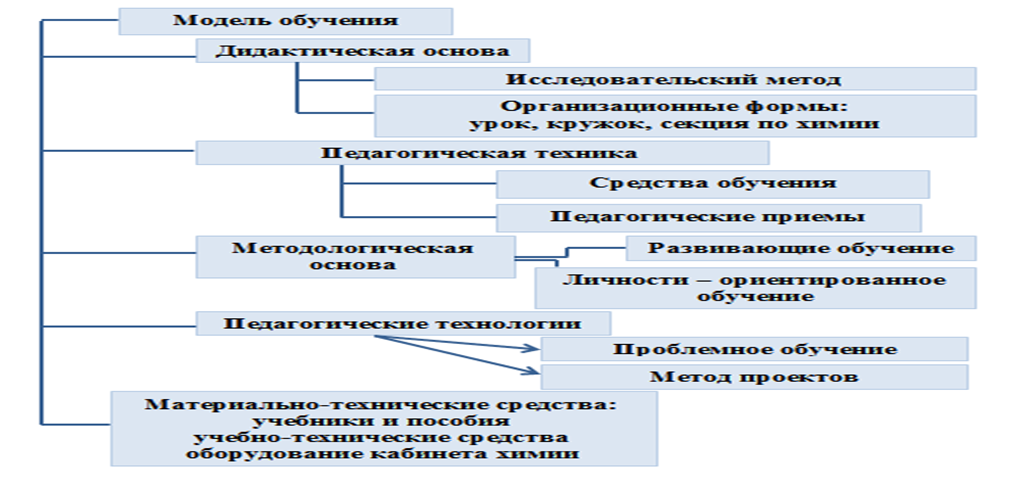
Scheme 1 - Model of pedagogical activity on organization of students ' research as a factor of their development creative activity and skills to solve new problems
CONCLUSION
So, we can safely say - research is the organization of educational work, which is aimed at solving a set of problems of a search nature, leading to the discovery of unknown facts, theoretical knowledge and methods of activity. In the course of research students develop the ability to analyze, compare, summarize, apply the knowledge. Educational and search activity is collective and distributive. This creates a mutual interest among students to each other's work, encourages its active analysis and evaluation. The use of group work forms the ability of students to interact "face to face", to cooperate, develops a sense of responsibility, positive interdependence in solving common educational problems. The main task of the teacher is precisely to guide and adjust the educational and research activities of students. In the process of such training, students learn to think logically, scientifically, creatively, feel confident in their capabilities.
Currently, teachers are faced with the task of creating such conditions in which students in a short time could absorb the maximum possible amount of knowledge together with the acquisition of skills of their creative application in practice.
It is motivation - the main tool that will make it possible to increase the level of interest of students to the educational process.

 Жүктеу


 Жүктеу
шағым қалдыра аласыз

 Бұл курс Қазақстан Республикасы Оқу-ағарту министрлігімен келісілген










