|
Learning objectives(s)
that this lesson is
contributing to
|
2.R1 read and spell out words for
others
2.S3 ask
questions in basic exchanges about people, objects and classroom
routines
2.L5 identify given
words
2.UE6 use have got/ has
got
2.W3 write short
phrases to identify people, places and
objects
|
|
Beginning the
lesson
8
min
Middle of the
lesson
|
Org.
moment
Get students ready to the
class by greeting them, asking questions about their
feelings.
Hello! How are you
today?
Introduction of the
lesson:
Teacher divides learners into
subgroups using puzzle
pictures.
1. T tells the children about the purpose of the lesson and
about the criteria for success.
2. Offers to guess the theme of the lesson from the
pictures that they already have
3. Active pupils receive one smiley at the end of the
lesson who will have more smiley, we will award him and her medal!
The best in English
Brainstorming:
A) Teaching
vocabulary
1. (Т-S), (S-S) (G) Teacher makes a list of words that students need
to know. Writes simple definitions for the words and explains the
words using body. The
pupils repeat, chorally and/or individually. Asks individual pupils
to name them. Ask the rest of the class for
verification
New words:
-
Hair, Eyes, Ears, Nose,
Mouth.
(W) The final stage is to check
that all students understand all the words and
drilling.
Activity
1. Teacher hangs the pictures on
the blackboard. And hides one of them students task is to find the
words.
Activity
2.
Warm-up:
Letters:
E, T, H, N, M,
F.
B) Grammar. Have got/ has
got
Activity 1. Personalization
method (game). (Group work)
(T) Teacher shows students the
papers, and both sides of the papers have pictures. Teacher shows
them the pictures one by one. Tells them to remember what is
backside of each picture and make up sentences
according to the grammar
construction they have just been taught. Learners use their cards
to make sentences randomly.
- Have got or has
got.
For
example:
Activity
2. Learners listen to and sing
the Teddy
bear song.
Learner dance to music around
the classroom.
Activity
3. Teacher uses visuals and
puppets/toys to model and practice body parts names. Learners
listen to the dialogue very attentively several times. Learners
role play using their toys and phrases from the dialogue or make up
their own dialogues.
- Look at my
ballerina.
-
She has
got blue
eyes.
Activity 4. Draw, color and say.
(Individual work)
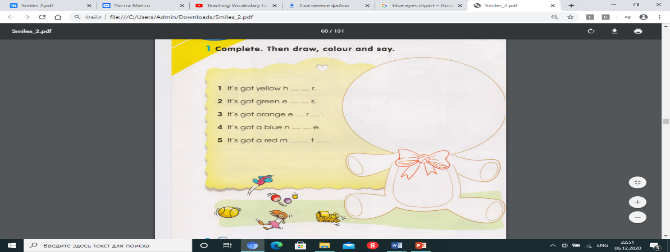 Teacher reads the sentences.
Learners should follow instructions.
I have got a teddy
bear.
-
It has got yellow
hair
-
It’s got green
eyes
-
It’s got orange
ears.
-
It’s got a blue
nose.
|
Hello
song.
Smiles student’s
book flashcards
.
Smiles student’s
book flashcards
Picture
Student’s
book
at page
60.
CD, DVD
discs
DVD discs, grammar
cards notebook,
Smiles Student’s
book2, p 61
Student’s book
at page
60
|
|

 ЖИ көмекші


 Қауіпсіз төлем













 Бұл курс Қазақстан Республикасы Оқу-ағарту министрлігімен келісілген










