Тексерілді: ДОІЖО: Ж. Мамадалиева
|
Unit of a long term plan: Unit 6 The natural world |
School №18: named after Abay |
||
|
Date: 19.02.2025 |
Teacher`s name:G. Dauylova |
||
|
Grade: 8 «б» |
Number present: |
absent: |
|
|
Lesson title |
CLIL Natural environments: Tropical rainforests |
||
|
Learning objectives |
8.3.7.1 use appropriate subject-specific vocabulary and syntax to talk about a range of general topics, and some curricular topics 8.4.1.1 understand the main points in texts on a growing range of unfamiliar general and curricular topics, including some extended texts |
||
|
Lesson objectives |
Learners will be able to: • Learn vocabulary of natural environments. • Read and listen a text about tropical rainforests |
||
|
Plan |
|||
|
Stages / Time |
Teachers’ actions |
Students’ actions |
Assessment criteria |
Resources |
|
Beginning of the lesson 5 min |
Organization moment 1.Greeting. Ask about the weather. The teacher sets the lesson objectives, letting students know what to anticipate from the lesson. Warm-up students wish each other by holding a wishes lamp Lead – In Show the video about tropical rainforest • Elicit a variety of ideas, then ask what they know about the conditions in a rainforest. Ask what types of animals and plants there are, and where they live in the forest. |
The aim: To develop pupils speaking skills and create friendly atmosphere Efficiency: By telling the wishes they show their appreciations . Students of the class are listed. Students' attention is drawn to the lesson. Students analyze the given pictures in pairs. Students say different words from the picture |
At the organization moment teacher tries to award active pupils. «The praise» method is used to evaluate pupils with phrases like: “Good job! Well done!” Formative Assessment
Good job! |
Pictures Student’s book |
|
Middle of the lesson Presentation part. 35 min |
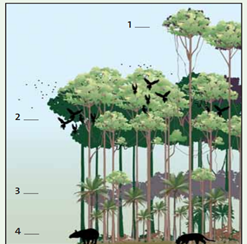
Ex: 3 P:77 • After students have labelled the diagram, check answers and ask what the layers of a rainforest are called in their language.
Write the new words in dictionary Environment-қоршаған Wildlife-жабайы табиғат Mammals-сүтқоректілер Layers-қабаттар Natural-табиғи Vegetation-өсімдіктер Shrubs-бұталар Rainforest-жаңбырлы орман Ex: 2 P:77 • Ask students to listen and read the text, and check their answers to exercise 1.
Ask the question in the text) 1 Where is located tropical rainforests? 2 What is temperature in rainforests? 3 Which layer receives the most sunlight? 4 What animals live in the forest floor? 5 Which layer 1 % of the sunlight falls? 6 Why are the people destroyed the tropical rainforests? |
ANSWERS: Students read paragraph 2 again. Label the diagram. ANSWERS: 1 emergent layer 2 canopy 3 understorey 4 forest floor Students read and listen to the text. Check your answer in exercise 1. ANSWERS: 1 vegetation 2 wildlife 3 layers 4 mammals 5 shrubs 6 natural |
Assessment criteria - Learn vocabulary of natural environments.
Descriptor: - check the meaning of the words in the box. Then complete the text.
Assessment criteria: - Read a text about tropical rainforests
Descriptor: - read paragraph 2 again. Label the diagram. Make CCQ questions Yes / No |
Cards Worksheets |
|
End of the lesson 5 min |
FEEDBACK Learners provide feedback on what they have learned at the lesson.. Home task: Ex: 5. Write two paragraphs about coral reefs |
|
Students use their stickers to show their knowledge according to the lesson. |
Poster
|
жүктеу мүмкіндігіне ие боласыз
Бұл материал сайт қолданушысы жариялаған. Материалдың ішінде жазылған барлық ақпаратқа жауапкершілікті жариялаған қолданушы жауап береді. Ұстаз тілегі тек ақпаратты таратуға қолдау көрсетеді. Егер материал сіздің авторлық құқығыңызды бұзған болса немесе басқа да себептермен сайттан өшіру керек деп ойласаңыз осында жазыңыз
Natural environments: Tropical rainforests
Тексерілді: ДОІЖО: Ж. Мамадалиева
|
Unit of a long term plan: Unit 6 The natural world |
School №18: named after Abay |
||
|
Date: 19.02.2025 |
Teacher`s name:G. Dauylova |
||
|
Grade: 8 «б» |
Number present: |
absent: |
|
|
Lesson title |
CLIL Natural environments: Tropical rainforests |
||
|
Learning objectives |
8.3.7.1 use appropriate subject-specific vocabulary and syntax to talk about a range of general topics, and some curricular topics 8.4.1.1 understand the main points in texts on a growing range of unfamiliar general and curricular topics, including some extended texts |
||
|
Lesson objectives |
Learners will be able to: • Learn vocabulary of natural environments. • Read and listen a text about tropical rainforests |
||
|
Plan |
|||
|
Stages / Time |
Teachers’ actions |
Students’ actions |
Assessment criteria |
Resources |
|
Beginning of the lesson 5 min |
Organization moment 1.Greeting. Ask about the weather. The teacher sets the lesson objectives, letting students know what to anticipate from the lesson. Warm-up students wish each other by holding a wishes lamp Lead – In Show the video about tropical rainforest • Elicit a variety of ideas, then ask what they know about the conditions in a rainforest. Ask what types of animals and plants there are, and where they live in the forest. |
The aim: To develop pupils speaking skills and create friendly atmosphere Efficiency: By telling the wishes they show their appreciations . Students of the class are listed. Students' attention is drawn to the lesson. Students analyze the given pictures in pairs. Students say different words from the picture |
At the organization moment teacher tries to award active pupils. «The praise» method is used to evaluate pupils with phrases like: “Good job! Well done!” Formative Assessment
Good job! |
Pictures Student’s book |
|
Middle of the lesson Presentation part. 35 min |
Ex: 3 P:77 • After students have labelled the diagram, check answers and ask what the layers of a rainforest are called in their language.
Write the new words in dictionary Environment-қоршаған Wildlife-жабайы табиғат Mammals-сүтқоректілер Layers-қабаттар Natural-табиғи Vegetation-өсімдіктер Shrubs-бұталар Rainforest-жаңбырлы орман Ex: 2 P:77 • Ask students to listen and read the text, and check their answers to exercise 1.
Ask the question in the text) 1 Where is located tropical rainforests? 2 What is temperature in rainforests? 3 Which layer receives the most sunlight? 4 What animals live in the forest floor? 5 Which layer 1 % of the sunlight falls? 6 Why are the people destroyed the tropical rainforests? |
ANSWERS: Students read paragraph 2 again. Label the diagram. ANSWERS: 1 emergent layer 2 canopy 3 understorey 4 forest floor Students read and listen to the text. Check your answer in exercise 1. ANSWERS: 1 vegetation 2 wildlife 3 layers 4 mammals 5 shrubs 6 natural |
Assessment criteria - Learn vocabulary of natural environments.
Descriptor: - check the meaning of the words in the box. Then complete the text.
Assessment criteria: - Read a text about tropical rainforests
Descriptor: - read paragraph 2 again. Label the diagram. Make CCQ questions Yes / No |
Cards Worksheets |
|
End of the lesson 5 min |
FEEDBACK Learners provide feedback on what they have learned at the lesson.. Home task: Ex: 5. Write two paragraphs about coral reefs |
|
Students use their stickers to show their knowledge according to the lesson. |
Poster
|
шағым қалдыра аласыз