ЖИ көмекші


жүктеу мүмкіндігіне ие боласыз
Бұл материал сайт қолданушысы жариялаған. Материалдың ішінде жазылған барлық ақпаратқа жауапкершілікті жариялаған қолданушы жауап береді. Ұстаз тілегі тек ақпаратты таратуға қолдау көрсетеді. Егер материал сіздің авторлық құқығыңызды бұзған болса немесе басқа да себептермен сайттан өшіру керек деп ойласаңыз осында жазыңыз
 02 Сәуір 2024
 244
244
қмж 4 тоқсан
Short term plan: term 4
|
Unit 8 Food and drink |
|
||
|
Teacher name: |
|
||
|
Date: |
|
||
|
Grade: 8 |
Number present: |
absent: |
|
|
Lesson title |
Action and protest |
||
|
Learning objectives |
8.1.9.1 use imagination to express thoughts, ideas, experiences and feelings 8.2.2.1 understand with little or no support most specific information in extended talk on a wide range of general and curricular topics 8.3.7.1 use appropriate subject-specific vocabulary and syntax to talk about a range of general topics, and some curricular topics |
||
|
Lesson objectives |
Learners will be able to: • Learn vocabulary to do with action and protest. • Do a questionnaire on attitudes to taking action. • Learn the use of will and might. • Practise using will, won’t, might and might not to make predictions. |
||
|
Value links |
Hospitality: Traditionally a nomadic culture, hospitality has always been an important part of Kazakh culture. |
||
|
Plan |
|||
|
Stages / Time |
Teachers’ actions |
Students’ actions |
Assessment criteria |
Resources |
|
Beginning of the lesson 5 min |
Organization moment 1.Greeting. Ask about the weather. The teacher sets the lesson objectives, letting students know what to anticipate from the lesson. Warm-up
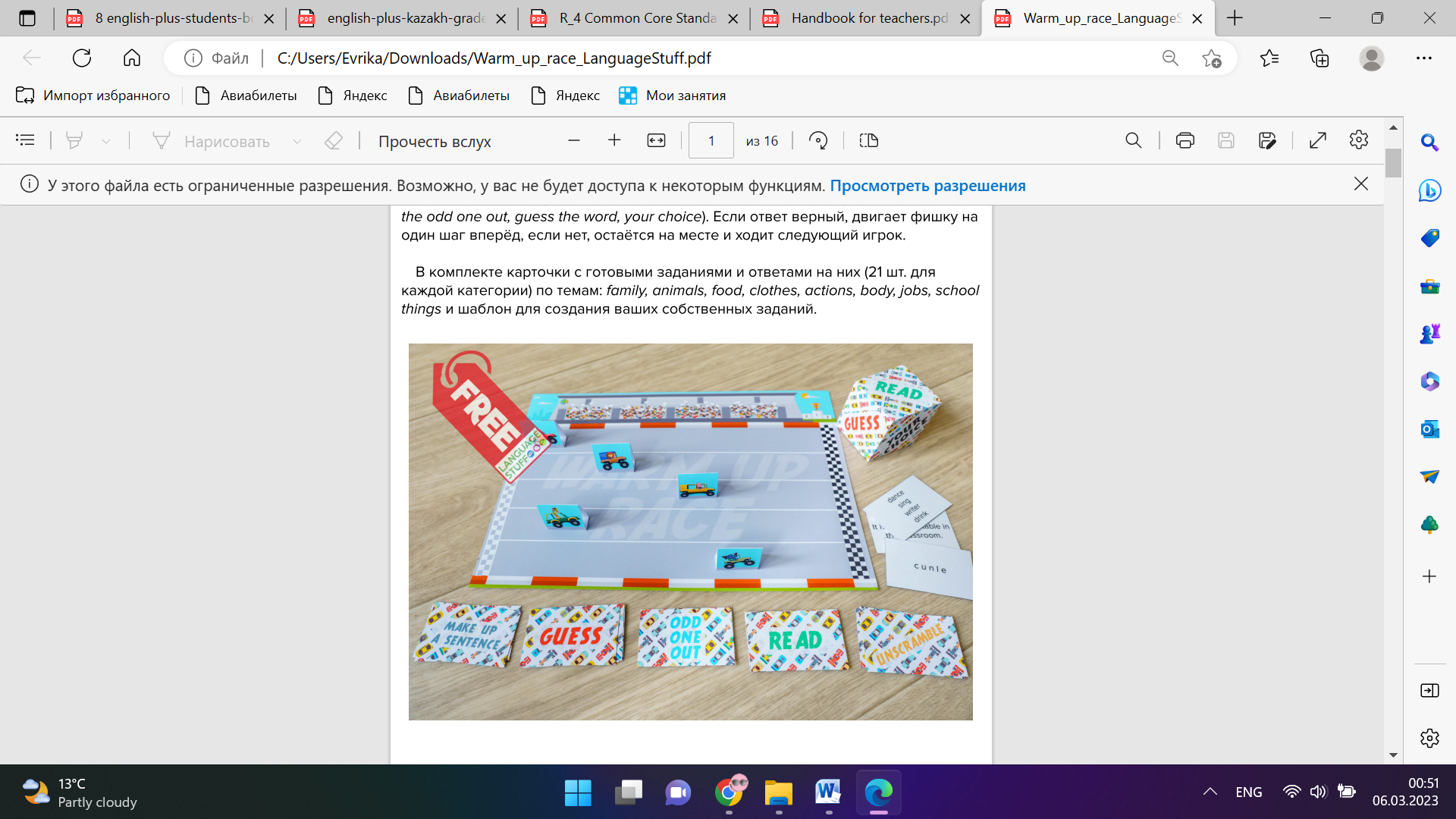
Fasten your seat belts and get ready for the all-round race Lead – In • With books closed, ask students if they watch the news or read newspapers. Ask them what issues in the world they care about. Elicit some examples, such as climate change, animal experiments, etc. • Ask students what they can do to change situations. Elicit some ideas. Encourage students to join in and express their opinions; there are no right or wrong answers. |
Students' attention is drawn to the lesson. Students discuss the pictures in pairs. Determines the topic and aim of the lesson Students say different words from the picture |
Formative Assessment
Good job! Assessment criteria -Identify detailed information in extended conversation with support |
Pictures Student’s book |
|
Middle of the lesson Presentation part. 35 min |
Ex: 1 P:92 • If necessary, allow students to use their dictionaries to check the meaning of the new words. • When checking answers, model and drill pronunciation of the words, paying attention to the change of stress between some nouns and verbs such as organize / organization. • Ask students to do the questionnaire individually, then compare their answers with a partner and discuss which is the best plan of action in each case. • Ask some students to report back to the class on their discussions. Encourage other students to agree or disagree with them. Ex: 2 P:92 • In a weaker class, help students understand the meaning of each sentence by reading through them all with the class and answering the question in the instructions before students listen. • In a stronger class, allow students time to read through the options before listening. Follow up by answering the question in the instructions. Ex: 3 P:92 • After students have completed the key phrases, read through them with the class. • After saying each phrase, elicit whether it is used to make a suggestion, or comment on a suggestion. Make suggestions: Let’s (organize a meeting). How about (starting an email campaign)? I think we should try … Why don’t we (boycott the shops)? I think the best thing to do is … We could write to the council Conclusion during the lesson some tasks differentiated by outcomes of the students and by their abilities. |
Students complete the table with the words in blue in the Plan of action questionnaire. Answers: 1 meeting 2 organize 3 march 4 donate 5 collection 6 protest 7 volunteer 8 supporter 9 sponsor 10 petition 11 ban 12 boycott 13 campaign Differentiation: «Verbal support» method is used to help Students use new words in the text. Students listen to two people discussing questionnaire. Match opinions with dialogues Answers: 1 e 2 a 3 c 4 d 5 b Sentences which express certainty: b, d and e Students complete the key phrases with the words in the box. Descriptor: - complete the key phrases Answers: 1 idea 2 help 3 about 4 think 5 don’t 6 work 7 thing 8 could |
Descriptor: - model and drill pronunciation of the words - complete the table with the words in blue Total: 1 point Descriptor: - listen to two people discussing questionnaire - Match opinions with dialogues Total: 1 point Descriptor: - complete the key phrases Total: 1 point . |
Cards Worksheets |
|
End of the lesson 5 min |
FEEDBACK Learners provide feedback on what they have learned at the lesson. |
|
Students evaluate each other and encourage classmate with phrases like: Well done! Brilliant! Good job! I like it! . |
Poster
|




Short term plan: term 4
|
Unit 8 Food and drink |
|
||
|
Teacher name: |
|
||
|
Date: |
|
||
|
Grade: 8 |
Number present: |
absent: |
|
|
Lesson title |
The food waste scandal |
||
|
Learning objectives |
8.1.8.1 develop intercultural awareness through reading and discussion 8.3.7.1 use appropriate subject-specific vocabulary and syntax to talk about a range of general topics, and some curricular topics 8.4.2.1 understand specific information and detail in texts on a growing range of familiar general and curricular topics, including some extended texts |
||
|
Lesson objectives |
Learners will be able to: • Read a text about freegans and food waste. • Read for general meaning and specific details. • Learn about negative prefixes un-, in- and im-. • Express opinions about a campaign against food waste. |
||
|
Value links |
Tradition: Kazakh traditions and culture have been passed on from one generation to another through oral histories told by traditional Kazakh tribal leaders and elders. |
||
|
Plan |
|||
|
Stages / Time |
Teachers’ actions |
Students’ actions |
Assessment criteria |
Resources |
|
Beginning of the lesson 5 min |
Organization moment 1.Greeting. Ask about the weather. The teacher sets the lesson objectives, letting students know what to anticipate from the lesson.
|

 Жүктеу



 Бұл курс Қазақстан Республикасы Оқу-ағарту министрлігімен келісілген