
 ЖИ көмекші


 Қауіпсіз төлем

жүктеу мүмкіндігіне ие боласыз
Бұл материал сайт қолданушысы жариялаған. Материалдың ішінде жазылған барлық ақпаратқа жауапкершілікті жариялаған қолданушы жауап береді. Ұстаз тілегі тек ақпаратты таратуға қолдау көрсетеді. Егер материал сіздің авторлық құқығыңызды бұзған болса немесе басқа да себептермен сайттан өшіру керек деп ойласаңыз осында жазыңыз
 02 Мамыр 2025
 391
391
1 жыл бойы шексіз жүктеңіз
қмж Excel-8, 4-тоқс
Short term plan: term 4
|
Unit 8: Food and drink |
Lesson 81 |
||
|
Teacher name: |
|
||
|
Date: |
|
||
|
Grade: 8 |
Number present: |
absent: |
|
|
Lesson title |
Reading: Festive food calendar |
||
|
Learning objectives |
8.6.17.1 use if / unless/ if only in second conditional clauses and wish [that] clauses [present reference]; use a growing variety of relative clauses including why clauses on a range of familiar general and curricular topics 8.5.3.1 write with moderate grammatical accuracy on a limited range of familiar general and curricular topics |
||
|
Lesson objectives |
Learners will be able to: - present foods and drinks - talk about foods and drinks |
||
|
Value links |
Hospitality: Traditionally a nomadic culture, hospitality has always been an important part of Kazakh culture. |
||
|
Plan |
|||
|
Stages / Time |
Teachers actions |
Students actions |
Assessment criteria |
Resources |
|
Beginning of the lesson Warming-up
3 min. Pre-learning «Brainstorming» method 7 min. |
Organization moment : 1.Greeting. Ask about the weather. The teacher sets the lesson objectives, letting students know what to anticipate from the lesson. Warming up Where are you from? How old are you? What color is it? How many students are there in class? What day of the week today? Lead – In
|
The aim: To develop pupils speaking skills and create friendly atmosphere Students of the class are listed. Students' attention is drawn to the lesson. Students say different words from the picture •Learners remember previous lesson vocabulary •Learners answer the questions |
The teacher to assess learners for their ability. “Good job! Well done!” Formative Assessment
Good job! Descriptor: - remembers the lesson passed Point 1 Assessment criteria Learners have met the learning objectives if they can talk about twenty thousand leagues under the sea |
Pictures worksheet Picture |
|
Middle of the lesson Presentation part. 30 min |
Ex:1 P:87 • Direct Ss to the pictures. • Play the recording. Ss listen and repeat chorally and/or individually. Ex: 2 P: 87 • Read the question and the example aloud and then ask various Ss to offer answers. Differentiation: «Verbal support» method is used to help Ss use new words in the sentences. Ex: 3 P: 87 •Read the question and the example aloud and then elicit answers from various Ss from around the class. Conclusion during the lesson some tasks differentiated by outcomes of the students and by their abilities. |
• Learners listen and repeat. ANSWERS Student’s own answer. • Learners which of the foods/drinks in the pictures would you eat/drink for breakfast? lunch? dinner? a snack? dessert? ANSWERS I’d eat pizza/roast chicken with potatoes and carrots/ grilled fish and rice for dinner. I’d eat salad/a burger for lunch. I’d eat cereal with milk/yoghurt for breakfast. I’d eat chocolate cake/yoghurt/fresh fruit for dessert. I’d drink orange juice for breakfast. I’d drink a milkshake for a snack • Learners which of the foods/drinks do you like eating/drinking? Why? ANSWERS I like eating chocolate cake because it is delicious. I like eating yoghurt because it is light. I like eating roast chicken with potatoes and carrots because it is filling. I like eating cereal because it is light. I like drinking orange juice because it is tasty. I like eating burgers because they are delicious. I like eating pizza because it is tasty. I like eating grilled fish and rice because it is nourishing. I like eating salad because it is healthy. I like drinking milkshakes because they are tasty. |
Descriptor: - look at the pictures - repeat chorally and/or individually. Total: 2point
Self assessment Descriptor: - read the question - answer the question Total: 2 point Descriptor: - read the question - answer the question Total: 2 point -Make CCQ questions Yes / No Total: 1 point. |
Card Worksheet Students book |
|
End of the lesson 5 min |
FEEDBACK Learners provide feedback on what they have learned at the lesson. Ex: P: Home task: Write the days |
|
Poster Success
|
|





Short term plan: term 4
|
Unit 8: Food and drink |
Lesson 82 |
||
|
Teacher name: |
|
||
|
Date: |
|
||
|
Grade: 8 |
Number present: |
absent: |
|
|
Lesson title |
Vocabulary: foods |
||
|
Learning objectives |
8.2.2.1 understand with little or no support most specific information in extended talk on a wide range of general and curricular topics 8.3.7.1 use appropriate subject-specific vocabulary and syntax to talk about a range of general topics, and some curricular topics 8.5.3.1 write with moderate grammatical accuracy on a limited range of familiar general and curricular topics |
||
|
Lesson objectives |
Learners will be able to: - introduce the topic; To listen and read for gist - read for specific information - consolidate comprehension of a text |
||
|
Value links |
Tradition: Kazakh traditions and culture have been passed on from one generation to another through oral histories told by traditional Kazakh tribal leaders and elders. |
||
|
Plan |
|||
|
Stages / Time |
Teachers actions |
Students actions |
Assessment criteria |
Resources |
|
Beginning of the lesson Warming-up
3 min. Pre-learning «Brainstorming» method 7 min. |
Organization moment : 1.Greeting. Ask about the weather. The teacher sets the lesson objectives, letting students know what to anticipate from the lesson. Warming up Where are you from? How old are you? What color is it? How many students are there in class? What day of the week today? Lead – In
|
The aim: To develop pupils speaking skills and create friendly atmosphere Students of the class are listed. Students' attention is drawn to the lesson. Students say different words from the picture •Learners remember previous lesson vocabulary •Learners answer the questions |
The teacher to assess learners for their ability. “Good job! Well done!” Formative Assessment
Good job! Descriptor: - remembers the lesson passed Point 1 Assessment criteria Learners have met the learning objectives if they can talk about twenty thousand leagues under the sea |
Pictures worksheet Picture |
|
Middle of the lesson Presentation part. 30 min |
Ex:1 P:88 • Ask Ss to look at the pictures and guess which festival each food is related to. • Play the recording. Ss listen and read the text and find out. • Refer Ss to the Word List to look up the words in the Check these words box. • Play the video for Ss and elicit their comments Ex: 2 P: 89 • Explain the task. • Allow Ss time to read the headings and then read the text again and complete the task. • Check Ss’ answers. Differentiation: «Verbal support» method is used to help Ss use new words in the sentences. Ex: 3 P: 89 • Read out the example question and answer and then ask Ss to ask and answer questions based on the text in closed pairs. • Monitor the activity around the class and then ask some Ss to ask and answer in front of the class. Ex: 4 P: 89 •Explain the task and give Ss time to complete it referring to the text as necessary. Ex: 5 P: 89 •Explain the task and give Ss time to use the underlined words/phrases in the text to complete the sentences. • Check Ss’ answers Ex: 6 P: 89 •Explain the task and give Ss time to complete it. • Ask Ss to check their answers in their dictionaries. Conclusion during the lesson some tasks differentiated by outcomes of the students and by their abilities. |
• Learners look at the pictures. Which festival is each food related to? Listen and read to find out. ANSWERS haggis – Burns Night minestrone – Sagra delle Virtú smoked fish – Midsummer hotdogs, corn on the cob – Independence Day jerk chicken – Notting Hill Carnival parkin – Bonfire Night Dundee cake – Hogmanay • Learners read the texts again and match the paragraphs to the headings. One heading is extra ANSWERS A 7 B 5 C 2 D 6 E 8 F 1 G 3 • Learners in pairs, ask and answer comprehension questions based on the text ANSWERS A: What do the Swedish and Finnish celebrate between 20th and 26th June? B: Midsummer. A: What do people do on 4th July in the USA? B: They watch fireworks, and have barbecues and picnics. A: What dish do people eat at the Notting Hill Carnival? B: They eat jerk chicken. A: When is Guy Fawkes’ Night? B: It is on 5th November. A: What is the New Year’s Eve celebration called in Scotland? B: It’s called Hogmanay • Learners complete the collocations. Use: thick, fireworks, dinner, vegetables, street, colourful ANSWERS 1 dinner 2 thick 3 vegetables 4 fireworks 5 street 6 colourful • Learners complete the sentences with one of the underlined words/phrases in the text. ANSWERS 1 main course 2 early hours 3 population 4 stuffed 5 ashes • Learners choose the correct word. Compare answers with your partner. Check in your dictionaries ANSWERS 1 bitter 2 still 3 spicy 4 grate 5 dessert 6 recipe |
Descriptor: - look at the pictures - answer the question Total: 2point
Self assessment Descriptor: - read the text - match the paragraphs to the headings Total: 2 point Descriptor: - in pairs, ask and answer - answer the question Total: 2 point -Make CCQ questions Yes / No Total: 1 point. Descriptor: - complete the collocations - Use: thick, fireworks, dinner, vegetables, street, colourful Total: 2 point Descriptor: - complete the sentences - complete the sentences Total: 2 point Descriptor: - complete the collocations - compare answers with your partner Total: 2 point |
Card Worksheet Students book |
|
End of the lesson 5 min |
FEEDBACK Learners provide feedback on what they have learned at the lesson. Ex: P: Home task: Write the days |
|
Poster Success
|
|

Short term plan: term 4
|
Unit 8: Food and drink |
Lesson 83 |
||
|
Teacher name: |
|
||
|
Date: |
|
||
|
Grade: 8 |
Number present: |
absent: |
|
|
Lesson title |
Use of English: Countable and uncountable nouns |
||
|
Learning objectives |
8.1.6.1 organize and present information clearly to others 8.6.8.1 use a growing variety of future forms including present continuous and present simple with future meaning on a range of familiar general and curricular topics 8.5.3.1 write with moderate grammatical accuracy on a limited range of familiar general and curricular topics |
||
|
Lesson objectives |
Learners will be able to: -present countable/uncountable & quantifiers - practise using countable/uncountable & quantifiers - present vocabulary related to food/drinks |
||
|
Value links |
Freedom: Freedom is the major value of the civil society being formed in Kazakhstan. This must provide everyone with the possibility of creative self-realization. |
||
|
Plan |
|||
|
Stages / Time |
Teachers actions |
Students actions |
Assessment criteria |
Resources |
|
Beginning of the lesson Warming-up
3 min. Pre-learning «Brainstorming» method 7 min. |
Organization moment : 1.Greeting. Ask about the weather. The teacher sets the lesson objectives, letting students know what to anticipate from the lesson. Warming up Where are you from? How old are you? What color is it? How many students are there in class? What day of the week today? Lead – In
|
The aim: To develop pupils speaking skills and create friendly atmosphere Students of the class are listed. Students' attention is drawn to the lesson. Students say different words from the picture •Learners remember previous lesson vocabulary •Learners answer the questions |
The teacher to assess learners for their ability. “Good job! Well done!” Formative Assessment
Good job! Descriptor: - remembers the lesson passed Point 1 Assessment criteria Learners have met the learning objectives if they can talk about twenty thousand leagues under the sea |
Pictures worksheet Picture |
|
Middle of the lesson Presentation part. 30 min |
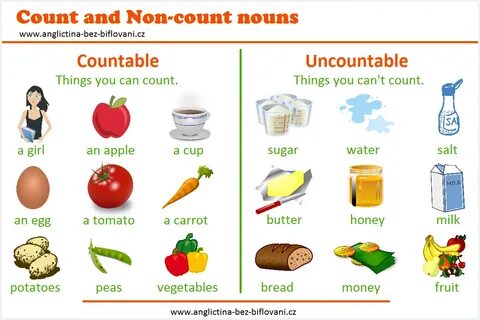
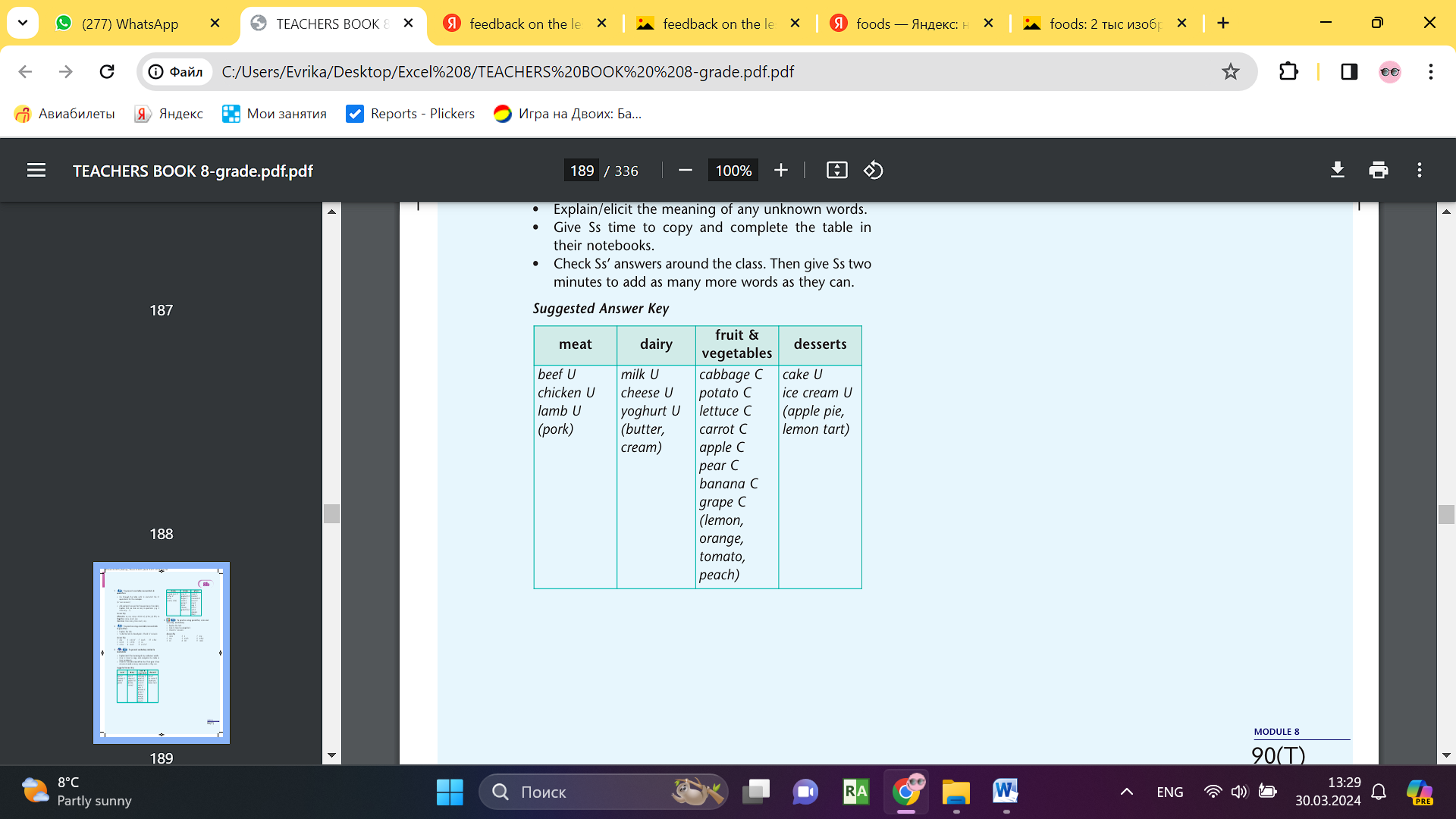
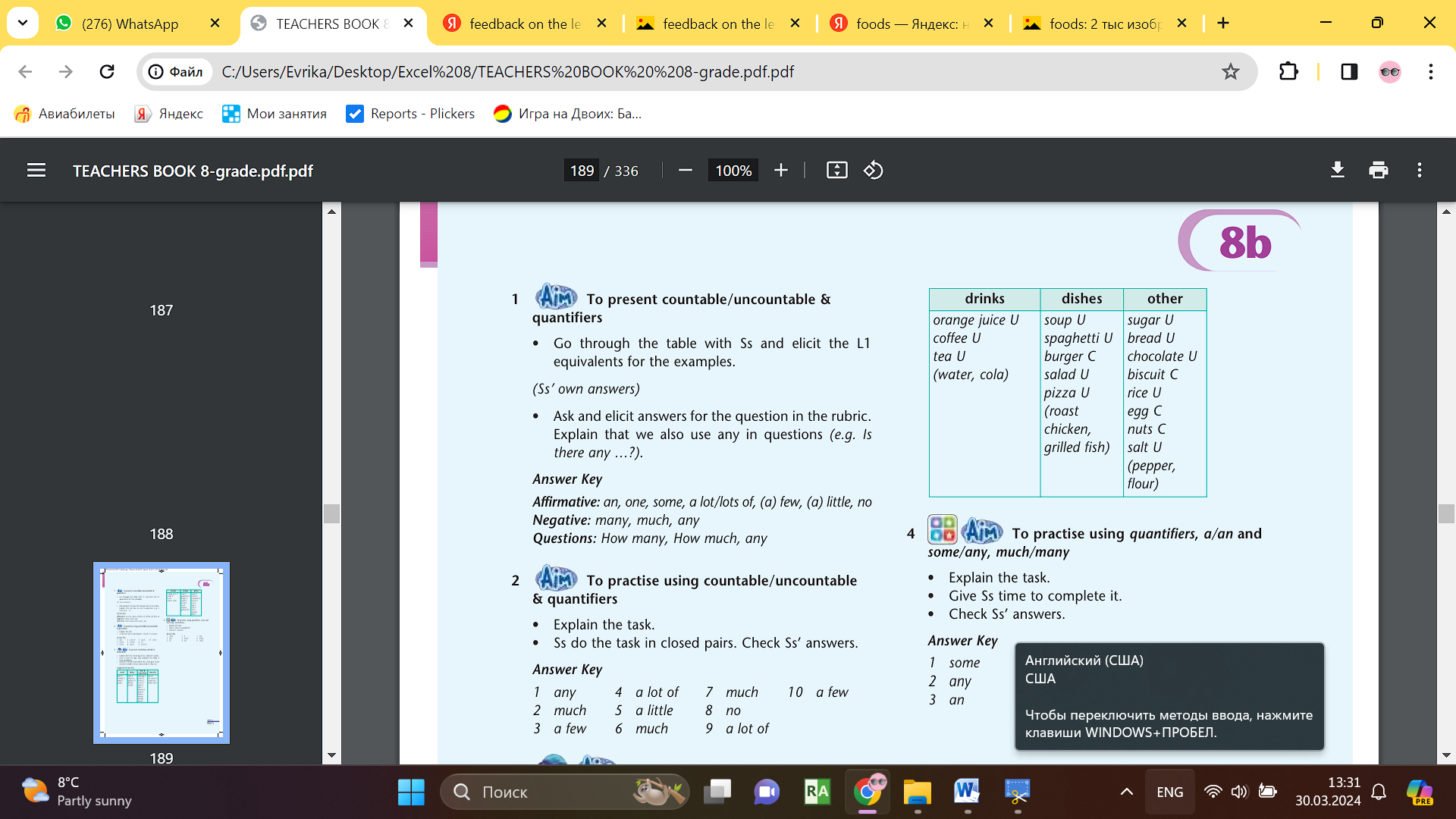
Ex:1 P:90 • Go through the table with Ss and elicit the L1 equivalents for the examples. (Ss’ own answers) • Ask and elicit answers for the question in the rubric. Explain that we also use any in questions (e.g. Is there any …?). Ex: 2 P: 90 •Explain the task. • Ss do the task in closed pairs. Check Ss’ answers. Differentiation: «Verbal support» method is used to help Ss use new words in the sentences. Ex: 3 P: 90 • Explain/elicit the meaning of any unknown words. • Give Ss time to copy and complete the table in their notebooks. • Check Ss’ answers around the class. Then give Ss two minutes to add as many more words as they can. Ex: 4 P: 90 • Explain the task. • Give Ss time to complete it. • Check Ss’ answers. Conclusion during the lesson some tasks differentiated by outcomes of the students and by their abilities. |
• Learners read the theory and say the examples in your language. Which of the words in bold do we use in ANSWERS Affirmative: an, one, some, a lot/lots of, (a) few, (a) little, no Negative: many, much, any Questions: How many, How much, any • Learners choose the correct words. ANSWERS 1 any 2 much 3 a few 4 a lot of 5 a little 6 much 7 much 8 no 9 a lot of 10 a few • Learners copy the table in your notebook and list the words under the headings. In two minutes, add as many more words as you can. Then write C for countable or U for uncountable. ANSWERS
• Learners complete the dialogue. Use: much, many, a, an, some, any. ANSWERS 1 some 2 any 3 an 4 a 5 much 6 lots 7 any 8 many 9 some |
Descriptor: - read the theory - answers for the question Total: 2point
Self assessment Descriptor: - do the task - answers for the question Total: 2 point Descriptor: - copy the table - add as many more words as you can Total: 2 point Descriptor: - complete the dialogue. - complete the dialogue. Total: 2 point -Make CCQ questions Yes / No Total: 1 point. |
Card Worksheet Students book |
|
End of the lesson 5 min |
FEEDBACK Learners provide feedback on what they have learned at the lesson. Ex: P: Home task: Write the days |
|
Poster Success
|
|
Short term plan: term 4
|
Unit 8: Food and drink |
Lesson 84 |
||
|
Teacher name: |
|
||
|
Date: |
|
||
|
Grade: 8 |
Number present: |
absent: |
|
|
Lesson title |
Use of English: word formation |
||
|
Learning objectives |
8.2.5.1 recognise the opinion of the speaker(s) with little or no support in extended talk on a wide range of general and curricular topics 8.3.7.1 use appropriate subject-specific vocabulary and syntax to talk about a range of general topics, and some curricular topics |
||
|
Lesson objectives |
Learners will be able to: - present several, plenty of, (a large/small) amount/number - practise several, plenty of, (a large/ small) amount/number - Practising word formation (verb suffixes) |
||
|
Value links |
Patriotism: The formation of civil society institutions is impossible without the development of a patriotism shared by the entire Kazakhstan, and with deep roots in the culture, psychology, and historical past of the Kazakhs. |
||
|
Plan |
|||
|
Stages / Time |
Teachers actions |
Students actions |
Assessment criteria |
Resources |
|
Beginning of the lesson Warming-up
3 min. Pre-learning «Brainstorming» method 7 min. |
Organization moment : 1.Greeting. Ask about the weather. The teacher sets the lesson objectives, letting students know what to anticipate from the lesson. Warming up Where are you from? How old are you? What color is it? How many students are there in class? What day of the week today? Lead – In
|
The aim: To develop pupils speaking skills and create friendly atmosphere Students of the class are listed. Students' attention is drawn to the lesson. Students say different words from the picture •Learners remember previous lesson vocabulary •Learners answer the questions |
The teacher to assess learners for their ability. “Good job! Well done!” Formative Assessment
Good job! Descriptor: - remembers the lesson passed Point 1 Assessment criteria Learners have met the learning objectives if they can talk about twenty thousand leagues under the sea |
Pictures worksheet Picture |
|
Middle of the lesson Presentation part. 30 min |
Ex:5a P:91 • Go through the table with Ss and elicit the L1 equivalents for the examples. (Ss’ own answers) • Ask the question in the rubric and elicit answers from Ss around the class. Ex: 5b P: 901 • Explain the task. • Give Ss time to complete it. • Check Ss’ answers. Differentiation: «Verbal support» method is used to help Ss use new words in the sentences. Ex: 6 P: 91 • Read out the containers in the list and ask Ss to complete the gaps under the pictures with them. • Play the recording for Ss to listen an check their answers Ex: 7 P: 91 • Ask Ss to read the theory box and then explain the task. • Give Ss time to complete the task and then check their answers. Ex: 8 P: 91 • Go through the table with Ss and explain any points they are unsure of. • Give Ss time to complete the sentences and then check Ss’ answers.. Conclusion during the lesson some tasks differentiated by outcomes of the students and by their abilities. |
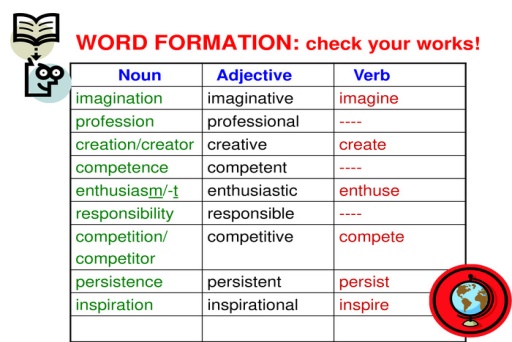
• Learners read the examples. Say them in your language. How do we use the words in bold? ANSWERS We use plenty of with countable and uncountable nouns. We use several only with countable nouns to express a small number of something. We use (a large/small) amount of with uncountable nouns. We use (a large/small) number of with countable nouns. • Learners fill in: plenty, several, amount, number ANSWERS 1 several 2 number 3 plenty 4 amount • Learners fill in: box, bag, can, bottle, packet, cartoon. ANSWERS 1 box 3 bag 5 carton 2 bottle 4 packet 6 can • Learners read the theory. Form verbs from the words in brackets in the correct form ANSWERS 1 strengthen 2 classify 3 specialise 4 formulating • Learners read the theory, then complete the sentences. Use: all, both or half. ANSWERS 1 Both 2 all 3 half 4 Both |
Descriptor: - read the examples - answers for the question Total: 2point
Self assessment Descriptor: - fill the gaps Total: 2 point Descriptor: - fill the gaps Total: 2 point Descriptor: - read the theory. - complete the sentences Total: 2 point Descriptor: - read the theory. - complete the sentences Total: 2 point -Make CCQ questions Yes / No Total: 1 point. |
Card Worksheet Students book |
|
End of the lesson 5 min |
FEEDBACK Learners provide feedback on what they have learned at the lesson. Ex: P: Home task: Write the days |
|
Poster Success
|
|
Short term plan: term 4
|
Unit 8: Food and drink |
Lesson 85 |
||
|
Teacher name: |
|
||
|
Date: |
|
||
|
Grade: 8 |
Number present: |
absent: |
|
|
Lesson title |
Reading: food for thought |
||
|
Learning objectives |
8.1.7.1 develop and sustain a consistent argument when speaking or writing 8.3.7.1 use appropriate subject-specific vocabulary and syntax to talk about a range of general topics, and some curricular topics 8.5.1.1 plan, write, edit and proofread work at text level with little support on a range of general and curricular topics |
||
|
Lesson objectives |
Learners will be able to: -listen and read for gist - read for specific information - assess acquired knowledge from a text, to express an opinion |
||
|
Value links |
Respect: Respect of elders and of the spiritual freedom of other nations are principal values. It is important to develop a productive dialogue between confessions and to acknowledge religion as an element of civil society. |
||
|
Plan |
|||
|
Stages / Time |
Teachers actions |
Students actions |
Assessment criteria |
Resources |
|
Beginning of the lesson Warming-up
3 min. Pre-learning «Brainstorming» method 7 min. |
Organization moment : 1.Greeting. Ask about the weather. The teacher sets the lesson objectives, letting students know what to anticipate from the lesson. Warming up Where are you from? How old are you? What color is it? How many students are there in class? What day of the week today? Lead – In
|
The aim: To develop pupils speaking skills and create friendly atmosphere Students of the class are listed. Students' attention is drawn to the lesson. Students say different words from the picture •Learners remember previous lesson vocabulary •Learners answer the questions |
The teacher to assess learners for their ability. “Good job! Well done!” Formative Assessment
Good job! Descriptor: - remembers the lesson passed Point 1 Assessment criteria Learners have met the learning objectives if they can talk about twenty thousand leagues under the sea |
Pictures worksheet Picture |
|
Middle of the lesson Presentation part. 30 min |
Ex:1 P:92 • Ask Ss to look at the picture and read the title of the text. • Elicit Ss’ guesses as to what the text is about. • Play the recording. Ss read the text and find out. Ex: 2 P: 92 •Ask Ss to read the questions and answer choices 1-3. • Give Ss time to read the text and complete the task. • Check Ss’ answers around the class. Differentiation: «Verbal support» method is used to help Ss use new words in the sentences. Ex: 3 P: 92 • Ask Ss to discuss the questions in pairs. • Monitor the activity around the class and then ask various Ss to tell the class. Conclusion during the lesson some tasks differentiated by outcomes of the students and by their abilities. |
• Learners look at the picture and the title of the text. How do you think food is related to our brain? ANSWERS I think food affects how the brain works. • Learners read again and choose the correct answer ANSWERS 1 A 2 C 3 C • Learners what did you learn from the text? How can this information help you? Tell the class. ANSWERS I learnt about how food affects the functions in the brain. I will try to eat more protein and fatty acids to help my brain be healthy |
Descriptor: - look at the picture - answers for the question Total: 2point
Self assessment Descriptor: - read again - choose the correct answer Total: 2 point Descriptor: - discuss the questions in pairs. - tell the class Total: 2 point -Make CCQ questions Yes / No Total: 1 point. |
Card Worksheet Students book |
|
End of the lesson 5 min |
FEEDBACK Learners provide feedback on what they have learned at the lesson. Ex: P: Home task: Write the days |
|
Poster Success
|
|

Short term plan: term 4
|
Unit 8: Food and drink |
Lesson 86 |
||
|
Teacher name: |
|
||
|
Date: |
|
||
|
Grade: 8 |
Number present: |
absent: |
|
|
Lesson title |
Phrasal verbs (break) |
||
|
Learning objectives |
8.3.7.1 use appropriate subject-specific vocabulary and syntax to talk about a range of general topics, and some curricular topics 8.6.3.1 use a growing variety of compound adjectives and adjectives as participles and some comparative structures including not as…as, much …than to indicate degree on a range of familiar general and curricular topics |
||
|
Lesson objectives |
Learners will be able to: - present and practise prepositional phrases - present and practise phrasal verbs with break - talk about eating habits |
||
|
Value links |
Respect - treating people with respect, value and courtesy. Especially apologising to them where the situation calls for it. |
||
|
Plan |
|||
|
Stages / Time |
Teachers actions |
Students actions |
Assessment criteria |
Resources |
|
Beginning of the lesson Warming-up
3 min. Pre-learning «Brainstorming» method 7 min. |
Organization moment : 1.Greeting. Ask about the weather. The teacher sets the lesson objectives, letting students know what to anticipate from the lesson. Warming up Where are you from? How old are you? What color is it? How many students are there in class? What day of the week today? Lead – In
|
The aim: To develop pupils speaking skills and create friendly atmosphere Students of the class are listed. Students' attention is drawn to the lesson. Students say different words from the picture •Learners remember previous lesson vocabulary •Learners answer the questions |
The teacher to assess learners for their ability. “Good job! Well done!” Formative Assessment
Good job! Descriptor: - remembers the lesson passed Point 1 Assessment criteria Learners have met the learning objectives if they can talk about twenty thousand leagues under the sea |
Pictures worksheet Picture |
|
Middle of the lesson Presentation part. 30 min |
Ex:4 P:93 • Explain the task and give Ss some time to complete it then check Ss’ answers. Ex: 5 P: 93 • Read out the box and explain the task. • Give Ss time to complete the task. • Check Ss’ answers. Differentiation: «Verbal support» method is used to help Ss use new words in the sentences. Ex: 6 P: 93 • Explain the task and ask Ss to look at the gapped text and think about what the missing information might be. • Play the recording. Ss listen and complete the blanks 1-5. • Check Ss’ answers . Ex: 7 P: 93 • Ask Ss to talk in pairs about their eating habits using the table to help them. • Monitor the activity around the class and then ask various Ss to tell the rest of the class. Conclusion during the lesson some tasks differentiated by outcomes of the students and by their abilities. |
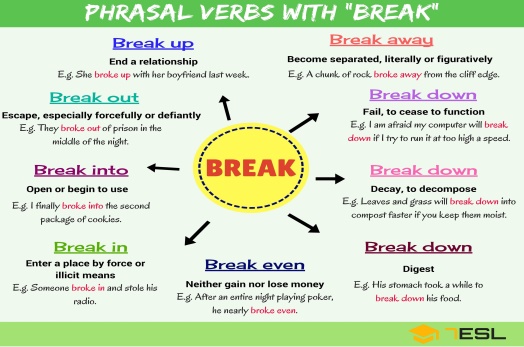
• Learners complete with: in (x2), for, on, at. ANSWERS 1 At 2 in 3 on 4 for 5 in • Learners read the box and complete the sentences. ANSWERS 1 out 2 down 3 into 4 up • Learners listen to a boy called Kairat talking about his family’s eating habits. Fill in the gaps ANSWERS 1 cereal 2 apple 3 beef 4 ice cream 5 cake • Learners what do you eat/drink every day? Use the phrases to tell your partner. ANSWERS I don’t eat any cake or biscuits, but I eat some sweets from time to time. I don’t drink any milk, but I eat a lot of fruit. |
Descriptor: - fill the gaps - complete the task. Total: 2point
Self assessment Descriptor: - read the box - complete the sentences Total: 2 point Descriptor: - complete the sentences - answer the question Total: 2 point -Make CCQ questions Yes / No Total: 1 point. |
Card Worksheet Students book |
|
End of the lesson 5 min |
FEEDBACK Learners provide feedback on what they have learned at the lesson. Ex: P: Home task: Write the days |
|
Poster Success
|
|
Short term plan: term 4
|
Unit 8: Food and drink |
Lesson 87 |
||
|
Teacher name: |
|
||
|
Date: |
|
||
|
Grade: 8 |
Number present: |
absent: |
|
|
Lesson title |
Everyday English: Ordering breakfast |
||
|
Learning objectives |
8.1.10.1 use talk or writing as a means of reflecting on and exploring a range of perspectives on the world 8.3.7.1 use appropriate subject-specific vocabulary and syntax to talk about a range of general topics, and some curricular topics |
||
|
Lesson objectives |
Learners will be able to: - listen and read for gist - learn synonymous phrases |
||
|
Value links |
Respect - treating people with respect, value and courtesy. Especially apologising to them where the situation calls for it. |
||
|
Plan |
|||
|
Stages / Time |
Teachers actions |
Students actions |
Assessment criteria |
Resources |
|
Beginning of the lesson Warming-up
3 min. Pre-learning «Brainstorming» method 7 min. |
Organization moment : 1.Greeting. Ask about the weather. The teacher sets the lesson objectives, letting students know what to anticipate from the lesson. Warming up Where are you from? How old are you? What color is it? How many students are there in class? What day of the week today? Lead – In
|
The aim: To develop pupils speaking skills and create friendly atmosphere Students of the class are listed. Students' attention is drawn to the lesson. Students say different words from the picture •Learners remember previous lesson vocabulary •Learners answer the questions |
The teacher to assess learners for their ability. “Good job! Well done!” Formative Assessment
Good job! Descriptor: - remembers the lesson passed Point 1 Assessment criteria Learners have met the learning objectives if they can talk about twenty thousand leagues under the sea |
Pictures worksheet Picture |
|
Middle of the lesson Presentation part. 30 min |
Ex:1 P:94 •Refer Ss to the first and last sentences in the dialogue and elicit Ss’ guesses as to what the dialogue is about. • Play the recording. Ss listen and read the text and find out. Ex: 2 P: 94 • Read out the phrases. Refer Ss back to the dialogue and elicit which of the underlined phrases are synonymous with each one from various Ss around the class. Differentiation: «Verbal support» method is used to help Ss use new words in the sentences. Ex: 3 P: 94 • Explain the situation and ask Ss to read the menu. • Remind Ss that they can use the dialogue in Ex. 1 as a model as well as any ideas of their own to complete the task. • Ss complete the task in pairs. To help Ss, draw the following diagram on the board and elicit appropriate phrases Ss should use. Write them on the board. Ss can refer to the diagram while doing the task. Ex: 4 P: 94 • Play the recording with pauses for Ss to repeat chorally and/or individually. • Check Ss’ intonation. Conclusion during the lesson some tasks differentiated by outcomes of the students and by their abilities. |
• Learners read the first and the last exchange in the dialogue. Answer the question. ANSWERS The dialogue is about someone who is ordering breakfast. • Learners match the underlined phrases in the dialogue with the ones from the list below. ANSWERS Is it too late to order breakfast? = Are you still serving breakfast? I’d prefer something lighter. = I don’t want to eat a heavy meal What would you like to drink? = What about a beverage? Can I get you anything else? = Would you like anything else? I’ll bring you your order in a moment. = Your meal will be ready soon. • Learners look at the menu. In pairs, act out a dialogue similar to the one in Ex. 1. ANSWERS A: Good morning. What can I get you? B: Hi. Are you still serving breakfast? A: Yes, we serve breakfast until noon. And we’ve got a special offer today – our full English is £6. B: Oh. Can I have the full English, then please? A: Yes, of course. What would you like to drink? B: I’d like tea, please. A: Can I get you anything else? B: No, thanks. A: OK. Your meal will be ready soon. B: Thanks. • Learners listen and repeat. ANSWERS Student’s own answer. . |
Descriptor: - read the first - answer the question. Total: 2point
Self assessment Descriptor: - read out the phrases - match the underlined phrases Total: 2 point Descriptor: - look at the menu. - act out a dialogue similar Total: 2 point Descriptor: - listen and repeat. Total: 2 point -Make CCQ questions Yes / No Total: 1 point. |
Card Worksheet Students book |
|
End of the lesson 5 min |
FEEDBACK Learners provide feedback on what they have learned at the lesson. Ex: P: Home task: Write the days |
|
Poster Success
|
|

Short term plan: term 4
|
Unit 8: Food and drink |
Lesson 88 |
||
|
Teacher name: |
|
||
|
Date: |
|
||
|
Grade: 8 |
Number present: |
absent: |
|
|
Lesson title |
Across culture: The best way to start the day |
||
|
Learning objectives |
8.1.5.1 use feedback to set personal learning objectives 8.2.5.1 recognise the opinion of the speaker(s) with little or no support in extended talk on a wide range of general and curricular topics 8.5.3.1 write with moderate grammatical accuracy on a limited range of familiar general and curricular topics |
||
|
Lesson objectives |
Learners will be able to: - introduce the topic; to read for gist - read and listen for key information; to compare breakfast habits of two countries |
||
|
Value links |
Respect - treating people with respect, value and courtesy. Especially apologising to them where the situation calls for it. |
||
|
Plan |
|||
|
Stages / Time |
Teachers actions |
Students actions |
Assessment criteria |
Resources |
|
Beginning of the lesson Warming-up
3 min. Pre-learning «Brainstorming» method 7 min. |
Organization moment : 1.Greeting. Ask about the weather. The teacher sets the lesson objectives, letting students know what to anticipate from the lesson. Warming up Where are you from? How old are you? What color is it? How many students are there in class? What day of the week today? Lead – In
|
The aim: To develop pupils speaking skills and create friendly atmosphere Students of the class are listed. Students' attention is drawn to the lesson. Students say different words from the picture •Learners remember previous lesson vocabulary •Learners answer the questions |
The teacher to assess learners for their ability. “Good job! Well done!” Formative Assessment
Good job! Descriptor: - remembers the lesson passed Point 1 Assessment criteria Learners have met the learning objectives if they can talk about |
Pictures worksheet Picture |
|
Middle of the lesson Presentation part. 30 min |
Ex:1 P:95 •Direct Ss' attention to the title of the text and the pictures and elicit how breakfast in the UK is similar/different to breakfast in Kazakhstan. • Allow Ss time to read through the texts and find out. Ex: 2 P: 95 • Explain the task. • Play the audio and ask Ss to listen and follow the text in their books. • Then ask Ss to compare the breakfast habits of people in the UK and in Kazakhstan in pairs following the example. • Monitor the activity around the class and then ask some Ss to tell the class Differentiation: «Verbal support» method is used to help Ss use new words in the sentences. Ex: 3 P: 95 • Explain the task and tell Ss they must research online and collect information about lunch foods in the UK and in Kazakhstan and then write a short text. • Assign the task as HW. • Ask Ss to read their texts to the class. Conclusion during the lesson some tasks differentiated by outcomes of the students and by their abilities. |
• Learners read through to find out. How similar/different is the breakfast in the UK and Kazakhstan? ANSWERS Both countries have a simple breakfast during the week. Both nations have porridge as a breakfast dish and both the British and the Kazakhs drink tea • Learners read and listen to the texts. Compare the breakfast habits of people in the UK and Kazakhstan. ANSWERS A typical British breakfast includes fried eggs, bacon, sausages, baked beans and toast. It can also include black pudding, fried mushrooms and tomatoes. A typical Kazakh breakfast includes lots of dairy-based products such as milk and ayran. During the week, both British and Kazakh people might eat porridge, or bread with different toppings. The British eat toast with butter and jam or marmalade, or breakfast cereal, while the Kazakhs eat fried eggs, bread, jam, milk and berries. People from both countries drink tea with breakfast • Learners in groups, collect information about the typical food people eat in the UK and Kazakhstan for lunch. Write a text. Read it to the class. ANSWERS A typical lunch in the UK is a sandwich with a packet of crisps, some fruit, and a drink. Cheese, ham or chicken sandwiches are popular. Alternatively, soup is a popular lunch choice. The exception is on Sundays, when a full meal of roast meat and vegetables is served in the middle of the day. Lunch in Kazkahstan is very different. It is a large, cooked meal. |
Descriptor: - read the text - answer the question. Total: 2point
Self assessment Descriptor: - read and listen to the texts - compare the breakfast habits Total: 2 point Descriptor: - collect information - write a text Total: 2 point -Make CCQ questions Yes / No Total: 1 point. |
Card Worksheet Students book |
|
End of the lesson 5 min |
FEEDBACK Learners provide feedback on what they have learned at the lesson. Ex: P: Home task: Write the days |
|
Poster Success
|
|

Short term plan: term 4
|
Unit 8: Food and drink |
Lesson 89 |
||
|
Teacher name: |
|
||
|
Date: |
|
||
|
Grade: 8 |
Number present: |
absent: |
|
|
Lesson title |
Across the curriculum: food labeling |
||
|
Learning objectives |
8.1.5.1 use feedback to set personal learning objectives 8.2.5.1 recognise the opinion of the speaker(s) with little or no support in extended talk on a wide range of general and curricular topics 8.5.3.1 write with moderate grammatical accuracy on a limited range of familiar general and curricular topics |
||
|
Lesson objectives |
Learners will be able to: - introduce the topic and listen and read for gist - read for specific information - consolidate comprehension of a text |
||
|
Value links |
Respect - treating people with respect, value and courtesy. Especially apologising to them where the situation calls for it. |
||
|
Plan |
|||
|
Stages / Time |
Teachers actions |
Students actions |
Assessment criteria |
Resources |
|
Beginning of the lesson Warming-up
3 min. Pre-learning «Brainstorming» method 7 min. |
Organization moment : 1.Greeting. Ask about the weather. The teacher sets the lesson objectives, letting students know what to anticipate from the lesson. Warming up Where are you from? How old are you? What color is it? How many students are there in class? What day of the week today? Lead – In
|
The aim: To develop pupils speaking skills and create friendly atmosphere Students of the class are listed. Students' attention is drawn to the lesson. Students say different words from the picture •Learners remember previous lesson vocabulary •Learners answer the questions |
The teacher to assess learners for their ability. “Good job! Well done!” Formative Assessment
Good job! Descriptor: - remembers the lesson passed Point 1 Assessment criteria Learners have met the learning objectives if they can talk about |
Pictures worksheet Picture |
|
Middle of the lesson Presentation part. 30 min |
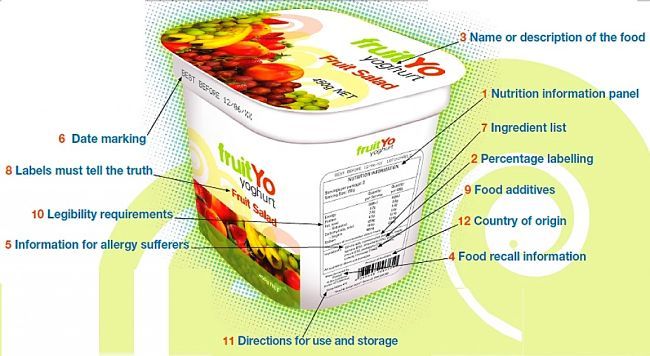
Ex:1 P:96 Ask Ss to look at the labels. • Elicit Ss’ guesses as to what they are for. • Play the recording. Ss listen and read the text and find out. Ex: 2 P: 96 • Ask Ss to read the statements 1-5. • Give Ss time to read the text again and complete the task. • Check Ss’ answers around the class Differentiation: «Verbal support» method is used to help Ss use new words in the sentences. Ex: 3 P: 96 • Give Ss time to read the text again and formulate their answers. • Then ask various Ss to tell the class. Ex: 4 P: 96 Ask Ss to work in small groups and collect labels from various food products in their country. • Then ask various groups of Ss to present them to the class. Conclusion during the lesson some tasks differentiated by outcomes of the students and by their abilities. |
• Learners look at the labels. What are they for? Listen and read to find out. ANSWERS The labels are found on food products and give information about storage, ingredients, nutrition and more. • Learners read the text again and mark statements as T (true), F (false) or DS (doesn’t say). Correct the false statements ANSWERS 1 F 2 F 3 T 4 DS 5 T • Learners do you think it’s important to have labels on food products? Why? Discuss. ANSWERS I think it is important for food products to have labels so we can know exactly what we are eating and make informed decisions about products before we buy them. • Learners look at the packaging of products in your country. Collect as many labels as you can. Present them to the class. ANSWERS Ss’ own answers |
Descriptor: - look at the labels - listen and read to find out Total: 2point
Self assessment Descriptor: - read the text again - mark statements Total: 2 point Descriptor: - read the text - answer the question Total: 2 point Descriptor: - look at the packaging of products - collect as many labels Total: 2 point -Make CCQ questions Yes / No Total: 1 point. |
Card Worksheet Students book |
|
End of the lesson 5 min |
FEEDBACK Learners provide feedback on what they have learned at the lesson. Ex: P: Home task: Write the days |
|
Poster Success
|
|
Short term plan: term 4
|
Unit 8: Food and drink |
Lesson 90 |
||
|
Teacher name: |
|
||
|
Date: |
|
||
|
Grade: 8 |
Number present: |
absent: |
|
|
Lesson title |
Writing: An email describing how to make your favorite food Summative assessment for the unit 8 |
||
|
Learning objectives |
8.5.1.1 plan, write, edit and proofread work at text level with little support on a range of general and curricular topics 8.2.5.1 recognise the opinion of the speaker(s) with little or no support in extended talk on a wide range of general and curricular topics |
||
|
Lesson objectives |
Learners will be able to: - read for specific information - read for cohesion and coherence - practise saying measurements |
||
|
Value links |
Respect - treating people with respect, value and courtesy. Especially apologising to them where the situation calls for it. |
||
|
Plan |
|||
|
Stages / Time |
Teachers actions |
Students actions |
Assessment criteria |
Resources |
|
Beginning of the lesson Warming-up
3 min. Pre-learning «Brainstorming» method 7 min. |
Organization moment : 1.Greeting. Ask about the weather. The teacher sets the lesson objectives, letting students know what to anticipate from the lesson. Warming up Where are you from? How old are you? What color is it? How many students are there in class? What day of the week today? Lead – In
|
The aim: To develop pupils speaking skills and create friendly atmosphere Students of the class are listed. Students' attention is drawn to the lesson. Students say different words from the picture •Learners remember previous lesson vocabulary •Learners answer the questions |
The teacher to assess learners for their ability. “Good job! Well done!” Formative Assessment
Good job! Descriptor: - remembers the lesson passed Point 1 Assessment criteria Learners have met the learning objectives if they can talk about |
Pictures worksheet Picture |
|
Middle of the lesson Presentation part. 30 min |
Ex:1 P:97 Ask Ss to read the text and then elicit answers to the questions. Ex: 2 P: 97 • Explain the task and ask Ss to read the email again. Give Ss time to complete the task using their dictionaries as necessary. • Play the recording for Ss to listen and check their answers. Differentiation: «Verbal support» method is used to help Ss use new words in the sentences. Ex: 3 P: 97 • Ask Ss to look at the recipe for chocolate cake and read the box explaining measurements and ask and answer in pairs following the example. • Monitor the activity around the class and then ask some Ss to ask and answer in front of the class. Summative assessment for the unit 8 Conclusion during the lesson some tasks differentiated by outcomes of the students and by their abilities. |
• Learners look at the email. Who is writing it? What is it about? Read and check. ANSWERS The writer is Luiza. It is about a recipe for a dish. • Learners complete the gaps with: chop, grate, pour, boil, fry, sprinkle, peel. Use your dictionaries. Listen and check. ANSWERS 1 Chop 2 grate 3 peel 4 Fry 5 boil 6 Pour 7 sprinkle • Learners look at the ingredients. Ask and answer. ANSWERS A: How much sugar do we need? B: 150 g. How much cocoa powder do we need? A: 100 g. How much baking powder do we need? B: 2 tsp. How many eggs do we need? A: Three. How much milk do we need? B: 250 ml. How much butter do we need? A: 250 g. |
Descriptor: - look at the email - read and check. Total: 2point
Self assessment Descriptor: - complete the gaps - use your dictionaries Total: 2 point Descriptor: - look at the ingredients - answer the question Total: 2 point -Make CCQ questions Yes / No Total: 1 point. |
Card Worksheet Students book |
|
End of the lesson 5 min |
FEEDBACK Learners provide feedback on what they have learned at the lesson. Ex: P: Home task: Write the days |
|
Poster Success
|
|

Short term plan: term 4
|
Unit 8: Food and drink |
Lesson 91 |
||
|
Teacher name: |
|
||
|
Date: |
|
||
|
Grade: 8 |
Number present: |
absent: |
|
|
Lesson title |
Edutainment |
||
|
Learning objectives |
8.1.10.1 use talk or writing as a means of reflecting on and exploring a range of perspectives on the world 8.3.7.1 use appropriate subject-specific vocabulary and syntax |
||
|
Lesson objectives |
Learners will be able to: - discuss the value of healthy eating habits and express an opinion - test knowledge learnt in this module/to do a quiz |
||
|
Value links |
Respect - treating people with respect, value and courtesy. Especially apologising to them where the situation calls for it. |
||
|
Plan |
|||
|
Stages / Time |
Teachers actions |
Students actions |
Assessment criteria |
Resources |
|
Beginning of the lesson Warming-up
3 min. Pre-learning «Brainstorming» method 7 min. |
Organization moment : 1.Greeting. Ask about the weather. The teacher sets the lesson objectives, letting students know what to anticipate from the lesson. Warming up Where are you from? How old are you? What color is it? How many students are there in class? What day of the week today? Lead – In
|
The aim: To develop pupils speaking skills and create friendly atmosphere Students of the class are listed. Students' attention is drawn to the lesson. Students say different words from the picture •Learners remember previous lesson vocabulary •Learners answer the questions |
The teacher to assess learners for their ability. “Good job! Well done!” Formative Assessment
Good job! Descriptor: - remembers the lesson passed Point 1 Assessment criteria Learners have met the learning objectives if they can talk about |
Pictures worksheet Picture |
|
Middle of the lesson Presentation part. 30 min |
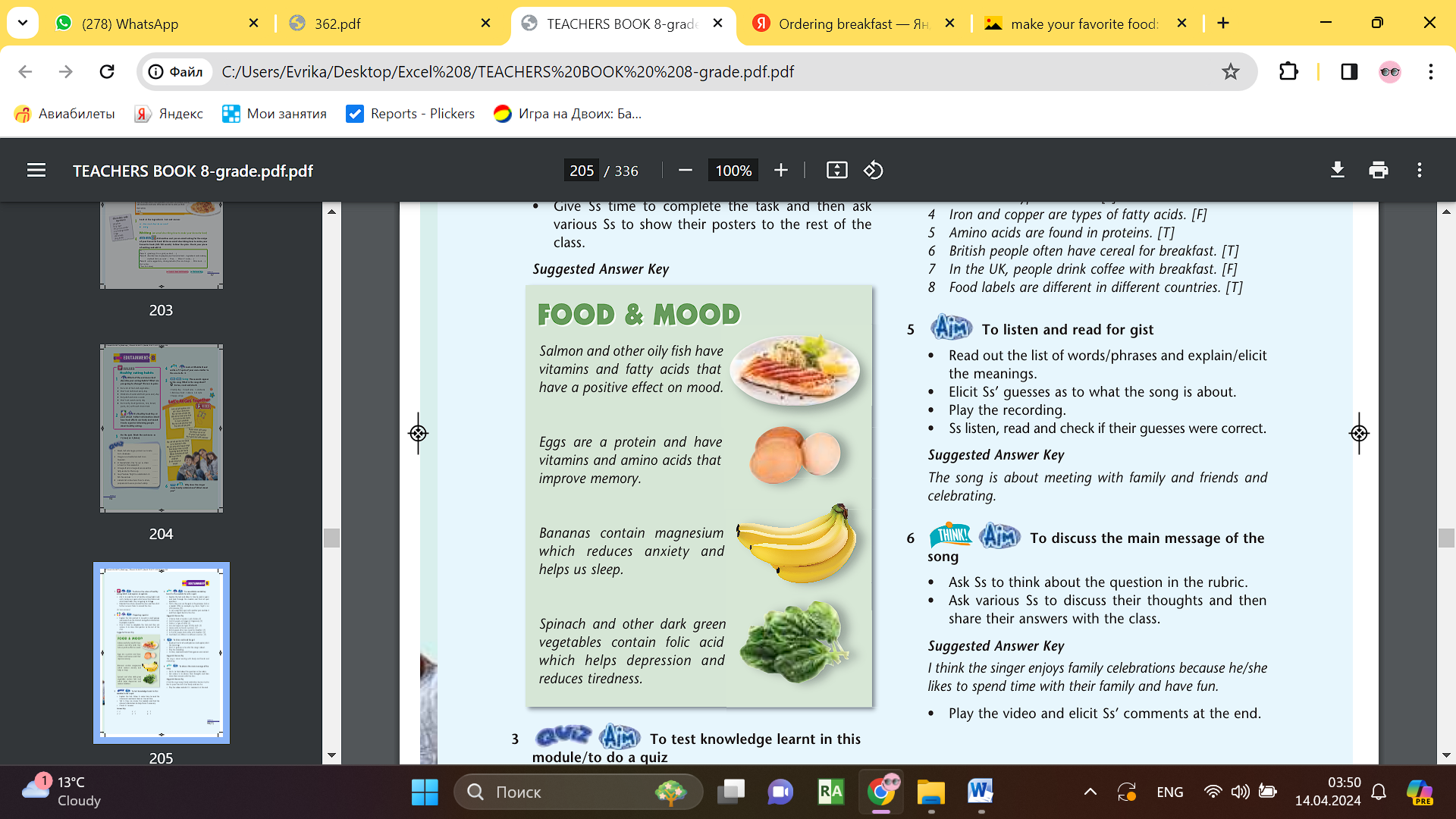
Ex:1 P:98 Ask Ss to read the list of healthy eating habits and ask Ss to discuss in pairs which ones they follow and which bad habits they are going to change. Monitor the activity around the class and then elicit further answers from Ss around the class. Ex: 2 P: 98 • Explain the task and ask Ss to work in small groups and research on the Internet and gather information to prepare a poster. • Give Ss time to complete the task and then ask various Ss to show their posters to the rest of the class. Differentiation: «Verbal support» method is used to help Ss use new words in the sentences. Ex: 3 P: 98 • Explain the task. Allow Ss some time to read the statements and mark them as true or false. • Tell Ss they can review the module and find the relevant information to help them if necessary. • Check Ss’ answers. Ex: 4 P: 98 • Explain the task and allow Ss time to work in pairs and look through the module and think of quiz questions. • Tell Ss they can use the quiz in the previous task as a model. Offer an example (e.g. Burns Night is on 25th January. [T]). • Ss can swap their quiz with another pair and do it and then report back to the class. Conclusion during the lesson some tasks differentiated by outcomes of the students and by their abilities. |
• Learners which of the sentences best describe your eating habits? What are you going to change? Discuss in pairs. ANSWERS Ss' own answers • Learners collect information about how food affects our body and mood. Create a poster informing people about healthy eating. ANSWERS
• Learners do the quiz. Mark the sentences as T (true) or F (false). ANSWERS 1 F 3 F 5 T 2 F 4 T 6 T • Learners look at Module 8 and write a T/F quiz of your own similar to the one in Ex. 3. ANSWERS 1 A festive food in Sweden is jerk chicken. [F] 2 Scottish people eat haggis at Hogmanay. [F] 3 Parkin is a type of toffee. [F] 4 Iron and copper are types of fatty acids. [F] 5 Amino acids are found in proteins. [T] 6 British people often have cereal for breakfast. [T] 7 In the UK, people drink coffee with breakfast. [F] 8 Food labels are different in different countries. [T] |
Descriptor: - read the list of healthy eating habits - discuss in pairs. Total: 2point
Self assessment Descriptor: - collect information about how food affects - create a poster informing Total: 2 point Descriptor: - do the quiz - mark the sentences Total: 2 point -Make CCQ questions Yes / No Total: 1 point. |
Card Worksheet Students book |
|
End of the lesson 5 min |
FEEDBACK Learners provide feedback on what they have learned at the lesson. Ex: P: Home task: Write the days |
|
Poster Success
|
|

Short term plan: term 4
|
Unit 9: The world of work |
Lesson 92 |
||
|
Teacher name: |
|
||
|
Date: |
|
||
|
Grade: 8 |
Number present: |
absent: |
|
|
Lesson title |
Vocabulary: work and jobs |
||
|
Learning objectives |
8.1.6.1 organise and present information clearly to others 8.3.7.1 use appropriate subject-specific vocabulary and syntax to talk about a range of general topics, and some curricular topics 8.5.3.1 write with moderate grammatical accuracy on a limited range of familiar general and curricular topics |
||
|
Lesson objectives |
Learners will be able to: - present vocabulary for jobs - present/practise vocabulary for work activities |
||
|
Value links |
Respect - treating people with respect, value and courtesy. Especially apologising to them where the situation calls for it. |
||
|
Plan |
|||
|
Stages / Time |
Teachers actions |
Students actions |
Assessment criteria |
Resources |
|
Beginning of the lesson Warming-up
3 min. Pre-learning «Brainstorming» method 7 min. |
Organization moment : 1.Greeting. Ask about the weather. The teacher sets the lesson objectives, letting students know what to anticipate from the lesson. Warming up Where are you from? How old are you? What color is it? How many students are there in class? What day of the week today? Lead – In
|
The aim: To develop pupils speaking skills and create friendly atmosphere Students of the class are listed. Students' attention is drawn to the lesson. Students say different words from the picture •Learners remember previous lesson vocabulary •Learners answer the questions |
The teacher to assess learners for their ability. “Good job! Well done!” Formative Assessment
Good job! Descriptor: - remembers the lesson passed Point 1 Assessment criteria Learners have met the learning objectives if they can talk about |
Pictures worksheet Picture |
|
Middle of the lesson Presentation part. 30 min |
Ex:1 P:99 Draw Ss’ attention to the pictures (1-12). • Play the audio with pauses for Ss to listen and repeat. Check Ss’ pronunciation and intonation. Ex: 2 P: 99 •Explain the task and read out the example sentence. • Ask various Ss to tell the class what each person in the pictures does at work. Differentiation: «Verbal support» method is used to help Ss use new words in the sentences. Conclusion during the lesson some tasks differentiated by outcomes of the students and by their abilities. |
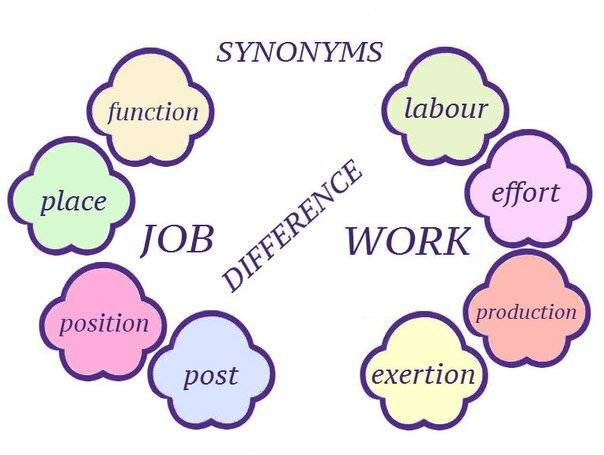
• Learners look at the pictures (1-12). Listen and repeat. ANSWERS Ss' own answers • Learners what does each person do at work? Use the phrases to tell the class. ANSWERS A newsreader reads the news on TV or radio. A tutor gives private lessons. A firefighter puts out fires. A police officer makes sure people obey the law. A plumber fixes broken water pipes. A surgeon performs operations. A chef cooks delicious food. A receptionist receives calls and welcomes visitors. A lawyer advises people on the law. A hairdresser cuts and styles people’s hair. An electrician fixes electrical problems. |
Descriptor: - look at the pictures - listen and repeat. Total: 2point
Self assessment Descriptor: - read out the example sentence. - use the phrases to tell the class Total: 2 point -Make CCQ questions Yes / No Total: 1 point. |
Card Worksheet Students book |
|
End of the lesson 5 min |
FEEDBACK Learners provide feedback on what they have learned at the lesson. Ex: P: Home task: Write the days |
|
Poster Success
|
|
Short term plan: term 4
|
Unit 9: The world of work |
Lesson 93 |
||
|
Teacher name: |
|
||
|
Date: |
|
||
|
Grade: 8 |
Number present: |
absent: |
|
|
Lesson title |
Reading: strange jobs |
||
|
Learning objectives |
8.1.8.1 develop intercultural awareness through reading and discussion 8.2.2.1 understand with little or no support most specific information in extended talk on a wide range of general and curricular topics 8.3.7.1 use appropriate subject-specific vocabulary and syntax to talk about a range of general topics, and some curricular topics |
||
|
Lesson objectives |
Learners will be able to: - generate topic-related vocabulary - introduce the topic and predict the content of the text |
||
|
Value links |
Respect - treating people with respect, value and courtesy. Especially apologising to them where the situation calls for it. |
||
|
Plan |
|||
|
Stages / Time |
Teachers actions |
Students actions |
Assessment criteria |
Resources |
|
Beginning of the lesson Warming-up
3 min. Pre-learning «Brainstorming» method 7 min. |
Organization moment : 1.Greeting. Ask about the weather. The teacher sets the lesson objectives, letting students know what to anticipate from the lesson. Warming up Where are you from? How old are you? What color is it? How many students are there in class? What day of the week today? Lead – In
|
The aim: To develop pupils speaking skills and create friendly atmosphere Students of the class are listed. Students' attention is drawn to the lesson. Students say different words from the picture •Learners remember previous lesson vocabulary •Learners answer the questions |
The teacher to assess learners for their ability. “Good job! Well done!” Formative Assessment
Good job! Descriptor: - remembers the lesson passed Point 1 Assessment criteria Learners have met the learning objectives if they can talk about |
Pictures worksheet Picture |
|
Middle of the lesson Presentation part. 30 min |
Ex:1 P:100 Write the title ‘entertainment’ on the board and the examples ‘actor’ and ‘singer’. Explain the task to Ss. Allow them one minute to complete the task. • Ask Ss to share their answers with their partner and then with the rest of the class. Ex: 2 P: 100 • Direct Ss’ attention to the pictures. • Elicit a variety of answers to the questions in the rubric. Play the recording. Ss listen and follow the text in their books. • Ss match the pictures to the texts. • Check Ss’ answers around the class Differentiation: «Verbal support» method is used to help Ss use new words in the sentences. Ex: 3 P: 100 • Allow Ss some time to read the text again and answer the questions. • Check Ss’ answers. Conclusion during the lesson some tasks differentiated by outcomes of the students and by their abilities. |
• Learners in a minute, write as many jobs as you can related to entertainment (actor, singer, etc). Compare with your partner. ANSWERS dancer, comedian, musician, clown, director, composer, magician, ballerina, circus performer, etc • Learners look at the pictures. Where do these people work? What do they do for a living? Listen and read to find out. Then match the pictures to the texts. ANSWERS The pictures show people who have strange jobs. There is someone dressed as a cartoon character and a woman who looks like a statue. I think the cartoon character works at a theme park and the statue woman might be an actress. 1 B 2 A • Learners read the texts and answer the questions. Which of the entertainers ANSWERS 1 A 2 B 3 B 4 A 5 A |
Descriptor: - in a minute, write as many jobs - complete the task Total: 2point
Self assessment Descriptor: - look at the pictures - match the pictures to the texts Total: 2 point Descriptor: - read the texts - read the texts Total: 2 point -Make CCQ questions Yes / No Total: 1 point. |
Card Worksheet Students book |
|
End of the lesson 5 min |
FEEDBACK Learners provide feedback on what they have learned at the lesson. Ex: P: Home task: Write the days |
|
Poster Success
|
|

Short term plan: term 4
|
Unit 9: The world of work |
Lesson 94 |
||
|
Teacher name: |
|
||
|
Date: |
|
||
|
Grade: 8 |
Number present: |
absent: |
|
|
Lesson title |
Vocabulary: jobs |
||
|
Learning objectives |
8.3.3.1 give an opinion at discourse level on a wide range of general and curricular topics 8.5.3.1 write with moderate grammatical accuracy on a limited range of familiar general and curricular topics |
||
|
Lesson objectives |
Learners will be able to: - consolidate new vocabulary - present and practise prepositional phrases |
||
|
Value links |
Respect - treating people with respect, value and courtesy. Especially apologising to them where the situation calls for it. |
||
|
Plan |
|||
|
Stages / Time |
Teachers actions |
Students actions |
Assessment criteria |
Resources |
|
Beginning of the lesson Warming-up
3 min. Pre-learning «Brainstorming» method 7 min. |
Organization moment : 1.Greeting. Ask about the weather. The teacher sets the lesson objectives, letting students know what to anticipate from the lesson. Warming up Where are you from? How old are you? What color is it? How many students are there in class? What day of the week today? Lead – In
|
The aim: To develop pupils speaking skills and create friendly atmosphere Students of the class are listed. Students' attention is drawn to the lesson. Students say different words from the picture •Learners remember previous lesson vocabulary •Learners answer the questions |
The teacher to assess learners for their ability. “Good job! Well done!” Formative Assessment
Good job! Descriptor: - remembers the lesson passed Point 1 Assessment criteria Learners have met the learning objectives if they can talk about |
Pictures worksheet Picture |
|
Middle of the lesson Presentation part. 30 min |
Ex:4 P:101 Explain the task and allow Ss some time to complete it. Tell Ss to refer back to the text to find the phrases. • Check Ss’ answers around the class. Ex: 5 P: 101 • Explain the task and give Ss some time to complete it then check Ss’ answers. Differentiation: «Verbal support» method is used to help Ss use new words in the sentences. Ex: 6 P: 101 • Ask various Ss around the class to say three things they remember from the text. Ex: 7a P: 101 Draw Ss’ attention to the Study Skills box and read through the examples. • Explain the task and any unknown words. • Allow Ss some time to complete the task. • Play the recording. Ss listen and check their answers. Ex: 7b P: 101 Explain the task and go through the vocabulary with Ss. Explain that the vocabulary can relate to several different jobs. • Allow Ss some time to do the exercise. • Check Ss’ answers around the class. Conclusion during the lesson some tasks differentiated by outcomes of the students and by their abilities. |
• Learners complete with the words. Use the phrases to present Christina and Joe to the class ANSWERS 1 still 2 statue 3 clothes 4 job 5 costume 6 room 7 mask 8 slowly 9 paint 10 humour • Learners complete with: in, with, at (x2), of ANSWERS 1 with 2 at 3 of 4 in 5 at • Learners tell the class three things you remember from the texts in Ex. 2. ANSWERS 1 Christina covers her skin with body paint. 2 Joe works at Disney World in Florida. 3 Joe cannot speak at work. • Learners listen and check. Listen again and repeat. Mind the stressed syllables. ANSWERS 1 security guard 2 make-up artist 3 travel agent 4 social worker 5 airline pilot 6 shop assistant 7 graphic designer 8 computer programmer 9 bus driver 10 personal trainer 11 TV presenter 12 heart surgeon |
Descriptor: - complete with the words. - use the phrases to present Total: 2point
Self assessment Descriptor: - complete with: in, with Total: 2 point Descriptor: - tell the class three things Total: 2 point Descriptor: - listen and check - mind the stressed syllables Total: 2 point -Make CCQ questions Yes / No Total: 1 point. |
Card Worksheet Students book |
|
End of the lesson 5 min |
FEEDBACK Learners provide feedback on what they have learned at the lesson. Ex: P: Home task: Write the days |
|
Poster Success
|
|

Short term plan: term 4
|
Unit 9: The world of work |
Lesson 95 |
||
|
Teacher name: |
|
||
|
Date: |
|
||
|
Grade: 8 |
Number present: |
absent: |
|
|
Lesson title |
Use of English: Reported Speech |
||
|
Learning objectives |
8.1.8.1 develop intercultural awareness through reading and discussion 8.2.2.1 understand with little or no support most specific information in extended talk on a wide range of general and curricular topics 8.6.17.1 use if / unless/ if only in second conditional clauses and wish [that] clauses [present reference]; use a growing variety of relative clauses including |
||
|
Lesson objectives |
Learners will be able to: - present reported speech - present say/tell in direct/reported speech - practise say/tell |
||
|
Value links |
Respect - treating people with respect, value and courtesy. Especially apologising to them where the situation calls for it. |
||
|
Plan |
|||
|
Stages / Time |
Teachers actions |
Students actions |
Assessment criteria |
Resources |
|
Beginning of the lesson Warming-up
3 min. Pre-learning «Brainstorming» method 7 min. |
Organization moment : 1.Greeting. Ask about the weather. The teacher sets the lesson objectives, letting students know what to anticipate from the lesson. Warming up Where are you from? How old are you? What color is it? How many students are there in class? What day of the week today? Lead – In
|
The aim: To develop pupils speaking skills and create friendly atmosphere Students of the class are listed. Students' attention is drawn to the lesson. Students say different words from the picture •Learners remember previous lesson vocabulary •Learners answer the questions |
The teacher to assess learners for their ability. “Good job! Well done!” Formative Assessment
Good job! Descriptor: - remembers the lesson passed Point 1 Assessment criteria Learners have met the learning objectives if they can talk about |
Pictures worksheet Picture |
|
Middle of the lesson Presentation part. 30 min |
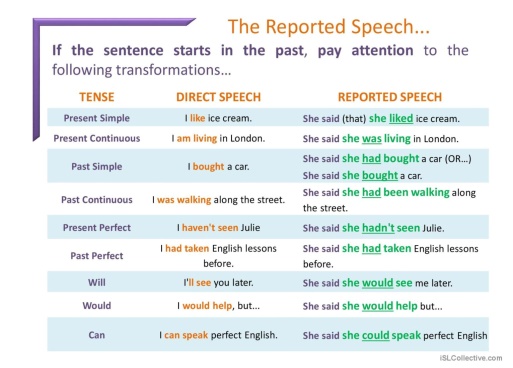
Ex:1 P:102 • Explain that when we report statements, we use say or tell. We use say in direct and reported speech without to when it is not followed by the person being spoken to (e.g. Tom said “I need help.”/ Tom said (that) he needed help.) and with to when it is followed by the person being spoken to as well (e.g. Tom said to me, “I need help.”/ Tom said to me (that) he needed help.) Ex: 2 P: 102 •Ask Ss to read the table and then elicit when we use the verbs said/told. Differentiation: «Verbal support» method is used to help Ss use new words in the sentences. Ex: 3 P: 102 • Explain the task and then give Ss time to complete the task. • Check Ss’ answers. Ex: 4 P: 102 •Explain the task and then give Ss time to complete it. • Check Ss’ answers. Conclusion during the lesson some tasks differentiated by outcomes of the students and by their abilities. |
• Learners read the theory and answer the questions. ANSWERS 1 We use the verbs ‘say/tell’ in reported statements. 2 The tenses change as follows – present simple → past simple, present continuous → past continuous, present perfect → past perfect, past simple → past perfect, past continuous → past perfect continuous, future simple → would + bare infinitive, present modal → past modal 3 Pronouns/possessives change according to the meaning. 4 We use the verb ‘ask’ to report questions. 5 We report a positive/negative command with the verb tell + sb + (not) to- infinitive. • Learners read the sentences. When do we use the verbs said? told? ANSWERS We use said in direct and reported speech without to when it is not followed by the person being spoken to and with to when it is followed by the person being spoken to. We use told in direct and reported speech with to + personal pronoun. • Learners fill in: said or told. ANSWERS 1 said 2 told 3 said 4 said 5 told 6 said • Learners rewrite the sentences from direct into reported speech. ANSWERS 1 Sezim said (that) he would finish work in two hours. 2 He said to/told us (that) he had got a job at Disneyland. 3 Bota said (that) he had passed all of his examinations. 4 They said (that) they had had a great meeting. 5 Nurlybek said (that) he didn’t want to go to work. 6 Bibigul told/said to Aru (that) Gulmira had been working until 4:00 pm the previous afternoon. 7 Jane said (that) she hadn’t finished her project yet. 8 Nursultan said to/told Timur (that) Kanat had finished school and he was looking for a job. |
Descriptor: - read the theory - answer the questions. Total: 2point
Self assessment Descriptor: - read the sentences. -answer the question Total: 2 point Descriptor: - fill in: said or told. - complete the task Total: 2 point Descriptor: - rewrite the sentences - complete the task Total: 2 point -Make CCQ questions Yes / No Total: 1 point. |
Card Worksheet Students book |
|
End of the lesson 5 min |
FEEDBACK Learners provide feedback on what they have learned at the lesson. Ex: P: Home task: Write the days |
|
Poster Success
|
|
Short term plan: term 4
|
Unit 9: The world of work |
Lesson 96 |
||
|
Teacher name: |
|
||
|
Date: |
|
||
|
Grade: 8 |
Number present: |
absent: |
|
|
Lesson title |
Use of English: word formation |
||
|
Learning objectives |
8.5.3.1 write with moderate grammatical accuracy on a limited range of familiar general and curricular topics 8.6.13.1 use a growing variety of modal forms for different functions: obligation, necessity, possibility, permission, requests, suggestions, prohibition on a range of familiar general and curricular topics |
||
|
Lesson objectives |
Learners will be able to: -practise reported questions/ commands -present/practise word formation (people nouns from verbs/nouns) -act out a dialogue and practise reported speech |
||
|
Value links |
Respect - treating people with respect, value and courtesy. Especially apologising to them where the situation calls for it. |
||
|
Plan |
|||
|
Stages / Time |
Teachers actions |
Students actions |
Assessment criteria |
Resources |
|
Beginning of the lesson Warming-up
3 min. Pre-learning «Brainstorming» method 7 min. |
Organization moment : 1.Greeting. Ask about the weather. The teacher sets the lesson objectives, letting students know what to anticipate from the lesson. Warming up Where are you from? How old are you? What color is it? How many students are there in class? What day of the week today? Lead – In
|
The aim: To develop pupils speaking skills and create friendly atmosphere Students of the class are listed. Students' attention is drawn to the lesson. Students say different words from the picture •Learners remember previous lesson vocabulary •Learners answer the questions |
The teacher to assess learners for their ability. “Good job! Well done!” Formative Assessment
Good job! Descriptor: - remembers the lesson passed Point 1 Assessment criteria Learners have met the learning objectives if they can talk about |
Pictures worksheet Picture |
|
Middle of the lesson Presentation part. 30 min |
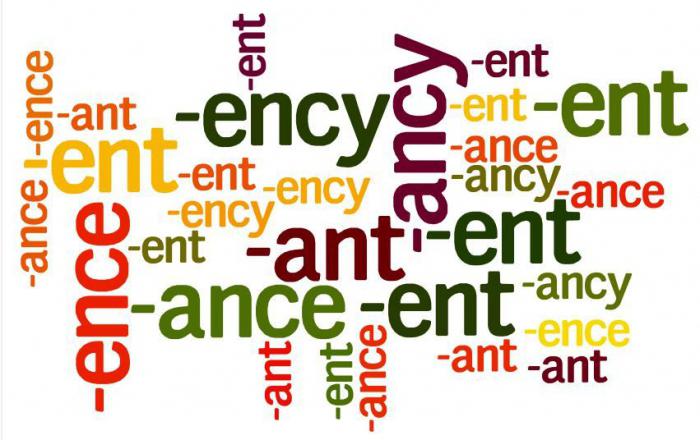
Ex:5 P:103 • Explain the task and give Ss time to complete it. Then, check Ss’ answers. Ex: 6 P: 103 •Ask Ss to read the table and then give them time to complete the task. • Check Ss’ answers and then refer Ss to the Grammar Reference section for more information. Differentiation: «Verbal support» method is used to help Ss use new words in the sentences. Ex: 7 P: 103 •Read out the theory box and the examples. • Then give Ss time to complete the sentences by forming a noun from the words in brackets. • Check Ss’ answers around the class. Ex: 8 P: 103 •Read out the box and explain the task. • Give Ss time to complete the task. • Check Ss’ answers. Conclusion during the lesson some tasks differentiated by outcomes of the students and by their abilities. |
• Learners report the questions and commands ANSWERS 1 He asked where the manager’s office was. 2 He asked me if Fatiha was at the meeting. 3 Inkar said to/told Azat not to forget his papers. 4 He told me to check if the file was on his computer. 5 Lucy asked Ben if he had read the report. 6 Mum said to/told Nurlan to wake up • Learners read the theory and report the sentences. Use the special introductory verbs in brackets ANSWERS 1 He ordered me to go to my room. 2 She asked him to give her the book. 3 Ulan apologised for shouting at me. 4 He refused to go to the shop. 5 Sholpan offered to show Nurgul how to use the cash register. • Learners read the theory box. Then, complete each sentence with the correct noun formed from the words in brackets. ANSWERS 1 writer 2 actor 3 salesperson 4 artist, mathematician 5 president • Learners read the box, then complete the sentences. ANSWERS 1 after 2 up 3 over 4 on |
Descriptor: - report the questions - answer the questions. Total: 2point
Self assessment Descriptor: - read the theory - report the sentences Total: 2 point Descriptor: - read the theory box. - read the theory box. Total: 2 point Descriptor: - read the box - complete the task Total: 2 point -Make CCQ questions Yes / No Total: 1 point. |
Card Worksheet Students book |
|
End of the lesson 5 min |
FEEDBACK Learners provide feedback on what they have learned at the lesson. Ex: P: Home task: Write the days |
|
Poster Success
|
|
Short term plan: term 4
|
Unit 9: The world of work |
Lesson 97 |
||
|
Teacher name: |
|
||
|
Date: |
|
||
|
Grade: 8 |
Number present: |
absent: |
|
|
Lesson title |
Reading: dream jobs |
||
|
Learning objectives |
8.2.1.1 understand with little or no support the main points in extended talk on a wide range of general and curricular topics 8.5.3.1 write with moderate grammatical accuracy on a limited range of familiar general and curricular topics 8.3.7.1 use appropriate subject-specific vocabulary and syntax to talk about a range of general topics, and some curricular topics |
||
|
Lesson objectives |
Learners will be able to: - predict the topic of the text; to read for specific information -read for cohesion and coherence -present and practise topic-related vocabulary; to discuss choosing a career |
||
|
Value links |
Respect - treating people with respect, value and courtesy. Especially apologising to them where the situation calls for it. |
||
|
Plan |
|||
|
Stages / Time |
Teachers actions |
Students actions |
Assessment criteria |
Resources |
|
Beginning of the lesson Warming-up
3 min. Pre-learning «Brainstorming» method 7 min. |
Organization moment : 1.Greeting. Ask about the weather. The teacher sets the lesson objectives, letting students know what to anticipate from the lesson. Warming up Where are you from? How old are you? What color is it? How many students are there in class? What day of the week today? Lead – In
|
The aim: To develop pupils speaking skills and create friendly atmosphere Students of the class are listed. Students' attention is drawn to the lesson. Students say different words from the picture •Learners remember previous lesson vocabulary •Learners answer the questions |
The teacher to assess learners for their ability. “Good job! Well done!” Formative Assessment
Good job! Descriptor: - remembers the lesson passed Point 1 Assessment criteria Learners have met the learning objectives if they can talk about |
Pictures worksheet Picture |
|
Middle of the lesson Presentation part. 30 min |
Ex:1 P:104 •Read the title of the text aloud and direct Ss’ attention to the picture. • Elicit Ss’ guesses as to what Dylan does for a living and elicit three questions from the class. • Give Ss time to read the text and see if they can answer the questions. Ex: 2 P: 104 • Ask Ss to read the parts of sentences 1-7 and then allow Ss time to read the text again and complete the task. • Check Ss’ answers. Differentiation: «Verbal support» method is used to help Ss use new words in the sentences. Ex: 3 P: 105 • Go through the list of phrases and explain or elicit the meanings of any unknown words and ask Ss to read out the example dialogue. • Ask Ss to discuss in pairs what is important to them when choosing a career following the example. • Monitor the activity around the class and then ask various Ss to tell the rest of the class what they discussed. Ex: 4a P: 105 • Ask Ss to look at the CV and elicit what type of information is missing (e.g. a name, a phone number, etc). Check answers around the class. Ex: 4b P: 105 •Explain the task and ask Ss to read the CV again. • Play the audio and give Ss time complete the task and then check their answers. Conclusion during the lesson some tasks differentiated by outcomes of the students and by their abilities. |
• Learners read the title and look at the picture. What does Dylan do for a living? Think of three questions you would like to ask him. Read the text and see if you can answer them. ANSWERS Dylan is an artist. 1) When did Dylan first begin painting? (As a child) 2) How did Dylan become known in the art world? (Through art shows) 3) What advice would Dylan give to other young people about finding a job? (Don’t let anyone tell you that you can’t do what you love.) • Learners read the text and complete the gaps with the parts of the sentences. There is one extra part. Then explain the words in bold. Listen, read and check. ANSWERS A 5 B 3 C 7 D 1 E 4 F 2 • Learners which of the following would you consider when choosing a career? Discuss in pairs. ANSWERS A: What kind of job would you like to do for a living? B: I’d like to be a pilot. A: Really? Why? B: Well, I don’t mind working long hours or shifts. I would get high wages and I’d visit lots of exotic destinations. What about you? A: I’d like to work as a forensic investigator. B: Wow. Why would you want to do that job? A: Well, I like working under pressure and as part of a team. I also think I’d get to meet lots of interesting people. B: It sounds like an interesting job. • Learners look at the CV below. What type of information is missing? ANSWERS 1 surname 2 part of address 3 a number (part of date of birth) 4 phone number 5 part of job title • Learners listen and complete the gaps. Write in your note book. ANSWERS 1 Evans 2 Brighton 3 11/eleven 4 7802756048 5 office |
Descriptor: - read the title - answer the questions. Total: 2point
Self assessment Descriptor: - read the title - complete the gaps Total: 2 point Descriptor: - discuss in pairs. - answer the question Total: 2 point Descriptor: - look at the CV below - check answers Total: 2 point -Make CCQ questions Yes / No Total: 1 point. Descriptor: - listen and complete the gaps - write in your note book. Total: 2 point |
Card Worksheet Students book |
|
End of the lesson 5 min |
FEEDBACK Learners provide feedback on what they have learned at the lesson. Ex: P: Home task: Write the days |
|
Poster Success
|
|

Short term plan: term 4
|
Unit 9: The world of work |
Lesson 98 |
||
|
Teacher name: |
|
||
|
Date: |
|
||
|
Grade: 8 |
Number present: |
absent: |
|
|
Lesson title |
Everyday English: A job interview |
||
|
Learning objectives |
8.1.10.1 use talk or writing as a means of reflecting on and exploring a range of perspectives on the world 8.3.7.1 use appropriate subject-specific vocabulary and syntax to talk about a range of general topics, and some curricular topics 8.5.1.1 plan, write, edit and proofread work at text |
||
|
Lesson objectives |
Learners will be able to: - present language related to a job interview - predict the content of a dialogue - learn synonymous phrases |
||
|
Value links |
Respect - treating people with respect, value and courtesy. Especially apologising to them where the situation calls for it. |
||
|
Plan |
|||
|
Stages / Time |
Teachers actions |
Students actions |
Assessment criteria |
Resources |
|
Beginning of the lesson Warming-up
3 min. Pre-learning «Brainstorming» method 7 min. |
Organization moment : 1.Greeting. Ask about the weather. The teacher sets the lesson objectives, letting students know what to anticipate from the lesson. Warming up Where are you from? How old are you? What color is it? How many students are there in class? What day of the week today? Lead – In
|
The aim: To develop pupils speaking skills and create friendly atmosphere Students of the class are listed. Students' attention is drawn to the lesson. Students say different words from the picture •Learners remember previous lesson vocabulary •Learners answer the questions |
The teacher to assess learners for their ability. “Good job! Well done!” Formative Assessment
Good job! Descriptor: - remembers the lesson passed Point 1 Assessment criteria Learners have met the learning objectives if they can talk about |
Pictures worksheet Picture |
|
Middle of the lesson Presentation part. 30 min |
Ex:1 P:106 • Ask Ss to read the advert and then elicit what it is about. Ex: 2 P: 106 • Play the recording with pauses for Ss to repeat either chorally or individually. • Pay attention to Ss’ pronunciation and correct as necessary. Differentiation: «Verbal support» method is used to help Ss use new words in the sentences. Ex: 3 P: 106 • Ask Ss to read the sentences in Ex. 2 again and elicit Ss’ guesses as to what it may be about and what style it is. Play the audio for Ss to listen and read and check if their guesses were correct. Ex: 4 P: 106 • Read out the phrases in the list and give Ss time to find the synonymous ones in the dialogue and then check Ss’ answers around the class. Conclusion during the lesson some tasks differentiated by outcomes of the students and by their abilities. |
• Learners read the advert. What is it about? ANSWERS The advert is for a job as a sales assistant. • Learners listen and repeat. ANSWERS Student’s own answer • Learners the sentences above are from the dialogue below. What is the dialogue about? Is the dialogue formal or informal? Listen and check. ANSWERS The dialogue is a job interview and it is formal. • Learners find sentences in the dialogue which mean: ANSWERS Why do you want the job? = Why do you want to work for us? I can’t wait for you to call me. = I’m looking forward to hearing from you. There are others who want the job. = There are a number of other candidates. |
Descriptor: - read the advert - answer the questions. Total: 2point
Self assessment Descriptor: - repeat either chorally or individually - listen and check Total: 2 point Descriptor: - find sentences in the dialogue - answer the question Total: 2 point -Make CCQ questions Yes / No Total: 1 point. |
Card Worksheet Students book |
|
End of the lesson 5 min |
FEEDBACK Learners provide feedback on what they have learned at the lesson. Ex: P: Home task: Write the days |
|
Poster Success
|
|

Short term plan: term 4
|
Unit 9: The world of work |
Lesson 99 |
||
|
Teacher name: |
|
||
|
Date: |
|
||
|
Grade: 8 |
Number present: |
absent: |
|
|
Lesson title |
Across cultures: Off work! Public holidays Summative assessment for the unit 9 |
||
|
Learning objectives |
8.3.7.1 use appropriate subject-specific vocabulary and syntax to talk about a range of general topics, and some curricular topics 8.4.1.1 understand the main points in texts on a growing range of unfamiliar general and curricular topics, including some extended texts 8.5.1.1 plan, write, edit and proofread work at |
||
|
Lesson objectives |
Learners will be able to: - introduce the topic; to read for gist - read for cohesion and coherence; to practise word formation - read and listen for key information; to compare festivals in two countries |
||
|
Value links |
Respect - treating people with respect, value and courtesy. Especially apologising to them where the situation calls for it. |
||
|
Plan |
|||
|
Stages / Time |
Teachers actions |
Students actions |
Assessment criteria |
Resources |
|
Beginning of the lesson Warming-up
3 min. Pre-learning «Brainstorming» method 7 min. |
Organization moment : 1.Greeting. Ask about the weather. The teacher sets the lesson objectives, letting students know what to anticipate from the lesson. Warming up Where are you from? How old are you? What color is it? How many students are there in class? What day of the week today? Lead – In
|
The aim: To develop pupils speaking skills and create friendly atmosphere Students of the class are listed. Students' attention is drawn to the lesson. Students say different words from the picture •Learners remember previous lesson vocabulary •Learners answer the questions |
The teacher to assess learners for their ability. “Good job! Well done!” Formative Assessment
Good job! Descriptor: - remembers the lesson passed Point 1 Assessment criteria Learners have met the learning objectives if they can talk about |
Pictures worksheet Picture |
|
Middle of the lesson Presentation part. 30 min |
Ex:1 P:107 • Direct Ss’ attention to the titles of the text and the pictures and elicit what Ss think people celebrate on these days. Allow Ss time to read through the texts and find out. Ex: 2 P: 107 • Explain the task. Allow Ss time to read the texts and complete the gaps with derivatives of the words in brackets. • Remind Ss to read the completed texts for cohesion and coherence and then check Ss’ answers. Differentiation: «Verbal support» method is used to help Ss use new words in the sentences. Ex: 3 P: 107 • Ask Ss to copy the headings into their notebooks and then ask Ss to read the texts again and make notes under the headings. • Then ask individual Ss to come up in front of the class and give a short presentation on the festivals to the class using their notes. Summative assessment for the unit 9 Conclusion during the lesson some tasks differentiated by outcomes of the students and by their abilities. |
• Learners look at the pictures and read the titles of the texts. What do people celebrate on these days? Read through to find out. ANSWERS People celebrate May Day in the UK and Women’s Day in Kazakhstan. • Learners read the texts and complete the gaps with words derived from the words in brackets. Listen and check. ANSWERS 1 celebration 5 official 2 traditional 6 entertainers 3 procession 7 performances 4 flowery • Learners listen to and read the texts again. Make notes under the headings: ANSWERS Suggested Answer Key Name of festival/holiday: May Day Date: 1st Monday in May Why it is a special day: Spring festival Celebrations: parade led by a May Queen and a Green Man, Morris Dancers with flowery hats and bells around their knees, festival field, young girls dance around a Maypole, funfair with rides, stalls selling sweet treats On the first Monday in May, the UK celebrates May Day. This is a traditional spring festival. There is a parade led by the May Queen and the Green Man. It also has Morris Dancers with flowery hats and bells around their knees. Then at the festival field, young girls dance around a Maypole and there is a funfair with rides as well as stalls selling sweet treats. |
Descriptor: - look at the pictures - read the titles of the texts Total: 2point
Self assessment Descriptor: - read the texts - complete the gaps Total: 2 point Descriptor: - complete the gaps - make notes under the headings Total: 2 point -Make CCQ questions Yes / No Total: 1 point. |
Card Worksheet Students book |
|
End of the lesson 5 min |
FEEDBACK Learners provide feedback on what they have learned at the lesson. Ex: P: Home task: Write the days |
|
Poster Success
|
|
Short term plan: term 4
|
Unit 9: The world of work |
Lesson 100 |
||
|
Teacher name: |
|
||
|
Date: |
|
||
|
Grade: 8 |
Number present: |
absent: |
|
|
Lesson title |
Across curriculum: A Christmas carol |
||
|
Learning objectives |
8.2.1.1 understand with little or no support the main points in extended talk on a wide range of general and curricular topics 8.3.7.1 use appropriate subject-specific vocabulary and syntax to talk about a range of general topics, and some curricular topics 8.4.1.1 understand the main points in texts on a growing range of unfamiliar general and curricular topics, including some extended texts |
||
|
Lesson objectives |
Learners will be able to: - read for specific information - make inferences and describe characters in a story |
||
|
Value links |
Respect - treating people with respect, value and courtesy. Especially apologising to them where the situation calls for it. |
||
|
Plan |
|||
|
Stages / Time |
Teachers actions |
Students actions |
Assessment criteria |
Resources |
|
Beginning of the lesson Warming-up
3 min. Pre-learning «Brainstorming» method 7 min. |
Organization moment : 1.Greeting. Ask about the weather. The teacher sets the lesson objectives, letting students know what to anticipate from the lesson. Warming up Where are you from? How old are you? What color is it? How many students are there in class? What day of the week today? Lead – In
|
The aim: To develop pupils speaking skills and create friendly atmosphere Students of the class are listed. Students' attention is drawn to the lesson. Students say different words from the picture •Learners remember previous lesson vocabulary •Learners answer the questions |
The teacher to assess learners for their ability. “Good job! Well done!” Formative Assessment
Good job! Descriptor: - remembers the lesson passed Point 1 Assessment criteria Learners have met the learning objectives if they can talk about |
Pictures worksheet Picture |
|
Middle of the lesson Presentation part. 30 min |
Ex:1 P:108 • Ask Ss to read the short biography to find out what ‘A Christmas Carol’ is about. Elicit answers. Ex: 2 P: 108 •Ask Ss to read the questions 1-3 and the answer choices. Then give them time to read the main text and choose the correct answers for the questions. • Check Ss’ answers. Differentiation: «Verbal support» method is used to help Ss use new words in the sentences. Ex: 3 P: 108 • Read out the list of adjectives and explain or elicit the meaning if any unknown words. • Then allow Ss time to consider which ones apply to which characters in the story by making inferences. • Ask various Ss to tell the class giving reasons for their answers. . Conclusion during the lesson some tasks differentiated by outcomes of the students and by their abilities. |
• Learners answer the question. What is the story A Christmas Carol about? Read the biography to find out. ANSWERS It is about a miser called Ebenezer Scrooge who mistreats his employee, but his life changes after some unusual visitors. • Learners listen to and read the text. For questions 1-3, choose the correct answer (A, B, C or D). Then, explain the words in bold. ANSWERS 1 B 2 D 3 B • Learners answer the question. Which adjectives best describe Scrooge? the clerk? ANSWERS Scrooge: moody, mean, grumpy, nasty We understand this because he doesn’t want to give his employee Christmas Day off work and he doesn’t want to pay him for it either. Also, he wants him to come in early the day after Christmas to make up for it and he doesn’t wish him a happy Christmas even though it is Christmas Eve. Also, he leaves the office angrily. The clerk: kind, shy, polite, loyal We understand this because he speaks politely to Scrooge and doesn’t argue with him or say anything unkind despite his attitude. Also, he agrees to come into work early the day after Christmas. |
Descriptor: - read the short biography - answer the question. Total: 2point
Self assessment Descriptor: - listen to and read the text - choose the correct answer Total: 2 point Descriptor: - read out the list of adjectives Total: 2 point -Make CCQ questions Yes / No Total: 1 point. |
Card Worksheet Students book |
|
End of the lesson 5 min |
FEEDBACK Learners provide feedback on what they have learned at the lesson. Ex: P: Home task: Write the days |
|
Poster Success
|
|

Short term plan: term 4
|
Unit 9: The world of work |
Lesson 100 |
||
|
Teacher name: |
|
||
|
Date: |
|
||
|
Grade: 8 |
Number present: |
absent: |
|
|
Lesson title |
Writing: A letter of application |
||
|
Learning objectives |
8.1.5.1 use feedback to set personal learning objectives 8.2.1.1 understand with little or no support the main points in extended talk on a wide range of general and curricular topics 8.5.3.1 write with moderate grammatical accuracy on a limited range of familiar general and curricular topics |
||
|
Lesson objectives |
Learners will be able to: - identify an opinion and read for structure and content - read for comprehension; to substitute linkers - prepare for a writing task |
||
|
Value links |
Respect - treating people with respect, value and courtesy. Especially apologising to them where the situation calls for it. |
||
|
Plan |
|||
|
Stages / Time |
Teachers actions |
Students actions |
Assessment criteria |
Resources |
|
Beginning of the lesson Warming-up
3 min. Pre-learning «Brainstorming» method 7 min. |
Organization moment : 1.Greeting. Ask about the weather. The teacher sets the lesson objectives, letting students know what to anticipate from the lesson.
Warming up Where are you from? How old are you? What color is it? How many students are there in class? What day of the week today? Lead – In |
The aim: To develop pupils speaking skills and create friendly atmosphere Students of the class are listed. Students' attention is drawn to the lesson. Students say different words from the picture •Learners remember previous lesson vocabulary •Learners answer the questions |
The teacher to assess learners for their ability. “Good job! Well done!” Formative Assessment
Good job! Descriptor: - remembers the lesson passed Point 1 Assessment criteria Learners have met the learning objectives if they can talk about |
Pictures worksheet Picture |
|
Middle of the lesson Presentation part. 30 min |
Ex:1 P:109 • Ask Ss to read the essay and the elicit answers to the questions. Ex: 2 P: 109 • Ask Ss to read the TIP box and explain any points they are unsure of. • Then give Ss time to read through the model again and the Useful Language box. • Direct Ss’ attention to the linkers in bold in the model and elicit appropriate alternatives from the Useful Language box from various Ss around the class Differentiation: «Verbal support» method is used to help Ss use new words in the sentences. Ex: 3 P: 109 • Ask Ss to read the rubric and then read the viewpoints and the reasons. • Give Ss time to match the viewpoints to the reasons and then elicit answers from Ss around the class. • Play the recording. Ss listen and check. Conclusion during the lesson some tasks differentiated by outcomes of the students and by their abilities. |
• Learners read the essay. What is the writer’s opinion on the topic? What reasons/examples do they use to support their opinion? What is the opposing viewpoint? ANSWERS The writer’s opinion is that there are many benefits to working while studying. Reasons/examples = helps to find a job later because they have work experience, helps financial situation because they will have less debt Opposing viewpoint = may get lower marks because of less time to study and prepare for exams • Learners read the model again and replace the linkers in bold with other appropriate ones from the Useful Language box. ANSWERS First of all: Firstly Secondly: Furthermore For instance: For example However: On the other hand In conclusion: All in all • Learners read the rubric. Then match the viewpoints below (1-3) to their reasons/examples (A-C). Compare with your partner ANSWERS 1 C 2 A 3 B |
Descriptor: - read the essay - answers to the questions Total: 2point
Self assessment Descriptor: - read the model - replace the linkers in bold Total: 2 point Descriptor: - read the rubric - match the viewpoints below Total: 2 point -Make CCQ questions Yes / No Total: 1 point. |
Card Worksheet Students book |
|
End of the lesson 5 min |
FEEDBACK Learners provide feedback on what they have learned at the lesson. Ex: P: Home task: Write the days |
|
Poster Success
|
|
Short term plan: term 4
|
Unit 9 The world of work |
|
||
|
Teacher name: |
|
||
|
Date: |
|
||
|
Grade: 8 |
Number present: |
absent: |
|
|
Lesson title |
Summative Assessment for the 4th term |
||
|
Learning objectives |
8.2.4.1 (8.L5) Recognise the opinion of the speaker(s) with little or no support in extended talk on a wide range of general and curricular topics. 8.4.6.1(8.R6) Recognise the attitude or opinion of the writer on a growing range of unfamiliar general and curricular topics, including some extended texts 8.5.1.1(8.W1) Plan, write, edit and proofread work at text level with little support on a growing range of general and curricular topics. 8.3.5.1(8.S5) Interact with peers to negotiate, agree and organise priorities and plans for completing classroom tasks. |
||
|
Lesson objectives |
Learners will be able to: - explain the topical word by giving definition/synonym - identify the central idea, the intended audience and the author’s purpose |
||
|
Plan |
|||
|
Stages / Time |
Teachers’ actions |
Students’ actions |
Assessment criteria |
Resources |
|
Beginning of the lesson 5 min |
Organization moment 1.Greeting. Ask about the weather. The teacher sets the lesson objectives, letting students know what to anticipate from the lesson. Warm-up Method speaking phone was used to develop speaking skills.
Lead – In |
Students' attention is drawn to the lesson. Students discuss the pictures in pairs. Determines the topic and aim of the lesson Students say different words from the picture |
Formative Assessment
Good job! Assessment criteria -Identify detailed information in extended conversation with support |
Pictures Student’s book |
|
Middle of the lesson Presentation part. 35 min |
Listening Task. You will hear a radio interview with a famous cardiologist. Decide whether the statements are TRUE or FALSE. Transcript for listening task can be found after the mark scheme. Example: Heart attacks are more common now than they were in the past. True Listen and complete the sentences with NO MORE THAN TWO words. Example: Dr. Shaw gives some advice on how to keep our hearts in good condition. Reading Task. Read the text about Kenneth. Mark the sentences TRUE or FALSE according to the context. Writing Task. Choose ONE of the topics to write. Topic 1. Write an essay about the following topic: Nowadays food has become easier to prepare. Has this change improved the way people live? Give reasons for your answer using your own ideas Topic 2. Write an essay about the following topic: Doctors, nurses and teachers make a great contribution to society and should be paid more than entertainment and sports celebrities. Do you agree or disagree? Give reasons for your answer using your own ideas SPEAKING Task. Work in pairs. Choose one of the cards and answer the questions. You have 1 minute to prepare and 3 minutes to speak. Conclusion during the lesson some tasks differentiated by outcomes of the students and by their abilities. |
Students listen and complete the sentences Answers: Differentiation: «Verbal support» method is used to help Students use new words in the text. Students read the text about Kenneth Answers: Students write an essay Answers: Students work in pairs. choose one of the cards and answer the questions Answers: |
Descriptor: - decide whether the statements are TRUE or FALSE Total: 6 point Descriptor: - work individually - read the text about Kenneth Total: 6 point Descriptor: - write an essay about the following topic Total: 6 point Descriptor: choose one of the cards and answer the questions Total: 6 point |
Cards Worksheets |
|
End of the lesson 5 min |
FEEDBACK Learners provide feedback on what they have learned at the lesson. |
|
Students evaluate each other and encourage classmate with phrases like: Well done! Brilliant! Good job! I like it! . |
Poster
|











 Бұл курс Қазақстан Республикасы Оқу-ағарту министрлігімен келісілген










