
 ЖИ көмекші


 Қауіпсіз төлем

жүктеу мүмкіндігіне ие боласыз
Бұл материал сайт қолданушысы жариялаған. Материалдың ішінде жазылған барлық ақпаратқа жауапкершілікті жариялаған қолданушы жауап береді. Ұстаз тілегі тек ақпаратты таратуға қолдау көрсетеді. Егер материал сіздің авторлық құқығыңызды бұзған болса немесе басқа да себептермен сайттан өшіру керек деп ойласаңыз осында жазыңыз
 02 Мамыр 2025
 221
221
1 жыл бойы шексіз жүктеңіз
қмж Eyes Open-5, 4-тоқс
Short term plan: term 4
|
Unit 8: Sports |
Lesson 81 |
||
|
Teacher name: |
|
||
|
Date: |
|
||
|
Grade: 5 |
Number present: |
absent: |
|
|
Lesson title |
Vocabulary: Sport for all |
||
|
Learning objectives |
5.2.2.1 understand an increasing range of unsupported basic questions which ask for personal information; 5.3.4.1 respond with limited flexibility at sentence level to unexpected comments on an increasing range of general and curricular topics; |
||
|
Lesson objectives |
Learners will be able to: - learn vocabulary for sports and activities. - talk about the sports I do |
||
|
Value links |
Hospitality: Traditionally a nomadic culture, hospitality has always been an important part of Kazakh culture. |
||
|
Plan |
|||
|
Stages / Time |
Teachers actions |
Students actions |
Assessment criteria |
Resources |
|
Beginning of the lesson Warming-up
3 min. Pre-learning «Brainstorming» method 7 min. |
Organization moment : 1.Greeting. Ask about the weather. The teacher sets the lesson objectives, letting students know what to anticipate from the lesson. Warming up Where are you from? How old are you? What color is it? How many students are there in class? What day of the week today? Hand out the completed Progress Report Cards for the previous module and ask the pupils to file them in their language. Lead – In
|
The aim: To develop pupils speaking skills and create friendly atmosphere Efficiency: By wishing each other they feel better and feel the support of others Students of the class are listed. Students' attention is drawn to the lesson. Students say different words from the picture •Learners remember previous lesson vocabulary •Learners answer the questions |
The teacher to assess learners for their ability. “Good job! Well done!” Formative Assessment
Good job! Descriptor: - remembers the lesson passed Point 1 Assessment criteria make basic statements related to personal information, people and objects on familiar topics and a treasure hunt |
Pictures worksheet Picture |
|
Middle of the lesson Presentation part. 30 min |
Ex:1 P:83 • Ask students to open their books at page 83. Refer students to the phrases in the box and then ask them to work alone to match the phrases with the pictures. Allow weaker students to use dictionaries or to look words up online. Students can compare answers in pairs before you check answers with the class. Play the recording. Students listen to it and check their answers. Play the recording again for students to repeat the words Ex: 2 P: 83 Before students do this exercise, check their understanding of wheels and board. Put students into pairs to do the exercise. Check answers. To extend the work on the sports and activities vocabulary, you could ask students to turn to the Vocabulary bank on page 122 and do the activities for Sport. Ex: 3 P: 83 Read out the four questions. Put students into pairs to ask and answer the questions. Encourage students to ask additional questions, e.g. What's your favourite football team? Game Play The picture game using the sports and activities vocabulary. See Games bank on page 29 Conclusion during the lesson some tasks differentiated by outcomes of the students and by their abilities. |
• Learners label the pictures with the sports words in the box. . ANSWERS 2 play baseball 3 go cycling 4 go skateboarding 5 go skiing 6 do judo 7 go windsurfing 8 go snowboarding 9 go surfing 10 go bowling 11 play volleyball • Learners look again at the sports in ex 1. ANSWERS 1 windsurfing, surfing 2 basketball, baseball, bowling, volleyball 3 cycling, skateboarding 4 skateboarding, skiing, windsurfing, snowboarding, surfing 5 basketball, baseball, bowling, volleyball 6 cycling, skateboarding, skiing, windsurfing, snowboarding, surfing • Learners work with a partner. Ask and answer the questions. ANSWERS Students own answer |
Descriptor: - label the pictures - compare answers in pairs Total: 2 point
Self assessment Differentiation: «Verbal support» method is used to help Ss use new words in the sentences. Descriptor: - look again at the sports Total: 2 point Descriptor: - work with a partner - ask and answer the questions Total: 2 point -Make CCQ questions Yes / No Total: 1 point |
Card Worksheet Students book |
|
End of the lesson 5 min |
FEEDBACK Learners provide feedback on what they have learned at the lesson. Ex: P: Home task: Write the days |
|
Poster Success
|
|





Short term plan: term 4
|
Unit 8: Sports |
Lesson 82 |
||
|
Teacher name: |
|
||
|
Date: |
|
||
|
Grade: 5 |
Number present: |
absent: |
|
|
Lesson title |
Reading: FAQs |
||
|
Learning objectives |
5.2.4.1 understand the main points of supported extended talk on a range of general and curricular topics 5.4.1.1 understand the main points in a limited range of short simple texts on general and curricular topics |
||
|
Lesson objectives |
Learners will be able to: - read FAQs about a paralympic champion - learn adverbs - talk about my sports habits |
||
|
Value links |
Tradition: Kazakh traditions and culture have been passed on from one generation to another through oral histories told by traditional Kazakh tribal leaders and elders. |
||
|
Plan |
|||
|
Stages / Time |
Teachers actions |
Students actions |
Assessment criteria |
Resources |
|
Beginning of the lesson Warming-up
3 min. Pre-learning «Brainstorming» method 7 min. |
Organization moment : 1.Greeting. Ask about the weather. The teacher sets the lesson objectives, letting students know what to anticipate from the lesson. Warming up Where are you from? How old are you? What color is it? How many students are there in class? What day of the week today? Lead – In Books closed. Ask: What does an athlete need to be to run a marathon? Elicit or suggest fit, healthy, slim, dedicated, have a good diet, be motivated, etc. Write wheelchair racing on the board and ask students what they know about it |
The aim: To develop pupils speaking skills and create friendly atmosphere Efficiency: By wishing each other they feel better and feel the support of others Students of the class are listed. Students' attention is drawn to the lesson. Students say different words from the picture •Learners remember previous lesson vocabulary •Learners answer the questions |
The teacher to assess learners for their ability. “Good job! Well done!” Formative Assessment
Good job! Descriptor: - remembers the lesson passed Point 1 Assessment criteria make basic statements related to personal information, people and objects on familiar topics and a treasure hunt |
Pictures worksheet Picture |
|
Middle of the lesson Presentation part. 30 min |
Ex:1 P:84 •Put students in pairs and ask them to tell you what they know about the Paralympic Games. Give students a few minutes to discuss the questions in Ex 1. Elicit answers and encourage students to add any further information they know. If students are interested, they can find out more about the Paralympic Games, the events, the athletes, world records, etc., at Ex: 2 P: 84 Put students in pairs to complete the matching exercise. To help weaker students, you could do the first one as an example. Play the recording for students to check their answers. Refer students to the information in the FACT! box. Ex: 3 P: 84 Give students time to read through the sentences. Ask students to work alone to do the exercise. You could prepare additional true/false sentences for stronger students or ask them to write their own which you can then use as further practice with the class. Students can compare answers in pairs before you check answers with the class. Ex: 4 P: 84 Ask students to look back at the answers to the FAQs and find five adverbs that end in -ly. Students complete the exercise alone. Check answers. You can also point out that frequently in FAQ is another adverb ending in -ly. Conclusion during the lesson some tasks differentiated by outcomes of the students and by their abilities. |
• Learners work with a partner. Answer the question ANSWERS Student’s own answer • Learners read the text and match the questions with the answers. Then listen and check. ANSWERS 1e 2g 3a 4d 5f 6b 7c • Learners read the text again. Mark the statements. ANSWERS 1 F (She's got strong arms, but she can't move her legs.) 2 F (She didn't have a wheelchair when she was very young.) 3T 4T 5 F (She competes in marathons.) 6 F (She trains for 4½ hours a day.) • Learners read the answers to the FAQs again. Find five –ly adverbs. ANSWERS immediately, usually, normally, unfortunately, luckily |
Descriptor: - work with a partner - answer the question Total: 2 point
Self assessment Differentiation: «Verbal support» method is used to help Ss use new words in the sentences. Descriptor: - read the text - match the questions Total: 2 point Descriptor: - read the text - mark the statements Total: 2 point -Make CCQ questions Yes / No Total: 1 point |
Card Worksheet Students book |
|
End of the lesson 5 min |
FEEDBACK Learners provide feedback on what they have learned at the lesson. Ex: P: Home task: Write the days |
|
Poster Success
|
|

Short term plan: term 4
|
Unit 8: Sports |
Lesson 83 |
||
|
Teacher name: |
|
||
|
Date: |
|
||
|
Grade: 5 |
Number present: |
absent: |
|
|
Lesson title |
Language focus: Past simple yes / no questions |
||
|
Learning objectives |
5.4.1.1 understand the main points in a limited range of short simple texts on general and curricular topics 5.5.1.1 plan, write, edit and proofread work at text level with support on a limited range of general and curricular topics |
||
|
Lesson objectives |
Learners will be able to: - learn yes/no questions in the past simple. - practise asking and answering yes/no questions in the past simple |
||
|
Value links |
Freedom: Freedom is the major value of the civil society being formed in Kazakhstan. This must provide everyone with the possibility of creative self-realization. |
||
|
Plan |
|||
|
Stages / Time |
Teachers actions |
Students actions |
Assessment criteria |
Resources |
|
Beginning of the lesson Warming-up
3 min. Pre-learning «Brainstorming» method 7 min. |
Organization moment : 1.Greeting. Ask about the weather. The teacher sets the lesson objectives, letting students know what to anticipate from the lesson. Warming up Where are you from? How old are you? What color is it? How many students are there in class? What day of the week today Lead – In Books closed. Write go on the board. Ask: What is the past simple form of this verb? Elicit the verb (went) and write it on the board. Ask: How do we form questions in the past simple? Put Did you went to the cinema last night? and Did you go to the cinema last night? on the board and ask students to say which one is correct (the second one). |
The aim: To develop pupils speaking skills and create friendly atmosphere Efficiency: By wishing each other they feel better and feel the support of others Students of the class are listed. Students' attention is drawn to the lesson. Students say different words from the picture •Learners remember previous lesson vocabulary •Learners answer the questions |
The teacher to assess learners for their ability. “Good job! Well done!” Formative Assessment
Good job! Descriptor: - remembers the lesson passed Point 1 Assessment criteria make basic statements related to personal information, people and objects on familiar topics and a treasure hunt |
Pictures worksheet Picture |
|
Middle of the lesson Presentation part. 30 min |
Ex:1 P:85 • Ask students to open their books at page 85 and copy the chart into their notebooks. Students to work alone to complete the chart. Encourage stronger students to try to complete it without looking at the text on page 84. Check answers. Ex: 2 P: 85 Ask a pair of students to read out the example. Put students into small groups to complete the exercise. Check answers. Students can practise the conversation in pairs. Ex: 3 P: 85 Refer students to the example and then ask them to work alone to complete the exercise. Students can compare answers in pairs before you check answers with the class. Ex: 4 P: 85 Go through the example with class, emphasising where the stress falls. Put students into pairs to ask and answer the questions. Conclusion during the lesson some tasks differentiated by outcomes of the students and by their abilities. |
• Learners complete the examples from the text. ANSWERS Yes/No questions Did she do other sports? Short answers Yes, she did. No, she didn't • Learners complete the question and answers with the past simple. ANSWERS A: Did you go to the football match last night? B: Yes, I'did. A: Did you sit with your friends? B: No, I didn't. I sat with my parents. A: 'Did you have a good time? B: Yes, we did. A: Did your team win? B: No, they didn't. They lost. A: Did you eat after the game? B: Yes, we did. We went to a Chinese restaurant. A: 10 Did your parents like the food? B: Yes, they did. • Learners write questions in the past simple. ANSWERS 2 Did you study last night? 3 Did you speak English five years ago? 4 Did your friends play football last week? 5 Did your sister have a shower three hours ago? • Learners work with a partner and answers with the past simple. ANSWERS 2 Did John Lennon sing with the Beatles? Yes, he did. 3 Did Christopher Columbus discover Japan? No, he didn't. He discovered America. 4 Did dinosaurs live on Earth a hundred years ago? No, they didn't. They lived on Earth 230 million years ago. 5 Did Germany win the Word Cup in 2014? Yes, they did. |
Descriptor: - complete the examples Total: 2 point
Self assessment Differentiation: «Verbal support» method is used to help Ss use new words in the sentences. Descriptor: - complete the question - answers with the past simple. Total: 2 point Descriptor: - write questions in the past simple. Total: 2 point -Make CCQ questions Yes / No Total: 1 point |
Card Worksheet Students book |
|
End of the lesson 5 min |
FEEDBACK Learners provide feedback on what they have learned at the lesson. Ex: P: Home task: Write the days |
|
Poster Success
|
|
Short term plan: term 4
|
Unit 8: Sports |
Lesson 84 |
||
|
Teacher name: |
|
||
|
Date: |
|
||
|
Grade: 5 |
Number present: |
absent: |
|
|
Lesson title |
Listening: A conversation |
||
|
Learning objectives |
5.4.1.1 understand the main points in a limited range of short simple texts on general and curricular topics 5.5.1.1 plan, write, edit and proofread work at text level with support on a limited range of general and curricular topics |
||
|
Lesson objectives |
Learners will be able to: - listen to a conversation about sports events. - learn words for clothes. - talk about what I am wearing and the clothes I wear to do my favourite sport. |
||
|
Value links |
Freedom: Freedom is the major value of the civil society being formed in Kazakhstan. This must provide everyone with the possibility of creative self-realization. |
||
|
Plan |
|||
|
Stages / Time |
Teachers actions |
Students actions |
Assessment criteria |
Resources |
|
Beginning of the lesson Warming-up
3 min. Pre-learning «Brainstorming» method 7 min. |
Organization moment : 1.Greeting. Ask about the weather. The teacher sets the lesson objectives, letting students know what to anticipate from the lesson. Warming up Books closed. Elicit examples of great sporting events, e.g. the football World Cup or the Olympics. Ask: Do you watch any of these events on TV Lead – In
|
The aim: To develop pupils speaking skills and create friendly atmosphere Efficiency: By wishing each other they feel better and feel the support of others Students of the class are listed. Students' attention is drawn to the lesson. Students say different words from the picture •Learners remember previous lesson vocabulary •Learners answer the questions |
The teacher to assess learners for their ability. “Good job! Well done!” Formative Assessment
Good job! Descriptor: - remembers the lesson passed Point 1 Assessment criteria make basic statements related to personal information, people and objects on familiar topics and a treasure hunt |
Pictures worksheet Picture |
|
Middle of the lesson Presentation part. 30 min |
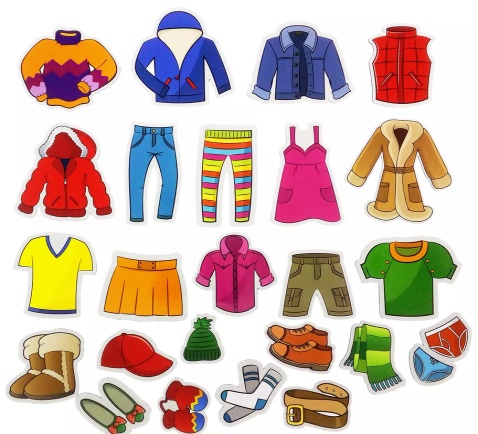
Ex:1 P:86 • Students open their books at page 80. Read out the two questions. Students ask and answer them in pairs. Ask a few students to report back to the class on their partner. Ex: 2 P: 86 Tell students they are going to listen to a conversation between two friends. Read out the question and play the recording. Check answer. To extend this, you could put additional questions on the board: Ex: 3 P: 86 Give students time to read through the things in the list. Play the recording again for students to listen and tick the things Vicky did. Check answers with the class. Ex: 4 P: 86 Check students can pronounce clothes /klərōz/. A common error is to pronounce the -es /1z/ rather than /z/. Put students in pairs to do the exercise. If you have the Presentation Plus software, put the photos on the interactive whiteboard and ask students to come to the board to match the words and photos. Point out that clothes words that end in -s can be used after a if you include pair of, e.g. a pair of boots/jeans/trousers/ shorts/socks.. Conclusion during the lesson some tasks differentiated by outcomes of the students and by their abilities. |
• Learners complete the examples from the listening. ANSWERS Wh- questions What did you do? Who did you watch? Where did you go? Answers I went to a skateboard competition. My friend Dennis. We went to a Mexican restaurant • Learners complete the questions with the correct form of the past simple. Use the verbs in brackets. ANSWERS 2 did Rick buy 3 did Sarah play 4 did the game end 5 did we score 6 did they go • Learners complete the conversation with questions in the past simple. ANSWERS Student’s own answer. • Learners listen and check. Practise the conversation with a partner. ANSWERS 2 Who did they play? 3 Where did they play? 4 How many points did they score? 5 Who did you g |
Descriptor: - read out the two questions - ask and answer them in pairs Total: 2 point
Self assessment Differentiation: «Verbal support» method is used to help Ss use new words in the sentences. Descriptor: - complete the questions with the correct form - use the verbs in brackets. Total: 2 point Descriptor: - listen and check - practise the conversation Total: 2 point -Make CCQ questions Yes / No Total: 1 point |
Card Worksheet Students book |
|
End of the lesson 5 min |
FEEDBACK Learners provide feedback on what they have learned at the lesson. |
|
Poster Success
|
|
Short term plan: term 4
|
Unit 8: Sports |
Lesson 85 |
||
|
Teacher name: |
|
||
|
Date: |
|
||
|
Grade: 5 |
Number present: |
absent: |
|
|
Lesson title |
Language focus: Past simple Wh –question |
||
|
Learning objectives |
5.6.8.1 use a verb to be to talk about favourite things on a limited range of familiar general and curricular topics 5.2.4.1 understand the main points of supported extended talk on a range of general and curricular topics 5.3.2.1 ask simple questions to get information about a limited range of general topics. |
||
|
Lesson objectives |
Learners will be able to: - learn Wh-questions in the past simple. - ask and answer questions about a sports event I went to |
||
|
Value links |
Freedom: Freedom is the major value of the civil society being formed in Kazakhstan. This must provide everyone with the possibility of creative self-realization. |
||
|
Plan |
|||
|
Stages / Time |
Teachers actions |
Students actions |
Assessment criteria |
Resources |
|
Beginning of the lesson Warming-up
3 min. Pre-learning «Brainstorming» method 7 min. |
Organization moment : 1.Greeting. Ask about the weather. The teacher sets the lesson objectives, letting students know what to anticipate from the lesson. Warming up Books closed. Elicit a yes/no question in the past simple, e.g. Did you go to the cinema? Ask students if they can add any other words to the beginning of the sentence to make a different kind of question, e.g. When did you go to the cinema? Why did you go to the cinema? Lead – In
|
The aim: To develop pupils speaking skills and create friendly atmosphere Efficiency: By wishing each other they feel better and feel the support of others Students of the class are listed. Students' attention is drawn to the lesson. Students say different words from the picture •Learners remember previous lesson vocabulary •Learners answer the questions |
The teacher to assess learners for their ability. “Good job! Well done!” Formative Assessment
Good job! Descriptor: - remembers the lesson passed Point 1 Assessment criteria make basic statements related to personal information, people and objects on familiar topics and a treasure hunt |
Pictures worksheet Picture |
|
Middle of the lesson Presentation part. 30 min |
Ex:1 P:87 • Ask students to open their books at page 81. Put students into pairs and ask them to complete the example sentences from the listening on page 80. You could either play the recording for students to check their answers or simply go through the answers orally. Ex: 2 P: 87 Read out the example sentence. Ask students to work in pairs to complete the remaining sentences. Check answers. Ex: 3 P: 87 Ask out the example. small groups and ask them to complete Cambridge Guide weaker students through the exercise by asking them to first identify the question words needed. Once students have done this they can move on to looking at the verbs they need. Encourage them to check their first answer with you before they do the rest of the exercise Ex: 4 P: 87 Play the recording for students to check their answers. Put students into pairs and ask them to read the conversation twice, taking a different part each time. Conclusion during the lesson some tasks differentiated by outcomes of the students and by their abilities. |
• Learners complete the examples from the listening. ANSWERS Student’s own answer. • Learners listen to Vicky and Joe talking about skateboarding competition. ANSWERS Wh- questions What did you do? Who did you watch? Where did you go? Answers I went to a skateboard competition. My friend Dennis. We went to a Mexican restaurant • Learnerscomplete the questions with the correct form of the past simple. Use the verbs in brackets. ANSWERS 2 did Rick buy 3 did Sarah play 4 did the game end 5 did we score 6 did they go • Learners complete the conversation with questions in the past simple. ANSWERS Student’s own answer. • Learners listen and check. Practise the conversation with a partner. ANSWERS 2 Who did they play? 3 Where did they play? 4 How many points did they score? 5 Who did you go |
Descriptor: - complete the examples Total: 2 point
Self assessment Differentiation: «Verbal support» method is used to help Ss use new words in the sentences. Descriptor: - listen Vicky and Joe talking about skateboarding - answer the question Total: 2 point Descriptor: - talking about skateboarding - listen, check and repeat. Total: 2 point -Make CCQ questions Yes / No Total: 1 point |
Card Worksheet Students book |
|
End of the lesson 5 min |
FEEDBACK Learners provide feedback on what they have learned at the lesson. |
|
Poster Success
|
|

Short term plan: term 4
|
Unit 8: Sports |
Lesson 86 |
||
|
Teacher name: |
|
||
|
Date: |
|
||
|
Grade: 5 |
Number present: |
absent: |
|
|
Lesson title |
Discovery culture |
||
|
Learning objectives |
5.4.1.1 understand the main points in a limited range of short simple texts on general and curricular topics 5.5.1.1 plan, write, edit and proofread work at text level with support on a limited range of general and curricular topics |
||
|
Lesson objectives |
Learners will be able to: - watch a video about an Indian cricketer. - talk about cricket and my sporting hero. |
||
|
Value links |
National values begin with respect for the nation Kazakhstan is a multinational state. According to research, there are more than 130 nationalities in Kazakhstan. The formation of a nation as a nation begins primarily with the glorification of national values. |
||
|
Plan |
|||
|
Stages / Time |
Teachers actions |
Students actions |
Assessment criteria |
Resources |
|
Beginning of the lesson Warming-up
3 min. Pre-learning «Brainstorming» method 7 min. |
Organization moment : 1.Greeting. Ask about the weather. The teacher sets the lesson objectives, letting students know what to anticipate from the lesson. Warming up Write the following on the board: They eat a lot of cake and chocolate. They practise every day. They go on lots of holidays. They never give up. Check students' understanding of give up. Ask students to say which sentences describe the best sport stars Lead – In
|
The aim: To develop pupils speaking skills and create friendly atmosphere Efficiency: By wishing each other they feel better and feel the support of others Students of the class are listed. Students' attention is drawn to the lesson. Students say different words from the picture •Learners remember previous lesson vocabulary •Learners answer the questions |
The teacher to assess learners for their ability. “Good job! Well done!” Formative Assessment
Good job! Descriptor: - remembers the lesson passed Point 1 Assessment criteria make basic statements related to personal information, people and objects on familiar topics and a treasure hunt |
Pictures worksheet Picture |
|
Middle of the lesson Presentation part. 30 min |
Ex:1 P:88 • Ask students to open their books at page 82. Refer students to the photos and ask them to identify the sport. Ex: 2 P: 88 Put students into pairs. Ask some students to report their ideas to the class. Write students' ideas on the board. Ex: 3 P: 88 Ask students to read the information in 1-5. on in 1-5. Play the video with the sound off. Students watch the video and order the information. Students compare their answers in pairs before you check answers with the class. Ask one student to come to the front of the class to write the events on the board in the correct order. Ask the rest of the class whether or not they agree with the order that the student at the board has given Ex: 4 P: 88 Before you play the video again, ask students if they can complete the gaps. This is only a quick test of memory. Students should not be discouraged if they cannot complete the gaps. Play the video. Students complete the text with the correct information. Ex: 5 P: 88 Ask a student to read out the four questions. Play the rest of the video so students can answer the questions. Check answers. Conclusion during the lesson some tasks differentiated by outcomes of the students and by their abilities. |
• Learners look at the pictures. Answer the question. ANSWERS b • Learners work with a partner. Answer the question. ANSWERS Student’s own answer • Learners watch the video without sounds. Put these things in the order that you see them. ANSWERS 1 players wearing normal clothes 2 a cow and lots of traffic nearby 3 nets 4 a trainer 5 children playing • Learners watch the video again with sound. Complete the paragraph with the correct numbers. ANSWERS 1 one 2 500 3 22 4 six 5 160 • Learners watch the rest of the video answer the question ANSWERS 1 He's deaf. / He can't hear. 2 He uses sign language to communicate. 3 He plays the best game of his life. 4 He finds new players for professional cricket teams |
Descriptor: - look at the pictures - answer the question. Total: 2 point
Self assessment Differentiation: «Verbal support» method is used to help Ss use new words in the sentences. Descriptor: - work with a partner. - answer the question Total: 2 point Descriptor: - watch the video again - complete the paragraph Total: 2 point Descriptor: - watch the video rest - answer the question Total: 2 point -Make CCQ questions Yes / No Total: 1 point |
Card Worksheet Students book |
|
End of the lesson 5 min |
FEEDBACK Learners provide feedback on what they have learned at the lesson. |
|
Poster Success
|
|

Short term plan: term 4
|
Unit 8: Sports |
Lesson 87 |
||
|
Teacher name: |
|
||
|
Date: |
|
||
|
Grade: 5 |
Number present: |
absent: |
|
|
Lesson title |
Reading: an article |
||
|
Learning objectives |
5.2.3.1 understand an increasing range of unsupported basic questions on general and curricular topics 5.5.1.1 plan, write, edit and proofread work at text level with support on a limited range of general and curricular topics 5.5.6.1 link, with some support, sentences into coherent paragraphs using basic connectors on a limited range of familiar general topics |
||
|
Lesson objectives |
Learners will be able to: - read a text about the Highland Games in Scotland. - learn about irregular plurals. - talk about which events in the Highland Games I would like and not like to do. |
||
|
Value links |
National values begin with respect for the nation Kazakhstan is a multinational state. According to research, there are more than 130 nationalities in Kazakhstan. The formation of a nation as a nation begins primarily with the glorification of national values. |
||
|
Plan |
|||
|
Stages / Time |
Teachers actions |
Students actions |
Assessment criteria |
Resources |
|
Beginning of the lesson Warming-up
3 min. Pre-learning «Brainstorming» method 7 min. |
Organization moment : 1.Greeting. Ask about the weather. The teacher sets the lesson objectives, letting students know what to anticipate from the lesson. Warming up Books closed. Ask: What are the most popular sports in your country? Elicit answers and write them on the board. Ask students if they can name any unusual sports, i.e. sports that few people do and which, in global terms, do not attract a large television audience, e.g. bowls, handball, lacrosse or taekwondo Lead – In |
The aim: To develop pupils speaking skills and create friendly atmosphere Efficiency: By wishing each other they feel better and feel the support of others Students of the class are listed. Students' attention is drawn to the lesson. Students say different words from the picture •Learners remember previous lesson vocabulary •Learners answer the questions |
The teacher to assess learners for their ability. “Good job! Well done!” Formative Assessment
Good job! Assessment criteria make basic statements related to personal information, people and objects on familiar topics and a treasure hunt |
Pictures worksheet Picture |
|
Middle of the lesson Presentation part. 30 min |
Ex:1 P:89 • Ask students to open their books at page 83. Put students in pairs and give them one minute to answer the questions about the photos. Tell students not to look at the text to find answers. Alternatively, put videos of the sports on the interactive whiteboard instead of asking them to look at the photos. You can find videos of the sports on YouTube by putting in the name of the sport plus Highland Games into the search engine on that site. Check answers. Ex: 2 P: 89 Read out the names of the four sports. Give students a couple of minutes to scan the article to find the information about these sports. Students can work in pairs to do the matching exercise. Check answers. Ex: 3 P: 89 Give students a minute to read through sentences 1-6. Ask students to work alone to do the exercise. Students can compare answers in pairs before you check answers with the class. Ex: 4 P: 89 Ask: What type of word is a 'plural'? Elicit the answer and then explain that some plurals are irregular. Refer students to the nouns in the box. Students can work alone to find the plural forms of words in the text and note which are regular a ar and which irregular. Conclusion during the lesson some tasks differentiated by outcomes of the students and by their abilities. |
• Learners look at the pictures. Answer the question. ANSWERS It's Scotland • Learners read the article. Match the photos with the sports. ANSWERS 1c 2d 3a 4b • Learners read the article again. Mark the statements. Correct the false ones. ANSWERS 2T 3 F (He was an 11th century king.) 4T 5F (In the past, people wore tartan to show which family they were from.) 6 F (Nowadays, people from all round the world compete in the events.) • Learners find the plurals of these words in the text. Are they (R) regular or (I) irregular ANSWERS men (I) children ( (I) teams (R) people (I) sports (R) women (I) |
Descriptor: - look at the pictures - answer the question. Total: 2 point
Self assessment Differentiation: «Verbal support» method is used to help Ss use new words in the sentences. Descriptor: - read the article - match the photos with the sports Total: 2 point Descriptor: - read the article - mark the statements Total: 2 point Descriptor: - find the plurals of these words Total: 2 point -Make CCQ questions Yes / No Total: 1 point |
Card Worksheet Students book |
|
End of the lesson 5 min |
FEEDBACK Learners provide feedback on what they have learned at the lesson. |
|
Poster Success
|
|
Short term plan: term 4
|
Unit 8: Sports |
Lesson 88 |
||
|
Teacher name: |
|
||
|
Date: |
|
||
|
Grade: 5 |
Number present: |
absent: |
|
|
Lesson title |
Speaking: Expressing |
||
|
Learning objectives |
5.4.1.1 understand the main points in a limited range of short simple texts on general and curricular topics 5.5.1.1 plan, write, edit and proofread work at text level with support on a limited range of general and curricular topics |
||
|
Lesson objectives |
Learners will be able to: - watch teenagers talking about their favourite sport. - practise talking about the sport I did at the weeke |
||
|
Value links |
National values begin with respect for the nation Kazakhstan is a multinational state. According to research, there are more than 130 nationalities in Kazakhstan. The formation of a nation as a nation begins primarily with the glorification of national values. |
||
|
Plan |
|||
|
Stages / Time |
Teachers actions |
Students actions |
Assessment criteria |
Resources |
|
Beginning of the lesson Warming-up
3 min. Pre-learning «Brainstorming» method 7 min. |
Organization moment : 1.Greeting. Ask about the weather. The teacher sets the lesson objectives, letting students know what to anticipate from the lesson. Warming up Books closed. Ask: What are the most popular sports in your country? Elicit answers and write them on the board. Ask students if they can name any unusual sports, i.e. sports that few people do and which, in global terms, do not attract a large television audience, e.g. bowls, handball, lacrosse or taekwondo Lead – In |
The aim: To develop pupils speaking skills and create friendly atmosphere Efficiency: By wishing each other they feel better and feel the support of others Students of the class are listed. Students' attention is drawn to the lesson. Students say different words from the picture •Learners remember previous lesson vocabulary •Learners answer the questions |
The teacher to assess learners for their ability. “Good job! Well done!” Formative Assessment
Good job! Assessment criteria make basic statements related to personal information, people and objects on familiar topics and a treasure hunt |
Pictures worksheet Picture |
|
Middle of the lesson Presentation part. 30 min |
Ex:1 P:90 •Ask students to open their books at page 84. Tell students they are going to watch some teenagers answering the following question: What's your favourite sport and why? Give students some time to look at the list of sports and then play the video. Students work alone to tick the sports. Students can compare answers in pairs before you check answers with the class Ex: 2 P: 90 Put students into pairs to ask and answer the question. You could then find out which is the most popular sport with the class as a whole Ex: 3 P: 90 Give students time to read the question, then play the recording. T Students compare answers in pairs before you check the answer with the class Ex: 4 P: 90 Refer students to the words and phrases in the Useful language box and check understanding. Explain that when expressing interest, we need to get the intonation right. If our voice is flat it will either seem that we are not interested or that we are being sarcastic. Put students into pairs and give them a couple of minutes to Conclusion during the lesson some tasks differentiated by outcomes of the students and by their abilities. |
• Learners watch the teenagers in the video. Write the sports they talk about. ANSWERS baseball football soccer swimming table tennis • Learners ask and answer with your partner ANSWERS Student’s own answer. • Learners listen to Max and Rachel talking about the weekend. ANSWERS She went windsurfing. • Learners complete the conversation with the useful language. ANSWERS Student’s own answer |
Descriptor: - watch the teenagers - write the sports they talk about Total: 2 point
Self assessment Differentiation: «Verbal support» method is used to help Ss use new words in the sentences. Descriptor: - work in pairs - answer the question Total: 2 point Descriptor: - complete the conversation Total: 2 point -Make CCQ questions Yes / No Total: 1 point |
Card Worksheet Students book |
|
End of the lesson 5 min |
FEEDBACK Learners provide feedback on what they have learned at the lesson. |
|
Poster Success
|
|
Short term plan: term 4
|
Unit 8: Sports |
Lesson 89 |
||
|
Teacher name: |
|
||
|
Date: |
|
||
|
Grade: 5 |
Number present: |
absent: |
|
|
Lesson title |
Writing: a biography Summative assessment for the unit “Sports” |
||
|
Learning objectives |
5.3.6.1 communicate meaning clearly at sentence level during, pair, group and whole class exchanges 5.2.2.1 understand an increasing range of unsupported basic questions which ask for personal information 5.4.2.1 understand with little support specific information and detail in short, simple texts on a limited range of general and curricular topics. |
||
|
Lesson objectives |
Learners will be able to: - read a biography. - learn about prepositions of time and place. - write a biography of someone I know |
||
|
Value links |
National values begin with respect for the nation Kazakhstan is a multinational state. According to research, there are more than 130 nationalities in Kazakhstan. The formation of a nation as a nation begins primarily with the glorification of national values. |
||
|
Plan |
|||
|
Stages / Time |
Teachers actions |
Students actions |
Assessment criteria |
Resources |
|
Beginning of the lesson Warming-up
3 min. Pre-learning «Brainstorming» method 7 min. |
Organization moment : 1.Greeting. Ask about the weather. The teacher sets the lesson objectives, letting students know what to anticipate from the lesson. Warming up Books closed. Ask: What are the most popular sports in your country? Elicit answers and write them on the board. Ask students if they can name any unusual sports, i.e. sports that few people do and which, in global terms, do not attract a large television audience, e.g. bowls, handball, lacrosse or taekwondo Lead – In |
The aim: To develop pupils speaking skills and create friendly atmosphere Efficiency: By wishing each other they feel better and feel the support of others Students of the class are listed. Students' attention is drawn to the lesson. Students say different words from the picture •Learners remember previous lesson vocabulary •Learners answer the questions |
The teacher to assess learners for their ability. “Good job! Well done!” Formative Assessment
Good job! Assessment criteria make basic statements related to personal information, people and objects on familiar topics and a treasure hunt |
Pictures worksheet Picture |
|
Middle of the lesson Presentation part. 30 min |
Ex:1 P:91 • Ask students to open their books at page 85 and say, by looking at that photo, what sport Mohammed does. Tell students to read the biography quickly to check their answer. Ex: 2 P: 91 Refer students to the information in the box and make sure that they understand each word or phrase. If necessary, explain: record (noun): the best result achieved in a sport, e.g. Usain Bolt holds the world records in the 100 m and the 200 m; medal: a small round piece of metal (typically gold, silver and bronze) given to athletes who finish first, second and third in a particular event. Ask students to work alone to do the exercise. Students can compare answers in pairs before answers with the class. Ex: 3 P: 91 Refer students back to the text to find the answers. Students compare answers in pairs before you check the answer with the class Ex: 4 P: 91 Read out the information about prepositions in the Useful language box. Check students' understanding by calling out dates, months, years, cities and events and asking students to say which prepositions are used, e.g. Ex: 5 P: 91 Go through the first sentence with the class as an example. Ask students to work in pairs to complete the remaining sentences with the correct prepositions. Check answers. Conclusion during the lesson some tasks differentiated by outcomes of the students and by their abilities. |
• Learners look at the photo. Answer the question ANSWERS He's a runner • Learners write the information in the order it appears in the biography ANSWERS 1 place and year of birth 2 sport(s) 3 medals and records 4 his/her future • Learners read the biography again. Answer the question. ANSWERS 2008 - He won his first international race in Nigeria. the age of 19-He won the gold medal at the 2013 World Championship in Moscow. September – 2011 He broke his own record. • Learners complete the examples in the Useful Language box. ANSWERS on August 9th; in December, in 2014; in London, in Nigeria; at the World Championships, at the age of 12 • Learners complete the sentences with the correct preposition. ANSWERS 1 in, on 2 At, in 3 at, in 4 in, on, in |
Descriptor: - look at the photo. - answer the question Total: 2 point
Self assessment Differentiation: «Verbal support» method is used to help Ss use new words in the sentences. Descriptor: - write the information in the order Total: 2 point Descriptor: - read the biography - answer the question. Total: 2 point Descriptor: - complete the sentences with the correct preposition Total: 2 point -Make CCQ questions Yes / No Total: 1 point |
Card Worksheet Students book |
|
End of the lesson 5 min |
FEEDBACK Learners provide feedback on what they have learned at the lesson. |
|
Poster Success
|
|

Short term plan: term 4
|
Unit 8: Sports |
Lesson 90 |
||
|
Teacher name: |
|
||
|
Date: |
|
||
|
Grade: 5 |
Number present: |
absent: |
|
|
Lesson title |
CLIL: PE Outdoor sports and activities |
||
|
Learning objectives |
5.3.7.1 use appropriate subject-specific vocabulary and syntax to talk about a limited range of general topics; 5.5.1.1 plan, write, edit |
||
|
Lesson objectives |
Learners will be able to: - read about outdoor sports and activities. - learn the words for some pieces of equipment needed to do outdoor sports. - make a poster about an outdoor sport or activity. |
||
|
Value links |
National values begin with respect for the nation Kazakhstan is a multinational state. According to research, there are more than 130 nationalities in Kazakhstan. The formation of a nation as a nation begins primarily with the glorification of national values. |
||
|
Plan |
|||
|
Stages / Time |
Teachers actions |
Students actions |
Assessment criteria |
Resources |
|
Beginning of the lesson Warming-up
3 min. Pre-learning «Brainstorming» method 7 min. |
Organization moment : 1.Greeting. Ask about the weather. The teacher sets the lesson objectives, letting students know what to anticipate from the lesson. Warming up Books closed. Ask: What are the most popular sports in your country? Elicit answers and write them on the board. Ask students if they can name any unusual sports, i.e. sports that few people do and which, in global terms, do not attract a large television audience, e.g. bowls, handball, lacrosse or taekwondo Lead – In |
The aim: To develop pupils speaking skills and create friendly atmosphere Efficiency: By wishing each other they feel better and feel the support of others Students of the class are listed. Students' attention is drawn to the lesson. Students say different words from the picture •Learners remember previous lesson vocabulary •Learners answer the questions |
The teacher to assess learners for their ability. “Good job! Well done!” Formative Assessment
Good job! Assessment criteria make basic statements related to personal information, people and objects on familiar topics and a treasure hunt |
Pictures worksheet Picture |
|
Middle of the lesson Presentation part. 30 min |
Ex:1 P:92 •Ask students to open their books at page 121. Put students into pairs to copy and complete the table. If you have the Presentation Plus software, put the photos on the interactive whiteboard and ask students to come to the board in turn to do complete the table . Ex: 2 P: 92 Play the recording. Students listen to it, read the text and check their answers to Exercise 1. Point out that gym is an abbreviation of gymnasium. Ex: 3 P: 92 Refer students to the words in the box. Explain that they are examples of equipment, i.e. objects that we use when doing a particular activity. Give students dictionaries and set a five-minute time limit for this exercise. Pair stronger students with weaker students to do this exercise. Check answers. Write definitions of the words on the board Ex: 4 P: 92 Before you play the recording, put students into pairs and ask them to say which sports requires which pieces of equipment seen in Exercise 1. Play the recording for students to write down the sports and the equipment they use. Conclusion during the lesson some tasks differentiated by outcomes of the students and by their abilities. |
• Learners look at the pictures. Answer the question ANSWERS Student’s own answer • Learners read the text. Check your ideas. ANSWERS On land horse riding In the air bungee jumping paragliding In the water windsurfing canoeing • Learners check the meaning of the words in the box. ANSWERS Student’s own answer. • Learners listen and write the sports for each piece of equipment. ANSWERS Goggles and gloves: skiing, snowboarding Wetsuit: surfing, windsurfing Waterproof clothes: canoeing Life jacket: canoeing |
Descriptor: - look at the pictures . - answer the question Total: 2 point
Self assessment Differentiation: «Verbal support» method is used to help Ss use new words in the sentences. Descriptor: - read the text - check your ideas Total: 2 point Descriptor: - check the meaning of the words in the box. Total: 2 point Descriptor: - listen and write the sports Total: 2 point -Make CCQ questions Yes / No Total: 1 point |
Card Worksheet Students book |
|
End of the lesson 5 min |
FEEDBACK Learners provide feedback on what they have learned at the lesson. |
|
Poster Success
|
|
Short term plan: term 4
|
Unit 9: Holidays |
Lesson 91 |
||
|
Teacher name: |
|
||
|
Date: |
|
||
|
Grade: 5 |
Number present: |
absent: |
|
|
Lesson title |
Vocabulary: Seasons and weather |
||
|
Learning objectives |
5.2.3.1 understand an increasing range of unsupported basic questions on general and curricular topics 5.5.1.1 plan, write, edit and proofread work at text level with support on a limited range of general and curricular topics |
||
|
Lesson objectives |
Learners will be able to: - learn vocabulary for the seasons and weather. - talk about favourite months and seasons. |
||
|
Value links |
National values begin with respect for the nation Kazakhstan is a multinational state. According to research, there are more than 130 nationalities in Kazakhstan. The formation of a nation as a nation begins primarily with the glorification of national values. |
||
|
Plan |
|||
|
Stages / Time |
Teachers actions |
Students actions |
Assessment criteria |
Resources |
|
Beginning of the lesson Warming-up
3 min. Pre-learning «Brainstorming» method 7 min. |
Organization moment : 1.Greeting. Ask about the weather. The teacher sets the lesson objectives, letting students know what to anticipate from the lesson. Warming up Books closed. Ask: What are the most popular sports in your country? Elicit answers and write them on the board. Ask students if they can name any unusual sports, i.e. sports that few people do and which, in global terms, do not attract a large television audience, e.g. bowls, handball, lacrosse or taekwondo Lead – In |
The aim: To develop pupils speaking skills and create friendly atmosphere Efficiency: By wishing each other they feel better and feel the support of others Students of the class are listed. Students' attention is drawn to the lesson. Students say different words from the picture •Learners remember previous lesson vocabulary •Learners answer the questions |
The teacher to assess learners for their ability. “Good job! Well done!” Formative Assessment
Good job! Assessment criteria make basic statements related to personal information, people and objects on familiar topics and a treasure hunt |
Pictures worksheet Picture |
|
Middle of the lesson Presentation part. 30 min |
Ex:1 P:95 • Refer students to the calendar. First, ask students to say when the seasons occur in their country and then ask them to work in pairs to complete the calendars with the months when the seasons occur in countries in the northern hemisphere. If you have the Presentation Plus software, put the calendars on the interactive whiteboard and ask students to come to the board in turn to write the months underneath. Play the recording again for students to repeat the words. Remind students that north and south experience the seasons differently. When it is winter in the southern hemisphere it is summer in the northern hemisphere; when it is summer in the southern hemisphere it is winter in the northern hemisphere. Ex: 2 P: 95 Ask students to work in pairs to match the phrases with the To extend the work on weather vocabulary, you could teach students it's hot/cold and show students how to talk about students to learn complete phrases in English, e.g. wet weather, when they learn vocabulary for a particular subject. Play the recording for students to check their answers. Ex: 3 P: 95 Give students a few minutes to complete the chart Ex: 4 P: 95 Put students in pairs. Students ask and answer questions about the information they put in the table in Exercise 3. Conclusion during the lesson some tasks differentiated by outcomes of the students and by their abilities. |
• Learners look at the seasons. Which months are in each season in your country? Then listen and repeat. ANSWERS Spring: March, April, May Summer: June, July, August Autumn: September, October, November Winter: December, January, February • Learners match the photos of the weather with the phrases in the box. ANSWERS 2 It's windy. 3 It's sunny. 4 It's foggy. 5 It's rainy. 6 It's cloudy. 7 It's snowy. 8 It's stormy • Learners complete the table for you. ANSWERS Student’s own answer. • Learners ask and answer the questions. ANSWERS Student’s own answer |
Descriptor: - look at the seasons - answer the question Total: 2 point
Self assessment Differentiation: «Verbal support» method is used to help Ss use new words in the sentences. Descriptor: - match the photos of the weather with the phrases - work on weather vocabulary Total: 2 point Descriptor: - complete the table Total: 2 point Descriptor: - ask and answer the questions Total: 2 point -Make CCQ questions Yes / No Total: 1 point |
Card Worksheet Students book |
|
End of the lesson 5 min |
FEEDBACK Learners provide feedback on what they have learned at the lesson. |
|
Poster Success
|
|
Short term plan: term 4
|
Unit 9: Holidays |
Lesson 92 |
||
|
Teacher name: |
|
||
|
Date: |
|
||
|
Grade: 5 |
Number present: |
absent: |
|
|
Lesson title |
Reading: A web page |
||
|
Learning objectives |
5.2.3.1 Give an opinion at sentence level on a limited range of general and curricular topics; 5.3.7.1 use appropriate subject-specific vocabulary and syntax to talk about a limited range of general topics; 5.4.4.1 read with some support a limited range of short fiction and non-fiction texts. |
||
|
Lesson objectives |
Learners will be able to: - read descriptions of holidays. - learn holiday collocations. - talk about my last holiday |
||
|
Value links |
National values begin with respect for the nation Kazakhstan is a multinational state. According to research, there are more than 130 nationalities in Kazakhstan. The formation of a nation as a nation begins primarily with the glorification of national values. |
||
|
Plan |
|||
|
Stages / Time |
Teachers actions |
Students actions |
Assessment criteria |
Resources |
|
Beginning of the lesson Warming-up
3 min. Pre-learning «Brainstorming» method 7 min. |
Organization moment : 1.Greeting. Ask about the weather. The teacher sets the lesson objectives, letting students know what to anticipate from the lesson. Warming up Books closed. Ask: What are the most popular sports in your country? Elicit answers and write them on the board. Ask students if they can name any unusual sports, i.e. sports that few people do and which, in global terms, do not attract a large television audience, e.g. bowls, handball, lacrosse or taekwondo Lead – In |
The aim: To develop pupils speaking skills and create friendly atmosphere Efficiency: By wishing each other they feel better and feel the support of others Students of the class are listed. Students' attention is drawn to the lesson. Students say different words from the picture •Learners remember previous lesson vocabulary •Learners answer the questions |
The teacher to assess learners for their ability. “Good job! Well done!” Formative Assessment
Good job! Assessment criteria make basic statements related to personal information, people and objects on familiar topics and a treasure hunt |
Pictures worksheet Picture |
|
Middle of the lesson Presentation part. 30 min |
Ex:1 P:96 • Students open their books at page 88 and describe the photos. Put students in pairs to ask and answer the question. Ask some students to report back to the class on what their partner said Ex: 2 P: 96 Before students read the three posts, check their understanding of the following: cabin (a small wooden house often found in a wood), countryside (land away from urban areas either used for farming of left in its natural state) and wildlife (animals that are not domesticated and which live in the wild). Ask students to read the texts and work in pairs to match the texts with the photos. Check answers. Ex: 3 P: 96 Ask a student to read out the questions. Elicit answers from the class. Ask students to read the text again to check their answers. Alternatively, put students into pairs (A and B). Student As find the answers to questions 1, 2 and 3. Student Bs find the answers to questions 4, 5 and 6. Students then share their answers. Ex: 4 P: 96 Refer students to the information in the table. Students work alone to complete the table with expressions in the texts. Tell students to scan the texts for the verbs stay, spend and take. Conclusion during the lesson some tasks differentiated by outcomes of the students and by their abilities. |
• Learners look at the pictures. Answer the question ANSWERS Student’s own answer. • Learners read the teenagers posts about their holiday plans. Match each speaker with the correct activity pictures. ANSWERS Chloe1, 2, 3 Carla-5 Ivan - 4 • Learners read about Chloe, Carla and Ivan’s holiday plan again. ANSWERS 1 Chloe 2 Carla 3 Chloe 4 Ivan 5 Chloe and Carla 6 Carla • Learners look at the expressions in the table. ANSWERS stay in a cabin, in a tree house, in a hotel spend two weeks take summer clothes, camera, phones |
Descriptor: - look at the pictures - answer the question Total: 2 point
Self assessment Differentiation: «Verbal support» method is used to help Ss use new words in the sentences. Descriptor: - read the teenagers posts - match each speaker Total: 2 point Descriptor: - read about students’ holiday plan Total: 2 point Descriptor: - look at the expressions in the table Total: 2 point -Make CCQ questions Yes / No Total: 1 point |
Card Worksheet Students book |
|
End of the lesson 5 min |
FEEDBACK Learners provide feedback on what they have learned at the lesson. |
|
Poster Success
|
|
Short term plan: term 4
|
Unit 9: Holidays |
Lesson 93 |
||
|
Teacher name: |
|
||
|
Date: |
|
||
|
Grade: 5 |
Number present: |
absent: |
|
|
Lesson title |
Language focus: be going to |
||
|
Learning objectives |
5.4.1.1 understand the main points in a limited range of short simple texts (a poem) on general and curricular topics 5.2.2.1 understand an increasing range of unsupported basic questions which ask for personal information on the poem |
||
|
Lesson objectives |
Learners will be able to: - learn the affirmative, negative and question forms of be going to. talk about future plans |
||
|
Value links |
National values begin with respect for the nation Kazakhstan is a multinational state. According to research, there are more than 130 nationalities in Kazakhstan. The formation of a nation as a nation begins primarily with the glorification of national values. |
||
|
Plan |
|||
|
Stages / Time |
Teachers actions |
Students actions |
Assessment criteria |
Resources |
|
Beginning of the lesson Warming-up
3 min. Pre-learning «Brainstorming» method 7 min. |
Organization moment : 1.Greeting. Ask about the weather. The teacher sets the lesson objectives, letting students know what to anticipate from the lesson. Warming up Books closed. Ask: What are the most popular sports in your country? Elicit answers and write them on the board. Ask students if they can name any unusual sports, i.e. sports that few people do and which, in global terms, do not attract a large television audience, e.g. bowls, handball, lacrosse or taekwondo Lead – In |
The aim: To develop pupils speaking skills and create friendly atmosphere Efficiency: By wishing each other they feel better and feel the support of others Students of the class are listed. Students' attention is drawn to the lesson. Students say different words from the picture •Learners remember previous lesson vocabulary •Learners answer the questions |
The teacher to assess learners for their ability. “Good job! Well done!” Formative Assessment
Good job! Assessment criteria make basic statements related to personal information, people and objects on familiar topics and a treasure hunt |
Pictures worksheet Picture |
|
Middle of the lesson Presentation part. 30 min |
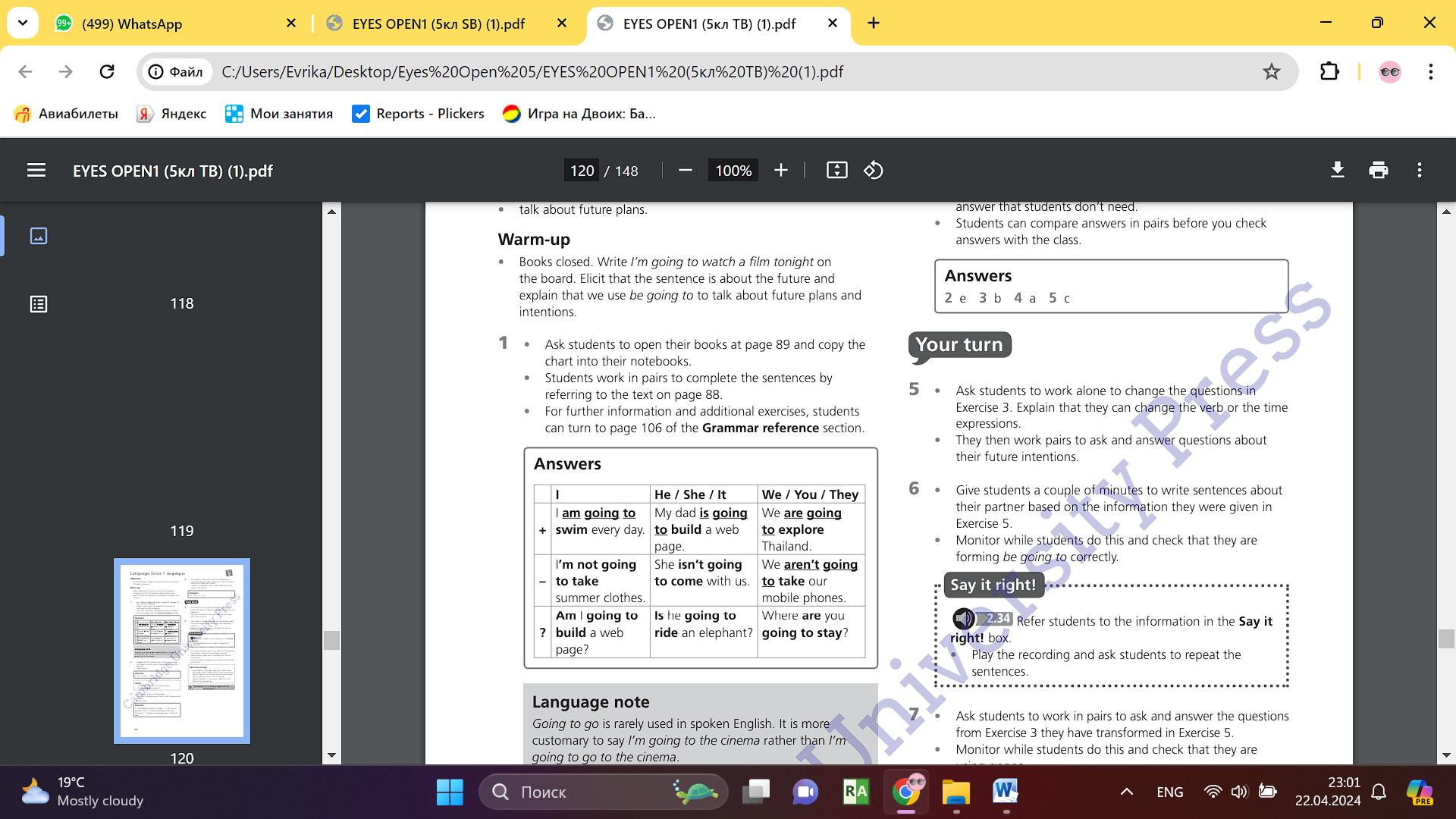
Ex:1 P:97 • Ask students to open their books at page 89 and copy the chart into their notebooks. Students work in pairs to complete the sentences by referring to the text on page 88. For further information and additional exercises, students can turn to page 106 of the Grammar reference section Ex: 2 P: 97 Complete the first sentence with the class as an example. Ask students to work in pairs to complete the remaining sentences. Check answers. Ex: 3 P: 97 Cambridge Play Expanding Sentences using be going to. See Games Bank on page 28. Ask a student to read out the example. Put students into pairs and ask them to write the remaining questions. Check answers. Ex: 4 P: 97 Ask students to work alone to match the questions in Exercise 3 with the answers in Exercise 4. There is one extra answer that students don't need. Students can compare answers in pairs before you check answers with the class. . Conclusion during the lesson some tasks differentiated by outcomes of the students and by their abilities. |
• Learners complete the examples from the text. ANSWERS
• Learners complete the sentences with the correct form of to be. ANSWERS 2 are 3 aren't 4 isn't 5 are • Learners write questions with be going to. ANSWERS 2 Are you going to watch TV tonight? 3 What are you going to watch? 4 When are they going to do their homework? 5 Where are we going to go on holiday this year? • Learners match questions with the correct answers ANSWERS 2 e 3 b 4 a 5 c |
Descriptor: - complete the examples - complete the sentences Total: 2 point
Self assessment Differentiation: «Verbal support» method is used to help Ss use new words in the sentences. Descriptor: - work in pairs - complete the sentences Total: 2 point Descriptor: - write questions with be going to. Total: 2 point Descriptor: - match questions with the correct answers Total: 2 point -Make CCQ questions Yes / No Total: 1 point |
Card Worksheet Students book |
|
End of the lesson 5 min |
FEEDBACK Learners provide feedback on what they have learned at the lesson. |
|
Poster Success
|
|
Short term plan: term 4
|
Unit 9: Holidays |
Lesson 94 |
||
|
Teacher name: |
|
||
|
Date: |
|
||
|
Grade: 5 |
Number present: |
absent: |
|
|
Lesson title |
Listening: A conversation |
||
|
Learning objectives |
5.2.8.1 understand supported narratives, including some extended talk, on an increasing range of general and curricular topics 5.4.3.1 understand the detail of an argument on a limited range of familiar general and curricular topics; |
||
|
Lesson objectives |
Learners will be able to: -listen to a conversation about planned holidays. - learn vocabulary to describe landscapes. - talk about holiday destinations. |
||
|
Value links |
National values begin with respect for the nation Kazakhstan is a multinational state. According to research, there are more than 130 nationalities in Kazakhstan. The formation of a nation as a nation begins primarily with the glorification of national values. |
||
|
Plan |
|||
|
Stages / Time |
Teachers actions |
Students actions |
Assessment criteria |
Resources |
|
Beginning of the lesson Warming-up
3 min. Pre-learning «Brainstorming» method 7 min. |
Organization moment : 1.Greeting. Ask about the weather. The teacher sets the lesson objectives, letting students know what to anticipate from the lesson. Warming up Books closed. Ask: What country is visited most often by tourists? Elicit students' ideas and put them on the board. Explain that France is visited most often by tourists. Lead – In
|
The aim: To develop pupils speaking skills and create friendly atmosphere Efficiency: By wishing each other they feel better and feel the support of others Students of the class are listed. Students' attention is drawn to the lesson. Students say different words from the picture •Learners remember previous lesson vocabulary •Learners answer the questions |
The teacher to assess learners for their ability. “Good job! Well done!” Formative Assessment
Good job! Assessment criteria make basic statements related to personal information, people and objects on familiar topics and a treasure hunt |
Pictures worksheet Picture |
|
Middle of the lesson Presentation part. 30 min |
Ex:1 P:98 • Ask students to open their books at page 90. If you have the Presentation Plus software, put the photographs on the interactive whiteboard and then go through the three questions with the class. Ex: 2 P: 98 • Read out the question and play the recording. Students compare answers in pairs before you check answers with the whole class. Ex: 3 P: 98 • Give students time to read through the sentences. Play the recording again. Ask students to work in pairs to do the exercise. Check answers. Ex: 4 P: 98 • Teach the meaning of landscape. Read out the words in the box and check understanding. Ask students to work in pairs to do the exercise. Conclusion during the lesson some tasks differentiated by outcomes of the students and by their abilities. |
• Learners look at the photos. What country do you think they show? Which do you like best? Why? ANSWERS A a lake in Scotland B Patagonia in Argentina C a beach in Thailand D a desert in Namibia • Learners listen to the conversation between Chloe and Ivan. Which of the places in the photos do they NOT talk about? ANSWERS They don't talk about the desert • Learners listen again. Are the sentences true (7) or false (F) ANSWERS 1T 2 F (She's going to visit Scotland in the summer.) 3 F (She's going to take a lot of photos) 4T 5 T 6 F (She loved it.) • Learners look at the photos in Exercise 1. Find the landscape words below. Which words aren't in the photos ANSWERS river, jungle, forest |
Descriptor: - look at the photos - answer the question Total: 2 point
Self assessment Differentiation: «Verbal support» method is used to help Ss use new words in the sentences. Descriptor: - listen to the conversation - compare answers in pairs Total: 2 point Descriptor: - read through the sentences. -mark the sttements Total: 2 point Descriptor: - read through the sentences. Total: 2 point -Make CCQ questions Yes / No Total: 1 point |
Card Worksheet Students book |
|
End of the lesson 5 min |
FEEDBACK Learners provide feedback on what they have learned at the lesson. |
|
Poster Success
|
|

Short term plan: term 4
|
Unit 9: Holidays |
Lesson 95 |
||
|
Teacher name: |
|
||
|
Date: |
|
||
|
Grade: 5 |
Number present: |
absent: |
|
|
Lesson title |
Language focus: future with will / won’t |
||
|
Learning objectives |
5.3.6.1 communicate meaning clearly at sentence level during, pair, group and whole class exchanges; 5.5.3.1 write with support factual descriptions at text level which describe people, places and objects; 5.6.9.1 use simple present and imperatives to describe holiday activities; |
||
|
Lesson objectives |
Learners will be able to: -learn will/won't for prediction. -talk about the future using will/won't |
||
|
Value links |
National values begin with respect for the nation Kazakhstan is a multinational state. According to research, there are more than 130 nationalities in Kazakhstan. The formation of a nation as a nation begins primarily with the glorification of national values. |
||
|
Plan |
|||
|
Stages / Time |
Teachers actions |
Students actions |
Assessment criteria |
Resources |
|
Beginning of the lesson Warming-up
3 min. Pre-learning «Brainstorming» method 7 min. |
Organization moment : 1.Greeting. Ask about the weather. Warming up Books closed. Ask: What do we use 'be going to' to talk about? Elicit that we use it to talk about future plans and intentions. Elicit an example sentence, e.g. I'm going to visit my grandparents this weekend, and then add to it, e.g. I think I will have a good time. Highlight the verb will and explain or elicit that we are using it in this sentence to make a prediction. You could then tell students that will is usually used in the abbreviated form 'l. Drill the pronunciation by saying simple phrases for students to repeat, e.g. We'll win, I'll see it, They'll lose. You could then introduce the negative by changing these phrases, e.g. We won't win, I won't see it, They won't lose. Lead – In |
The aim: To develop pupils speaking skills and create friendly atmosphere Efficiency: By wishing each other they feel better and feel the support of others Students of the class are listed. Students' attention is drawn to the lesson. Students say different words from the picture •Learners remember previous lesson vocabulary •Learners answer the questions |
The teacher to assess learners for their ability. “Good job! Well done!” Formative Assessment
Good job! Assessment criteria make basic statements related to personal information, people and objects on familiar topics and a treasure hunt |
Pictures worksheet Picture |
|
Middle of the lesson Presentation part. 30 min |
Ex:1 P:99 • Ask students to open their books at page 91. Tell students that the gapped sentences are from the listening on page 90. Ask: What can you remember from the listening? Ask students to copy and complete the sentences. You can either play the recording for students to check their answers or simply confirm that the answers students give are correct. Ex: 2 P: 99 • Ask a student to read out the example sentence. Put students in pairs and ask them to complete the remaiming sentences. Ex: 3 P: 99 • Ask a student to read out the gapped email. Whenever the student comes to a gap, he or she chooses a student and says What verb goes here? If that student does not know the answer, he or she says pass and the first student asks someone else for the answer. Ex: 4 P: 99 • Teach the meaning of landscape. Read out the words in the box and check understanding. Ask students to work in pairs to do the exercise. Conclusion during the lesson some tasks differentiated by outcomes of the students and by their abilities. |
• Learners complete the examples from the listening on page 98 ANSWERS
• Learners complete the sentences with the correct form of will and the verb in brackets. ANSWERS 2 won’t be 3 'll have 4 won't see 5 won't enjoy • Learners complete the email with will and the verbs below ANSWERS 1 'll have 2 will make 3 'll like 4 'll leave 5 'll walk 6 won't rain • Learners write sentences about the future using a prompt from each box ANSWERS Student’s own answer |
Descriptor: - complete the examples from the listening Total: 2 point
Self assessment Differentiation: «Verbal support» method is used to help Ss use new words in the sentences. Descriptor: - read out the example sentence - complete the sentences with the correct form Total: 2 point Descriptor: - read out the gapped email - complete the email Total: 2 point Descriptor: - read out the words - work in pairs to do the exercise. Total: 2 point -Make CCQ questions Yes / No Total: 1 point |
Card Worksheet Students book |
|
End of the lesson 5 min |
FEEDBACK Learners provide feedback on what they have learned at the lesson. |
|
Poster Success
|
|

Short term plan: term 4
|
Unit 9: Holidays |
Lesson 96 |
||
|
Teacher name: |
|
||
|
Date: |
|
||
|
Grade: 5 |
Number present: |
absent: |
|
|
Lesson title |
Discovery culture |
||
|
Learning objectives |
5.4.2.1 understand with little support specific information and detail in short, simple texts on a limited range of general and curricular topics; 5.5.3.1 write with support factual descriptions at text level which describe people, places and objects. |
||
|
Lesson objectives |
Learners will be able to: - watch a video about adventure holidays in Alaska. - talk about extreme sports and why people like to come to my country on holiday |
||
|
Value links |
National values begin with respect for the nation Kazakhstan is a multinational state. According to research, there are more than 130 nationalities in Kazakhstan. The formation of a nation as a nation begins primarily with the glorification of national values. |
||
|
Plan |
|||
|
Stages / Time |
Teachers actions |
Students actions |
Assessment criteria |
Resources |
|
Beginning of the lesson Warming-up
3 min. Pre-learning «Brainstorming» method 7 min. |
Organization moment : 1.Greeting. Ask about the weather. Warming up Write: North America on the board. Ask: How many cities can you name in North America? Put students into small groups and give them one minute to write down places. Find out which group came up with the most correct places Lead – In
|
The aim: To develop pupils speaking skills and create friendly atmosphere Efficiency: By wishing each other they feel better and feel the support of others Students of the class are listed. Students' attention is drawn to the lesson. Students say different words from the picture •Learners remember previous lesson vocabulary •Learners answer the questions |
The teacher to assess learners for their ability. “Good job! Well done!” Formative Assessment
Good job! Assessment criteria make basic statements related to personal information, people and objects on familiar topics and a treasure hunt |
Pictures worksheet Picture |
|
Middle of the lesson Presentation part. 30 min |
Ex:1 P:100 • Students open their books at page 92. Refer students to the map and the photo. Elicit answers to the three questions. Ex: 2 P: 100 • Read out the four extreme sports and ask students to say what they know about them. Do the matching exercise with the whole class. Ex: 3 P: 100 •Read out the words and phrases in understanding. Elicit some example sentences using the words and put them on the board. Ask students to work alone to make a note of the things in the box that they expect to see in the video. Ex: 4 P: 100 • Play the first part of the video without the sound for students to check their answers to Exercise 3. Ex: 5 P: 100 • Students work in pairs to complete the gaps with the words and phrases from the box. Play the video with the sound and check answers. Ex: 6 P: 100 •Do this with the class. Read out the paragraph and ask students to say Stop! when you come to a positive adjective. Conclusion during the lesson some tasks differentiated by outcomes of the students and by their abilities. |
• Learners look at the map. Which country is next to Alaska? Which country is Alaska part of? What else do you know about Alaska? ANSWERS Canada is next to Alaska, but Alaska is part of the United States of America • Learners match the extreme sports to the pictures. ANSWERS 1 b 2 a 3 c 4 d • Learners which of the things do you think you'll see in the video ANSWERS Student’s own answer • Learners watch the first part of the video (up to 0.38) without sound and check your answers ANSWERS icebergs a volcano a mountain top the Northern Lights a glacier • Learners watch the video with sound. Complete the paragraph with the words below ANSWERS 2 cold 3 exciting 4 a lot of 5 sport 6 snowy 7 mountains • Learners find six positive adjectives in the text. ANSWERS great, exciting, spectacular, amazing, incredible, beautiful, perfect, good, strong, easy, good, lucky |
Descriptor: - look at the map - answers to the three questions. Total: 2 point
Self assessment Differentiation: «Verbal support» method is used to help Ss use new words in the sentences. Descriptor: - read out the four extreme sports - match the extreme sports Total: 2 point Descriptor: - read out the words and phrases in understanding Total: 2 point Descriptor: - and phrases in understanding - complete the paragraph with the words Total: 2 point -Make CCQ questions Yes / No Total: 1 point |
Card Worksheet Students book |
|
End of the lesson 5 min |
FEEDBACK Learners provide feedback on what they have learned at the lesson. |
|
Poster Success
|
|
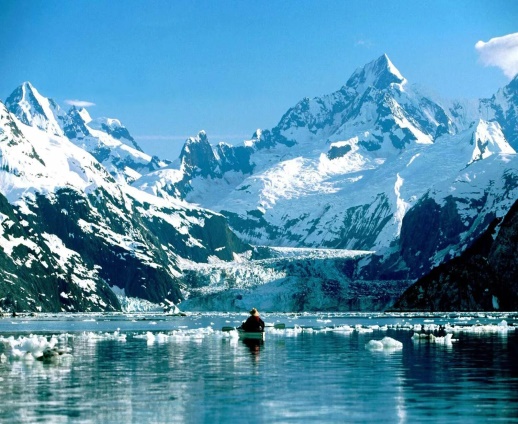
Short term plan: term 4
|
Unit 9: Holidays |
Lesson 97 |
||
|
Teacher name: |
|
||
|
Date: |
|
||
|
Grade: 5 |
Number present: |
absent: |
|
|
Lesson title |
Reading: A holiday brochure |
||
|
Learning objectives |
5.3.3.1 give an opinion at sentence level on a limited range of general and curricular topics; 5.4.2.1 understand with little support specific information and detail in short, simple texts on a limited range of general and curricular topics; 5.5.4.1 write with support a sequence of extended sentences in a paragraph to give basic personal information; |
||
|
Lesson objectives |
Learners will be able to: - read about summer camps in the USA. - learn adjectives used to describe positive experiences. - compare my own summer holidays with the description of what happens at the summer camp. |
||
|
Value links |
National values begin with respect for the nation Kazakhstan is a multinational state. According to research, there are more than 130 nationalities in Kazakhstan. The formation of a nation as a nation begins primarily with the glorification of national values. |
||
|
Plan |
|||
|
Stages / Time |
Teachers actions |
Students actions |
Assessment criteria |
Resources |
|
Beginning of the lesson Warming-up
3 min. Pre-learning «Brainstorming» method 7 min. |
Organization moment : 1.Greeting. Ask about the weather. Warming up 1 Ask students to open their books at page 93. Books closed. Draw a tent on the board. Elicit or teach the word camp. Ask students if they go camping. If any student do, ask them what they like or dislike about camping. Ask. Do you know what a summer camp is? Lead – In
|
The aim: To develop pupils speaking skills and create friendly atmosphere Efficiency: By wishing each other they feel better and feel the support of others Students of the class are listed. Students' attention is drawn to the lesson. Students say different words from the picture •Learners remember previous lesson vocabulary •Learners answer the questions |
The teacher to assess learners for their ability. “Good job! Well done!” Formative Assessment
Good job! Assessment criteria make basic statements related to personal information, people and objects on familiar topics and a treasure hunt |
Pictures worksheet Picture |
|
Middle of the lesson Presentation part. 30 min |
Ex:1 P:101 • Books closed. Draw a tent on the board. Elicit or teach the word camp. Ask students if they go camping. If any student do, ask them what they like or dislike about camping. Ask. Do you know what a summer camp is? Refer students to the five photos and elicit the activities shown in them Ex: 2 P: 101 • Read out the five titles and then ask students to work in pairs to match the descriptions with the titles. To help weaker students you could do the first one as an example. Ask stronger students to think of an each of the five descriptions. alternative title for Ex: 3 P: 101 • You could test students' memories by asking how many of the six questions they can answer without looking back at the text. Ask students to work alone to read the text and answer the questions. Encourage stronger students to pay attention to the way the text has been organised, e.g. the title, the use of paragraphs, the length of the sentences. How does the way a text has been organised affect the way students read it? Ex: 4 P: 101 • Read out the adjectives and go through the meaning of each in turn. Allow weaker students to find out how the words translate into their language. Ask students to work in pairs to find out what the adjectives describe in the text. Check answers. Conclusion during the lesson some tasks differentiated by outcomes of the students and by their abilities. |
• Learners look at the pictures on this page. What activities can you see? ANSWERS canoeing, music classes, ICT classes, volleyball, horse riding • Learners what kind of holiday is the brochure describing? Read the brochure and match the titles with the descriptions A-E ANSWERS A3 B1 C5 D4 • Learners read the text again. Answer the question. ANSWERS 1 AE 2D 3 C 4 B, E 5A 6A • Learners what do these adjectives describe? Read the text again and check your answers ANSWERS popular summer camps perfect introduction special concert amazing technology luxury cabin |
Descriptor: - look at the pictures - answer the question Total: 2 point
Self assessment Differentiation: «Verbal support» method is used to help Ss use new words in the sentences. Descriptor: - read the brochure - match the titles Total: 2 point Descriptor: - read the text - answer the question Total: 2 point Descriptor: - read the text - check your answers Total: 2 point -Make CCQ questions Yes / No Total: 1 point |
Card Worksheet Students book |
|
End of the lesson 5 min |
FEEDBACK Learners provide feedback on what they have learned at the lesson. |
|
Poster Success
|
|

Short term plan: term 4
|
Unit 9: Holidays |
Lesson 98 |
||
|
Teacher name: |
|
||
|
Date: |
|
||
|
Grade: 5 |
Number present: |
absent: |
|
|
Lesson title |
Speaking: making suggestions |
||
|
Learning objectives |
5.2.8.1 understand supported narratives, including some extended talk, on an increasing range of general and curricular topics; 5.3.4.1 respond with limited flexibility at sentence level to unexpected comments on an increasing range of general and curricular topics; |
||
|
Lesson objectives |
Learners will be able to: - watch teenagers talking about where they like going on holiday. - practise making suggestions. |
||
|
Value links |
National values begin with respect for the nation Kazakhstan is a multinational state. According to research, there are more than 130 nationalities in Kazakhstan. The formation of a nation as a nation begins primarily with the glorification of national values. |
||
|
Plan |
|||
|
Stages / Time |
Teachers actions |
Students actions |
Assessment criteria |
Resources |
|
Beginning of the lesson Warming-up
3 min. Pre-learning «Brainstorming» method 7 min. |
Organization moment : 1.Greeting. Ask about the weather. Warming up 1 Ask students to open their Books closed. Write places we can go and things we can do on holiday on the board. Elicit students' ideas, e.g. places: beach, city, mountains; things to do: swim, sunbathe, take photos, do sports, visit museums and historical monuments. Write the expressions on the board Lead – In
|
The aim: To develop pupils speaking skills and create friendly atmosphere Efficiency: By wishing each other they feel better and feel the support of others Students of the class are listed. Students' attention is drawn to the lesson. Students say different words from the picture •Learners remember previous lesson vocabulary •Learners answer the questions |
The teacher to assess learners for their ability. “Good job! Well done!” Formative Assessment
Good job! Assessment criteria make basic statements related to personal information, people and objects on familiar topics and a treasure hunt |
Pictures worksheet Picture |
|
Middle of the lesson Presentation part. 30 min |
Ex:1 P:102 • Ask students to open their books at page 94. Tell students they are going to watch some teenagers answering the following question: Where do you like going on holiday? Refer students to the list of countries and then play the video. Students work alone to tick which countries the teenagers like going to. Students can compare answers in pairs before you check answers with the class. Ex: 2 P: 102 • Ask students to work in pairs to ask and answer the question. Encourage students to ask additional questions, e.g. Why do you like going there? What do you like doing there? Ask some students to report back to the class on what their partner said Ex: 3 P: 102 • Give students time to read the question, then play the recording. Students can compare their ideas in pairs before you check the answer with the class. Ex: 5 P: 102 •Play the recording again for students to check their answers to Exercise 4. Conclusion during the lesson some tasks differentiated by outcomes of the students and by their abilities. |
• Learners watch the teenagers in the video. Write down the places that they talk about ANSWERS Florida Ireland Turkey Barbados • Learners where do you like going on holiday? Ask and answer with your partner ANSWERS Student’s own answer • Learners listen to Mia and Rose talking about their summer holiday. Who doesn't want to go on a summer camp? ANSWERS Mia - she wants to go to Portugal. • Learners listen again I check your answers ANSWERS 1 do you want to go 2 What about 3 I'd prefer 4 Why don't we 5 That's a good idea 6 Let's |
Descriptor: -watch the teenagers in the video - write down the places that they talk Total: 2 point
Self assessment Descriptor: - work in pairs - ask and answer with your partner Total: 2 point Descriptor: - work in pairs - compare their ideas in pairs Total: 2 point Descriptor: - listen again I check your answers Total: 2 point -Make CCQ questions Yes / No Total: 1 point |
Card Worksheet Students book |
|
End of the lesson 5 min |
FEEDBACK Learners provide feedback on what they have learned at the lesson. |
|
Poster Success
|
|
Short term plan: term 4
|
Unit 9: Holidays |
Lesson 99 |
||
|
Teacher name: |
|
||
|
Date: |
|
||
|
Grade: 5 |
Number present: |
absent: |
|
|
Lesson title |
Writing: an email |
||
|
Learning objectives |
5.4.2.1 understand with little support specific information and detail in short, simple texts on a limited range of general and curricular topics; 5.5.3.1 write with support factual descriptions at text level which describe places and people; 5.6.10.1 use present continuous forms with present and future meaning on a limited range of familiar general and curricular topics. |
||
|
Lesson objectives |
Learners will be able to: - read an email. - learn how to start and finish an email. - write an email about my next holiday. |
||
|
Value links |
National values begin with respect for the nation Kazakhstan is a multinational state. According to research, there are more than 130 nationalities in Kazakhstan. The formation of a nation as a nation begins primarily with the glorification of national values. |
||
|
Plan |
|||
|
Stages / Time |
Teachers actions |
Students actions |
Assessment criteria |
Resources |
|
Beginning of the lesson Warming-up
3 min. Pre-learning «Brainstorming» method 7 min. |
Organization moment : 1.Greeting. Ask about the weather. Warming up Books closed. Ask: Can you guess where I'm going for my next holiday? Give students clues. Start with a difficult one before making them easier until they guess the destination. It doesn't matter if you are actually going on holiday to the place or not Lead – In
|
The aim: To develop pupils speaking skills and create friendly atmosphere Efficiency: By wishing each other they feel better and feel the support of others Students of the class are listed. Students' attention is drawn to the lesson. Students say different words from the picture •Learners remember previous lesson vocabulary •Learners answer the questions |
The teacher to assess learners for their ability. “Good job! Well done!” Formative Assessment
Good job! Assessment criteria make basic statements related to personal information, people and objects on familiar topics and a treasure hunt |
Pictures worksheet Picture |
|
Middle of the lesson Presentation part. 30 min |
Ex:1 P:103 •Ask students to open their books at page 95 and look at the photo of Rio. Ask: How many places in Brazil do you think Simon is going to visit on his holiday? Give students a minute to scan the email to find the answer. Check answers. Ex: 2 P: 103 • Give students a minute to read through the questions. Ask students to work alone to read the email and answer the questions. Students can compare their answers in pairs before you check answers with the class. Ex: 3 P: 103 • Ask: What phrases can we use to start and finish Cam an email? Elicit students' ideas and write them on the board. Read out the information in the Useful language box and then ask students to work alone to find examples of the phrases referred to in the box in the email in Exercise 1. Check answers with the class. Conclusion during the lesson some tasks differentiated by outcomes of the students and by their abilities. |
• Learners look at the photo and read Simon's email. How many places is he going to visit in Brazil? ANSWERS two places - Rio and Paraty • Learners Read Simon's email again. What are his Simon answers to these questions? ANSWERS 1 I'm going to go to a Brazil! parents, my 2 I'm going to go with my 3 We're to Rio. 4 We're going to stay with going to fly Dad's friend, Cristiano. 5 Then we're going to drive south to a city called Paraty and go to the beach there. 6 We'll stay there for a week, I think, • Learners answer the question. How does Simon start and finish his email? ut the phrases in the correct column above. ANSWERS start-Thanks for your email. finish - Write again soon, |
Descriptor: - look at the photo - read Simon's email. - answer the question. Total: 2 point
Self assessment Descriptor: - read through the questions. - answer the questions. Total: 2 point Descriptor: - read out the information in the Useful language - answer the questions. Total: 2 point -Make CCQ questions Yes / No Total: 1 point |
Card Worksheet Students book |
|
End of the lesson 5 min |
FEEDBACK Learners provide feedback on what they have learned at the lesson. |
|
Poster Success
|
|

Short term plan: term 4
|
Unit 9: Holidays |
Lesson 100 |
||
|
Teacher name: |
|
||
|
Date: |
|
||
|
Grade: 5 |
Number present: |
absent: |
|
|
Lesson title |
CLIL: Math frequency tables and bar charts |
||
|
Learning objectives |
5.3.6.1 communicate meaning clearly at sentence level during, pair, group and whole class exchanges; 5.4.1.1 understand the main points in a limited range of short simple texts on general and curricular topics; 5.2.8.1 understand supported narratives, including some extended talk, on an increasing range of general and curricular topics; |
||
|
Lesson objectives |
Learners will be able to: - read about frequency tables and bar charts. - make a frequency table and bar chart |
||
|
Value links |
National values begin with respect for the nation Kazakhstan is a multinational state. According to research, there are more than 130 nationalities in Kazakhstan. The formation of a nation as a nation begins primarily with the glorification of national values. |
||
|
Plan |
|||
|
Stages / Time |
Teachers actions |
Students actions |
Assessment criteria |
Resources |
|
Beginning of the lesson Warming-up
3 min. Pre-learning «Brainstorming» method 7 min. |
Organization moment : 1.Greeting. Ask about the weather. Warming up Books closed. Ask: Can you guess where I'm going for my next holiday? Give students clues. Start with a difficult one before making them easier until they guess the destination. It doesn't matter if you are actually going on holiday to the place or not Lead – In
|
The aim: To develop pupils speaking skills and create friendly atmosphere Efficiency: By wishing each other they feel better and feel the support of others Students of the class are listed. Students' attention is drawn to the lesson. Students say different words from the picture •Learners remember previous lesson vocabulary •Learners answer the questions |
The teacher to assess learners for their ability. “Good job! Well done!” Formative Assessment
Good job! Assessment criteria make basic statements related to personal information, people and objects |
Pictures worksheet Picture |
|
Middle of the lesson Presentation part. 30 min |
Ex:1 P:104 • Ask students to open their books at page 122 and explain that they are going to read about how we can organise information graphically. Refer them to the picture and then ask them to read the explanations of data total and frequency. Point out that the data total refers to the total number of sports represented in the picture by the different icons, whereas frequency refers to how many icons there are for each sport, with the icons representing the number of students who like the sport in question. Read out the two questions. Ask students to work in pairs to answer them. Check answers. Ex: 2 P: 104 • Point out the examples in the table (football and tennis). Ask students to check with the picture in Exercise 1 that these figures are correct. Ask students to work in pairs to complete the table with the frequency of each sport. Check answers. Ex: 3 P: 104 • Explain that a bar chart is a graph that uses parallel bars of differing lengths to represent information. Point out that the information in the bar chart in Exercise 3 is the same as that in the frequency table in Exercise 2 Ask students to work in pairs to answer the questions. Check answers. Conclusion during the lesson some tasks differentiated by outcomes of the students and by their abilities. |
• Learners work with a partner. Look at the picture of class 1B's favourite sports and read the text. Answer the questions ANSWERS 1 The data total for Class 1B is 30. 2 The frequency of tennis is 2. • Learners look at the picture in Exercise 1 again. What is the frequency of each sport? Copy and complete the table. ANSWERS cycling -6 rollerblading - 4 basketball-6 swimming-3 total-30 • Learners look at the information from Exercise 2 in a bar chart. Answer the questions ANSWERS 1 The frequency of basketball is wrong. 2 X is a horizontal line. Y is a vertical line Optional |
Descriptor: - work with a partner. - look at the picture - answer the question. Total: 2 point
Self assessment Descriptor: - look at the picture - copy and complete the table. Total: 2 point Descriptor: - look at the information - answer the questions. Total: 2 point -Make CCQ questions Yes / No Total: 1 point |
Card Worksheet Students book |
|
End of the lesson 5 min |
FEEDBACK Learners provide feedback on what they have learned at the lesson. |
|
Poster Success
|
|
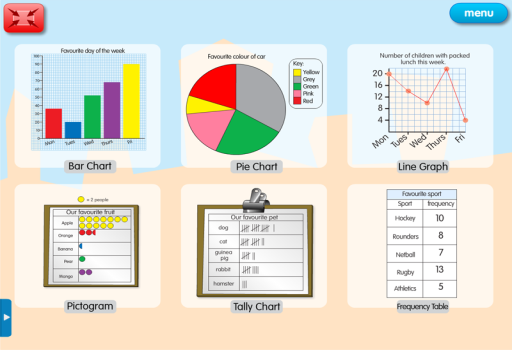
Short term plan: term 4
|
Unit 9: Holidays |
Lesson 101 |
||
|
Teacher name: |
|
||
|
Date: |
|
||
|
Grade: 5 |
Number present: |
absent: |
|
|
Lesson title |
Extra reading: Emma’s holiday blog. Summative assessment for the unit “Holidays” |
||
|
Learning objectives |
5.2.3.1 understand an increasing range of unsupported basic questions on general and curricular topics; 5.5.4.1 write with support a sequence of extended sentences in a paragraph to give basic personal information; 5.4.1.1 Understand the main points in a limited range of short simple texts on general and curricular topics |
||
|
Lesson objectives |
Learners will be able to: - read for gist |
||
|
Value links |
National values begin with respect for the nation Kazakhstan is a multinational state. According to research, there are more than 130 nationalities in Kazakhstan. The formation of a nation as a nation begins primarily with the glorification of national values. |
||
|
Plan |
|||
|
Stages / Time |
Teachers actions |
Students actions |
Assessment criteria |
Resources |
|
Beginning of the lesson Warming-up
3 min. Pre-learning «Brainstorming» method 7 min. |
Organization moment : 1.Greeting. Ask about the weather. Warming up Books closed. Ask: Can you guess where I'm going for my next holiday? Give students clues. Start with a difficult one before making them easier until they guess the destination. It doesn't matter if you are actually going on holiday to the place or not Lead – In
|
The aim: To develop pupils speaking skills and create friendly atmosphere Efficiency: By wishing each other they feel better and feel the support of others Students of the class are listed. Students' attention is drawn to the lesson. Students say different words from the picture •Learners remember previous lesson vocabulary •Learners answer the questions |
The teacher to assess learners for their ability. “Good job! Well done!” Formative Assessment
Good job! Assessment criteria make basic statements related to personal information, people and objects |
Pictures worksheet Picture |
|
Middle of the lesson Presentation part. 30 min |
Ex:1 P:105 • While reading ask pupils answer the questions. Read the text, then answer these questions. Where are the 'singing dunes'? Where did Emma stay on the steppe? What animals did she see? What did Emma think about her rafting trip? Did Emma cycle to North Inylchek Base Camp? How did she feel after her trip to the canyons? What was the best part of her holiday Summative assessment for the unit “Holidays” Conclusion during the lesson some tasks differentiated by outcomes of the students and by their abilities. |
• Learners read the text, then answer these questions ANSWERS 1. about 180 km from Almaty 2. in yurts for three nights 3. rabbits, eagles, foxes, 4. It's quite scary 5. No 6. She enjoyed this trip. 7. Mountain biking in the mountains and canyons. |
Descriptor: - read the text - answer these questions Total: 2 point
Self assessment -Make CCQ questions Yes / No Total: 1 point |
Card Worksheet Students book |
|
End of the lesson 5 min |
FEEDBACK Learners provide feedback on what they have learned at the lesson. |
|
Poster Success
|
|
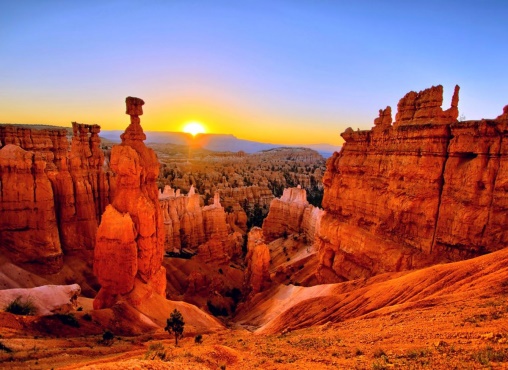
Short term plan: term 4
|
Unit: 7 Holidays |
Lesson 101 |
||
|
Teacher’s name: |
|
||
|
Date: 24.05.23 |
|
||
|
Grade: 5 |
Number present: |
absent: |
|
|
Lesson title |
Summative control work for the 4th term |
||
|
Learning objectives |
5.2.8.1 Understand supported narratives, including some extended talk, on an increasing range of general and curricular topics. 5.4.3.1 Understand the detail of an argument on a limited range of familiar general and curricular topics 5.5.4.1 Write with support a sequence of extended sentences in a paragraph to give basic personal information. 5.3.2.1 Ask simple questions to get information about a limited range of general topics |
||
|
Lesson objectives |
Learners will be able to: -recognize and interpret the narrative by timeline, by drawing, by retelling, summarizing of events - formulate closed and some open questions - identify supporting details in a paragraph or text |
||
|
Plan |
|||


Short term plan: term 4
|
Unit 9: Holidays |
Lesson 101 |
||
|
Teacher name: |
|
||
|
Date: |
|
||
|
Grade: 5 |
Number present: |
absent: |
|
|
Lesson title |
8-9 Review |
||
|
Learning objectives |
5.2.3.1 understand an increasing range of unsupported basic questions on general and curricular topics; 5.5.3.1 write with support factual descriptions at text level which describe people, places and objects; |
||
|
Lesson objectives |
Learners will be able to: - use vocabulary for sports and activities. - use vocabulary for the season and weather. |
||
|
Value links |
National values begin with respect for the nation Kazakhstan is a multinational state. According to research, there are more than 130 nationalities in Kazakhstan. The formation of a nation as a nation begins primarily with the glorification of national values. |
||
|
Plan |
|||
|
Stages / Time |
Teachers actions |
Students actions |
Assessment criteria |
Resources |
|
Beginning of the lesson Warming-up
3 min. Pre-learning «Brainstorming» method 7 min. |
Organization moment : 1.Greeting. Ask about the weather. Warming up Books closed. Ask: Can you guess where I'm going for my next holiday? Give students clues. Start with a difficult one before making them easier until they guess the destination. It doesn't matter if you are actually going on holiday to the place or not Lead – In
|
The aim: To develop pupils speaking skills and create friendly atmosphere Efficiency: By wishing each other they feel better and feel the support of others Students of the class are listed. Students' attention is drawn to the lesson. Students say different words from the picture •Learners remember previous lesson vocabulary •Learners answer the questions |
The teacher to assess learners for their ability. “Good job! Well done!” Formative Assessment
Good job! Assessment criteria make basic statements related to personal information, people and objects |
Pictures worksheet Picture |
|
Middle of the lesson Presentation part. 30 min |
Ex:1 P: 106 • Ask the work in pairs. Write the names of the sports. Include the verbs. Check answers as a class. Ex: 2 P: 106 • Ask students to write the names of the clothes in the pictures. Elicit responses and encourage discussion Differentiation: «Verbal support» method is used to help Ss use new words in the sentences. Ex: 3 P: 74 • Ask the work in pairs match the months with the seasons. Check answers as a class Conclusion during the lesson some tasks differentiated by outcomes of the students and by their abilities. |
• Learners write the names of the sports. Include the verbs. ANSWERS 2 go surfing 3 play basketball 4 go skiing 5 do karate 6 go skateboarding • Learners write the names of the clothes in the pictures ANSWERS 2 sweatshirt 3 shorts 4 jacket 5 shoes/trainers 6 trousers 7 hoodie 8 jeans 9 T-shirt 10 skirt 11 boots 12 sock • Learners match the months with the seasons. ANSWERS 1d 2 c 3b 4a |
Descriptor: - write the names of the sports - complete the tsk Total: 2 point
Self assessment Descriptor: - write the names of the clothes - complete the tsk Total: 2 point Descriptor: - match the months with the seasons. - complete the tsk Total: 2 point -Make CCQ questions Yes / No Total: 1 point |
Card Worksheet Students book |
|
End of the lesson 5 min |
FEEDBACK Learners provide feedback on what they have learned at the lesson. |
|
Poster Success
|
|









 Бұл курс Қазақстан Республикасы Оқу-ағарту министрлігімен келісілген










