
 ЖИ көмекші


 Қауіпсіз төлем

жүктеу мүмкіндігіне ие боласыз
Бұл материал сайт қолданушысы жариялаған. Материалдың ішінде жазылған барлық ақпаратқа жауапкершілікті жариялаған қолданушы жауап береді. Ұстаз тілегі тек ақпаратты таратуға қолдау көрсетеді. Егер материал сіздің авторлық құқығыңызды бұзған болса немесе басқа да себептермен сайттан өшіру керек деп ойласаңыз осында жазыңыз
 02 Мамыр 2025
 327
327
1 жыл бойы шексіз жүктеңіз
қмж Eyes Open-8, 4-тоқс
Short term plan: term 4
|
Unit 8: Food and drink |
Lesson 81 |
||
|
Teacher name: |
|
||
|
Date: |
|
||
|
Grade: 8 |
Number present: |
absent: |
|
|
Lesson title |
Vocabulary: Cooking verbs |
||
|
Learning objectives |
8.3.7.1 use appropriate subject-specific vocabulary and syntax to talk about a range of general topics, and some curricular topics 8.4.2.1 understand specific information and detail in texts on a growing range of familiar general and curricular topics, including some extended texts |
||
|
Lesson objectives |
Learners will be able to: -learn cooking verbs. - listen to someone explaining how to make a dish. - describe a simple recipe. |
||
|
Value links |
Hospitality: Traditionally a nomadic culture, hospitality has always been an important part of Kazakh culture. |
||
|
Plan |
|||
|
Stages / Time |
Teachers actions |
Students actions |
Assessment criteria |
Resources |
|
Beginning of the lesson Warming-up
3 min. Pre-learning «Brainstorming» method 7 min. |
Organization moment : 1.Greeting. Ask about the weather. The teacher sets the lesson objectives, letting students know what to anticipate from the lesson. Warming up Where are you from? How old are you? What color is it? How many students are there in class? What day of the week today? Lead – In Books closed. Put students into pairs and ask them to talk abou what they had for dinner last night. Students should not only explain what was in the dish that they had, but say who made it and who did the dishes |
The aim: To develop pupils speaking skills and create friendly atmosphere Students of the class are listed. Students' attention is drawn to the lesson. Students say different words from the picture •Learners remember previous lesson vocabulary •Learners answer the questions |
The teacher to assess learners for their ability. “Good job! Well done!” Formative Assessment
Good job! Descriptor: - remembers the lesson passed Point 1 Assessment criteria make basic statements related to personal information, people and objects on familiar topics and a treasure hunt |
Pictures worksheet Picture |
|
Middle of the lesson Presentation part. 30 min |
Ex:1 P87 • Ask students to open their books at page 87. Put students into pairs to match the verbs in the box with the photos. Play the recording for students to listen, check their answers and repeat the verbs. Ex: 2 P: 87 • Refer students to the words in the box as well as the examples. Check that students are able to pronounce onion /'ʌn.jǝn/, sauce /so:s/, steak/sterk/ and garlic /'ga:lık/. Put students into pairs and ask them to match the food items with the cooking verbs. Point out that some of the food items can be put together with more than one verb. Ex: 3 P: 87 • Tell students they are going to listen to someone explaining how to make a dish. Before you play the recording, ask students to copy the table into their notebooks. Play the recording for students to complete the table by putting the words they hear in it into the correct category. Students can compare answers before you check answers with the whole class. Once you have checked the answers, ask students whether they would like to try the dish referred to in the recording and why/why no Ex: 4 P: 57 • Read out the three questions. Put students into pairs to ask and answer the questions. Students should develop a conversation rather than simply see this as an exercise in answering the three questions quickly Conclusion during the lesson some tasks differentiated by outcomes of the students and by their abilities. |
• Learners match the verbs in the box with the photos. Then listen, check and repeat. ANSWERS a boil b fry c grill d roast e grate f chop g slice h mix i bake j spread • Learners match the foods in the box with the verbs in Ex 1to make instructions. ANSWERS Boil: eggs, pasta Fry: eggs, chicken, steak, onion, garlic grill: bread, chicken, steak roast: chicken grate: cheese chop: onion, garlic slice: bread, cake, tomatoes mix: pasta, sauce spread: butter bake: bread, cake • Learners listen to someone explaining how to make a dish. Copy and complete the table below. ANSWERS Ingredients: bread, cheese, salt, pepper, egg, tomato cooking verbs: slice, grill, grate, mix, spread • Learners ask and answer with your partner. ANSWERS Students own answer |
Descriptor: - match the verbs - listen, check their answers Total: 2 point
Self assessment Differentiation: «Verbal support» method is used to help Ss use new words in the sentences. Descriptor: - match the foods - make instructions. Total: 2 point Descriptor: - listen to someone - copy and complete Total: 2 point Descriptor: - ask and answer Total: 1 point -Make CCQ questions Yes / No |
Card Worksheet Students book |
|
End of the lesson 5 min |
FEEDBACK Learners provide feedback on what they have learned at the lesson. Ex: P: Home task: Write the days |
|
Poster Success
|
|




Short term plan: term 4
|
Unit 8: Food and drink |
Lesson 82 |
||
|
Teacher name: |
|
||
|
Date: |
|
||
|
Grade: 8 |
Number present: |
absent: |
|
|
Lesson title |
Reading: Short online texts |
||
|
Learning objectives |
8.1.6.1 organise and present information clearly to others 8.6.17.1 use if / unless/ if only in second conditional clauses and wish [that] clauses [present reference]; use a growing variety of relative clauses including why clauses on a range of familiar general and curricular topics 8.5.3.1 write with moderate grammatical accuracy on a limited range of familiar general and curricular topics |
||
|
Lesson objectives |
Learners will be able to: -read texts about dangerous foods. -learn words in context. -talk about my eating habits and foods which are dangerous to eat |
||
|
Value links |
Tradition: Kazakh traditions and culture have been passed on from one generation to another through oral histories told by traditional Kazakh tribal leaders and elders. |
||
|
Plan |
|||
|
Stages / Time |
Teachers actions |
Students actions |
Assessment criteria |
Resources |
|
Beginning of the lesson Warming-up
3 min. Pre-learning «Brainstorming» method 7 min. |
Organization moment : 1.Greeting. Ask about the weather. The teacher sets the lesson objectives, letting students know what to anticipate from the lesson. Warming up Where are you from? How old are you? What color is it? How many students are there in class? What day of the week today? Lead – In Books closed. Write mushroom on the board. Ask: Can we eat every type of mushroom? Explain that certain mushrooms are poisonous. Tell students that they are going to read about foods which can be dangerous |
The aim: To develop pupils speaking skills and create friendly atmosphere Students of the class are listed. Students' attention is drawn to the lesson. Students say different words from the picture •Learners remember previous lesson vocabulary •Learners answer the questions |
The teacher to assess learners for their ability. “Good job! Well done!” Formative Assessment
Good job! Descriptor: - remembers the lesson passed Point 1 Assessment criteria make basic statements related to personal information, people and objects on familiar topics and a treasure hunt |
Pictures worksheet Picture |
|
Middle of the lesson Presentation part. 30 min |
Ex:1 P88 •Ask students to open their books at page 88. Ask students to look at the photos and say what kind of food can be seen in each of them. Check answers. Students will find out how dangerous the food is and why in the next exercise. To extend this exercise, put students into pairs and ask them to say whether they enjoy eating onions, peanuts, fish and garlic or the dishes that contain them. Some students could then tell the class about their partner. Ex: 2 P: 88 • Point out the pronunciation of fugu/fu:gu:/. Ask students to read the text and put the food referred to in order from the least to the most dangerous. Students can compare their answers in pairs before you check answers with the class. Refer students to the information in the FACT! box. Check that students understand that plasma is the part of blood that is liquid, in which red and white blood cells are suspended Ex: 3 P: 88 • Tell students the table is a summary of the information in the text. Show how the table is separated into three columns: food, possible dangers and advice. Ask students to read the text again. Put students into pairs to copy and complete the table. Check answers. Conclusion during the lesson some tasks differentiated by outcomes of the students and by their abilities. |
• Learners work with a partner. Look at the photos. Answer the question. ANSWERS onions, peanuts, fish (fugu), garlic • Learners read the webpage. Order the food from the least dangerous to the most dangerous. ANSWERS onions (can make you cry) - garlic (can burn your peanuts (can cause a very bad allergic reaction) - fugu fish (can kill you) skin) – • Learners read the webpage again. Copy and complete the table. ANSWERS 1 cry 2 a running tap 3 dogs 4 reaction 5 hospital 6 poisonous 7 specially trained fugu chef 8 burn 9 skin |
Descriptor: - work with a partner. - nswer the question. Total: 2 point
Self assessment Differentiation: «Verbal support» method is used to help Ss use new words in the sentences. Descriptor: - read the webpage. - order the food from the least dangerous Total: 2 point Descriptor: - read the webpage again - copy and complete Total: 2 point -Make CCQ questions Yes / No |
Card Worksheet Students book |
|
End of the lesson 5 min |
FEEDBACK Learners provide feedback on what they have learned at the lesson. Ex: P: Home task: Write the days |
|
Poster Success
|
|
Short term plan: term 4
|
Unit 8: Food and drink |
Lesson 83 |
||
|
Teacher name: |
|
||
|
Date: |
|
||
|
Grade: 8 |
Number present: |
absent: |
|
|
Lesson title |
Language focus 1 First conditional with if, when and unless |
||
|
Learning objectives |
8.2.2.1 understand with little or no support most specific information in extended talk on a wide range of general and curricular topics 8.3.7.1 use appropriate subject-specific vocabulary and syntax to talk about a range of general topics, and some curricular topics 8.5.3.1 write with moderate grammatical accuracy on a limited range of familiar general and curricular topics |
||
|
Lesson objectives |
Learners will be able to: - learn about the use of if, when and unless in the first conditional. - organise and talk about a special dinner for my friends. |
||
|
Value links |
Tradition: Kazakh traditions and culture have been passed on from one generation to another through oral histories told by traditional Kazakh tribal leaders and elders. |
||
|
Plan |
|||
|
Stages / Time |
Teachers actions |
Students actions |
Assessment criteria |
Resources |
|
Beginning of the lesson Warming-up
3 min. Pre-learning «Brainstorming» method 7 min. |
Organization moment : 1.Greeting. Ask about the weather. The teacher sets the lesson objectives, letting students know what to anticipate from the lesson. Warming up Books closed. Write the word if on the board and ask students if they can use the word in a sentence about the future. Most students will have learnt the first conditional before and so you should be able to elicit an example sentence. If students struggle to produce anything, you could put the beginning of a sentence on the board and ask students to complete it, e.g. If I pass my exams Lead – In |
The aim: To develop pupils speaking skills and create friendly atmosphere Students of the class are listed. Students' attention is drawn to the lesson. Students say different words from the picture •Learners remember previous lesson vocabulary •Learners answer the questions |
The teacher to assess learners for their ability. “Good job! Well done!” Formative Assessment
Good job! Descriptor: - remembers the lesson passed Point 1 Assessment criteria make basic statements related to personal information, people and objects on familiar topics and a treasure hunt |
Pictures worksheet Picture |
|
Middle of the lesson Presentation part. 30 min |
Ex:1 P89 • Ask students to open their books at page 89. Tell students that the gapped sentences are from the text on page 88. Ask students to copy the sentences into their notebooks and complete them. Then ask them to match each of the sentences with the meanings (a-c). Check answers. Ex: 2 P: 89 • Put students into pairs to do the matching exercise. Encourage weaker students to underline if, when and unless in each sentence as doing so may focus their attention on those words. Monitor and help as necessary. Check answers. Ex: 3 P: 89 • Read out the information in the Get it right! box and then refer students to the dialogue. Put students into pairs and ask them to complete the dialogue using if, when and unless and the verbs in brackets. Play the recording for students to check their answers. Conclusion during the lesson some tasks differentiated by outcomes of the students and by their abilities. |
• Learners complete the examples from the text. Then match the missing words with the meanings ANSWERS 1 If you are ever in Japan and want to try fugu fish for yourself, you'll have to be very careful! 2 You'll need to make sure you go to a restaurant that has a 'fugu certified' chef unless you want it to be your last supper! 3 When I go on holiday this year, I'll make sure I eat lots of garlic! 1 b 2 c 3 a • Learners match the beginnings and the ends of the sentences ANSWERS 2a 3e 4f 5b 6d • Learners complete the conversation using if, when and unless or the correct form of the verbs in brackets. Then listen and check ANSWERS 1 If 2 finish 3 'll put 4 when 5 'll put 6 unless 7 if 8 will you choose |
Descriptor: - complete the examples from the text - match the missing words Total: 2 point
Self assessment Differentiation: «Verbal support» method is used to help Ss use new words in the sentences. Descriptor: - match the beginnings the ends of the sentences Total: 2 point Descriptor: - complete the conversation - listen and check Total: 2 point -Make CCQ questions Yes / No |
Card Worksheet Students book |
|
End of the lesson 5 min |
FEEDBACK Learners provide feedback on what they have learned at the lesson. Ex: P: Home task: Write the days |
|
Poster Success
|
|
Short term plan: term 4
|
Unit 8: Food and drink |
Lesson 84 |
||
|
Teacher name: |
|
||
|
Date: |
|
||
|
Grade: 8 |
Number present: |
absent: |
|
|
Lesson title |
Vocabulary Adjectives describing food and drink |
||
|
Learning objectives |
8.1.6.1 organize and present information clearly to others 8.6.8.1 use a growing variety of future forms including present continuous and present simple with future meaning on a range of familiar general and curricular topics 8.5.3.1 write with moderate grammatical accuracy on a limited range of familiar general and curricular topics |
||
|
Lesson objectives |
Learners will be able to: -learn adjectives, to describe food and drink. - listen to a game show. - talk about dishes I would like to try, unusual dishes and my favourite dishes. |
||
|
Value links |
Tradition: Kazakh traditions and culture have been passed on from one generation to another through oral histories told by traditional Kazakh tribal leaders and elders. |
||
|
Plan |
|||
|
Stages / Time |
Teachers actions |
Students actions |
Assessment criteria |
Resources |
|
Beginning of the lesson Warming-up
3 min. Pre-learning «Brainstorming» method 7 min. |
Organization moment : 1.Greeting. Ask about the weather. The teacher sets the lesson objectives, letting students know what to anticipate from the lesson. Warming up Books closed. Write adjectives describing food on the board. Elicit adjectives used to describe reactions to the taste of food. Students might produce words like nice, tasty or horrible Lead – In
|
The aim: To develop pupils speaking skills and create friendly atmosphere Students of the class are listed. Students' attention is drawn to the lesson. Students say different words from the picture •Learners remember previous lesson vocabulary •Learners answer the questions |
The teacher to assess learners for their ability. “Good job! Well done!” Formative Assessment
Good job! Descriptor: - remembers the lesson passed Point 1 Assessment criteria make basic statements related to personal information, people and objects on familiar topics and a treasure hunt |
Pictures worksheet Picture |
|
Middle of the lesson Presentation part. 30 min |
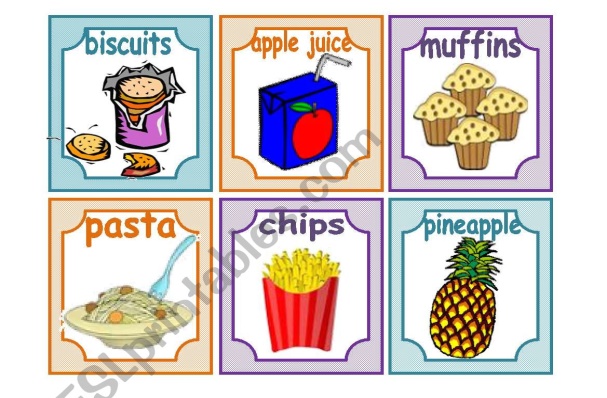
Ex:1 P90 • Ask students to open their books at page 90. Put students into pairs to match the adjectives in bold with the definitions. Check answers. Once you have checked answers, refer students to the use of mmm in sentences 2 and 5 and yuk in sentence 8. Mm, which can also be written mmm, is an exclamation used to express contentment, pleasure, agreement or uncertainty. Ex: 2 P: 90 • Read out the question, then put students into pairs to answer it. Check answers. You could then ask students to name food items or dishes which are salty, spicy, etc. To extend the work on the vocabulary, you could ask students to turn to the Vocabulary bank on page 128 and do the exercises for Adjectives describing food. Ex: 3 P: 90 • Refer students to the photos of the dishes. You could then either put students into pairs to describe the dishes using the adjectives which were introduced in Exercise 1, or elicit descriptions from the class as a whole. Ex: 5 P: 90 Refer students to the notes. Make sure that students understand that they should circle the correct answer or complete gaps. Play the recording for students to do the exercise. Check answers. Conclusion during the lesson some tasks differentiated by outcomes of the students and by their abilities. |
• Learners match the adjectives in bold with the definitions (a–j). Then listen, check and repeat ANSWERS a sweet b salty c spicy d disgusting e delicious f bland g crunchy h slimy I savoury j bitter • Learners which adjectives in Exercise 1 describe a) taste, b) texture (how they feel in your mouth) and c) a good or bad opinion? ANSWERS a) taste: salty, spicy, bland, sweet, bitter, savoury b) texture: crunchy, slimy c) good and bad opinion: delicious, disgusting • Learners work with a partner. Look at the photos. Use adjectives from Exercise 1 to describe each dish ANSWERS chapulines (grasshoppers) • Learners listen again and copy and complete the notes for each dish ANSWERS 1 a jellyfish b Vietnam c sweet, (a bit) spicy, disgusting, slimy 2 a cockscombs b Italy c light, crunchy, (a bit) bland, crunchy (on the outside), (a bit) soft (on the inside) 3 a grasshoppers b Mexico c salty, spicy, crunchy, perfect, delicious |
Descriptor: - match the adjectives in bold - listen, check and repeat Total: 2 point
Self assessment Differentiation: «Verbal support» method is used to help Ss use new words in the sentences. Descriptor: - work with a partner. - use adjectives Total: 2 point Descriptor: - listen again and copy - complete the notes for each Total: 2 point -Make CCQ questions Yes / No |
Card Worksheet Students book |
|
End of the lesson 5 min |
FEEDBACK Learners provide feedback on what they have learned at the lesson. |
|
Poster Success
|
|
Short term plan: term 4
|
Unit 8: Food and drink |
Lesson 85 |
||
|
Teacher name: |
|
||
|
Date: |
|
||
|
Grade: 8 |
Number present: |
absent: |
|
|
Lesson title |
Language focus 2 Second conditional with could and might |
||
|
Learning objectives |
8.1.6.1 organise and present information clearly to others 8.2.5.1 recognise the opinion of the speaker(s) with little or no support in extended talk on a wide range of general and curricular topics 8.3.7.1 use appropriate subject-specific vocabulary and syntax to talk about a range of general topics, and some curricular topics |
||
|
Lesson objectives |
Learners will be able to: - learn the second conditional with could and might. - talk about disgusting and delicious food. |
||
|
Value links |
Tradition: Kazakh traditions and culture have been passed on from one generation to another through oral histories told by traditional Kazakh tribal leaders and elders. |
||
|
Plan |
|||
|
Stages / Time |
Teachers actions |
Students actions |
Assessment criteria |
Resources |
|
Beginning of the lesson Warming-up
3 min. Pre-learning «Brainstorming» method 7 min. |
Organization moment : 1.Greeting. Ask about the weather. The teacher sets the lesson objectives, letting students know what to anticipate from the lesson. Warming up Books closed. Elicit a first conditional sentence. Write it on the board, e.g. If we go to the café, I will have an omelette. Ask students if they can turn this sentence into a second conditional sentence, e.g. If we went to the café, I would have an omelette. Elicit the basic difference between these two forms, which is that the second conditional, by contrast with the first, refers to a hypothetical situation rather than a real one |
The aim: To develop pupils speaking skills and create friendly atmosphere Students of the class are listed. Students' attention is drawn to the lesson. Students say different words from the picture •Learners remember previous lesson vocabulary •Learners answer the questions |
The teacher to assess learners for their ability. “Good job! Well done!” Formative Assessment
Good job! Descriptor: - remembers the lesson passed Point 1 Assessment criteria make basic statements related to personal information, people and objects on familiar topics and a treasure hunt |
Pictures worksheet Picture |
|
Middle of the lesson Presentation part. 30 min |
Ex:1 P:91 • Ask students to open their books at page 91. Tell students that the example sentences are from the listening on page 90. Put students into pairs to match the beginnings of the sentences with the ends. Ask students to copy the sentences into their notebooks. Check answers. Ex: 2 P: 91 • Refer students to the words and phrases in the box. Put students into pairs and ask them to complete the rules using the information in the box. Check answers. Ex: 3 P: 91 • Complete the first sentence with the class as an example. Put students into pairs and ask them to complete the remaining sentences. Monitor while students do this task. Guide weaker students to the correct answers by helping them to distinguish between the different parts of the second conditional sentence. Check answers. Ex: 4 P: 91 Read out the example question. Ask students to use the example to help them complete the rest of the exercise. Students can work alone on this exercise. Check answers Conclusion during the lesson some tasks differentiated by outcomes of the students and by their abilities. |
• Learners match the beginnings and the ends of the sentences from the listening ANSWERS 1 b If I saw it on a menu, I might eat it again. 2 dl wouldn't eat it again if you paid me! 3 a Would you eat it again if you had the chance? 4 cl could eat that again if you offered it to me. • Learners look at the examples in Exercise 1 and complete the rules with the words and phrases in the box. There are three that you don’t need to use. ANSWERS 1 To form the second conditional, use if + past simple for the situation, and would, could or might for a possible consequence: 2 To form questions, use (question word) + would + subject + verb. 3 If can come at the beginning or at the end of the sentence/question • Learners choose the correct form of the verbs in the sentences below. ANSWERS 1 could never eat; was 2 Would you like; got 3 had; 'd give up 4 was; might be 5 picked; 'd never eat 6 offered; didn't like; would you say • Learners write second conditional questions using the prompts. ANSWERS 2 What would you say if a friend asked you to lend her some money? 3 If you could live anywhere in the world, where would you like to live? 4 If you won the lottery, what would you do with the money? |
Descriptor: - match the beginnings and the ends Total: 2 point
Self assessment Differentiation: «Verbal support» method is used to help Ss use new words in the sentences. Descriptor: - look at the examples - complete the rules with the words Total: 2 point Descriptor: - choose the correct form - complete the sentences Total: 2 point -Make CCQ questions Yes / No 5 What advice would you give your friend if he was worried about his exams? 6 If you didn't need to study this evening, what would you do instead? |
Card Worksheet Students book |
|
End of the lesson 5 min |
FEEDBACK Learners provide feedback on what they have learned at the lesson. |
|
Poster Success
|
|
Short term plan: term 4
|
Unit 8: Food and drink |
Lesson 86 |
||
|
Teacher name: |
|
||
|
Date: |
|
||
|
Grade: 8 |
Number present: |
absent: |
|
|
Lesson title |
Discover Culture |
||
|
Learning objectives |
8.1.7.1 develop and sustain a consistent argument when speaking or writing 8.3.7.1 use appropriate subject-specific vocabulary and syntax to talk about a range of general topics, and some curricular topics 8.5.1.1 plan, write, edit and proofread work at text level with little support on a range of general and curricular topics |
||
|
Lesson objectives |
Learners will be able to: - watch a video about fishing in Japan. - talk about seafood and food that is popular in my country. |
||
|
Value links |
Tradition: Kazakh traditions and culture have been passed on from one generation to another through oral histories told by traditional Kazakh tribal leaders and elders. |
||
|
Plan |
|||
|
Stages / Time |
Teachers actions |
Students actions |
Assessment criteria |
Resources |
|
Beginning of the lesson Warming-up
3 min. Pre-learning «Brainstorming» method 7 min. |
Organization moment : 1.Greeting. Ask about the weather. The teacher sets the lesson objectives, letting students know what to anticipate from the lesson. Warming up Books closed. Elicit answers to the following questions: Have you ever eaten Japanese food? What dishes did you try? What did you think of them
|
The aim: To develop pupils speaking skills and create friendly atmosphere Students of the class are listed. Students' attention is drawn to the lesson. Students say different words from the picture •Learners remember previous lesson vocabulary •Learners answer the questions |
The teacher to assess learners for their ability. “Good job! Well done!” Formative Assessment
Good job! Descriptor: - remembers the lesson passed Point 1 Assessment criteria make basic statements related to personal information, people and objects on familiar topics and a treasure hunt |
Pictures worksheet Picture |
|
Middle of the lesson Presentation part. 30 min |
Ex:1 P:92 • Ask students to open their books at page 92. Refer students to the photos and the words in the box. Put students into pairs to tell each other what they know about Japan. Ex: 2 P: 92 • Tell students they are going to watch a video about Japan. Play the video for students to note down the topics in the box in Exercise 1 which are mentioned. Check answers. Encourage stronger students to give as much detail as they can Ex: 3 P: 92 • Refer students to the three summaries. Play the video again for students to choose the best summary. Check answers. Ex: 4 P: 92 Ask students to work alone to note down which of the images in the list can be seen in the video. Students then think of three more images which appeared in the video. Check answers. Check answers Ex: 5 P: 92 Refer students to the information in the box. Play the recording again for students to note down what this information refers to. Check answers. Conclusion during the lesson some tasks differentiated by outcomes of the students and by their abilities. |
• Learners work with a partner. What do you know about Japan? Think about the topics in the box ANSWERS Students own answer • Learners watch the video. Which of the topics in Exercise 1 does it talk about? ANSWERS geography, food, people, work • Learners watch the video again and choose the best summary. ANSWERS 2 • Learners test your memory. Which images below did you see in the video? Think of three more images you remember from the video ANSWERS the islands and seas surrounding Japan old people being active fishing boats tuna, squid and shellfish • Learners watch the video again. What are the numbers, times and places in the box referring to? ANSWERS The Japanese eat 10% of all the fish caught in the world. Life expectancy in Japan is over 80. Fishermen catch squid at night. Blue fin tuna swim in the deep waters of northern Japan. Over 40,000 buyers come to the Tsukiji fish market in Tokyo every day. They buy fresh fish for restaurants and supermarkets across the country. |
Descriptor: - work with a partner. Total: 2 point
Self assessment Differentiation: «Verbal support» method is used to help Ss use new words in the sentences. Descriptor: - watch the video - choose the best summary. Total: 2 point Descriptor: - test your memory - complete the sentences Total: 2 point -Make CCQ questions Yes / No |
Card Worksheet Students book |
|
End of the lesson 5 min |
FEEDBACK Learners provide feedback on what they have learned at the lesson. |
|
Poster Success
|
|

Short term plan: term 4
|
Unit 8: Food and drink |
Lesson 87 |
||
|
Teacher name: |
|
||
|
Date: |
|
||
|
Grade: 8 |
Number present: |
absent: |
|
|
Lesson title |
Reading An online article |
||
|
Learning objectives |
8.1.10.1 use talk or writing as a means of reflecting on and exploring a range of perspectives on the world 8.3.7.1 use appropriate subject-specific vocabulary and syntax to talk about a range of general topics, and some curricular topics 8.4.2.1 understand specific information and detail in texts on a growing range of familiar general and curricular topics, including some extended texts |
||
|
Lesson objectives |
Learners will be able to: - read an article about how what we eat is influenced by different things. - learn prepositional phrases. - talk about the food in my country. |
||
|
Value links |
Tradition: Kazakh traditions and culture have been passed on from one generation to another through oral histories told by traditional Kazakh tribal leaders and elders. |
||
|
Plan |
|||
|
Stages / Time |
Teachers actions |
Students actions |
Assessment criteria |
Resources |
|
Beginning of the lesson Warming-up
3 min. Pre-learning «Brainstorming» method 7 min. |
Organization moment : 1.Greeting. Ask about the weather. The teacher sets the lesson objectives, letting students know what to anticipate from the lesson. Warming up Books closed. Choose a dish that is popular in the students' country. Ask students to say why they think this dish is popular, how it is prepared and if they know anything about the history of the dish. Lead – In
|
The aim: To develop pupils speaking skills and create friendly atmosphere Students of the class are listed. Students' attention is drawn to the lesson. Students say different words from the picture •Learners remember previous lesson vocabulary •Learners answer the questions |
The teacher to assess learners for their ability. “Good job! Well done!” Formative Assessment
Good job! Descriptor: - remembers the lesson passed Point 1 Assessment criteria make basic statements related to personal information, people and objects on familiar topics and a treasure hunt |
Pictures worksheet Picture |
|
Middle of the lesson Presentation part. 30 min |
Ex:1 P:93 • Ask students to open their books at page 93 and look at the photos. Put students into pairs to ask and answer the questions. Check answers Ex: 2 P: 93 •Ask students to read the article to check their answers from Exercise 1. Ex: 3 P: 93 • Refer students to the facts numbered 1-5, then read out the example. Ask students to read the article again to identify which country each fact refers to. Help weaker students by encouraging them to skim the text to look for key words such as coast, rice. Check answers. Ex: 4 P: 93 Put students into pairs to choose the correct word in each sentence. Tell students not to look into the article until they have completed the exercise. They should look at the article to check rather than find the answers. Check answers. Ex: 5 P: 93 Refer students to the gapped questions. Put students into pairs and ask them to complete the questions with the phrases from Exercise 4. To extend the work on the vocabulary, you could ask students to turn to the Vocabulary bank on page 128 and do the exercises for Explore prepositional phrases. Conclusion during the lesson some tasks differentiated by outcomes of the students and by their abilities. |
• Learners work with a partner. Look at the photos. What kind of food can you see? Where do you think the foods come from? ANSWERS Students own answer • Learners read the online article about food from different countries and check your answers. ANSWERS buuz - dumplings with mutton, from Mongolia hangi - a traditional Maori way of preparing food arancino - a ball of fried rice filled with a rich tomato and meat sauce, from Sicily, in southern Italy • Learners read the article again and identify the countries. ANSWERS 2 Mongolia 3 Italy 4 New Zealand 5 New Zealand • Learners choose the correct words. Then check your answers in the article. ANSWERS 1 by 2 in 3 on 4 on • Learners complete the questions with the prepositions and underlined phrases in Exercise 4 ANSWERS 1 on the go 2 by land 3 in a number of different ways 4 on the streets |
Descriptor: - work with a partner - look at the photos - answer the question Total: 2 point
Self assessment Differentiation: «Verbal support» method is used to help Ss use new words in the sentences. Descriptor: - read the online article - check your answers Total: 2 point Descriptor: - choose the correct words - underlined phrases Total: 2 point -Make CCQ questions Yes / No |
Card Worksheet Students book |
|
End of the lesson 5 min |
FEEDBACK Learners provide feedback on what they have learned at the lesson. |
|
Poster Success
|
|
Short term plan: term 4
|
Unit 8: Food and drink |
Lesson 88 |
||
|
Teacher name: |
|
||
|
Date: |
|
||
|
Grade: 8 |
Number present: |
absent: |
|
|
Lesson title |
Speaking Giving instructions |
||
|
Learning objectives |
8.1.5.1 use feedback to set personal learning objectives 8.2.5.1 recognise the opinion of the speaker(s) with little or no support in extended talk on a wide range of general and curricular topics 8.5.3.1 write with moderate grammatical accuracy on a limited range of familiar general and curricular topics |
||
|
Lesson objectives |
Learners will be able to: -watch teenagers talking about cooking for their family. - listen to a description of how to cook a particular dish. - practise giving instructions. |
||
|
Value links |
Tradition: Kazakh traditions and culture have been passed on from one generation to another through oral histories told by traditional Kazakh tribal leaders and elders. |
||
|
Plan |
|||
|
Stages / Time |
Teachers actions |
Students actions |
Assessment criteria |
Resources |
|
Beginning of the lesson Warming-up
3 min. Pre-learning «Brainstorming» method 7 min. |
Organization moment : 1.Greeting. Ask about the weather. The teacher sets the lesson objectives, letting students know what to anticipate from the lesson. Warming up Books closed. Put students into pairs and ask them to tell each other who does most of the cooking in their house and how often they cook at home. Ask some students to report back to the class on their partner Lead – In
|
The aim: To develop pupils speaking skills and create friendly atmosphere Students of the class are listed. Students' attention is drawn to the lesson. Students say different words from the picture •Learners remember previous lesson vocabulary •Learners answer the questions |
The teacher to assess learners for their ability. “Good job! Well done!” Formative Assessment
Good job! Descriptor: - remembers the lesson passed Point 1 Assessment criteria make basic statements related to personal information, people and objects on familiar topics and a treasure hunt |
Pictures worksheet Picture |
|
Middle of the lesson Presentation part. 30 min |
Ex:1 P:94 •Ask students to open their books at page 94. Tell students they are going to watch some teenagers answering the following question: What would you make if you had to cook for your family for a day? Tell students that they are going to match the words and phrases with each of the teenagers in the video. Play the video for students to complete the exercise. Check answers Ex: 2 P: 94 • Put students into pairs to ask and answer the question. Ex: 3 P: 94 • Tell students they are going to listen to Josh talking to his mum. Read out the question. Play the recording. Students listen and answer the question. Check answer. Ex: 4 P: 94 Refer students to the phrases in the Useful language box. Students can work alone to complete the conversation using the phrases in the Useful language box Ex: 5 P: 94 Play the recording for students to check their answers. Conclusion during the lesson some tasks differentiated by outcomes of the students and by their abilities. |
• Learners watch or listen to the teenagers. What food items does each person talk about? ANSWERS Speaker 1 steak, eggs, pancakes, lasagne, salad Speaker 2 soup, pasta, vegetables, potato salad Speaker 3 rice dish, chicken, steak, cake, berry pie Speaker 4 nothing Speaker 5 sandwiches, pizzas Speaker 6 omelette, meat • Learners what would you make if you had to cook for your family for a day? Ask and answer with your partner. ANSWERS Students own answer • Learners listen to Josh talking to his mum on the phone. What is he going to make? ANSWERS a • Learners complete the conversation with the useful language. ANSWERS Students own answer • Learners listen again and check your answers ANSWERS 2 First of all, chop 3 Next, you 4 You need to stir it 5 Then, add 6 Finally, when |
Descriptor: - watch or listen to the teenagers - answer the question Total: 2 point
Self assessment Differentiation: «Verbal support» method is used to help Ss use new words in the sentences. Descriptor: - Ask and answer with your partner. Total: 2 point Descriptor: - listen to Josh talking to his mum - answer the question Total: 2 point Descriptor: - listen again - check answers Total: 2 point -Make CCQ questions Yes / No |
Card Worksheet Students book |
|
End of the lesson 5 min |
FEEDBACK Learners provide feedback on what they have learned at the lesson. |
|
Poster Success
|
|

Short term plan: term 4
|
Unit 8: Food and drink |
Lesson 89 |
||
|
Teacher name: |
|
||
|
Date: |
|
||
|
Grade: 8 |
Number present: |
absent: |
|
|
Lesson title |
Writing Describing a local dish |
||
|
Learning objectives |
8.1.5.1 use feedback to set personal learning objectives 8.2.5.1 recognise the opinion of the speaker(s) with little or no support in extended talk on a wide range of general and curricular topics 8.5.3.1 write with moderate grammatical accuracy on a limited range of familiar general and curricular topics |
||
|
Lesson objectives |
Learners will be able to: - read a description of a local dish. - learn phrases to describe ingredients and how food is cooked and eaten. - write a description of a traditional dish |
||
|
Value links |
Tradition: Kazakh traditions and culture have been passed on from one generation to another through oral histories told by traditional Kazakh tribal leaders and elders. |
||
|
Plan |
|||
|
Stages / Time |
Teachers actions |
Students actions |
Assessment criteria |
Resources |
|
Beginning of the lesson Warming-up
3 min. Pre-learning «Brainstorming» method 7 min. |
Organization moment : 1.Greeting. Ask about the weather. The teacher sets the lesson objectives, letting students know what to anticipate from the lesson. Warming up Books closed. Ask students to say what dishes from their country are known around the world, e.g. fish and chips is associated with the United Kingdom. At this point, you could ask students which adjective, currently popular in English and which was introduced in Unit 1, could be used to describe fish and chips. Elicit iconic and write it on the board. Lead – In |
The aim: To develop pupils speaking skills and create friendly atmosphere Students of the class are listed. Students' attention is drawn to the lesson. Students say different words from the picture •Learners remember previous lesson vocabulary •Learners answer the questions |
The teacher to assess learners for their ability. “Good job! Well done!” Formative Assessment
Good job! Descriptor: - remembers the lesson passed Point 1 Assessment criteria make basic statements related to personal information, people and objects on familiar topics and a treasure hunt |
Pictures worksheet Picture |
|
Middle of the lesson Presentation part. 30 min |
Ex:1 P:95 • Ask students to open their books at page 95. Refer students to the photo and then ask them to read the description and answer the question. Check answer. Ex: 2 P: 95 • Ask students to read the description again. Put students into pairs to note down the paragraphs in the description in which the things in the list are mentioned. Point out that two things in the list are not mentioned in the description. Check answers. Ex: 3 P: 95 • Read out the information about phrases used to describe food in the Useful language box. Ask students to work alone to find further examples of such phrases in the description in Exercise 1. Check answers. Ex: 4 P: 95 Refer students to the phrases in the box. Complete the first sentence with the class as an example. Put students into pairs to complete the remaining sentences using the phrases in the box. Check answers. Conclusion during the lesson some tasks differentiated by outcomes of the students and by their abilities. |
• Learners look at the photo and read the description on an Internet forum. What is the dish Lamorna describes and what is it made from? ANSWERS Cornish pastry: thick pastry filled with steak, potato, onion and swede • Learners read the description again. In which paragraph does Lamorna talk about these things? Which two things in the list doesn't she mention? ANSWERS The ingredients. 1 Where the food is from. 1 Who eats it. 2 Why people like it. 2 Where you can buy it. 3 The history of the dish. 2 How it's cooked, 1 When you eat it and How easy or difficult it is to cook are not in the text. • Learners look at the Useful language box. Find similar phrases in the text ANSWERS filled with small pieces of Then it's baked in the oven. but unless they are made in Cornwall... • Learners complete the sentences with the phrases in the box. ANSWERS 1 served with 2 bake; in 3 filled with 4 consists of 5 made in 6 contain |
Descriptor: - look at the photo - read the description on an Internet Total: 2 point
Self assessment Differentiation: «Verbal support» method is used to help Ss use new words in the sentences. Descriptor: - read the description again -answer the question Total: 2 point Descriptor: - look at the Useful language box - Find similar phrases in the text Total: 2 point Descriptor: - complete the sentences Total: 2 point -Make CCQ questions Yes / No |
Card Worksheet Students book |
|
End of the lesson 5 min |
FEEDBACK Learners provide feedback on what they have learned at the lesson. |
|
Poster Success
|
|
Short term plan: term 4
|
Unit 8: Food and drink |
Lesson 90 |
||
|
Teacher name: |
|
||
|
Date: |
|
||
|
Grade: 8 |
Number present: |
absent: |
|
|
Lesson title |
CLIL: Technology Vertical farming Summative assessment for the unit 8 |
||
|
Learning objectives |
8.5.1.1 plan, write, edit and proofread work at text level with little support on a range of general and curricular topics 8.2.5.1 recognise the opinion of the speaker(s) with little or no support in extended talk on a wide range of general and curricular topics 8.3.7.1 use appropriate subject-specific vocabulary and syntax to talk about a range of general topics, and some curricular topics |
||
|
Lesson objectives |
Learners will be able to: - learn about vertical farming. - talk about the idea of vertical farming. |
||
|
Value links |
Tradition: Kazakh traditions and culture have been passed on from one generation to another through oral histories told by traditional Kazakh tribal leaders and elders. |
||
|
Plan |
|||
|
Stages / Time |
Teachers actions |
Students actions |
Assessment criteria |
Resources |
|
Beginning of the lesson Warming-up
3 min. Pre-learning «Brainstorming» method 7 min. |
Organization moment : 1.Greeting. Ask about the weather. The teacher sets the lesson objectives, letting students know what to anticipate from the lesson. Warming up Books closed. Ask students to say what dishes from their country are known around the world, e.g. fish and chips is associated with the United Kingdom. At this point, you could ask students which adjective, currently popular in English and which was introduced in Unit 1, could be used to describe fish and chips. Elicit iconic and write it on the board. Lead – In |
The aim: To develop pupils speaking skills and create friendly atmosphere Students of the class are listed. Students' attention is drawn to the lesson. Students say different words from the picture •Learners remember previous lesson vocabulary •Learners answer the questions |
The teacher to assess learners for their ability. “Good job! Well done!” Formative Assessment
Good job! Descriptor: - remembers the lesson passed Point 1 Assessment criteria make basic statements related to personal information, people and objects on familiar topics and a treasure hunt |
Pictures worksheet Picture |
|
Middle of the lesson Presentation part. 30 min |
Ex:1 P:96 • Ask students to open their books at page 96. Put students into pairs to think of solutions to the problems in the box. Ex: 2 P: 96 • Ask students to read the text and answer the question. Check answer. Ex: 3 P: 96 • Put students into pairs to label the diagram. Check answers. Ex: 4 P: 96 Tell students they are going to listen to a radio interview. Read out the question. Play the recording for students to answer the question. Check answers Ex: 5 P: 96 Read out the questions. Play the recording again for students to answer the questions. Check answers Conclusion during the lesson some tasks differentiated by outcomes of the students and by their abilities. |
• Learners work with a partner. Look at the problems connected with a growing global population and discuss possible solutions. ANSWERS Student’s own answer • Learners read the information about vertical farming. What is the main difference between vertical farming and traditional farming? ANSWERS Farmers have full control of the growing conditions in vertical farms • Learners look complete the diagram of a vertical farm with the words in bold from the text. ANSWERS a sunlight b water c pots d plants • Learners listen to a radio interview with a vertical farmer. His farm helps in two important ways – what are they? ANSWERS It is environmentally friendly and it's good for the local community. • Learners listen again and answer the questions ANSWERS 1 It would have been knocked down. 2 It is close to lots of restaurants and shops. 3 He sells them sell locally. |
Descriptor: - work with a partner - look at the problems Total: 2 point
Self assessment Differentiation: «Verbal support» method is used to help Ss use new words in the sentences. Descriptor: - read the information - answer the question Total: 2 point Descriptor: - label the diagram - complete the diagram Total: 2 point Descriptor: - listen to a radio - answer the questions Total: 2 point -Make CCQ questions Yes / No |
Card Worksheet Students book |
|
End of the lesson 5 min |
FEEDBACK Learners provide feedback on what they have learned at the lesson. |
|
Poster Success
|
|
Short term plan: term 4
|
Unit 8: Food and drink |
Lesson 91 |
||
|
Teacher name: |
|
||
|
Date: |
|
||
|
Grade: 8 |
Number present: |
absent: |
|
|
Lesson title |
Extra reading. Visiting a home in Kazakhstan |
||
|
Learning objectives |
8.3.7.1 use appropriate subject-specific vocabulary and syntax to talk about a range of general topics, and some curricular topics 8.4.2.1 understand specific information and detail in texts on a growing range of familiar general and curricular topics, including some extended |
||
|
Lesson objectives |
Learners will be able to: - read a blog post about visiting a home in Kazakhstan. - answer comprehension questions about the text. act out a roleplay |
||
|
Value links |
Tradition: Kazakh traditions and culture have been passed on from one generation to another through oral histories told by traditional Kazakh tribal leaders and elders. |
||
|
Plan |
|||
|
Stages / Time |
Teachers actions |
Students actions |
Assessment criteria |
Resources |
|
Beginning of the lesson Warming-up
3 min. Pre-learning «Brainstorming» method 7 min. |
Organization moment : 1.Greeting. Ask about the weather. The teacher sets the lesson objectives, letting students know what to anticipate from the lesson. Warming up Books closed. Ask students to say what dishes from their country are known around the world, e.g. fish and chips is associated with the United Kingdom. At this point, you could ask students which adjective, currently popular in English and which was introduced in Unit 1, could be used to describe fish and chips. Elicit iconic and write it on the board. Lead – In |
The aim: To develop pupils speaking skills and create friendly atmosphere Students of the class are listed. Students' attention is drawn to the lesson. Students say different words from the picture •Learners remember previous lesson vocabulary •Learners answer the questions |
The teacher to assess learners for their ability. “Good job! Well done!” Formative Assessment
Good job! Descriptor: - remembers the lesson passed Point 1 Assessment criteria make basic statements related to personal information, people and objects on familiar topics and a treasure hunt |
Pictures worksheet Picture |
|
Middle of the lesson Presentation part. 30 min |
Ex:1 P:97 • Explain that students are going to read a blog post Jenny wrote about her visit to the family home. Give them a minute to skim read the text and find out what Jenny thought of the experience. Check answers in class. (She enjoyed it but she also noticed different customs and traditions.) Put students in pairs do discuss the question: What do you and your family do when guests visit your home? Monitor and make a note of any language problems or good use of language to go over with the class. Ex: 2 P: 97 • Ask students to read the text again and answer the questions. You could pair weak students with strong students to do this task. Weak students can ask the questions and look in the text, while strong students answer without looking at the text. Read out the questions and invite students to call out the answers. Ex: 3 P: 97 • Refer students to the final paragraph of Jenny's blog a a reminder of her plans for the next day. Tell students they are going to write Jenny's blog for the next day as though they are her. If students need to, they can research the Zelyony Bazaar and Mega Alma-Aty shopping centre online. They make notes about Jenny's day, including at least one meal. Remind students to include opinions. What did they find interesting or unusual? What did they enjoy? Conclusion during the lesson some tasks differentiated by outcomes of the students and by their abilities. |
• Learners what do you and your family do when guests visit your home? ANSWERS Student’s own answer • Learners read Jenny’s blog and answer the questions. ANSWERS 1 She's from England. 2 She visited a family home in Kazakhstan for the first time. 3 No, they don't. 4 The tea cups were only half filled so that they could be refilled. 5 Because the custom in Kazakhstan is to leave some food on your plate. 6 Five (taking off shoes; shaking hands; tea cups half filled; too much food on plate; bigger and longer meals) 7 Students' own answers • Learners Imagine you are Jenny and it is the next evening. ANSWERS Student’s own answer . |
Descriptor: -work in pairs. - discuss the question Total: 2 point
Self assessment Differentiation: «Verbal support» method is used to help Ss use new words in the sentences. Descriptor: - read Jenny’s blog - answer the question Total: 2 point Descriptor: - read Jenny’s blog - complete the diagram Total: 2 point -Make CCQ questions Yes / No |
Card Worksheet Students book |
|
End of the lesson 5 min |
FEEDBACK Learners provide feedback on what they have learned at the lesson. |
|
Poster Success
|
|
Short term plan: term 4
|
Unit 9: The world of work |
Lesson 92 |
||
|
Teacher name: |
|
||
|
Date: |
|
||
|
Grade: 8 |
Number present: |
absent: |
|
|
Lesson title |
Vocabulary Training and qualifications |
||
|
Learning objectives |
8.1.6.1 organise and present information clearly to others 8.3.7.1 use appropriate subject-specific vocabulary and syntax to talk about a range of general topics, and some curricular topics 8.5.3.1 write with moderate grammatical accuracy on a limited range of familiar general and curricular topics |
||
|
Lesson objectives |
Learners will be able to: - learn vocabulary for training and qualifications. - listen to people talking about plans for when they leave school. - talk about what I would like to do after I leave school. |
||
|
Value links |
Tradition: Kazakh traditions and culture have been passed on from one generation to another through oral histories told by traditional Kazakh tribal leaders and elders. |
||
|
Plan |
|||
|
Stages / Time |
Teachers actions |
Students actions |
Assessment criteria |
Resources |
|
Beginning of the lesson Warming-up
3 min. Pre-learning «Brainstorming» method 7 min. |
Organization moment : 1.Greeting. Ask about the weather. The teacher sets the lesson objectives, letting students know what to anticipate from the lesson. Warming up Books closed. Ask students to say what dishes from their country are known around the world, e.g. fish and chips is associated with the United Kingdom. At this point, you could ask students which adjective, currently popular in English and which was introduced in Unit 1, could be used to describe fish and chips. Elicit iconic and write it on the board. Lead – In |
The aim: To develop pupils speaking skills and create friendly atmosphere Students of the class are listed. Students' attention is drawn to the lesson. Students say different words from the picture •Learners remember previous lesson vocabulary •Learners answer the questions |
The teacher to assess learners for their ability. “Good job! Well done!” Formative Assessment
Good job! Descriptor: - remembers the lesson passed Point 1 Assessment criteria make basic statements related to personal information, people and objects on familiar topics and a treasure hunt |
Pictures worksheet Picture |
|
Middle of the lesson Presentation part. 30 min |
Ex:1 P:99 • Ask students to open their books at page 99. Refer students to the photos. Put students into pairs to decide how each of the photos relates to the themes of training and qualifications. You may ask stronger students to describe the photos. Check answers. Ex: 2 P: 99 • Read out the examples. Put students into pairs to match more words from the two boxes to make common phrases. Play the recording for students to check their answers. Ex: 3 P: 99 • Ask students to work alone to match the expressions from Exercise 2 with the items a-c. Students may disagree on the answers, so ask students to give reasons for their choices. Encourage stronger students to offer greater detail when you ask them for answers. Ex: 4 P: 99 • Read out the information in the Get it right! box. Point out that we refer to a job but that we cannot say a work. Using a with work is a common error that English language learners make. Tell students they are going to listen to two people talking about their plans for when they leave school. Read out the two questions. Conclusion during the lesson some tasks differentiated by outcomes of the students and by their abilities. |
• Learners work with a partner. Look at the photos. How are they connected with learning and teaching? ANSWERS They show different ways of learning and teaching, e.g. learning by doing or listening to the teacher, learning in a big class or on your own. • Learners match words from each box to make new phrases. Then listen, check and repeat ANSWERS 1 university degree, university course, university fees, university exam 2 work experience 3 application form 4 part-time course 5 entrance fees, entrance exam 6 training course 7 career path • Learners which expressions do you associate with ANSWERS a university degree, university exam, university course, university fees, entrance exam b work experience, training course c application form, part-time course, entrance fees, career path • Learners listen to two people talking about their plans after they leave school. Answer the questions. ANSWERS 1 vet 2 university, degree, entrance exam, work experience Speaker 2 1 car mechanic or something similar 2 university, training course, part-time course, fees . |
Descriptor: -work with a partner - look at the photos - answer the question Total: 2 point
Self assessment Differentiation: «Verbal support» method is used to help Ss use new words in the sentences. Descriptor: - match words from each box - make new phrases Total: 2 point Descriptor: - match the expressions - answer the questions Total: 2 point -Make CCQ questions Yes / No |
Card Worksheet Students book |
|
End of the lesson 5 min |
FEEDBACK Learners provide feedback on what they have learned at the lesson. |
|
Poster Success
|
|
Short term plan: term 4
|
Unit 9: The world of work |
Lesson 93 |
||
|
Teacher name: |
|
||
|
Date: |
|
||
|
Grade: 8 |
Number present: |
absent: |
|
|
Lesson title |
Reading: A profile |
||
|
Learning objectives |
8.1.8.1 develop intercultural awareness through reading and discussion 8.2.2.1 understand with little or no support most specific information in extended talk on a wide range of general and curricular topics 8.3.7.1 use appropriate subject-specific vocabulary and syntax to talk about a range of general topics, and some curricular topics |
||
|
Lesson objectives |
Learners will be able to: - read an article about a teenager who has built her own sports car. learn expressions with take. - talk about my ideal career |
||
|
Value links |
Tradition: Kazakh traditions and culture have been passed on from one generation to another through oral histories told by traditional Kazakh tribal leaders and elders. |
||
|
Plan |
|||
|
Stages / Time |
Teachers actions |
Students actions |
Assessment criteria |
Resources |
|
Beginning of the lesson Warming-up
3 min. Pre-learning «Brainstorming» method 7 min. |
Organization moment : 1.Greeting. Ask about the weather. The teacher sets the lesson objectives, letting students know what to anticipate from the lesson. Warming up Books closed. Ask students to say what dishes from their country are known around the world, e.g. fish and chips is associated with the United Kingdom. At this point, you could ask students which adjective, currently popular in English and which was introduced in Unit 1, could be used to describe fish and chips. Elicit iconic and write it on the board. Lead – In |
The aim: To develop pupils speaking skills and create friendly atmosphere Students of the class are listed. Students' attention is drawn to the lesson. Students say different words from the picture •Learners remember previous lesson vocabulary •Learners answer the questions |
The teacher to assess learners for their ability. “Good job! Well done!” Formative Assessment
Good job! Descriptor: - remembers the lesson passed Point 1 Assessment criteria make basic statements related to personal information, people and objects on familiar topics and a treasure hunt |
Pictures worksheet Picture |
|
Middle of the lesson Presentation part. 30 min |
Ex:1 P:100 • Put students into pairs to look at the photo and say what the girl in the picture is doing and how she might be different from other teens. Check ideas with the class. Do not confirm or reject any ideas that students come up with at this stage Ex: 2 P: 100 • Ask students to read the text about Claudette to check their answers to Exercise 1. Refer students to the information in the FACT! box. Draw students attention to the pronunciation of Arkansas /"a:kənsɔ:/ and lowa /'nıǝwa/. Ask students at what age people can learn to drive in their country. Then find out if the consensus in the class is that the age should be raised or lowered, or if it is fine as it is. Ex: 3 P: 100 • Refer students to sentences 1-6. Drill the pronunciation of engineering/Endzı'nıǝrın/. Help weaker students by doing the first one as an example. Students can work alone to complete the true/false exercise. Ex: 4 P: 100 • Books closed. Write the following sentences on the board and ask students to explain the different meaning of the phrasal verb in each case: I took off my jumper and The plane took off on time. Elicit the two meanings of take off: remove clothes and begin flight. Check answers. Ex: 5 P: 100 Read out the example sentence. Put students into pairs and ask them to complete the remaining sentences with the expressions with take from Exercise 4 in the correct form. Check answers. |
• Learners work with a partner. Look at the photo of Claudette. What is she doing? How do you think she is different from other teens? ANSWERS Student’s own answer • Learners read Claudette’s profile and check your answers. ANSWERS She's restoring a car. She's getting a sports car for her next birthday, but she's building it herself • Learners read the profile again. Are these sentences true or false? Correct the false sentences. ANSWERS 1 F (She decided to restore a car when she was 12.) 2 F (She used the money she made working as a dog walker.) 3 F (She's going to drive it to school.) 4T 5T 6T • Learners match the expressions from the profile with the synonyms below. ANSWERS 1 take exams 2 take place 3 take up 4 take advice 5 take time • Learners complete the sentences with the correct form of the expressions in Exercise 4 ANSWERS 2 take time 3 take up 4 takes place 5 take exams |
Descriptor: - work with a partner. - look at the photo - answer the question Total: 2 point
Self assessment Differentiation: «Verbal support» method is used to help Ss use new words in the sentences. Descriptor: - read Claudette’s profile - check your answers Total: 2 point Descriptor: - read the profile - correct the false sentences Total: 2 point Descriptor: - match the expressions Total: 2 point Descriptor: - read out the example sentence - complete the sentences Total: 2 point -Make CCQ questions Yes / No |
Card Worksheet Students book |
|
End of the lesson 5 min |
FEEDBACK Learners provide feedback on what they have learned at the lesson. |
|
Poster Success
|
|
Short term plan: term 4
|
Unit 9: The world of work |
Lesson 94 |
||
|
Teacher name: |
|
||
|
Date: |
|
||
|
Grade: 8 |
Number present: |
absent: |
|
|
Lesson title |
Language focus 1 be going to and present tenses for the future |
||
|
Learning objectives |
8.3.3.1 give an opinion at discourse level on a wide range of general and curricular topics 8.5.3.1 write with moderate grammatical accuracy on a limited range of familiar general and curricular topics 8.6.13.1 use a growing variety of modal forms for different functions: obligation, necessity, possibility, permission, requests, suggestions, prohibition on a range of familiar general and curricular topics |
||
|
Lesson objectives |
Learners will be able to: - learn be going to and the present tenses for the future. - talk about my future plans |
||
|
Value links |
Tradition: Kazakh traditions and culture have been passed on from one generation to another through oral histories told by traditional Kazakh tribal leaders and elders. |
||
|
Plan |
|||
|
Stages / Time |
Teachers actions |
Students actions |
Assessment criteria |
Resources |
|
Beginning of the lesson Warming-up
3 min. Pre-learning «Brainstorming» method 7 min. |
Organization moment : 1.Greeting. Ask about the weather. The teacher sets the lesson objectives, letting students know what to anticipate from the lesson. Warming up Books closed. Write the following on the board. I'm meeting... I'm going to meet... I'll meet Ask students to complete the sentences with their own ideas. Students can then compare their sentences in pairs. Monitor while students do this. Lead – In |
The aim: To develop pupils speaking skills and create friendly atmosphere Students of the class are listed. Students' attention is drawn to the lesson. Students say different words from the picture •Learners remember previous lesson vocabulary •Learners answer the questions |
The teacher to assess learners for their ability. “Good job! Well done!” Formative Assessment
Good job! Descriptor: - remembers the lesson passed Point 1 Assessment criteria make basic statements related to personal information, people and objects on familiar topics and a treasure hunt |
Pictures worksheet Picture |
|
Middle of the lesson Presentation part. 30 min |
Ex:1 P:101 • Tell students that the gapped sentences are from the text on page 100. Ask students to copy the sentences into their notebooks and complete them. Check answers. Ask students to say which tenses are used to talk about future plans and intentions, arrangements at a specific time in the future and scheduled future events in their language. For further information and additional exercises, students Ex: 2 P: 101 • Read out the example. Put students into pairs and ask them to complete the matching exercise. Check answers. Ex: 3 P: 101 • Ask students to read through the text once to get a general idea of its content. You could ask students a couple of questions to check students' comprehension, e.g. What has Aaron Lucas always dreamed of being? (A train driver) Why is today an important day for him? (It's his first day at work). Put students into pairs and ask them to choose the correct form of the verbs in the text. Ex: 4 P: 101 • Refer students to the words and phrases in the box. Complete the first sentence with the class as an example. Tell students that hooray /ho'rex/ is another word for hurrah /ho'ra:/, words used as exclamatory expressions of approval or joy. Put students into pairs to complete the exercise. Check answers. Conclusion during the lesson some tasks differentiated by outcomes of the students and by their abilities. |
• Learners complete the examples from the text. Then complete the rules with be going to, present simple and present continuous. ANSWERS I'm going to start driving lessons as soon as I can. She's going to drive that dream car to school. I'm starting my holidays next week. She's getting a sports car for her next birthday. The degree course lasts for three years. My course starts next week. We use 'be going to for future plans and intentions. We use present continuous for arrangements at a specific time in the future. We use "present simple for scheduled future events • Learners read Claudette’s profile and check your answers. ANSWERS 2 e 3 b 4 f 5 a 6 c • Learners choose the correct form of the verbs in the text below. ANSWERS 1 leaves 2 arrives 3 's going to drive 4 isn't travelling 5 are taking 6 's going to wor • Learners complete the sentences with the correct future form of the verbs in brackets ANSWERS 1 start 2 finishes 3 'm not going to study 4 'm seeing 5 'm not meeting 6 'm going to learn |
Descriptor: - complete the examples - complete the rules Total: 2 point
Self assessment Differentiation: «Verbal support» method is used to help Ss use new words in the sentences. Descriptor: - read Claudette’s profile - check your answers. Total: 2 point Descriptor: - choose the correct form of the verbs - complete the task Total: 2 point Descriptor: - complete the sentences - complete the exercise Total: 2 point -Make CCQ questions Yes / No |
Card Worksheet Students book |
|
End of the lesson 5 min |
FEEDBACK Learners provide feedback on what they have learned at the lesson. |
|
Poster Success
|
|
Short term plan: term 4
|
Unit 9: The world of work |
Lesson 95 |
||
|
Teacher name: |
|
||
|
Date: |
|
||
|
Grade: 8 |
Number present: |
absent: |
|
|
Lesson title |
Listening A discussion |
||
|
Learning objectives |
8.1.8.1 develop intercultural awareness through reading and discussion 8.2.2.1 understand with little or no support most specific information in extended talk on a wide range of general and curricular topics 8.3.3.1 give an opinion at discourse level on a wide range of general and curricular topics |
||
|
Lesson objectives |
Learners will be able to: - listen to a discussion about a fashion itern. - learn vocabulary to describe achievements. - rank different achievements in order of importance |
||
|
Value links |
Tradition: Kazakh traditions and culture have been passed on from one generation to another through oral histories told by traditional Kazakh tribal leaders and elders. |
||
|
Plan |
|||
|
Stages / Time |
Teachers actions |
Students actions |
Assessment criteria |
Resources |
|
Beginning of the lesson Warming-up
3 min. Pre-learning «Brainstorming» method 7 min. |
Organization moment : 1.Greeting. Ask about the weather. The teacher sets the lesson objectives, letting students know what to anticipate from the lesson. Warming up Books closed. Write the word entrepreneur /,pntrǝprə'ns:r/on the board. Check students understand that this word refers to someone who starts their own business. Elicit ideas from the class about why people choose to start their own business. Are there any problems with doing so? Lead – In |
The aim: To develop pupils speaking skills and create friendly atmosphere Students of the class are listed. Students' attention is drawn to the lesson. Students say different words from the picture •Learners remember previous lesson vocabulary •Learners answer the questions |
The teacher to assess learners for their ability. “Good job! Well done!” Formative Assessment
Good job! Descriptor: - remembers the lesson passed Point 1 Assessment criteria make basic statements related to personal information, people and objects on familiar topics and a treasure hunt |
Pictures worksheet Picture |
|
Middle of the lesson Presentation part. 30 min |
Ex:1 P:102 • Ask students to open their books at page 129. Put students into pairs to look at the photo and answer the three questions. Do not check answers at this point. Students will do that in Exercise 2 by listening to the recording Ex: 2 P: 102 • Tell students they are going to listen to a discussion about the flip-flops shown in the photo. Play the recording for students to check their answers to Exercise 1 Ex: 3 P: 102 • Refer students to the profile of Madison. Point out the mistake in it. Play the recording again for students to listen and identify five further mistakes. Check answers. Ex: 4 P: 102 •Tell students that is a good idea to learn expressions related to a particular theme as it broadens the range of things that they can say about a subject. Explain to students that they are going to look at some expressions to describe achievements, all of which are taken from the recording. Ex: 5 P: 102 Read out the example sentence. Ask students to work alone to complete the remaining sentences with the correct form of the expressions in Exercise 4. Students can compare their answers in pairs before you check answers with the class as a whole. Conclusion during the lesson some tasks differentiated by outcomes of the students and by their abilities. |
• Learners work with a partner. Look at the photos and answer the questions. ANSWERS Student’s own answer • Learners listen to a discussion on a radio news programme and check your answers. ANSWERS 1 a collections of flip-flops 2 She's a millionaire because she set up a flip-flop business. 3 They're Fish Flops, i.e. flip-flops with fish on them. • Learners read this short profile of Madison Nicole Robinson, better known as Madison Nicole. Then listen again and find five more mistakes. ANSWERS Fish Flops are an amazing new fashion. Teenager Maddie Robinson had the idea for Fish Flops at the age of 13 8 and started her business immediately when she was 13. She developed the whole project herself and sold 70,000 60,000 pairs in her first year. The Fish Flops sold for £25 $25 a pair. This is how she became a millionaire. But she's not greedy, she also helps charities. For example, she gave away 15,000 10,000 pairs of Fish Flops to people in need. She also does other voluntary work to support the community. Sometimes, she signs them gets celebrities to sign them and donates them as well • Learners look at the expressions from the radio programme. ANSWERS a) money: made a fortune, become a millionaire b) fame: winning awards, break records c) work: started a business, developed the project d) helping others: does voluntary work, support the community |
Descriptor: - work with a partner - look at the photos - answer the questions. Total: 2 point Descriptor: - listen to a discussion on a radio - check your answers Total: 2 point Descriptor: - read this short profile of Madison Nicole - find five more mistakes. Total: 2 point
Self assessment Differentiation: «Verbal support» method is used to help Ss use new words in the sentences. Descriptor: - look at the expressions from the radio programme. Total: 2 point -Make CCQ questions Yes / No |
Card Worksheet Students book |
|
End of the lesson 5 min |
FEEDBACK Learners provide feedback on what they have learned at the lesson. |
|
Poster Success
|
|
Short term plan: term 4
|
Unit 9: The world of work |
Lesson 96 |
||
|
Teacher name: |
|
||
|
Date: |
|
||
|
Grade: 8 |
Number present: |
absent: |
|
|
Lesson title |
Language focus 2 Predictions with be going to, will and may/might |
||
|
Learning objectives |
8.5.3.1 write with moderate grammatical accuracy on a limited range of familiar general and curricular topics 8.6.13.1 use a growing variety of modal forms for different functions: obligation, necessity, possibility, permission, requests, suggestions, prohibition on a range of familiar general and curricular topics |
||
|
Lesson objectives |
Learners will be able to: - earn to use be going to, will and may/might for predictions. - learn the future continuous. - make predictions |
||
|
Value links |
Tradition: Kazakh traditions and culture have been passed on from one generation to another through oral histories told by traditional Kazakh tribal leaders and elders. |
||
|
Plan |
|||
|
Stages / Time |
Teachers actions |
Students actions |
Assessment criteria |
Resources |
|
Beginning of the lesson Warming-up
3 min. Pre-learning «Brainstorming» method 7 min. |
Organization moment : 1.Greeting. Ask about the weather. The teacher sets the lesson objectives, letting students know what to anticipate from the lesson. Warming up Books closed. Write the word entrepreneur /,pntrǝprə'ns:r/on the board. Check students understand that this word refers to someone who starts their own business. Elicit ideas from the class about why people choose to start their own business. Are there any problems with doing so? Lead – In |
The aim: To develop pupils speaking skills and create friendly atmosphere Students of the class are listed. Students' attention is drawn to the lesson. Students say different words from the picture •Learners remember previous lesson vocabulary •Learners answer the questions |
The teacher to assess learners for their ability. “Good job! Well done!” Formative Assessment
Good job! Descriptor: - remembers the lesson passed Point 1 Assessment criteria make basic statements related to personal information, people and objects on familiar topics and a treasure hunt |
Pictures worksheet Picture |
|
Middle of the lesson Presentation part. 30 min |
Ex:1 P:103 • Ask students to open their books at page 103. Tell students that the example sentences are from the listening on page 102. Ask students to copy the sentences into their notebooks. Put students into pairs to complete the sentences and rules. For further information and additional exercises, students can turn to page 121 of the Grammar reference section. Ex: 2 P: 103 • Ask students to use the verbs in the box to write sentences about what is going to happen. Ex: 3 P: 103 • Put students into pairs to choose the correct form of the verbs. Ex: 4 P: 103 • Tell students the example sentences are from the listening on page 102. Ask students to copy the sentences into their notebooks. Play the recording for them to complete the sentences. For further information and additional exercises, students can turn to page 121 of the Grammar reference section Conclusion during the lesson some tasks differentiated by outcomes of the students and by their abilities. |
• Learners сomplete the examples from the listening on page 104. Then match the beginnings and the ends of the sentences to complete the rules. ANSWERS 1 It's on the front page of all the local papers, it's going to be today's top story. 2 She might become the richest teenager in the States, I don't know. 3 Yes, she should, I'm sure she'll win! 4 Meanwhile, her Fish Flops will be the latest fashion. 1 c 2 b 3 a • Learners look at the pictures. What is going to happen? Use the verbs in the box to make predictions. ANSWERS 1... fall over. 2 They're going to slip. 3 It's going to rain. 4 He's going to score. • Learners choose the correct form of the verbs in the sentences below ANSWERS 1 'll make 2 's going to win; might win 3 's going to faint 4 's going to be; may change 5 will • Learners complete the examples from the listening on page 34. Then choose the correct words to complete the rules. ANSWERS
|
Descriptor: - сomplete the examples - match the beginnings and the ends Total: 2 point Descriptor: - look at the pictures. - use the verbs in the box Total: 2 point Descriptor: - choose the correct form Total: 2 point
Self assessment Differentiation: «Verbal support» method is used to help Ss use new words in the sentences. Descriptor: - complete the examples from the listening - choose the correct words Total: 2 point -Make CCQ questions Yes / No |
Card Worksheet Students book |
|
End of the lesson 5 min |
FEEDBACK Learners provide feedback on what they have learned at the lesson. |
|
Poster Success
|
|
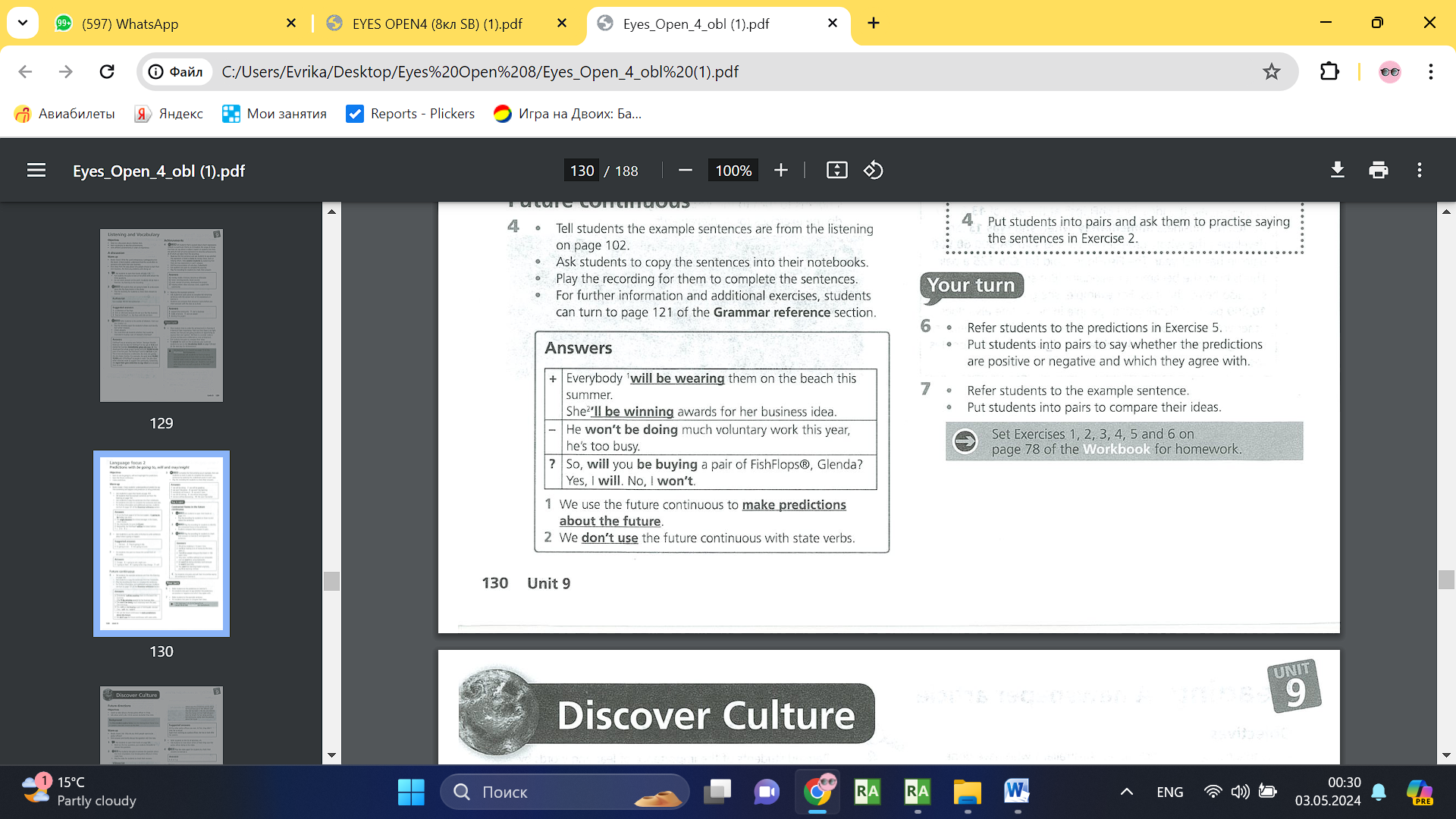
Short term plan: term 4
|
Unit 9: The world of work |
Lesson 97 |
||
|
Teacher name: |
|
||
|
Date: |
|
||
|
Grade: 8 |
Number present: |
absent: |
|
|
Lesson title |
Discover Culture |
||
|
Learning objectives |
8.2.1.1 understand with little or no support the main points in extended talk on a wide range of general and curricular topics 8.5.3.1 write with moderate grammatical accuracy on a limited range of familiar general and curricular topics 8.3.7.1 use appropriate subject-specific vocabulary and syntax to talk about a range of general topics, and some curricular topics |
||
|
Lesson objectives |
Learners will be able to: - watch a video about a female police officer in China. - talk about which jobs I think women do better than men. |
||
|
Value links |
Tradition: Kazakh traditions and culture have been passed on from one generation to another through oral histories told by traditional Kazakh tribal leaders and elders. |
||
|
Plan |
|||
|
Stages / Time |
Teachers actions |
Students actions |
Assessment criteria |
Resources |
|
Beginning of the lesson Warming-up
3 min. Pre-learning «Brainstorming» method 7 min. |
Organization moment : 1.Greeting. Ask about the weather. The teacher sets the lesson objectives, letting students know what to anticipate from the lesson. Warming up Books closed. Write the word entrepreneur /,pntrǝprə'ns:r/on the board. Check students understand that this word refers to someone who starts their own business. Elicit ideas from the class about why people choose to start their own business. Are there any problems with doing so? Lead – In |
The aim: To develop pupils speaking skills and create friendly atmosphere Students of the class are listed. Students' attention is drawn to the lesson. Students say different words from the picture •Learners remember previous lesson vocabulary •Learners answer the questions |
The teacher to assess learners for their ability. “Good job! Well done!” Formative Assessment
Good job! Descriptor: - remembers the lesson passed Point 1 Assessment criteria make basic statements related to personal information, people and objects on familiar topics and a treasure hunt |
Pictures worksheet Picture |
|
Middle of the lesson Presentation part. 30 min |
Ex:1 P:104 • Ask students to open their books at page 104. Read out the two questions, put students into pairs to answer the questions Ex: 2 P: 104 • Put students into pairs to answer the question about the kinds of problems that female police officers in China might face. Play the video for students to check their answers. Ex: 3 P: 104 • Refer students to the list of activities a-h. Ask students to note down which of them they saw the police officer doing in the video. Ex: 4 P: 104 • Play the video again for students to check their answers to Exercise 3. Ex: 5 P: 104 Ask students to work alone to choose the correct words to complete the quote. Play the video for students to check answers. Conclusion during the lesson some tasks differentiated by outcomes of the students and by their abilities. |
• Learners work with a partner. Look at the photo and answer the questions. ANSWERS Student’s own answer. • Learners what kinds of problems do you think a female police officer in China might face? Watch the video and check your ideas. ANSWERS All the other police officers are men. At first, they didn't treat her as equal. Apart from working as a police officer, she has to look after her parents. • Learners test your memory. Which activities did you see Jolene, the police officer, doing in the video? ANSWERS Student’s own answer. • Learners watch the video again and check your answers. ANSWERS b, d, e, f, g • Learners choose the correct words. Then watch the video from 00.48 to 01.05 and check your answers. ANSWERS 1 gentle 2 tougher 3 colleagues 4 guts 5 criminals |
Descriptor: - work with a partner - answer the questions Total: 2 point Descriptor: - answer the question about the kinds of problems Total: 2 point Descriptor: - test your memory - answer the questions Total: 2 point
Self assessment Differentiation: «Verbal support» method is used to help Ss use new words in the sentences. Descriptor: - choose the correct words - watch the video Total: 2 point -Make CCQ questions Yes / No |
Card Worksheet Students book |
|
End of the lesson 5 min |
FEEDBACK Learners provide feedback on what they have learned at the lesson. |
|
Poster Success
|
|
Short term plan: term 4
|
Unit 9: The world of work |
Lesson 98 |
||
|
Teacher name: |
|
||
|
Date: |
|
||
|
Grade: 8 |
Number present: |
absent: |
|
|
Lesson title |
Reading A newspaper article |
||
|
Learning objectives |
8.1.7.1 develop and sustain a consistent argument when speaking or writing 8.3.7.1 use appropriate subject-specific vocabulary and syntax to talk about a range of general topics, and some curricular topics 8.4.1.1 understand the main points in texts on a growing range of unfamiliar general and curricular topics, including some extended texts |
||
|
Lesson objectives |
Learners will be able to: - read a newspaper article about Australians who have done special things. - learn words in context. - talk about people in my country who have achieved a lot |
||
|
Value links |
Tradition: Kazakh traditions and culture have been passed on from one generation to another through oral histories told by traditional Kazakh tribal leaders and elders. |
||
|
Plan |
|||
|
Stages / Time |
Teachers actions |
Students actions |
Assessment criteria |
Resources |
|
Beginning of the lesson Warming-up
3 min. Pre-learning «Brainstorming» method 7 min. |
Organization moment : 1.Greeting. Ask about the weather. The teacher sets the lesson objectives, letting students know what to anticipate from the lesson. Warming up Books closed. Write prizes and awards on the board. Drill the pronunciation of the words: prizes /pratziz/ and awards /ǝ'wɔ:dz/ Check students understand that a prize or an award is something given as a reward to someone who has won a competition or in recognition of a particular achievement, e.g. A Nobel prize is the most prestigious award in science and literature. Lead – In |
The aim: To develop pupils speaking skills and create friendly atmosphere Students of the class are listed. Students' attention is drawn to the lesson. Students say different words from the picture •Learners remember previous lesson vocabulary •Learners answer the questions |
The teacher to assess learners for their ability. “Good job! Well done!” Formative Assessment
Good job! Descriptor: - remembers the lesson passed Point 1 Assessment criteria make basic statements related to personal information, people and objects on familiar topics and a treasure hunt |
Pictures worksheet Picture |
|
Middle of the lesson Presentation part. 30 min |
Ex:1 P:105 • Ask students to open their books at page 105. Put students in pairs to look at the photos and answer the questions. Elicit answers, but do not confirm or reject them at this stage. Students will check their answers in Exercise 2 Ex: 2 P: 105 • Before students read the article check their understanding of rural /ruǝr(ə)l/, which means relating to the countryside not towns. Ask students to read the article to check their answers to Exercise 1. Ex: 3 P: 105 • Refer students to questions 1-6. Ask students to read the magazine article. Then put them into pairs to answer the questions. Ex: 4 P: 105 • Remind students of the importance of learning words by working out their meaning from their context. Learning words in this way encourages students to see how words acquire their meaning from other words. Refer students to the highlighted words in the article. Ask students to work alone to complete the exercise. Check answers. Conclusion during the lesson some tasks differentiated by outcomes of the students and by their abilities. |
• Learners work with a partner. Look at the photos and answer the questions ANSWERS Student’s own answer • Learners read the newspaper article and check your answers. ANSWERS 1 They have won the Young Australian of the Year Award. 2 Akram Azimi has worked with Aboriginal communities in Western Australia. lan Thorpe has won medals at the Sydney Olympics. Trisha Broadbridge survived the 2004 tsunami and has set up a charity which helped to build the Broadbridge Education Centre on Thailand's Phi Phi island. 3 lan Thorpe is a famous swimmer. • Learners read the article again and answer the questions. ANSWERS 1 Because there are a lot of recommendations. 2 32 3 Because he arrived in Australia as a refugee from Afghanistan when he was 13, so English is not his first language. 4 He became the youngest male ever to represent Australia. 5 Trisha Broadbridge 6 Because it's on the eve of Australia Day • Learners match the highlighted words in the article with the definitions ANSWERS 1 shortlist 2 virtually 3 remote 4 refugee 5 fellow |
Descriptor: - work with a partner - answer the questions Total: 2 point Descriptor: - read the newspaper article - check your answers Total: 2 point Descriptor: - read the article again - answer the questions Total: 2 point
Self assessment Differentiation: «Verbal support» method is used to help Ss use new words in the sentences. Descriptor: - match the highlighted words - complete the exercise Total: 2 point -Make CCQ questions Yes / No |
Card Worksheet Students book |
|
End of the lesson 5 min |
FEEDBACK Learners provide feedback on what they have learned at the lesson. |
|
Poster Success
|
|
Short term plan: term 4
|
Unit 9: The world of work |
Lesson 99 |
||
|
Teacher name: |
|
||
|
Date: |
|
||
|
Grade: 8 |
Number present: |
absent: |
|
|
Lesson title |
Speaking Making decisions |
||
|
Learning objectives |
8.1.10.1 use talk or writing as a means of reflecting on and exploring a range of perspectives on the world 8.3.7.1 use appropriate subject-specific vocabulary and syntax to talk about a range of general topics, and some curricular topics 8.5.1.1 plan, write, edit and proofread work |
||
|
Lesson objectives |
Learners will be able to: - watch teenagers talking about what they are saving up for. -listen to teenagers talking about giving money to charity. -practise giving and asking for opinions, making suggestions and making decisions |
||
|
Value links |
Tradition: Kazakh traditions and culture have been passed on from one generation to another through oral histories told by traditional Kazakh tribal leaders and elders. |
||
|
Plan |
|||
|
Stages / Time |
Teachers actions |
Students actions |
Assessment criteria |
Resources |
|
Beginning of the lesson Warming-up
3 min. Pre-learning «Brainstorming» method 7 min. |
Organization moment : 1.Greeting. Ask about the weather. The teacher sets the lesson objectives, letting students know what to anticipate from the lesson. Warming up Books closed. Write prizes and awards on the board. Drill the pronunciation of the words: prizes /pratziz/ and awards /ǝ'wɔ:dz/ Check students understand that a prize or an award is something given as a reward to someone who has won a competition or in recognition of a particular achievement, e.g. A Nobel prize is the most prestigious award in science and literature. Lead – In |
The aim: To develop pupils speaking skills and create friendly atmosphere Students of the class are listed. Students' attention is drawn to the lesson. Students say different words from the picture •Learners remember previous lesson vocabulary •Learners answer the questions |
The teacher to assess learners for their ability. “Good job! Well done!” Formative Assessment
Good job! Descriptor: - remembers the lesson passed Point 1 Assessment criteria make basic statements related to personal information, people and objects on familiar topics and a treasure hunt |
Pictures worksheet Picture |
|
Middle of the lesson Presentation part. 30 min |
Ex:1 P:106 • Ask students to open their books at page 106. Tell students they are going to watch some teenagers answering the following question: Are you saving up for something special? What? Refer students to the gapped sentences. Tell students that they are going to complete the sentences with what each person is saving up for. Play the video. Students work alone to complete the sentences. Check answers Ex: 2 P: 106 •Put students into pairs to ask and answer the question Ex: 3 P: 106 • Tell students they are going to listen to two teenagers discussing giving money to charity. Read out the question Play the recording. Students listen and answer the question. Check answer. Ex: 4 P: 106 • Refer students to the phrases in the Useful language box. Check students' understanding of the language. Students can work alone to complete the conversation using the phrases in the Useful language box. Stronger students can try to complete the conversation without looking at the phrases in the box Ex: 5 P: 106 • Play the recording for students to check their answers. Conclusion during the lesson some tasks differentiated by outcomes of the students and by their abilities. |
• Learners watch or listen to the teenagers. Complete the sentences with what each person is saving up for. ANSWERS 1 tickets; favourite band 2 new (electric) 3 motorbike 4 college 5 trip • Learners are you saving up for something special? What? Ask and answer with your partner ANSWERS Student’s own answer • Learners listen to Bella and Joseph discussing giving money to a charity. What do they decide to do? ANSWERS to have a vote in class • Learners complete the conversation with the useful language. ANSWERS Student’s own answer • Learners listen again and check your answers. ANSWERS 2 thinking of 3 I'd rather 4 What kind of thing 5 a good idea 6 shall we decide 7 the best way is |
Descriptor: - watch or listen to the teenagers - complete the sentences Total: 2 point
Descriptor: - work in pairs - ask and answer Total: 2 point Descriptor: - listen to Bella and Joseph discussing giving money - answer the questions Total: 2 point Differentiation: «Verbal support» method is used to help Ss use new words in the sentences. Descriptor: - complete the conversation - check your answers. Total: 2 point -Make CCQ questions Yes / No |
Card Worksheet Students book |
|
End of the lesson 5 min |
FEEDBACK Learners provide feedback on what they have learned at the lesson. |
|
Poster Success
|
|
Short term plan: term 4
|
Unit 9: The world of work |
Lesson 100 |
||
|
Teacher name: |
|
||
|
Date: |
|
||
|
Grade: 8 |
Number present: |
absent: |
|
|
Lesson title |
Writing An opinion essay Summative assessment for the unit 9 |
||
|
Learning objectives |
8.3.7.1 use appropriate subject-specific vocabulary and syntax to talk about a range of general topics, and some curricular topics 8.4.1.1 understand the main points in texts on a growing range of unfamiliar general and curricular topics, including some extended texts 8.5.1.1 plan, write, edit and proofread work at text level with little support on a range of general and curricular topics |
||
|
Lesson objectives |
Learners will be able to: - read an essay about school leaving age. - learn about the use of linking phrases. - write an opinion essay about school. |
||
|
Value links |
Tradition: Kazakh traditions and culture have been passed on from one generation to another through oral histories told by traditional Kazakh tribal leaders and elders. |
||
|
Plan |
|||
|
Stages / Time |
Teachers actions |
Students actions |
Assessment criteria |
Resources |
|
Beginning of the lesson Warming-up
3 min. Pre-learning «Brainstorming» method 7 min. |
Organization moment : 1.Greeting. Ask about the weather. The teacher sets the lesson objectives, letting students know what to anticipate from the lesson. Warming up Books closed. Write prizes and awards on the board. Drill the pronunciation of the words: prizes /pratziz/ and awards /ǝ'wɔ:dz/ Check students understand that a prize or an award is something given as a reward to someone who has won a competition or in recognition of a particular achievement, e.g. A Nobel prize is the most prestigious award in science and literature. Lead – In |
The aim: To develop pupils speaking skills and create friendly atmosphere Students of the class are listed. Students' attention is drawn to the lesson. Students say different words from the picture •Learners remember previous lesson vocabulary •Learners answer the questions |
The teacher to assess learners for their ability. “Good job! Well done!” Formative Assessment
Good job! Descriptor: - remembers the lesson passed Point 1 Assessment criteria make basic statements related to personal information, people and objects on familiar topics and a treasure hunt |
Pictures worksheet Picture |
|
Middle of the lesson Presentation part. 30 min |
Ex:1 P:107 • Read out the question in the rubric and the title of the essay. Ask students to describe the photos (one shows two girls excitedly doing something with wires; another a group of students looking bored in a lecture). Point out that if the photos reflect the writer's opinion about education in general, we might imagine, that he/she doesn't think a university education will suit everyone and that many young people might be better off learning practical skills. Ask students to read the essay to find the answer to the question. Ex: 2 P: 107 •Ask students to identify the paragraphs in which the information in Exercise 2 appears in the essay. Students can compare their answers in pairs before you check answers with the class. Ex: 3 P: 107 • Read out the information about conjunctions in the Useful language box. Explain that such phrases are used to explain reasons and give the writer the opportunity to structure his or her paragraphs. Check answers. Ex: 4 P: 107 • Match the first sentence as an example. Put students into pairs and ask them to match the beginnings and ends of the sentences. Check answers. Summative assessment for the unit 9 Conclusion during the lesson some tasks differentiated by outcomes of the students and by their abilities. |
• Learners read out the question in the rubric and the title of the essay. ANSWERS The writer disagrees. • Learners read the essay again and identify which paragraph each of these points is in. ANSWERS Paragraph 1: b, c Paragraph 2: a Paragraph 3: e Paragraph 4: d, c • Learners look at the Useful language box. Find two other conjunctions in the text that are used to explain reasons ANSWERS Student’s own answer • Learners complete the sentences with the phrases in the box. ANSWERS 1 c 2 d 3 a 4 b 5 e |
Descriptor: - read out the question - find the answer to the question Total: 2 point
Descriptor: - read the essay again - identify which paragraph each Total: 2 point Descriptor: - look at the Useful language box - find two other conjunctions in the text Total: 2 point Differentiation: «Verbal support» method is used to help Ss use new words in the sentences. Descriptor: - match the first sentence as an example - complete the sentences with the phrases Total: 2 point -Make CCQ questions Yes / No |
Card Worksheet Students book |
|
End of the lesson 5 min |
FEEDBACK Learners provide feedback on what they have learned at the lesson. |
|
Poster Success
|
|
Short term plan: term 4
|
Unit 9: The world of work |
Lesson 101 |
||
|
Teacher name: |
|
||
|
Date: |
|
||
|
Grade: 8 |
Number present: |
absent: |
|
|
Lesson title |
CLIL: Natural Science The Archimedes’ Principle |
||
|
Learning objectives |
8.2.1.1 understand with little or no support the main points in extended talk on a wide range of general and curricular topics 8.3.7.1 use appropriate subject-specific vocabulary and syntax to talk about a range of general topics, and some curricular topics 8.4.1.1 understand the main points in texts on a growing range of unfamiliar general and curricular topics, including some extended texts |
||
|
Lesson objectives |
Learners will be able to: - learn about the Archimedes' principle. - talk about scientists and their achievement |
||
|
Value links |
Tradition: Kazakh traditions and culture have been passed on from one generation to another through oral histories told by traditional Kazakh tribal leaders and elders. |
||
|
Plan |
|||
|
Stages / Time |
Teachers actions |
Students actions |
Assessment criteria |
Resources |
|
Beginning of the lesson Warming-up
3 min. Pre-learning «Brainstorming» method 7 min. |
Organization moment : 1.Greeting. Ask about the weather. The teacher sets the lesson objectives, letting students know what to anticipate from the lesson. Warming up Books closed. Write prizes and awards on the board. Drill the pronunciation of the words: prizes /pratziz/ and awards /ǝ'wɔ:dz/ Check students understand that a prize or an award is something given as a reward to someone who has won a competition or in recognition of a particular achievement, e.g. A Nobel prize is the most prestigious award in science and literature. Lead – In |
The aim: To develop pupils speaking skills and create friendly atmosphere Students of the class are listed. Students' attention is drawn to the lesson. Students say different words from the picture •Learners remember previous lesson vocabulary •Learners answer the questions |
The teacher to assess learners for their ability. “Good job! Well done!” Formative Assessment
Good job! Descriptor: - remembers the lesson passed Point 1 Assessment criteria make basic statements related to personal information, people and objects on familiar topics and a treasure hunt |
Pictures worksheet Picture |
|
Middle of the lesson Presentation part. 30 min |
Ex:1 P:108 • sk students to open their books at page 108. Put students into pairs and ask them to answer the questions. Discuss students' ideas and elicit that water is denser than air. Ex: 2 P: 108 • Write Archimedes /,a:kı'mi:di:z/ on the board. Drill the pronunciation. Elicit everything that students know about the Greek mathematician and inventor. Refer students to the text. Before they read the text, ask them to describe the illustrations. If possible, show the illustrations on the interactive whiteboard. Ask students to read the text and then put them into pairs to answer the question. Check answer. Ex: 3 P: 108 • Give students time to read the five statements. Ask students to read the text again and then ask them to decide whether they are true or false. Remind students to correct the false sentences. Students can then compare answers in pairs before you check answers with the class. Ex: 4 P: 108 • Put students into pairs to talk about the scientists and their achievements. Monitor and help as necessary. Check answers. Conclusion during the lesson some tasks differentiated by outcomes of the students and by their abilities. |
• Learners work with a partner. When you are swimming in a pool, do you feel lighter, heavier or the same as when you are walking on the ground? Can you explain why? ANSWERS Student’s own answer • Learners read about Archimedes. What was he trying to find out? ANSWERS He was trying to find out if the king's crown was made out of solid gold. • Learners read the article again. Are these sentences true or false? Correct the false sentences. ANSWERS 1 T 2 T 3 F (The crown and the pure gold displaced different amounts of water.) 4 F (The crown wasn't made of pure gold.) 5 F (Density is calculated by diving the weight of an object by its volume.) • Learners work in pairs. What do you know about what these scientists studied and their achievements? ANSWERS Charles Darwin: the theory of evolution Marie Curie: the discovery of radioactivity Galileo Galilei: the Earth's orbit around the Sun Albert Einstein: the theory of relativity Isaac Newton: the theory of gravity |
Descriptor: - work with a partner. - answer the questions Total: 2 point
Descriptor: - read about Archimedes - answer the questions Total: 2 point Descriptor: - read the article again - correct the false sentences. Total: 2 point Differentiation: «Verbal support» method is used to help Ss use new words in the sentences. Descriptor: - work in pairs - monitor and help as necessary Total: 2 point -Make CCQ questions Yes / No |
Card Worksheet Students book |
|
End of the lesson 5 min |
FEEDBACK Learners provide feedback on what they have learned at the lesson. |
|
Poster Success
|
|
Short term plan: term 4
|
Unit 9 The world of work |
|
||
|
Teacher name: |
|
||
|
Date: |
|
||
|
Grade: 8 |
Number present: |
absent: |
|
|
Lesson title |
Summative Assessment for the 4th term |
||
|
Learning objectives |
8.2.4.1 (8.L5) Recognise the opinion of the speaker(s) with little or no support in extended talk on a wide range of general and curricular topics. 8.4.6.1(8.R6) Recognise the attitude or opinion of the writer on a growing range of unfamiliar general and curricular topics, including some extended texts 8.3.5.1(8.S5) Interact with peers to negotiate, agree and organise priorities and plans for completing classroom tasks. |
||
|
Lesson objectives |
Learners will be able to: - explain the topical word by giving definition/synonym - identify the central idea, the intended audience and the author’s purpose |
||
|
Plan |
|||
|
Stages / Time |
Teachers’ actions |
Students’ actions |
Assessment criteria |
Resources |
|
Beginning of the lesson 5 min |
Organization moment 1.Greeting. Ask about the weather. The teacher sets the lesson objectives, letting students know what to anticipate from the lesson. Warm-up Method speaking phone was used to develop speaking skills.
Lead – In |
Students' attention is drawn to the lesson. Students discuss the pictures in pairs. Determines the topic and aim of the lesson Students say different words from the picture |
Formative Assessment
Good job! Assessment criteria -Identify detailed information in extended conversation with support |
Pictures Student’s book |
|
Middle of the lesson Presentation part. 35 min |
Listening Task. You will hear a radio interview with a famous cardiologist. Decide whether the statements are TRUE or FALSE. Transcript for listening task can be found after the mark scheme. Example: Heart attacks are more common now than they were in the past. True Listen and complete the sentences with NO MORE THAN TWO words. Example: Dr. Shaw gives some advice on how to keep our hearts in good condition. Reading Task. Read the text about Kenneth. Mark the sentences TRUE or FALSE according to the context. Writing Task. Choose ONE of the topics to write. Topic 1. Write an essay about the following topic: Nowadays food has become easier to prepare. Has this change improved the way people live? Give reasons for your answer using your own ideas Topic 2. Write an essay about the following topic: Doctors, nurses and teachers make a great contribution to society and should be paid more than entertainment and sports celebrities. Do you agree or disagree? Give reasons for your answer using your own ideas SPEAKING Task. Work in pairs. Choose one of the cards and answer the questions. You have 1 minute to prepare and 3 minutes to speak. Conclusion during the lesson some tasks differentiated by outcomes of the students and by their abilities. |
Students listen and complete the sentences Answers: Differentiation: «Verbal support» method is used to help Students use new words in the text. Students read the text about Kenneth Answers: Students write an essay Answers: Students work in pairs. choose one of the cards and answer the questions Answers: |
Descriptor: - decide whether the statements are TRUE or FALSE Total: 6 point Descriptor: - work individually - read the text about Kenneth Total: 6 point Descriptor: - write an essay about the following topic Total: 6 point Descriptor: choose one of the cards and answer the questions Total: 6 point |
Cards Worksheets |
|
End of the lesson 5 min |
FEEDBACK Learners provide feedback on what they have learned at the lesson. |
|
Students evaluate each other and encourage classmate with phrases like: Well done! Brilliant! Good job! I like it! . |
Poster
|


Short term plan: term 4
|
Unit 9: The world of work |
Lesson 101 |
||
|
Teacher name: |
|
||
|
Date: |
|
||
|
Grade: 8 |
Number present: |
absent: |
|
|
Lesson title |
Extra reading |
||
|
Learning objectives |
8.3.7.1 use appropriate subject-specific vocabulary and syntax to talk about a range of general topics, and some curricular topics 8.4.1.1 understand the main points in texts on a growing range of unfamiliar general and curricular topics, including some extended texts |
||
|
Lesson objectives |
Learners will be able to: -read short texts about teenagers' career plans. - answer comprehension questions about the text. - talk about our own career plans. |
||
|
Value links |
Tradition: Kazakh traditions and culture have been passed on from one generation to another through oral histories told by traditional Kazakh tribal leaders and elders. |
||
|
Plan |
|||
|
Stages / Time |
Teachers actions |
Students actions |
Assessment criteria |
Resources |
|
Beginning of the lesson Warming-up
3 min. Pre-learning «Brainstorming» method 7 min. |
Organization moment : 1.Greeting. Ask about the weather. The teacher sets the lesson objectives, letting students know what to anticipate from the lesson. Warming up Books closed. Show students the photos of the three teenagers. Write the names on the board: Zhanar, Baglan and Damir. Put students in pairs or small groups and ask them to guess each teenager's dream job. Elicit ideas and write them on the board under each name. Lead – In |
The aim: To develop pupils speaking skills and create friendly atmosphere Students of the class are listed. Students' attention is drawn to the lesson. Students say different words from the picture •Learners remember previous lesson vocabulary •Learners answer the questions |
The teacher to assess learners for their ability. “Good job! Well done!” Formative Assessment
Good job! Descriptor: - remembers the lesson passed Point 1 Assessment criteria make basic statements related to personal information, people and objects on familiar topics and a treasure hunt |
Pictures worksheet Picture |
|
Middle of the lesson Presentation part. 30 min |
Ex:1 P:109 •1. Ask students to open their books at page 109. Give them a minute to scan the three texts and find the people's dream job. Elicit answers. (Zhanar - hotel employee; Baglan - TV sports presenter, Damir - vet or architect) Ask students to think of their dream job and write it down in their notebooks. Then demonstrate the following exchange with a student: A: What's your dream job? B: I'd really like to work as a(n)... What about you? A: I want to become a(n)... That'd be great! You could write it on the board for students' reference. Ask students to walk around the class and ask as many classmates as they can about their dream job. Refer them to the exchange on the board. Monitor and make sure students mingle and do the task. Ex: 2 P: 109 • Ex: 3 P: 109 • Conclusion during the lesson some tasks differentiated by outcomes of the students and by their abilities. |
• Learners work with a partner. When you are swimming in a pool, do you feel lighter, heavier or the same as when you are walking on the ground? Can you explain why? ANSWERS Student’s own answer • Learners read about Archimedes. What was he trying to find out? ANSWERS He was trying to find out if the king's crown was made out of solid gold. • Learners read the article again. Are these sentences true or false? Correct the false sentences. ANSWERS |
Descriptor: - work with a partner. - answer the questions Total: 2 point
Descriptor: - read about Archimedes - answer the questions Total: 2 point Descriptor: - read the article again - correct the false sentences. Total: 2 point Differentiation: «Verbal support» method is used to help Ss use new words in the sentences. -Make CCQ questions Yes / No |
Card Worksheet Students book |
|
End of the lesson 5 min |
FEEDBACK Learners provide feedback on what they have learned at the lesson. |
|
Poster Success
|
|









 Бұл курс Қазақстан Республикасы Оқу-ағарту министрлігімен келісілген










