ЖИ көмекші


жүктеу мүмкіндігіне ие боласыз
Бұл материал сайт қолданушысы жариялаған. Материалдың ішінде жазылған барлық ақпаратқа жауапкершілікті жариялаған қолданушы жауап береді. Ұстаз тілегі тек ақпаратты таратуға қолдау көрсетеді. Егер материал сіздің авторлық құқығыңызды бұзған болса немесе басқа да себептермен сайттан өшіру керек деп ойласаңыз осында жазыңыз
 17 Қаңтар 2026
 0
0
Шет тілін үйренудегі қосымша ресурстар
Khoja Akhmet Yassawi International Kazakh-Turkish University
Faculty Philology
Department of Pedagogical Foreign Languages

Scientific Project
Theme: «Digital Tools That Make English Lessons More Engaging»
Project Section: English language
Scientific Supervisor: Toymetova Umida
Performed by: FAG - 412 group student Rakhmanberdiev Ruslan
Turkestan – 2025
Khoja Akhmet Yassawi International
Kazakh-Turkish University
Faculty Philology
Department of Pedagogical Foreign Languages
Rakhmanberdiev Ruslan
About the scientific work on the topic
« Digital Tools That Make English Lessons More Engaging »
Opinion
Khoja Akhmet Yassawi International Kazakh-Turkish University, Faculty of Philology, prepared by FAG – 412 group student Rakhmanberdiev Ruslan, the scientific project titled “Digital Tools That Make English Lessons More Engaging” is a valuable and timely study reflecting modern trends in language education.
This project is significant as it explores how digital technologies enhance students’ motivation, participation, and creativity in English learning. The student examines a variety of digital tools—such as interactive platforms, mobile applications, gamified learning systems, and AI-based resources—analyzing their functions, advantages, and pedagogical effectiveness in the ESL classroom.
The work goes beyond simple description; it provides a critical evaluation of how digital tools transform traditional lessons into interactive and student-centered experiences. The project discusses the benefits, including increased engagement, improved communication and collaboration, and the development of digital literacy, while also acknowledging possible challenges such as unequal access to technology, teacher readiness, and maintaining a balance between entertainment and learning goals.
The research is well-structured, consisting of an introduction, main body, and conclusion, each clearly developed. It draws on recent studies, educational resources, and classroom case examples to support its arguments. The language of the project is clear, academic, and coherent, reflecting a mature understanding of educational innovation.
By presenting thoughtful opinions on the cultural, social, and pedagogical impact of digital tools, the student demonstrates strong analytical skills and awareness of 21st-century teaching strategies, which are essential qualities for modern educators.
Scientific Supervisor: Toymetova Umida
Contents
I. Introduction_____________________________________________________5
II. Main part____________________________________________________11
2.1. Types of Digital Tools
2.2. Advantages of Digital Tools
2.3. Impact on Student’s learning
2.4. Benefits for Teachers
2.5. Practical Examples
2.6. Challenges and Barriers
III. Conclusion___________________________________________________18
IV. References____________________________________________________21
Annotation
This research project explores the effectiveness of digital tools in making English lessons more engaging and interactive. The study aims to investigate how the integration of modern technologies—such as online learning platforms, mobile applications, gamification, and multimedia resources—can enhance students’ motivation, participation, and overall learning outcomes in English language classrooms.The project presents the theoretical foundations of using digital tools in education, emphasizing cognitive, communicative, and constructivist principles that promote active learning and student-centered instruction. It compares traditional teaching methods with technology-enhanced approaches, highlighting the advantages of incorporating interactivity, feedback, and real-life communication into the learning process.Furthermore, the research analyzes practical applications of various digital tools in the classroom, offering strategies for teachers to effectively implement and adapt them for different proficiency levels. The study also discusses the role of emerging technologies, such as artificial intelligence (AI), virtual and augmented reality (VR/AR), and collaborative platforms, in creating immersive and dynamic learning environments.Drawing on recent studies, classroom experiments, and practical examples, the project demonstrates how digital tools contribute to increased learner engagement, creativity, and confidence in communication. At the same time, it considers potential challenges such as digital literacy gaps, access to resources, and the need for teacher training to ensure effective and balanced use of technology.Overall, the research provides a comprehensive analysis of how digital tools can transform traditional English lessons into motivating, interactive, and learner-centered experiences, supporting the development of 21st-century skills and promoting continuous learning.
Abstract
This study investigates the effectiveness of digital tools in making English lessons more engaging and interactive. The research aims to evaluate how the integration of technology—such as multimedia resources, mobile applications, online platforms, and gamified learning tools—enhances students’ motivation, participation, and academic performance in English language learning. The study involved ten university students aged 18–20 who participated in a two-week classroom-based experiment that combined traditional instruction with digital activities. Data were collected through classroom observation, student feedback questionnaires, and performance-based speaking and writing tasks. The findings reveal that the use of digital tools significantly improved students’ engagement, confidence, and overall communication skills. Moreover, learners demonstrated greater enthusiasm and creativity when interacting with digital content. The study concludes that integrating digital technologies into English lessons promotes a more student-centered learning environment and supports the development of essential 21st-century skills such as collaboration, critical thinking, and digital literacy.
Introduction
Relevance of the Research
The topic of this research project, “Digital Tools That Make English Lessons More Engaging,” is highly relevant in the modern era of digital transformation and global communication. As English continues to serve as the primary international language for education, business, and technology, the demand for innovative and effective teaching methods has become increasingly important. Traditional approaches to language teaching often rely on rote learning, repetitive exercises, and teacher-centered instruction, which can lead to reduced motivation and limited practical communication skills. In contrast, the integration of digital tools provides new opportunities to make English lessons more interactive, learner-centered, and motivating.The relevance of this study lies in its potential to enhance the quality of English language education by demonstrating how digital technologies—such as online platforms, mobile applications, gamified learning systems, and multimedia tools—can foster engagement, creativity, and collaboration among students. These tools enable learners to practice English in real-life contexts through simulations, interactive exercises, and authentic communication, thus supporting the development of essential 21st-century skills.From a theoretical perspective, the study contributes to understanding how technology-supported instruction aligns with cognitive and communicative theories of language learning. It examines how digital environments promote active participation, immediate feedback, and adaptive learning processes, which are essential for effective language acquisition.
From a practical standpoint, this research offers insights into how educators can effectively incorporate digital tools into lesson planning and classroom practice. By exploring both the benefits—such as increased motivation, flexibility, and learner autonomy—and the challenges, including unequal access to technology, digital literacy gaps, and the need for teacher training, the project provides a balanced and evidence-based analysis.Moreover, the findings are significant not only for teachers but also for curriculum developers, educational policymakers, and students. In a world where English proficiency and digital competence are vital for academic and professional success, integrating digital tools into language teaching is no longer optional but necessary. This research aims to contribute to that process by identifying effective strategies for creating engaging, technology-enhanced English lessons that inspire active learning and long-term achievement.
Research Aim
The aim of this research project is to examine the effectiveness of digital tools in enhancing student engagement and learning outcomes in English language classrooms. The study seeks to explore how the integration of educational technologies—such as interactive platforms, mobile applications, gamified resources, and multimedia content—contributes to improving learners’ motivation, comprehension, and communication skills. Specifically, the research aims to analyze the impact of digital tools on speaking fluency, vocabulary development, creativity, and learner confidence.
Additionally, the study investigates the practical applications of digital technologies in classroom settings, focusing on teaching strategies, the role of digital literacy, and the level of learner participation. The research also aims to identify potential challenges associated with the use of digital tools, such as unequal access to technology, teacher readiness, and the risk of distraction or cognitive overload. Ultimately, the project seeks to provide evidence-based recommendations for teachers, curriculum designers, and learners on how to effectively implement digital tools to make English lessons more engaging, interactive, and effective.
Sources / References
This research is grounded in modern theories and studies on digital pedagogy and second language acquisition. Scholars such as Stephen Krashen (1985) emphasize the importance of comprehensible input in language learning, which can be effectively delivered through multimedia and digital platforms. Similarly, Merrill Swain’s Output Hypothesis (1995) supports the idea that producing language through interactive tools—like voice recording apps or online discussions—enhances accuracy and fluency.The study also draws on principles from Communicative Language Teaching (CLT) and Blended Learning frameworks, which promote authentic communication and learner-centered approaches supported by technology. Research by Nation (2007) and Prensky (2010) highlights that digital environments encourage learner autonomy, motivation, and creativity by providing meaningful contexts for practice and collaboration.Sources for this project include scientific papers, e-books, peer-reviewed journals, case studies, and online educational platforms that discuss digital innovation in language teaching. Empirical studies demonstrating the use of AI-based tools, gamification, VR/AR technologies, and mobile-assisted learning were reviewed to ensure the analysis reflects current educational trends. The selection of diverse, credible, and up-to-date references ensures the project’s academic reliability and comprehensive understanding of digital tool integration in English education.
Research Methods:
Participants: Ten university students aged 18–20, enrolled in an intermediate-level English course.
Procedure: The research was conducted over a two-week period. Students participated in lessons that combined traditional instruction with digital activities such as online quizzes, multimedia presentations, interactive games, and virtual collaboration.
Instruments:
-
Observation checklists to record engagement and participation.
-
Short speaking and writing tasks using online platforms to assess fluency and vocabulary use.
-
Questionnaires evaluating students’ motivation, digital literacy, and self-perceived improvement.
Data Analysis: Students’ performance and engagement were analyzed both qualitatively and quantitatively, comparing pre- and post-intervention results to determine changes in motivation, participation, and language proficiency.Additionally, the analysis and comparison methods were employed to identify differences between digital-assisted lessons and traditional approaches. Information from articles, textbooks, and case studies was organized into thematic sections using systematization and interpretation methods, providing a clear understanding of the pedagogical impact of digital tools.
Research Objectives:
-
To examine the role and effectiveness of digital tools in making English lessons more interactive and engaging.
-
To analyze how digital resources improve learners’ comprehension, speaking, writing, and vocabulary acquisition.
-
To assess the impact of digital tools on learner motivation, participation, and communication confidence.
-
To compare technology-enhanced learning with traditional teaching methods and identify their strengths and weaknesses.
-
To evaluate the integration of digital technologies in classroom strategies and curriculum design.
-
To provide practical, evidence-based recommendations for teachers and institutions on implementing digital tools effectively in ESL education.
Theoretical Significance:
This research provides a strong theoretical foundation for understanding how digital technologies transform English language teaching and learning. It explores the relationship between technology, active engagement, and communicative competence, emphasizing how digital environments support meaningful language use and personalized learning experiences.By analyzing key pedagogical and cognitive principles, the study explains how digital tools encourage self-directed learning, immediate feedback, and collaboration—essential components of successful second language acquisition. The research also categorizes various digital tools according to their functions (interactive, communicative, evaluative, creative) and explores how each contributes to improving learner outcomesThe theoretical significance lies in demonstrating that integrating digital technologies into English lessons not only enhances engagement and motivation but also fosters the development of critical thinking, problem-solving, and digital literacy skills—core competencies in 21st-century education. This framework can guide educators, curriculum developers, and policymakers in creating modern, technology-supported language learning environments that align with global educational trends.
Practical Value:
The results of this research are directed toward the practical application of digital tools in English language teaching and learning. The study provides teachers with effective strategies for integrating technology—such as online learning platforms, mobile applications, interactive games, and multimedia resources—into their lessons to enhance learner engagement and communication skills.By applying digital tools purposefully, educators can increase students’ motivation, encourage active participation, and create a more dynamic and student-centered classroom environment. The research offers practical recommendations for selecting appropriate tools, designing technology-based tasks, and balancing digital and traditional teaching methods to achieve optimal learning outcomes.
Furthermore, the study addresses common challenges such as differences in learners’ digital literacy, limited access to resources, and the need for professional development among teachers. It proposes strategies for overcoming these issues through collaborative learning, the use of low-cost digital resources, and gradual skill-building in both students and educators.Overall, this research contributes to improving the effectiveness of English language teaching by demonstrating how digital tools can make lessons more interactive, engaging, and relevant to modern learners. By providing evidence-based guidelines, the project supports teachers, curriculum developers, and students in using educational technologies responsibly and effectively to enhance both the teaching process and learning outcomes.
Findings / Results
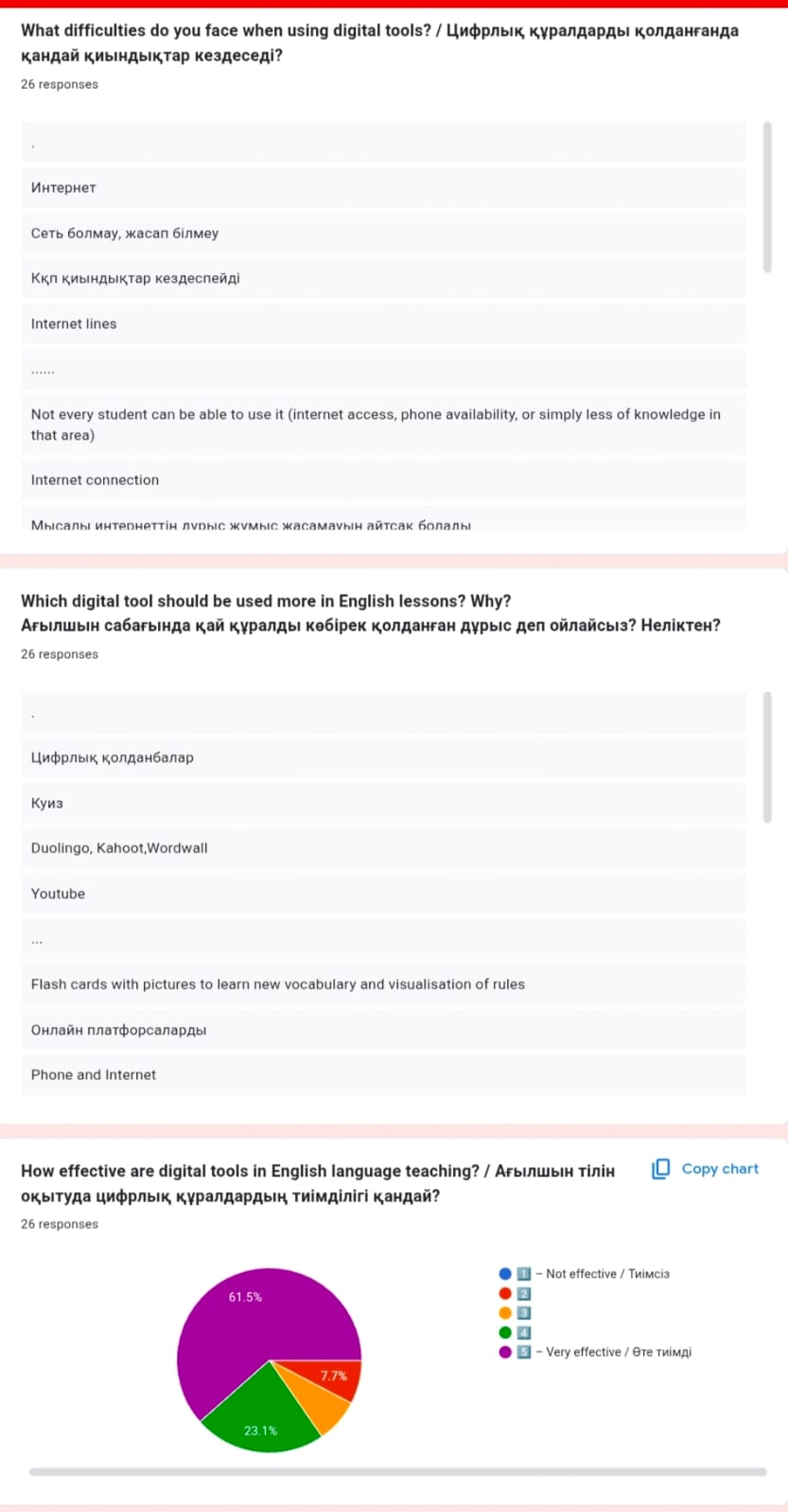
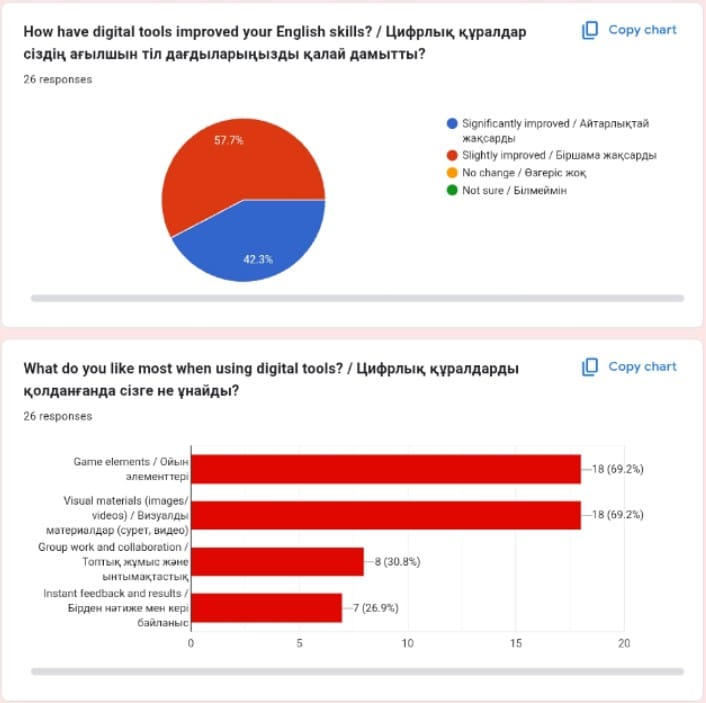
The analysis of the study showed notable improvements in student engagement, confidence, and overall language performance when digital tools were incorporated into lessons.
-
Student engagement: Learners demonstrated higher levels of participation and enthusiasm during lessons that involved interactive digital activities.
-
Motivation and confidence: All participants reported feeling more motivated and comfortable using English in digital learning environments.
-
Language skills: Improvement in vocabulary retention, pronunciation accuracy, and fluency was observed through online speaking and writing tasks.
-
Creativity and collaboration: Students showed increased creativity and teamwork when working on group projects using digital platforms.
-
Challenges: Some minor difficulties were noted, such as occasional technical issues and varying levels of digital literacy, but these did not significantly affect learning outcomes.
Overall, the findings confirm that the integration of digital tools enhances learner motivation, participation, and achievement, transforming the English classroom into a more engaging and interactive space.
About My Research Project:
My research project is titled “Digital Tools That Make English Lessons More Engaging.” I chose this topic because I have always been interested in how technology can improve the learning process and make English lessons more enjoyable and effective. In today’s world, digital literacy and communication skills are essential, and I believe that technology can help bridge the gap between traditional teaching and modern learning needs.Throughout my research, I explored both the advantages and challenges of using digital tools in English language education. The use of technology promotes creativity, motivation, and collaboration, allowing students to practice real communication in authentic contexts. At the same time, it requires teachers to adapt to new methods, manage digital resources effectively, and ensure that learning remains focused and purposeful.Working on this project helped me understand that digital tools are not just supplementary aids but powerful instruments for transforming education. They make lessons more interactive, help visualize complex concepts, and support individual learning paths. Through this research, I learned how different digital resources can be applied in the classroom to improve language proficiency, learner autonomy, and engagement.Ultimately, this project taught me the importance of balance—combining effective teaching strategies with innovative technology to achieve the best learning outcomes. It strengthened my belief that digital tools, when used thoughtfully, can make English lessons not only more engaging but also more meaningful, inclusive, and future-oriented.
Why I Conduct This Research:
I am conducting this research because of my strong interest in the use of digital tools in English language teaching and their increasing importance in modern education. As technology continues to transform the way we learn and communicate, I aim to explore how digital resources—such as interactive platforms, mobile applications, gamified learning systems, and multimedia content—can make English lessons more engaging, effective, and learner-centered. In particular, my main research question is: “How can digital tools enhance engagement, motivation, and learning outcomes in English language classrooms?”Many students still study English through traditional, grammar-based methods that often limit creativity and real-life communication. Such approaches may help learners understand grammatical rules, but they frequently fail to develop fluency, confidence, and active participation. This inspired me to examine alternative, technology-supported methods that can provide authentic contexts for communication, encourage collaboration, and make language learning more interactive and enjoyable.Through this research, I seek to understand how digital tools contribute to learner engagement, confidence, and motivation. I will explore how teachers can effectively integrate technology into their lessons while maintaining a balance between traditional instruction and digital interactivity. The study also investigates potential challenges, such as unequal access to digital resources, varying levels of digital literacy, and the need for teacher training to ensure the successful implementation of technology-enhanced learning strategies.Furthermore, this research aims to provide practical guidance for educators, curriculum designers, and students on the effective use of digital tools in English language education. It highlights the importance of creating inclusive, interactive, and engaging learning environments where students not only acquire language knowledge but also develop critical thinking, creativity, and problem-solving skills—competencies essential for success in the 21st century.By conducting this study, I also aim to expand my personal understanding of digital pedagogy and demonstrate the transformative potential of technology in language education. I believe that digital tools, when used responsibly and thoughtfully, can bridge the gap between traditional teaching and modern learning, fostering deeper engagement, improved communication, and lifelong learning habits. This research, therefore, emphasizes not only the practical benefits of technology integration but also its broader impact on learners’ academic development, self-expression, and global competence.
“Digital Tools That Make English Lessons More Engaging”
My research project is titled “Digital Tools That Make English Lessons More Engaging.” I chose this topic because I have a strong interest in innovative teaching methods and the growing importance of technology in modern language education. As a future educator, I believe that integrating digital tools into English lessons can make learning more interactive, effective, and enjoyable for students. From the early stages of my studies, I have been fascinated by how the use of technology—such as online platforms, mobile applications, and multimedia tools—can enhance motivation, participation, and creativity in English language classrooms. Observing different teaching approaches, I noticed that students become more confident and enthusiastic when digital resources are incorporated, compared to traditional, textbook-based instruction.Digital tools represent a modern and dynamic approach to language teaching, focusing on interaction, collaboration, and learner engagement. These tools include a wide range of resources such as educational applications, gamified learning systems, online quizzes, virtual classrooms, and multimedia presentations. They are designed to make English lessons more engaging by combining visual, auditory, and interactive elements that support different learning styles. By using these technologies, teachers can create student-centered learning environments where learners actively participate, practice communication, and receive instant feedback.
In today’s globalized and technologically driven world, English proficiency and digital literacy have become essential for success in both academic and professional fields. However, traditional grammar-focused lessons often fail to keep learners motivated or to prepare them for real-life communication. The integration of digital tools helps bridge this gap by creating authentic, technology-supported contexts for language practice and real-world communication.The importance of applying effective digital methods in English language teaching cannot be overstated. English serves as a global means of communication, and the use of technology allows teachers to deliver content in more creative, personalized, and efficient ways. Unlike rote memorization or repetitive grammar drills, digital tools promote active learning, collaboration, and critical thinking, which are vital skills for mastering a language in the 21st century. Through the use of interactive platforms, multimedia activities, and online collaboration, both teachers and students can experience a more dynamic, motivating, and engaging learning process.
Main part
2.1. Types of Digital Tools
Digital tools used in English language teaching encompass a wide range of technologies that support communication, collaboration, and creativity. They can be categorized according to their functions and purposes:
Interactive Learning Platforms: Tools such as Google Classroom, Edmodo, Moodle, and Microsoft Teams enable teachers to share materials, assign tasks, and communicate with students effectively.
Gamified Learning Applications: Kahoot!, Quizizz, Wordwall, and Duolingo turn learning into a fun and competitive experience through quizzes, challenges, and rewards that motivate learners.
Multimedia Tools: Canva, Powtoon, Prezi, and YouTube help integrate visuals, audio, and video to make explanations more engaging and memorable.
AI-Powered Tools: Chatbots, writing assistants (like Grammarly or ChatGPT), and speech-recognition programs (e.g., Elsa Speak) help students practice writing, pronunciation, and fluency individually.
Collaborative Tools: Padlet, Jamboard, Google Docs, and Trello promote teamwork, allowing learners to work on shared tasks, projects, and discussions in real time.
Mobile and Augmented Reality (AR/VR) Tools: Apps like Mondly AR and Google Expeditions immerse students in realistic situations where they can practice English in virtual environments.These tools not only modernize traditional teaching methods but also personalize learning, offering students a variety of ways to interact with the language and each other.
2.2. Advantages of Digital Tools
Digital tools provide numerous pedagogical, motivational, and cognitive advantages for both students and teachers.Increased Engagement: Interactive platforms and games turn lessons into exciting experiences, making students more interested in learning.
Personalized Learning: Many tools adapt to learners’ pace and preferences, allowing differentiated instruction for visual, auditory, and kinesthetic learners.
Instant Feedback: Online quizzes and writing apps provide immediate corrections, helping learners identify and fix errors quickly.Accessibility and Flexibility: Lessons can be accessed anytime and anywhere, which supports continuous learning beyond the classroom.
Collaboration and Communication: Students can interact, discuss, and solve tasks together through online forums, chats, and group projects.Integration of Skills: Digital tools combine reading, writing, listening, and speaking in one space, promoting holistic language learning.
Motivation and Autonomy: Gamified tools reward progress, while self-paced apps encourage responsibility for one’s own learning.Overall, these advantages make digital education more learner-centered, interactive, and reflective of real-world communication.
2.3. Impact on Student’s learning
The use of digital tools significantly affects students’ academic performance, engagement, and language competence.
Enhanced Comprehension and Retention: Visual and audio materials help students better understand complex grammar or vocabulary through context and repetition.
Improved Speaking and Listening Skills: Speech recognition and video-based exercises promote real-time communication and pronunciation accuracy.
Boosted Confidence: Students feel more comfortable expressing ideas in digital environments where they can experiment without fear of making mistakes.
Active Participation: Learners become active contributors rather than passive listeners, increasing ownership of their learning.
Critical Thinking and Creativity: Problem-solving games, project-based activities, and multimedia creation develop higher-order thinking skills.
Inclusive Learning: Digital tools accommodate diverse learners, including those with special needs, by offering subtitles, translations, or speech-to-text support.Studies show that technology-rich classrooms lead to higher achievement, better collaboration, and more positive attitudes toward learning English.
2.4. Benefits for Teachers
Digital tools offer numerous professional and practical benefits for educators, improving lesson delivery and classroom management.
Efficient Lesson Planning: Tools like Canva, Slidesgo, and Google Forms help teachers design visually appealing lessons and quick assessments.
Time Saving: Automated grading and data analytics save time and provide valuable insights into student progress.
Enhanced Communication: Platforms like Zoom or Teams allow teachers to interact with students outside class, maintaining engagement remotely.
Resource Variety: Teachers gain access to vast online libraries of lesson templates, interactive exercises, and digital textbooks.
Professional Development: Many tools offer communities of practice and online training, enabling teachers to improve their digital literacy and teaching methods.
Adaptability: Technology helps teachers tailor content for mixed-ability groups, ensuring inclusive education.Digital tools empower teachers to become facilitators and mentors rather than mere information providers, promoting creativity and collaboration in the classroom.
2.5. Practical Examples
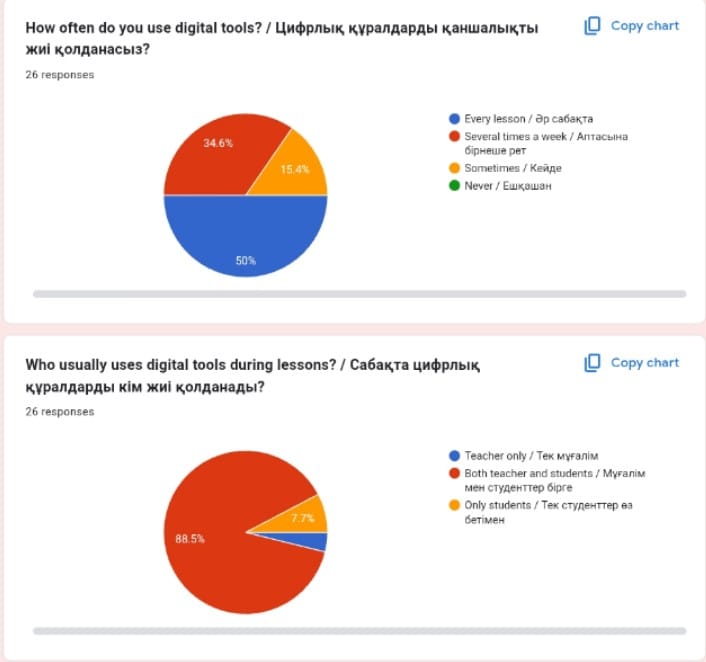
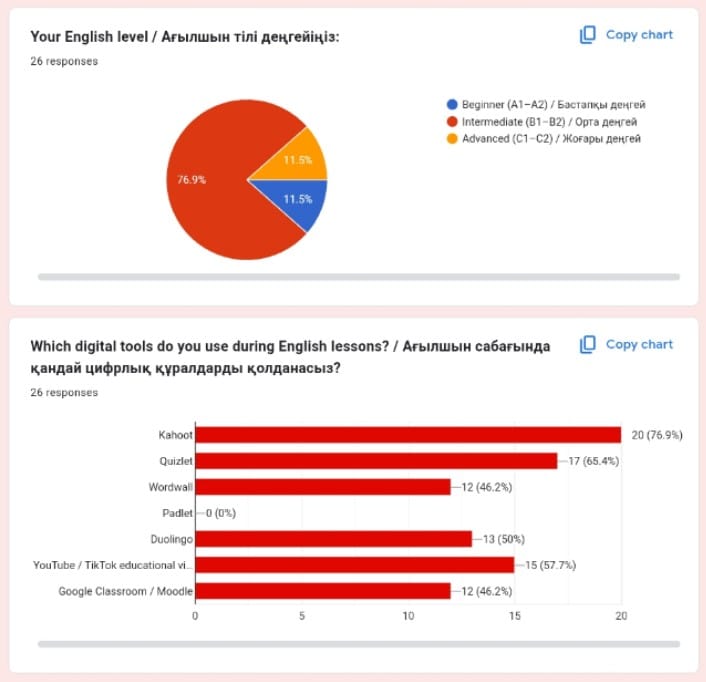
Below are practical examples of how digital tools can be used effectively in English lessons:
-
Kahoot! or Quizizz: Used at the end of lessons to review grammar or vocabulary through interactive quizzes that make assessment fun.
-
Padlet or Jamboard: Ideal for brainstorming ideas, sharing writing drafts, or collecting group reflections in real time.
-
Canva: Helps students design posters, infographics, or digital storyboards to present cultural topics or book summaries.
-
YouTube / TED-Ed: Enhances listening and discussion skills using authentic videos followed by comprehension questions.
-
Google Forms: Enables teachers to conduct formative assessments and gather instant feedback on students’ progress.
-
Duolingo or EWA: Encourages independent vocabulary and grammar practice outside the classroom.
-
Flip (by Microsoft): Allows students to record and share short videos on given topics, improving speaking fluency and pronunciation.
-
Such examples illustrate how technology can bridge theory and practice, making lessons interactive, communicative, and fun.
2.6. Challenges and Barriers
While digital tools offer many benefits, they also come with several challenges and limitations that must be considered:
Access and Equity: Not all students have reliable internet access or modern devices, leading to inequality in learning opportunities.
Digital Literacy: Both teachers and students may lack the necessary technical skills to use tools effectively.
Technical Issues: Software errors, poor connectivity, and device incompatibility can disrupt learning flow.
Distraction and Misuse: Students may lose focus or use digital tools for non-academic purposes during lessons.
Teacher Workload: Preparing digital lessons requires additional time for planning, testing, and troubleshooting.
Data Privacy and Security: Online platforms often collect user data, raising concerns about safety and confidentiality.
Dependence on Technology: Overreliance on digital tools can reduce face-to-face communication and creativity if not balanced properly.To overcome these barriers, institutions must provide teacher training, technical support, and equitable access to technology, ensuring that digital tools are used responsibly and effectively to improve learning outcomes.
Conclusion
The study of digital tools in English language teaching has shown that technology plays a crucial role in transforming modern education. The integration of digital resources—such as interactive platforms, gamified learning apps, multimedia presentations, and AI-based tools—makes English lessons more engaging, motivating, and effective. These tools not only help learners improve their language skills but also encourage creativity, collaboration, and independent learning.The findings of this research demonstrate that digital tools significantly enhance students’ motivation, communication skills, and confidence in using English. Learners who study through interactive and technology-supported methods show better comprehension, vocabulary retention, and speaking fluency compared to those taught by traditional approaches. The combination of visual, auditory, and interactive content supports different learning styles, allowing every student to participate actively and learn at their own pace.For teachers, digital tools provide practical benefits by simplifying lesson planning, improving classroom management, and enabling continuous feedback. They allow educators to create dynamic and student-centered environments that foster real communication rather than rote memorization. However, the study also highlights some challenges, including limited access to technology, lack of digital literacy, and the need for teacher training to use these tools effectively.
In conclusion, digital technologies have become an essential component of modern English education. When applied thoughtfully and responsibly, they turn traditional lessons into interactive experiences that develop not only linguistic competence but also critical thinking, creativity, and digital literacy. The successful use of digital tools depends on balancing innovation with pedagogy—ensuring that technology supports learning, not replaces it.Ultimately, this research confirms that digital tools make English lessons more engaging, inclusive, and effective, preparing students to communicate confidently and think critically in our global, technology-driven world.
Recommendations
The integration of digital tools in English language teaching has proven to be one of the most effective and innovative approaches for enhancing students’ engagement, motivation, and communication skills. However, to ensure their successful and sustainable implementation, several key recommendations can be made for teachers, institutions, and policymakers.
1. Systematic Integration of Digital Tools into the Curriculum
Teachers should incorporate digital technologies purposefully and systematically into lesson planning and curriculum design. English lessons should combine traditional instruction with interactive, technology-based activities such as online quizzes, multimedia projects, virtual discussions, and collaborative writing. Instead of focusing solely on grammar or textbook exercises, educators should design tasks that simulate real-life communication, for example, video interviews, digital storytelling, online debates, or problem-solving tasks using English. This approach promotes authenticity and helps students use English meaningfully in practical situations.
2. Use of Advanced Technologies for Interactive Learning
The use of modern technologies—including Artificial Intelligence (AI), Virtual Reality (VR), and Augmented Reality (AR)—should be expanded to create immersive and engaging English learning environments. Tools such as AI-powered tutors (like ELSA Speak or ChatGPT), language-learning apps, and virtual simulations can provide learners with personalized feedback, pronunciation correction, and real-time interaction. Platforms like Zoom, Teams, and Google Meet enable authentic communication with peers and teachers worldwide. As noted by Larsen-Freeman (2017) and Ellis (2015), technology-supported learning not only improves language proficiency but also motivates students by providing immediate feedback and authentic exposure.
3. Teacher Training and Professional Development
For digital tools to be applied effectively, teachers must receive appropriate training in technology integration and digital pedagogy. Many educators are still accustomed to traditional methods and may find it challenging to adapt to modern, technology-driven classrooms. Universities, ministries of education, and teacher training centers should therefore organize professional development workshops on digital literacy, gamification, and online resource management. Certification programs and continuous training will empower teachers to use digital platforms confidently and creatively, ensuring effective implementation.
4. Institutional Support and Technological Infrastructure
Educational institutions must provide adequate resources and infrastructure for digital learning. This includes access to computers, projectors, internet connectivity, and interactive platforms that support blended or hybrid teaching. Schools and universities should also establish multimedia language labs and promote the use of Learning Management Systems (LMS) such as Moodle, Canvas, or Google Classroom. Institutional investment in these technologies ensures equal access to digital learning opportunities and creates an environment conducive to innovation.
5. Attention to Student Motivation and Individual Differences
Not all learners respond equally to digital instruction. Some students may struggle with digital distractions, anxiety, or limited access to technology. Therefore, teachers should adopt differentiated teaching strategies to meet learners’ diverse needs and proficiency levels. Encouraging peer collaboration, setting clear goals, and incorporating elements of gamification and rewards can increase motivation and reduce digital fatigue. Teachers should also promote self-directed learning by teaching students how to use reliable digital resources independently.
6. Continuous Evaluation and Research
The effectiveness of digital tools must be regularly evaluated through feedback, data analysis, and classroom observation. Teachers and researchers should collaborate to collect evidence on students’ progress, engagement, and retention of knowledge. Periodic surveys and assessments can help identify which tools are most effective for improving different skills—listening, speaking, reading, or writing. As suggested by Stephen Bax (2011) and Godwin-Jones (2018), continuous research in Computer-Assisted Language Learning (CALL) helps refine digital strategies and align them with pedagogical goals.
7. Promotion of Real-World Communication and Cultural Awareness
Digital tools should not only be used for language drills but also for connecting students to real-world contexts. Teachers can integrate authentic materials—such as English-language news articles, podcasts, films, and social media content—to expose learners to diverse cultures and accents. Online cultural exchange programs or virtual collaborations with international peers foster intercultural competence, creativity, and global citizenship. As Prensky (2010) noted, digital education allows learners to participate actively in a connected world where communication is both linguistic and cultural.
In conclusion, the use of digital tools in English language teaching can greatly enhance both teaching quality and learning experiences when implemented thoughtfully and strategically. To achieve this, collaboration between teachers, institutions, and policymakers is essential. Teachers must be trained to use digital tools creatively, institutions must provide the necessary infrastructure, and policymakers must support innovation through funding and research.By combining modern technology with communicative teaching methods, English lessons become more interactive, inclusive, and learner-centered. Ultimately, digital tools not only improve linguistic proficiency but also prepare students for real-world communication, global collaboration, and lifelong learning. When used responsibly, they bridge the gap between classroom learning and authentic English use, empowering students to become confident, independent, and digitally literate global citizens.
References
-
Bax, S. (2011). Normalisation revisited: The effective use of technology in language education. International Journal of Computer-Assisted Language Learning and Teaching, 1(2), 1–15.
-
https://doi.org/10.4018/ijcallt.2011040101
-
Dudeney, G., & Hockly, N. (2012). Digital literacies: Research and resources in language learning. Language Learning & Technology, 16(3), 28–47.
-
Dudeney, G., Warschauer, M., Godwin-Jones, R., & Thomas, K. (2004). Language learning and technology. In Language Learning and Technology (pp. 13–45).
-
Fredricks, J. A., Blumenfeld, P. C., & Paris, A. H. (2004). School engagement: Potential of the concept, state of the evidence. Review of Educational Research, 74(1), 59–109.
-
https://doi.org/10.3102/00346543074001059
-
Godwin-Jones, R. (2015). Emerging technologies: The evolving roles of language teachers. Language Learning & Technology, 19(1), 10–16.
-
Kapp, K. M. (2012). The gamification of learning and instruction: Game-based methods and strategies for training and education. Pfeiffer.
-
Marquez, A. D. P., & Rodriguez, F. A. (2018). The role of learning management systems in education: A review. Journal of Educational Technology Development and Exchange, 11(2), 35–50.
-
https://doi.org/10.18785/jetde.1102.03
-
Ordoñez Procel, G. J., Freire Medina, M. L., Sotomayor Sanchez, D. J., & Poma Tacuri, M. A. (2024). Using technology in English teaching.
-
Thomas, S. (n.d.). Digital tools in the TEFL classroom: Enhancing engagement and learning.
-
Norris, D. (n.d.). Technology integration in TEFL: Transforming language instruction.
-
Martinez, L. (n.d.). Empowering TEFL through apps and digital resources.
-
Anderson, M. (n.d.). Innovative digital strategies for TEFL classrooms.
Acknowledgements
I would like to express my sincere gratitude to everyone who supported me throughout the process of completing this research project.
First and foremost, I am deeply thankful to my university instructors and my scientific supervisor, Toymetova Umida, for their continuous guidance, valuable feedback, and motivation during the preparation of this study. Their expertise and encouragement greatly contributed to the successful completion of my research.I would also like to extend my appreciation to the university librarians for their kind assistance in providing access to academic sources, books, and online materials that were essential for my work. Their help made the research process more effective and organized.My heartfelt thanks also go to my friends and classmates, who supported and inspired me throughout this journey. Their helpful comments and shared interest in the topic — Digital Tools That Make English Lessons More Engaging — encouraged me to think critically and improve the quality of my project.
Finally, I am grateful for the opportunity to conduct this research, which has expanded my academic knowledge and deepened my understanding of modern educational technologies and innovative teaching approaches. I sincerely appreciate everyone who contributed to the success of this study and accompanied me along the way.
12

 Жүктеу


 Жүктеу
шағым қалдыра аласыз