Short term plan:
|
Unit 6 Explorers & Inventors |
|||
|
Teacher name: |
|
||
|
Date: |
|
||
|
Grade: 3 |
Number present: |
absent: |
|
|
Lesson title |
Our world Exploring space. |
||
|
Learning objectives |
3.1.7.1 use contextual hints to predict the content of small dialogues with support on general and educational topics; 3.2.2.1 ask questions to identify existing experience within a limited range of general and educational topics; 3.4.5.1 connect words or phrases using basic conjunctions with support |
||
|
Lesson objectives |
- to talk about space exploration, NASA and the Baikonur Cosmodrome; - to consolidate the language at the module. |
||
|
Value links |
Open-Mindedness – An open-minded person is someone who is always willing to hear new points of view and even change their own point of view if new arguments are highly convincing. It’s the opposite of stubbornness. |
||
|
Plan |
|||
|
Stages / Time |
Teachers actions |
Students actions |
Assessment criteria |
Resource |
|
Beginning of the lesson Warming-up 3 min Pre-learning «Brainstorming» method 7 min. |
Organization moment : 1.Greeting. Ask about the weather. The teacher sets the lesson objectives, letting students know what to anticipate from the lesson. Warming up What is the weather like today? What month is it now? What season is it now? Ask pupils to tell you what they remember from the text about Marco Polo. Lead – In: -What do you see in the picture?

|
The aim: To develop pupils speaking skills and create friendly atmosphere Efficiency: By wishing each other they feel better and feel the support of others Students of the class are listed. Students' attention is drawn to the lesson. Determines the topic and purpose of the lesson Students say different words from the picture |
The teacher to assess learners for their ability. “Good job! Well done!” Formative Assessment

Good job! Descriptor: - answer the question. Total : 1 point |
Pictures |
|
Middle of the lesson Presentation part. 30 min |
Ex:28 P:90 ● Explain the activity. Go through the text and explain/elicit any unknown words. Refer pupils to the picture and read the example aloud. The pupils design their own object and write a short description about it. They can use the text in Ex. 4 as a model. Allow the pupils some time to complete the activity. Ask individual pupils to present their objects to the rest of the class. Ex: 29 P: 90 ● Read the example and explain the activity. Go through the text and explain/elicit any unknown words. The pupils, in pairs, ask and answer questions, as in the example. Check round the class providing any necessary help. Ask some pairs to report back to class. Ex:30 P: 90 Ask the pupils to use the Internet and find pictures of a Kazakh inventor. Mention that if Internet is not available they can draw their pictures instead. Have the pupils, one at a time, come to the front of the classroom and present their pictures. Make sure you display their pictures somewhere in the classroom. Alternatively, explain the activity and assign it for homework. . Conclusion during the lesson some tasks differentiated by outcomes of the students and by their abilities. |
Pupils design an object. Think about: ANSWERS
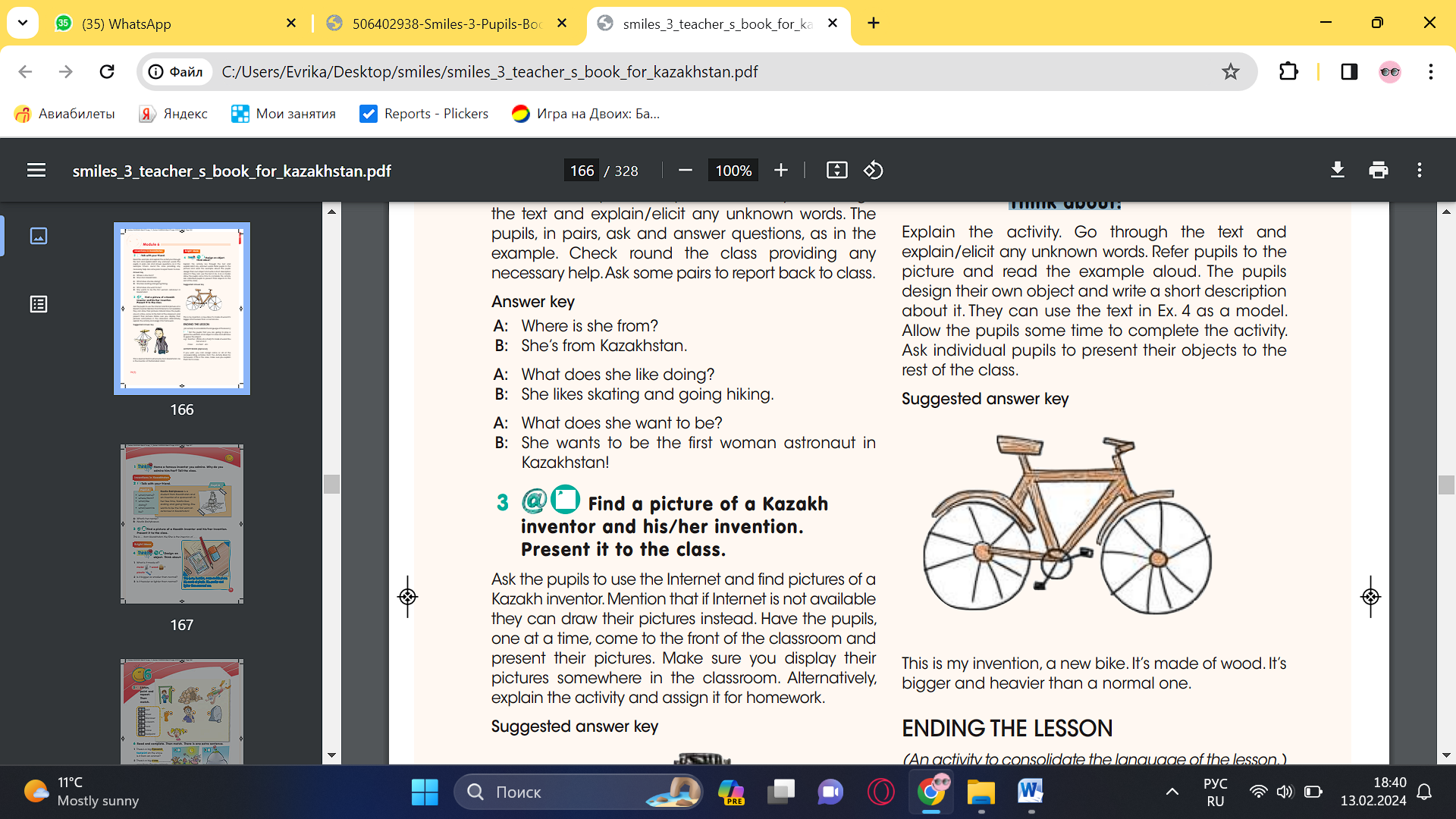
This is my invention, a new bike. It’s made of wood. It’s bigger and heavier than a normal one. Pupils talk with your friend. ANSWERS A: Where is she from? B: She’s from Kazakhstan. A: What does she like doing? B: She likes skating and going hiking. A: What does she want to be? B: She wants to be the first woman astronaut in Kazakhstan! Pupils find a picture of a Kazakh inventor and his/her invention. Present it to the class. ANSWERS
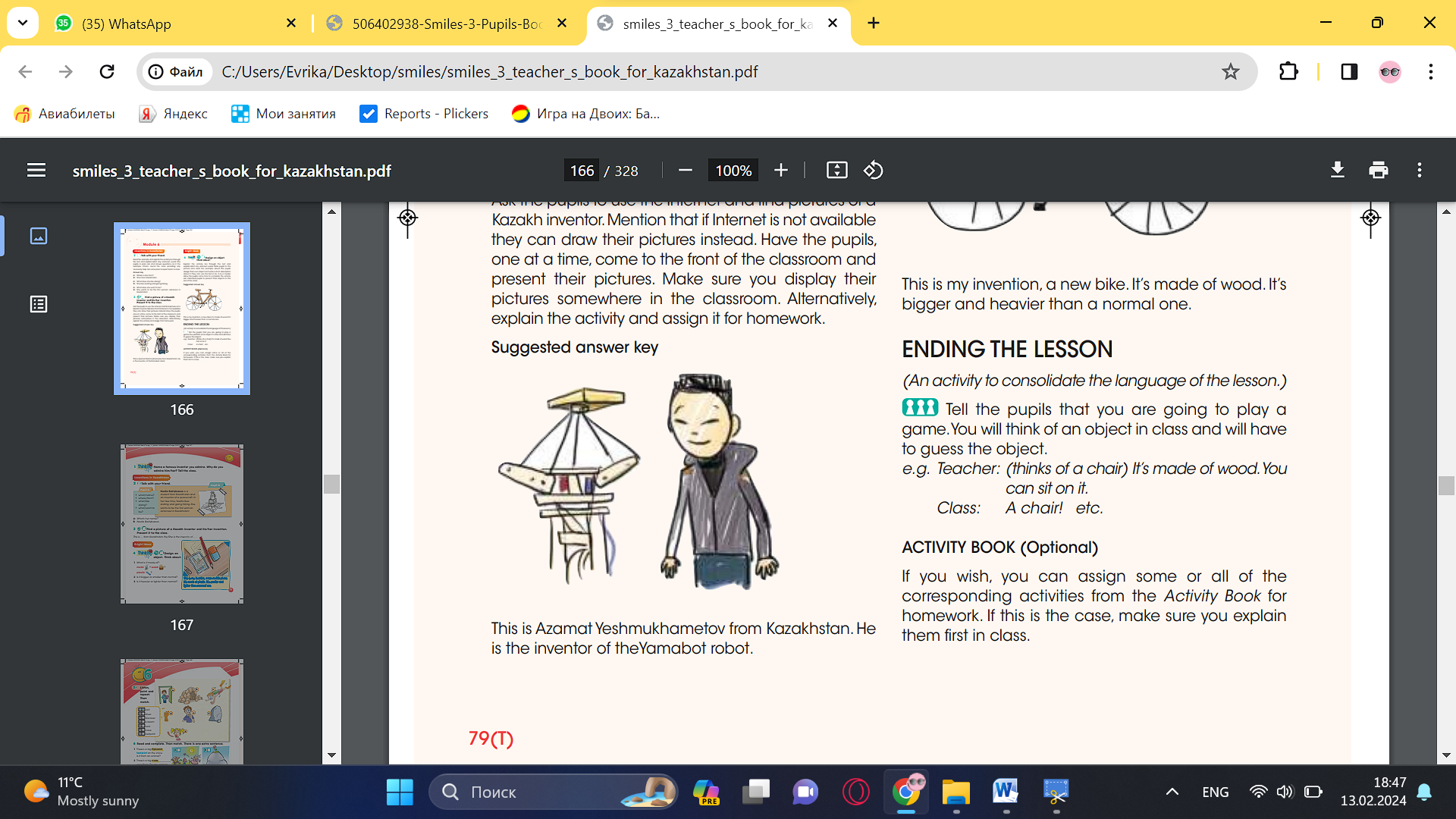
This is Azamat Yeshmukhametov from Kazakhstan. He is the inventor of theYamabot robot. |
Descriptor: - design an object - complete the activity Total: 3 point Descriptor: - talk with your friend. - ask and answer questions, Total: 3 point Descriptor: - find a picture of a Kazakh inventor - present it to the class Total: 3 point. Total: 10 point |
Students book |

|
End of the lesson 5 min |
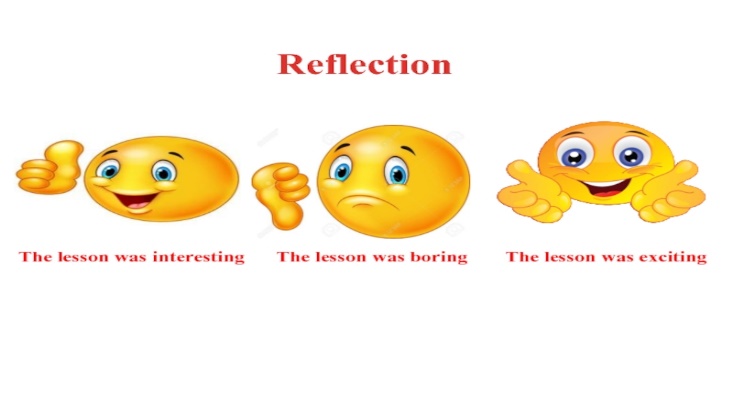
FEEDBACK Learners provide feedback on what they have learned at the lesson. Home task: Ex: |
|
|
|
жүктеу мүмкіндігіне ие боласыз
Бұл материал сайт қолданушысы жариялаған. Материалдың ішінде жазылған барлық ақпаратқа жауапкершілікті жариялаған қолданушы жауап береді. Ұстаз тілегі тек ақпаратты таратуға қолдау көрсетеді. Егер материал сіздің авторлық құқығыңызды бұзған болса немесе басқа да себептермен сайттан өшіру керек деп ойласаңыз осында жазыңыз
Smiles 3 Unit 6."Explorers and Inventors" Theme: "Exploring space"
Short term plan:
|
Unit 6 Explorers & Inventors |
|||
|
Teacher name: |
|
||
|
Date: |
|
||
|
Grade: 3 |
Number present: |
absent: |
|
|
Lesson title |
Our world Exploring space. |
||
|
Learning objectives |
3.1.7.1 use contextual hints to predict the content of small dialogues with support on general and educational topics; 3.2.2.1 ask questions to identify existing experience within a limited range of general and educational topics; 3.4.5.1 connect words or phrases using basic conjunctions with support |
||
|
Lesson objectives |
- to talk about space exploration, NASA and the Baikonur Cosmodrome; - to consolidate the language at the module. |
||
|
Value links |
Open-Mindedness – An open-minded person is someone who is always willing to hear new points of view and even change their own point of view if new arguments are highly convincing. It’s the opposite of stubbornness. |
||
|
Plan |
|||
|
Stages / Time |
Teachers actions |
Students actions |
Assessment criteria |
Resource |
|
Beginning of the lesson Warming-up 3 min Pre-learning «Brainstorming» method 7 min. |
Organization moment : 1.Greeting. Ask about the weather. The teacher sets the lesson objectives, letting students know what to anticipate from the lesson. Warming up What is the weather like today? What month is it now? What season is it now? Ask pupils to tell you what they remember from the text about Marco Polo. Lead – In: -What do you see in the picture?
|
The aim: To develop pupils speaking skills and create friendly atmosphere Efficiency: By wishing each other they feel better and feel the support of others Students of the class are listed. Students' attention is drawn to the lesson. Determines the topic and purpose of the lesson Students say different words from the picture |
The teacher to assess learners for their ability. “Good job! Well done!” Formative Assessment
Good job! Descriptor: - answer the question. Total : 1 point |
Pictures |
|
Middle of the lesson Presentation part. 30 min |
Ex:28 P:90 ● Explain the activity. Go through the text and explain/elicit any unknown words. Refer pupils to the picture and read the example aloud. The pupils design their own object and write a short description about it. They can use the text in Ex. 4 as a model. Allow the pupils some time to complete the activity. Ask individual pupils to present their objects to the rest of the class. Ex: 29 P: 90 ● Read the example and explain the activity. Go through the text and explain/elicit any unknown words. The pupils, in pairs, ask and answer questions, as in the example. Check round the class providing any necessary help. Ask some pairs to report back to class. Ex:30 P: 90 Ask the pupils to use the Internet and find pictures of a Kazakh inventor. Mention that if Internet is not available they can draw their pictures instead. Have the pupils, one at a time, come to the front of the classroom and present their pictures. Make sure you display their pictures somewhere in the classroom. Alternatively, explain the activity and assign it for homework. . Conclusion during the lesson some tasks differentiated by outcomes of the students and by their abilities. |
Pupils design an object. Think about: ANSWERS
This is my invention, a new bike. It’s made of wood. It’s bigger and heavier than a normal one. Pupils talk with your friend. ANSWERS A: Where is she from? B: She’s from Kazakhstan. A: What does she like doing? B: She likes skating and going hiking. A: What does she want to be? B: She wants to be the first woman astronaut in Kazakhstan! Pupils find a picture of a Kazakh inventor and his/her invention. Present it to the class. ANSWERS
This is Azamat Yeshmukhametov from Kazakhstan. He is the inventor of theYamabot robot. |
Descriptor: - design an object - complete the activity Total: 3 point Descriptor: - talk with your friend. - ask and answer questions, Total: 3 point Descriptor: - find a picture of a Kazakh inventor - present it to the class Total: 3 point. Total: 10 point |
Students book |
|
End of the lesson 5 min |
FEEDBACK Learners provide feedback on what they have learned at the lesson. Home task: Ex: |
|
|
|
шағым қалдыра аласыз