ЖИ көмекші


 Қауіпсіз төлем

жүктеу мүмкіндігіне ие боласыз
Бұл материал сайт қолданушысы жариялаған. Материалдың ішінде жазылған барлық ақпаратқа жауапкершілікті жариялаған қолданушы жауап береді. Ұстаз тілегі тек ақпаратты таратуға қолдау көрсетеді. Егер материал сіздің авторлық құқығыңызды бұзған болса немесе басқа да себептермен сайттан өшіру керек деп ойласаңыз осында жазыңыз
 24 Сәуір 2025
 345
345
1 жыл бойы шексіз жүктеңіз
The role of music in learning English
Түркістан облысы Ордабасы ауданы Шұбарсу ауылдық округі <<Өмірхан Қозыбақ мектебі >> жауапкершілігі шектеулі серіктестігі
Зерттеу жұмысының тақырыбы : The role of music in learning English
Секциясы : Ағылшын тілі
Сыныбы : 9
Оқушы: Омарова Береке
Ғылыми жетекшісі : Турысмуратова Жансулу
2024 - 2025 оқу жылы
Аннотация
Бұл ғылыми жобада музыка, әсіресе ағылшын тіліндегі әндердің шет тілін үйренудегі маңызы зерттелді. Жобаның негізгі мақсаты – музыканың ағылшын тілін үйренуге әсерін анықтау және оның тиімді әдіс ретінде қолданылу мүмкіндігін қарастыру. Зерттеу барысында оқушылардың сүйікті ағылшын әндері арқылы жаңа сөздерді оңай есте сақтайтыны, айтылымы жақсаратыны және грамматикалық құрылымдарды жақсы түсінетіні байқалды. Жоба аясында сауалнама жүргізіліп, 8-сынып оқушыларының пікірлері зерттелді. 90%-ға жуық оқушы музыка тіл үйренуге көмектесетінін растады. Сонымен қатар, ән мәтінін оқу, аудару, караоке айту және грамматикалық талдау жасау әдістері қолданылды. Жоба нәтижесінде музыка ағылшын тілін қызығушылықпен, шығармашылық жолмен меңгерудің тиімді құралы екені дәлелденді. Бұл жұмыс тіл үйренуді жеңіл әрі қызықты етудің жолын көрсетеді.
Аннотация
В данном научном проекте изучается роль музыки, особенно англоязычных песен, в процессе изучения иностранного языка. Цель проекта — определить, как музыка влияет на усвоение английского языка и может ли она быть эффективным методом обучения. В ходе исследования было установлено, что слушая любимые песни, учащиеся быстрее запоминают новые слова, улучшают произношение и легче понимают грамматические структуры. Среди восьмиклассников был проведён опрос, в котором приняли участие 20 человек. Около 90% опрошенных подтвердили, что музыка помогает им в изучении английского. Также использовались такие методы, как чтение и перевод текстов песен, пение караоке и грамматический разбор. В результате было доказано, что музыка является интересным и действенным способом изучения языка. Проект показывает, как сделать обучение лёгким, творческим и увлекательным.
Annotation
This research project explores the impact of music, especially English-language songs, on learning a foreign language. The main goal is to find out how music influences English language acquisition and whether it can be used as an effective learning tool. The study revealed that students remember new vocabulary more easily, improve their pronunciation, and understand grammar better when learning through songs they enjoy. A survey was conducted among 8th-grade students, with 90% confirming that music helps them learn English. Methods used included reading and translating song lyrics, singing karaoke, and analyzing grammar structures found in songs. The project demonstrates that music is not only a source of entertainment but also a powerful and creative educational method. It makes the language learning process more engaging, enjoyable, and effective. This project encourages students to use music as a tool to boost their interest and motivation in learning English.
Пікір
Оқушы өзінің ғылыми жұмысында қазіргі заманғы өзекті әрі оқушыларға жақын тақырыпты – ағылшын тілін үйренудегі музыканың рөлін зерттеген. Тақырып таңдау сәтті және зерттеудің мақсаты нақты қойылған. Жұмыс барысында оқушы шынайы қызығушылық танытып, өз бетімен ізденіп, зерттеу жүргізе алды.
Жобаның құрылымы жүйелі: кіріспе, теориялық бөлім, практикалық зерттеу, қорытынды және қосымшалар – барлығы ретімен берілген. Теориялық бөлімде музыка мен тіл үйрену арасындағы байланыс ғылыми тұрғыда түсіндірілген. Практикалық бөлімде оқушы өз сыныптастары арасында сауалнама жүргізіп, нақты деректермен жұмыс істеген. Сауалнама нәтижелерін диаграмма түрінде ұсынуы – зерттеу жұмысын көрнекі әрі дәлелді етіп көрсетеді.
Оқушы музыка арқылы сөздік қорды дамыту, айтылым мен акцентті жетілдіру, грамматиканы әндер арқылы түсіну сияқты нақты әдістерді қолданып, олардың тиімділігін іс жүзінде дәлелдеген. Сондай-ақ, караоке айту, ән мәтінін аудару, грамматикалық құрылымды талдау сияқты шығармашылық жұмыстар да жоғары деңгейде орындалған.
Оқушы зерттеу күнделігін ұқыпты және жоспарлы түрде жүргізген. Әр айда қандай жұмыс атқарылғаны нақты жазылған. Бұл оның жауапкершілігін, еңбекқорлығын және жоспарлау қабілетін көрсетеді.
Бұл ғылыми жоба — оқушының өз бетімен зерттеу жүргізу, мәлімет жинау, сараптау және шығармашылықпен жұмыс істеу дағдыларының жақсы қалыптасқанын көрсетеді. Жоба мазмұны мен орындалу сапасы жоғары деңгейде. Зерттеу нәтижелері сенімді, өзекті және практикада қолдануға жарамды.
Осыған орай, оқушының ғылыми-зерттеу жұмысын қорғауға ұсынамын және жоғары баға қоюға лайық деп есептеймін.
Сontent
-
Introduction
-
Relevance of the research project
-
Research goals and objectives
-
Research question: How does music affect English language learning?
-
-
Theoretical part
-
The connection between music and language learning
-
The importance of English songs in language learning
-
Improving pronunciation and accent
-
-
Practical part
-
Popular methods for teenagers
-
Survey and research results
-
-
Conclusion
-
References
Introduction
Relevance of the research project
I love learning English. But sometimes it is difficult to memorize new words. Recently, I have started listening to English songs a lot. When I listen to songs, I remember new words quickly, and I can memorize their pronunciation. My classmates also listen to songs, and then I thought: does music help me learn English? I wanted to find out in this project. Because studying with music seems interesting and easy.
Music is not only a means of entertainment, it is also a way for us to easily remember new information. When listening to music, we can understand how words are pronounced and sentences are built. Therefore, in my research project, I wanted to study the effect of music on learning English. This topic is very interesting and relevant for me, because many students like me love listening to music and I think it can be turned into a useful activity.
Research goals and objectives
-
My goal is to find out if music can help me learn English.
To achieve this goal:
-
I examined the benefits of music
-
I studied how to learn through English songs
-
I collected answers from my classmates through questions
-
Based on the data I collected, I made a conclusion
Research question:
-
How does music affect learning English?
Theoretical part
The connection between music and language learning
Nowadays, many people are learning English. There are both students and adults. Everyone learns English in different ways: some read books, some watch movies, and some listen to songs. I personally like learning through English songs. Because this method is very interesting and useful for me.
I think there is a big connection between music and language learning. When a person listens to songs, he quickly remembers the words along with the music. After listening to some songs several times, you can memorize their words. This way you can learn new words and phrases. For example, I learned the words “friendship”, “count on”, “helping hand” from the song “Count on Me”. These words came up later in English class, and I easily understood them.
When we listen to music, we learn not only words, but also pronunciation and intonation. Singers say words beautifully, clearly and correctly. Listening to them, we try to pronounce the words ourselves correctly. This has a good effect on our speaking skills. Sometimes I sing my favorite songs myself. This is a very interesting and useful exercise.
In addition, songs also help to learn grammar. For example, in the song “Yesterday” there are many words in the past simple tense: “I was”, “She said”, “Life was so easy then.” This allowed me to see and remember how the past simple tense is used in a concrete example. And in songs like “I will survive” or “I will always love you”, you can see the future simple tense.
Another important thing is that studying with music is fun. Sometimes we get tired of reading and memorizing books. And listening to songs is like relaxing, but at the same time we learn. While listening to songs, we learn the language without even realizing it.
When I talked to my classmates, I noticed that many students listen to English songs. But not everyone understands that they can learn through them. In this project, I wanted to show how music helps in language learning.
In short, music and language learning are very closely related. Listening to songs is not only fun, but also a way to learn. Through songs, we learn words, learn to speak correctly, improve our listening skills, understand grammar, and most importantly, our interest in the English language increases.
The importance of English songs in language learning
Nowadays, English is one of the most widely used and important languages in the world. There are various ways to learn English: reading books, watching movies, writing exercises, participating in online courses. But these methods can sometimes seem boring, difficult or boring to students. Therefore, methods are needed that make learning a language easy and interesting. One of them is listening to and using English songs.
In my opinion, songs are one of the most interesting and effective ways to learn English. Because when we listen to songs, we hear not only the melody, but also the words, sentence structures, and pronunciation features. Thanks to music, we can memorize new words, learn to speak correctly, and develop our listening skills.
1. Learning new words and phrases
You can enrich your vocabulary through English songs. Words and phrases that are often found in song lyrics are quickly remembered. For example, I learned the phrases "trust", "friend", "count on", "I'll be there" from the song "Count on Me". It was easier to memorize these words through singing than just reading. Because in a song they are repeated, and what is repeated is better remembered.
Also, songs contain words that are often used in everyday life. For example, words such as “Happy”, “Love”, “Dream”, “Forever”, “Together”, “Miss you”, “Need you” are familiar to us from various songs. With these words, we can compose simple sentences.
2. Developing correct pronunciation and listening skills
By listening to English songs, we learn to pronounce words correctly. Singers pronounce words clearly and clearly. We listen to them and learn to repeat them. By practicing singing along, we can improve our pronunciation. I myself learned to repeat several of my favorite songs, thanks to which I learned to pronounce some words correctly.
In addition, listening to songs is very useful for developing listening skills. To understand English speech, we need to listen a lot. And songs are the most interesting form of listening. When we listen to a song, we notice how words are pronounced, how stress is placed, how sentences are built.
3. Helps to learn grammar
Many English songs use certain grammatical rules. For example, the song "Yesterday" uses the past simple: "I was", "She said", "I believed", etc. And the song "I will always love you" uses the future simple: "I will...", "you will...", etc. Thus, we learn grammar through songs with examples. It is easier to remember these rules along with the song than to read them by heart.
4. Increases motivation and interest
Listening to songs is an interesting process for students. Through songs, we can use English not only in class, but also in everyday life. We listen to songs, try to understand the meaning of the song, translate the words, and practice singing along. This increases our interest in learning the language.
Especially, understanding our favorite songs gives us special motivation. For example, I wanted to know what songs I like, like "Perfect" or "Let it Go", were about. So I found the lyrics, translated them, and looked them up in a dictionary. This helped me improve my self-study skills.
5. It's easier to remember words
Psychologists say that people remember words they hear through songs more easily. This is because music has rhythm and repetition. For example, if you listen to a song several times, you can memorize the words without even realizing it. Therefore, when you read along with the song, you don't need to memorize them - the words will be remembered on their own.
In conclusion, English songs are very important in learning a language. They are an interesting, effective and useful tool for students. By listening to songs, we learn new words, master pronunciation, understand grammar and develop our listening skills. Most importantly, this method helps us to love and learn English with interest.
Therefore, I advise myself and my classmates to use more music and songs when learning English.
Improving pronunciation and accent
One of the most difficult things when learning English is to pronounce words correctly and speak without making mistakes with a foreign accent. Especially for us, students studying in Kazakh schools, sometimes we hear English words in Kazakh and get used to it. That is why it is important for us to learn to pronounce them correctly and speak with the right accent.
I myself noticed that this problem can be solved through songs. Every time I listen to songs in English, I begin to learn by hearing how the words are pronounced. Listening to how the singers speak, with what accent they say, I try to repeat the same thing. Thus, my pronunciation and accent began to improve.
What is pronunciation?
Pronunciation is the correct pronunciation of words. Each language has its own sounds. There are sounds in English that are not found in Kazakh, for example:
[θ] — think, three
[ð] — this, that
[æ] — cat, black
[ɜː] — girl, world
To pronounce these correctly, we need to listen and repeat them a lot. And listening to songs is the best exercise for this.
What is accent?
Accent is a person's speech style. To speak English correctly, we need to speak close to the accent of a foreign language. Of course, we are not obliged to speak with a pure British or American accent, but pronouncing words correctly is very important.
How to improve pronunciation through music?
English songs allow us to listen to the pronunciation of words. For example, when I listened to the song "Shape of You", I learned how to pronounce the words in the sentence "I'm in love with the shape of you". This sentence is said quickly in the song, but I listened to it several times and memorized both the slow and fast pronunciation. Later, I tried to say it myself.
Sometimes words are shortened in songs. For example:
Instead of "I'm gonna", "I'm gonna" (I am going to)
"wanna" – want to
"gotta" – got to
"lemme" – let me
These shortened forms, typical of spoken language, are often found in songs. We also learn this by listening to songs.
Practical part
Popular methods for teenagers
There are many ways to learn English, but for us, students, the most interesting methods are those related to music. Learning through music is both fun and useful. These methods are especially effective for teenagers. Because we love listening to music and singing. Below I will separately focus on the 3 most popular methods that I have tried myself or that my classmates often use.
1. Singing Karaoke
Karaoke is a way to learn to sing along with music. I really like this method because you can not only listen to the song, but also sing it yourself. During karaoke, the lyrics are displayed on the screen, and the music is played. I also sing and learn the pronunciation and rhythm of the words.
For example, I memorized the song "Perfect" (Ed Sheeran) through karaoke. Since the song is slow and has a pleasant melody, it was easy to memorize the words. And with the song "Let it Go", I learned to pronounce some difficult words correctly.
Singing karaoke:
-
Helps you pronounce words correctly
-
Develops speaking skills
-
Gives you confidence (especially when speaking)
You can do the karaoke method on YouTube or using special karaoke applications (for example, Smule, Karaoke Lite, Yokee).
2. Reading and translating lyrics
When listening to a song, we sometimes don't know the meaning of the words. But if we find, read, and translate the lyrics, we can easily learn new words and phrases.
Sometimes I search for the lyrics of my favorite song on the Internet (for example: lyrics.com or azlyrics.com). While listening to the song, I read the lyrics at the same time. I highlight the words I don't know and translate them with a dictionary. Sometimes I try to translate the entire song into Kazakh.
For example, from the song “Count on Me” (Bruno Mars), I learned the following phrases:
-
"you can count on me" – сен маған сене аласың
-
"I'll be there" – мен қасыңда боламын
-
"friendship" - достық
Reading and translating lyrics:
-
enriches vocabulary
-
develops translation skills
-
helps us understand sentence structure
With this method, we learn not only individual words, but also whole sentences. Sometimes teachers also give song lyrics as an assignment.
3. Understanding grammar through songs
Some students think that memorizing grammar is difficult. But learning grammar through songs with real examples is very easy and interesting.
Many English songs use certain verb tenses. By listening to the song, we learn when and how to use these tenses.
Examples:
Past Simple
“Yesterday” – The Beatles
Example:
"Yesterday, all my troubles seemed so far away..."
→ Seemed is a verb in the past tense.
Future Simple
“I Will Always Love You” – Whitney Houston
Example:
"I will always love you..."
→ Will love is the future tense.
Present Continuous
“I’m Yours” – Jason Mraz
Example:
"I’m trying to reach out to you..."
→ "I’m trying" is an action in the present tense.
With examples like these, we can remember grammar more clearly. It's easier to memorize rules learned through songs because they are memorable with melody.
For teenagers, it is effective to turn learning English into a game, into music. Singing karaoke, reading and translating lyrics, learning grammar through songs - these are methods that I have tried on my own. Everything was useful and interesting.
I especially like singing karaoke and translating songs. Because singing improves your mood and you learn the language faster. And when you read the text and translate it with a dictionary, you really learn. Through songs, you can practice not only words, but also speaking, listening, writing, understanding - everything at once.
Therefore, I advise all students to work with English songs. Learning a language is much more interesting and easier if it is not limited to textbooks, but also creatively.
Survey and research results
In my research project, I wanted to find out not only theoretically, but also through practical research how listening to music affects learning English. For this reason, I conducted a small survey among my classmates and friends. The purpose of this study was to find out how much teenagers listen to English songs and how they help them learn the language.
How was the survey conducted?
I distributed the survey among students of grades 8 "A" and 8 "B". A total of 20 students participated. The survey had 5 questions. The students answered anonymously. I gave them ready-made papers and asked them to mark them. I collected the answers and analyzed them myself.
Survey questions:
-
Do you often listen to English songs?
-
Do you learn new words when listening to English songs?
-
Does listening to songs help your speaking (pronunciation) skills?
-
Is it easier to understand grammar through songs?
-
Do you think music helps you learn English?
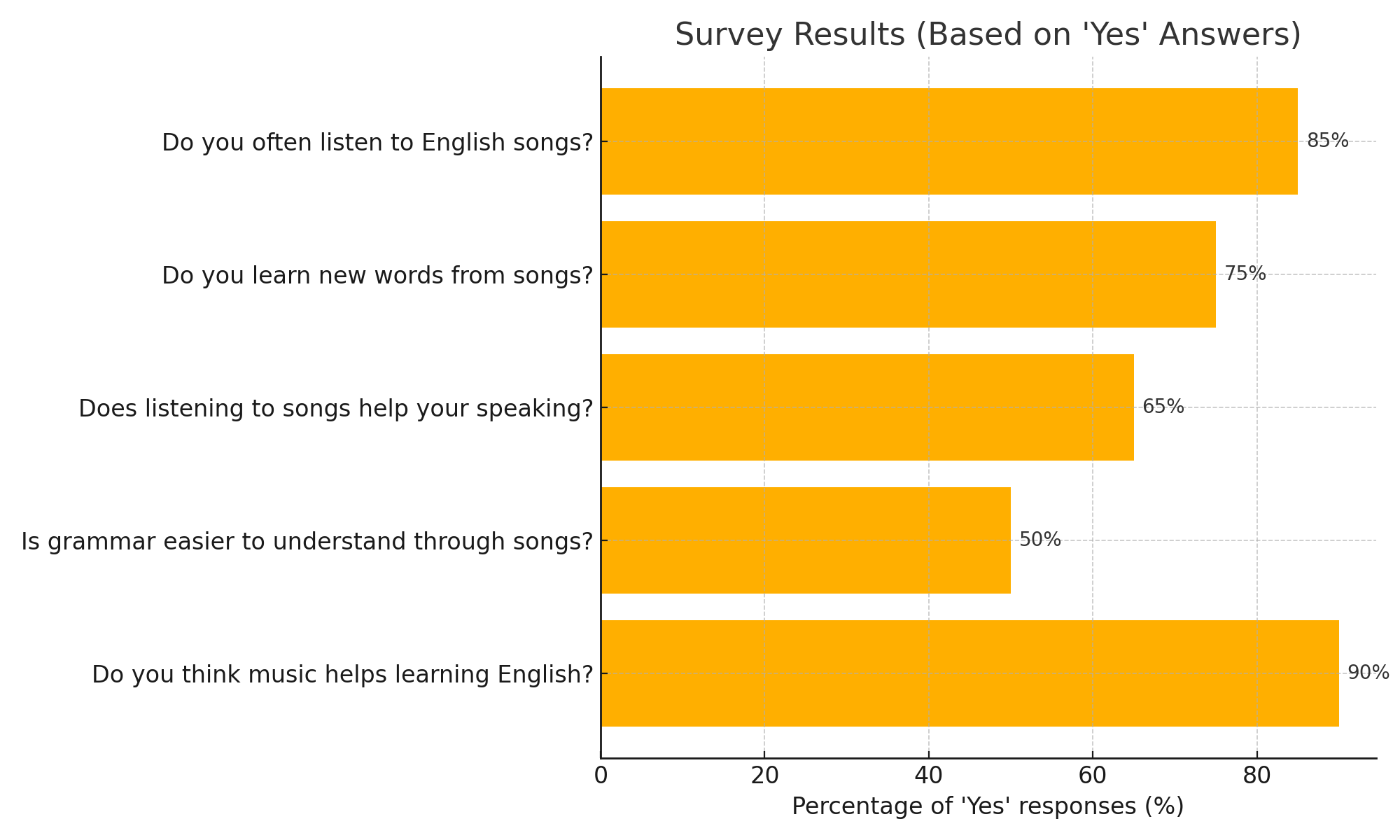
-
85% – Listen to English songs often
-
75% – Learn new words from songs
-
65% – Singing helps with speaking
-
50% – Understand grammar through songs
-
90% – Think music helps with language learning
The survey results showed that most students often listen to English songs and learn new words through them. 90% of respondents believe that music helps them learn English. In addition, 65% said that they improve their speaking skills by singing. This proves that music is an effective and popular method of language learning.
Сonclusion
Have you ever listened to a song and suddenly memorized the lyrics?
It was exactly the same for me. One day, I was just listening to my favorite song, and suddenly I noticed that I was understanding and saying the English words along. At that moment, a thought arose in my mind: "Why not learn English not only through books, but also through music?"
The reason I started this project was this simple, but for me important question. Simply listening to music led me to learn words, speak correctly, and even understand grammar. Music helped me go beyond the English lessons at school and accept language as a part of life.
In this project, I did not limit myself to my own experience. I also asked my classmates. Through a survey, I found out that they also learn a lot through music. 90% of students answered that music helps them learn a language. This is not just a number. This is real evidence of how our generation perceives language.
Songs are not just for fun, they are also a way of education. When we listen to songs, we don’t just memorize words. We learn emotions, accents, speech patterns, and sincerity. Through songs, we feel the language with our hearts.
The power of music lies in its memorability. Words are deeply embedded in the mind along with music. Sometimes we may forget the rules we read in a book. But we never forget a line from our favorite song, even after years. Why? Because it touched our hearts.
What I learned through this project:
? Learning a language with love is the most effective method.
? And music is the key to awakening that love.
Therefore, I want to tell all students, friends, and teachers:
? If you want to learn English - listen to a song!
? If you want to memorize words - translate them!
? If you want to learn to speak correctly - try speaking together!
? Don’t just be a student, connect the language with lifе !
References:
-
Lyrics.com. (2024). English Song Lyrics Database. https://www.lyrics.com
-
→ Used to search and read song lyrics.
-
Cambridge Dictionary. (2024). Online English Dictionary. https://dictionary.cambridge.org
-
→ Used to check the meaning and pronunciation of new words.
-
YouTube. (2024). Official Music Videos & Karaoke Versions
-
→ Used to listen to English songs and sing karaoke.
-
Ed Sheeran – Perfect
-
Bruno Mars – Count on Me
-
Disney – Let it Go
-
AZLyrics. (2024). Popular English Song Lyrics Archive. https://www.azlyrics.com
-
→ Used to compare song lyrics.
-
Sana-survey (Author's survey).
-
→ Author's survey conducted among 8th grade students. Total number of participants – 20 students.
-
Teaching materials and personal observation provided by teachers
Оқушының жобаны зерттеу күнделігі
|
Айы |
Атқарылған нақты жұмыс |
|
Қыркүйек |
•
Жоба тақырыбын таңдадым – «Ағылшын
тілін үйренудегі музыканың рөлі». |
|
Қазан |
•
Ағылшын тіліндегі танымал әндерді
тыңдап, тізім жасадым. |
|
Қараша |
•
Караоке әдісімен ән айтуға
жаттықтым. |
|
Желтоқсан |
•
«Count on Me», «Let it Go», «Perfect»
сияқты әндермен терең жұмыс жүргіздім. |
|
Қаңтар |
•
Грамматикалық шақтарды әндер арқылы
зерттедім (Past Simple, Future Simple). |
|
Ақпан |
•
Сыныптастармен екі топтық тәжірибе
өткіздім: ән арқылы және мәтін арқылы сөз жаттау. |
|
Наурыз |
•
Сауалнама сұрақтарын дайындап,
сыныптастарым арасында тараттым (20 оқушы). |
|
Сәуір |
•
Практикалық бөлімді жаздым: сауалнама,
тәжірибе нәтижесі, ән талдау. |
|
Мамыр |
•
Жобаның барлық бөлімдерін мұқият
тексердім. |
|
Маусым |
•
Слайд презентация жасадым. |









 Бұл курс Қазақстан Республикасы Оқу-ағарту министрлігімен келісілген