
 ЖИ көмекші


 Қауіпсіз төлем

жүктеу мүмкіндігіне ие боласыз
Бұл материал сайт қолданушысы жариялаған. Материалдың ішінде жазылған барлық ақпаратқа жауапкершілікті жариялаған қолданушы жауап береді. Ұстаз тілегі тек ақпаратты таратуға қолдау көрсетеді. Егер материал сіздің авторлық құқығыңызды бұзған болса немесе басқа да себептермен сайттан өшіру керек деп ойласаңыз осында жазыңыз
 10 Наурыз 2025
 419
419
1 жыл бойы шексіз жүктеңіз
Types of questions
|
|
«Интердент» жоғары медициналық колледжі |
Құжаттама тәртібі ҚТ-СМЖ-003.3-2020 Әдістемелік қызметті басқару |
Басылым 1 |

Theme: «Types of question. General and special»
Professional English Language
Teacher: Turmaganbetova G.B
02.11.2020
1. General information’s:
Course: 2
Year of study: 2020-2021
Group: 201
The type of the lesson: Lesson of new knowledge.
The aim of the lesson/ Learning Result: understand the main points of supported extended talk on a range of general and curricular topics; understand the main points in a limited range of short simple texts on general and curricular topics; respond with limited flexibility at sentence level to unexpected comments on an increasing range of general and curricular topics; use appropriate subject-specific vocabulary to talk about a limited range of general topics
a) Educational: to know and use the terms that are useful for analyzing language: role of techniques in Modern life; to develop monological and dialogic speech skills based on oral presentation and dialogue on the topic.
b) Pedagogical: to teach students` to get the information, to express their own opinion
c)Developing: to promote establishment in the student’s mind of stable links between the accumulated and new experience of cognitive and practical activity; to form and develop educational and organizational skills (mutual control, independent work, collective activity); to develop the ability to reflect as an essential component of the ability to learn.
Obligations, assessment criteria: identify the relevant opinion of the speaker in a talk; use the following structure to create arguments: Statement, Explanation, Example; speak fluently and grammatically true at the time of explaining own point of view range of general topic; use new vocabulary while speaking
1.1List of professional skills and abilities acquired by
students during training sessions:
using correctly new grammar structure based to the theme; asking
questions and answering them; writing new sentences by using
correctly grammar rule based to the theme; understanding new
grammar structures in the tasks.
2. Lesson equipment:
2.1 Educational and methodical manuals, reference literature:
1. Essential English fore medical students- A.M.Maslova; Z.I.Winestein;
2. Английский для медицинских колледжей и училищ- Л.Г. Козырева; Т.В.Шадская;
3. Грамматика. Сборник упражнений- Ю.Глицынский; Н.Голицынская.
Equipments: Handouts, cards, tape, flipchart, video and presentation, interactive whiteboard.
Procedure of the lesson
|
Lesson stages: |
Teacher's activities |
|
Beginning of the lesson Warm-up activities |
Good morning, my dear students. Sit down, please. Glad to see you. Hope you are well today. Let’s start our lesson with some common questions: What date/day is it today? Who is absent? Why (who is absent for a good/disrespectful reason)? Let’s begin our lesson. |
|
Checking up the home task: |
Check up the home task: ex. 1-2, page 147-149 (Козырева Л.Г- Английский язык для медицинских колледжей и училищ). Retelling the text.
|
|
Discussion point |
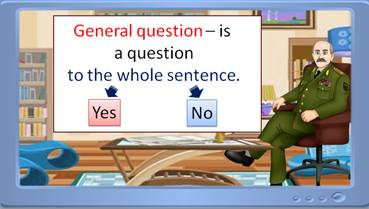
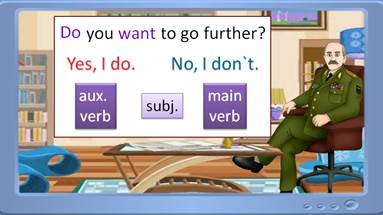
And now I’ll tell you about questions. There are many types of them, but today we’ll study the basic ones: General and Special. Firstly, look at the board and write down in your copybooks: General question is a question whether you can answer only ‘Yes’ or ‘No”. To form it, you need to change the subject and object: She is tall. Is she tall? You’re free. Are you free? |
|
Main part |
1. General question. If you need to know general information, then you ask a general question. "Do you like flowers?", "Will you come tomorrow?". In other words, you do not specify the time, place, etc. The answer implies either agreement or disagreement.
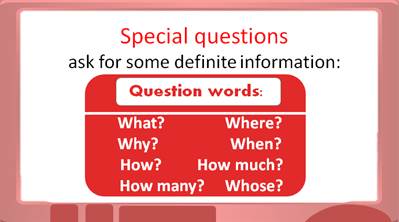
2. Special question. If you are aiming to get specific information, then a special question is used. "Where are you flying away this fall?". To answer such a question, you need to give your interlocutor a complete and detailed answer. Task #1. Give the special questions 1. There is a book on the table. 2. He must work hard today. 3. We are leaving for Moscow next week. 4. We were reading the whole evening. 5. They don't go to work on Sunday. 6. It is not cold today. 7. We learn English at school. 8. It wasn't difficult to do this task. Task #2. Transfer these sentences into interrogative and give answers, e. g. . Tom is a driver. Is Tom a driver? – Yes, he is. No, he isn’t. The child is ill today. It is hot today. ü Our friends are in France. The cake is nice. The boy is five. The girls are lazy. Task #3. Ask special questions to the sentences beginning with the words given in brackets.
|
|
Conclusive stage Feedback Home task |
All right, thank you, it’s time to finish our lesson. Who can tell me what kind of questions are in the English language? How do we form them? What’s the difference between Special and General questions? Well done! Now you know it. Here’s your home task. Good buy! Feedback:
Home work: ex. 1-4, page 14-15 (Козырева Л.Г- Английский язык для медицинских колледжей и училищ) |









 Бұл курс Қазақстан Республикасы Оқу-ағарту министрлігімен келісілген










