
 ЖИ көмекші


жүктеу мүмкіндігіне ие боласыз
Бұл материал сайт қолданушысы жариялаған. Материалдың ішінде жазылған барлық ақпаратқа жауапкершілікті жариялаған қолданушы жауап береді. Ұстаз тілегі тек ақпаратты таратуға қолдау көрсетеді. Егер материал сіздің авторлық құқығыңызды бұзған болса немесе басқа да себептермен сайттан өшіру керек деп ойласаңыз осында жазыңыз
 12 Қараша 2025
 37
37
Writing. An opinion essay
|
LESSON: Module 2 Lesson 8 Writing. An opinion essay |
School: |
||||||
|
Date: |
Teacher’s name: |
||||||
|
CLASS: 11 |
Number present: |
absent: |
|||||
|
Learning objectives that this lesson is contributing to |
11.5.7 - use independently appropriate layout at text level on a wide range of general and curricular topics 11.3.6 - navigate talk and modify language through paraphrase and correction in talk on a wide range of familiar and some unfamiliar general and curricular topics 11.5.6 - write coherently at text level using a variety of connectors on a wide range of familiar general and curricular topics 11.3.4 - evaluate and comment on the views of others in a growing variety of talk contexts on a wide range of general and curricular topics, including some unfamiliar topics 11.5.5 - develop with minimal support coherent arguments supported when necessary by examples and reasons for a wide range of written genres in familiar general and curricular topics 11.5.1 - plan, write, edit and proofread work at text level independently on a wide range of general and curricular topics 11.5.2 - use a wide range of vocabulary, which is appropriate to topic and genre, and which is spelt accurately 11.5.3 - write with grammatical accuracy on a wide range of general and curricular topics 11.5.4 - use style and register to achieve an appropriate degree of formality in a wide variety of written genres on general and curricular topics 11.5.9 - punctuate written work at text level on a wide range of general and curricular topics with a good degree of accuracy 11.6.7 - use a wide variety of simple perfect active and passive forms and a variety of perfect continuous forms on a wide range of general and curricular topics 11.6.9 - use a wide variety of present and past forms, including a growing number of more nuanced contrasts [past and perfective aspect/simple and progressive aspect] on a wide range of general and curricular topics |
||||||
|
Lesson objectives |
All learners will be able to: |
||||||
|
use some target vocabulary successfully in opinion tasks and show some gist understanding of the appropriate situation Most learners will be able to: use most target vocabulary successfully inn opinion tasks and show some gist understanding of the appropriate situation Some learners will be able to: use most target vocabulary successfully in opinion tasks, read effectively for gist and identify all specific information |
|||||||
|
ICT skills |
Using videos& pictures, working with URLs |
||||||
|
Assessment criteria |
Learners have met the learning objective (C10 / S7) if they can: speak about the problems and suggest the solutions to some of the problems |
||||||
|
Previous learning |
Passive Forms |
||||||
|
Planned timings |
Teacher’s activities |
Pupil’s activities |
Marks |
Resources |
|||
|
Beginning the lesson
Warming-up Team work 10 min. |
Organization moment : 1.Greeting. T give them different shapes and ask them to divide into 3groups. I-circle II -square III–triangle In differentiation part t «Flexible pace learning» method was used to give students a choice in order to make them interested in learning process. |
“The wish flower” method helps to start the lesson with good wishes to each other. The aim: To develop Ss speaking skills and create friendly atmosphere Efficiency: By wishing each other they feel better and feel the support of others. |
At the organization moment T tries to award active Ss. «The praise» method is used to evaluate Ss with phrases like: “Good job! Well done!” |
Envelop with shapes
|
|||
|
25 min |
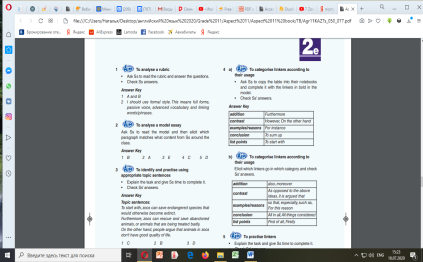
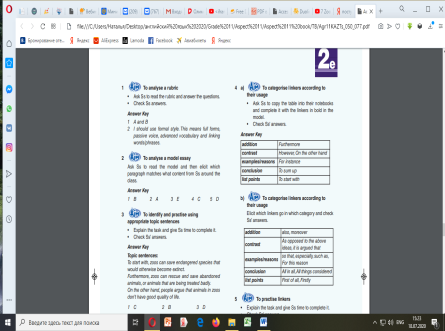
SB Ex. 1 p. 30 To analyse a rubric • Ask Ss to read the rubric and answer the questions. • Check Ss answers. Answer Key 1 A and B 2 I should use formal style. This means full forms, passive voice, advanced vocabulary and linking words/phrases. |
Ex. 2 p. 30 To analyse a model essay Ask Ss to read the model and then elicit which paragraph matches what content from Ss around the class. Answer Key 1 B 2 A 3 E 4 C 5 D
|
Ss evaluate each other and encourage classmate with phrases like: Well done! Brilliant! Good job! I like it!
|
Whiteboard Pupils Book Poster. |
|||
|
|
Ex. 3 p. 30 To identify and practise using appropriate topic sentences • Explain the task and give Ss time to complete it. • Check Ss’ answers. Answer Key Topic sentences: To start with, zoos can save endangered species that would otherwise become extinct. Furthermore, zoos can rescue and save abandoned animals, or animals that are being treated badly. On the other hand, people argue that animals in zoos don’t have good quality of life. 1 C 2 B 3 D
|
Ex. 4 p. 30 a) To categorise linkers according to their usage • Ask Ss to copy the table into their notebooks and complete it with the linkers in bold in the model. • Check Ss’ answers. Answer Key
|
Ss evaluate each other and encourage classmate with phrases like: Well done! Brilliant! Good job! I like it!
|
Whiteboard Pupils Book Poster. |
|||
|
|
b) To categorise linkers according to their usage Elicit which linkers go in which category and check Ss’ answers.
|
Ex. 5 p. 30 To practise linkers • Explain the task and give Ss time to complete it. • Check Ss’ answers. Answer Key 1 In addition 2 All things considered 3 However 4 as a result 5 Besides
|
Ss evaluate each other and encourage classmate with phrases like: Well done! Brilliant! Good job! I like it!
|
Whiteboard Pupils Book Poster. |
|||
|
|
Ex. 6 p. 31 To expand notes into supporting sentences using appropriate linkers • Explain the task and give Ss time to complete it using the prompts and phrases from the Useful Language box. • Check Ss’ answers. Suggested Answer Key It is expensive to keep wild animals in captivity. To start with, they have to eat a special diet. People argue that all animals should be free. In addition, they say that animals don’t belong in cages |
Ex. 7 p. 31 To practise expressing opinions Read out the statements and elicit sentences expressing opinion using the useful language from Ss around the class. Suggested Answer Key In my opinion, keeping animals as pets is cruel. Personally, I think that human beings are the reason that animals become endangered or extinct.
|
Ss evaluate each other and encourage classmate with phrases like: Well done! Brilliant! Good job! I like it!
|
Whiteboard Pupils Book Poster. |
|||
|
|
Ex. 8 p. 31 a) To match viewpoints to reasons/examples • Give Ss time to read the viewpoints 1-5 and the reasons/examples a-e and complete the task. • Elicit answers from various Ss around the class. Answer Key 1 e 2 d 3 b 4 a 5 c
|
b) To practise joining viewpoints to reasons/examples using appropriate linkers. • Explain the task and give Ss time to complete it. • Check Ss’ answers. Suggested Answer Key To start with, large mammals need to run free in their natural habitat. For example, animals such as lions and cheetahs have limitless space to run in the wild, but in captivity they are confined to small enclosures. Furthermore, animals in captivity can be dangerous. For instance, they might attack their keepers or other animals in their enclosure if they are scared or angry. Moreover, zoos and sanctuaries can provide animals with medical treatment. This means that sick or injured animals that would not survive in the wild, in captivity they have a chance of getting better. On the other hand, wild animals lose their skills and identity in captivity. For instance, predators like lions forget how to hunt because they are given fresh meat every day. Some people argue that animals can die of hunger and thirst in the wild. However, in captivity animals are well-cared for and have all the food and water they need.
|
Ss evaluate each other and encourage classmate with phrases like: Well done! Brilliant! Good job! I like it!
|
Whiteboard Pupils Book Poster. |
|||
|
|
Ex. 9 p. 31 To write an opinion essay • Give Ss time to complete the task using the Useful Language box and their answers from Ex 8. • Remind Ss to follow the plan, not to use short forms and to start each main body paragraph which a topic sentence. • Check Ss’ answers. |
Alternatively, assign the task as HW and check Ss’ answers in the next lesson. Suggested Answer Key Some people believe that animals are always better off in the wild. Personally, I have always believed that it is better for animals to live in their natural habitats, but that isn’t always the case. First of all, large animals need to have a lot of space to run free. Lions and cheetahs for example have limitless space to run in the jungle, but in captivity they are confined to small cages. In addition, when wild animals are kept in zoos, they lose their skills and identity. For instance, predators like lions forget how to hunt because they are given fresh meat every day. On the other hand, wild animals – especially endangered ones - are protected, cared for and fed in captivity. Also, sick animals can receive the treatment they need in a sanctuary or zoo.This means that a sick, injured or endangered animal has the chance to get well whereas in the wild it might not survive. All things considered, I believe that animals are usually better off in the wild,but sometimes they need our help, particularly if they are endangered or if they have been injured. |
Ss evaluate each other and encourage classmate with phrases like: Well done! Brilliant! Good job! I like it!
|
Whiteboard Pupils Book Poster. |
|||

 Жүктеу


 Жүктеу
шағым қалдыра аласыз




 Бұл курс Қазақстан Республикасы Оқу-ағарту министрлігімен келісілген










