
 ЖИ көмекші


жүктеу мүмкіндігіне ие боласыз
Бұл материал сайт қолданушысы жариялаған. Материалдың ішінде жазылған барлық ақпаратқа жауапкершілікті жариялаған қолданушы жауап береді. Ұстаз тілегі тек ақпаратты таратуға қолдау көрсетеді. Егер материал сіздің авторлық құқығыңызды бұзған болса немесе басқа да себептермен сайттан өшіру керек деп ойласаңыз осында жазыңыз
 28 Қазан 2025
 53
53
Country and language report
|
School |
Valery Chkalov |
|
|
Term 1 Unit 2 |
Helping and heroes |
|
|
Teacher’s name: |
Sanagul Berikkyzy |
|
|
Date |
14/10/2025 |
|
|
Grade: 6 “А” |
Number present: 12 |
Number absent: 0 |
|
Theme of the lesson: |
Country and language report |
|
|
Learning objectives(s) that this lesson is contributing to |
6.3.5.1 interact with peers to negotiate, agree and organise priorities and plans for completing classroom tasks 6.5.3.1write with support factual descriptions at text level which describe people, places and objects |
|
|
Lesson objective |
All learners will be able to: • Study a model report. • Learn about punctuation. • Learn key phrases for a report. |
|
|
Instilling values of the program “Birtutas tarbiye” |
|
|
Plan of the lesson
|
|
|
|||
|
Planned timings |
Teacher’s activities |
Pupil’s activities |
Assessment |
Resources |
|
Beginning the lesson 3 min 5 min 5 min |
1. Organization moment: Teacher greets learners and ask some questions: -Good afternoon, dear students! -How are you? -What season is it now? -What date is it today? -Who is on duty today? -What date is it today? -Who is absent today? -What’s the weather like today? -How do you do? -I hope that you are fine! -Are you ready for this lesson? That’s great! 2. Checking up the home task: - Before beginning our lesson let’s check our home task Ex:3, p:26 Complete the key phrases from the dialogue. Then practice the dialogue.
Descriptor:
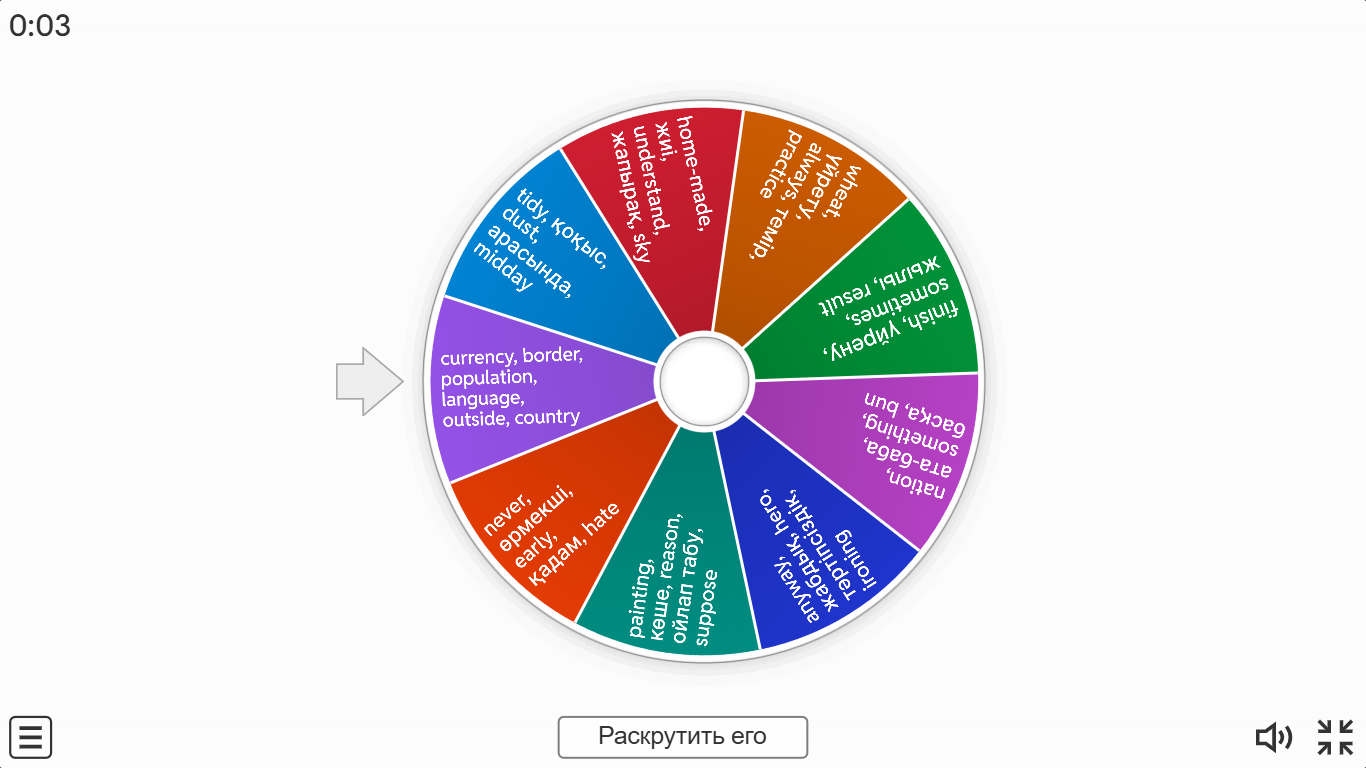
VOCABULARY REVISION: To review and consolidate previously learned vocabulary.
Descriptor: The learner: - Recognises and recalls the meaning of previously learned words. - Uses target vocabulary correctly in oral or written activities. 3.Warm up and lead in: IMMERSIVE INTERACTIVE Warm-up To create a positive learning atmosphere and prepare learners emotionally and mentally for the lesson. The teacher greets the learners, introduces the warm-up activity, and guides them through short positive affirmations and simple interactive movements to set a motivating classroom mood.
Descriptor: The learner: - Actively participates in the interactive warm-up activity. - Responds appropriately to visual, audio or movement-based stimuli. - Interacts with peers in a positive and collaborative way. |
Learners respond to the teacher’s greeting, get ready for the lesson, and actively answer the teacher’s introductory questions. Learners fill in the missing phrases in the dialogue at home, practise reading it aloud or with a partner, record or present their version, and use correct expressions to show likes and dislikes. Learners recall and review the vocabulary from the previous lesson, match words with their meanings or use them in short sentences to check understanding. Learners respond to the teacher’s repeat positive affirmations with enthusiasm, follow instructions, and actively participate in the interactive warm-up to get ready for the lesson. |
Oral and individual evaluation: “Great!” “Perfect” “
Oral and individual evaluation: “Great!” “Perfect” “
Oral and individual evaluation: “Great!” “Perfect” “
|
PPT https://youtu.be/G1VmLofwcHE?si=hh1x29OVmgYEgIco |
|
Main Activities 5 min 7 min 10 min |
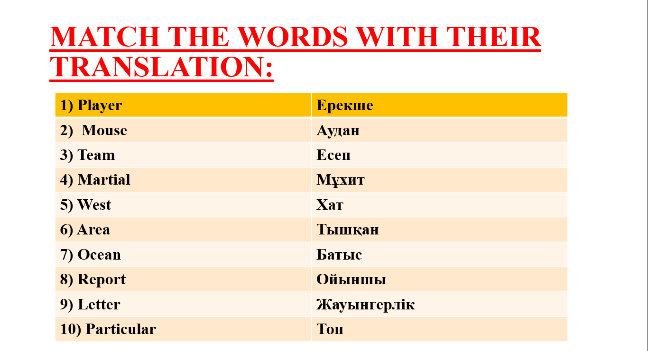
Pre-listening Individual work Teacher explains how to do the task. New words: Area [ˈe(ə)rɪə] – аудан Particular [pəˈtɪkjʊlə] – ерекше Report [rɪˈpɔːt] – есеп Ocean [əʊʃn] – мұхит
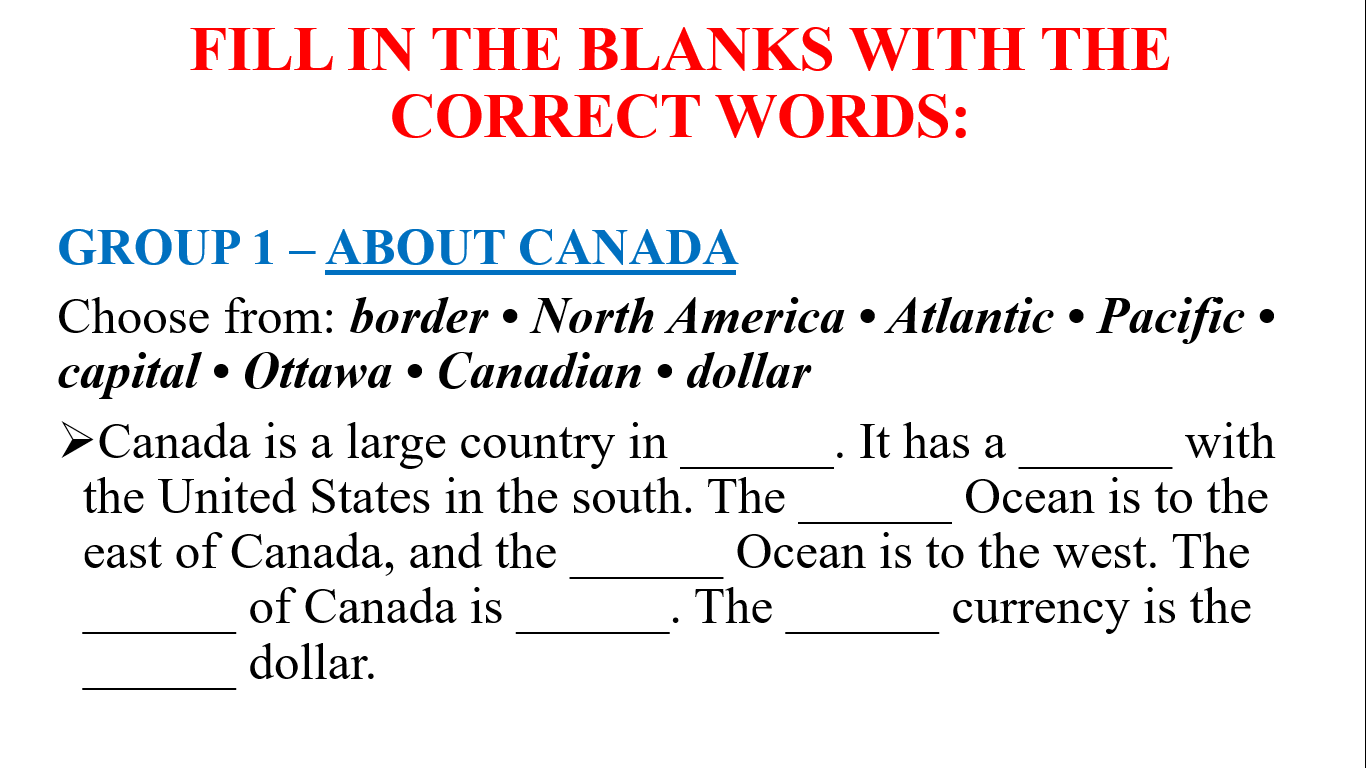
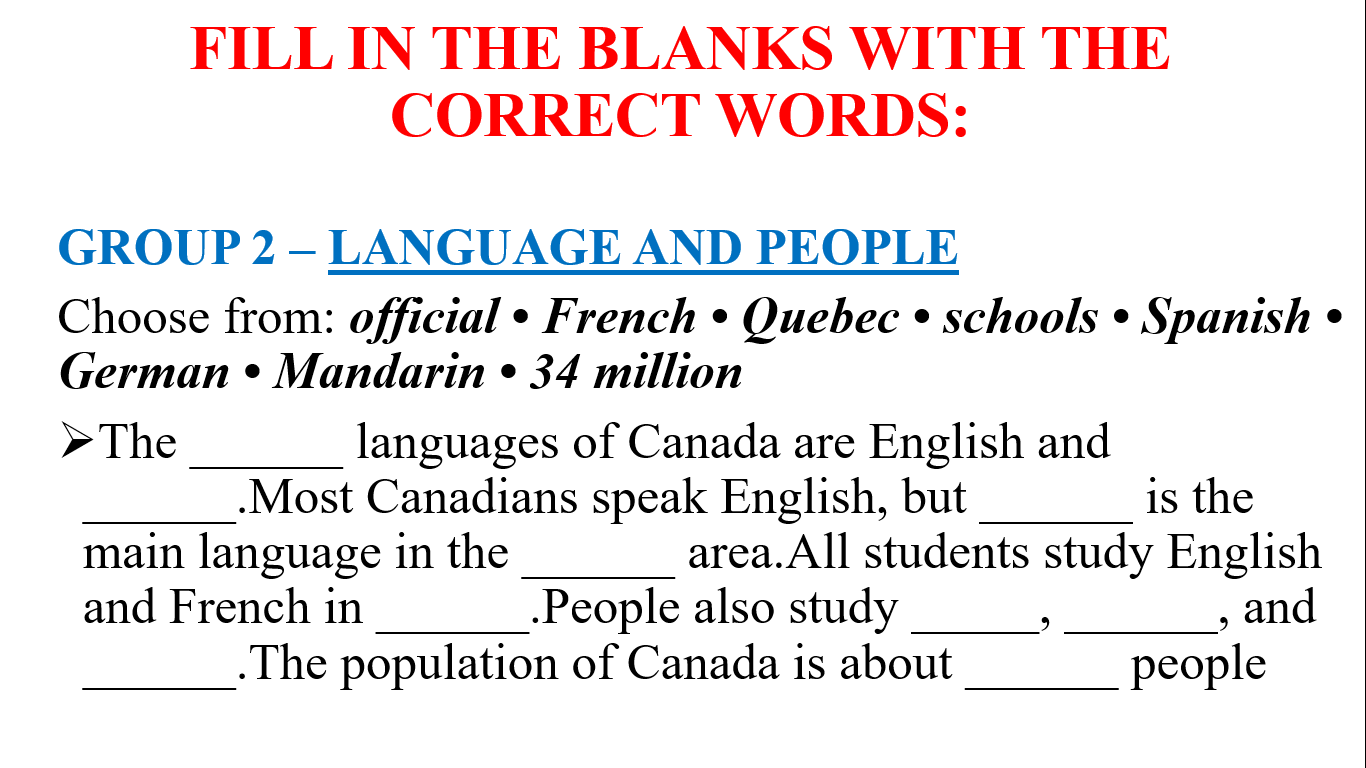
To help learners recognise, understand, and use new vocabulary correctly. Descriptor The learner: - Correctly matches English words with their appropriate translations. - Demonstrates understanding of vocabulary meaning and usage. Differentiation tasks Teacher divides the class into groups: Group 1 “COUNTRY” Group 2 “LANGUAGE” Ex:1, p:27 Read the model text and match the paragraphs 1-3 with these topics. To identify the main idea of each paragraph and match it with correct topic. ANSWERS: Paragraph 1 Where it is Paragraph 2 Languages Paragraph 3 Population Descriptor: The learner: - Reads the model text carefully and understands the main ideas of each paragraph. - Matches each paragraph (1–3) with the correct topic. - Demonstrates understanding of paragraph structure and content. Ex:2, p:27 Answer the questions. To check learners’ comprehension and ability to extract specific information from the text. 1. What nationality and language are in the report? 2. What is the population of Canada? 3. What languages do people study in Canadian schools? 4. What is the capital city? 5. Which other parts of the world do a lot of people in Canada come from? ANSWERS: 1) Nationality: Canadian Languages: English, French, Spanish, German, Mandarin 2) About 34 million. 3) English, French, Spanish, German and Mandarin. 4) Ottawa. 5) Europe, Asia, the USA, Africa and South America. Descriptor: The learner: - Reads and understands the questions related to the text. - Finds and writes correct answers using information from the passage. FILL IN THE BLANKS WITH THE CORRECT WORDS: To use appropriate vocabulary and grammar to complete sentences meaningfully and accurately.
ANSWERS: 1 – Group 1. North America 2. border 3. Atlantic 4. Pacific 5. capital 6. Ottawa 7. Canadian 8. dollar 2 – Group 1. official 2. French 3. French 4. Quebec 5. schools 6. Spanish 7. German 8. 34 million Descriptor:
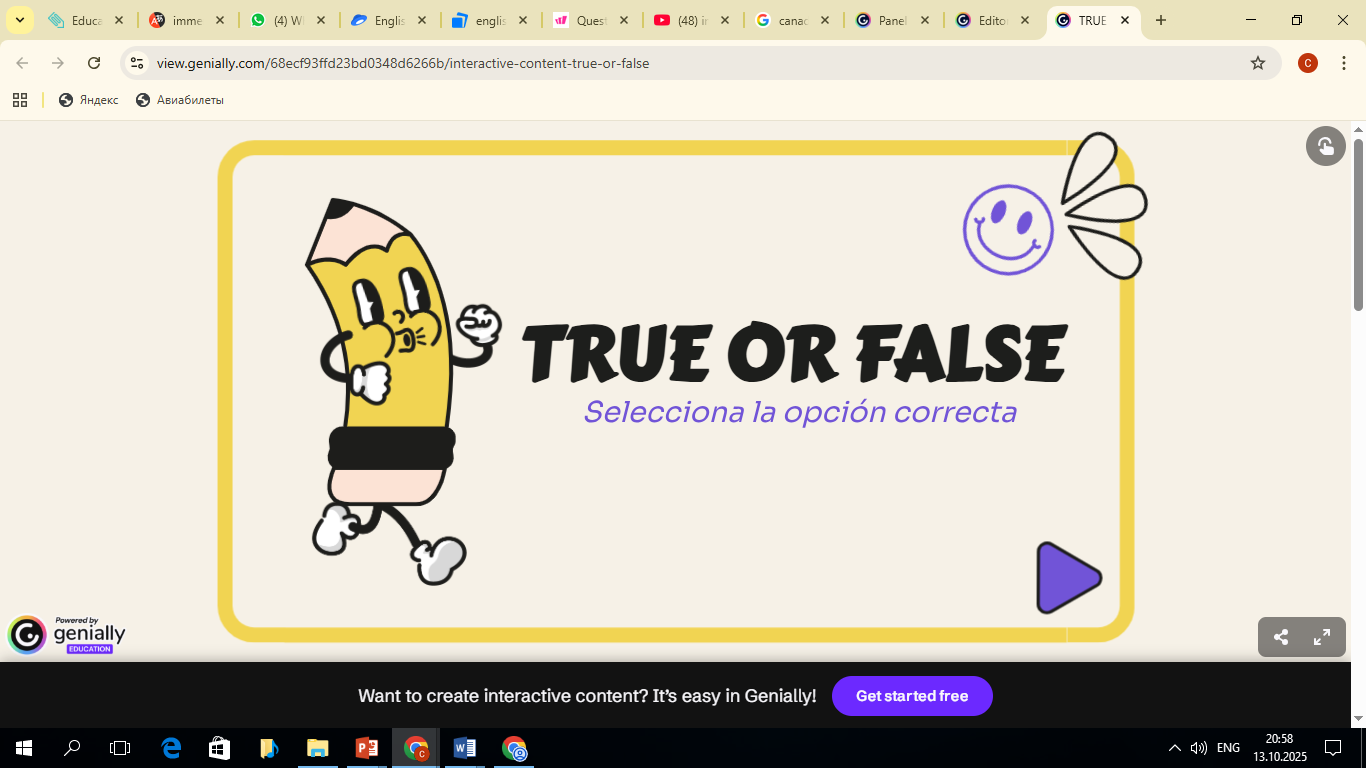
TRUE OR FALSE – “CANADA REPORT” To check students’ understanding of factual statements about Canada and to encourage careful reading and critical thinking.
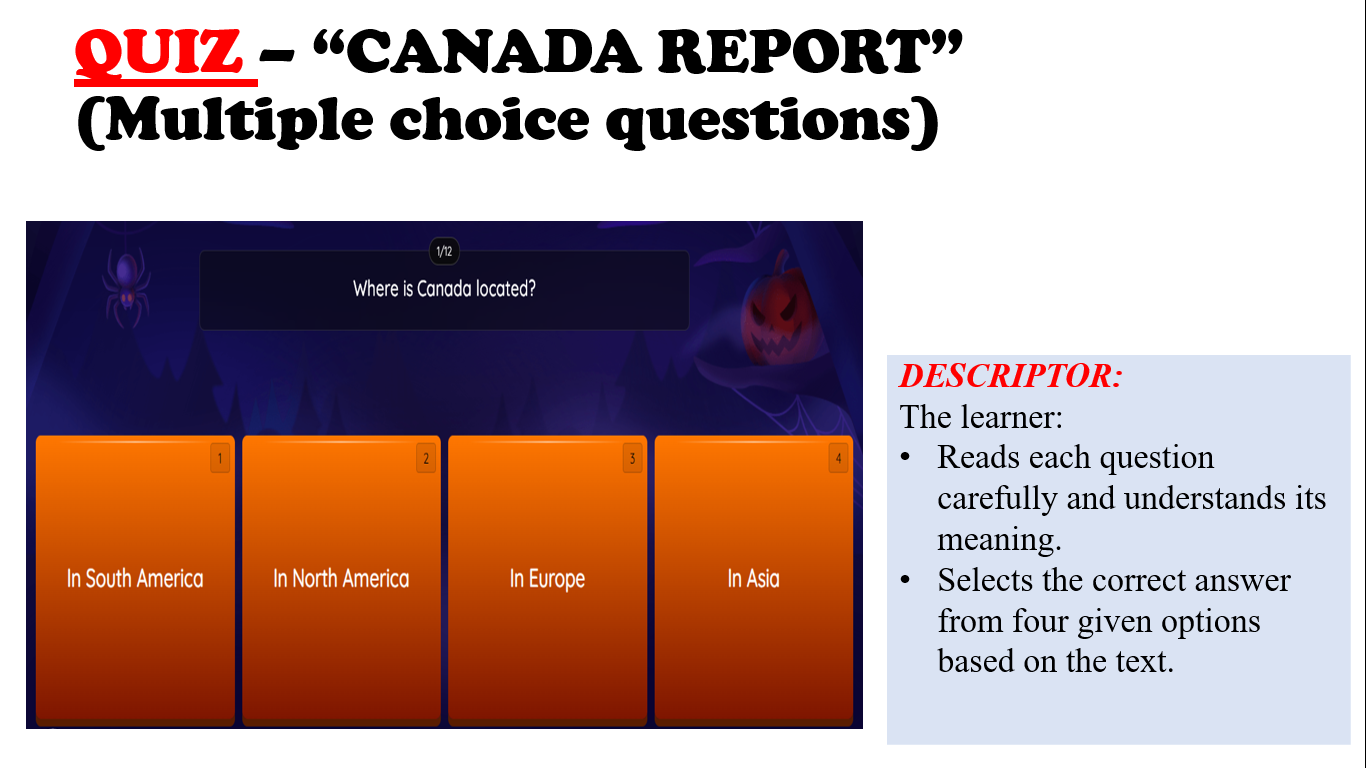
1. Canada is a small country in South America. — False 2. Canada is located in North America. — True 3. The United States is to the north of Canada. — False 4. The Atlantic Ocean is to the east of Canada. — True 5. The Pacific Ocean is to the west of Canada. — True 6. The capital city of Canada is Toronto. — False 7. The capital of Canada is Ottawa. — True 8. The currency of Canada is the Canadian dollar. — True 9. The official languages of Canada are English and French. — True 10. Most Canadians speak French. — False 11. French is the main language in the Quebec area. — True 12. Students in Canada study only English in schools. — False 13. People in Canada also study Spanish, German, and Mandarin. — True 14. The population of Canada is about 34 million. — True 15. Many people in Canada come from Europe, Asia, Africa, and South America. — True Descriptor: The learner: - Reads each statement carefully. - Decides whether each statement is true or false based on the text. - Compares and discusses answers with classmates. QUIZ – “CANADA REPORT” (Multiple choice questions) To check students’ comprehension of the text “Canada Report” and their ability to identify key information and details accurately.
1. Where is Canada located? b) In North America 2. What country is to the south of Canada? c) The United States 3. What ocean is to the east of Canada? c) The Atlantic Ocean 4. What ocean is to the west of Canada? b) The Pacific Ocean 5. What is the capital of Canada? b) Ottawa 6. What is the currency of Canada? b) The Canadian dollar 7. What are the official languages of Canada? c) English and French 8. Where is French the main language? b) In the Quebec area 9. What other languages do people in Canada study? a) Spanish, German and Mandarin 10. What is the population of Canada? c) About 34 million 11. In which cities do many foreigners live? b) Vancouver and Toronto 12. From which continents do people come to Canada? c) Europe, Asia, Africa and South America Descriptor: The learner: - Reads each question carefully and understands its meaning. - Selects the correct answer from four given options based on the text. |
Learners match the given English words with their correct translations, check their answers using provided materials or cards, and practise pronouncing and using the new vocabulary in context. Learners read the model text attentively, determine the main idea of each paragraph, and match it with the appropriate topic according to meaning. Learners read each question carefully, look for relevant information in the text, and write short, accurate answers based on what they have read. Learners read the sentences attentively, identify the missing words, and fill in each blank with the correct word according to context and grammar. Learners carefully read each statement about the text “Canada Report”, identify whether the information is true or false based on their understanding of the passage. Learners read each question carefully, choose the correct answer from four options, and check their understanding of the “Canada Report” text. |
Individual evaluation
Individual e
Group evaluation
Group evaluation Group evaluation
Group evaluation
|
Card №1 PPT Book exercise books Book exercise books Book Exercise books Card №2 genially.com https://app.genially.com/editor/68ecf93ffd23bd0348d6266b Guizizz.com https://wayground.com/admin/quiz/68eccdc209a56345621e4ef7 |
|
Ending of the lesson 5 min |
The teacher gives learners stickers to reflect on their performance; learners write their names and place the stickers on the reflection chart according to their level of participation. Home task: ex:3, p:27 REFLECTION The teacher organizes the reflection stage, invites learners to share their opinions about the lesson using the “thumbs up/thumbs down” method, gives feedback, thanks everyone for active participation, and ends the lesson. |
Learners write their names on the stickers, place them on the reflection chart, and evaluate their participation and understanding of the lesson. Learners reflect on the lesson by showing thumbs up or thumbs down to express their opinions about the activities, share brief comments if needed, and listen to the teacher’s feedback and closing remarks. |
Self-assessment |
Posters Stickers |

 Well done”



 Жүктеу


 Жүктеу
шағым қалдыра аласыз

 Бұл курс Қазақстан Республикасы Оқу-ағарту министрлігімен келісілген










