"Family relationships"

Тақырып бойынша 11 материал табылды

"Family relationships"

Материал туралы қысқаша түсінік
5.S6 communicate meaning clearly at sentence level during, pair, group and whole class exchanges 5.S7 appropriate subject-specific vocabulary and syntax to talk about a limited range of general topics 5.W3 write with support factual descriptions at text level which describe people, places and objects
Материалдың қысқаша нұсқасы

Short term plan
Long-term plan unit: Unit 3. Values

School: Ulyanovsk secondary school

Date: 14.10.17

Teacher name: Kuanshbaeva A.K

Grade: 5

Number present:

absent:

Theme of the lesson


Family relationships

Learning objectives(s) that this lesson is contributing to (link to the Subject programme)

5.S6 communicate meaning clearly at sentence level during, pair, group and whole class exchanges

5.S7 appropriate subject-specific vocabulary and syntax to talk about a limited range of general topics

5.W3 write with support factual descriptions at text level which describe people, places and objects

5.W8 spell most high-frequency words accurately for a limited range of general topics

5.UE3 use a growing variety of adjectives and regular and irregular comparative and superlative adjectives on a limited range of familiar general and curricular topics

Lesson objectives


Most learners will:

;


  • develop critical thinking skills

  • practice speaking skills and asking questions

Some learners will:

  • develop critical thinking skills by drawing a family tree

  • identify comparative adjectives while working

  • develop their ability to recognize the specific information in the text while selecting the words

  • practice to describe one of the members of family using comparative and superlative adjectives

A few students might

  • find mistakes in the sentences and correct them

  • compose an essay

Assessment criteria

  • Give feedback orally

  • Identify good works to motivate them to act

  • Identifying success


Value links

Respect, responsibility, honesty, trust, creativity.

Cross curricular links

Self-knowledge and Art

ICT skills

Smart board

Previous learning

Human beings

Plan

Planned timings

Planned activities (replace the notes below with your planned activities)

Resources

Beginning

5 mins


Warm-up

GREETING

Hello, children! How are you?

Now children there many paper clips in my hand. You may take one or more paper clips. Teacher shows a picture drawn a family. What do you see?

Please, say about your family. If you have one clip tell one sentence, for two clips two sentences. Before speaking write your composition clearly and accurately. Give you a minute to prepare.

Now everyone, comes here, make a circle. Tell us about your family. /thinking, writing, speaking/

How could you describe the word ‘family’? dynasty relationship band

Family means a close unit of parents and their children living together

Now I’d like to divide into 2 groups by your paperclips. Who has one or three clips sit here, if you have 2 or 4 take a sit here.

Even / odd numbers


www.eslprintables.com

A set of family visuals / flashcards to project, paper clips


Middle


3 mins


5 mins


2 mins


15 mins


1 min


9 mins


Lead-in

  • T. shows the video of a family and learners call out any names of people in a family. (listening, speaking)

  • T. asks learners about the topic of the lesson and introduces the lesson objectives


Main part

  • T. shows the presentation or flashcards with the members of family to introduce and learners write the words on their copybooks: dad, son, uncle, grandson, grandfather, mum, daughter, granddaughter, grandmother, aunt, brother, sister, niece, nephew, cousins (reading, writing)


(W) Activity 1: T. shows the flashcards and learners put right hand up if the word is a female family member, left hand up if the word is a male family member. (understanding)

(G) Activity 2: 1 group:

Answer the questions below to help you identify some cultural influences in your life. In your answer use the words in brackets.

1. Are your family large?

2. Who is the most important person in your family?

3. With whom do you spend your extended time? (aunts, uncles, grandparents, etc.)?

4. What holidays do you celebrate with your family? Which holiday is the most important, and why? (Nauryz, New Year,)

5. What special types of food do you and your family prefer? (beshbarmak, palau, borsh, chak-chak.)

6. What types of music do you and your family listen to? (folk, classic, children’s music, opera, romantic, hip-hop,)

(speaking, thinking,listening)

2 group: T. shows the picture of a tree, elicits ‘tree’, and explains that learners can also draw a family tree. T. asks learners to draw what they think a family tree looks like. T. asks why it’s called a family tree – there are roots and the family grows. Learners draw their family tree with the names of his/her family members and should say 5 or 6 sentences about their family members, e.g. It’s my mum. Her name is _______. She is _____ years old. She is ________ (profession). She is ________ (adjective to describe her appearance or character)

T. can choose 2-3 learners to present their family tree but learners should choose only one member of their family to tell about. (speaking)

Physical activity

Families
Some families are large. (spread arms out wide)
Some families are small (bring arms close together)
But I love my family (cross arms over chest) best of all!

(P) Activity 3:

Group #1

Your next task is to find mistakes in the sentences and correct them. Each mistake is 1 point.

Your grandfather’s son is your daughter.

Your mother is your grandfather’s son.

Your mother’s brother is your aunt.

Your brother is your mother’s son.

Your mother’s mother is your parents.

Your brother’s grandfather is your father.

Group #2

Flashcards with five pictures. Task: Write ‘What are they look like?’ Use comparatives: taller, smaller, younger, older, etc. For example: Father is taller than mother.

(G) Activity 4:


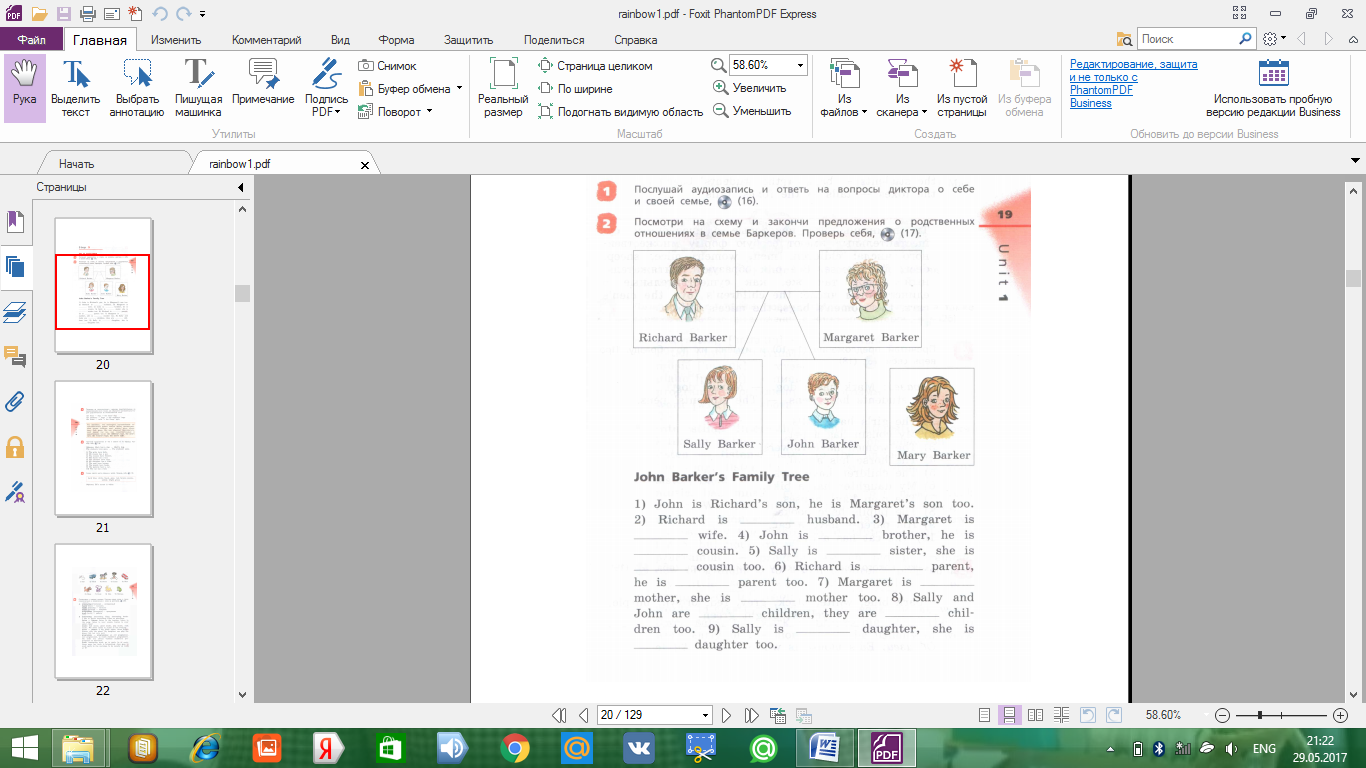
T.: Look at the scheme then complete

the sentences about Barker’s family

John Baker’s Family Tree.

John is Richard’s son, he is Margaret’s

son too. Richard is _________husband.

Margaret is ________ wife. John is

_________brother, he is ___________

cousin. Sally is _________sister, she is

________cousin too. Richard is _____

parent, he is _______parent too. Margaret is ________mother, she is __________mother too. Sally and John are __________ children, they are _______children too. Sally is ______daughter, she is _______daughter too.

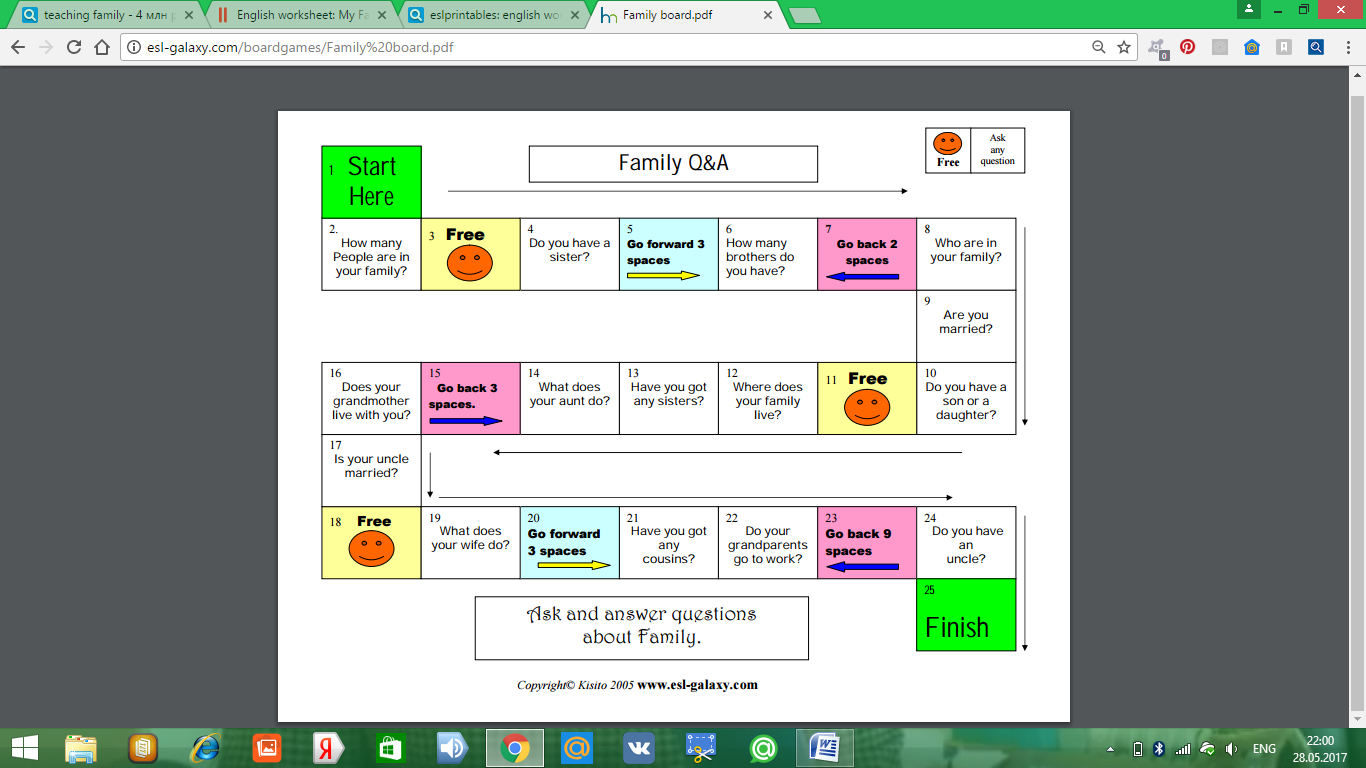
B oard – Game.


(I). Write a newsletter to school magazine ‘Mektep ainasy’ the title is “My family”

This month’s topic is “My family”. We would like to hear about our student’s family. We will choose best essays and publish them in the next month’s magazine.

You may write about a member of your family. Describe how you picture him or her and how you feel about him or her.

So, write 25-30 words in four paragraphs. Here are some questions you might ask yourself.

  • What does this person look like?

  • What do you admire about this person?

  • What have you learned from him or her?

  • What is your favourite activity with this family member?

Useful phrases:

My ____’s name is...

He/she looks like...

He/she is +adjective

(I think) the best thing about him/her is...

I’m learned from him/her to be...

I’m pleasured to ... with him/her

Useful vocabulary:

Appearance: tall / short / slim / beautiful / handsome / attractive

Personality: creative / friendly / easy-going / generous / intelligent / positive / talkative / courageous /


And / so / but / because / also


https://www.youtube.com/watch?v=Eq0O0MPhZhU


flashcards with the members of family

English Plus Student’s Book, p.41


www.eslprintables.com

flashcards with the members of family


Necessary words on cards, holidays parties, dishes cards

Magazine ‘Modern English’ p27


picture of ‘Family tree’

Examples of family tree

www.eslprintables.com


Rockin English

Comparative and superlative song”

https://www.youtube.com/watch?v=872gqAJjc1g


English Plus Student’s Book, p.52


Rainbow English

Английский язык

O. В. Афанасьева,

часть 1


Sheets, dice


End

5 min

Feedback.

Name 3 things:

I have learnt…

I still want to know

I didn’t understand …


Additional information

Differentiation – how do you plan to give more support? How do you plan to challenge the more able learners?

Assessment – how are you planning to check learners’ learning?

Cross-curricular links
Health and safety check
ICT links
Values links


  • More support can be given in Activity 2 when they write about their family members by providing less-able learners with examples or words to make up the sentence

  • Learners who are less confident at drawing the family tree, can be given a picture of a tree

  • More-able learners can be encouraged to write more sentences, essays and ask more questions.

  • Monitor when you show the flashcards of family members in Activity 1

  • Monitor when learners write their sentences about family members in Activity 2 and answering the questions


  • Monitor when they find correct answers and make sentences using comparative adjectives in Activity 3


  • Monitor when some pupils write an essay

  • Self-knowledge and Art: when learners draw their family tree and make a presentation in Activity 2 in activity 3 they develop their creativity, critical thinking

  • Make sure learners have sufficient space to do physical activity.

  • Use of Smart board while presenting the words and tasks

  • Develop learners’ love, respect to their family, a sense of responsibility and concern for the family.


Reflection

Were the lesson objectives/learning objectives realistic?

What did the learners learn today?

What was the learning atmosphere like?

Did my planned differentiation work well?


Did I stick to timings? What changes did I make from my plan and why?


Use the space below to reflect on your lesson. Answer the most relevant questions from the box on the left about your lesson.


Summary evaluation


What two things went really well (consider both teaching and learning)?


1:


2:


What two things would have improved the lesson (consider both teaching and learning)?


1:


2:


What have I learned from this lesson about the class or individuals that will inform my next lesson?


Жүктеу
bolisu
Бөлісу
ЖИ арқылы жасау
Файл форматы:
docx
12.06.2018
523
Жүктеу
ЖИ арқылы жасау
Бұл материалды қолданушы жариялаған. Ustaz Tilegi ақпаратты жеткізуші ғана болып табылады. Жарияланған материалдың мазмұны мен авторлық құқық толықтай автордың жауапкершілігінде. Егер материал авторлық құқықты бұзады немесе сайттан алынуы тиіс деп есептесеңіз,
шағым қалдыра аласыз
Қазақстандағы ең үлкен материалдар базасынан іздеу
Сіз үшін 400 000 ұстаздардың еңбегі мен тәжірибесін біріктіріп, ең үлкен материалдар базасын жасадық. Төменде керек материалды іздеп, жүктеп алып сабағыңызға қолдана аласыз
Материал жариялап, аттестацияға 100% жарамды сертификатты тегін алыңыз!
Ustaz tilegi журналы министірліктің тізіміне енген. Qr коды мен тіркеу номері беріледі. Материал жариялаған соң сертификат тегін бірден беріледі.
Оқу-ағарту министірлігінің ресми жауабы
Сайтқа 5 материал жариялап, тегін АЛҒЫС ХАТ алыңыз!
Қазақстан Республикасының білім беру жүйесін дамытуға қосқан жеке үлесі үшін және де Республика деңгейінде «Ustaz tilegi» Республикалық ғылыми – әдістемелік журналының желілік басылымына өз авторлық материалыңызбен бөлісіп, белсенді болғаныңыз үшін алғыс білдіреміз!
Сайтқа 25 материал жариялап, тегін ҚҰРМЕТ ГРОМАТАСЫН алыңыз!
Тәуелсіз Қазақстанның білім беру жүйесін дамытуға және білім беру сапасын арттыру мақсатында Республика деңгейінде «Ustaz tilegi» Республикалық ғылыми – әдістемелік журналының желілік басылымына өз авторлық жұмысын жариялағаны үшін марапатталасыз!
Министірлікпен келісілген курстар тізімі