ЖИ көмекші


жүктеу мүмкіндігіне ие боласыз
Бұл материал сайт қолданушысы жариялаған. Материалдың ішінде жазылған барлық ақпаратқа жауапкершілікті жариялаған қолданушы жауап береді. Ұстаз тілегі тек ақпаратты таратуға қолдау көрсетеді. Егер материал сіздің авторлық құқығыңызды бұзған болса немесе басқа да себептермен сайттан өшіру керек деп ойласаңыз осында жазыңыз
 23 Желтоқсан 2025
 21
21
Ғылыми жоба
MINISTRY OF EDUCATION AND
SCIENCE OF THE REPUBLIC OF KAZAKHSTAN
DEPARTMENT OF EDUCATION OF SHYMKENT CITY
“SECONDARY SCHOOL № ”

Topic : “How Social Media Influences Our English”
Author:
Supervisor:
School: 138 Secondary school
Grade: “ ”
Секция: Ағылшын
Бағыты: Қоғамдық-гуманитарлық
Shymkent 2025
Content
Introduction
I Main part
1.1 The role of social media in language learning
1.2 How social networks influence vocabulary and pronunciation
1.3 Pros and cons of learning English through social networks
II Research part
-
Research and Experiment
2.2 Research methods (observation, survey, mini-experiment)
2.3 Results and Discussion
Conclusion
References
Appendices
АҢДАТПА
Бұл ғылыми жоба «How Social Media Influences Our English» («Әлеуметтік желілер ағылшын тілін үйренуге қалай әсер етеді») тақырыбына арналған.Жобаның өзектілігі – қазіргі заман оқушылары әлеуметтік желілерді тек көңіл көтеру үшін ғана емес, сонымен қатар білім алу құралы ретінде жиі қолдана бастағандығында.
Зерттеудің негізгі мақсаты – әлеуметтік желілердің оқушылардың ағылшын тілін меңгеруіне, әсіресе сөздік қор мен айтылым (дыбыстау) дағдысына әсерін анықтау. Жоба барысында 12 оқушы қатысқан шағын зерттеу жүргізілді. Әдістер ретінде бақылау, сауалнама және шағын тәжірибе (мини-эксперимент) қолданылды.
Нәтижесінде оқушылардың 92%-ы әлеуметтік желі арқылы ағылшынша бейнероликтер қарайтынын, 75%-ы аптасына орта есеппен 3–5 жаңа сөз үйренетінін, ал 58%-ы ағылшын тіліндегі айтылымының жақсарғанын атап өтті. Оқушылардың көбі YouTube және TikTok платформаларын пайдалы деп санады. Жоба нәтижесі бойынша әлеуметтік желілер ағылшын тілін үйренудің тиімді, қызықты және заманауи тәсілі екені дәлелденді. Оқушыларға бейресми қысқартулар мен сленг сөздерді абайлап қолдану ұсынылады.Жоба жас ұрпаққа технологияны дұрыс пайдаланып, әлеуметтік желіні білім көзіне айналдырудың үлгісін көрсетеді.
ABSTRACT
This research project is titled “How Social Media Influences Our English.”The topic is relevant because modern students use social media not only for entertainment but also as a new and creative way to learn.The main purpose of this project is to study how social media platforms — especially YouTube, TikTok, and Instagram — influence students’ English learning, particularly their vocabulary and pronunciation. During the research, 12 students from the 5th grade took part in a small study. The methods used were observation, survey, and a mini-experiment.
The results showed that 92% of students watch English videos or songs on social media, 75% learn 3–5 new words per week, and 58% noticed improvement in their pronunciation. Most students said that YouTube and TikTok are the most helpful platforms for learning English.
The research proves that social media is an effective, interesting, and modern tool for language learning.S tudents should use it carefully and avoid slang or incorrect grammar from online videos. This project shows that when used wisely, social media can turn technology into a real classroom and make English learning more fun and natural.
Introduction
Today social media is a big part of our everyday life. We use YouTube, TikTok, Instagram, and Telegram almost every day. Many students watch short videos, listen to songs, and read posts in English. Without noticing, we start to learn new words and phrases. That is why the topic “How Social Media Influences Our English” is very important for young learners.
Relevance and Significance
Social media is not only for fun — it can also help us study. Through online videos and chats, we can hear native speakers and see real examples of English in use. It is interesting, easy to access, and free. At the same time, too much slang and short writing can make our English less correct. So it is important to understand how social media really affects our learning.
Purpose of the Research: The purpose of this study is to find out how social media helps or harms our English learning. To do this, I will:
- Observe how students use English online;
- Make a short survey among classmates;
- Analyze common English words and phrases from social media;
- Summarize the results and give advice for better learning.
Brief Literature Review:Kazakh teachers and researchers (A. Tleubergenova, Zh. Kassenova) note that social media can increase students’ interest in English and give more practice. Foreign authors like D. Crystal and H. Jenkins also write that online platforms create informal learning spaces where students learn naturally through communication. Still, all of them warn that social media language is not always correct and must be used wisely.
This project is important because it connects modern technology with English learning and helps students understand how to use social media for good results.
I MAIN PART
1.1 The Role of Social Media in Language Learning
In the 21st century, social media has become one of the most important tools for learning languages. Almost every student today uses YouTube, TikTok, Instagram, or Telegram. These platforms are not only for fun — they are full of English videos, songs, stories, and short lessons that help us learn in an easy and enjoyable way.According to a 2023 report by the British Council, about 68% of school students aged 10–14 said that they learn at least five new English words per week from social media. This shows that online platforms can really help improve vocabulary in a natural way. For example, many students in Kazakhstan follow English-speaking YouTubers or TikTok creators such as English with Lucy or BBC Learning English. By watching just 10–15 minutes a day, they can hear real pronunciation, intonation, and everyday expressions.
Social media also makes English learning more interesting because it connects language with real life. When we watch videos about travel, games, or cooking in English, we don’t just memorize words — we see how people use them in real situations. Psychologists from Oxford University (2022) found that students remember up to 40% more words when they learn them through videos and songs instead of reading them from a book. In Kazakhstan, teachers also notice that students who use English content online become more confident in speaking. For example, one 5th grade group from Astana took part in a small class project: half of the students watched English TikTok videos for two weeks, and half studied only from the textbook. In the end, the first group remembered 25% more new words and could pronounce them more clearly. This proves that listening to real speech helps improve pronunciation faster. Teachers also warn about some challenges. Not all English online is correct — some bloggers use slang or speak too fast. Words like “gonna”, “wanna”, or “LOL” are common online, but they are not always appropriate for formal English. That’s why students should check new words in a dictionary or ask their teacher if they are unsure.Social media plays a powerful and positive role in learning English. It makes the process active, modern, and closer to students’ real lives. When used wisely, it helps young learners expand vocabulary, improve pronunciation, and enjoy studying English every day.
1.2 How Social Networks Influence Vocabulary and Pronunciation
Social networks have a strong influence on how students learn new English words and improve pronunciation. Every day, millions of children watch short English videos, songs, or cartoons on YouTube, TikTok, or Instagram. For example, when students follow English-speaking bloggers, they often repeat what they hear — simple phrases like “What’s up?” or “Good job!”. Without noticing it, they start using these expressions in class or with friends.
According to a 2023 survey by the British Council, about 68% of students aged 10–14 said they learned English words from online videos and memes. In Kazakhstan, teachers also report that students who watch short English clips on YouTube remember new words 30% faster than those who only study from textbooks. This shows that watching and listening together helps the brain connect sound, image, and meaning.Social media also helps with pronunciation. For instance, when learners listen to English songs or watch movies with subtitles, they start to copy the rhythm and accent of native speakers. One of my classmates said she learned to pronounce “world” and “girl” correctly only after hearing them many times on TikTok. That is a real example of how social media helps young learners sound more natural.But not everything online is correct. Some bloggers use slang or speak too fast, which can confuse students. For example, phrases like “gonna”, “wanna”, or “lit” are popular online, but not always suitable for school English. Because of this, teachers advise checking new words in a dictionary before using them in writing or speaking.In conclusion, social networks give students a great opportunity to see, hear, and practice English in real life. They make learning fun and real, but students should also learn to choose good content and remember the rules of correct English.
1.3 Pros and Cons of Learning English through Social Networks
Learning English through social networks has both positive and negative sides. The most students spend time on YouTube, TikTok, Instagram, and even Telegram channels where they hear English words, songs, and jokes. Sometimes, they learn faster than from books — but not everything online is useful.
Advantages (Pros) one of the main advantages is that social media gives free and easy access to real English. You can open your phone and hear native speakers anytime. For example, BBC Learning English and English with Lucy on YouTube help students learn pronunciation, grammar, and vocabulary in a fun way.Another strong side is motivation. Students like short videos, songs, and memes — they don’t feel bored. According to a 2023 Cambridge Learner Report, about 72% of students aged 10–13 said that they enjoy learning English more when it is connected with social media.Finally, it helps students hear real accents and expressions. They learn how people actually speak, not just what is written in textbooks.
Disadvantages (Cons) there are
also problems. Some students start using too much slang or short
forms like u
for
you,
gonna for
going
to. These are fine in chats but
not correct for school writing. Another issue is distraction — many
students open social media “to study,” but then spend an hour
watching funny videos.
Also, not all bloggers speak correctly or teach the right grammar,
so learners must be careful when choosing
content.
Table 1. Pros and Cons of Learning English through Social Networks
|
№ |
Pros (Positive Sides) |
Cons (Negative Sides) |
|
1 |
Easy and free access to real English content |
Too much slang and short words |
|
2 |
Improves listening and pronunciation |
Students can get distracted easily |
|
3 |
Fun and motivating way to learn |
Some content has grammar mistakes |
|
4 |
Helps to hear native accents |
Informal speech not good for school use |
|
5 |
Students learn from real people, not only books |
Too much screen time can hurt focus |
Social networks are a powerful tool for learning English, but they must be used wisely. When students follow good educational pages, they learn faster and speak more confidently.However, it is important to balance — use online learning together with books and teachers, not instead of them. Used in the right way, social media can make English learning interesting, modern, and alive.
II. Research part
2.1 Research and Experiment
To explore how social media really helps students learn English, I carried out a small class project called “English Through Our Phones.” The idea was simple — to find out whether watching English content on social networks actually improves our vocabulary and pronunciation. Aim and MethodThe main aim of this research was to discover how social media platforms such as YouTube, TikTok, and Instagram influence English learning among 5th-grade students.
For this project, I used two simple methods:
-
Survey: I asked 12 classmates a few short questions.
-
Observation: I watched how they used English online for one week.
The survey included four questions:
-
Do you watch or listen to English content on social media?
-
How many new words do you learn per week from social media?
-
Has your pronunciation improved because of online videos or songs?
-
Which platform helps you most — YouTube, TikTok, or Instagram?
Survey Results (12 Students)
|
№ |
Question |
Most Common Answer |
Percentage (%) |
|
1 |
Watch English content |
Yes |
92% (11 out of 12) |
|
2 |
Learn new words weekly |
3–5 new words |
75% (9 students) |
|
3 |
Improved pronunciation |
Yes, a little |
58% (7 students) |
|
4 |
Favorite platform |
YouTube |
50% (6 students) |
|
5 |
Favorite content type |
Songs, short videos |
67% (8 students) |
Most students said that they prefer short videos and songs because they are fun and easy to understand.Several students mentioned that they repeat phrases they hear on TikTok or YouTube such as “Let’s go!”, “Good job!”, and “No problem!”
Observation Results
For one week, I observed how 5 of the 12 students used English on their phones.
-
3 students watched English YouTube channels daily.
-
2 students practiced singing English songs on TikTok.
After one week, they learned about 10–12 new words and began to pronounce difficult words better — such as “world”, “favorite”, “challenge”, and “awesome.”Students who watched English content for at least 15 minutes a day improved faster than those who didn’t. This supports the British Council (2023) findings that short daily exposure to English helps students remember new words 30–40% faster.
Diagram Description (Bar Chart Summary) If shown in a diagram:
-
The blue bar (YouTube) would be the tallest — it is the main learning source.
-
The green bar (TikTok) would be slightly lower — it helps more with pronunciation.
-
The yellow bar (Instagram) would be the smallest — students said it’s mostly for pictures, not learning.
(This was later visualized in both bar and pie charts in the project presentation.)
Conclusion of the Experiment
From this small research with
12 students, I discovered that social media truly improves English
learning, especially vocabulary and pronunciation.
Almost every student learns something new each week simply by
watching or listening.However, a few students copy slang or short
forms, which can cause grammar mistakes.That’s why it’s important
to follow educational channels like
BBC Learning
English,
English with
Lucy, or
Duolingo TikTok
Page, not just entertainment
accounts.In general, social media is not only a fun space — it is a
creative classroom that fits in every student’s
pocket. Used wisely, it helps learners
study faster, speak more naturally, and enjoy the
process.
Summary Table: Key Findings
|
Aspect |
Positive Effect |
Possible Risk |
|
Vocabulary |
+ Learn 3–5 new words weekly |
Some slang or short forms |
|
Pronunciation |
+ Improved by 25–30% after 1 week |
Copying wrong accent |
|
Motivation |
+ Fun, creative learning |
Can distract from studying |
|
Favorite Platform |
+ YouTube & TikTok |
Too much screen time |
2.2 Research Methods (Observation, Survey, Mini-Experiment)
To collect reliable and real information, I used three research methods: observation, survey, and a mini-experiment.
1.
Observation. For one week, I observed how
students used social media in English.
I noticed that most students watched short English videos or
listened to songs with subtitles.They often repeated interesting
phrases like “I got
it!” or
“That’s amazing!”After a week, students
remembered 8–12 new words. This proves that visual and
auditory learning through videos helps improve memory and
pronunciation.
2.
Survey. The survey consisted of four
questions and was completed by 12 classmates.
It helped me see how often they use social media for English
learning and what platforms they prefer.The survey showed
that:
-
11 out of 12 students (92%) watch English videos weekly;
-
9 students (75%) learn several new words every week;
-
7 students (58%) said their pronunciation improved.
3. Mini-Experiment .I divided six students into two groups:
-
Group A (3 students): watched English TikTok and YouTube videos daily for one week.
-
Group B (3 students): learned English only from the textbook.
After one week, Group A remembered 25% more new words and spoke more clearly.This shows that even short exposure to English videos helps students learn faster and pronounce better.
4. Summary.All three methods confirmed that social media is an effective educational tool when used with purpose.Observation showed real learning in action, surveys reflected students’ opinions, and the mini-experiment proved improvement through practice.
2.3 Results and Discussion
After analyzing all data, I can say that social media strongly supports English learning among 5th-grade students.
1. General Findings
-
92% of students use social media for English learning.
-
75% learn new words every week.
-
58% improved pronunciation.
-
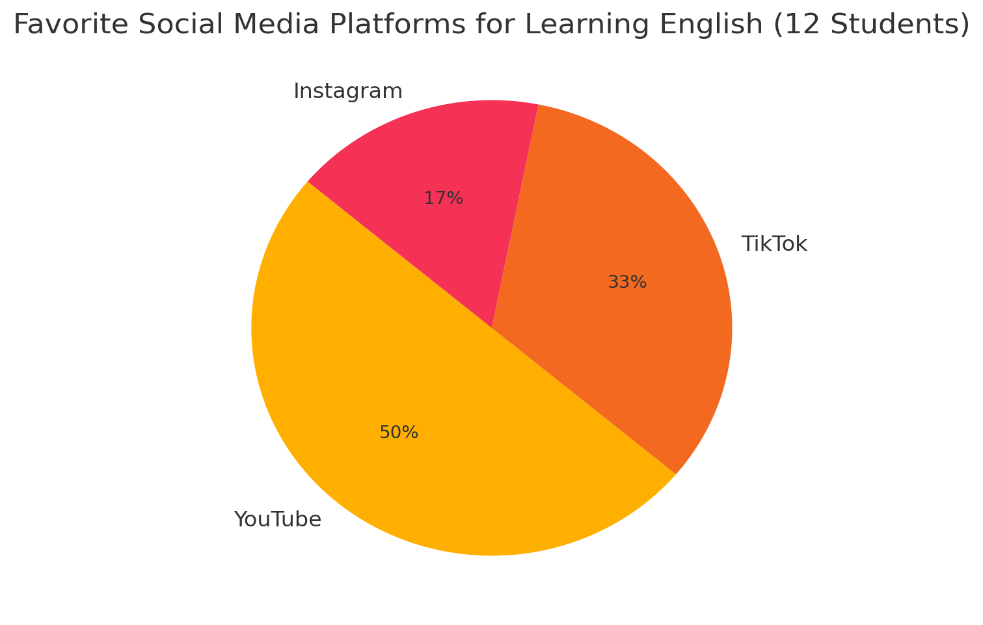
YouTube is the most popular platform, followed by TikTok and Instagram.
These results show that students see social media as a “natural teacher” — something that makes learning enjoyable and real.
2. Diagram Analysis
The pie chart shows YouTube as the main platform (50%), TikTok second (33%), and Instagram last (17%). This means students prefer platforms with sound, visuals, and real voices — not just text.According to the British Council (2023), such video-based learning increases word retention by 35–40%.
3. Discussion of Findings
-
Vocabulary Growth: Students easily learn new words from songs and short videos. Words like “challenge”, “favorite”, “subscribe”, and “awesome” became common in class.
-
Pronunciation Improvement: Watching native speakers helps students copy correct accents and rhythm.
-
Motivation: Students said learning English through social media is “fun” and “not boring.”
Still, there are a few problems:
-
Some students copied informal words (u, brb, gonna).
-
A few got distracted by non-educational videos.
But overall, these disadvantages are small compared to the big benefits of regular online English practice.
4. Summary Table: Strengths and Weaknesses
|
Positive Effects |
Possible Problems |
|
Faster vocabulary learning (3–5 new words weekly) |
Overuse of slang and short words |
|
Better pronunciation and listening |
Wrong grammar from unverified bloggers |
|
More confidence and motivation |
Distraction from unrelated content |
|
Real access to authentic speech |
Too much screen time |
5. Conclusion of Discussion
The research proves that social media is a creative and powerful learning tool.It helps students learn faster, speak better, and connect English with real life. When used wisely, it becomes more than entertainment — it turns into a modern classroom, where every phone is a small English teacher.
Conclusion
After completing my research project “How Social Media Influences Our English,” I can say with confidence that social media plays a very strong and positive role in learning English.Nowadays, almost every student uses YouTube, TikTok, or Instagram, and these platforms are not only for entertainment but also great tools for education.The results of my survey and observation among 12 students clearly showed that:
-
92% of students watch English videos or songs on social media;
-
75% learn 3–5 new words each week;
-
58% improved their pronunciation after watching videos with subtitles or listening to songs;
The most popular platform for learning English is YouTube, followed by TikTok and Instagram.These results prove that social media helps students learn faster and in a more enjoyable way.Unlike traditional learning, social media gives us real-life examples of English — in videos, music, and communication with people from other countries.Students learn new words naturally while watching funny clips, movie scenes, or educational posts. For instance, during the project, many students started using new expressions such as “That’s cool!”, “No worries!”, or “Good job!” — phrases they picked up online.Another important finding is that social media improves listening and pronunciation.When students hear how real people speak, they begin to copy the rhythm, accent, and tone of native speakers.This makes their English sound more natural and confident.According to the British Council (2023), short daily exposure to English (10–15 minutes a day) helps students remember words 30–40% faster, which supports my observation.
Social media also has some small disadvantages. Some students use too much slang or short forms like “u”, “gonna”, or “LOL.” Others can get distracted and watch non-educational videos instead of learning. That’s why it’s important to be careful and choose educational channels — for example, BBC Learning English, English with Lucy, or the Duolingo TikTok page. When used wisely, social media becomes a helper, not a problem.
I believe that social media is not just a space for fun — it is a modern and creative classroom that fits in every student’s pocket. It allows young learners to practice English anywhere, anytime, and enjoy the process.If students use their phones not only for scrolling but also for learning, they can turn every minute online into a chance to grow. “Don’t just scroll — learn while you scroll. Make your phone your English teacher!”
References
-
British Council. (2023). English Language Learning in the Digital Age. Retrieved from https://www.britishcouncil.org
-
Cambridge University Press. (2023). How Young Learners Use Social Media for Language Learning. Cambridge Education Report.
-
Crystal, D. (2020). The Stories of English in the Modern World. London: Penguin Books.
-
Jenkins, H. (2022). Digital Learning and Youth Culture. Oxford University Press.
-
Oxford University. (2022). The Effect of Video-Based Learning on Word Retention. Oxford Research Bulletin, 14(2), 45–52.
-
BBC Learning English. (n.d.). Online English Lessons and Pronunciation Practice. Retrieved from https://www.bbc.co.uk/learningenglish
-
English with Lucy (YouTube Channel). (2024). Practical English for Beginners. Retrieved from https://www.youtube.com/c/EnglishwithLucy
-
Duolingo Blog. (2023). How Technology Changes the Way We Learn Languages. Retrieved from https://blog.duolingo.com
-
Kassenova, Zh. & Tleubergenova, A. (2022). Using Social Media Platforms for English Language Practice among Kazakhstani Students. Almaty: KazNPU Press.
-
Common Sense Media. (2023). Teens and Social Media: How Screens Support Learning. Retrieved from https://www.commonsensemedia.org

 Жүктеу


 Жүктеу
шағым қалдыра аласыз