ЖИ көмекші


0 / 1

Барлық 400 000 материалдарды тегін жүктеу үшін
Ұнаған тарифті таңдаңыз
Айлық
Жылдық
1 - күндік
Танысу 690 ₸ / 1 күнге
Таңдау
UstazTilegi AI - ЖИ арқылы тегін ҚМЖ, БЖБ, ТЖБ, тест, презентация, авторлық бағдарлама т.б. 10 материал жасау
Материалдар бөлімі - Барлық 400 000 материалдарды тегін 30 материал жүктеу
Аттестация ПББ тестеріне доступ аласыз шексіз
Жеке ҚМЖ бөлімінде - дайын ҚМЖ-ларды, презентацияларды жүктеу5 файлды тегін жүктеу
Олимпиада, турнир, байқауларға 50% жеңілдік
1 - айлық
Стандарт
2990 ₸ / айына
UstazTilegi AI - ЖИ арқылы тегін ҚМЖ, БЖБ, ТЖБ, тест, презентация, авторлық бағдарлама т.б. жасау 30 материал жасау
Материалдар бөлімі - Барлық 400 000 материалдарды тегін 900 материал жүктеу
Аттестация ПББ тестеріне доступ аласыз шексіз
Жеке ҚМЖ бөлімінде - дайын ҚМЖ-ларды, презентацияларды жүктеу 150 файлды тегін жүктеу
Жинақталған ҚМЖ бөлімінде 10 файлды тегін жүктеу
Олимпиада, турнир, байқауларға 50% жеңілдік
Іс-шаралар (мини-курстар, семинарлар, конференциялар) тегін қатысу
1 - айлық
Шебер 7990 ₸ / айына
Таңдау
UstazTilegi AI - ЖИ арқылы тегін ҚМЖ, БЖБ, ТЖБ, тест, презентация, авторлық бағдарлама т.б. жасау 150 материал жасау
Материалдар бөлімі - Барлық 400 000 материалдарды тегін 900 материал жүктеу
Аттестация ПББ тестеріне доступ аласыз шексіз
Жеке ҚМЖ бөлімінде - дайын ҚМЖ-ларды, презентацияларды жүктеу 300 файлды тегін жүктеу
Жинақталған ҚМЖ бөлімінде 50 файлды тегін жүктеу
Олимпиада, турнир, байқауларға 50% жеңілдік
Іс-шаралар (мини-курстар, семинарлар, конференциялар) тегін қатысу

Назар аударыңыз!
Сіз барлық мүмкіндікті қолдандыңыз.
Қалған материалдарды ертең жүктей аласыз.
Ок
Материалдың қысқаша нұсқасы
|
Module 4. Organic and non-organic worlds.Lesson 10 |
||
|
School: |
# 11 |
|
|
Teacher’s name: |
Abildashova L.N. |
|
|
Date: |
21.12.2021 |
|
|
Сlass: |
10 “Ә”Number present: |
absent: |
|
Theme: |
How to be a responsible shopper |
|
|
Learning objectives(s) that this lesson is contributing to |
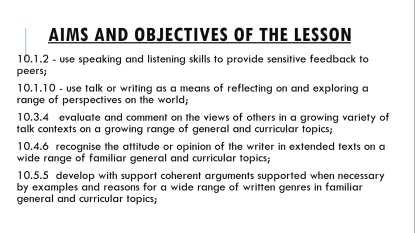
10.1.2 - usespeakingandlisteningskillstoprovidesensitivefeedbacktopeers; 10.1.10 - usetalkorwritingas a meansofreflectingonandexploring a rangeofperspectivesontheworld; 10.3.4 evaluateandcommentontheviewsofothersin a growingvarietyoftalkcontextson a growingrangeofgeneralandcurriculartopics; 10.4.6 recognisetheattitudeoropinionofthewriterinextendedtextson a widerangeoffamiliargeneralandcurriculartopics; 10.5.5 develop with support coherent arguments supported when necessary by examples and reasons for a wide range of written genres in familiar general and curricular topics; |
|
|
Lessonobjectives |
All learners will be able to: Listen and read for a gist, read for specific information Most learners will be able to: Listen and read for a gist, learn about values, do a quiz Some learners will be able to: Listen and read for a gist, learn about values, do a quiz, write a quiz, discuss values |
|
|
Assessmentcriteria |
Learners have met the learning objectives if they can: speak about values |
|
|
Valuelinks |
Solutions to global issues, natural disasters and global citizenships |
|
|
Cross - curricularlinks |
Global issues |
|
|
ICT skills |
Using educational programs like Quizizz, Kahoot and educational platform Bilimland. Videos& pictures, Power point presentation, working with URLs |
|
|
Previouslearning |
The organic industry in the UK |
|
|
Duration of the lesson |
45 minutes |
|
Plan
|
Stages Planned timing |
Teacher’s action |
Students’ action |
Assessment |
Resources |
|||||||||||||||||||||||||||||||||||||||||||||||||||||||||||||||||||||||||||||||||||||||||||||||||||||||||||||||||||||||
|
Beginning the lesson Greeting Duty’s report 2 minutes |
Teacher: Good morning, Dear students! I am glad to see you! Take your seats, please. Teacher: Who is on duty today? Who is absent? What day is it today? What date is it today? |
Students greet the teacher and sit down Duty’s report: All are present. Today is Tuesday, the 21 st of December. |
|
Active board Slide 1 |
|||||||||||||||||||||||||||||||||||||||||||||||||||||||||||||||||||||||||||||||||||||||||||||||||||||||||||||||||||||||
|
Assessment 1 minute |
Teacher:Today I will assess your work with chocolate coins. So you get them if you answer correctly. Students with the most coins will get 8, 9, 10 points in Kundelik. |
|
|
chocolate coins |
|||||||||||||||||||||||||||||||||||||||||||||||||||||||||||||||||||||||||||||||||||||||||||||||||||||||||||||||||||||||
|
Checking up homework Pair work. 3 minutes |
Teacher: Your homework was Student’s book ex 2 p.58. Filling in the gaps. Teacher: Please, swap your copybooks with your neighbor and check his/ her work. There is the answer key on the board
|
Students swap their copybooks and check each other. Answer key: 1.industry, 2.synthetical 3.alternative, 4.wool, 5.chemical, 6.logo, 7.materials, 8.sector |
Summative assessment |
Slide 2 S.b. ex 2 p.58
|
|||||||||||||||||||||||||||||||||||||||||||||||||||||||||||||||||||||||||||||||||||||||||||||||||||||||||||||||||||||||
|
Brainstorming Introducing the topic 2 minutes |
Teacher: Look over some funny quotes. Try to predict what we shall talk about today – the topic of our lesson.
Teacher: You are right. The topic of our lesson is “How to be a responsible shopper” Please, open your copybooks, write down the date and the topic of our lesson. |
Students’ possible answers: We shall talk about shopping, shopping online, buying goods, wasting money, prices, shops and etc. Students open their copybooks, write down the date and the topic of the lesson. |
|
Slide 3
|
|||||||||||||||||||||||||||||||||||||||||||||||||||||||||||||||||||||||||||||||||||||||||||||||||||||||||||||||||||||||
|
Presenting aims and objectives of the lesson 2 minutes |
Teacher: Let’s learn the aims and objectives of today’s lesson. What shall we do today? |
Students get accuanted with the aims of the lesson
|
|
A poster with aims and objectives
|
|||||||||||||||||||||||||||||||||||||||||||||||||||||||||||||||||||||||||||||||||||||||||||||||||||||||||||||||||||||||
|
Speaking. Whole class interaction 3 minutes
|
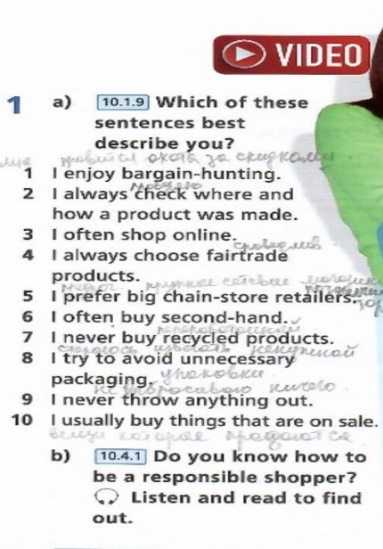
Teacher: Each student gets “Find someone who…” card. Walk around the class. Ask your question and find at least one person who answers “Yes”. Write down his/her name. Tell the class the results of your research
|
Students walk around the class and ask questions.
Students look up the meaning of the unknown words in the dictionaries or ask the teacher
Write down appropriate names
|
Formative assessment |
S.B. p.59 ex 1
|
|||||||||||||||||||||||||||||||||||||||||||||||||||||||||||||||||||||||||||||||||||||||||||||||||||||||||||||||||||||||
|
Pre-reading activity New vocabulary Writing 4 minutes |
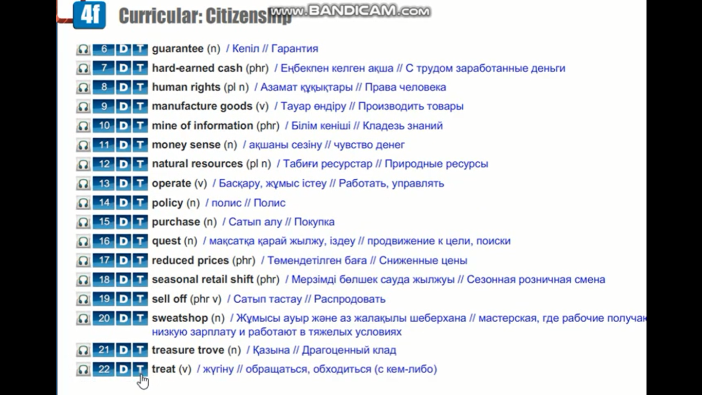
Teacher: Let’s learn new words and phrases in order to widen your vocabulary and make it easier to understand the text, that we will read. Listen and repeat. Write down new words
Wordlist Student’s book WL 17. Module 4F
|
Students listen and repeat, write down new words and phrases into their vocabulary copybooks
|
|
Action 10 video material
|
|||||||||||||||||||||||||||||||||||||||||||||||||||||||||||||||||||||||||||||||||||||||||||||||||||||||||||||||||||||||
|
While reading activity
Listening and speaking Group work 5 minutes |
Student’s book p. 59 ex 1 b Teacher: Do you know how to be a responsible shopper? Let’s read the text to find out. First, there is a group discussion. Then the leader of each group goes to other two groups ant retell the content of his/her excerpt.
|
Students are divided into 3 groups. Students read the introduction of the text together. The 1 st group reads “Be ethical ” excerpt The 2 nd group reads “Be green” excerpt The 3 rd group reads “Be smart” excerpt The group leaders move on the other groups and tells the content of his/ her passage.
|
Summative assessment |
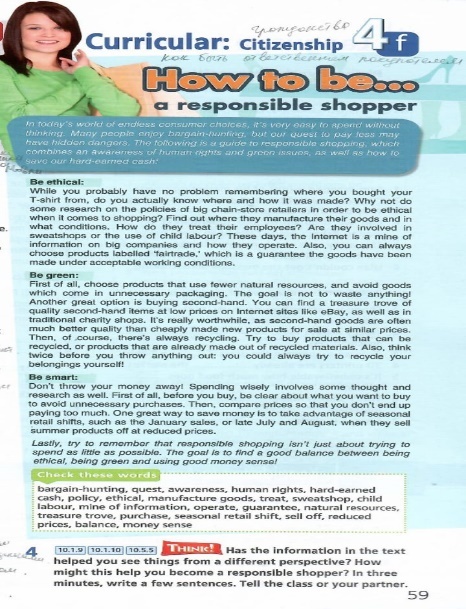
How to be a responsible shopper In today’s world of endless consumer choices, it is very easy to spend without thinking. Many people enjoy bargain – hunting, but our quest to pay less may have hidden dangers. The following is a guide to responsible shopping, which combines an awareness of human rights and green issues, as well as how to save our hard-earned cash!
Be ethical: While you probably have no problem remembering where you bought your T-shirt from, do you actually know where and how it was made? Why not do some research on the policies of big chain- store retailers in order to be ethical when it comes to shopping? Find out where they manufacture their goods and in what conditions. How do they treat their employees? Are they involved in sweatshops or the use of child labour? These days, the Internet is a mine of information on big companies and how they operate. Also, you can always choose products labelled “fairtrade”, which is guarantee the goods have been made under acceptable working conditions.
Be green: First of all, choose products that use fewer natural resources, and avoid goods which come in unnecessary packaging. The goal is not to waste anything! Another great option is buying second-hand. You can find a treasure trove of quality second- hand items at low prices on Internet sites like eBay, as well as in traditional charity shops. It’s really worthwhile , as second - hand goods are often much better quality than cheaply made new products for sale at similar prices. Then, of course, there’s always recycling. Try to buy products that can be recycled, or products that are already made out of recycled materials. Also think twice before you throw anything out: you could always try to recycle your belongings yourself!
Бұл материал сайт қолданушысы жариялаған. Материалдың ішінде жазылған барлық ақпаратқа жауапкершілікті жариялаған қолданушы жауап береді. Ұстаз тілегі тек ақпаратты таратуға қолдау көрсетеді. Егер материал сіздің авторлық құқығыңызды бұзған болса немесе басқа да себептермен сайттан өшіру керек деп ойласаңыз осында жазыңыз Module
4. Organic and non-organic
worlds.Lesson
10 School: #
11 Teacher’s
name: Abildashova
L.N. Date: 21.12.2021 Сlass: 10 “Ә”Number
present: absent: Theme: How to be a responsible
shopper Learning objectives(s) that
this lesson is contributing to 10.1.2 -
usespeakingandlisteningskillstoprovidesensitivefeedbacktopeers; 10.1.10 -
usetalkorwritingas a meansofreflectingonandexploring a
rangeofperspectivesontheworld; 10.3.4
evaluateandcommentontheviewsofothersin a
growingvarietyoftalkcontextson a
growingrangeofgeneralandcurriculartopics; 10.4.6
recognisetheattitudeoropinionofthewriterinextendedtextson a
widerangeoffamiliargeneralandcurriculartopics; 10.5.5 develop with
support coherent arguments supported when necessary by examples and
reasons for a wide range of written genres in familiar general and
curricular topics; Lessonobjectives All learners will be
able to: Listen and read for a
gist, read for specific information Most learners will be
able to: Listen and read for a
gist, learn about values, do a quiz Some learners will be
able to: Listen and read for a gist,
learn about values, do a quiz, write a quiz, discuss
values Assessmentcriteria Learners have met the learning
objectives if they can: speak about
values Valuelinks Solutions to global issues,
natural disasters and global
citizenships Cross -
curricularlinks Global
issues ICT skills Using educational
programs like Quizizz, Kahoot and educational platform
Bilimland. Videos& pictures, Power point
presentation, working with URLs Previouslearning The organic industry in the
UK Duration of the
lesson 45
minutes
Plan Stages Planned
timing Teacher’s
action Students’
action Assessment Resources Beginning the
lesson Greeting Duty’s
report 2
minutes Teacher: Good morning, Dear students! I
am glad to see you! Take your seats,
please. Teacher: Who is on duty today? Who is
absent? What day is it today? What date is it
today? Students greet the
teacher and sit down Duty’s
report: All are present. Today is
Tuesday, the 21 st of
December. Active
board Slide
1 Assessment 1
minute Teacher:Today I will assess your work
with chocolate coins. So you get them if you answer correctly.
Students with the most coins will get 8, 9, 10 points in
Kundelik. chocolate
coins Checking up
homework Pair
work. 3
minutes Teacher: Your homework was Student’s
book ex 2 p.58. Filling in the
gaps. Teacher: Please, swap your copybooks
with your neighbor and check his/ her
work. There is the answer key on the
board Assessment
criteria
Descriptors
Points Remembering Identifies
the meanings of the words
Fills in
the correct gap 1 1
Students swap their copybooks
and check each other. Answer
key: 1.industry,
2.synthetical 3.alternative,
4.wool, 5.chemical,
6.logo, 7.materials,
8.sector
Summative
assessment
Slide
2
S.b. ex 2
p.58
Brainstorming
Introducing the
topic
2
minutes Teacher: Look over some funny quotes.
Try to predict what we shall talk about today – the topic of our
lesson.
Teacher: You are right. The topic of
our lesson is “How to be a responsible
shopper” Please, open your copybooks,
write down the date and the topic of our
lesson. Students’ possible
answers: We shall talk about shopping,
shopping online, buying goods, wasting money, prices, shops and
etc. Students open their copybooks,
write down the date and the topic of the
lesson.
Slide
3
Presenting aims and objectives
of the lesson
2
minutes
Teacher:
Let’s learn the aims and
objectives of today’s
lesson.
What shall we do
today?
Students get accuanted with
the aims of the lesson
A poster with aims and
objectives
Speaking.
Whole class
interaction
3
minutes
Teacher: Each student gets “Find
someone who…” card. Walk around the class. Ask your question and
find at least one person who answers “Yes”. Write down his/her
name. Tell the class the results of
your research Students walk around the class
and ask questions.
Students look up the meaning
of the unknown words in the dictionaries or ask the
teacher
Write down appropriate
names
Criteria Descriptor Understanding answers to the
questions formulates his/ her opinion
correctly
Formative
assessment
S.B. p.59 ex
1
Card
1
Find someone who
enjoys bargain-hunting (Do you enjoy
bargain-hunting?)
Student’s
name ____________
Card
2 Find someone who always checks
where and how a product was
made ___________
Card
3 Find someone who often shops
online ___________
Card
4 Find someone who always chooses
fairtrade products ___________
Card
5 Find someone who prefers big
chain- store retailers ____________
Card
6 Find someone who often buys
second -hand ____________
Card
7 Find someone who never buys
recycled products ____________
Card
8 Find someone who tries to avoid
unnecessary packaging ____________
Card
9 Find someone who never throws
anything out ____________
Card
10 Find someone who usually buys
things that are on sale ____________
Pre-reading
activity
New
vocabulary
Writing
4
minutes Teacher: Let’s learn new words and
phrases in order to widen your vocabulary and make it easier to
understand the text, that we will read. Listen and
repeat. Write down new
words
Wordlist Student’s book WL 17.
Module 4F
Students listen and repeat,
write down new words and phrases into their vocabulary
copybooks
Action 10 video
material
While reading
activity
Listening and
speaking
Group
work
5
minutes
Student’s book p. 59 ex 1
b Teacher: Do you know how to be a
responsible shopper? Let’s read the text to find
out. First, there is a group
discussion. Then the leader of each group goes
to other two groups ant retell the content of his/her
excerpt.
Students are divided into 3
groups. Students read the
introduction of the text
together. The 1 st group reads “Be
ethical ” excerpt The 2 nd group reads “Be
green” excerpt The 3 rd group reads “Be
smart” excerpt The group leaders move on
the other groups and tells the content of his/ her
passage.
Summative
assessment How to be a responsible
shopper In today’s world of endless
consumer choices, it is very easy to spend without thinking. Many
people enjoy bargain – hunting, but our quest to pay less may have
hidden dangers. The following is a guide to responsible shopping,
which combines an awareness of human rights and green issues, as
well as how to save our hard-earned
cash!
Be
ethical: While you probably have no
problem remembering where you bought your T-shirt from, do you
actually know where and how it was made? Why not do some research
on the policies of big chain- store retailers in order to be
ethical when it comes to shopping? Find out where they manufacture
their goods and in what conditions. How do they treat their
employees? Are they involved in sweatshops or the use of child
labour? These days, the Internet is a mine of information on big
companies and how they operate. Also, you can always choose
products labelled “fairtrade”, which is guarantee the goods have
been made under acceptable working
conditions.
Be
green: First of all, choose products
that use fewer natural resources, and avoid goods which come in
unnecessary packaging. The goal is not to waste anything! Another
great option is buying second-hand. You can find a treasure trove
of quality second- hand items at low prices on Internet sites like
eBay, as well as in traditional charity shops. It’s really
worthwhile , as second - hand goods are often much better quality
than cheaply made new products for sale at similar prices. Then, of
course, there’s always recycling. Try to buy products that can be
recycled, or products that are already made out of recycled
materials. Also think twice before you throw anything out: you
could always try to recycle your belongings
yourself!
| |||||||||||||||||||||||||||||||||||||||||||||||||||||||||||||||||||||||||||||||||||||||||||||||||||||||||||||||||||||||


 Жүктеу