
 ЖИ көмекші


 Қауіпсіз төлем

жүктеу мүмкіндігіне ие боласыз
Бұл материал сайт қолданушысы жариялаған. Материалдың ішінде жазылған барлық ақпаратқа жауапкершілікті жариялаған қолданушы жауап береді. Ұстаз тілегі тек ақпаратты таратуға қолдау көрсетеді. Егер материал сіздің авторлық құқығыңызды бұзған болса немесе басқа да себептермен сайттан өшіру керек деп ойласаңыз осында жазыңыз
 01 Сәуір 2025
 96
96
1 жыл бойы шексіз жүктеңіз
ҚМЖ Excel 8 term 4
Short term plan: term 4
|
Unit 8: Food and drink |
Lesson 81 |
||
|
Teacher name: |
|
||
|
Date: |
|
||
|
Grade: 8 |
Number present: |
absent: |
|
|
Lesson title |
Reading: Festive food calendar |
||
|
Learning objectives |
8.6.17.1 use if / unless/ if only in second conditional clauses and wish [that] clauses [present reference]; use a growing variety of relative clauses including why clauses on a range of familiar general and curricular topics 8.5.3.1 write with moderate grammatical accuracy on a limited range of familiar general and curricular topics |
||
|
Lesson objectives |
Learners will be able to: - present foods and drinks - talk about foods and drinks |
||
|
Value links |
Hospitality: Traditionally a nomadic culture, hospitality has always been an important part of Kazakh culture. |
||
|
Plan |
|||
|
Stages / Time |
Teachers actions |
Students actions |
Assessment criteria |
Resources |
|
Beginning of the lesson Warming-up
3 min. Pre-learning «Brainstorming» method 7 min. |
Organization moment : 1.Greeting. Ask about the weather. The teacher sets the lesson objectives, letting students know what to anticipate from the lesson. Warming up Where are you from? How old are you? What color is it? How many students are there in class? What day of the week today? Lead – In
|
The aim: To develop pupils speaking skills and create friendly atmosphere Students of the class are listed. Students' attention is drawn to the lesson. Students say different words from the picture •Learners remember previous lesson vocabulary •Learners answer the questions |
The teacher to assess learners for their ability. “Good job! Well done!” Formative Assessment
Good job! Descriptor: - remembers the lesson passed Point 1 Assessment criteria Learners have met the learning objectives if they can talk about twenty thousand leagues under the sea |
Pictures worksheet Picture |
|
Middle of the lesson Presentation part. 30 min |
Ex:1 P:87 • Direct Ss to the pictures. • Play the recording. Ss listen and repeat chorally and/or individually. Ex: 2 P: 87 • Read the question and the example aloud and then ask various Ss to offer answers. Differentiation: «Verbal support» method is used to help Ss use new words in the sentences. Ex: 3 P: 87 •Read the question and the example aloud and then elicit answers from various Ss from around the class. Conclusion during the lesson some tasks differentiated by outcomes of the students and by their abilities. |
• Learners listen and repeat. ANSWERS Student’s own answer. • Learners which of the foods/drinks in the pictures would you eat/drink for breakfast? lunch? dinner? a snack? dessert? ANSWERS I’d eat pizza/roast chicken with potatoes and carrots/ grilled fish and rice for dinner. I’d eat salad/a burger for lunch. I’d eat cereal with milk/yoghurt for breakfast. I’d eat chocolate cake/yoghurt/fresh fruit for dessert. I’d drink orange juice for breakfast. I’d drink a milkshake for a snack • Learners which of the foods/drinks do you like eating/drinking? Why? ANSWERS I like eating chocolate cake because it is delicious. I like eating yoghurt because it is light. I like eating roast chicken with potatoes and carrots because it is filling. I like eating cereal because it is light. I like drinking orange juice because it is tasty. I like eating burgers because they are delicious. I like eating pizza because it is tasty. I like eating grilled fish and rice because it is nourishing. I like eating salad because it is healthy. I like drinking milkshakes because they are tasty. |
Descriptor: - look at the pictures - repeat chorally and/or individually. Total: 2point
Self assessment Descriptor: - read the question - answer the question Total: 2 point Descriptor: - read the question - answer the question Total: 2 point -Make CCQ questions Yes / No Total: 1 point. |
Card Worksheet Students book |
|
End of the lesson 5 min |
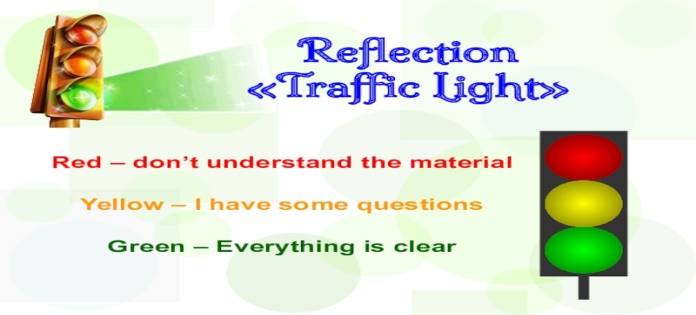
FEEDBACK Learners provide feedback on what they have learned at the lesson. Ex: P: Home task: Write the days |
|
Poster Success
|
|





Short term plan: term 4
|
Unit 8: Food and drink |
Lesson 82 |
||
|
Teacher name: |
|
||
|
Date: |
|
||
|
Grade: 8 |
Number present: |
absent: |
|
|
Lesson title |
Vocabulary: foods |
||
|
Learning objectives |
8.2.2.1 understand with little or no support most specific information in extended talk on a wide range of general and curricular topics 8.3.7.1 use appropriate subject-specific vocabulary and syntax to talk about a range of general topics, and some curricular topics 8.5.3.1 write with moderate grammatical accuracy on a limited range of familiar general and curricular topics |
||
|
Lesson objectives |
Learners will be able to: - introduce the topic; To listen and read for gist - read for specific information - consolidate comprehension of a text |
||
|
Value links |
Tradition: Kazakh traditions and culture have been passed on from one generation to another through oral histories told by traditional Kazakh tribal leaders and elders. |
||
|
Plan |
|||
|
Stages / Time |
Teachers actions |
Students actions |
Assessment criteria |
Resources |
|
Beginning of the lesson Warming-up
3 min. Pre-learning «Brainstorming» method 7 min. |
Organization moment : 1.Greeting. Ask about the weather. The teacher sets the lesson objectives, letting students know what to anticipate from the lesson. Warming up Where are you from? How old are you? What color is it? How many students are there in class? What day of the week today? Lead – In
|
The aim: To develop pupils speaking skills and create friendly atmosphere Students of the class are listed. Students' attention is drawn to the lesson. Students say different words from the picture •Learners remember previous lesson vocabulary •Learners answer the questions |
The teacher to assess learners for their ability. “Good job! Well done!” Formative Assessment
Good job! Descriptor: - remembers the lesson passed Point 1 Assessment criteria Learners have met the learning objectives if they can talk about twenty thousand leagues under the sea |
Pictures worksheet Picture |
|
Middle of the lesson Presentation part. 30 min |
Ex:1 P:88 • Ask Ss to look at the pictures and guess which festival each food is related to. • Play the recording. Ss listen and read the text and find out. • Refer Ss to the Word List to look up the words in the Check these words box. • Play the video for Ss and elicit their comments Ex: 2 P: 89 • Explain the task. • Allow Ss time to read the headings and then read the text again and complete the task. • Check Ss’ answers. Differentiation: «Verbal support» method is used to help Ss use new words in the sentences. Ex: 3 P: 89 • Read out the example question and answer and then ask Ss to ask and answer questions based on the text in closed pairs. • Monitor the activity around the class and then ask some Ss to ask and answer in front of the class. Ex: 4 P: 89 •Explain the task and give Ss time to complete it referring to the text as necessary. Ex: 5 P: 89 •Explain the task and give Ss time to use the underlined words/phrases in the text to complete the sentences. • Check Ss’ answers Ex: 6 P: 89 •Explain the task and give Ss time to complete it. • Ask Ss to check their answers in their dictionaries. Conclusion during the lesson some tasks differentiated by outcomes of the students and by their abilities. |
• Learners look at the pictures. Which festival is each food related to? Listen and read to find out. ANSWERS haggis – Burns Night minestrone – Sagra delle Virtú smoked fish – Midsummer hotdogs, corn on the cob – Independence Day jerk chicken – Notting Hill Carnival parkin – Bonfire Night Dundee cake – Hogmanay • Learners read the texts again and match the paragraphs to the headings. One heading is extra ANSWERS A 7 B 5 C 2 D 6 E 8 F 1 G 3 • Learners in pairs, ask and answer comprehension questions based on the text ANSWERS A: What do the Swedish and Finnish celebrate between 20th and 26th June? B: Midsummer. A: What do people do on 4th July in the USA? B: They watch fireworks, and have barbecues and picnics. A: What dish do people eat at the Notting Hill Carnival? B: They eat jerk chicken. A: When is Guy Fawkes’ Night? B: It is on 5th November. A: What is the New Year’s Eve celebration called in Scotland? B: It’s called Hogmanay • Learners complete the collocations. Use: thick, fireworks, dinner, vegetables, street, colourful ANSWERS 1 dinner 2 thick 3 vegetables 4 fireworks 5 street 6 colourful • Learners complete the sentences with one of the underlined words/phrases in the text. ANSWERS 1 main course 2 early hours 3 population 4 stuffed 5 ashes • Learners choose the correct word. Compare answers with your partner. Check in your dictionaries ANSWERS 1 bitter 2 still 3 spicy 4 grate 5 dessert 6 recipe |
Descriptor: - look at the pictures - answer the question Total: 2point
Self assessment Descriptor: - read the text - match the paragraphs to the headings Total: 2 point Descriptor: - in pairs, ask and answer - answer the question Total: 2 point -Make CCQ questions Yes / No Total: 1 point. Descriptor: - complete the collocations - Use: thick, fireworks, dinner, vegetables, street, colourful Total: 2 point Descriptor: - complete the sentences - complete the sentences Total: 2 point Descriptor: - complete the collocations - compare answers with your partner Total: 2 point |
Card Worksheet Students book |
|
End of the lesson 5 min |
FEEDBACK Learners provide feedback on what they have learned at the lesson. Ex: P: Home task: Write the days |
|
Poster Success
|
|

Short term plan: term 4
|
Unit 8: Food and drink |
Lesson 83 |
||
|
Teacher name: |
|
||
|
Date: |
|
||
|
Grade: 8 |
Number present: |
absent: |
|
|
Lesson title |
Use of English: Countable and uncountable nouns |
||
|
Learning objectives |
8.1.6.1 organize and present information clearly to others 8.6.8.1 use a growing variety of future forms including present continuous and present simple with future meaning on a range of familiar general and curricular topics 8.5.3.1 write with moderate grammatical accuracy on a limited range of familiar general and curricular topics |
||
|
Lesson objectives |
Learners will be able to: -present countable/uncountable & quantifiers - practise using countable/uncountable & quantifiers - present vocabulary related to food/drinks |
||
|
Value links |
Freedom: Freedom is the major value of the civil society being formed in Kazakhstan. This must provide everyone with the possibility of creative self-realization. |
||
|
Plan |
|||
|
Stages / Time |
Teachers actions |
Students actions |
Assessment criteria |
Resources |
|
Beginning of the lesson Warming-up
3 min. Pre-learning «Brainstorming» method 7 min. |
Organization moment : 1.Greeting. Ask about the weather. The teacher sets the lesson objectives, letting students know what to anticipate from the lesson. Warming up Where are you from? How old are you? What color is it? How many students are there in class? What day of the week today? Lead – In
|
The aim: To develop pupils speaking skills and create friendly atmosphere Students of the class are listed. Students' attention is drawn to the lesson. Students say different words from the picture •Learners remember previous lesson vocabulary •Learners answer the questions |
The teacher to assess learners for their ability. “Good job! Well done!” Formative Assessment
Good job! Descriptor: - remembers the lesson passed Point 1 Assessment criteria Learners have met the learning objectives if they can talk about twenty thousand leagues under the sea |
Pictures worksheet Picture |
|
Middle of the lesson Presentation part. 30 min |
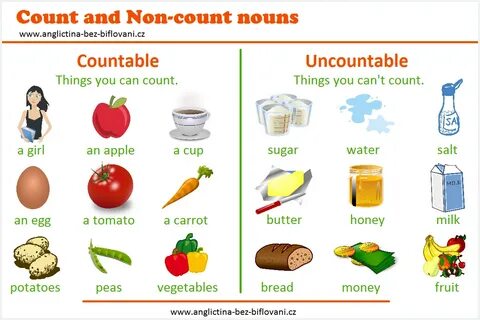
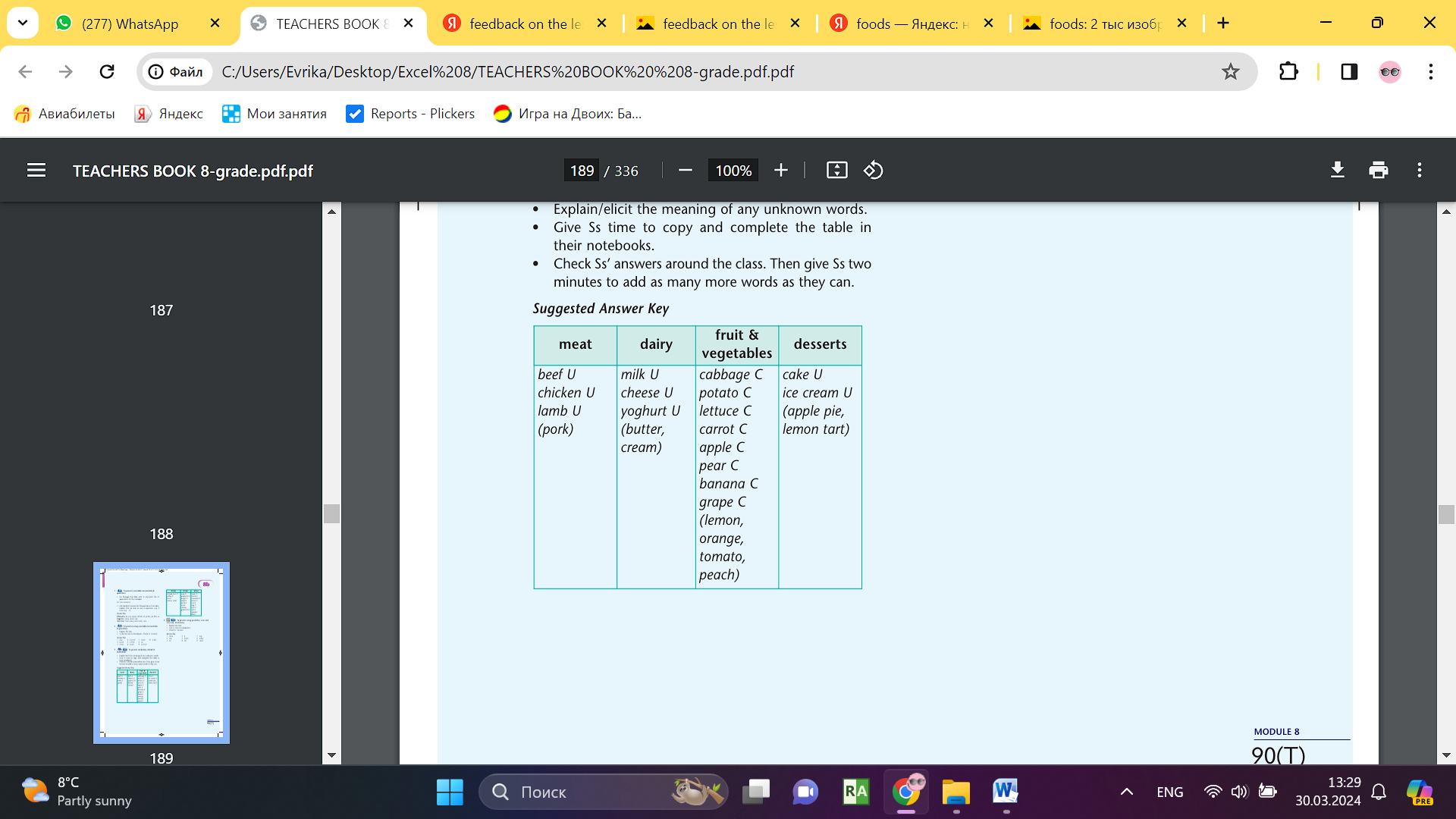
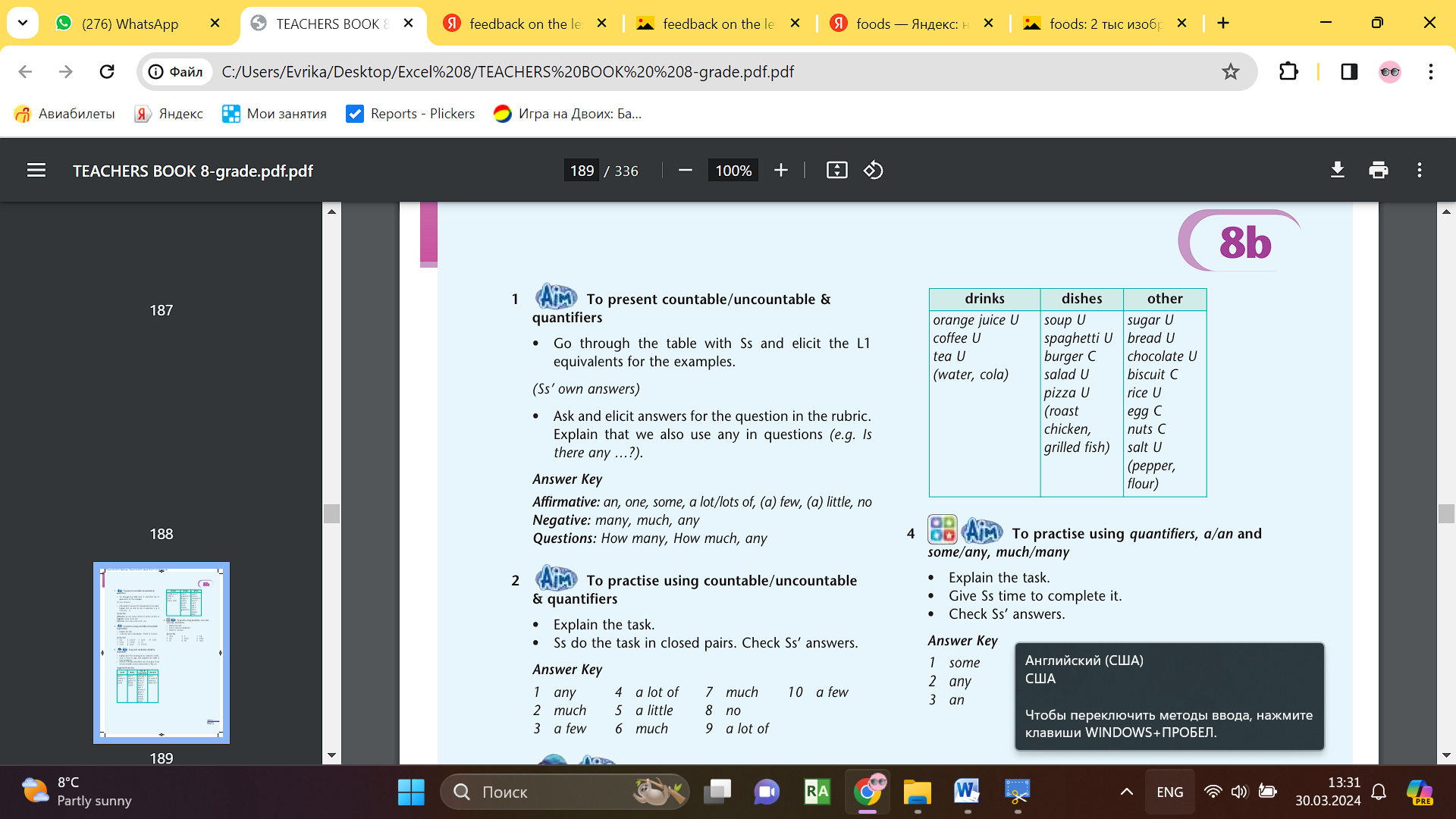
Ex:1 P:90 • Go through the table with Ss and elicit the L1 equivalents for the examples. (Ss’ own answers) • Ask and elicit answers for the question in the rubric. Explain that we also use any in questions (e.g. Is there any …?). Ex: 2 P: 90 •Explain the task. • Ss do the task in closed pairs. Check Ss’ answers. Differentiation: «Verbal support» method is used to help Ss use new words in the sentences. Ex: 3 P: 90 • Explain/elicit the meaning of any unknown words. • Give Ss time to copy and complete the table in their notebooks. • Check Ss’ answers around the class. Then give Ss two minutes to add as many more words as they can. Ex: 4 P: 90 • Explain the task. • Give Ss time to complete it. • Check Ss’ answers. Conclusion during the lesson some tasks differentiated by outcomes of the students and by their abilities. |
• Learners read the theory and say the examples in your language. Which of the words in bold do we use in ANSWERS Affirmative: an, one, some, a lot/lots of, (a) few, (a) little, no Negative: many, much, any Questions: How many, How much, any • Learners choose the correct words. ANSWERS 1 any 2 much 3 a few 4 a lot of 5 a little 6 much 7 much 8 no 9 a lot of 10 a few • Learners copy the table in your notebook and list the words under the headings. In two minutes, add as many more words as you can. Then write C for countable or U for uncountable. ANSWERS
• Learners complete the dialogue. Use: much, many, a, an, some, any. ANSWERS 1 some 2 any 3 an 4 a 5 much 6 lots 7 any 8 many 9 some |
Descriptor: - read the theory - answers for the question Total: 2point
Self assessment Descriptor: - do the task - answers for the question Total: 2 point Descriptor: - copy the table - add as many more words as you can Total: 2 point Descriptor: - complete the dialogue. - complete the dialogue. Total: 2 point -Make CCQ questions Yes / No Total: 1 point. |
Card Worksheet Students book |
|
End of the lesson 5 min |
FEEDBACK Learners provide feedback on what they have learned at the lesson. Ex: P: Home task: Write the days |
|
Poster Success
|
|
Short term plan: term 4
|
Unit 8: Food and drink |
Lesson 84 |
||
|
Teacher name: |
|
||
|
Date: |
|
||
|
Grade: 8 |
Number present: |
absent: |
|
|
Lesson title |
Use of English: word formation |
||
|
Learning objectives |
8.2.5.1 recognise the opinion of the speaker(s) with little or no support in extended talk on a wide range of general and curricular topics 8.3.7.1 use appropriate subject-specific vocabulary and syntax to talk about a range of general topics, and some curricular topics |
||
|
Lesson objectives |
Learners will be able to: - present several, plenty of, (a large/small) amount/number - practise several, plenty of, (a large/ small) amount/number - Practising word formation (verb suffixes) |
||
|
Value links |
Patriotism: The formation of civil society institutions is impossible without the development of a patriotism shared by the entire Kazakhstan, and with deep roots in the culture, psychology, and historical past of the Kazakhs. |
||
|
Plan |
|||
|
Stages / Time |
Teachers actions |
Students actions |
Assessment criteria |
Resources |
|
Beginning of the lesson Warming-up
3 min. Pre-learning «Brainstorming» method 7 min. |
Organization moment : 1.Greeting. Ask about the weather. The teacher sets the lesson objectives, letting students know what to anticipate from the lesson. Warming up Where are you from? How old are you? What color is it? How many students are there in class? What day of the week today? Lead – In
|
The aim: To develop pupils speaking skills and create friendly atmosphere Students of the class are listed. Students' attention is drawn to the lesson. Students say different words from the picture •Learners remember previous lesson vocabulary •Learners answer the questions |
The teacher to assess learners for their ability. “Good job! Well done!” Formative Assessment
Good job! Descriptor: - remembers the lesson passed Point 1 Assessment criteria Learners have met the learning objectives if they can talk about twenty thousand leagues under the sea |
Pictures worksheet Picture |
|
Middle of the lesson Presentation part. 30 min |
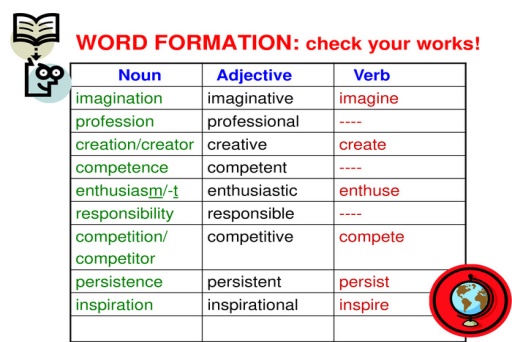
Ex:5a P:91 • Go through the table with Ss and elicit the L1 equivalents for the examples. (Ss’ own answers) • Ask the question in the rubric and elicit answers from Ss around the class. Ex: 5b P: 901 • Explain the task. • Give Ss time to complete it. • Check Ss’ answers. Differentiation: «Verbal support» method is used to help Ss use new words in the sentences. Ex: 6 P: 91 • Read out the containers in the list and ask Ss to complete the gaps under the pictures with them. • Play the recording for Ss to listen an check their answers Ex: 7 P: 91 • Ask Ss to read the theory box and then explain the task. • Give Ss time to complete the task and then check their answers. Ex: 8 P: 91 • Go through the table with Ss and explain any points they are unsure of. • Give Ss time to complete the sentences and then check Ss’ answers.. Conclusion during the lesson some tasks differentiated by outcomes of the students and by their abilities. |
• Learners read the examples. Say them in your language. How do we use the words in bold? ANSWERS We use plenty of with countable and uncountable nouns. We use several only with countable nouns to express a small number of something. We use (a large/small) amount of with uncountable nouns. We use (a large/small) number of with countable nouns. • Learners fill in: plenty, several, amount, number ANSWERS 1 several 2 number 3 plenty 4 amount • Learners fill in: box, bag, can, bottle, packet, cartoon. ANSWERS 1 box 3 bag 5 carton 2 bottle 4 packet 6 can • Learners read the theory. Form verbs from the words in brackets in the correct form ANSWERS 1 strengthen 2 classify 3 specialise 4 formulating • Learners read the theory, then complete the sentences. Use: all, both or half. ANSWERS 1 Both 2 all 3 half 4 Both |
Descriptor: - read the examples - answers for the question Total: 2point
Self assessment Descriptor: - fill the gaps Total: 2 point Descriptor: - fill the gaps Total: 2 point Descriptor: - read the theory. - complete the sentences Total: 2 point Descriptor: - read the theory. - complete the sentences Total: 2 point -Make CCQ questions Yes / No Total: 1 point. |
Card Worksheet Students book |
|
End of the lesson 5 min |
FEEDBACK Learners provide feedback on what they have learned at the lesson. Ex: P: Home task: Write the days |
|
Poster Success
|
|
Short term plan: term 4
|
Unit 8: Food and drink |
Lesson 85 |
||
|
Teacher name: |
|
||
|
Date: |
|
||
|
Grade: 8 |
Number present: |
absent: |
|
|
Lesson title |
Reading: food for thought |
||
|
Learning objectives |
8.1.7.1 develop and sustain a consistent argument when speaking or writing 8.3.7.1 use appropriate subject-specific vocabulary and syntax to talk about a range of general topics, and some curricular topics 8.5.1.1 plan, write, edit and proofread work at text level with little support on a range of general and curricular topics |
||
|
Lesson objectives |
Learners will be able to: -listen and read for gist - read for specific information - assess acquired knowledge from a text, to express an opinion |
||
|
Value links |
Respect: Respect of elders and of the spiritual freedom of other nations are principal values. It is important to develop a productive dialogue between confessions and to acknowledge religion as an element of civil society. |
||
|
Plan |
|||
|
Stages / Time |
Teachers actions |
Students actions |
Assessment criteria |
Resources |
|
Beginning of the lesson Warming-up
3 min. Pre-learning «Brainstorming» method 7 min. |
Organization moment : 1.Greeting. Ask about the weather. The teacher sets the lesson objectives, letting students know what to anticipate from the lesson. Warming up Where are you from? How old are you? What color is it? How many students are there in class? What day of the week today? Lead – In
|
The aim: To develop pupils speaking skills and create friendly atmosphere Students of the class are listed. Students' attention is drawn to the lesson. Students say different words from the picture •Learners remember previous lesson vocabulary •Learners answer the questions |
The teacher to assess learners for their ability. “Good job! Well done!” Formative Assessment
Good job! Descriptor: - remembers the lesson passed Point 1 Assessment criteria Learners have met the learning objectives if they can talk about twenty thousand leagues under the sea |
Pictures worksheet Picture |
|
Middle of the lesson Presentation part. 30 min |
Ex:1 P:92 • Ask Ss to look at the picture and read the title of the text. • Elicit Ss’ guesses as to what the text is about. • Play the recording. Ss read the text and find out. Ex: 2 P: 92 •Ask Ss to read the questions and answer choices 1-3. • Give Ss time to read the text and complete the task. • Check Ss’ answers around the class. Differentiation: «Verbal support» method is used to help Ss use new words in the sentences. Ex: 3 P: 92 • Ask Ss to discuss the questions in pairs. • Monitor the activity around the class and then ask various Ss to tell the class. Conclusion during the lesson some tasks differentiated by outcomes of the students and by their abilities. |
• Learners look at the picture and the title of the text. How do you think food is related to our brain? ANSWERS I think food affects how the brain works. • Learners read again and choose the correct answer ANSWERS 1 A 2 C 3 C • Learners what did you learn from the text? How can this information help you? Tell the class. ANSWERS I learnt about how food affects the functions in the brain. I will try to eat more protein and fatty acids to help my brain be healthy |
Descriptor: - look at the picture - answers for the question Total: 2point
Self assessment Descriptor: - read again - choose the correct answer Total: 2 point Descriptor: - discuss the questions in pairs. - tell the class Total: 2 point -Make CCQ questions Yes / No Total: 1 point. |
Card Worksheet Students book |
|
End of the lesson 5 min |
FEEDBACK Learners provide feedback on what they have learned at the lesson. Ex: P: Home task: Write the days |
|
Poster Success
|
|

Short term plan: term 4
|
Unit 8: Food and drink |
Lesson 86 |
||
|
Teacher name: |
|
||
|
Date: |
|
||
|
Grade: 8 |
Number present: |
absent: |
|
|
Lesson title |
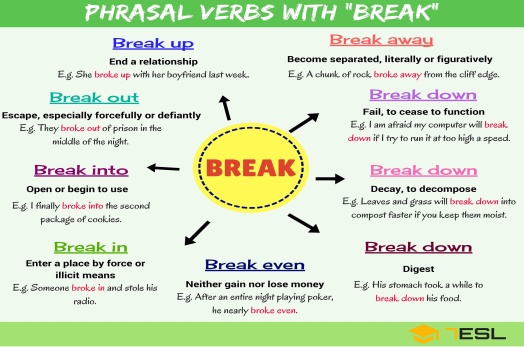
Phrasal verbs (break) |
||
|
Learning objectives |
8.3.7.1 use appropriate subject-specific vocabulary and syntax to talk about a range of general topics, and some curricular topics 8.6.3.1 use a growing variety of compound adjectives and adjectives as participles and some comparative structures including not as…as, much …than to indicate degree on a range of familiar general and curricular topics |
||
|
Lesson objectives |
Learners will be able to: - present and practise prepositional phrases - present and practise phrasal verbs with break - talk about eating habits |
||
|
Value links |
Respect - treating people with respect, value and courtesy. Especially apologising to them where the situation calls for it. |
||
|
Plan |
|||
|
Stages / Time |
Teachers actions |
Students actions |
Assessment criteria |
Resources |
|
Beginning of the lesson Warming-up
3 min. Pre-learning «Brainstorming» method 7 min. |
Organization moment : 1.Greeting. Ask about the weather. The teacher sets the lesson objectives, letting students know what to anticipate from the lesson. Warming up Where are you from? How old are you? What color is it? How many students are there in class? What day of the week today? Lead – In
|
The aim: To develop pupils speaking skills and create friendly atmosphere Students of the class are listed. Students' attention is drawn to the lesson. Students say different words from the picture •Learners remember previous lesson vocabulary •Learners answer the questions |
The teacher to assess learners for their ability. “Good job! Well done!” Formative Assessment
Good job! Descriptor: - remembers the lesson passed Point 1 Assessment criteria Learners have met the learning objectives if they can talk about twenty thousand leagues under the sea |
Pictures worksheet Picture |
|
Middle of the lesson Presentation part. 30 min |
Ex:4 P:93 • Explain the task and give Ss some time to complete it then check Ss’ answers. Ex: 5 P: 93 • Read out the box and explain the task. • Give Ss time to complete the task. • Check Ss’ answers. Differentiation: «Verbal support» method is used to help Ss use new words in the sentences. Ex: 6 P: 93 • Explain the task and ask Ss to look at the gapped text and think about what the missing information might be. • Play the recording. Ss listen and complete the blanks 1-5. • Check Ss’ answers . Ex: 7 P: 93 • Ask Ss to talk in pairs about their eating habits using the table to help them. • Monitor the activity around the class and then ask various Ss to tell the rest of the class. Conclusion during the lesson some tasks differentiated by outcomes of the students and by their abilities. |
• Learners complete with: in (x2), for, on, at. ANSWERS 1 At 2 in 3 on 4 for 5 in • Learners read the box and complete the sentences. ANSWERS 1 out 2 down 3 into 4 up • Learners listen to a boy called Kairat talking about his family’s eating habits. Fill in the gaps ANSWERS 1 cereal 2 apple 3 beef 4 ice cream 5 cake • Learners what do you eat/drink every day? Use the phrases to tell your partner. ANSWERS I don’t eat any cake or biscuits, but I eat some sweets from time to time. I don’t drink any milk, but I eat a lot of fruit. |
Descriptor: - fill the gaps - complete the task. Total: 2point
Self assessment Descriptor: - read the box - complete the sentences Total: 2 point Descriptor: - complete the sentences - answer the question Total: 2 point -Make CCQ questions Yes / No Total: 1 point. |
Card Worksheet Students book |
|
End of the lesson 5 min |
FEEDBACK Learners provide feedback on what they have learned at the lesson. Ex: P: Home task: Write the days |
|
Poster Success
|
|









 Бұл курс Қазақстан Республикасы Оқу-ағарту министрлігімен келісілген










