“USE EFFECTIVE ACTIVITIES TO IMPROVE ENGLISH
LEARNERS’ SPEAKING SKILLS”
Semey2024
AZIMBAYEVA
BALZHAN
ALINA AINUR
What teachers need to know once they know
that they will be teaching an online class or a real
classroom:
-
What is the most frequent learning
goals?
-
What type of skills should be provided before
speaking?
-
What sorts of questions or tasks are used for
each level?
-
How many main types of speaking are
there?
-
How much time is allowed for each
task?
-
What are the assessment criteria for each task
type?
-
How are the tasks marked?
-
How are the results presented?
How many main types of speaking are
there?
There are three types of speaking: talk as
interaction which serves a social purpose like chatting: talk as
transaction which focuses on giving and receiving information like
asking direction and talk as perfomance which transmits information
to an audience like speeches.
There are lots of activities for group lessons
such as games, roleplays. But if a teacher works one-on-one online
or in a real classroom mode the choice is not so various and a bit
limited. Individual classes are very popular with adults who are
very busy to commute to class or want more personalized attitude.
In addition, what is the most frequent learning goal? Of course,
speaking. Adults want to be able to talk. We all know that is
impossible without other skills and subskills such as listening,
reading, grammar and vocabulary. So in this reference
brochure you
can find some speaking tasks which are suitable for any level and
almost any topic. You know your students better and can adaptate
these activities to make them more effective and interesting. The
advantage of these tasks is that they allow to activate target
grammar and vocabulary in an engaging way. We suggest using them
after some controlled practice or as revision
activities.
Contents
-
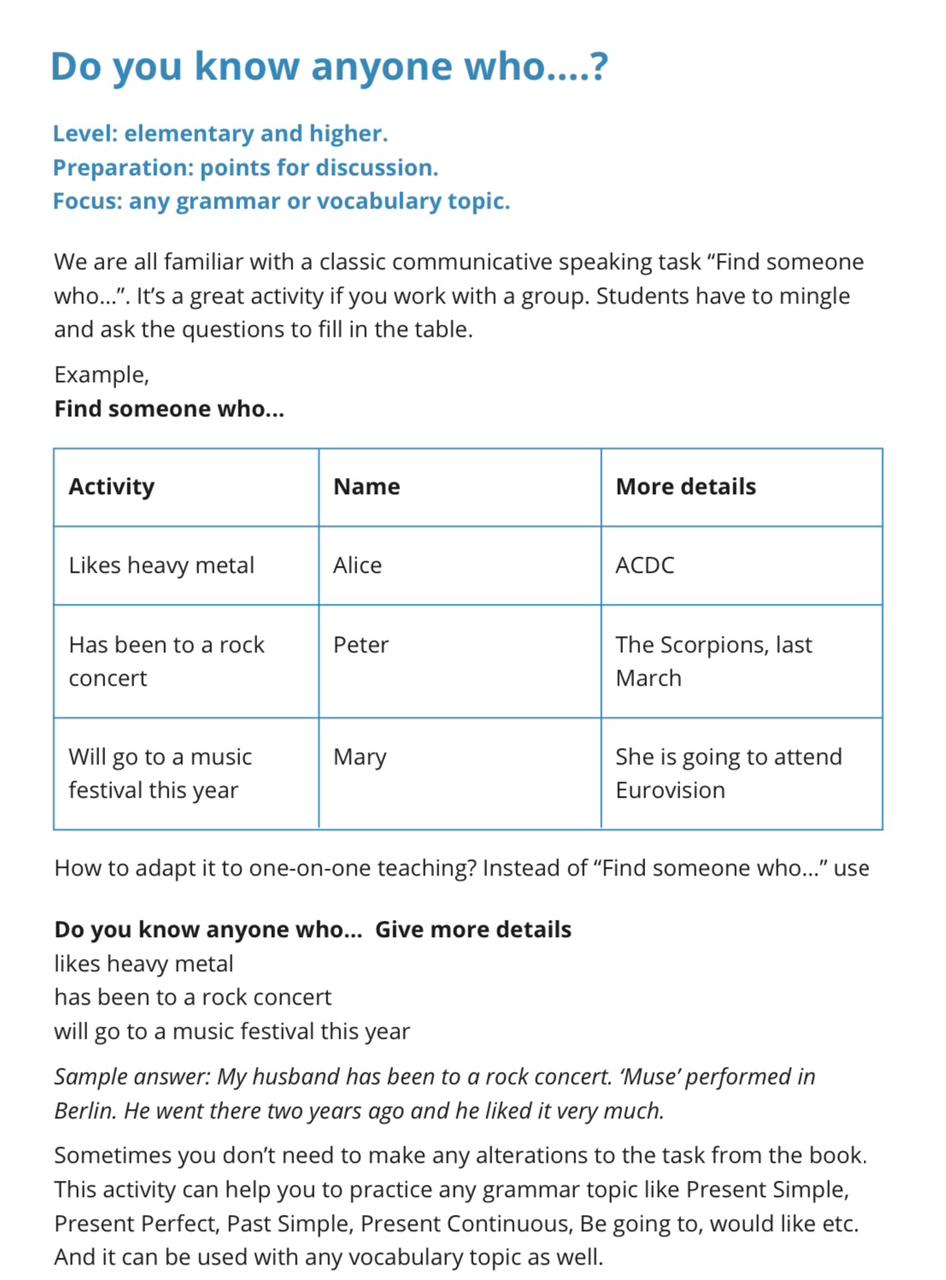
Do
you know someone who
-
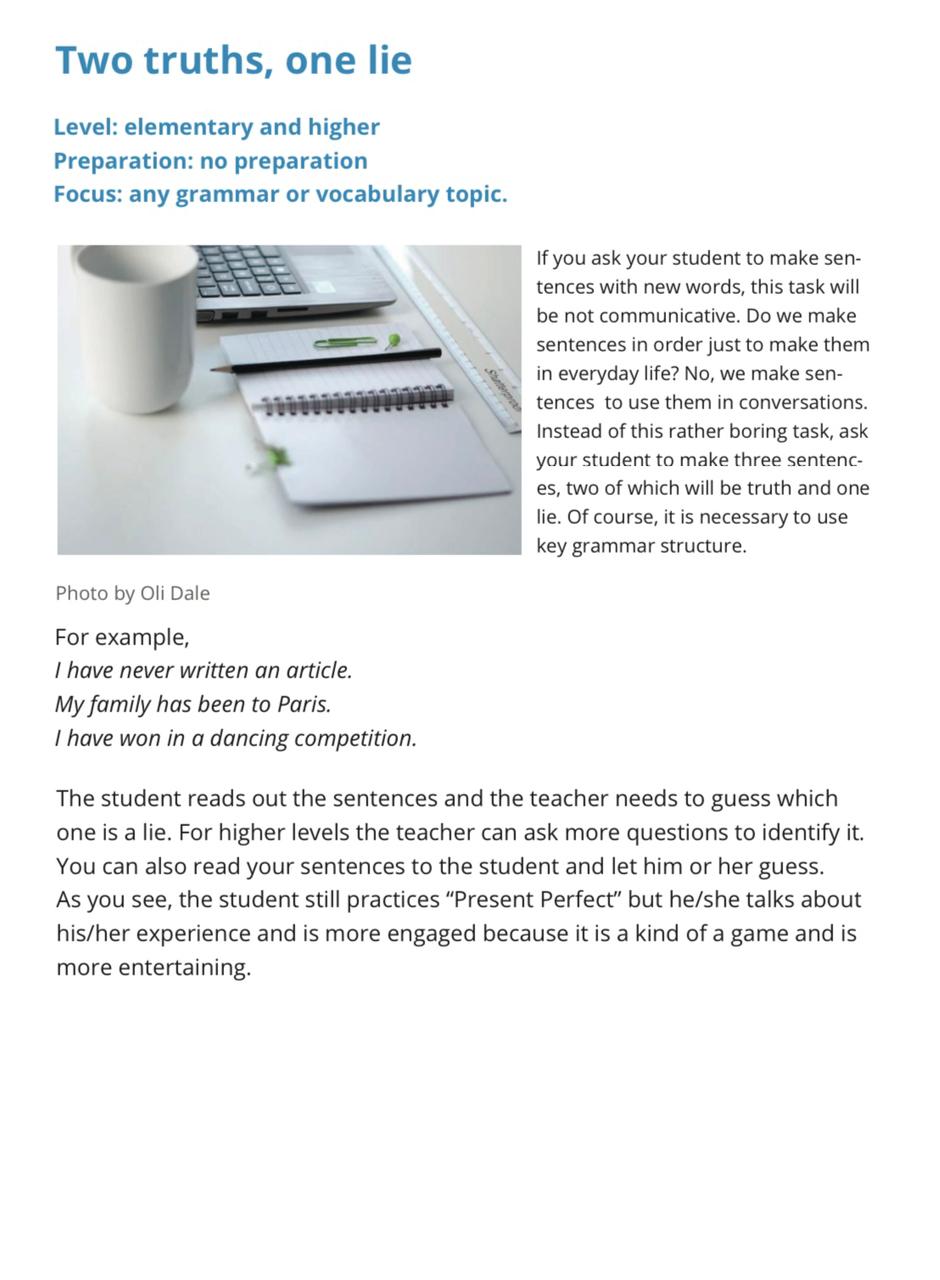
Two
truths, one lie
-
Guess my answer
-
Celebrity interviews
-
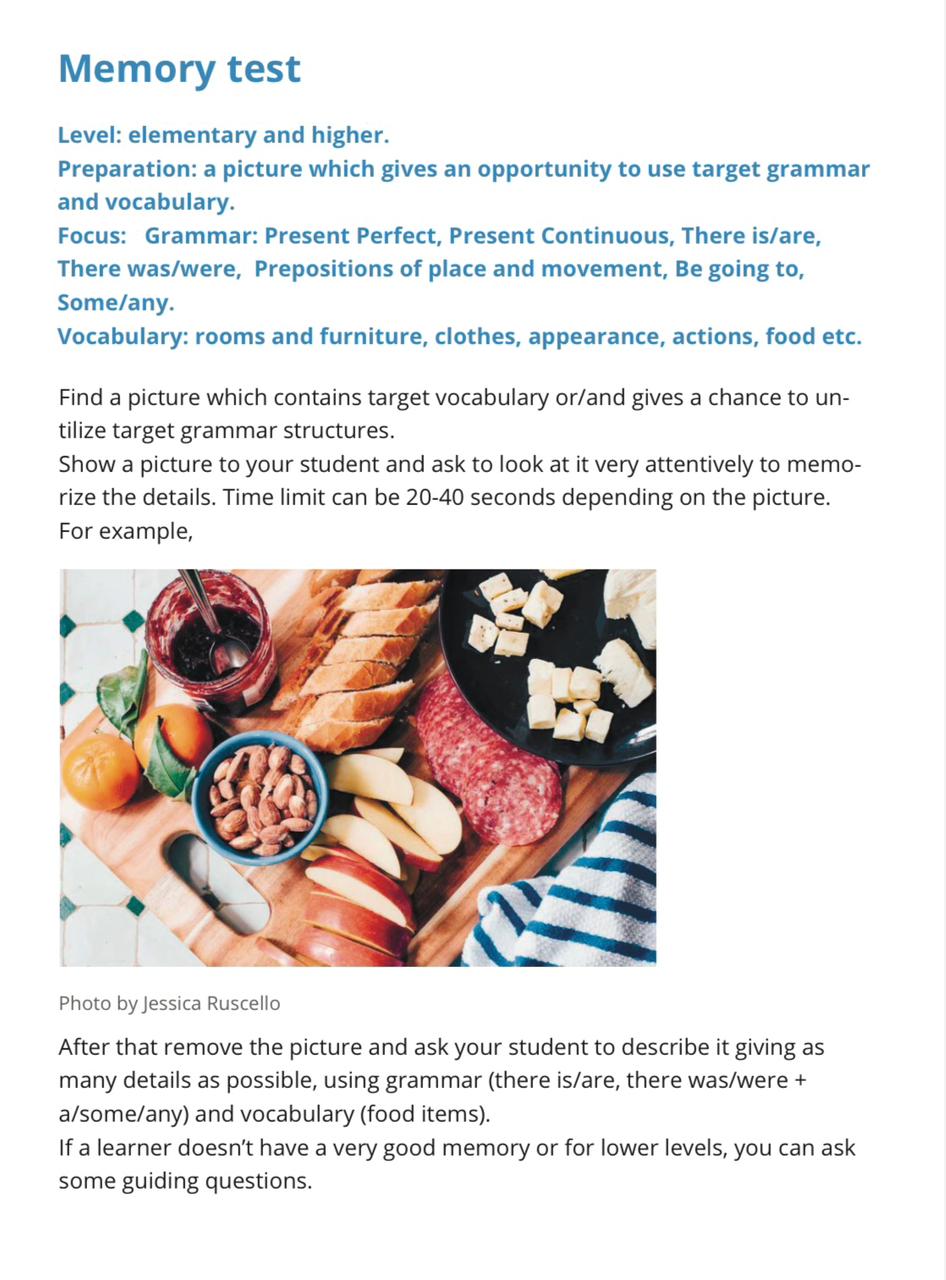
Memory test
-
Wheel of fortune
-
Voice -over
-
Use
the words
-
Assosiations
-
A
reason why
-
Yes, but
-
Quotes
-
Webprojects
-
What the connection
-
Find similiarities between us









Successful
speaking activities
Tips for
teachers on what makes a speaking activity
successful.

Read the tips
about what makes a speaking activity successful and give your own
ideas below.
-
Choose
the right
topic A bit
obvious this one! Of course learners will be more motivated to
participate in an activity which they are interested in and which
relates to their lives or
experience.
-
Be
specific Speaking activities with a clear
communicative goal work best. For example, ‘Tell your partner what
you did at the weekend and find one thing you have in common’ gives
learners a specific task and an end goal so that they know when
they have achieved it. Vague activities like ‘Talk about things you
like’ can leave learners wondering what a teacher
wants.
-
Give
support and preparation
time Sometimes, a speaking activity falls
flat because learners simply don’t feel ready to speak. Make sure
they have the language they need and give them a bit of time to
prepare. This could be time to read instructions for a role play
for example. Making notes can help, but writing a speech interferes
with fluency.
-
Allow
learners to work
together If
learners talk in pairs or groups, they get much more speaking
practice than when you are asking questions to one learner at a
time. You could demonstrate the speaking activity with a strong
learner first, to make sure that learners are clear about what you
want them to
do.
-
Provide a
clear
purpose Activities where learners have to
exchange information in order to complete an activity provide a
real reason for speaking. These are sometimes known as ‘information
gap’ activities. This could be a simple question and answer
activity, or something more complex like a group activity where
learners have different information which they have to share in
order to solve a
puzzle.
-
Do you have any
other suggestions for criteria for successful speaking
activities?
-
Which
activities do you use to motivate your
learners?
-
Why do they
motivate your learners
Thank you for reading these
brucheres! We
hope you can find many inspirational ideas for
your lessons. I wish you to be creative and motivated
teachers!

 ЖИ көмекші


 Қауіпсіз төлем













 Бұл курс Қазақстан Республикасы Оқу-ағарту министрлігімен келісілген