ЖИ көмекші





блум әдістемесі
Тақырып бойынша 11 материал табылды
блум әдістемесі
Материал туралы қысқаша түсінік
барлық сыныпқа қажетті ашық сабақ
Материалдың қысқаша нұсқасы
1 / 4

 Жүктеу
Бөлісу
ЖИ арқылы жасау
Слайдтың жеке беттері
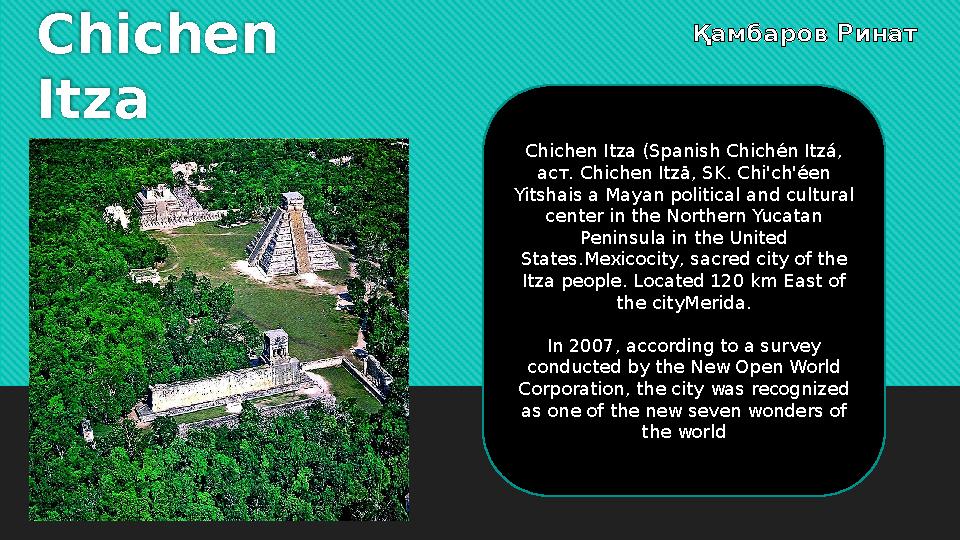
#1 слайд
Chichen
Itza
Chichen Itza (Spanish Chichén Itzá,
аст. Chichen Itzā, SK. Chi'ch'éen
Yitshais a Mayan political and cultural
center in the Northern Yucatan
Peninsula in the United
States.Mexicocity, sacred city of the
Itza people. Located 120 km East of
the cityMerida.
In 2007, according to a survey
conducted by the New Open World
Corporation, the city was recognized
as one of the new seven wonders of
the world Қамбаров Ринат
1 слайд
Chichen Itza Chichen Itza (Spanish Chichén Itzá, аст. Chichen Itzā, SK. Chi'ch'éen Yitshais a Mayan political and cultural center in the Northern Yucatan Peninsula in the United States.Mexicocity, sacred city of the Itza people. Located 120 km East of the cityMerida. In 2007, according to a survey conducted by the New Open World Corporation, the city was recognized as one of the new seven wonders of the world Қамбаров Ринат
#2 слайд
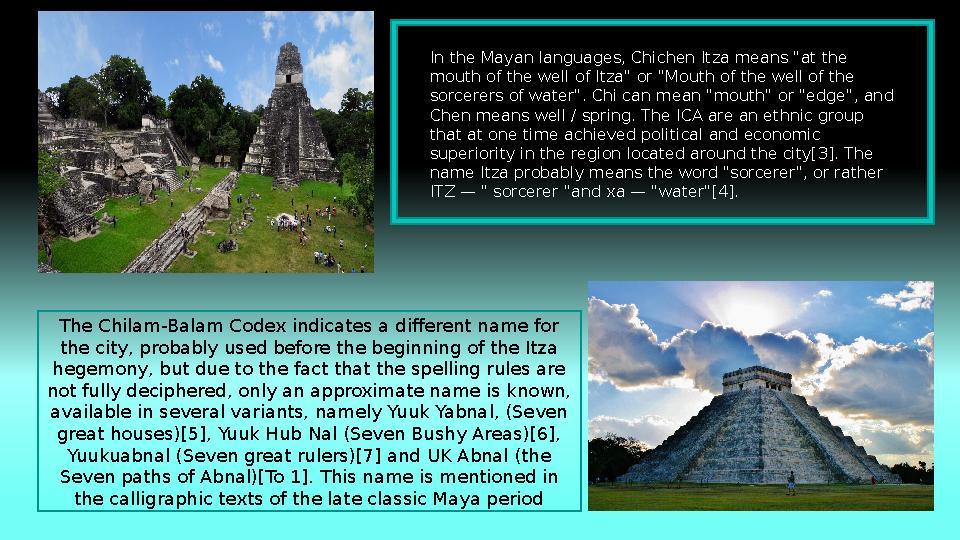
In the Mayan languages, Chichen Itza means "at the
mouth of the well of Itza" or "Mouth of the well of the
sorcerers of water". Chi can mean "mouth" or "edge", and
Chen means well / spring. The ICA are an ethnic group
that at one time achieved political and economic
superiority in the region located around the city[3]. The
name Itza probably means the word "sorcerer", or rather
ITZ — " sorcerer "and xa — "water"[4].
The Chilam-Balam Codex indicates a different name for
the city, probably used before the beginning of the Itza
hegemony, but due to the fact that the spelling rules are
not fully deciphered, only an approximate name is known,
available in several variants, namely Yuuk Yabnal, (Seven
great houses)[5], Yuuk Hub Nal (Seven Bushy Areas)[6],
Yuukuabnal (Seven great rulers)[7] and UK Abnal (the
Seven paths of Abnal)[To 1]. This name is mentioned in
the calligraphic texts of the late classic Maya period
2 слайд
In the Mayan languages, Chichen Itza means "at the mouth of the well of Itza" or "Mouth of the well of the sorcerers of water". Chi can mean "mouth" or "edge", and Chen means well / spring. The ICA are an ethnic group that at one time achieved political and economic superiority in the region located around the city[3]. The name Itza probably means the word "sorcerer", or rather ITZ — " sorcerer "and xa — "water"[4]. The Chilam-Balam Codex indicates a different name for the city, probably used before the beginning of the Itza hegemony, but due to the fact that the spelling rules are not fully deciphered, only an approximate name is known, available in several variants, namely Yuuk Yabnal, (Seven great houses)[5], Yuuk Hub Nal (Seven Bushy Areas)[6], Yuukuabnal (Seven great rulers)[7] and UK Abnal (the Seven paths of Abnal)[To 1]. This name is mentioned in the calligraphic texts of the late classic Maya period
![Histor y It was probably founded around 455.[9] A city can be divided into two groups. The first group includes buildings Datin](https://api.ust.kz/storage/files/materials/pptx/image/2021/may/d05/1620232666-3.jpeg "Histor y It was probably founded around 455.[9] A city can be divided into two groups. The first group includes buildings Datin")
#3 слайд
Histor
y
It was probably founded around 455.[9] A city can be divided into
two groups. The first group includes buildings Dating from the
6th-7th centuries ad and Dating back to the Mayan period. The
second group of buildings belongs to the Toltec period of the X-XI
centuries ad.
In the X century, it was captured by the Toltecs. In the middle of
the XI century Chichen Itza became the capital of the Toltec state.
In 1178[source not specified 89 days] it was defeated by a
combined army of three city-States — Mayapan, Uxmal and
Itsmal, which was headed by Hunak Keel. By the time of the
Spanish conquests (mid-16th century), Chichen Itza was a ruin.
After 1194, the city was completely deserted. There is no exact
information about what caused this. The policies of the Spanish
conquerors who invaded Mexico included the burning of
manuscripts and the killing of Mayan priests. However,
archaeologists have found that in the 13th century, Chichen Itza
was attacked and looted, at the same time the city's economic
influence on neighboring regions began to weaken[10], which
probably led to the Exodus of the urban elite and the desolation of
Chichen Itza[11]. When the Spanish invaded Mexico, they found
the city empty, but according to Spanish sources, there were
compact Mayan settlements in or around the city itself. [12 ]
Spanish sources claimed that the ruins of the city became a place
of pilgrimage for the Indians.
3 слайд
Histor y It was probably founded around 455.[9] A city can be divided into two groups. The first group includes buildings Dating from the 6th-7th centuries ad and Dating back to the Mayan period. The second group of buildings belongs to the Toltec period of the X-XI centuries ad. In the X century, it was captured by the Toltecs. In the middle of the XI century Chichen Itza became the capital of the Toltec state. In 1178[source not specified 89 days] it was defeated by a combined army of three city-States — Mayapan, Uxmal and Itsmal, which was headed by Hunak Keel. By the time of the Spanish conquests (mid-16th century), Chichen Itza was a ruin. After 1194, the city was completely deserted. There is no exact information about what caused this. The policies of the Spanish conquerors who invaded Mexico included the burning of manuscripts and the killing of Mayan priests. However, archaeologists have found that in the 13th century, Chichen Itza was attacked and looted, at the same time the city's economic influence on neighboring regions began to weaken[10], which probably led to the Exodus of the urban elite and the desolation of Chichen Itza[11]. When the Spanish invaded Mexico, they found the city empty, but according to Spanish sources, there were compact Mayan settlements in or around the city itself. [12 ] Spanish sources claimed that the ruins of the city became a place of pilgrimage for the Indians.
Файл форматы:

pptx

05.05.2021

415
Жүктеу
ЖИ арқылы жасау
Жариялаған:
Бұл материалды қолданушы жариялаған. Ustaz Tilegi ақпаратты жеткізуші ғана болып табылады. Жарияланған материалдың мазмұны мен авторлық құқық толықтай автордың жауапкершілігінде. Егер материал авторлық құқықты бұзады немесе сайттан алынуы тиіс деп есептесеңіз,
шағым қалдыра аласыз
шағым қалдыра аласыз